REVIEW 2 major objections 6 minor 1 cited by
Explainability for Vision Foundation Models: A Survey
T0 review · 2 major / 6 minor · reviewed 2026-08-10 · deepseek-v4-flash
Pith's one-line read This survey claims that explainability for vision foundation models is a distinct subfield whose methods are increasingly textual and qualitative, with quantitative evaluation dropping to 36% of surveyed works from a 58% pre-foundation…
desk verdict Useful survey of explainability for vision foundation models, but the headline 36% quantitative-evaluation statistic is not reproducible and the paper needs a documented protocol before it can be cited. read the letter →
The pith
A machine-rendered reading of the paper's core claim, the machinery that carries it, and where it could break.
The reading
What carries the argument
The corpus is the central object, and the taxonomy is the mechanism that organizes it: each of the 122 papers is classified along the four dimensions borrowed from the taxonomy literature, scope, output format, functioning, and result type, with result type covering feature importance, examples, and surrogate models. The second piece of machinery is the consolidated axiom list, built by taking the desiderata from prior XAI surveys and collapsing them into five categories, together with a metric inventory that records which axiom each evaluation tool measures and whether it needs ground truth. These two structures carry the survey's argument by turning a pile of papers into countable cells, which is what allows the 36% versus 58% comparison.
What would settle it
Reassemble the corpus with a stated search strategy and an explicit coding rule for quantitative evaluation, then compare the resulting paper count and the percentage of methods with quantitative results against the survey's 122 and 36%; if a reasonable re-run lands far from 36%, the claimed drop from the 58% baseline is not a stable fact about the field.
Extended reading notes
Core claim
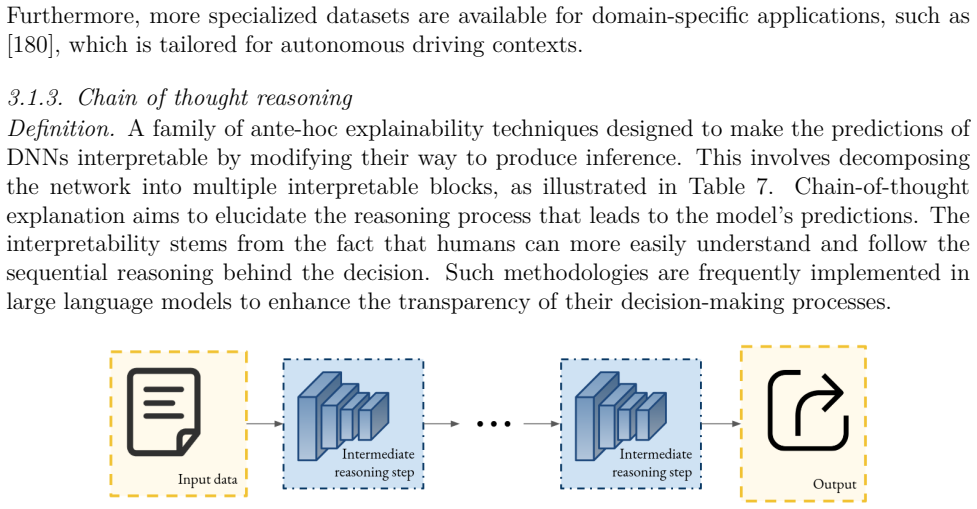
The paper's central claim is that explainability research for vision foundation models has its own structure, distinct from pre-foundation XAI. Its corpus of 122 papers splits into inherently explainable models (76 papers: concept bottleneck models, textual rationale generation, chain-of-thought reasoning, prototypical networks, and a few others) and post-hoc explanation methods (20 papers: input perturbation, counterfactual examples, meta-explanation datasets, and neuron/layer interpretation), plus 26 papers concerned with explaining the foundation models themselves. Every method is placed on the same four taxonomy axes, namely scope, output format, functioning, and result type, which lets the survey compare families and measure evaluation practice. The survey reports that only 36% of these methods include quantitative results, versus the 58% found in a systematic review of pre-foundation XAI, and it explains the gap by the rise of textual and visual explanations that are harder to score than feature-attribution maps. It also consolidates the scattered desiderata from earlier surveys into five axioms, trustworthiness, robustness, complexity, generalizability, and objectiveness, and attaches an inventory of evaluation metrics to those axioms.
Load-bearing premise
The load-bearing premise is that the 122-paper corpus is representative and that the authors' implicit judgement of what counts as 'quantitative results' is consistent, because the survey does not document its search strategy, inclusion criteria, or coding rules.
Editorial extensions
If this is right
- If the 36% figure is correct, current foundation-model-based explainability is less measured than the pre-foundation XAI literature was, and claims of interpretability rest more often on qualitative examples.
- Text-producing families inherit mature text metrics, while concept bottleneck and prototypical methods lack an equally standard quantitative route, so evaluation quality will stay uneven across families.
- Multimodal explanations require multimodal metrics, and the survey points to emerging text-image alignment benchmarks as the natural place to build them.
- Frozen or lightly adapted foundation models remove the need for task-specific training sets, shifting the bottleneck from training data to the validity and comparability of the explanations themselves.
- The four-axis taxonomy offers a reusable grid that future work can use to state exactly what kind of explanation a new method produces and how it should be evaluated.
Reading between the lines
- Extension: because the corpus selection and the 'quantitative' judgement are not documented, the 36% figure is best treated as an indicative estimate; re-running the count with explicit inclusion rules would test how much of the drop is a measurement choice.
- Extension: if chain-of-thought and textual-rationale methods dominate the field, explanation quality becomes entangled with language quality, so a fluent but visually wrong rationale could pass current text metrics; the taxonomy does not separate these two failures.
- Extension: the authors' open challenge about spurious explanations suggests a concrete test: construct images where a concept word is present in the prompt but absent from the pixels, and measure how often a CLIP-based concept bottleneck model still reports that concept.
- Extension: the closing proposal to model the latent space of a foundation model rather than its internals implies a research programme in which the opaque encoder is treated as a fixed distribution and only the transparent head is trained, a route that could restore quantitative guarantees to concept-based explanations.
Editorial analysis
A structured set of objections, weighed in public.
Referee Report
Summary. The paper surveys explainability techniques for vision foundation models, which the authors term Pretrained Foundation Models (PFMs). It compiles a corpus of 122 papers, proposes a taxonomy that separates methods into inherently explainable models (concept bottleneck models, textual rationale generation, chain-of-thought reasoning, prototypical networks, and others) and post-hoc methods (input perturbation, counterfactual examples, meta-explanation datasets, and neuron/layer interpretation), and reviews evaluation practices. The paper reports that only 36% of the surveyed methods include quantitative evaluation, contrasting with a 58% figure drawn from the earlier survey by Nauta et al. [14], and it discusses challenges and open problems for XAI in the PFM era, such as spurious explanations, bias, and reasoning capabilities.
Significance. The paper is timely and addresses an important intersection: explainability for vision foundation models. Its taxonomy, especially the detailed tables mapping each surveyed work to the Speith taxonomy (Tables 2 and 3), and the consolidated inventory of evaluation metrics (Table 5) are useful organizational contributions that will help orient new researchers. The survey also makes a falsifiable empirical claim about the prevalence of quantitative evaluation (36%) that, if supported by a reproducible methodology, would be a valuable observation about the field's current practices. However, in its current form that central statistic is not verifiable, so the paper's empirical contribution rests on undocumented choices. If the authors add a transparent corpus-selection protocol and an operational definition of quantitative results, the survey would be a solid reference for the community.
major comments (2)
- [Section 2.4] The corpus selection is not documented. The paper states that the corpus comprises 122 studies published until January 2025 and gives a breakdown into 76 inherently explainable, 20 post-hoc, and 26 challenge-addressing papers, but it does not describe the databases searched, the query strings used, the inclusion/exclusion criteria, or the screening procedure. Without this protocol, the claim of comprehensiveness cannot be verified, and any statistics derived from the corpus, including the 36% figure in Section 4.2.2, are not reproducible. Provide a step-by-step methodology, including the initial search, deduplication, and title/abstract/full-text screening, preferably in a PRISMA-style flow diagram.
- [Section 4.2.2] The definition of 'quantitative results' is not operationalized. The paper reports that only 36% of the surveyed methods include quantitative results, but it never states what qualifies as quantitative: whether a single metric on one benchmark suffices, whether user studies count, whether qualitative examples with error bars count, or whether the judgment was made by multiple annotators with inter-annotator agreement. The comparison with the 58% figure from Nauta et al. [14] is therefore not like-for-like, because that survey used its own coding scheme and scope. To make the headline finding meaningful, the authors must provide a coding rubric and, ideally, report agreement statistics; they should also consider publishing the coded data as supplementary material.
minor comments (6)
- [Section 1 and Figure 2] The text states 'GPT-2 (1.5T parameters)' but GPT-2 has 1.5B parameters; Figure 2 shows '~1.7B params' for 2019, creating an internal inconsistency. Correct the text to 1.5B.
- [Section 3.1.3] The classification of chain-of-thought methods as ante-hoc is not fully aligned with the paper's own definitions in Section 2.2, since CoT prompting is often applied to a frozen pretrained model at inference time. Clarify the operative distinction between 'modifying the way to produce inference' and post-hoc use.
- [Table 2] The entry 'Concept Gridlock' lacks a citation number, although the related work appears in the text as reference [168]. Add the missing reference.
- [Multiple sections] There are several typos that should be fixed: 'componant' for 'component' in Section 3.1.2 (twice), 'noticable' for 'noticeable' in Section 3.1.1, 'Chain-of-Throught' for 'Chain-of-Thought' in Section 4.2.2, and 'mathematicaly' for 'mathematically' in Section 6.2.1.
- [Section 4.2.2] The sentence 'as reported by [14], around 58% of research papers in the field have integrated quantitative evaluation methods' is vague about the scope of [14]'s analysis; specify that the 58% figure refers to XAI methods before the PFM era, as the authors later acknowledge.
- [Abstract] The stylization 'eXplainable AI' is nonstandard; consider using 'explainable AI' consistently throughout, or at least define the capitalization at first use.
Circularity Check
No significant circularity: the survey's central statistics are descriptive aggregations, and self-citations are illustrative rather than load-bearing.
full rationale
This manuscript is a survey and narrative synthesis; it contains no mathematical derivation, fitted parameters, or predictive claims whose output could reduce to its inputs. The central quantitative observation (36% of 122 surveyed PFM-XAI methods include quantitative evaluation, Section 4.2.2) is a descriptive aggregation of the authors' own corpus classification, not a prediction derived from a model, and the 58% comparison is explicitly attributed to Nauta et al. [14]. The authors cite several of their own works (CLIP-QDA [82], PASTA-metric [238], MUAD [202], TeDeSC [159]) as examples or inventory entries, but these citations are illustrative rather than load-bearing: removing them would not alter the survey's taxonomy, the 36% figure would remain a sum over the remaining corpus, and no uniqueness theorem or ansatz is imported from these papers. The reproducibility concern about the undocumented corpus-selection procedure (Section 2.4) is a methodological transparency issue, not circularity, since the statistic is not defined in terms of itself. Under the stated rubric, no circular step can be exhibited with a specific equation or reduction, so the appropriate finding is no significant circularity.
Assumptions & free parameters
assumptions (4)
- domain assumption Foundation models are defined as any model trained on broad data that can be adapted to a wide range of downstream tasks.
- domain assumption Interpretability and explainability are treated as synonyms.
- ad hoc to paper The corpus of 122 papers is comprehensive and representative.
- ad hoc to paper The 36% quantitative evaluation rate is measured with a consistent and meaningful definition of 'quantitative results'.
Cite this review
Pith. "Pith review of Explainability for Vision Foundation Models: A Survey." pith.science (2026). https://pith.science/paper/BQIV6GER
@misc{pith2026250112203,
  author       = {Pith},
  title        = {Pith review of: Explainability for Vision Foundation Models: A Survey},
  year         = {2026},
  howpublished = {\url{https://pith.science/paper/BQIV6GER}},
  note         = {Machine review of arXiv:2501.12203}
}
read the original abstract
As artificial intelligence systems become increasingly integrated into daily life, the field of explainability has gained significant attention. This trend is particularly driven by the complexity of modern AI models and their decision-making processes. The advent of foundation models, characterized by their extensive generalization capabilities and emergent uses, has further complicated this landscape. Foundation models occupy an ambiguous position in the explainability domain: their complexity makes them inherently challenging to interpret, yet they are increasingly leveraged as tools to construct explainable models. In this survey, we explore the intersection of foundation models and eXplainable AI (XAI) in the vision domain. We begin by compiling a comprehensive corpus of papers that bridge these fields. Next, we categorize these works based on their architectural characteristics. We then discuss the challenges faced by current research in integrating XAI within foundation models. Furthermore, we review common evaluation methodologies for these combined approaches. Finally, we present key observations and insights from our survey, offering directions for future research in this rapidly evolving field.
Figures


Figures from the paper (10 more)




Forward citations
Cited by 1 Pith paper
-
Concept-Based Mechanistic Interpretability Using Structured Knowledge Graphs
BAGEL trains per-layer logistic-regression probes on CLIP-defined concepts and compares per-class concept probabilities with dataset-level concept frequencies, visualizing the alignment in a knowledge graph.
Reference graph
Works this paper leans on
-
[14]
Nauta, J
M. Nauta, J. Trienes, S. Pathak, E. Nguyen, M. Peters, Y. Schmitt, J. Schl¨ otterer, M. van Keulen, C. Seifert, From anecdotal evidence to quantitative evaluation methods: A systematic review on evaluating explainable ai, ACM Computing Surveys 55 (2023) 1–42
2023
-
[1]
LeCun, Y
Y. LeCun, Y. Bengio, G. Hinton, Deep learning, Nature 521 (2015) 436–444
2015
-
[2]
W. Wang, J. Dai, Z. Chen, Z. Huang, Z. Li, X. Zhu, X. Hu, T. Lu, L. Lu, H. Li, et al., Internimage: Exploring large-scale vision foundation models with deformable convolutions, in: Proceedings of the IEEE/CVF Conference on Computer Vision and Pattern Recognition, 2023, pp. 14408–14419
2023
-
[3]
Wortsman, G
M. Wortsman, G. Ilharco, S. Y. Gadre, R. Roelofs, R. Gontijo-Lopes, A. S. Morcos, H. Namkoong, A. Farhadi, Y. Carmon, S. Kornblith, et al., Model soups: averaging weights of multiple fine-tuned models improves accuracy without increasing inference time, in: International Conference on Machine Learning, 2022, pp. 23965–23998
2022
-
[4]
Sauer, K
A. Sauer, K. Schwarz, A. Geiger, Stylegan-xl: Scaling stylegan to large diverse datasets, in: ACM SIGGRAPH 2022 Conference Proceedings, 2022, pp. 1–10
2022
-
[5]
Castelvecchi, Can we open the black box of ai?, Nature News 538 (2016) 20
D. Castelvecchi, Can we open the black box of ai?, Nature News 538 (2016) 20
2016
-
[6]
A. B. Arrieta, N. Diaz-Rodriguez, J. Del Ser, A. Bennetot, S. Tabik, A. Barbado, S. Gar- cia, S. Gil-Lopez, D. Molina, R. Benjamins, et al., Explainable artificial intelligence (xai): Concepts, taxonomies, opportunities and challenges toward responsible ai, Information Fusion 58 (2020) 82–115
2020
- [7]
Show all 270 references
-
[8]
Rawal, J
A. Rawal, J. McCoy, D. B. Rawat, B. M. Sadler, R. S. Amant, Recent advances in trustworthy explainable artificial intelligence: Status, challenges, and perspectives, IEEE Transactions on Artificial Intelligence 3 (2021) 852–866
2021
-
[9]
S. C.-H. Yang, N. E. T. Folke, P. Shafto, A psychological theory of explainability, in: International Conference on Machine Learning, 2022, pp. 25007–25021
2022
-
[10]
D. Wang, Q. Yang, A. Abdul, B. Y. Lim, Designing theory-driven user-centric explainable ai, in: Proceedings of the 2019 CHI Conference on Human Factors in Computing Systems, 2019, pp. 1–15
2019
-
[11]
B. H. Van der Velden, H. J. Kuijf, K. G. Gilhuijs, M. A. Viergever, Explainable artificial intelligence (xai) in deep learning-based medical image analysis, Medical Image Analysis 79 (2022) 102470
2022
-
[12]
Atakishiyev, M
S. Atakishiyev, M. Salameh, H. Yao, R. Goebel, Explainable artificial intelligence for autonomous driving: A comprehensive overview and field guide for future research direc- tions, arXiv preprint arXiv:2112.11561 (2021). 26
2021 arXiv
-
[13]
L. A. Hendricks, K. Burns, K. Saenko, T. Darrell, A. Rohrbach, Women also snowboard: Overcoming bias in captioning models, in: Proceedings of the European Conference on Computer Vision (ECCV), 2018, pp. 771–787
2018
-
[15]
H. Liu, C. Li, Q. Wu, Y. J. Lee, Visual instruction tuning, Advances in Neural Information Processing Systems 36 (2024)
2024
-
[16]
S. Liu, Z. Zeng, T. Ren, F. Li, H. Zhang, J. Yang, Q. Jiang, C. Li, J. Yang, H. Su, et al., Grounding dino: Marrying dino with grounded pre-training for open-set object detection, in: European Conference on Computer Vision, Springer, 2025, pp. 38–55
2025
-
[17]
Schneider, C
J. Schneider, C. Meske, P. Kuss, Foundation models: A new paradigm for artificial intelligence, Business & Information Systems Engineering (2024) 1–11
2024
-
[18]
Brown, B
T. Brown, B. Mann, N. Ryder, M. Subbiah, J. D. Kaplan, P. Dhariwal, A. Neelakantan, P. Shyam, G. Sastry, A. Askell, et al., Language models are few-shot learners, Advances in Neural Information Processing Systems 33 (2020) 1877–1901
2020
-
[19]
Radford, J
A. Radford, J. W. Kim, C. Hallacy, A. Ramesh, G. Goh, S. Agarwal, G. Sastry, A. Askell, P. Mishkin, J. Clark, et al., Learning transferable visual models from natural language supervision, in: International Conference on Machine Learning, 2021, pp. 8748–8763
2021
-
[20]
C. Zhou, Q. Li, C. Li, J. Yu, Y. Liu, G. Wang, K. Zhang, C. Ji, Q. Yan, L. He, et al., A comprehensive survey on pretrained foundation models: A history from bert to chatgpt, arXiv preprint arXiv:2302.09419 (2023)
2023 arXiv
-
[21]
Simonyan, A
K. Simonyan, A. Zisserman, Very deep convolutional networks for large-scale image recognition, arXiv preprint arXiv:1409.1556 (2014)
2014 arXiv
-
[22]
K. He, X. Zhang, S. Ren, J. Sun, Deep residual learning for image recognition, in: Proceedings of the IEEE Conference on Computer Vision and Pattern Recognition, 2016, pp. 770–778
2016
-
[23]
Dosovitskiy, L
A. Dosovitskiy, L. Beyer, A. Kolesnikov, D. Weissenborn, X. Zhai, T. Unterthiner, M. De- hghani, M. Minderer, G. Heigold, S. Gelly, et al., An image is worth 16x16 words: Transformers for image recognition at scale, arXiv preprint arXiv:2010.11929 (2020)
2020 arXiv
-
[24]
J. Deng, W. Dong, R. Socher, L.-J. Li, K. Li, L. Fei-Fei, Imagenet: A large-scale hi- erarchical image database, in: 2009 IEEE Conference on Computer vision and Pattern Recognition, Ieee, 2009, pp. 248–255
2009
-
[25]
H. Zhao, Y. Zhang, S. Liu, J. Shi, C. C. Loy, D. Lin, J. Jia, Psanet: Point-wise spatial attention network for scene parsing, in: Proceedings of the European Conference on Computer Vision (ECCV), 2018, pp. 267–283
2018
-
[26]
K. He, R. Girshick, P. Doll´ ar, Rethinking imagenet pre-training, in: Proceedings of the IEEE/CVF International Conference on Computer Vision, 2019, pp. 4918–4927
2019
-
[27]
Vaswani, N
A. Vaswani, N. Shazeer, N. Parmar, J. Uszkoreit, L. Jones, A. N. Gomez, /suppress L. Kaiser, I. Polosukhin, Attention is all you need, Advances in Neural Information Processing Systems 30 (2017). 27
2017
-
[28]
Radford, J
A. Radford, J. Wu, R. Child, D. Luan, D. Amodei, I. Sutskever, et al., Language models are unsupervised multitask learners, OpenAI blog 1 (2019) 9
2019
-
[29]
Devlin, M.-W
J. Devlin, M.-W. Chang, K. Lee, K. Toutanova, Bert: Pre-training of deep bidirectional transformers for language understanding, arXiv preprint arXiv:1810.04805 (2018)
2018 arXiv
-
[30]
D. Li, Y. Zhang, H. Peng, L. Chen, C. Brockett, M.-T. Sun, B. Dolan, Contextualized perturbation for textual adversarial attack, arXiv preprint arXiv:2009.07502 (2020)
2020 arXiv
-
[31]
Ravichander, E
A. Ravichander, E. Hovy, K. Suleman, A. Trischler, J. C. K. Cheung, On the systematicity of probing contextualized word representations: The case of hypernymy in bert, in: Proceedings of the Ninth Joint Conference on Lexical and Computational Semantics, 2020, pp. 88–102
2020
-
[32]
J. Li, D. Li, S. Savarese, S. Hoi, Blip-2: Bootstrapping language-image pre-training with frozen image encoders and large language models, in: International Conference on Machine Learning, PMLR, 2023, pp. 19730–19742
2023
-
[33]
Rombach, A
R. Rombach, A. Blattmann, D. Lorenz, P. Esser, B. Ommer, High-resolution image synthesis with latent diffusion models, in: CVF Conference on Computer Vision and Pattern Recognition (CVPR), 2021, pp. 10674–10685
2021
-
[34]
Girdhar, A
R. Girdhar, A. El-Nouby, Z. Liu, M. Singh, K. V. Alwala, A. Joulin, I. Misra, Imagebind: One embedding space to bind them all, in: Proceedings of the IEEE/CVF Conference on Computer Vision and Pattern Recognition, 2023, pp. 15180–15190
2023
-
[35]
S. Reed, K. Zolna, E. Parisotto, S. G. Colmenarejo, A. Novikov, G. Barth-maron, M. Gim´ enez, Y. Sulsky, J. Kay, J. T. Springenberg, et al., A generalist agent, Transactions on Machine Learning Research (2022)
2022
-
[36]
Touvron, T
H. Touvron, T. Lavril, G. Izacard, X. Martinet, M.-A. Lachaux, T. Lacroix, B. Rozi` ere, N. Goyal, E. Hambro, F. Azhar, et al., Llama: Open and efficient foundation language models, arXiv preprint arXiv:2302.13971 (2023)
2023 arXiv
-
[37]
X. Zou, J. Yang, H. Zhang, F. Li, L. Li, J. Wang, L. Wang, J. Gao, Y. J. Lee, Segment everything everywhere all at once, Advances in Neural Information Processing Systems 36 (2024)
2024
-
[38]
N. Ravi, V. Gabeur, Y.-T. Hu, R. Hu, C. Ryali, T. Ma, H. Khedr, R. R¨ adle, C. Rolland, L. Gustafson, et al., Sam 2: Segment anything in images and videos, arXiv preprint arXiv:2408.00714 (2024)
2024 arXiv
-
[39]
Achiam, S
J. Achiam, S. Adler, S. Agarwal, L. Ahmad, I. Akkaya, F. L. Aleman, D. Almeida, J. Altenschmidt, S. Altman, S. Anadkat, et al., Gpt-4 technical report, arXiv preprint arXiv:2303.08774 (2023)
2023 arXiv
-
[40]
Agrawal, S
P. Agrawal, S. Antoniak, E. B. Hanna, B. Bout, D. Chaplot, J. Chudnovsky, D. Costa, B. De Monicault, S. Garg, T. Gervet, et al., Pixtral 12b, arXiv preprint arXiv:2410.07073 (2024)
2024 arXiv
-
[41]
E. J. Hu, Y. Shen, P. Wallis, Z. Allen-Zhu, Y. Li, S. Wang, L. Wang, W. Chen, Lora: Low-rank adaptation of large language models, arXiv preprint arXiv:2106.09685 (2021)
2021 arXiv
-
[42]
T. Speith, A review of taxonomies of explainable artificial intelligence (xai) methods, in: Proceedings of the 2022 ACM Conference on Fairness, Accountability, and Transparency, 2022, pp. 2239–2250. 28
2022
-
[43]
J. Yu, Z. Wang, V. Vasudevan, L. Yeung, M. Seyedhosseini, Y. Wu, Coca: Contrastive captioners are image-text foundation models, arXiv preprint arXiv:2205.01917 (2022)
2022 arXiv
-
[44]
Ramesh, P
A. Ramesh, P. Dhariwal, A. Nichol, C. Chu, M. Chen, Hierarchical text-conditional image generation with clip latents, arXiv preprint arXiv:2204.06125 1 (2022) 3
2022 arXiv
-
[45]
Betker, G
J. Betker, G. Goh, L. Jing, T. Brooks, J. Wang, L. Li, L. Ouyang, J. Zhuang, J. Lee, Y. Guo, et al., Improving image generation with better captions, Computer Science. https://cdn. openai. com/papers/dall-e-3. pdf 2 (2023) 8
2023
-
[46]
Alayrac, J
J.-B. Alayrac, J. Donahue, P. Luc, A. Miech, I. Barr, Y. Hasson, K. Lenc, A. Mensch, K. Millican, M. Reynolds, et al., Flamingo: a visual language model for few-shot learning, Advances in Neural Information Processing Systems 35 (2022) 23716–23736
2022
-
[47]
J. Wang, Z. Yang, X. Hu, L. Li, K. Lin, Z. Gan, Z. Liu, C. Liu, L. Wang, Git: A genera- tive image-to-text transformer for vision and language, arXiv preprint arXiv:2205.14100 (2022)
2022 arXiv
-
[48]
Nichol, P
A. Nichol, P. Dhariwal, A. Ramesh, P. Shyam, P. Mishkin, B. McGrew, I. Sutskever, M. Chen, Glide: Towards photorealistic image generation and editing with text-guided diffusion models, arXiv preprint arXiv:2112.10741 (2021)
2021 arXiv
-
[49]
H. Tan, M. Bansal, Lxmert: Learning cross-modality encoder representations from trans- formers, arXiv preprint arXiv:1908.07490 (2019)
2019 arXiv
-
[50]
D. Zhu, J. Chen, X. Shen, X. Li, M. Elhoseiny, Minigpt-4: Enhancing vision-language understanding with advanced large language models, arXiv preprint arXiv:2304.10592 (2023)
2023 arXiv
-
[51]
C. Li, H. Xu, J. Tian, W. Wang, M. Yan, B. Bi, J. Ye, H. Chen, G. Xu, Z. Cao, et al., mplug: Effective and efficient vision-language learning by cross-modal skip-connections, arXiv preprint arXiv:2205.12005 (2022)
2022 arXiv
-
[52]
P. Wang, A. Yang, R. Men, J. Lin, S. Bai, Z. Li, J. Ma, C. Zhou, J. Zhou, H. Yang, Ofa: Unifying architectures, tasks, and modalities through a simple sequence-to-sequence learning framework, in: International Conference on Machine Learning, PMLR, 2022, pp. 23318–23340
2022
-
[53]
Kirillov, E
A. Kirillov, E. Mintun, N. Ravi, H. Mao, C. Rolland, L. Gustafson, T. Xiao, S. Whitehead, A. C. Berg, W.-Y. Lo, et al., Segment anything, arXiv preprint arXiv:2304.02643 (2023)
2023 arXiv
-
[54]
C. Chen, B. Zhang, L. Cao, J. Shen, T. Gunter, A. M. Jose, A. Toshev, J. Shlens, R. Pang, Y. Yang, Stair: Learning sparse text and image representation in grounded tokens, arXiv preprint arXiv:2301.13081 (2023)
2023 arXiv
-
[55]
L. H. Li, M. Yatskar, D. Yin, C.-J. Hsieh, K.-W. Chang, Visualbert: A simple and performant baseline for vision and language, arXiv preprint arXiv:1908.03557 (2019)
2019 arXiv
-
[56]
H. Zhao, H. Chen, F. Yang, N. Liu, H. Deng, H. Cai, S. Wang, D. Yin, M. Du, Explain- ability for large language models: A survey, ACM Transactions on Intelligent Systems and Technology 15 (2024) 1–38
2024
-
[57]
Poeta, G
E. Poeta, G. Ciravegna, E. Pastor, T. Cerquitelli, E. Baralis, Concept-based explainable artificial intelligence: A survey, arXiv preprint arXiv:2312.12936 (2023). 29
2023
-
[58]
Galton, Regression towards mediocrity in hereditary stature., The Journal of the Anthropological Institute of Great Britain and Ireland 15 (1886) 246–263
F. Galton, Regression towards mediocrity in hereditary stature., The Journal of the Anthropological Institute of Great Britain and Ireland 15 (1886) 246–263
-
[59]
McCullagh, Generalized Linear Models, Routledge, 2019
P. McCullagh, Generalized Linear Models, Routledge, 2019
2019
-
[60]
J. R. Quinlan, Induction of decision trees, Machine Learning 1 (1986) 81–106
1986
-
[61]
A. d. Garcez, S. Bader, H. Bowman, L. C. Lamb, L. de Penning, B. Illuminoo, H. Poon, C. G. Zaverucha, Neural-symbolic learning and reasoning: A survey and interpretation, Neuro-Symbolic Artificial Intelligence: The State of the Art 342 (2022) 327
2022
-
[62]
Why should I trust you?
M. T. Ribeiro, S. Singh, C. Guestrin, “Why should I trust you?”: Explaining the pre- dictions of any classifier, in: Proceedings of the 22nd ACM SIGKDD International Conference on Knowledge Discovery and Data Mining, San Francisco, CA, USA, August 13-17, 2016, 2016, pp. 1135–1144
2016
-
[63]
R. R. Selvaraju, M. Cogswell, A. Das, R. Vedantam, D. Parikh, D. Batra, Grad-cam: Visual explanations from deep networks via gradient-based localization, in: Proceedings of the IEEE International Conference on Computer Vision, 2017, pp. 618–626
2017
-
[64]
Petsiuk, A
V. Petsiuk, A. Das, K. Saenko, Rise: Randomized input sampling for explanation of black-box models, arXiv preprint arXiv:1806.07421 (2018)
2018 arXiv
-
[65]
Cortez, M
P. Cortez, M. J. Embrechts, Opening black box data mining models using sensitivity analysis, in: 2011 IEEE Symposium on Computational Intelligence and Data Mining (CIDM), IEEE, 2011, pp. 341–348
2011
-
[66]
S. M. Lundberg, S.-I. Lee, A unified approach to interpreting model predictions, Advances in Neural Information Processing Systems 30 (2017)
2017
-
[67]
Akhtar, A survey of explainable ai in deep visual modeling: Methods and metrics, arXiv preprint arXiv:2301.13445 (2023)
N. Akhtar, A survey of explainable ai in deep visual modeling: Methods and metrics, arXiv preprint arXiv:2301.13445 (2023)
2023 arXiv
-
[68]
Chatzimparmpas, R
A. Chatzimparmpas, R. M. Martins, I. Jusufi, A. Kerren, A survey of surveys on the use of visualization for interpreting machine learning models, Information Visualization 19 (2020) 207–233
2020
-
[69]
Saeed, C
W. Saeed, C. Omlin, Explainable ai (xai): A systematic meta-survey of current challenges and future opportunities, Knowledge-Based Systems 263 (2023) 110273
2023
-
[70]
Joshi, R
G. Joshi, R. Walambe, K. Kotecha, A review on explainability in multimodal deep neural nets, IEEE Access 9 (2021) 59800–59821
2021
-
[71]
J. Choi, J. Raghuram, Y. Li, S. Banerjee, S. Jha, Adaptive concept bottleneck for foundation models, in: ICML 2024 Workshop on Foundation Models in the Wild, 2024
2024
-
[72]
Fumanal-Idocin, J
J. Fumanal-Idocin, J. Andreu-Perez, O. Cord, H. Hagras, H. Bustince, et al., Artxai: Explainable artificial intelligence curates deep representation learning for artistic images using fuzzy techniques, IEEE Transactions on Fuzzy Systems (2023)
2023
-
[73]
T. Li, M. Ma, X. Peng, Beyond accuracy: Ensuring correct predictions with correct rationales, in: The Thirty-eighth Annual Conference on Neural Information Processing Systems, 2024. 30
2024
-
[74]
X. Zhao, X. Huang, T. Fu, Q. Li, S. Gong, L. Liu, W. Bi, L. Kong, Bba: Bi-modal behavioral alignment for reasoning with large vision-language models, arXiv preprint arXiv:2402.13577 (2024)
2024 arXiv
-
[75]
I. Kim, J. Kim, J. Choi, H. J. Kim, Concept bottleneck with visual concept filtering for explainable medical image classification, in: International Conference on Medical Image Computing and Computer-Assisted Intervention, Springer, 2023, pp. 225–233
2023
-
[76]
Achille, G
A. Achille, G. V. Steeg, T. Y. Liu, M. Trager, C. Klingenberg, S. Soatto, Interpretable measures of conceptual similarity by complexity-constrained descriptive auto-encoding, arXiv preprint arXiv:2402.08919 (2024)
2024 arXiv
-
[77]
Y. Cui, S. Liu, L. Li, Z. Yuan, Ceir: Concept-based explainable image representation learning, arXiv preprint arXiv:2312.10747 (2023)
2023 arXiv
-
[78]
J. Liu, T. Hu, Y. Zhang, X. Gai, Y. Feng, Z. Liu, A chatgpt aided explainable framework for zero-shot medical image diagnosis, arXiv preprint arXiv:2307.01981 (2023)
2023 arXiv
-
[79]
Z. Ren, Y. Su, X. Liu, Chatgpt-powered hierarchical comparisons for image classification, Advances in Neural Information Processing Systems 36 (2024)
2024
-
[80]
M. Liu, D. Chen, Y. Li, G. Fang, Y. Shen, Chartthinker: A contextual chain-of-thought approach to optimized chart summarization, arXiv preprint arXiv:2403.11236 (2024)
2024 arXiv
-
[81]
Menon, C
S. Menon, C. Vondrick, Visual classification via description from large language models, in: The Eleventh International Conference on Learning Representations, 2022
2022
-
[82]
Kazmierczak, E
R. Kazmierczak, E. Berthier, G. Frehse, G. Franchi, Clip-qda: An explainable concept bottleneck model, Transactions on Machine Learning Research (2024)
2024
-
[83]
Zhang, M
Y. Zhang, M. Jiang, Q. Zhao, Learning chain of counterfactual thought for bias-robust vision-language reasoning, in: A. Leonardis, E. Ricci, S. Roth, O. Russakovsky, T. Sattler, G. Varol (Eds.), Computer Vision – ECCV 2024, Springer Nature Switzerland, Cham, 2025, pp. 334–351
2024
-
[84]
Mannix, H
E. Mannix, H. Bondell, Scalable and robust transformer decoders for interpretable image classification with foundation models, arXiv preprint arXiv:2403.04125 (2024)
2024
-
[85]
J. Ge, H. Luo, S. Qian, Y. Gan, J. Fu, S. Zhan, Chain of thought prompt tuning in vision language models, arXiv preprint arXiv:2304.07919 (2023)
2023 arXiv
-
[86]
Harvey, F
W. Harvey, F. Wood, Visual chain-of-thought diffusion models, arXiv preprint arXiv:2303.16187 (2023)
2023 arXiv
-
[87]
Y. Chen, K. Sikka, M. Cogswell, H. Ji, A. Divakaran, Measuring and improving chain- of-thought reasoning in vision-language models, arXiv preprint arXiv:2309.04461 (2023)
2023 arXiv
-
[88]
L. Li, Cpseg: Finer-grained image semantic segmentation via chain-of-thought language prompting, in: Proceedings of the IEEE/CVF Winter Conference on Applications of Computer Vision, 2024, pp. 513–522
2024
-
[90]
Zheng, B
G. Zheng, B. Yang, J. Tang, H.-Y. Zhou, S. Yang, Ddcot: Duty-distinct chain-of-thought prompting for multimodal reasoning in language models, Advances in Neural Information Processing Systems 36 (2023) 5168–5191
2023
-
[91]
Z. Wang, J. Xiao, T. Chen, L. Chen, Decap: Towards generalized explicit caption editing via diffusion mechanism, arXiv preprint arXiv:2311.14920 (2023)
2023 arXiv
-
[92]
W. Han, D. Guo, C.-Z. Xu, J. Shen, Dme-driver: Integrating human decision logic and 3d scene perception in autonomous driving, arXiv preprint arXiv:2401.03641 (2024)
2024 arXiv
-
[93]
Grover, V
S. Grover, V. Vineet, Y. S. Rawat, Navigating hallucinations for reasoning of uninten- tional activities, arXiv preprint arXiv:2402.19405 (2024)
2024 arXiv
-
[94]
Y. Ma, Y. Cao, J. Sun, M. Pavone, C. Xiao, Dolphins: Multimodal language model for driving, arXiv preprint arXiv:2312.00438 (2023)
2023 arXiv
-
[95]
Z. Xu, Y. Zhang, E. Xie, Z. Zhao, Y. Guo, K. K. Wong, Z. Li, H. Zhao, Drivegpt4: Interpretable end-to-end autonomous driving via large language model, arXiv preprint arXiv:2310.01412 (2023)
2023 arXiv
-
[96]
C. Han, J. C. Liang, Q. Wang, M. Rabbani, S. Dianat, R. Rao, Y. N. Wu, D. Liu, Image translation as diffusion visual programmers, arXiv preprint arXiv:2401.09742 (2024)
2024 arXiv
-
[97]
Zhang, J
F. Zhang, J. Liu, Q. Zhang, E. Sun, J. Xie, Z.-J. Zha, Ecenet: Explainable and context- enhanced network for muti-modal fact verification, in: Proceedings of the 31st ACM International Conference on Multimedia, 2023, pp. 1231–1240
2023
-
[98]
A. K. Thakur, F. Ilievski, H.- ˆA. Sandlin, Z. Sourati, L. Luceri, R. Tommasini, A. Mer- moud, Multimodal and explainable internet meme classification, arXiv preprint arXiv:2212.05612 (2022)
2022 arXiv
-
[99]
Uehara, N
K. Uehara, N. Goswami, H. Wang, T. Baba, K. Tanaka, T. Hashimoto, K. Wang, R. Ito, T. Naoya, R. Umagami, et al., Advancing large multi-modal models with explicit chain- of-reasoning and visual question generation, arXiv preprint arXiv:2401.10005 (2024)
2024 arXiv
-
[100]
J. Yow, N. P. Garg, M. Ramanathan, W. T. Ang, et al., Extract–explainable trajectory corrections from language inputs using textual description of features, arXiv preprint arXiv:2401.03701 (2024)
2024 arXiv
-
[101]
J. Hu, J. Lin, S. Gong, W. Cai, Relax image-specific prompt requirement in sam: A single generic prompt for segmenting camouflaged objects, in: Proceedings of the AAAI Conference on Artificial Intelligence, volume 38, 2024, pp. 12511–12518
2024
-
[102]
Hwang, S
H. Hwang, S. Kwon, Y. Kim, D. Kim, Is it safe to cross? interpretable risk assessment with gpt-4v for safety-aware street crossing, arXiv preprint arXiv:2402.06794 (2024)
2024 arXiv
-
[103]
K. P. Panousis, D. Ienco, D. Marcos, Hierarchical concept discovery models: A concept pyramid scheme, arXiv preprint arXiv:2310.02116 (2023)
2023 arXiv
-
[104]
J. Kil, F. Tavazoee, D. Kang, J.-K. Kim, Ii-mmr: Identifying and improving multi-modal multi-hop reasoning in visual question answering, arXiv preprint arXiv:2402.11058 (2024)
2024 arXiv
-
[105]
Y. Ando, N. J.-Y. Park, G. O. Chong, S. Ko, D. Lee, J. Cho, H. Han, Interpretable pap smear cell representation for cervical cancer screening, arXiv preprint arXiv:2311.10269 (2023). 32
2023 arXiv
-
[106]
X. Fu, B. Zhou, S. Chen, M. Yatskar, D. Roth, Interpretable by design visual question answering, arXiv preprint arXiv:2305.14882 (2023)
2023 arXiv
-
[107]
H. Lin, Z. Luo, W. Gao, J. Ma, B. Wang, R. Yang, Towards explainable harmful meme detection through multimodal debate between large language models, arXiv preprint arXiv:2401.13298 (2024)
2024 arXiv
-
[108]
Mondal, S
D. Mondal, S. Modi, S. Panda, R. Singh, G. S. Rao, Kam-cot: Knowledge augmented multimodal chain-of-thoughts reasoning, arXiv preprint arXiv:2401.12863 (2024)
2024 arXiv
-
[109]
Oikarinen, S
T. Oikarinen, S. Das, L. Nguyen, L. Weng, Label-free concept bottleneck models, in: International Conference on Learning Representations, 2023
2023
-
[110]
Y. Yang, A. Panagopoulou, S. Zhou, D. Jin, C. Callison-Burch, M. Yatskar, Language in a bottle: Language model guided concept bottlenecks for interpretable image classifi- cation, in: Proceedings of the IEEE/CVF Conference on Computer Vision and Pattern Recognition, 2023, pp. ...
2023
-
[111]
X. Chen, Y. Liu, Y. Yang, J. Yuan, Q. You, L.-P. Liu, H. Yang, Reason out your layout: Evoking the layout master from large language models for text-to-image synthesis, arXiv preprint arXiv:2311.17126 (2023)
2023 arXiv
-
[112]
H. Li, C. Shen, P. Torr, V. Tresp, J. Gu, Self-discovering interpretable diffusion la- tent directions for responsible text-to-image generation, arXiv preprint arXiv:2311.17216 (2023)
2023 arXiv
-
[113]
A. Yan, Y. Wang, Y. Zhong, C. Dong, Z. He, Y. Lu, W. Y. Wang, J. Shang, J. McAuley, Learning concise and descriptive attributes for visual recognition, in: Proceedings of the IEEE/CVF International Conference on Computer Vision, 2023, pp. 3090–3100
2023
-
[114]
Kassab, M
C. Kassab, M. Mattamala, L. Zhang, M. Fallon, Language-extended indoor slam (lexis): A versatile system for real-time visual scene understanding, arXiv preprint arXiv:2309.15065 (2023)
2023 arXiv
-
[115]
L. Lian, B. Li, A. Yala, T. Darrell, Llm-grounded diffusion: Enhancing prompt under- standing of text-to-image diffusion models with large language models, arXiv preprint arXiv:2305.13655 (2023)
2023 arXiv
-
[116]
Chiquier, U
M. Chiquier, U. Mall, C. Vondrick, Evolving interpretable visual classifiers with large language models, arXiv preprint arXiv:2404.09941 (2024)
2024 arXiv
-
[117]
C. Lai, S. Song, S. Meng, J. Li, S. Yan, G. Hu, Towards more faithful natural language explanation using multi-level contrastive learning in vqa, in: Proceedings of the AAAI Conference on Artificial Intelligence, volume 38, 2024, pp. 2849–2857
2024
-
[118]
L. Hu, S. Lai, W. Chen, H. Xiao, H. Lin, L. Yu, J. Zhang, D. Wang, Towards multi- dimensional explanation alignment for medical classification, in: The Thirty-eighth An- nual Conference on Neural Information Processing Systems, 2024
2024
-
[119]
Y. Wu, Y. Liu, Y. Yang, M. S. Yao, W. Yang, X. Shi, L. Yang, D. Li, Y. Liu, J. C. Gee, et al., A concept-based interpretable model for the diagnosis of choroid neoplasias using multimodal data, arXiv preprint arXiv:2403.05606 (2024)
2024 arXiv
-
[120]
H. Zhu, R. Togo, T. Ogawa, M. Haseyama, Multimodal natural language explanation generation for visual question answering based on multiple reference data, Electronics 12 (2023) 2183. 33
2023
-
[121]
Norrenbrock, M
T. Norrenbrock, M. Rudolph, B. Rosenhahn, Q-senn: Quantized self-explaining neural networks, in: Proceedings of the AAAI Conference on Artificial Intelligence, volume 38, 2024, pp. 21482–21491
2024
-
[122]
J. Xu, C. Lan, W. Xie, X. Chen, Y. Lu, Retrieval-based video language model for efficient long video question answering, arXiv preprint arXiv:2312.04931 (2023)
2023
-
[123]
M. Nie, R. Peng, C. Wang, X. Cai, J. Han, H. Xu, L. Zhang, Reason2drive: To- wards interpretable and chain-based reasoning for autonomous driving, arXiv preprint arXiv:2312.03661 (2023)
2023 arXiv
-
[124]
A. Yan, Y. Wang, Y. Zhong, Z. He, P. Karypis, Z. Wang, C. Dong, A. Gentili, C.-N. Hsu, J. Shang, et al., Robust and interpretable medical image classifiers via concept bottleneck models, arXiv preprint arXiv:2310.03182 (2023)
2023 arXiv
-
[125]
Patr´ ıcio, L
C. Patr´ ıcio, L. F. Teixeira, J. C. Neves, Towards concept-based interpretability of skin lesion diagnosis using vision-language models, arXiv preprint arXiv:2311.14339 (2023)
2023 arXiv
-
[126]
Banerjee, S
D. Banerjee, S. Teso, B. Sayin, A. Passerini, Learning to guide human decision makers with vision-language models, arXiv preprint arXiv:2403.16501 (2024)
2024
-
[127]
P. Qi, Z. Yan, W. Hsu, M. L. Lee, Sniffer: Multimodal large language model for ex- plainable out-of-context misinformation detection, in: Proceedings of the IEEE/CVF Conference on Computer Vision and Pattern Recognition, 2024, pp. 13052–13062
2024
-
[128]
J. Qi, Z. Xu, Y. Shen, M. Liu, D. Jin, Q. Wang, L. Huang, The art of socratic questioning: Recursive thinking with large language models, in: Proceedings of the 2023 Conference on Empirical Methods in Natural Language Processing, 2023, pp. 4177–4199
2023
-
[129]
K. P. Panousis, D. Ienco, D. Marcos, Sparse linear concept discovery models, in: Proceed- ings of the IEEE/CVF International Conference on Computer Vision, 2023, pp. 2767– 2771
2023
-
[130]
Q. Wan, R. Wang, X. Chen, Interpretable object recognition by semantic prototype anal- ysis, in: Proceedings of the IEEE/CVF Winter Conference on Applications of Computer Vision, 2024, pp. 800–809
2024
-
[131]
B. Chen, Z. Xu, S. Kirmani, B. Ichter, D. Driess, P. Florence, D. Sadigh, L. Guibas, F. Xia, Spatialvlm: Endowing vision-language models with spatial reasoning capabilities, arXiv preprint arXiv:2401.12168 (2024)
2024 arXiv
-
[132]
Bhalla, A
U. Bhalla, A. Oesterling, S. Srinivas, F. P. Calmon, H. Lakkaraju, Interpreting clip with sparse linear concept embeddings (splice), arXiv preprint arXiv:2402.10376 (2024)
2024 arXiv
-
[133]
Vandenhirtz, S
M. Vandenhirtz, S. Laguna, R. Marcinkeviˇ cs, J. E. Vogt, Stochastic concept bottleneck models, in: The Thirty-eighth Annual Conference on Neural Information Processing Systems, 2024
2024
-
[134]
Y. K. Kim, J. M. Di Martino, G. Sapiro, Vision transformers with natural language semantics, arXiv preprint arXiv:2402.17863 (2024)
2024 arXiv
-
[135]
Moayeri, K
M. Moayeri, K. Rezaei, M. Sanjabi, S. Feizi, Text-to-concept (and back) via cross-model alignment, in: International Conference on Machine Learning, PMLR, 2023, pp. 25037– 25060. 34
2023
-
[136]
Liang, Y
M. Liang, Y. Wu, et al., Toa: task-oriented active vqa, Advances in Neural Information Processing Systems 36 (2024)
2024
-
[137]
Natarajan, A
P. Natarajan, A. Nambiar, Vale: A multimodal visual and language explanation frame- work for image classifiers using explainable ai and language models, arXiv preprint arXiv:2408.12808 (2024)
2024 arXiv
-
[138]
S. Wang, Q. Zhao, M. Q. Do, N. Agarwal, K. Lee, C. Sun, Vamos: Versatile action models for video understanding, arXiv preprint arXiv:2311.13627 (2023)
2023 arXiv
-
[139]
T. Meng, Y. Tao, R. Lyu, W. Yin, Few-shot image classification and segmentation as visual question answering using vision-language models, arXiv preprint arXiv:2403.10287 (2024)
2024 arXiv
-
[140]
D. Rose, V. Himakunthala, A. Ouyang, R. He, A. Mei, Y. Lu, M. Saxon, C. Sonar, D. Mirza, W. Y. Wang, Visual chain of thought: Bridging logical gaps with multimodal infillings, arXiv preprint arXiv:2305.02317 (2023)
2023 arXiv
-
[141]
H. Shao, S. Qian, H. Xiao, G. Song, Z. Zong, L. Wang, Y. Liu, H. Li, Visual cot: Unleashing chain-of-thought reasoning in multi-modal language models, arXiv preprint arXiv:2403.16999 (2024)
2024 arXiv
-
[142]
Srivastava, G
D. Srivastava, G. Yan, T.-W. Weng, Vlg-cbm: Training concept bottleneck models with vision-language guidance, in: The Thirty-eighth Annual Conference on Neural Informa- tion Processing Systems, 2024
2024
-
[143]
P. Wu, Y. Mu, B. Wu, Y. Hou, J. Ma, S. Zhang, C. Liu, Voronav: Voronoi-based zero-shot object navigation with large language model, arXiv preprint arXiv:2401.02695 (2024)
2024 arXiv
-
[144]
Y. Bie, L. Luo, Z. Chen, H. Chen, Xcoop: Explainable prompt learning for computer- aided diagnosis via concept-guided context optimization, in: International Conference on Medical Image Computing and Computer-Assisted Intervention, Springer, 2024, pp. 773–783
2024
-
[145]
Arias-Duart, V
A. Arias-Duart, V. Gimenez-Abalos, U. Cort´ es, D. Garcia-Gasulla, Assessing biases through visual contexts, Electronics 12 (2023) 3066
2023
-
[146]
Balasubramanian, S
S. Balasubramanian, S. Basu, S. Feizi, Decomposing and interpreting image representa- tions via text in vits beyond clip, arXiv preprint arXiv:2406.01583 (2024)
2024 arXiv
-
[147]
Oikarinen, T.-W
T. Oikarinen, T.-W. Weng, Clip-dissect: Automatic description of neuron representations in deep vision networks, arXiv preprint arXiv:2204.10965 (2022)
2022 arXiv
-
[148]
Gandikota, J
R. Gandikota, J. Materzynska, T. Zhou, A. Torralba, D. Bau, Concept sliders: Lora adaptors for precise control in diffusion models, arXiv preprint arXiv:2311.12092 (2023)
2023 arXiv
-
[149]
Farid, S
K. Farid, S. Schrodi, M. Argus, T. Brox, Latent diffusion counterfactual explanations, arXiv preprint arXiv:2310.06668 (2023)
2023 arXiv
-
[150]
Bl¨ ucher, J
S. Bl¨ ucher, J. Vielhaben, N. Strodthoff, Decoupling pixel flipping and occlusion strategy for consistent xai benchmarks, arXiv preprint arXiv:2401.06654 (2024)
2024 arXiv
-
[151]
Augustin, V
M. Augustin, V. Boreiko, F. Croce, M. Hein, Diffusion visual counterfactual explanations, Advances in Neural Information Processing Systems 35 (2022) 364–377. 35
2022
-
[152]
S. Jain, H. Lawrence, A. Moitra, A. Madry, Distilling model failures as directions in latent space, arXiv preprint arXiv:2206.14754 (2022)
2022 arXiv
-
[153]
A. Sun, P. Ma, Y. Yuan, S. Wang, Explain any concept: Segment anything meets concept- based explanation, Advances in Neural Information Processing Systems 36 (2024)
2024
-
[154]
Kalibhat, S
N. Kalibhat, S. Bhardwaj, C. B. Bruss, H. Firooz, M. Sanjabi, S. Feizi, Identifying in- terpretable subspaces in image representations, in: International Conference on Machine Learning, PMLR, 2023, pp. 15623–15638
2023
-
[155]
S. Kim, J. Oh, S. Lee, S. Yu, J. Do, T. Taghavi, Grounding counterfactual explanation of image classifiers to textual concept space, in: Proceedings of the IEEE/CVF Conference on Computer Vision and Pattern Recognition, 2023, pp. 10942–10950
2023
-
[156]
Y. Wen, N. Jain, J. Kirchenbauer, M. Goldblum, J. Geiping, T. Goldstein, Hard prompts made easy: Gradient-based discrete optimization for prompt tuning and discovery, Ad- vances in Neural Information Processing Systems 36 (2024)
2024
-
[157]
Y. Wang, S. Shen, B. Y. Lim, Reprompt: Automatic prompt editing to refine ai-generative art towards precise expressions, in: Proceedings of the 2023 CHI Conference on Human Factors in Computing Systems, 2023, pp. 1–29
2023
-
[158]
Y. Luo, R. An, B. Zou, Y. Tang, J. Liu, S. Zhang, Llm as dataset analyst: Subpopulation structure discovery with large language model, in: European Conference on Computer Vision, Springer, 2025, pp. 235–252
2025
-
[159]
M. Liu, Z. Zhong, J. Li, G. Franchi, S. Roy, E. Ricci, Organizing unstructured image collections using natural language, arXiv preprint arXiv:2410.05217 (2024)
2024 arXiv
-
[160]
Y. Hu, B. Liu, J. Kasai, Y. Wang, M. Ostendorf, R. Krishna, N. A. Smith, Tifa: Accu- rate and interpretable text-to-image faithfulness evaluation with question answering, in: Proceedings of the IEEE/CVF International Conference on Computer Vision, 2023, pp. 20406–20417
2023
-
[161]
M. Ku, D. Jiang, C. Wei, X. Yue, W. Chen, Viescore: Towards explainable metrics for conditional image synthesis evaluation, arXiv preprint arXiv:2312.14867 (2023)
2023 arXiv
-
[162]
J. Luo, Z. Wang, C. H. Wu, D. Huang, F. De la Torre, Zero-shot model diagnosis, in: Proceedings of the IEEE/CVF Conference on Computer Vision and Pattern Recognition, 2023, pp. 11631–11640
2023
-
[163]
T. R. Shaham, S. Schwettmann, F. Wang, A. Rajaram, E. Hernandez, J. Andreas, A. Tor- ralba, A multimodal automated interpretability agent, in: Forty-first International Con- ference on Machine Learning, 2024
2024
-
[164]
Chegini, S
A. Chegini, S. Feizi, Identifying and mitigating model failures through few-shot clip-aided diffusion generation, arXiv preprint arXiv:2312.05464 (2023)
2023 arXiv
-
[165]
J. Gao, Q. Wu, A. Blair, M. Pagnucco, Lora: A logical reasoning augmented dataset for visual question answering, Advances in Neural Information Processing Systems 36 (2024)
2024
-
[166]
P. Knab, S. Marton, C. Bartelt, Dseg-lime–improving image explanation by hierarchical data-driven segmentation, arXiv preprint arXiv:2403.07733 (2024). 36
2024
-
[167]
Dombrowski, H
M. Dombrowski, H. Reynaud, J. P. M¨ uller, M. Baugh, B. Kainz, Trade-offs in fine-tuned diffusion models between accuracy and interpretability, in: Proceedings of the AAAI Conference on Artificial Intelligence, volume 38, 2024, pp. 21037–21045
2024
-
[168]
Echterhoff, A
J. Echterhoff, A. Yan, K. Han, A. Abdelraouf, R. Gupta, J. McAuley, Driving through the concept gridlock: Unraveling explainability bottlenecks in automated driving, in: Proceedings of the IEEE/CVF Winter Conference on Applications of Computer Vision, 2024, pp. 7346–7355
2024
-
[169]
Kumar, A
N. Kumar, A. C. Berg, P. N. Belhumeur, S. K. Nayar, Attribute and simile classifiers for face verification, in: 2009 IEEE 12th International Conference on Computer Vision, IEEE, 2009, pp. 365–372
2009
-
[170]
C. H. Lampert, H. Nickisch, S. Harmeling, Learning to detect unseen object classes by between-class attribute transfer, in: 2009 IEEE Conference on Computer Vision and Pattern Recognition, IEEE, 2009, pp. 951–958
2009
-
[171]
P. W. Koh, T. Nguyen, Y. S. Tang, S. Mussmann, E. Pierson, B. Kim, P. Liang, Concept bottleneck models, in: International Conference on Machine Learning, 2020, pp. 5338– 5348
2020
-
[172]
Losch, M
M. Losch, M. Fritz, B. Schiele, Interpretability beyond classification output: Semantic bottleneck networks, arXiv preprint arXiv:1907.10882 (2019)
2019 arXiv
-
[173]
Chalasani, J
P. Chalasani, J. Chen, A. R. Chowdhury, X. Wu, S. Jha, Concise explanations of neural networks using adversarial training, in: International Conference on Machine Learning, PMLR, 2020, pp. 1383–1391
2020
-
[174]
E. H. Shortliffe, B. G. Buchanan, A model of inexact reasoning in medicine, Mathematical biosciences 23 (1975) 351–379
1975
-
[175]
Van Lent, W
M. Van Lent, W. Fisher, M. Mancuso, An explainable artificial intelligence system for small-unit tactical behavior, in: Proceedings of the national conference on artificial intelligence, Menlo Park, CA; Cambridge, MA; London; AAAI Press; MIT Press; 1999, 2004, pp. 900–907
1999
-
[176]
D. H. Park, L. A. Hendricks, Z. Akata, A. Rohrbach, B. Schiele, T. Darrell, M. Rohrbach, Multimodal explanations: Justifying decisions and pointing to the evidence, in: Proceed- ings of the IEEE Conference on Computer Vision and Pattern Recognition, 2018, pp. 8779–8788
2018
-
[177]
T. T. H. Nguyen, T. Clement, P. T. L. Nguyen, N. Kemmerzell, V. B. Truong, V. T. K. Nguyen, M. Abdelaal, H. Cao, Langxai: Integrating large vision models for generating textual explanations to enhance explainability in visual perception tasks, arXiv preprint arXiv:2402.12525 (2024)
2024 arXiv
-
[178]
Papineni, S
K. Papineni, S. Roukos, T. Ward, W.-J. Zhu, Bleu: a method for automatic evaluation of machine translation, in: Proceedings of the 40th annual meeting of the Association for Computational Linguistics, 2002, pp. 311–318
2002
-
[179]
Lin, Rouge: A package for automatic evaluation of summaries, in: Text summa- rization branches out, 2004, pp
C.-Y. Lin, Rouge: A package for automatic evaluation of summaries, in: Text summa- rization branches out, 2004, pp. 74–81. 37
2004
-
[180]
J. Kim, A. Rohrbach, T. Darrell, J. Canny, Z. Akata, Textual explanations for self-driving vehicles, in: Proceedings of the European Conference on Computer Vision (ECCV), 2018, pp. 563–578
2018
-
[181]
J. Wei, X. Wang, D. Schuurmans, M. Bosma, F. Xia, E. Chi, Q. V. Le, D. Zhou, et al., Chain-of-thought prompting elicits reasoning in large language models, Advances in Neural Information Processing Systems 35 (2022) 24824–24837
2022
-
[182]
Snell, K
J. Snell, K. Swersky, R. Zemel, Prototypical networks for few-shot learning, Advances in Neural Information Processing Systems 30 (2017)
2017
-
[183]
C. Chen, O. Li, D. Tao, A. Barnett, C. Rudin, J. K. Su, This looks like that: deep learning for interpretable image recognition, Advances in Neural Information Processing Systems 32 (2019)
2019
-
[184]
Nauta, R
M. Nauta, R. Van Bree, C. Seifert, Neural prototype trees for interpretable fine-grained image recognition, in: Proceedings of the IEEE/CVF Conference on Computer Vision and Pattern Recognition, 2021, pp. 14933–14943
2021
-
[185]
M. Xue, Q. Huang, H. Zhang, L. Cheng, J. Song, M. Wu, M. Song, Protopformer: Con- centrating on prototypical parts in vision transformers for interpretable image recognition, arXiv preprint arXiv:2208.10431 (2022)
2022
-
[186]
Oquab, T
M. Oquab, T. Darcet, T. Moutakanni, H. Vo, M. Szafraniec, V. Khalidov, P. Fernandez, D. Haziza, F. Massa, A. El-Nouby, et al., Dinov2: Learning robust visual features without supervision, arXiv preprint arXiv:2304.07193 (2023)
2023 arXiv
-
[187]
C. Wah, S. Branson, P. Welinder, P. Perona, S. Belongie, The caltech-ucsd birds-200-2011 dataset (2011)
2011
-
[188]
Zhang, F
Y. Zhang, F. Xu, J. Zou, O. L. Petrosian, K. V. Krinkin, Xai evaluation: evaluating black-box model explanations for prediction, in: 2021 II International Conference on Neural Networks and Neurotechnologies (NeuroNT), IEEE, 2021, pp. 13–16
2021
-
[189]
Goyal, Z
Y. Goyal, Z. Wu, J. Ernst, D. Batra, D. Parikh, S. Lee, Counterfactual visual explana- tions, in: International Conference on Machine Learning, PMLR, 2019, pp. 2376–2384
2019
-
[190]
Peters, D
J. Peters, D. Janzing, B. Sch¨ olkopf, Elements of Causal Inference: Foundations and Learning Algorithms, The MIT Press, 2017
2017
-
[191]
Pearl, Causal inference in statistics: An overview (2009)
J. Pearl, Causal inference in statistics: An overview (2009)
2009
-
[192]
Woodward, Making things happen: A theory of causal explanation, Oxford university press, 2005
J. Woodward, Making things happen: A theory of causal explanation, Oxford university press, 2005
2005
-
[193]
Pawelczyk, K
M. Pawelczyk, K. Broelemann, G. Kasneci, Learning model-agnostic counterfactual ex- planations for tabular data, in: Proceedings of the Web Conference 2020, 2020, pp. 3126–3132
2020
-
[194]
T. D. Duong, Q. Li, G. Xu, Ceflow: A robust and efficient counterfactual explana- tion framework for tabular data using normalizing flows, in: Pacific-Asia Conference on Knowledge Discovery and Data Mining, Springer, 2023, pp. 133–144
2023
-
[195]
X. Zhao, K. Broelemann, G. Kasneci, Counterfactual explanation via search in gaussian mixture distributed latent space, arXiv preprint arXiv:2307.13390 (2023). 38
2023 arXiv
-
[196]
F. Yang, N. Liu, M. Du, X. Hu, Generative counterfactuals for neural networks via attribute-informed perturbation, ACM SIGKDD Explorations Newsletter 23 (2021) 59– 68
2021
-
[197]
C.-H. Lee, Z. Liu, L. Wu, P. Luo, Maskgan: Towards diverse and interactive facial image manipulation, in: Proceedings of the IEEE/CVF Conference on Computer Vision and Pattern Recognition, 2020, pp. 5549–5558
2020
-
[198]
Heusel, H
M. Heusel, H. Ramsauer, T. Unterthiner, B. Nessler, S. Hochreiter, Gans trained by a two time-scale update rule converge to a local nash equilibrium, Advances in Neural Information Processing Systems 30 (2017)
2017
-
[199]
Zhang, P
R. Zhang, P. Isola, A. A. Efros, E. Shechtman, O. Wang, The unreasonable effectiveness of deep features as a perceptual metric, in: Proceedings of the IEEE Conference on Computer Vision and Pattern Recognition, 2018, pp. 586–595
2018
-
[200]
Szegedy, Intriguing properties of neural networks, arXiv preprint arXiv:1312.6199 (2013)
C. Szegedy, Intriguing properties of neural networks, arXiv preprint arXiv:1312.6199 (2013)
2013 arXiv
-
[201]
K. Xiao, L. Engstrom, A. Ilyas, A. Madry, Noise or signal: The role of image backgrounds in object recognition, arXiv preprint arXiv:2006.09994 (2020)
2020 arXiv
-
[202]
Franchi, X
G. Franchi, X. Yu, A. Bursuc, A. Tena, R. Kazmierczak, S. Dubuisson, E. Aldea, D. Fil- liat, Muad: Multiple uncertainties for autonomous driving, a benchmark for multiple uncertainty types and tasks, in: 33rd British Machine Vision Conference, 2022
2022
-
[203]
Krizhevsky, I
A. Krizhevsky, I. Sutskever, G. E. Hinton, Imagenet classification with deep convolutional neural networks, Advances in Neural Information Processing Systems 25 (2012)
2012
-
[204]
Zeiler, Visualizing and understanding convolutional networks, in: European confer- ence on computer vision/arXiv, volume 1311, 2014
M. Zeiler, Visualizing and understanding convolutional networks, in: European confer- ence on computer vision/arXiv, volume 1311, 2014
2014
-
[205]
C. Olah, A. Mordvintsev, L. Schubert, Feature visualization, Distill 2 (2017) e7
2017
-
[206]
Q. V. Liao, Y. Zhang, R. Luss, F. Doshi-Velez, A. Dhurandhar, Connecting algorithmic research and usage contexts: a perspective of contextualized evaluation for explainable ai, in: Proceedings of the AAAI Conference on Human Computation and Crowdsourcing, volume 10, 2022, pp. 147–159
2022
-
[207]
P. Q. Le, M. Nauta, V. B. Nguyen, S. Pathak, J. Schl¨ otterer, C. Seifert, Benchmarking explainable ai: a survey on available toolkits and open challenges, in: International Joint Conference on Artificial Intelligence, 2023
2023
-
[208]
T. Fel, D. Vigouroux, R. Cad` ene, T. Serre, How good is your explanation? algorithmic stability measures to assess the quality of explanations for deep neural networks, in: Proceedings of the IEEE/CVF Winter Conference on Applications of Computer Vision, 2022, pp. 720–730
2022
-
[209]
S. Ali, T. Abuhmed, S. El-Sappagh, K. Muhammad, J. M. Alonso-Moral, R. Confalonieri, R. Guidotti, J. Del Ser, N. D´ ıaz-Rodr´ ıguez, F. Herrera, Explainable artificial intelligence (xai): What we know and what is left to attain trustworthy artificial intelligence, Infor- matio...
2023
-
[210]
Guidotti, A
R. Guidotti, A. Monreale, S. Ruggieri, F. Turini, F. Giannotti, D. Pedreschi, A survey of methods for explaining black box models, ACM Computing Surveys (CSUR) 51 (2018) 1–42. 39
2018
-
[211]
Burkart, M
N. Burkart, M. F. Huber, A survey on the explainability of supervised machine learning, Journal of Artificial Intelligence Research 70 (2021) 245–317
2021
-
[212]
Doshi-Velez, B
F. Doshi-Velez, B. Kim, Towards a rigorous science of interpretable machine learning, arXiv preprint arXiv:1702.08608 (2017)
2017 arXiv
-
[213]
J. Zhou, A. H. Gandomi, F. Chen, A. Holzinger, Evaluating the quality of machine learning explanations: A survey on methods and metrics, Electronics 10 (2021) 593
2021
-
[214]
Confalonieri, L
R. Confalonieri, L. Coba, B. Wagner, T. R. Besold, A historical perspective of explainable artificial intelligence, Wiley Interdisciplinary Reviews: Data Mining and Knowledge Discovery 11 (2021) e1391
2021
-
[215]
A. F. Markus, J. A. Kors, P. R. Rijnbeek, The role of explainability in creating trustworthy artificial intelligence for health care: a comprehensive survey of the terminology, design choices, and evaluation strategies, Journal of biomedical informatics 113 (2021) 103655
2021
-
[216]
Belle, I
V. Belle, I. Papantonis, Principles and practice of explainable machine learning, Frontiers in big Data 4 (2021) 688969
2021
-
[217]
Vilone, L
G. Vilone, L. Longo, Explainable artificial intelligence: a systematic review, arXiv preprint arXiv:2006.00093 (2020)
2020 arXiv
-
[218]
Rojat, R
T. Rojat, R. Puget, D. Filliat, J. Del Ser, R. Gelin, N. D´ ıaz-Rodr´ ıguez, Explainable artificial intelligence (XAI) on timeseries data: A survey, arXiv preprint arXiv:2104.00950 (2021)
2021 arXiv
-
[219]
Beaudouin, I
V. Beaudouin, I. Bloch, D. Bounie, S. Cl´ emen¸ con, F. d’Alch´ e Buc, J. Eagan, W. Maxwell, P. Mozharovskyi, J. Parekh, Flexible and context-specific ai explainability: a multidisci- plinary approach, arXiv preprint arXiv:2003.07703 (2020)
2020 arXiv
-
[220]
Bennetot, G
A. Bennetot, G. Franchi, J. Del Ser, R. Chatila, N. Diaz-Rodriguez, Greybox XAI: A neural-symbolic learning framework to produce interpretable predictions for image classification, Knowledge-Based Systems 258 (2022) 109947
2022
-
[221]
Hedstr¨ om, L
A. Hedstr¨ om, L. Weber, D. Krakowczyk, D. Bareeva, F. Motzkus, W. Samek, S. La- puschkin, M. M. M. H¨ ohne, Quantus: An explainable ai toolkit for responsible evaluation of neural network explanations and beyond, Journal of Machine Learning Research 24 (2023) 1–11. URL: http:...
2023
-
[222]
T. Fel, L. Hervier, D. Vigouroux, A. Poche, J. Plakoo, R. Cadene, M. Chalvidal, J. Colin, T. Boissin, L. Bethune, A. Picard, C. Nicodeme, L. Gardes, G. Flandin, T. Serre, Xplique: A deep learning explainability toolbox, Workshop on Explainable Artificial Intelligence for Compu...
2022
-
[223]
Yeh, C.-Y
C.-K. Yeh, C.-Y. Hsieh, A. Suggala, D. I. Inouye, P. K. Ravikumar, On the (in) fidelity and sensitivity of explanations, Advances in Neural Information Processing Systems 32 (2019)
2019
-
[224]
Vedantam, C
R. Vedantam, C. Lawrence Zitnick, D. Parikh, Cider: Consensus-based image description evaluation, in: Proceedings of the IEEE Conference on Computer Vision and Pattern Recognition, 2015, pp. 4566–4575
2015
-
[225]
Sundararajan, A
M. Sundararajan, A. Taly, Q. Yan, Axiomatic attribution for deep networks, in: Inter- national Conference on Machine Learning, PMLR, 2017, pp. 3319–3328. 40
2017
-
[226]
Bhatt, A
U. Bhatt, A. Weller, J. M. Moura, Evaluating and aggregating feature-based model explanations, arXiv preprint arXiv:2005.00631 (2020)
2020 arXiv
-
[227]
Dasgupta, N
S. Dasgupta, N. Frost, M. Moshkovitz, Framework for evaluating faithfulness of local explanations, in: International Conference on Machine Learning, PMLR, 2022, pp. 4794– 4815
2022
-
[228]
Montavon, W
G. Montavon, W. Samek, K.-R. M¨ uller, Methods for interpreting and understanding deep neural networks, Digital signal processing 73 (2018) 1–15
2018
-
[229]
J. Cho, Y. Hu, J. M. Baldridge, R. Garg, P. Anderson, R. Krishna, M. Bansal, J. Pont- Tuset, S. Wang, Davidsonian scene graph: Improving reliability in fine-grained evaluation for text-to-image generation, in: The Twelfth International Conference on Learning Representations, 2024
2024
-
[230]
Nguyen, M
A.-p. Nguyen, M. R. Mart´ ınez, On quantitative aspects of model interpretability, arXiv preprint arXiv:2007.07584 (2020)
2020 arXiv
-
[231]
Hedstr¨ om, L
A. Hedstr¨ om, L. Weber, S. Lapuschkin, M. H¨ ohne, Sanity checks revisited: An explo- ration to repair the model parameter randomisation test, arXiv preprint arXiv:2401.06465 (2024)
2024 arXiv
-
[232]
Alvarez Melis, T
D. Alvarez Melis, T. Jaakkola, Towards robust interpretability with self-explaining neural networks, Advances in Neural Information Processing Systems 31 (2018)
2018
-
[233]
Kindermans, S
P.-J. Kindermans, S. Hooker, J. Adebayo, M. Alber, K. T. Sch¨ utt, S. D¨ ahne, D. Erhan, B. Kim, The (un) reliability of saliency methods, Explainable AI: Interpreting, explaining and visualizing deep learning (2019) 267–280
2019
-
[234]
Rieger, L
L. Rieger, L. K. Hansen, Irof: a low resource evaluation metric for explanation methods, arXiv preprint arXiv:2003.08747 (2020)
2020 arXiv
-
[235]
Banerjee, A
S. Banerjee, A. Lavie, Meteor: An automatic metric for mt evaluation with improved correlation with human judgments, in: Proceedings of the ACL Workshop on Intrinsic and Extrinsic Evaluation Measures for Machine Translation and/or Summarization, 2005, pp. 65–72
2005
-
[236]
V. Arya, R. K. Bellamy, P.-Y. Chen, A. Dhurandhar, M. Hind, S. C. Hoffman, S. Houde, Q. V. Liao, R. Luss, A. Mojsilovi´ c, et al., One explanation does not fit all: A toolkit and taxonomy of ai explainability techniques, arXiv preprint arXiv:1909.03012 (2019)
2019 arXiv
-
[237]
Adebayo, J
J. Adebayo, J. Gilmer, M. Muelly, I. Goodfellow, M. Hardt, B. Kim, Sanity checks for saliency maps, Advances in Neural Information Processing Systems 31 (2018)
2018
-
[238]
Kazmierczak, S
R. Kazmierczak, S. Azzolin, E. Berthier, A. Hedstr¨ om, P. Delhomme, N. Bousquet, G. Frehse, M. Mancini, B. Caramiaux, A. Passerini, et al., Benchmarking xai expla- nations with human-aligned evaluations, arXiv preprint arXiv:2411.02470 (2024)
2024 arXiv
-
[239]
S. Bach, A. Binder, G. Montavon, F. Klauschen, K.-R. M¨ uller, W. Samek, On pixel-wise explanations for non-linear classifier decisions by layer-wise relevance propagation, PloS one 10 (2015) e0130140
2015
-
[240]
L. Sixt, M. Granz, T. Landgraf, When explanations lie: Why many modified bp at- tributions fail, in: International Conference on Machine Learning, PMLR, 2020, pp. 9046–9057. 41
2020
-
[241]
Samek, A
W. Samek, A. Binder, G. Montavon, S. Lapuschkin, K.-R. M¨ uller, Evaluating the visual- ization of what a deep neural network has learned, IEEE transactions on neural networks and learning systems 28 (2016) 2660–2673
2016
-
[242]
Agarwal, N
C. Agarwal, N. Johnson, M. Pawelczyk, S. Krishna, E. Saxena, M. Zitnik, H. Lakkaraju, Rethinking stability for attribution-based explanations, arXiv preprint arXiv:2203.06877 (2022)
2022 arXiv
-
[243]
Y. Rong, T. Leemann, V. Borisov, G. Kasneci, E. Kasneci, A consistent and efficient evaluation strategy for attribution methods, arXiv preprint arXiv:2202.00449 (2022)
2022 arXiv
-
[244]
Ancona, E
M. Ancona, E. Ceolini, C. ¨Oztireli, M. Gross, Towards better understanding of gradient- based attribution methods for deep neural networks, arXiv preprint arXiv:1711.06104 (2017)
2017 arXiv
-
[245]
Yarom, Y
M. Yarom, Y. Bitton, S. Changpinyo, R. Aharoni, J. Herzig, O. Lang, E. Ofek, I. Szpektor, What you see is what you read? improving text-image alignment evaluation, Advances in Neural Information Processing Systems 36 (2024)
2024
-
[246]
Anderson, B
P. Anderson, B. Fernando, M. Johnson, S. Gould, Spice: Semantic propositional image caption evaluation, in: Computer Vision–ECCV 2016: 14th European Conference, Ams- terdam, The Netherlands, October 11-14, 2016, Proceedings, Part V 14, Springer, 2016, pp. 382–398
2016
-
[247]
Z. Lin, X. Chen, D. Pathak, P. Zhang, D. Ramanan, Revisiting the role of language priors in vision-language models, arXiv preprint arXiv:2306.01879 (2023)
2023 arXiv
-
[248]
J. Cho, A. Zala, M. Bansal, Visual programming for step-by-step text-to-image generation and evaluation, Advances in Neural Information Processing Systems 36 (2024)
2024
-
[249]
H. Yang, J. Gee, J. Shi, Brain decodes deep nets, arXiv preprint arXiv:2312.01280 (2023)
2023 arXiv
-
[250]
X. Zhu, P. Sun, C. Wang, J. Liu, Z. Li, Y. Xiao, J. Huang, A contrastive composi- tional benchmark for text-to-image synthesis: A study with unified text-to-image fidelity metrics, arXiv preprint arXiv:2312.02338 (2023)
2023 arXiv
-
[251]
Opie/suppress lka, J
G. Opie/suppress lka, J. Loke, S. Scholte, Saliency suppressed, semantics surfaced: Visual trans- formations in neural networks and the brain, arXiv preprint arXiv:2404.18772 (2024)
2024 arXiv
-
[252]
D. S. Martinez Pandiani, N. Lazzari, M. v. Erp, V. Presutti, Hypericons for inter- pretability: decoding abstract concepts in visual data, International Journal of Digital Humanities 5 (2023) 451–490
2023
-
[253]
Ghiasi, H
A. Ghiasi, H. Kazemi, E. Borgnia, S. Reich, M. Shu, M. Goldblum, A. G. Wilson, T. Goldstein, What do vision transformers learn? a visual exploration, arXiv preprint arXiv:2212.06727 (2022)
2022 arXiv
-
[254]
Ahrabian, Z
K. Ahrabian, Z. Sourati, K. Sun, J. Zhang, Y. Jiang, F. Morstatter, J. Pujara, The curious case of nonverbal abstract reasoning with multi-modal large language models, arXiv preprint arXiv:2401.12117 (2024)
2024 arXiv
-
[255]
Zhang, D
R. Zhang, D. Jiang, Y. Zhang, H. Lin, Z. Guo, P. Qiu, A. Zhou, P. Lu, K.-W. Chang, P. Gao, et al., Mathverse: Does your multi-modal llm truly see the diagrams in visual math problems?, arXiv preprint arXiv:2403.14624 (2024). 42
2024 arXiv
-
[256]
X. He, Q. Zhang, A. Jin, Y. Yuan, S.-M. Yiu, et al., Tubench: Benchmarking large vision-language models on trustworthiness with unanswerable questions, arXiv preprint arXiv:2410.04107 (2024)
2024 arXiv
-
[257]
Giledereli, Y
B. Giledereli, Y. Hou, Y. Tu, M. Sachan, Do vision-language models really understand visual language?, arXiv preprint arXiv:2410.00193 (2024)
2024 arXiv
-
[258]
Jiang, Z
Y. Jiang, Z. Li, X. Shen, Y. Liu, M. Backes, Y. Zhang, Modscan: Measuring stereotypical bias in large vision-language models from vision and language modalities, arXiv preprint arXiv:2410.06967 (2024)
2024 arXiv
-
[259]
Q. Gao, Y. Li, H. Lyu, H. Sun, D. Luo, H. Deng, Vision language models see what you want but not what you see, arXiv preprint arXiv:2410.00324 (2024)
2024 arXiv
-
[260]
Zhang, B
M. Zhang, B. Colman, A. Shahriyari, G. Bharaj, et al., Common-sense bias discovery and mitigation for classification tasks, arXiv preprint arXiv:2401.13213 (2024)
2024 arXiv
-
[261]
Moayeri, W
M. Moayeri, W. Wang, S. Singla, S. Feizi, Spuriosity rankings: Sorting data to measure and mitigate biases, Advances in Neural Information Processing Systems 36 (2024)
2024
-
[262]
Chefer, S
H. Chefer, S. Gur, L. Wolf, Generic attention-model explainability for interpreting bi- modal and encoder-decoder transformers, in: Proceedings of the IEEE/CVF International Conference on Computer Vision, 2021, pp. 397–406
2021
-
[263]
Y. Wang, T. G. Rudner, A. G. Wilson, Visual explanations of image-text representations via multi-modal information bottleneck attribution, Advances in Neural Information Processing Systems 36 (2024)
2024
-
[264]
Park, Y.-J
J.-H. Park, Y.-J. Ju, S.-W. Lee, Explaining generative diffusion models via visual analysis for interpretable decision-making process, Expert Systems with Applications 248 (2024) 123231
2024
-
[265]
Y. Li, H. Wang, Y. Duan, X. Li, Clip surgery for better explainability with enhancement in open-vocabulary tasks, arXiv preprint arXiv:2304.05653 (2023)
2023 arXiv
-
[266]
P. Chen, Q. Li, S. Biaz, T. Bui, A. Nguyen, gscorecam: What objects is clip looking at?, in: Proceedings of the Asian Conference on Computer Vision, 2022, pp. 1959–1975
2022
-
[267]
Y. Li, H. Wang, Y. Duan, H. Xu, X. Li, Exploring visual interpretability for contrastive language-image pre-training, arXiv preprint arXiv:2209.07046 (2022)
2022 arXiv
-
[268]
S. Arya, S. Rao, M. Boehle, B. Schiele, B-cosification: Transforming deep neural networks to be inherently interpretable, in: 38th Conference on Neural Information Processing Systems, 2024
2024
-
[269]
Dewan, R
S. Dewan, R. Zawar, P. Saxena, Y. Chang, A. Luo, Y. Bisk, Diffusionpid: Interpreting diffusion via partial information decomposition, arXiv preprint arXiv:2406.05191 (2024)
2024 arXiv
-
[270]
Bousselham, A
W. Bousselham, A. Boggust, S. Chaybouti, H. Strobelt, H. Kuehne, Legrad: An explain- ability method for vision transformers via feature formation sensitivity, arXiv preprint arXiv:2404.03214 (2024)
2024 arXiv
-
[271]
B¨ ohle, M
M. B¨ ohle, M. Fritz, B. Schiele, B-cos networks: Alignment is all we need for interpretabil- ity, in: Proceedings of the IEEE/CVF Conference on Computer Vision and Pattern Recognition, 2022, pp. 10329–10338. 43
2022
Reviewed August 10, 2026 · model on record in the stance chip above.
Discussion (0). Continue with ORCID to comment.