REVIEW 2 major objections 6 minor 41 references
Accelerating End-Cloud Collaborative Inference via Near Bubble-free Pipeline Optimization
T0 review · 2 major / 6 minor · reviewed 2026-08-11 · deepseek-v4-flash
Pith's one-line read COACH claims to make edge-cloud inference nearly bubble-free by pairing offline DAG partitioning with online cache-aware quantization, cutting latency by up to 2.1x and raising throughput by up to 2.5x while keeping accuracy loss under…
desk verdict Useful engineering addition to edge-cloud inference, but the missing accuracy results undermine the central claim. read the letter →
The pith
A machine-rendered reading of the paper's core claim, the machinery that carries it, and where it could break.
The reading
What carries the argument
The machinery has four pieces. The bubble functions $B_c(V_p)=|T_e-T_c|$ and $B_t(V_p)$ quantify pipeline imbalance: $B_c$ penalizes unequal end-device and cloud compute times, while $B_t$ penalizes transmission that cannot hide behind the other stages. The virtual-block decomposition clusters parallel DAG layers into a sequential chain flow so a recursive divide-and-conquer algorithm searches partition and quantization jointly in $O(cn)$ time. Online, the GAP-pooled task feature $F$ is compared with cached per-label semantic centers $T_c$ by cosine similarity, producing a separability score $S$ that gates early exit and picks the quantization precision $Q_c$ that minimizes the current bubble term under real-time bandwidth.
What would settle it
Run COACH on a held-out stream of out-of-distribution frames whose features score high separability against cached centers but whose true labels differ; if accuracy loss exceeds 0.5% or early-exit errors grow, the cache-similarity premise fails.
Extended reading notes
Core claim
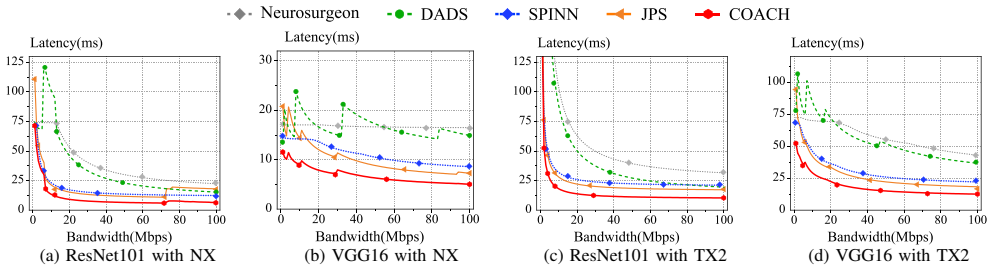
The paper's central claim is that pipeline bubbles in end-cloud inference can be attacked at two time scales: offline, by choosing where to cut the DAG and how many bits to transmit each layer's intermediate data, and online, by making quantization precision a per-task decision driven by how confidently the task's pooled feature matches the cached semantic center of its class. The offline objective minimizes a computation bubble term $B_c(V_p)=|T_e-T_c|$ together with a transmission bubble term and the maximum stage latency, and the recursive algorithm clusters parallel layers into virtual blocks so the DAG partition search reduces to a chain-flow search in $O(cn)$ time. Online, the GAP-pooled feature vector is compared with per-class semantic centers by cosine similarity; a high separability score $S$ permits early exit or lower-precision quantization, and the chosen precision $Q_c$ minimizes the bubble term under the current bandwidth. The evaluation on ResNet101 and VGG16 over UCF101 and ImageNet-100 reports latency reductions of 22.48% to 73.59% and throughput gains up to 9.3x versus specific baselines, with accuracy preserved within 0.5%.
Load-bearing premise
The load-bearing premise is that the cosine similarity between a task's pooled feature vector and the cached per-class semantic centers reliably predicts both the classification confidence and the quantization precision needed to keep accuracy loss at or below 0.5%.
Editorial extensions
If this is right
- Deploying the offline partition-and-quantization strategy on a DAG model such as ResNet101 should reduce average latency by 22% to 74% relative to the four baselines, depending on device and bandwidth.
- When bandwidth drops from 20 Mbps to 5 Mbps, COACH's throughput should stay within about 15% of its static throughput, while baseline throughput falls further.
- On highly correlated streams such as consecutive video frames, most tasks satisfy the early-exit condition, cutting transmission cost by about two-thirds and latency by more than half.
- Per-task quantization chosen from cache similarity keeps classification accuracy within 0.5% of the uncompressed model on the evaluated datasets.
Reading between the lines
- Because the separability score $S$ is essentially a calibrated confidence measure, the same signal could drive other split-execution decisions, such as whether to offload a task at all or which compression method to use.
- The early-exit and quantization thresholds are fit to a calibration set, so a distribution shift in the input stream would likely require recalibration; the paper does not evaluate this failure mode.
- The context-aware gains depend on temporal locality; shuffled or adversarial frames would retain the offline partitioning benefit but lose most of the cache-driven acceleration.
- Quantization here is drawn from a small discrete set (3, 4, or 5 bits), so the online loop could plausibly be replaced by a learned bandwidth-to-precision policy; the paper's core contribution is the bubble-minimizing formulation around it.
Editorial analysis
A structured set of objections, weighed in public.
Referee Report
Summary. The paper proposes COACH, a framework for end-cloud collaborative DNN inference that combines an offline component (joint model partitioning and transmission quantization via a recursive divide-and-conquer algorithm) with an online component (adaptive quantization and early exit driven by cached label semantic centers). The aim is to reduce pipeline bubbles and thereby lower latency and raise throughput under dynamic network conditions. The evaluation reports latency, throughput, and transmission-cost results on ResNet101 and VGG16 with UCF101 and ImageNet-100 on two end devices, comparing against Neurosurgeon, DADS, SPINN, and JPS; the reported numbers consistently favor COACH.
Significance. If the accuracy-preservation claim can be substantiated, COACH would be a useful engineering contribution: it integrates partitioning, quantization, early exit, and caching into one pipeline-aware framework, and the empirical study covers multiple devices, models, datasets, and bandwidth regimes. The paper ships a fairly complete system prototype and compares against relevant baselines. The main missing element is accuracy evidence, which is load-bearing because the paper's central claim is 'while maintaining comparable accuracy'; without it, the significance of the latency/throughput gains is conditional. The paper's strengths include the breadth of latency/throughput measurements and the explicit treatment of dynamic bandwidth, but the missing accuracy measurements currently block acceptance.
major comments (2)
- [§IV (Tables I–II, Figs. 5–7) and Eq. (1)] The paper's central claim is that COACH maintains comparable accuracy (accuracy loss within 0.5%) while delivering 1.7–2.1x latency and 2.1–2.5x throughput gains, but the evaluation reports no accuracy measurements at all. Table I reports latency only; Table II reports early-exit ratio, latency, and transmission cost; Figs. 5–7 report throughput and latency. No table or figure compares COACH's top-1 accuracy with the uncompressed full model or with the baselines, and no accuracy is reported separately for early-exited versus cloud-completed tasks or across quantization precisions. Because the thresholds S_ext and S_adj are calibrated on dataset D to enforce Eq. (1), the absence of test-set accuracy leaves an alternative explanation for every observed speedup—that early exit and adaptive quantization trade accuracy for latency/throughput—and blocks attribution of the gains to near bubble-free pipeline scheduling. The authors should add accuracy tables for all main configurations (datasets, models, devices, bandwidths), including the accuracy loss relative to the full model, before the performance claims can be accepted.
- [§III-C, Eq. (7)] The label semantic centers T_c are updated online using Eq. (7), which requires the true label j of each task feature F_j. The paper never states where these true labels come from during inference. If the labels are obtained from the early-exit prediction (Eq. (10)) or from another pseudo-labeling scheme, the centers can drift and systematically bias the similarity and separability estimates that drive both early exit and quantization adjustment. The authors should specify the label source, and if pseudo-labels are used, analyze the effect of label noise on the accuracy guarantee of Eq. (1).
minor comments (6)
- [Abstract vs. Section I] The abstract reports up to 1.7x faster inference and 2.1x higher throughput, while the contributions in Section I report up to 2.1x faster inference and 2.5x higher throughput; please reconcile these numbers and state which configuration yields each value.
- [§III-B, Algorithm 1 description] The complexity statement says the conventional approach exhibits O(cn) and that the proposed algorithm achieves O(cn) with 'substantial' improvement; as typeset these are identical, so either the superscript formatting was lost (e.g., O(c^n) versus O(cn)) or the claim of reduction is unsupported. Please correct the notation and state the exact complexity.
- [§III-C, Eq. (9)] The variable t_SH is used but never defined; please define it explicitly as the second-highest similarity degree in T.
- [§III-C, Algorithm 1] The notation for the quantization adjustment threshold is inconsistent: it appears as S_ad j, S_adj, and 'Sad j' in different places; please use one consistent subscript, e.g., S_adj.
- [§IV-B, Table II] The construction of the Low, Medium, and High data-correlation levels is not fully specified; please describe exactly how 'random frames', 'continuous frames from random videos', and 'continuous frames from sequential videos' are generated so that the results are reproducible.
- [§I] There are unresolved placeholder citation markers '[?]' in the introduction; these should be replaced with proper references.
Circularity Check
No circular derivation: the bubble-minimization and latency/throughput claims are benchmarked against external baselines; the unverified 0.5% accuracy guarantee is a validation gap, not a circularity.
full rationale
Walking the derivation chain, the offline component (Algorithm 1, Eq. 6) optimizes a bubble/latency objective over model partitioning and quantization, and the online component (Eqs. 7-11) uses cosine similarity to calibration-initialized semantic centers to set early-exit and quantization decisions. The reported latency and throughput improvements are measured quantities compared against external baselines (NS, DADS, SPINN, JPS) in Table I, Table II, and Figs. 5-7; they are not restatements of the fitted thresholds or of the optimization objective. The paper does contain a serious evidentiary gap: the Abstract and Section I assert that COACH maintains 'comparable accuracy,' and Section IV.A states 'We maintain a strict accuracy loss threshold of 0.5%,' but no accuracy measurement appears anywhere in Section IV. Table I reports only latency; Table II reports early-exit ratio, latency, and transmission cost; Figs. 5-7 report throughput and latency. Thus the 0.5% accuracy-loss guarantee is never verified on test tasks, and the possibility that early exit and aggressive quantization trade away accuracy for latency/throughput is not excluded. This is a correctness/validation concern, not circularity: no equation reduces to its own input by construction, and no load-bearing claim is justified solely by a self-citation chain. The cited references to prior work by the same group ([8], [22], [29], [36], [40]) are background or methodological, not the basis of the central bubble-free claim.
Assumptions & free parameters
free parameters (3)
- Accuracy loss limit epsilon =
0.5%
- Early-exit threshold Sext =
not reported
- Quantization adjustment thresholds Sadj =
not reported
assumptions (4)
- ad hoc to paper Bubble functions Bc(Vp) and Bt(Vp) in Eq. (5) and the objective in Eq. (6) faithfully capture pipeline bubbles, and minimizing them yields near bubble-free execution.
- domain assumption Cosine similarity between GAP-pooled task features and per-class semantic centers predicts both classification confidence and the quantization precision needed to preserve accuracy.
- ad hoc to paper Clustering parallel DAG layers into virtual blocks and reducing the model to chain flows does not exclude the optimal partition or quantization strategy.
- domain assumption Thresholds Sext and Sadj calibrated on dataset D generalize to the online inference distribution and to the bandwidth conditions tested.
invented entities (1)
-
Label semantic centers (cache of per-class feature centroids)
Cite this review
Pith. "Pith review of Accelerating End-Cloud Collaborative Inference via Near Bubble-free Pipeline Optimization." pith.science (2026). https://pith.science/paper/KQIHWUMF
@misc{pith2026250112388,
  author       = {Pith},
  title        = {Pith review of: Accelerating End-Cloud Collaborative Inference via Near Bubble-free Pipeline Optimization},
  year         = {2026},
  howpublished = {\url{https://pith.science/paper/KQIHWUMF}},
  note         = {Machine review of arXiv:2501.12388}
}
read the original abstract
End-cloud collaboration offers a promising strategy to enhance the Quality of Service (QoS) in DNN inference by offloading portions of the inference workload from end devices to cloud servers. Despite the potential, the complex model architectures and dynamic network conditions will introduce numerous bubbles (\ie, idle waiting time) in pipeline execution, resulting in inefficient resource utilization and degraded QoS. To address these challenges, we introduce a novel framework named COACH, designed for near bubble-free pipeline collaborative inference, thereby achieving low inference latency and high system throughput. Initially, COACH employs an \textit{offline} component that utilizes an efficient recursive divide-and-conquer algorithm to optimize both model partitioning and transmission quantization, aiming to minimize the occurrence of pipeline bubbles. Subsequently, the \textit{online} component in COACH employs an adaptive quantization adjustment and a context-aware caching strategy to further stabilize pipeline execution. Specifically, COACH analyzes the correlation between intermediate data and label semantic centers in the cache, along with its influence on the quantization adjustment, thereby effectively accommodating network fluctuations. Our experiments demonstrate the efficacy of COACH in reducing inference latency and enhancing system throughput. Notably, while maintaining comparable accuracy, COACH achieves up to 1.7x faster inference and 2.1x higher system throughput than baselines.
Figures


Figures from the paper (3 more)


Reference graph
Works this paper leans on
-
[1]
Cloud computing: issues and challenges,
T. Dillon, C. Wu, and E. Chang, “Cloud computing: issues and challenges,” in 2010 24th IEEE international conference on advanced information networking and applications . Ieee, 2010, pp. 27–33
work page 2010
-
[2]
Dynamic adaptive dnn surgery for inference acceleration on the edge,
C. Hu, W. Bao, D. Wang, and F. Liu, “Dynamic adaptive dnn surgery for inference acceleration on the edge,” in IEEE INFOCOM 2019-IEEE Conference on Computer Communications . IEEE, 2019, pp. 1423– 1431
2019
-
[3]
Dyno: Dynamic onloading of deep neural networks from cloud to device,
M. Almeida, S. Laskaridis, S. I. Venieris, I. Leontiadis, and N. D. Lane, “Dyno: Dynamic onloading of deep neural networks from cloud to device,” ACM Transactions on Embedded Computing Systems , vol. 21, no. 6, pp. 1–24, 2022
work page 2022
-
[4]
Cnnpc: End- edge-cloud collaborative cnn inference with joint model partition and compression,
S. Yang, Z. Zhang, C. Zhao, X. Song, S. Guo, and H. Li, “Cnnpc: End- edge-cloud collaborative cnn inference with joint model partition and compression,” IEEE Transactions on Parallel and Distributed Systems , vol. 33, no. 12, pp. 4039–4056, 2022
work page 2022
-
[5]
Neurosurgeon: Collaborative intelligence between the cloud and mobile edge,
Y . Kang, J. Hauswald, C. Gao, A. Rovinski, T. Mudge, J. Mars, and L. Tang, “Neurosurgeon: Collaborative intelligence between the cloud and mobile edge,” ACM SIGARCH Computer Architecture News, vol. 45, no. 1, pp. 615–629, 2017
2017
-
[6]
S. Sonko, E. A. Etukudoh, K. I. Ibekwe, V . I. Ilojianya, and C. D. Daudu, “A comprehensive review of embedded systems in autonomous vehicles: Trends, challenges, and future directions,” World Journal of Advanced Research and Reviews, vol. 21, no. 1, pp. 2009–2020, 2024
work page 2009
-
[7]
Jalad: Joint accuracy-and latency-aware deep structure decoupling for edge-cloud execution,
H. Li, C. Hu, J. Jiang, Z. Wang, Y . Wen, and W. Zhu, “Jalad: Joint accuracy-and latency-aware deep structure decoupling for edge-cloud execution,” in 2018 IEEE 24th international conference on parallel and distributed systems (ICPADS). IEEE, 2018, pp. 671–678
work page 2018
-
[8]
Finch: Enhancing federated learning with hierarchical neural architecture search,
J. Liu, J. Yan, H. Xu, Z. Wang, J. Huang, and Y . Xu, “Finch: Enhancing federated learning with hierarchical neural architecture search,” IEEE Transactions on Mobile Computing , 2023
2023
Show all 41 references
-
[9]
Zero bubble (almost) pipeline parallelism,
P. Qi, X. Wan, G. Huang, and M. Lin, “Zero bubble (almost) pipeline parallelism,” in The Twelfth International Conference on Learning Representations, 2024
2024
-
[10]
Optimizing job offloading schedule for collabora- tive dnn inference,
Y . Duan and J. Wu, “Optimizing job offloading schedule for collabora- tive dnn inference,” IEEE Transactions on Mobile Computing , 2023
2023
-
[11]
Very deep convolutional networks for large-scale image recognition,
K. Simonyan and A. Zisserman, “Very deep convolutional networks for large-scale image recognition,” arXiv preprint arXiv:1409.1556 , 2014
2014 arXiv
-
[12]
Deep residual learning for image recognition,
K. He, X. Zhang, S. Ren, and J. Sun, “Deep residual learning for image recognition,” in Proceedings of the IEEE conference on computer vision and pattern recognition , 2016, pp. 770–778
2016
-
[13]
Edge-cloud polarization and collaboration: A comprehensive survey for ai,
J. Yao, S. Zhang, Y . Yao, F. Wang, J. Ma, J. Zhang, Y . Chu, L. Ji, K. Jia, T. Shen et al. , “Edge-cloud polarization and collaboration: A comprehensive survey for ai,” IEEE Transactions on Knowledge and Data Engineering, vol. 35, no. 7, pp. 6866–6886, 2022
2022
-
[14]
Edge intelligence: On-demand deep learning model co-inference with device-edge synergy,
E. Li, Z. Zhou, and X. Chen, “Edge intelligence: On-demand deep learning model co-inference with device-edge synergy,” in Proceedings of the 2018 workshop on mobile edge communications, 2018, pp. 31–36
2018
-
[15]
A survey on collaborative dnn inference for edge intelligence,
W. Ren, Y . Qu, C. Dong, Y . Jing, H. Sun, Q. Wu, and S. Guo, “A survey on collaborative dnn inference for edge intelligence,” arXiv preprint arXiv:2207.07812, 2022
2022 arXiv
-
[16]
Auto-split: A general framework of collaborative edge-cloud ai,
A. Banitalebi-Dehkordi, N. Vedula, J. Pei, F. Xia, L. Wang, and Y . Zhang, “Auto-split: A general framework of collaborative edge-cloud ai,” in Proceedings of the 27th ACM SIGKDD Conference on Knowledge Discovery & Data Mining , 2021, pp. 2543–2553
2021
-
[17]
Throughput maxi- mization of delay-aware dnn inference in edge computing by exploring dnn model partitioning and inference parallelism,
J. Li, W. Liang, Y . Li, Z. Xu, X. Jia, and S. Guo, “Throughput maxi- mization of delay-aware dnn inference in edge computing by exploring dnn model partitioning and inference parallelism,” IEEE Transactions on Mobile Computing , 2021
2021
-
[18]
Computation offloading scheduling for deep neural network inference in mobile computing,
Y . Duan and J. Wu, “Computation offloading scheduling for deep neural network inference in mobile computing,” in 2021 IEEE/ACM 29th International Symposium on Quality of Service (IWQOS) . IEEE, 2021, pp. 1–10
2021
-
[19]
Ionn: Incremental offloading of neural network computations from mobile devices to edge servers,
H.-J. Jeong, H.-J. Lee, C. H. Shin, and S.-M. Moon, “Ionn: Incremental offloading of neural network computations from mobile devices to edge servers,” in Proceedings of the ACM symposium on cloud computing , 2018, pp. 401–411
2018
-
[20]
Ofpcnn: On-demand fine- grained partitioning for cnn inference acceleration in heterogeneous devices,
L. Yang, C. Zheng, X. Shen, and G. Xie, “Ofpcnn: On-demand fine- grained partitioning for cnn inference acceleration in heterogeneous devices,” IEEE Transactions on Parallel and Distributed Systems, 2023
2023
-
[21]
Jointdnn: An efficient training and inference engine for intelligent mobile cloud computing services,
A. E. Eshratifar, M. S. Abrishami, and M. Pedram, “Jointdnn: An efficient training and inference engine for intelligent mobile cloud computing services,” IEEE Transactions on Mobile Computing , vol. 20, no. 2, pp. 565–576, 2019
2019
-
[22]
Yoga: Adaptive layer-wise model aggregation for decentralized federated learning,
J. Liu, J. Liu, H. Xu, Y . Liao, Z. Wang, and Q. Ma, “Yoga: Adaptive layer-wise model aggregation for decentralized federated learning,” IEEE/ACM Transactions on Networking , 2023
2023
-
[23]
Improving device-edge cooperative inference of deep learning via 2-step pruning,
W. Shi, Y . Hou, S. Zhou, Z. Niu, Y . Zhang, and L. Geng, “Improving device-edge cooperative inference of deep learning via 2-step pruning,” in IEEE INFOCOM 2019-IEEE Conference on Computer Communica- tions Workshops (INFOCOM WKSHPS) . IEEE, 2019, pp. 1–6
2019
-
[24]
Clio: Enabling automatic compilation of deep learning pipelines across iot and cloud,
J. Huang, C. Samplawski, D. Ganesan, B. Marlin, and H. Kwon, “Clio: Enabling automatic compilation of deep learning pipelines across iot and cloud,” in Proceedings of the 26th Annual International Conference on Mobile Computing and Networking , 2020, pp. 1–12
2020
-
[25]
Spinn: synergistic progressive inference of neural networks over device and cloud,
S. Laskaridis, S. I. Venieris, M. Almeida, I. Leontiadis, and N. D. Lane, “Spinn: synergistic progressive inference of neural networks over device and cloud,” in Proceedings of the 26th annual international conference on mobile computing and networking , 2020, pp. 1–15
2020
-
[26]
Coedge: Cooperative dnn inference with adaptive workload partitioning over heterogeneous edge devices,
L. Zeng, X. Chen, Z. Zhou, L. Yang, and J. Zhang, “Coedge: Cooperative dnn inference with adaptive workload partitioning over heterogeneous edge devices,” IEEE/ACM Transactions on Networking , vol. 29, no. 2, pp. 595–608, 2020
2020
-
[27]
Boost- ing mobile cnn inference through semantic memory,
Y . Li, C. Zhang, S. Han, L. L. Zhang, B. Yin, Y . Liu, and M. Xu, “Boost- ing mobile cnn inference through semantic memory,” in Proceedings of the 29th ACM International Conference on Multimedia, 2021, pp. 2362– 2371
2021
-
[28]
Edge computing: Vision and challenges,
W. Shi, J. Cao, Q. Zhang, Y . Li, and L. Xu, “Edge computing: Vision and challenges,” IEEE internet of things journal , vol. 3, no. 5, pp. 637–646, 2016
2016
-
[29]
Feder- ated learning with experience-driven model migration in heterogeneous edge networks,
J. Liu, S. Wang, H. Xu, Y . Xu, Y . Liao, J. Huang, and H. Huang, “Feder- ated learning with experience-driven model migration in heterogeneous edge networks,” IEEE/ACM Transactions on Networking , 2024
2024
-
[30]
Ucf101: A dataset of 101 human actions classes from videos in the wild,
K. Soomro, A. R. Zamir, and M. Shah, “Ucf101: A dataset of 101 human actions classes from videos in the wild,”arXiv preprint arXiv:1212.0402, 2012
2012 arXiv
-
[31]
Imagenet classification with deep convolutional neural networks,
A. Krizhevsky, I. Sutskever, and G. E. Hinton, “Imagenet classification with deep convolutional neural networks,” Advances in neural informa- tion processing systems , vol. 25, 2012
2012
-
[32]
Visualizing data using t-sne
L. Van der Maaten and G. Hinton, “Visualizing data using t-sne.” Journal of machine learning research , vol. 9, no. 11, 2008
2008
-
[33]
Collaborative intelligence: Challenges and opportunities,
I. V . Baji ´c, W. Lin, and Y . Tian, “Collaborative intelligence: Challenges and opportunities,” in ICASSP 2021-2021 IEEE International Confer- ence on Acoustics, Speech and Signal Processing (ICASSP) . IEEE, 2021, pp. 8493–8497
2021
-
[34]
Quantizing deep convolutional networks for effi- cient inference: A whitepaper,
R. Krishnamoorthi, “Quantizing deep convolutional networks for effi- cient inference: A whitepaper,” arXiv preprint arXiv:1806.08342, 2018
2018 arXiv
-
[35]
Dichotomous systemic analysis,
V . Y . Tsvetkov, “Dichotomous systemic analysis,”Life Science Journal, vol. 11, no. 6, pp. 586–590, 2014
2014
-
[36]
Peaches: Personalized federated learning with neural architecture search in edge computing,
J. Yan, J. Liu, H. Xu, Z. Wang, and C. Qiao, “Peaches: Personalized federated learning with neural architecture search in edge computing,” IEEE Transactions on Mobile Computing , 2024
2024
-
[37]
Ago: Boosting mobile ai infer- ence performance by removing constraints on graph optimization,
Z. Xu, H. Peng, and W. Wang, “Ago: Boosting mobile ai infer- ence performance by removing constraints on graph optimization,” in IEEE INFOCOM 2023-IEEE Conference on Computer Communications. IEEE, 2023, pp. 1–10
2023
-
[38]
Dis- tributed inference acceleration with adaptive dnn partitioning and of- floading,
T. Mohammed, C. Joe-Wong, R. Babbar, and M. Di Francesco, “Dis- tributed inference acceleration with adaptive dnn partitioning and of- floading,” in IEEE INFOCOM 2020-IEEE Conference on Computer Communications. IEEE, 2020, pp. 854–863
2020
-
[39]
Network in network,
M. Lin, Q. Chen, and S. Yan, “Network in network,” arXiv preprint arXiv:1312.4400, 2013
2013 arXiv
-
[40]
Ferrari: A personalized federated learning framework for heterogeneous edge clients,
Z. Yao, J. Liu, H. Xu, L. Wang, C. Qian, and Y . Liao, “Ferrari: A personalized federated learning framework for heterogeneous edge clients,” IEEE Transactions on Mobile Computing , 2024
2024
-
[41]
Cosine similarity metric learning for face verification,
H. V . Nguyen and L. Bai, “Cosine similarity metric learning for face verification,” in Asian conference on computer vision . Springer, 2010, pp. 709–720
2010
Reviewed August 11, 2026 · model on record in the stance chip above.
Discussion (0). Continue with ORCID to comment.