REVIEW 2 major objections 4 minor 17 references
Statistical Privacy
T0 review · 2 major / 4 minor · reviewed 2026-08-10 · deepseek-v4-flash
Pith's one-line read For property queries, this paper derives exact formulas for the statistical-privacy curve, showing that the entropy of the database distribution alone can guarantee strong privacy when the attacker knows the distribution but not the…
desk verdict The distributional-privacy curves for property queries are a useful contribution, but Theorem 1's threshold is misprinted and the 'exact formulas' claim needs a repair. read the letter →
The pith
A machine-rendered reading of the paper's core claim, the machinery that carries it, and where it could break.
The reading
What carries the argument
The load-bearing object is the privacy curve $\delta_{\nu_1,\nu_2}(\varepsilon)$, built from the privacy loss random variable $L(z)=\ln(\nu_1(z)/\nu_2(z))$; it gives the smallest $\delta$ for which two conditional output distributions are $(\varepsilon,\delta)$-indistinguishable. For a property query the two distributions are $\mu_+$, where the critical entry satisfies the property, and $\mu_-$, where it does not. Under the paper's independence and common-probability assumptions the number of positive entries is binomial, so the likelihood ratio $Q_+(j)$ becomes a rational function of $j$ and $\pi$, and the thresholds where $Q_+(j)=e^\varepsilon$ are solved explicitly. That explicit threshold calculation, together with the entropy bound $nH(\pi)$, is what carries the exact formulas for $\delta(\varepsilon)$.
What would settle it
Compute the true statistical-privacy $\delta(\varepsilon)$ for a property query on a database of size $n=1000$ whose entries are generated by a positively correlated two-state Markov chain with $\pi=0.5$; if for some $\varepsilon>0$ the value falls below the paper's Theorem 2 formula, the independence assumption on which the exact formulas rest is falsified.
Extended reading notes
Core claim
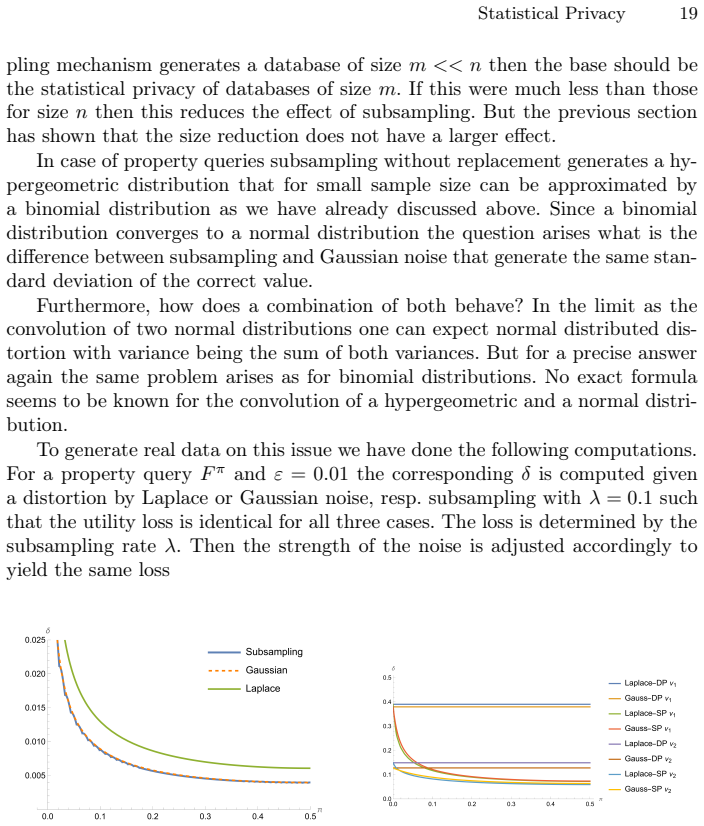
The central claim is that exact statistical-privacy curves can be computed for property queries. Theorem 2 states that when entries are independent and each satisfies the property with probability $\pi$, pure statistical privacy has $\delta(\varepsilon)=\max\{\delta_+(\varepsilon),\delta_-(\varepsilon)\}$, given by explicit binomial sums with thresholds $j_+^\star$ and $j_-^\star$. Theorem 1 extends the same structure to subsampling with rate $\lambda$, replacing $n$ by $n\lambda$ in the formulas. Because the thresholds sit a constant fraction away from the binomial mean, Chernoff's bound makes $\delta(\varepsilon)$ decrease exponentially in $n$; for small $\varepsilon$ the dependence is roughly exponential in $\varepsilon^2$. The paper's numerical computations conclude that, for the same $\varepsilon$, statistical privacy gives much smaller $\delta$ than differential privacy except for very small or very large $\pi$, and that Gaussian noise and subsampling at matched utility loss perform nearly identically while Laplace noise is noticeably worse.
Load-bearing premise
The exact privacy curves and the entropy bound $nH(\pi)$ rest on the assumption that all database entries are independent and each satisfies the queried property with the same probability $\pi$; with correlated entries or entry-dependent probabilities, the binomial formulas no longer apply.
Editorial extensions
If this is right
- For a fixed $\varepsilon$, statistical privacy yields a substantially smaller $\delta$ than differential privacy on the same property query, except when $\pi$ is very close to $0$ or $1$ where the database entropy nearly vanishes.
- The privacy parameter $\delta$ shrinks exponentially in the database size $n$; equivalently, increasing $n$ by a factor $\beta$ lowers the achievable $\varepsilon$ by roughly $\sqrt{\beta}$ at the same $\delta$.
- Subsampling with rate $\lambda$ and Gaussian noise chosen to match the same utility loss produce nearly identical $\delta$-values in the paper's numerical comparisons, while Laplace noise at the same utility loss is about 20% worse.
- Rare properties, such as a 1% disease rate, have weak statistical privacy on their own, so external noise matters most there; heavy noise, however, destroys utility.
- The exact formulas give practitioners a direct way to choose a mechanism's noise scale or sample size to hit a target privacy level, a step the paper argues is needed to apply privacy-enhancing techniques in practice.
Reading between the lines
- A natural next step is to relax the identical-probability assumption to entry-dependent probabilities $\pi_j$; the formulas would then depend on the variance of the weighted sum of independent Bernoulli variables rather than on $n\pi(1-\pi)$, and this is not tested in the paper.
- The paper's conjecture that subsampling never increases $\delta$ for property queries, if proved, would give a clean analogue of the differential-privacy amplification theorem; the paper only supports it with a few plotted parameter settings.
- The close numerical match between Gaussian noise and subsampling at equal utility loss suggests that, for small $\varepsilon$, privacy amplification is governed mainly by the variance of the released estimator rather than by the specific mechanism family; uniform or other mean-zero noise could be tested to see whether the pattern persists.
Editorial analysis
A structured set of objections, weighed in public.
Referee Report
Summary. This paper introduces 'statistical privacy' as a distributional alternative to differential privacy: the adversary knows the data-generating distribution but not the realized entries. For symmetric property queries on n independent entries with a common positive probability π, the authors derive closed-form expressions for the privacy curve δ(ε), analyze the privacy amplification and utility loss of subsampling, and give approximate bounds for additive Laplace and Gaussian noise. They compare the resulting parameters with differential privacy numerically and conclude that the entropy of the database distribution provides substantial privacy amplification except when π is very close to 0 or 1.
Significance. The question addressed here is well motivated, and the i.i.d./equal-π setting is analyzed with care. The explicit binomial formulas for the pure and subsampled cases are concrete and checkable, the utility-loss comparison between subsampling and noise is a useful contribution, and the paper is transparent about the main restrictions: independence and identical π are stated where used, and the noise bounds are explicitly approximate. The central claim is, however, not yet correct as printed: Theorem 1 contains a load-bearing error in the capped threshold j⋆+, so the stated subsampling privacy curve is not the δ of Definition 5. The derivation immediately preceding the theorem supplies the missing cap, so the error is fixable, but the present text does not deliver the 'exact formula' promised in the abstract.
major comments (2)
- [§4.1, Theorem 1] The displayed threshold j⋆+ = min{λ, λ + (e^ε − 1)/(1 + e^ε π_F/(1 − π_F))} · n π_F is incorrect. Since the second argument of the min is always larger than λ, the printed j⋆+ is always n π_F λ, i.e. the expected number of positive elements in the subsample. The derivation just before the theorem gives the correct cap j⋆+ = min{n λ, n π_F (λ + (e^ε − 1)/(1 + e^ε π_F/(1 − π_F)))}, equivalently min{m, (1 + γ⋆+) π_F m} with m = n λ. With the printed formula, the sum defining δ+(ε) includes indices j for which Q+(j) ≤ e^ε, so the expression is not δ_{F,SAMP,μ+,μ−}(ε) from Definition 5 and may be smaller than the true privacy-loss value or even negative. Because Theorem 1 is the paper's central exact formula for subsampling, this error must be corrected.
- [§4.1 and §4.2] The exactness claim in the abstract should be qualified: the exact formulas hold for the pure and subsampling privacy curves under the stated independence and identical-π assumptions, while the Gaussian and Laplace results of §4.3 are approximate (Lemma 6 uses '≈'). In particular, Theorem 2 is stated only for ε ≤ ln 2, and this restriction is essential for the printed pure-curve thresholds; the abstract and conclusion should not suggest that unconditional exact formulas are obtained for all noise mechanisms and all ε.
minor comments (4)
- [§4.1, Theorem 1] The paper should state explicitly that λ n is assumed to be an integer, since the formulas use binomial coefficients (n λ − 1 choose j); otherwise the summation bounds need floor and ceiling functions.
- [§4.1, Theorem 1] The summation limits involving j⋆+ and j⋆− should be written as ceilings and floors, respectively; the current rendering ("l j⋆ + m") is confusing.
- [§5] The numerical comparisons are not fully reproducible: the text reports Mathematica computations but does not give all parameter values, the number of terms used in the sums, or the code/data; adding this would strengthen the empirical claims.
- [§5] There are minor typos, e.g. 'x-achses' should be 'x-axes' and 'independend' should be 'independent'.
Circularity Check
No circularity: the privacy curves are derived directly from the paper's stated binomial model and definitions, not from fitted values or self-citations.
full rationale
The derivation chain is self-contained. Definition 4 defines statistical privacy by comparing conditional distributions, and Definition 5 defines the privacy curve directly from the same conditional likelihood ratio; Lemma 2 is a rewriting of the max-over-sets condition as the integral in (3), not a result that presupposes the target formulas. Theorems 1 and 2 are obtained by substituting the binomial marginal distributions that follow from the paper's explicit independence and common-pi assumption into that integral, so no parameter is fitted to data and no external benchmark is used as an input. The cited works on differential privacy, subsampling, and distributional privacy are contextual and comparative, not load-bearing for the algebraic derivation of the formulas. The apparent issue in the printed threshold j*_+ in Theorem 1, which caps at the mean n*pi*lambda rather than at the crossing point of Q_+(j)=e^epsilon, is a correctness or typographical concern about the stated formula, not a circularity: it does not make the result equivalent to its inputs by construction. The independence and equal-pi assumptions are strong and limit the setting, but they are declared assumptions rather than conclusions smuggled from the target result.
Assumptions & free parameters
assumptions (6)
- domain assumption The entries of the database are independent.
- domain assumption For the explicit formulas, every entry has the same probability π of fulfilling the property.
- domain assumption The adversary knows the exact generating distribution µ and only that (plus the query answer).
- domain assumption Queries are symmetric functions of the entries; property queries are counting queries.
- domain assumption The analysis is restricted to single queries, not composition.
- domain assumption For Gaussian noise, the binomial distribution of the query is approximated by a normal distribution.
Cite this review
Pith. "Pith review of Statistical Privacy." pith.science (2026). https://pith.science/paper/W5L2U4HM
@misc{pith2026250112893,
  author       = {Pith},
  title        = {Pith review of: Statistical Privacy},
  year         = {2026},
  howpublished = {\url{https://pith.science/paper/W5L2U4HM}},
  note         = {Machine review of arXiv:2501.12893}
}
read the original abstract
To analyze the privacy guarantee of personal data in a database that is subject to queries it is necessary to model the prior knowledge of a possible attacker. Differential privacy considers a worst-case scenario where he knows almost everything, which in many applications is unrealistic and requires a large utility loss. This paper considers a situation called statistical privacy where an adversary knows the distribution by which the database is generated, but no exact data of all (or sufficient many) of its entries. We analyze in detail how the entropy of the distribution guarantes privacy for a large class of queries called property queries. Exact formulas are obtained for the privacy parameters. We analyze how they depend on the probability that an entry fulfills the property under investigation. These formulas turn out to be lengthy, but can be used for tight numerical approximations of the privacy parameters. Such estimations are necessary for applying privacy enhancing techniques in practice. For this statistical setting we further investigate the effect of adding noise or applying subsampling and the privacy utility tradeoff. The dependencies on the parameters are illustrated in detail by a series of plots. Finally, these results are compared to the differential privacy model.
Figures


Figures from the paper (1 more)

Reference graph
Works this paper leans on
- [1]
-
[2]
Balle, B., Barthe, G., Gaboardi, M.: Privacy profiles and amplification by subsam- pling. J. Privacy and Confidentiality10(1) (2020). https://doi.org/10.29012/ jpc.726
work page 2020
-
[3]
Bassily, R., Groce, A., Katz, J., Smith, A.: Coupled-worlds privacy: Exploiting adversarial uncertainty in statistical data privacy. In: Proc. 54. FOCS. p. 439–448 (2013). https://doi.org/10.1109/FOCS.2013.54
- [4]
-
[5]
https://desfontain.es/blog/real-world-differential-privacy.html (2021)
Desfontaines, D.: A list of real-world uses of differential privacy. https://desfontain.es/blog/real-world-differential-privacy.html (2021)
work page 2021
-
[6]
Desfontaines, D., Mohammadi, E., Krahmer, E., Basin, D.: Differential privacy with partial knowledge (2020)
work page 2020
-
[7]
Desfontaines, D., Pejo, B.: Sok: Differential privacies – a taxonomy of differential privacy variants and extensions (2022)
work page 2022
-
[8]
Dwork, C., McSherry, F., Nissim, K., Smith, A.: Calibrating noise to sensitivity in private data analysis. J. Privacy and Confidentiality3, 17–51 (2016)
work page 2016
Show all 17 references
-
[9]
Foun- dations and Trends® in Theoretical Computer Science 9(3–4), 211–407 (2014)
Dwork, C., Roth, A.: The algorithmic foundations of differential privacy. Foun- dations and Trends® in Theoretical Computer Science 9(3–4), 211–407 (2014). https://doi.org/10.1561/0400000042
2014 doi
-
[10]
In: Proc
Imola, I., Chaudhuri, K.: Privacy amplification via Bernoulli sampling. In: Proc. 38. Int. Conf. on Machine Learning (2021)
2021
-
[11]
https://www.nist.gov/blogs/cybersecurity-insights/differential-privacy-future- work-open-challenges (1 2022), an official website of the United States government
Joseph, N., David, D.: Differential privacy: Future work & open challenges. https://www.nist.gov/blogs/cybersecurity-insights/differential-privacy-future- work-open-challenges (1 2022), an official website of the United States government
2022
-
[12]
Kifer, D., Lin, B.: An axiomatic view of statistical privacy and utility. J. Privacy and Confidentiality 4, 5–49 (2012)
2012
-
[13]
Cryptol- ogy ePrint Archive (2018)
Meiser, S.: Approximate and probabilistic differential privacy definitions. Cryptol- ogy ePrint Archive (2018)
2018
-
[14]
Mironov,I.:Renyidifferentialprivacy.In:Proc.30.ComputerSecurityFoundations Symposium (2017)
2017
-
[15]
In: Proc
Sommer, D., Meiser, S., Mohammadi, E.: Privacy loss classes: The central limit the- orem in differential privacy. In: Proc. Privacy Enhancing Technologies Symposium. vol. 2019 (2), pp. 245–269 (2019).https://doi.org/10.2478/popets-2019-0029
2019 doi
-
[16]
In: arXiv:2210.00597 (2022)
Steinke, T.: Composition of differential privacy and privacy amplification by sub- sampling. In: arXiv:2210.00597 (2022)
2022 arXiv
-
[17]
In: Proc
Wang, Y., Balle, B., Kasiviswanathan, S.: Subsampled Renyi differential privacy and analytical moments accountant. In: Proc. 22. AISTATS (2019)
2019
Reviewed August 10, 2026 · model on record in the stance chip above.
Discussion (0). Continue with ORCID to comment.