REVIEW 3 major objections 5 minor 25 references
Discrete Lagrangian Multiforms for ABS Equations I: Quad Equations
T0 review · 3 major / 5 minor · reviewed 2026-08-10 · deepseek-v4-flash
Pith's one-line read The ABS quad equations are the Euler–Lagrange equations of a discrete Lagrangian 2-form with auxiliary integer fields, making them variational in a literal sense.
desk verdict A real step forward in the variational theory of ABS equations, but the claim that 'quad equations are variational' only holds under a surface-dependent weakening of the multiform principle that the paper itself makes explicit. read the letter →
The pith
A machine-rendered reading of the paper's core claim, the machinery that carries it, and where it could break.
The reading
What carries the argument
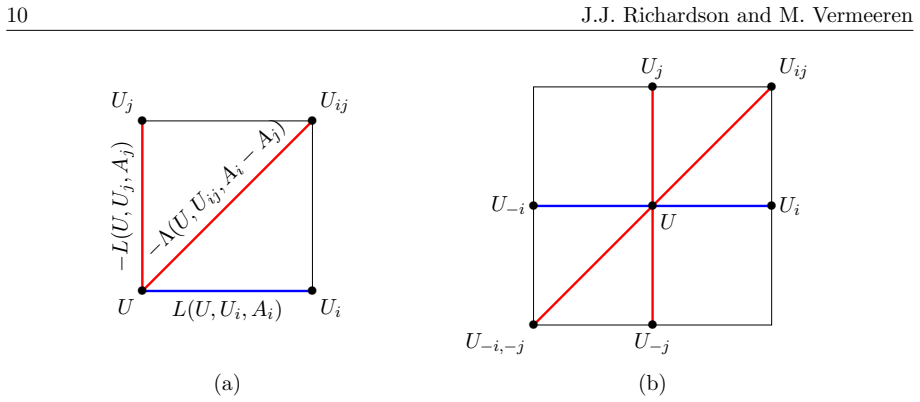
The object that carries the argument is the trident Lagrangian, a four-point discrete Lagrangian arranged like a three-legged fork: one leg along direction $i$, one along direction $j$, and a diagonal leg connecting the base vertex to the opposite corner, with leg functions $\psi$ and $\phi$ arising as derivatives of potentials $L$ and $\Lambda$. Around a cube, six such Lagrangians are summed with signs to form the action $S_{\Theta,\Xi}$, which is extended by vertex terms $2\pi i\Theta U$ and direction terms $2\pi i\Xi_i A_i$. The integer fields do the load-bearing work: $\Theta$ makes the three-leg form exactly equivalent to the multi-affine quad equation despite logarithm branch cuts, and $\Xi$ cancels the branch jumps so that the gradient of the action with respect to both fields and parameters vanishes on solutions. The closure proof then works by deforming a given solution to a trivial one along a one-parameter family, using Lemma 3.3 (a 2-form version of the spectrality property, proved via biquadratic identities) to choose $\Xi$, and Lemma 3.4 to control jumps when branch cuts are crossed.
What would settle it
For H3, A2, or Q3, take a one-parameter family of solutions to the quad equations that crosses a branch cut of the dilogarithm, and compute the extended action $S_{\Theta,\Xi}$ around an elementary cube; if the jump is ever a non-integer multiple of $4\pi^2$, Theorem 3.5's closure claim is false. A direct search for a closed discrete surface whose total action equals, for instance, $2\pi^2$ would also refute the claim.
Extended reading notes
Core claim
On the paper's own terms, the central discovery is that the multi-affine ABS quad equations are equivalent to the corner equations of a discrete 2-form action $S_{\Theta,\Xi}$ built from the trident Lagrangian $\mathcal{L}(U,U_i,U_j,U_{ij},A_i,A_j)=L(U,U_i,A_i)-L(U,U_j,A_j)-\Lambda(U,U_{ij},A_i-A_j)$. The integer fields $\Theta$ (one per lattice site) turn the additive three-leg equations, which otherwise hold only up to $2\pi i$, into exact equivalents of the multiplicative quad equations; the fields $\Xi$ (one per lattice direction) absorb branch-cut jumps in the logarithm and dilogarithm terms, so that the action's derivatives with respect to the lattice parameters vanish. Theorem 3.1 states that the corner equations of $S_{\Theta,\Xi}$ are precisely the quad equations and tetrahedron equations in three-leg form, and Theorem 3.5 states that on solutions the action around an elementary cube equals $0$ for H1, H2, Q1, Q2, and A1, and equals $4k\pi^2$ with $k\in\mathbb{Z}$ for H3, A2, and Q3. This makes the quad equations of the ABS list variational in a literal sense, contrary to the statement in earlier work that they are not.
Load-bearing premise
The whole construction depends on allowing the integer fields $\Theta$ and $\Xi$ to be chosen anew for each discrete surface; if a single global assignment on $\mathbb{Z}^N$ were required, the variational description would fail, as the paper's own H2 example on two adjacent cubes demonstrates.
Editorial extensions
If this is right
- The earlier caveat that 'quad equations are not variational' is no longer true: the trident 2-form gives corner equations equivalent to the ABS quad equations themselves.
- For H1, H2, Q1, Q2, and A1, the Lagrangian 2-form is closed on solutions in the strong sense that the action over every elementary cube is zero.
- For H3, A2, and Q3, closure holds modulo $4\pi^2$, and numerical evidence in the paper shows nonzero multiples occur, so the variational structure of these equations is best described as a pluri-Lagrangian system.
- The same branch-tracking technique provides a concrete route toward a closure relation for Q4, where the paper expects the $4\pi^2$ multiple to be replaced by quantities related to half-periods of the underlying elliptic curve.
- Definition 3.7 proposes the appropriate formulation of the Lagrangian multiform principle in the presence of integer fields: the fields may depend on the chosen discrete surface, even though no global assignment exists on the whole lattice.
Reading between the lines
- If the construction extends to Q4, the entire ABS list would sit on a uniform variational foundation, and the $4\pi^2$ obstruction for H3, A2, and Q3 might be interpretable as a topological term tied to elliptic periods.
- The surface-dependent integer fields behave like a discrete analogue of a connection: the action is not a single-valued function on field space but a section of a bundle with $\mathbb{Z}$-valued holonomy, which could give the integer fields a geometric meaning the paper leaves open.
- The same 'add integer fields to absorb branch ambiguities' recipe may apply to other discrete integrable systems whose Lagrangians involve logarithms or dilogarithms, such as star-triangle relations, where similar multiples of $2\pi i$ appear.
- A testable consequence of Definition 3.7 is that the variational principle and the quad equations remain equivalent on arbitrary discrete surfaces; checking this on surfaces with many cubes, where multiple $\Theta$ values meet at interior vertices, would stress-test Proposition 3.8.
Signed reviews
Editorial analysis
A structured set of objections, weighed in public.
Referee Report
Summary. The paper presents new discrete Lagrangian multiforms for the ABS list of quad equations, based on a four-point (trident) Lagrangian instead of the usual three-point (triangle) Lagrangian. The authors show that the corner equations of the trident action are equivalent to the quad equations, provided one adds integer-valued fields Θ and Ξ to account for branch choices of logarithms and dilogarithms. They also revisit the closure property, give counterexamples to existing closure proofs, and prove exact closure for H1, H2, Q1, Q2, A1 and closure modulo 4π² for H3, A2, Q3, using a deformation argument that tracks branch jumps. The final section extends the construction to arbitrary surfaces by allowing the integer fields to depend on the surface, and states an open problem for Q4.
Significance. If accepted as a generalized variational principle, this is a substantial contribution: it provides a variational formulation equivalent to the ABS quad equations, clarifying a long-standing issue in discrete Lagrangian multiform theory, and it draws attention to branch-cut subtleties that earlier works ignored. The paper is honest about the limits of its construction, including the absence of exact closure for H3, A2, Q3 and the surface-dependence of the integer fields. Strengths include explicit counterexamples, a deformation proof of closure, and the availability of SageMath verification code at a Zenodo repository. The central derivation in Section 3.2 is clean and the corner-equation computation is straightforward once the trident action is written out. The main risk is definitional: whether the surface-dependent integer fields in Definition 3.7 really produce a Lagrangian multiform in the established sense, and whether the branch-jump classification in Lemma 3.4 is complete.
major comments (3)
- [Section 3.5, Definition 3.7] The proposed Lagrangian multiform principle is weaker than the standard one: the integer fields Θ and Ξ are allowed to depend on the chosen discrete surface Γ, so the action S_{Θ,Ξ}^Γ is not a single fixed functional on Z^N. The H2 example in equations (3.6) and (3.7) shows that no global assignment of Θ and Ξ exists even for two adjacent cubes, so the standard interpretation of a Lagrangian multiform as a fixed 2-form on the lattice is not realized. The claim in the Introduction and Section 3.2 that 'quad equations are variational' should therefore be explicitly qualified as 'variational in this surface-dependent generalized sense'; without that qualification, the statement is misleading under the usual definition.
- [Lemma 3.4, proof] The proof of Lemma 3.4 classifies branch jumps into three term types and then asserts that all terms in the actions are of these forms. However, the actions in Appendix A contain many logarithms and dilogarithms with different arguments and sign patterns, and the proof does not provide a systematic check that each equation's action term satisfies the claimed coefficient relations (for example, that a jump of 2πi in a logarithm of a combination of fields is always multiplied by the same combination of fields and parameters, or that the dilogarithm terms always appear in the specific pairing claimed). Since Lemma 3.4 is load-bearing for Theorem 3.5, please add a per-equation verification table or a general argument that covers every logarithmic/dilogarithmic term in the listed Lagrangians.
- [Proof of Theorem 3.5 for H3, Q3, A2] The proof for H3, Q3, A2 relies on a generic assumption that w_i, w_j, w_k are distinct, with non-generic cases handled by 'a small perturbation of the original solution'. This is not justified: it is not shown that the value of S_{Θ,Ξ}(U,A,Θ,Ξ) modulo 4π² is continuous under such perturbations, especially since Θ(t) and Ξ(t) are piecewise-constant integer fields that can change when branch cuts are crossed. The proof should either give a direct argument for the non-generic cases or prove that the mod-4π² value is locally constant on the solution manifold in a way that survives the perturbation limit.
minor comments (5)
- [Theorem 3.5 statement] The phrase 'Let either S = S_{Θ,Ξ} or S = S_{Θ,Ξ}' is confusing because the two symbols are identical in the printed text; presumably the second should be S_{Ξ} (or the statement should specify whether Θ is included). Please correct the notation.
- [Lemma 3.3 statement] The first sentence of Lemma 3.3 repeats 'there exists a choice of integers Ξ_i, Ξ_j, Ξ_k ∈ Z such that ∂S_Ξ/∂α_i = ∂S_{Θ,Ξ}/∂α_i = 0' twice, with the second occurrence presumably intended to refer to S_{Ξ} or to an analogous condition for S_{Θ,Ξ} without the Θ terms; please rephrase to state clearly which action is meant in each case.
- [Example H3, part 3, numerical values] The numerical solution is described as 'a (non-unique) solution', but no numerical method or precision is given. Since the paper already points to the SageMath code, a brief sentence on how the numbers were computed (e.g., by solving the quad equations with a root-finding algorithm) would improve reproducibility.
- [The deformation family in the proof for H1, H2, Q1, Q2, A1] The claim that lim_{t→0} S(V(t), Θ, Ξ) = 0 is asserted to follow from 'elementary calculus', but the dilogarithm terms in H2 and Q1δ=1, Q2 involve limits of terms like x log x as x→0; a short justification of the vanishing of such limits would make the proof self-contained.
- [General typographical issues] There are several places where the text says 'A1δ=1' or 'Q1δ=1' etc., but the subscript formatting is inconsistent (e.g., 'Q1δ=1' versus 'Q1_{δ=1}'). These do not affect the mathematics but should be fixed in the final version.
Circularity Check
No significant circularity: the corner-equation equivalence and closure theorems are derived from the constructed action, not assumed.
full rationale
The paper's central construction is a standard inverse-problem-of-calculus-of-variations argument: the leg functions ψ and φ are taken from the ABS three-leg forms, and L and Λ are chosen as their antiderivatives (equations (2.16)–(2.17)). Differentiating the action then produces the three-leg expressions by direct calculus, and Proposition 2.3 independently establishes the equivalence between the multi-affine quad equations and those three-leg forms modulo 2πi. The integer fields Θ and Ξ are not fitted to force the claimed conclusions; they are introduced to absorb branch-of-logarithm ambiguities, and the theorems are then proved rather than assumed. In Theorem 3.1, the corner equations are shown to be the three-leg quad and tetrahedron equations, and the equivalence to the ABS equations follows from Proposition 2.3, not from the definition of the action. In Theorem 3.5, closure is proved by showing that the gradient of SΘ,Ξ vanishes on solutions (using the corner equations and Lemma 3.3), then deforming a solution to a trivial solution where S→0, and tracking branch jumps in Lemma 3.4. The integers Ξ are chosen to satisfy ∂S/∂A=0, not to set S=0 directly, so the conclusion S=0 is a genuine result rather than a fitted prediction. The paper is also transparent about its limitations: for H3, A2, and Q3 closure holds only modulo 4π², and Section 3.5 explicitly demonstrates that no global assignment of the integer fields exists for the H2 example, motivating the surface-dependent Definition 3.7. That weakening of the standard Lagrangian-multiform principle is a substantive interpretive and correctness concern, but it is not circularity: the paper does not define the variational principle in terms of the quad equations, and its derivation chain does not reduce to its own inputs by construction. The few self-references, such as [17] and [23], are not load-bearing evidence for the main theorems. The derivation is self-contained, and no circular step can be exhibited by quoting an equation that is equivalent to another by definition or by a fitted parameter renamed as a prediction.
Assumptions & free parameters
free parameters (2)
- Integer fields Θ(n) at each lattice site =
Solution-dependent integers; H2 example: Θ = -1, Θ_i = 1, Θ_k = 1, Θ_ij = 1, Θ_jk = -1, Θ_ki = -1, Θ_ijk = 1
- Integer fields Ξ_i per lattice direction =
Solution-dependent integers; H1 example gives Ξ_i = 0, Ξ_j = -1, Ξ_k = 1; the adjacent-cube H2 example gives…
assumptions (6)
- standard math Biquadratic identities and the relation ∂L/∂A ≡ log h + ... mod 2πi from [3, Lemma 3] and [1, Proposition 15]
- domain assumption The tetrahedron equation T=0 can be represented as a quad equation of type Q evaluated on a tetrahedron stencil
- domain assumption Choice of principal branches for log and dilogarithm with specified branch cuts
- ad hoc to paper Definition 3.7: integer fields Θ and Ξ may depend on the chosen discrete surface
- ad hoc to paper The closure requirement is relaxed to S ≡ 0 mod 4π² for H3, A2, and Q3
- ad hoc to paper Generic solution assumption wi, wj, wk distinct in the proof for H3, A2, Q3, with non-generic cases reached by perturbation
invented entities (2)
-
Integer-valued field Θ(n) at each lattice site
-
Integer-valued field Ξ_i per lattice direction
Cite this review
Pith. "Pith review of Discrete Lagrangian Multiforms for ABS Equations I: Quad Equations." pith.science (2026). https://pith.science/paper/ET4E35QF
@misc{pith2026250113012,
  author       = {Pith},
  title        = {Pith review of: Discrete Lagrangian Multiforms for ABS Equations I: Quad Equations},
  year         = {2026},
  howpublished = {\url{https://pith.science/paper/ET4E35QF}},
  note         = {Machine review of arXiv:2501.13012}
}
read the original abstract
Discrete Lagrangian multiform theory is a variational perspective on lattice equations that are integrable in the sense of multidimensional consistency. The Lagrangian multiforms for the equations of the ABS classification formed the start of this theory, but the Lagrangian multiforms that are usually considered in this context produce equations that are slightly weaker than the ABS equations. In this work, we present alternative Lagrangian multiforms that have Euler-Lagrange equations equivalent to the ABS equations. In addition, the treatment of the ABS Lagrangian multiforms in the existing literature fails to acknowledge that the complex functions in their definitions have branch cuts. The choice of branch affects both the existence of an additive three-leg form for the ABS equations and the closure property of the Lagrangian multiforms. We give counterexamples for both these properties, but we recover them by including integer-valued fields, related to the branch choices, in the action sums.
Figures


Figures from the paper (4 more)


Reference graph
Works this paper leans on
-
[1]
The consistency approach, Comm
Adler V.E., Bobenko A.I., Suris Yu.B., Classification of integrable equations on quad-graphs. The consistency approach, Comm. Math. Phys.233 (2003), 513–543, arXiv:nlin.SI/0202024
-
[2]
Bobenko A.I., G¨ unther F., On discrete integrable equations with convex variational principles, Lett. Math. Phys. 102 (2012), 181–202, arXiv:1111.6273
work page Pith review arXiv 2012
-
[3]
Bobenko A.I., Suris Yu.B., On the Lagrangian structure of integrable quad-equations, Lett. Math. Phys.92 (2010), 17–31, arXiv:0912.2464
work page Pith review arXiv 2010
-
[4]
Bobenko A.I., Suris Yu.B., Discrete pluriharmonic functions as solutions of linear pluri-Lagrangian systems, Comm. Math. Phys.336 (2015), 199–215, arXiv:1403.2876. 30 J.J. Richardson and M. Vermeeren
work page Pith review arXiv 2015
-
[5]
Boll R., Petrera M., Suris Yu.B., What is integrability of discrete variational systems?, Proc. R. Soc. Lond. Ser. A Math. Phys. Eng. Sci.470 (2014), 20130550, 15 pages, arXiv:1307.0523
work page Pith review arXiv 2014
-
[6]
Boll R., Petrera M., Suris Yu.B., On integrability of discrete variational systems: octahedron relations, Int. Math. Res. Not.2016 (2016), 645–668, arXiv:1406.0741
work page Pith review arXiv 2016
-
[7]
Caudrelier V., Nijhoff F., Sleigh D., Vermeeren M., Lagrangian multiforms on Lie groups and non-commuting flows, J. Geom. Phys.187 (2023), 104807, 35 pages, arXiv:2204.09663
work page Pith review arXiv 2023
-
[8]
Caudrelier V., Stoppato M., Vicedo B., Classical Yang–Baxter equation, Lagrangian multiforms and ul- tralocal integrable hierarchies, Comm. Math. Phys.405 (2024), 12, 67 pages, arXiv:2201.08286
work page Pith review arXiv 2024
Show all 25 references
-
[9]
Math., Cambridge University Press, Cambridge, 2016
Hietarinta J., Joshi N., Nijhoff F.W., Discrete systems and integrability, Cambridge Texts Appl. Math., Cambridge University Press, Cambridge, 2016
2016
-
[10]
Kels A.P., Interaction-round-a-face and consistency-around-a-face-centered-cube, J. Math. Phys.62 (2021), 033509, 36 pages, arXiv:2003.08883
2021 arXiv
-
[11]
D 448 (2023), 133723, 23 pages, arXiv:1910.03562
Kels A.P., Two-component Yang–Baxter maps and star-triangle relations, Phys. D 448 (2023), 133723, 23 pages, arXiv:1910.03562
2023 arXiv
-
[12]
Lobb S.B., Nijhoff F.W., Lagrangian multiforms and multidimensional consistency, J. Phys. A42 (2009), 454013, 18 pages, arXiv:0903.4086
2009 arXiv
-
[13]
Lobb S.B., Nijhoff F.W., A variational principle for discrete integrable systems, SIGMA 14 (2018), 041, 18 pages, arXiv:1312.1440
2018 arXiv
-
[14]
Nijhoff F.W., Lagrangian 3-form structure for the Darboux system and the KP hierarchy, Lett. Math. Phys. 113 (2023), 27, 19 pages, arXiv:2206.14338
2023 arXiv
-
[15]
Nonlinear Math
Nijhoff F.W., Lagrangian multiform structure of discrete and semi-discrete KP systems, Open Commun. Nonlinear Math. Phys.4 (2024), OCNMP Conference, 91–115, arXiv:2406.13423
2024 arXiv
-
[16]
Non- linear Math
Petrera M., Suris Yu.B., Variational symmetries and pluri-Lagrangian systems in classical mechanics,J. Non- linear Math. Phys.24 (2017), suppl. 1, 121–145, arXiv:1710.01526
2017 arXiv
-
[17]
Richardson J.J., Vermeeren M., Discrete Lagrangian multiforms for quad equations II: Tetrahedron and octahedron equations, SIGMA 21 (2025), 059, 27 pages, arXiv:2403.16845
2025 arXiv
-
[18]
Sleigh D., Nijhoff F.W., Caudrelier V., Lagrangian multiforms for Kadomtsev–Petviashvili (KP) and the Gelfand–Dickey hierarchy, Int. Math. Res. Not.2023 (2023), 1420–1460, arXiv:2011.04543
2023 arXiv
-
[19]
Sleigh D., Vermeeren M., Semi-discrete Lagrangian 2-forms and the Toda hierarchy, J. Phys. A55 (2022), 475204, 24 pages, arXiv:2204.13063
2022 arXiv
-
[20]
Suris Yu.B., Variational formulation of commuting Hamiltonian flows: Multi-time Lagrangian 1-forms, J. Geom. Mech.5 (2013), 365–379, arXiv:1212.3314
2013 arXiv
-
[21]
Suris Yu.B., Vermeeren M., On the Lagrangian structure of integrable hierarchies, in Advances in Discrete Differential Geometry, Springer, Berlin, 2016, 347–378, arXiv:1510.03724
2016 arXiv
-
[22]
The Sage Developers, SageMath, the Sage Mathematics Software System, Version 9.1 of 2020-05-21, aviable at https://www.sagemath.org
2020
-
[23]
Vermeeren M., SageMath code ABS-multiforms: v1.1, 2025, aviable at https://zenodo.org/doi/10.5281/ zenodo.15652765
2025
-
[24]
Vermeeren M., A variational perspective on continuum limits of ABS and lattice GD equations, SIGMA 15 (2019), 044, 35 pages, arXiv:1811.01855
2019 arXiv
-
[25]
Xenitidis P., Nijhoff F., Lobb S., On the Lagrangian formulation of multidimensionally consistent systems, Proc. R. Soc. Lond. Ser. A Math. Phys. Eng. Sci.467 (2011), 3295–3317, arXiv:1008.1952
2011 arXiv
Reviewed August 10, 2026 · model on record in the stance chip above.
Discussion (0). Continue with ORCID to comment.