REVIEW 5 major objections 6 minor 32 references
The GenUI Study: Exploring the Design of Generative UI Tools to Support UX Practitioners and Beyond
T0 review · 5 major / 6 minor · reviewed 2026-08-10 · deepseek-v4-flash
Pith's one-line read A week-long study of 37 UX professionals finds GenUI tools are best at quick first drafts and weakest at finishing them.
desk verdict A solid formative diary study that maps role-specific GenUI promises and gaps; the single-tool generalization is a real but disclosed limitation, not a fatal one. read the letter →
The pith
A machine-rendered reading of the paper's core claim, the machinery that carries it, and where it could break.
The reading
What carries the argument
The central object is the study itself: a one-week, project-based diary study in which each participant used a single commercial GenUI tool on a role-specific task (a five-screen onboarding prototype for UX designers, a product requirements document for PMs, a UI-only minimum viable product for software engineers, and a user research plan for UX researchers), logging daily responses to a four-question template and then taking part in a semi-structured interview. The load-bearing mechanism is the grounded-theory coding of those journals and interviews, which the authors distilled into 28 codes and then into 16 higher-level findings organized around workflow, benefits for all roles, benefits for specific non-designer roles, and gaps. This method is what lets the paper turn scattered practitioner reports into the 'first draft versus last mile' verdict and into a reusable list of design implications.
What would settle it
Run the same four role tasks side-by-side with several different GenUI tools, and with professional teams using the tools on their actual projects, then measure the time from a text prompt to a production-ready UI and count the editing operations needed per screen. If any current tool already produces screens that need little or no 'last mile' editing, or if the reported gaps and cross-role benefits disappear or change materially across tools and real projects, the paper's central claims would not hold.
Extended reading notes
Core claim
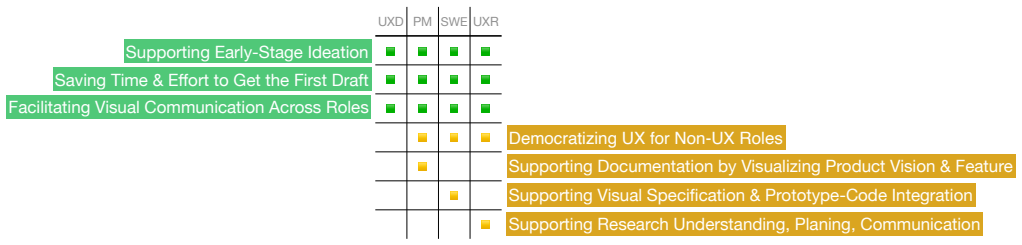
On the paper's own terms, the discovery is that generative UI tools currently act as an accelerated starting point, not a finishing tool: participants across all four roles consistently reported that GenUI reduced the effort to produce a first prototype and supported early ideation and cross-role visual communication, but that the generated screens carried quality issues (truncated text, misalignment, inconsistency, unwanted elements) and required a nontrivial amount of editing and re-prompting to become product- or engineering-ready. The paper names this the 'last mile' problem and argues that the right design response is either to keep improving the underlying code-generation models or to keep GenUI lightweight and hand off editing to existing design tools. It further claims that GenUI's benefits extend beyond UX designers, finding that product managers, software engineers, and UX researchers each gained role-specific value—visualizing product visions and requirements, providing visual specifications and prototype-to-code integration, and supporting research understanding, planning, and communication—while also surfacing the risk that non-designers might over-rely on imperfect outputs. The study also identifies that current GenUI tools lack support for problem formulation, reliable execution of explicit instructions, constraints from organizational design systems and accessibility standards, multimodal input and output, consistent connection of UI elements across screens, appropriate fidelity, original problem solving, and easy iteration.
Load-bearing premise
The study's conclusions rest on the assumption that the single unnamed commercial GenUI tool selected by the authors represents the entire class of GenUI tools, and that role-specific mini-projects completed in participants' personal time elicit the same workflows, benefits, and gaps as real work on real teams; the paper itself acknowledges the single-tool limitation.
Editorial extensions
If this is right
- GenUI tools should be marketed and designed as early-stage ideation and communication aids, with the expectation that their output is a draft to be edited or handed off, not a finished screen.
- Tool builders should add role-specific modes—PRD-oriented outputs for PMs, code and IDE integration for SWEs, and research-plan and study materials for UXRs—rather than a single designer-centric text-to-screen workflow.
- Investment in editing and iteration support, whether inside GenUI or via seamless export to tools like Figma, is necessary to close the last mile; without it, users will restart generation instead of refining.
- GenUI tools must respect organizational design systems, accessibility best practices, and domain constraints before practitioners will adopt their output beyond concepts.
- To support team-level use, GenUI needs to connect UI elements across screens with consistent styles, shared context, and coherent user flows, so that generated screens read as one application rather than isolated mock-ups.
Reading between the lines
- If the 'good first draft, tough last mile' framing holds, the competitive value of GenUI will shift toward handoff and integration layers—export, design-system compliance, and code generation—rather than standalone screen generation.
- The single-tool design leaves open the possibility that some reported gaps, such as element misalignment or editing friction, are artifacts of that one product; a multi-tool replication using identical role tasks would show which gaps are class-level GenUI problems.
- The democratization claim implies a governance risk the paper only touches on: if non-designers generate UIs without design review, organizations may need moderation or design-system enforcement to prevent low-quality or inaccessible output from reaching users.
- A direct quantitative test of the last-mile claim would measure, for each role, the time from a text prompt to a production-ready UI versus manual prototyping; if editing time consistently dominates, then GenUI's net benefit depends almost entirely on editing tooling, not generation quality.
Editorial analysis
A structured set of objections, weighed in public.
Referee Report
Summary. The paper reports a formative, week-long diary study with 37 UX-related professionals (UX designers, UX researchers, product managers, and software engineers) who used a single unnamed state-of-the-art GenUI tool to complete role-specific mini-project tasks. Data were collected through daily journals and semi-structured interviews, and analyzed with grounded theory. The paper's main findings are organized into four themes: how different roles use GenUI, how GenUI supports all roles (early ideation, first-draft time savings, visual communication), how GenUI can support non-UX roles (democratizing UX and role-specific support for PM, SWE, UXR), and gaps in GenUI (problem formulation, intent assimilation, constrained generation, multimodal I/O, UI element connectivity, quality/fidelity/originality, and editing/iteration). The paper concludes that GenUI is currently best suited to producing 'good enough' first drafts but suffers from a 'last mile' problem, and that GenUI tools can and should support roles beyond UX designers and facilitate team-level collaboration.
Significance. If the findings hold within their stated scope, this is one of the first empirical studies of how a GenUI tool is actually used by multiple software-team roles, and it provides a useful inventory of promises and gaps for the emerging GenUI tool space. The strength of the paper lies in its relatively large participant pool (n=37), the combination of daily logs and semi-structured interviews, a documented grounded-theory analysis with a codebook in the appendix, and role-specific tasks that go beyond a single-designer perspective. The paper also offers concrete design implications (e.g., multimodal input/output, support for editing and iteration, adherence to design systems) that can guide future tool builders. However, the study's single-tool design and its treatment of role-specific tasks as proxies for real work limit how far the findings can be generalized to 'GenUI' as a class; the paper itself acknowledges some of these limitations, but the Discussion sections (§5.1, §5.2) state class-level claims that exceed the evidentiary base.
major comments (5)
- [§4.4 (also §5.1, §5.2)] The paper's central claim that GenUI tools are 'good first draft, tough last mile' is presented as a statement about the entire class of GenUI tools, yet all evidence comes from one unnamed commercial tool described only generically in §3.2. The sentence in §4.4 — 'we believe these gaps likely exist in other GenUI tools as well, given these tools' similar technical back-ends and interactive front-ends' — is an unsupported assertion, not a finding. There is no comparative data, no named baseline tool, and no systematic analysis of how the chosen tool's specific features (e.g., its editing interface, generation quality, or latency) may have shaped the observed gaps and benefits. Because §5.1 and §5.2 build directly on these class-level claims, the manuscript should either (a) restrict the central claims to the specific tool studied and reframe the conclusions accordingly, or (b) provide evidence, even partial, that the identified benefits and gaps are not artifacts of the particular tool.
- [§3.4] The data-analysis section states that 'we excluded 5 codes due to their independence of GenUI (i.e., their likely existence in other contexts of literature), such as usability and explainability.' This exclusion is problematic for RQ3, which explicitly asks about 'gaps—challenges and areas for improvement.' Usability issues reported by participants are directly relevant to whether GenUI is ready for production use, and the codebook in Appendix B even identifies 'usability: Current GenUI tools have usability issues that add to learning difficulties, confusions, and frictions.' By dropping these codes, the paper may have removed exactly the kind of evidence that would either support or qualify the 'last mile' claim. The authors should (i) disclose the content of the excluded codes (e.g., representative quotes or frequencies), (ii) justify why usability and explainability are 'independent of GenUI' rather than intrinsic to the tool-usage experience, and (iii) explain how the exclusion criterion is consistent with a grounded-theory approach that is supposed to let themes emerge from data.
- [§4.2 and §5.1] The claim that GenUI helps users 'quickly and effortlessly' get a first draft is not supported by any time measurements or baseline comparison. The evidence in §4.2 consists of self-reported perceptions (e.g., 'significantly reducing the time to generate baseline UX ideas,' UXD6; SWE12's comment about CSS/HTML styling). Participants were completing a contrived task in their personal time with no comparison to their normal prototyping workflow (which may involve Figma, whiteboards, or code). While such perceptions are valid qualitative data, the emphatic phrasing in §5.1 ('quickly and effortlessly') overstates what the data can show. The authors should temper the language to 'reported time savings' or add qualifying statements about the study's lack of a comparative baseline.
- [§3.3.3 and §5.2] The claim that 'GenUI tools can and should support roles beyond UX' is based on role-specific tasks designed by the research team (e.g., PM writing a PRD, SWE building an MVP, UXR creating a research plan). These tasks are reasonable but not validated as representative of the participants' real work outside the study. For instance, the PM task required creating a PRD, but some PMs might not typically write PRDs with system diagrams; the SWE task specified a Web-based MVP, which frames one particular kind of engineering use. The findings in §4.3 are therefore about how the participants used GenUI for researcher-assigned tasks, not about how they would integrate GenUI into their actual jobs. The Discussion in §5.2 should acknowledge this gap more explicitly and avoid definitive statements such as 'the design of GenUI tool should foremost target at multiple roles' that go beyond what the study can demonstrate.
- [§3.3.1 and §6] The paper notes that all participants, experts, and authors are from the same North American company, but it does not discuss how this could affect the findings. For example, the company's internal guidelines (e.g., 'company regulations' mentioned in §3.3.3) may have shaped how participants used the tool, and the pre-study expert interviews were conducted within the same organization, potentially biasing the task design. The limitation paragraph in §6 mentions the single-tool issue but not the organizational homogeneity or the possible influence of the authors' affiliation on participants' responses. Adding a sentence on this is important for readers to judge the transferability of the results to other organizational contexts.
minor comments (6)
- [§6] There is a typo: 'we we will evaluate' should be 'we will evaluate.'
- [References] References [6] and [7] are the same paper (Feng et al., 2023) but listed as separate entries with different page ranges. This should be corrected.
- [§2.2] The sentence 'To date, no prior work has studied the use of these GenUI tools in an actual UX design setting' is contradicted by the paper's own review: Subramonyam et al. [25] studied software teams using a GenAI prototyping tool in a realistic setting. The authors should soften this claim or clarify why [25] does not count as prior work.
- [§3.4] The description of the grounded-theory process mentions 'the first author' and 'the second author' but does not specify how many coders were involved overall or how inter-coder reliability was handled beyond discussion. Since the paper emphasizes rigor, adding a sentence on the number of coders and the consensus process would be helpful.
- [Figure 5] Figure 5 is described as showing gaps spanning 'from before using GenUI, to specifying input, to issues related to output, and to interactions with the output.' The figure currently appears as a conceptual diagram with labels; adding example quotes or specific gap names to the figure would make it more informative.
- [§4.1] The term 'one third of participants' is used but not quantified. Reporting the exact count or percentage would improve transparency.
Circularity Check
No circular derivation: the findings are empirical themes from participant data, and the only self-citations are background context, not load-bearing inputs.
full rationale
This is a qualitative diary and interview study with no equations, fitted parameters, or formal derivation from assumptions to predictions. The central claims—GenUI gives a good-enough first draft with a 'last mile' editing problem (§5.1), GenUI can and should support roles beyond UX (§5.2), and the gaps in §4.4—are grounded in participants' daily journals and semi-structured interviews, coded through an iterative grounded-theory process (§3.4). The 'last mile' theme is itself a code derived from participant responses in the codebook, not an a priori commitment. The single-tool generalization in §4.4 rests on an asserted similarity of technical back-ends rather than comparative data, and the study limitation is acknowledged in §6, but this is an external-validity threat, not circularity: the paper does not reduce its conclusions to the tool's properties by construction. Author self-citations such as [11], [22], [29], [13], and [3] appear as technical background or related-work context, and none of the empirical findings is justified by those citations. The paper is therefore self-contained with respect to its qualitative evidence base, and no load-bearing circular step can be exhibited from the text.
Assumptions & free parameters
assumptions (4)
- domain assumption The single selected GenUI tool is representative of GenUI models and tools as a class.
- domain assumption Participants' daily journals and interview self-reports accurately reflect their actual GenUI usage and experiences.
- domain assumption The week-long, role-specific mini-project tasks, performed in personal time, elicit workflows and needs representative of real work.
- domain assumption Grounded theory coding by the first author with second-author review yields a valid, unbiased theme structure.
Cite this review
Pith. "Pith review of The GenUI Study: Exploring the Design of Generative UI Tools to Support UX Practitioners and Beyond." pith.science (2026). https://pith.science/paper/RY2QTWME
@misc{pith2026250113145,
  author       = {Pith},
  title        = {Pith review of: The GenUI Study: Exploring the Design of Generative UI Tools to Support UX Practitioners and Beyond},
  year         = {2026},
  howpublished = {\url{https://pith.science/paper/RY2QTWME}},
  note         = {Machine review of arXiv:2501.13145}
}
read the original abstract
AI can now generate high-fidelity UI mock-up screens from a high-level textual description, promising to support UX practitioners' work. However, it remains unclear how UX practitioners would adopt such Generative UI (GenUI) models in a way that is integral and beneficial to their work. To answer this question, we conducted a formative study with 37 UX-related professionals that consisted of four roles: UX designers, UX researchers, software engineers, and product managers. Using a state-of-the-art GenUI tool, each participant went through a week-long, individual mini-project exercise with role-specific tasks, keeping a daily journal of their usage and experiences with GenUI, followed by a semi-structured interview. We report findings on participants' workflow using the GenUI tool, how GenUI can support all and each specific roles, and existing gaps between GenUI and users' needs and expectations, which lead to design implications to inform future work on GenUI development.
Figures


Figures from the paper (2 more)

Reference graph
Works this paper leans on
-
[1]
Kathy Charmaz. 2006. Constructing grounded theory: A practical guide through qualitative analysis. sage
2006
-
[2]
Beenish Moalla Chaudhry. 2024. Concerns and Challenges of AI Tools in the UI/UX Design Process: A Cross-Sectional Survey. In Extended Abstracts of the CHI Conference on Human Factors in Computing Systems (Honolulu, HI, USA) (CHI EA ’24). Association for Computing Machinery, New York, NY, USA, Article 83, 6 pages. https://doi.org/10.1145/3613905.3650878
arXiv 2024
-
[3]
Hong, Jennifer Jacobs, Philippe Laban, Dingzeyu Li, Nanyun Peng, Karl D
Xiang ’Anthony’ Chen, Jeff Burke, Ruofei Du, Matthew K. Hong, Jennifer Jacobs, Philippe Laban, Dingzeyu Li, Nanyun Peng, Karl D. D. Willis, Chien-Sheng Wu, and Bolei Zhou. 2023. Next Steps for Human-Centered Generative AI: A Technical Perspective. arXiv:2306.15774 [cs.HC] https://arxiv.org/abs/2306.15774
arXiv 2023
-
[4]
Sarah Diefenbach, Lara Christoforakos, Bettina Maisch, and Kirstin Kohler. 2019. The state of prototyping practice in the industrial setting: Potential, challenges and implications. In Proceedings of the Design Society: International Conference on Engineering Design, Vol. 1. Cambridge University Press, 1703–1712
work page 2019
-
[5]
KJ Feng, Q Vera Liao, Ziang Xiao, Jennifer Wortman Vaughan, Amy X Zhang, and David W McDonald. 2024. Canvil: Designerly Adaptation for LLM-Powered User Experiences. arXiv preprint arXiv:2401.09051 (2024)
arXiv 2024
-
[7]
K. J. Kevin Feng, Maxwell James Coppock, and David W. McDonald. 2023. How Do UX Practitioners Communicate AI as a Design Material? Artifacts, Conceptions, and Propositions. In Proceedings of the 2023 ACM Designing Interactive Systems Conference (Pittsburgh, PA, USA)(DIS ’23). Association for Computing Machinery, New York, NY, USA, 2263–2280. https://doi.o...
arXiv 2023
-
[8]
Ian Goodfellow, Jean Pouget-Abadie, Mehdi Mirza, Bing Xu, David Warde-Farley, Sherjil Ozair, Aaron Courville, and Yoshua Bengio. 2014. Generative adversarial nets. Advances in neural information processing systems 27 (2014)
2014
-
[9]
Fleet, Mohammad Norouzi, and Tim Salimans
Jonathan Ho, Chitwan Saharia, William Chan, David J. Fleet, Mohammad Norouzi, and Tim Salimans. 2022. Cascaded Diffusion Models for High Fidelity Image Generation. Journal of Machine Learning Research 23, 47 (2022), 1–33. http: //jmlr.org/papers/v23/21-0635.html
work page 2022
Show all 32 references
-
[10]
Stephanie Houde and Charles Hill. 1997. What do prototypes prototype? In Handbook of human-computer interaction . Elsevier, 367–381
1997
-
[11]
Forrest Huang, Gang Li, Xin Zhou, John F Canny, and Yang Li. 2021. Creating user interface mock-ups from high-level text descriptions with deep-learning models. arXiv preprint arXiv:2110.07775 (2021)
2021 arXiv
-
[12]
Zhaoyun Jiang, Jiaqi Guo, Shizhao Sun, Huayu Deng, Zhongkai Wu, Vuksan Mijovic, Zijiang James Yang, Jian-Guang Lou, and Dongmei Zhang. 2023. Layout- Former++: Conditional Graphic Layout Generation via Constraint Serialization and Decoding Space Restriction. In Proceedings of t...
2023
-
[13]
Tiffany Knearem, Mohammed Khwaja, Yuling Gao, Frank Bentley, and Clara E Kliman-Silver. 2023. Exploring the future of design tooling: The role of artificial intelligence in tools for user experience professionals. In Extended Abstracts of the 2023 CHI Conference on Human Facto...
2023
-
[14]
Carlye Anne Lauff. 2018. Prototyping in the Wild: the Role of Prototypes in Com- panies. Ph. D. Dissertation. University of Colorado at Boulder
2018
-
[15]
Lauff, Daniel Knight, Daria Kotys-Schwartz, and Mark E
Carlye A. Lauff, Daniel Knight, Daria Kotys-Schwartz, and Mark E. Rentschler
-
[16]
Jie Li, Hancheng Cao, Laura Lin, Youyang Hou, Ruihao Zhu, and Abdallah El Ali
-
[17]
Jianan Li, Jimei Yang, Aaron Hertzmann, Jianming Zhang, and Tingfa Xu. [n. d.]. LayoutGAN: Generating Graphic Layouts with Wireframe Discriminators. In International Conference on Learning Representations
-
[18]
Lichter, M
H. Lichter, M. Schneider-Hufschmidt, and H. Zullighoven. 1994. Prototyping in industrial software projects-bridging the gap between theory and practice. IEEE Transactions on Software Engineering 20, 11 (1994), 825–832. https://doi.org/10. 1109/32.368126
1994
-
[19]
Youn-Kyung Lim, Erik Stolterman, and Josh Tenenberg. 2008. The anatomy of prototypes: Prototypes as filters, prototypes as manifestations of design ideas. ACM Trans. Comput.-Hum. Interact. 15, 2, Article 7 (July 2008), 27 pages. https: //doi.org/10.1145/1375761.1375762
2008
-
[20]
Yuwen Lu, Yuewen Yang, Qinyi Zhao, Chengzhi Zhang, and Toby Jia-Jun Li
-
[21]
Savvas Petridis, Michael Terry, and Carrie Jun Cai. 2023. PromptInfuser: Bring- ing User Interface Mock-ups to Life with Large Language Models. In Extended Abstracts of the 2023 CHI Conference on Human Factors in Computing Systems (Hamburg, Germany) (CHI EA ’23). Association f...
2023
-
[22]
Ritam Jyoti Sarmah, Yunpeng Ding, Di Wang, Cheuk Yin Phipson Lee, Toby Jia- Jun Li, and Xiang ’Anthony’ Chen. 2020. Geno: A Developer Tool for Authoring Multimodal Interaction on Existing Web Applications.. In UIST. ACM
2020
- [23]
-
[24]
Zamani, Patrick Mikalef, and Yuzhen Zhu
Åsne Stige, Efpraxia D. Zamani, Patrick Mikalef, and Yuzhen Zhu. 2023. Artificial intelligence (AI) for user experience (UX) design: a systematic literature review and future research agenda. Information Technology & People ahead-of-print, ahead-of-print (Jan. 2023). https://d...
2023 doi
-
[25]
Hari Subramonyam, Divy Thakkar, Jürgen Dieber, and Anoop Sinha. 2024. Content-Centric Prototyping of Generative AI Applications: Emerging Ap- proaches and Challenges in Collaborative Software Teams. arXiv preprint arXiv:2402.17721 (2024)
2024 arXiv
-
[26]
Joni Salminen, Sercan Sengün, Soon-gyo Jung, and Bernard J. Jansen. 2019. De- sign Issues in Automatically Generated Persona Profiles: A Qualitative Analy- sis from 38 Think-Aloud Transcripts. In Proceedings of the 2019 Conference on Human Information Interaction and Retrieval...
2019
-
[27]
Macy Takaffoli, Sijia Li, and Ville Mäkelä. 2024. Generative AI in User Experience Design and Research: How Do UX Practitioners, Teams, and Companies Use GenAI in Industry? https://doi.org/10.1145/3643834.3660720
2024
-
[28]
Clay to Play With
Severi Uusitalo, Tero Jokela, Antti Salovaara, and Marja Salmimaa. 2024. “Clay to Play With”: Generative AI Tools in UX and Industrial Design Practice. (2024)
2024
-
[29]
Ruichen He Syeda Masooma Naqvi and Harmanpreet Kaur. 2025. Catalyst for Cre- ativity or a Hollow Trend?: A Cross-Level Perspective on The Role of Generative AI in Design. In CHI. ACM
2025
-
[30]
First Draft
Maria C. Yang. 2005. A study of prototypes, design activity, and design outcome. Design Studies 26, 6 (2005), 649–669. https://doi.org/10.1016/j.destud.2005.04.005 A Additional Information About Participants’ Experiences with Generative AI The following tables outline our stud...
2005 doi
-
[32]
Xiang ’Anthony’ Chen, Ye Tao, Guanyun Wang, Runchang Kang, Tovi Grossman, Stelian Coros, and Scott E. Hudson. 2018. Forte: User-Driven Generative Design.. In CHI. ACM
2018
-
[2020]
Design Studies 66 (2020), 1–34
The role of prototypes in communication between stakeholders. Design Studies 66 (2020), 1–34. https://doi.org/10.1016/j.destud.2019.11.007
2020 doi
-
[2024]
In Proceedings of the CHI Conference on Human Factors in Computing Systems (CHI ’24)
User Experience Design Professionals’ Perceptions of Generative Artificial Intelligence. In Proceedings of the CHI Conference on Human Factors in Computing Systems (CHI ’24). Association for Computing Machinery, New York, NY, USA, 1–18. https://doi.org/10.1145/3613904.3642114
Reviewed August 10, 2026 · model on record in the stance chip above.
Discussion (0). Continue with ORCID to comment.