REVIEW 4 major objections 4 minor 16 references
MultiDreamer3D: Multi-concept 3D Customization with Concept-Aware Diffusion Guidance
T0 review · 4 major / 4 minor · reviewed 2026-08-10 · deepseek-v4-flash
Pith's one-line read MultiDreamer3D claims the first method for multi-concept 3D customization, using per-concept labeled Gaussians and concept-aware diffusion guidance to stop objects from disappearing or blending together.
desk verdict MultiDreamer3D is a sensible first pass at multi-concept 3D customization, but the RCA overlap issue and thin evaluation keep it from being more than conditionally acceptable. read the letter →
The pith
A machine-rendered reading of the paper's core claim, the machinery that carries it, and where it could break.
The reading
What carries the argument
The central object is the Regional Concept Attention (RCA) module, inserted into the cross-attention of a latent diffusion model. Concept masks $\mathbf{M}$ are obtained by rendering the labeled 3D Gaussians; a threshold $\tau$ turns the soft contribution into a binary mask for each concept plus a background mask. RCA then computes separate queries via $\mathbf{Q}_i = W^q(\mathbf{M}_i \cdot F)$ and separate keys/values via concept-specific LoRA weights and concept prompts, so each attention head attends only to its own concept's region. These per-concept attention features are blended with masked summation, and the result drives both the DDIM inversion and the interval score matching loss, giving CISM the ability to update each Gaussian group with its own identity-preserving signal. The layout side uses the same concept labels to assign point clouds with scale and translation derived from LLM-produced bounding boxes.
What would settle it
Run the method with two visually similar concepts of the same class (e.g., two different dog breeds) in an interacting pose, and monitor the thresholded concept masks during optimization; if the masks merge or swap at any point, the final 3D asset should exhibit a chimera, confirming that the mask-consistency loop is not stable.
Extended reading notes
Core claim
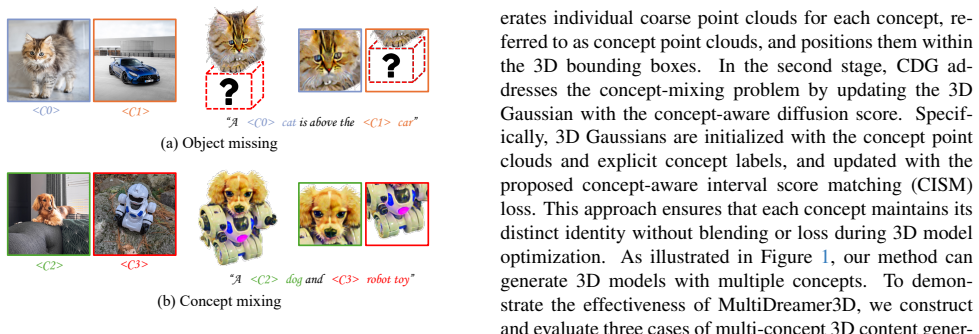
MultiDreamer3D is, to the authors' knowledge, the first method to address multi-concept 3D customization. The paper demonstrates that a 3D Gaussian Splatting scene initialized from per-concept point clouds and updated with concept-aware interval score matching (CISM) can keep the identities of several personalized concepts separate. The key enabling choice is labeling every 3D Gaussian with a one-hot concept label, so that rendering produces 2D concept masks; these masks are then used inside the cross-attention layers of a text-to-image diffusion model to compute isolated query, key, and value vectors per concept. The resulting score update gives each concept its own optimization signal, and the layout generator (an LLM that outputs 3D bounding boxes plus a point-cloud selector) ensures each concept is present in the right place. Quantitative CLIP scores and a user study indicate that the method outperforms baselines that merge LoRA weights of multiple concepts into a single diffusion model.
Load-bearing premise
The whole method rests on the rendered concept masks being accurate: if early in optimization the masks attribute pixels to the wrong concept, the attention gating strengthens that wrong mapping, and identities can be permanently swapped or blended.
Editorial extensions
If this is right
- Multi-concept 3D customization becomes possible with object presence guaranteed by the layout controller and identity preservation guaranteed by masked attention.
- The method handles complex cases such as property change (pose or attribute change) and interaction between concepts, which earlier single-concept approaches could only approximate.
- Users can feed a few reference images of their own objects and a text prompt, and receive a single 3D asset where each referenced object appears in a coherent scene.
- The per-concept Gaussian labeling enables direct image-3D alignment evaluation for each concept, not just global scene alignment.
- The approach suggests a general template for lifting any multi-concept 2D customization method into 3D without merging the concept weights.
Reading between the lines
- Beyond the paper: the concept-mask gating recipe could transfer to other explicit 3D representations (e.g., meshes or voxels) as long as per-object labels can be rendered into 2D masks.
- One testable extension is video generation: if per-frame masks are propagated, the same RCA gating might keep identities stable across time, which the paper does not claim.
- A likely failure mode not explored in the paper is strong overlap or occlusion between concepts; adversarial layouts where one concept fully hides another from most views could break the mask-consistency loop.
- The LLM layout controller and VLM point-cloud selector are modular; replacing them with deterministic 3D layout prediction would decouple the method from language-model quirks and is a natural ablation.
Editorial analysis
A structured set of objections, weighed in public.
Referee Report
Summary. The paper introduces MultiDreamer3D, a pipeline for multi-concept 3D customization that takes user-provided concept images and a text prompt and produces a 3D Gaussian Splatting scene containing the concepts. The method has two stages: a 3D Layout Generator (LG) that uses an LLM to predict bounding boxes and a VLM-filtered Shap-E module to create coarse concept point clouds, and Concept-aware Diffusion Guidance (CDG) that optimizes 3D Gaussians with concept labels and a proposed Regional Concept Attention (RCA) mechanism inside a diffusion model, trained with a Concept-aware Interval Score Matching (CISM) loss. The authors evaluate on three cases—multiple subjects, property change, and interaction—against baselines built from Mix-of-Show and FedAVG, reporting CLIP scores, a user study, and an ablation.
Significance. If the stated results hold, MultiDreamer3D would be a useful step toward multi-concept 3D customization, which the paper correctly identifies as underexplored relative to single-concept personalization. The pipeline is modular and the paper provides qualitative and quantitative comparisons that show large apparent gains over the chosen baselines in the displayed examples. The authors also ship a fairly complete system with explicit concept labeling and point cloud selection, which are valuable components. However, the central mechanism for preventing concept mixing has a structural weakness in interaction scenes, and the evaluation lacks variance reporting and independence in one metric, so the strength of the claimed results is not yet fully established.
major comments (4)
- [§3.2, Eqs. (6)–(11)] The Regional Concept Attention (RCA) aggregation assumes that concept masks are disjoint, but interaction cases violate this. For a prompt like "A <C0> dog is wearing <C1> sunglasses," the sunglasses and the dog's head project to overlapping pixels. After the threshold τ is applied, both M_0 and M_1 can be 1 at the same pixel while M_bg = 0. Then Eq. (11) produces A_0 + A_1 with no normalization, doubling the attention magnitude and mixing the key/value information from both concepts at those pixels. Likewise, Eq. (7) computes Q_i from M_i·F, but in the overlap region F contains both identities, so the queries are not concept-isolated. The paper provides no soft weighting, renormalization, or mask-refinement mechanism to handle overlaps. Since interaction is one of the three showcased cases and the abstract claims the method "successfully handles" interaction, this is a load-bearing gap that must be addressed either by revising the mechanism or by providing explicit handling of overlapping masks.
- [§4.5, Tables 1 and 3] The quantitative results in Tables 1 and 3 are reported as single point estimates with no error bars, no number of random seeds, and no significance tests. Text-to-3D optimization using score distillation is stochastic, and the reported differences, for example 0.2732 versus 0.2578 in Table 1, may be within run-to-run variation. The authors should report means and standard deviations over multiple runs, or otherwise justify that the differences are reproducible and meaningful.
- [§4.6, Table 2] The user study uses only 10 samples and 32 raters, and the paper reports no variance, inter-rater agreement, or statistical test. While the mean differences are large (4.72 vs. 2.17 for text alignment), the lack of any significance test makes it impossible to assess whether the observed preference is robust. The paper should include confidence intervals or a paired significance test, and describe how the 10 samples were selected (e.g., whether they are representative across the three cases).
- [§4.3] The image-align metric is computed by isolating each concept's 3D Gaussians using the paper's own concept-labeling scheme. For the baselines that are not initialized with the proposed 3D Layout Generator, the metric is only computed after equipping them with the LG module, which is part of the proposed method. This makes the image-align score dependent on the very mechanism that the paper aims to validate, and it is not an independent confirmation of concept-identity preservation. The manuscript should either use a metric computed on full renders (e.g., detection of each concept without explicit masking) or explicitly discuss this confounding factor as a limitation.
minor comments (4)
- [Title page] The affiliation "NA VER Cloud" appears to be a typo for "NAVER Cloud."
- [§3.2, Eq. (8)] The threshold τ used to binarize the concept masks is never specified or ablated; please provide the value and a sensitivity study.
- [§4.1] The paper states that 13 unique objects are selected from the Custom Diffusion and DreamBooth datasets, and that 47 text prompts are crafted, but it does not list the objects or give a per-case breakdown of prompts. Adding this detail would improve reproducibility.
- [§1, Contributions] The claim "we are the first to address multi-concept 3D customization" is strong and not supported by a literature search beyond the cited references; please qualify the claim or cite concurrent work if any exists.
Circularity Check
No significant circularity: the paper proposes a generative pipeline and evaluates it with external baselines and independent metrics.
full rationale
The paper does not derive a first-principles prediction that reduces to its inputs. MultiDreamer3D is a construction: the LLM-based layout controller, Shap-E point clouds, concept labeling, regional concept attention, and concept-aware interval score matching are system components that jointly produce 3D content. The central claims—object presence, identity preservation, and handling of property-change and interaction cases—are supported by qualitative results, CLIP scores, ablations, and a user study against external baselines (3DGS + ISM with Mix-of-Show and FedAVG), so they are not fitted-into-the-derivation. The only mildly self-referential evaluation choice is the image-alignment metric, which uses the method's own concept labeling to isolate each concept before comparing with reference images; however, this is an evaluation protocol rather than a derived prediction, it is applied to baselines where the same LG initialization is used, and the user study provides an independent check. There is no load-bearing self-citation: the cited prior work (LucidDreamer, Mix-of-Show, DreamBooth, etc.) is external, and no uniqueness claim is imported from the authors' own prior papers. The overlapping-mask concern for interaction cases (e.g., a dog wearing sunglasses) is a potential correctness limitation of the RCA aggregation in Eq. (11), not a circularity, because it does not make any claimed output equivalent to an input by construction.
Assumptions & free parameters
free parameters (4)
- Regional concept attention LoRA scale lambda =
not reported
- Concept mask threshold tau =
not reported
- DDIM inversion step size delta_T =
not reported
- Number of Shap-E candidate point clouds per concept =
not reported
assumptions (7)
- standard math The 3DGS rendering equations and DDIM inversion formulas from the cited literature are correct and applicable.
- domain assumption Shap-E provides sufficiently accurate coarse geometry for arbitrary user concepts.
- domain assumption The VLM point cloud selector reliably ranks Shap-E candidates by text fidelity.
- domain assumption The LLM layout controller, given hand-written in-context examples, outputs valid 3D bounding boxes.
- ad hoc to paper RCA's masked attention with per-concept LoRAs prevents concept mixing during diffusion.
- ad hoc to paper Manual decomposition of prompts into p0, p1, and pbg preserves interaction semantics.
- ad hoc to paper Binary concept masks from labeled Gaussians, after threshold tau, reflect true concept attribution in rendered images.
Cite this review
Pith. "Pith review of MultiDreamer3D: Multi-concept 3D Customization with Concept-Aware Diffusion Guidance." pith.science (2026). https://pith.science/paper/SD4MGYHX
@misc{pith2026250113449,
  author       = {Pith},
  title        = {Pith review of: MultiDreamer3D: Multi-concept 3D Customization with Concept-Aware Diffusion Guidance},
  year         = {2026},
  howpublished = {\url{https://pith.science/paper/SD4MGYHX}},
  note         = {Machine review of arXiv:2501.13449}
}
read the original abstract
While single-concept customization has been studied in 3D, multi-concept customization remains largely unexplored. To address this, we propose MultiDreamer3D that can generate coherent multi-concept 3D content in a divide-and-conquer manner. First, we generate 3D bounding boxes using an LLM-based layout controller. Next, a selective point cloud generator creates coarse point clouds for each concept. These point clouds are placed in the 3D bounding boxes and initialized into 3D Gaussian Splatting with concept labels, enabling precise identification of concept attributions in 2D projections. Finally, we refine 3D Gaussians via concept-aware interval score matching, guided by concept-aware diffusion. Our experimental results show that MultiDreamer3D not only ensures object presence and preserves the distinct identities of each concept but also successfully handles complex cases such as property change or interaction. To the best of our knowledge, we are the first to address the multi-concept customization in 3D.
Figures


Figures from the paper (3 more)


Reference graph
Works this paper leans on
-
[1]
Josh Achiam, Steven Adler, Sandhini Agarwal, Lama Ah- mad, Ilge Akkaya, Florencia Leoni Aleman, Diogo Almeida, Janko Altenschmidt, Sam Altman, Shyamal Anadkat, et al. Gpt-4 technical report. arXiv preprint arXiv:2303.08774 ,
-
[2]
An image is worth one word: Personalizing text-to- image generation using textual inversion
Rinon Gal, Yuval Alaluf, Yuval Atzmon, Or Patash- nik, Amit H Bermano, Gal Chechik, and Daniel Cohen- Or. An image is worth one word: Personalizing text-to- image generation using textual inversion. arXiv preprint arXiv:2208.01618, 2022. 1
arXiv 2022
-
[3]
Mix-of-show: Decentralized low- rank adaptation for multi-concept customization of diffusion models
Yuchao Gu, Xintao Wang, Jay Zhangjie Wu, Yujun Shi, Yun- peng Chen, Zihan Fan, Wuyou Xiao, Rui Zhao, Shuning Chang, Weijia Wu, et al. Mix-of-show: Decentralized low- rank adaptation for multi-concept customization of diffusion models. Advances in Neural Information Processing Sys- tems, 36, 2024. 2, 7
work page 2024
-
[4]
Likert scale: Explored and explained
Ankur Joshi, Saket Kale, Satish Chandel, and D Kumar Pal. Likert scale: Explored and explained. British journal of ap- plied science & technology, 7(4):396–403, 2015. 7
work page 2015
-
[5]
Shap-e: Generat- ing conditional 3d implicit functions
Heewoo Jun and Alex Nichol. Shap-e: Generat- ing conditional 3d implicit functions. arXiv preprint arXiv:2305.02463, 2023. 4, 8
arXiv 2023
-
[6]
3d gaussian splatting for real-time radiance field rendering
Bernhard Kerbl, Georgios Kopanas, Thomas Leimk ¨uhler, and George Drettakis. 3d gaussian splatting for real-time radiance field rendering. ACM Transactions on Graphics, 42 (4):1–14, 2023. 1, 2, 3
work page 2023
-
[7]
Multi-concept customization of text-to-image diffusion
Nupur Kumari, Bingliang Zhang, Richard Zhang, Eli Shechtman, and Jun-Yan Zhu. Multi-concept customization of text-to-image diffusion. In Proceedings of the IEEE/CVF Conference on Computer Vision and Pattern Recognition , pages 1931–1941, 2023. 6
work page 1931
-
[8]
Luciddreamer: Towards high-fidelity text-to-3d generation via interval score match- ing
Yixun Liang, Xin Yang, Jiantao Lin, Haodong Li, Xiao- gang Xu, and Yingcong Chen. Luciddreamer: Towards high-fidelity text-to-3d generation via interval score match- ing. arXiv preprint arXiv:2311.11284, 2023. 1, 2, 3, 7
arXiv 2023
Show all 16 references
-
[9]
Communication- efficient learning of deep networks from decentralized data
Brendan McMahan, Eider Moore, Daniel Ramage, Seth Hampson, and Blaise Aguera y Arcas. Communication- efficient learning of deep networks from decentralized data. In Artificial intelligence and statistics , pages 1273–1282. PMLR, 2017. 2, 7, 8
2017
-
[10]
Nerf: Representing scenes as neural radiance fields for view syn- thesis
Ben Mildenhall, Pratul P Srinivasan, Matthew Tancik, Jonathan T Barron, Ravi Ramamoorthi, and Ren Ng. Nerf: Representing scenes as neural radiance fields for view syn- thesis. Communications of the ACM, 65(1):99–106, 2021. 1, 3
2021
-
[11]
Dreamfusion: Text-to-3d using 2d diffusion
Ben Poole, Ajay Jain, Jonathan T Barron, and Ben Milden- hall. Dreamfusion: Text-to-3d using 2d diffusion. arXiv preprint arXiv:2209.14988, 2022. 1, 2, 3
2022 arXiv
-
[12]
Learning transferable visual models from natural language supervi- sion
Alec Radford, Jong Wook Kim, Chris Hallacy, Aditya Ramesh, Gabriel Goh, Sandhini Agarwal, Girish Sastry, Amanda Askell, Pamela Mishkin, Jack Clark, et al. Learning transferable visual models from natural language supervi- sion. In International conference on machine learning, ...
2021
-
[13]
High-resolution image 8 synthesis with latent diffusion models
Robin Rombach, Andreas Blattmann, Dominik Lorenz, Patrick Esser, and Bj ¨orn Ommer. High-resolution image 8 synthesis with latent diffusion models. In Proceedings of the IEEE/CVF conference on computer vision and pattern recognition, pages 10684–10695, 2022. 1, 2, 4, 5
2022
-
[14]
Dreambooth: Fine tuning text-to-image diffusion models for subject-driven generation
Nataniel Ruiz, Yuanzhen Li, Varun Jampani, Yael Pritch, Michael Rubinstein, and Kfir Aberman. Dreambooth: Fine tuning text-to-image diffusion models for subject-driven generation. In Proceedings of the IEEE/CVF Conference on Computer Vision and Pattern Recognition, pages 22500...
2023
-
[15]
Photorealistic text-to-image diffusion models with deep language understanding
Chitwan Saharia, William Chan, Saurabh Saxena, Lala Li, Jay Whang, Emily L Denton, Kamyar Ghasemipour, Raphael Gontijo Lopes, Burcu Karagol Ayan, Tim Salimans, et al. Photorealistic text-to-image diffusion models with deep language understanding. Advances in neural information...
2022
-
[16]
Denoising diffusion implicit models
Jiaming Song, Chenlin Meng, and Stefano Ermon. Denoising diffusion implicit models. arXiv preprint arXiv:2010.02502, 2020. 3, 5 9
2010 arXiv
Reviewed August 10, 2026 · model on record in the stance chip above.
Discussion (0). Continue with ORCID to comment.