REVIEW 3 major objections 6 minor 32 references
Continuous signal sparse encoding using analog neuromorphic variability
T0 review · 3 major / 6 minor · reviewed 2026-08-10 · deepseek-v4-flash
Pith's one-line read A shallow network of heterogeneous analog neurons encodes continuous signals into median-referenced first-spike times, from which a linear decoder recovers stimulus parameters with on-chip mean Pearson correlation 0.94.
desk verdict A solid median-referenced first-spike encoding for isolated stimuli, but the always-on continuous processing claim rests on an unevaluated heuristic. read the letter →
The pith
A machine-rendered reading of the paper's core claim, the machinery that carries it, and where it could break.
The reading
What carries the argument
The carrying object is the median-referenced first-spike-time code $\mathbf{y}^*$: for each stimulus, neuron $i$'s first spike time $t_i$ is recorded, the population median $\bar{t}$ is subtracted, and non-firing neurons are set to zero, yielding $y^*_i = t_i - \bar{t}$ or $0$. This transform makes the representation invariant to global timing shifts and supplies an internal clock, so no external onset marker is needed. A linear decoder $D$ maps $\mathbf{y}^*$ to stimulus parameters $\hat{\mathbf{p}} = D\,\mathbf{y}^*$, with network optimization—an evolutionary search over membrane and synaptic time constants and integer weights—maximizing Kendall-$\tau$ between $\mathbf{p}$ and $\hat{\mathbf{p}}$.
What would settle it
A test would present a real-world continuous signal stream with no onset markers to a fresh DYNAP-SE population and ask whether linear decoding of stimulus parameters from median-referenced first-spike times beats a shuffled-spike-time control; if accuracy falls to chance level, or if forcing all neurons to identical time constants and weights collapses decoding to near zero, the central claim would fail.
Extended reading notes
Core claim
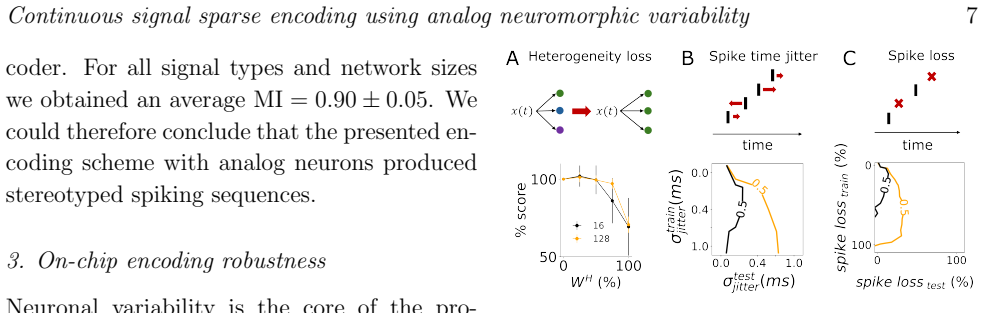
The central discovery is that a population of exponential LIF neurons with heterogeneous time constants and integer synaptic weights, each firing at most once, maps a continuous input into an $N$-dimensional vector $\mathbf{y}^*$ of first-spike times relative to the population median, and this vector is a linearly decodable representation of the stimulus parameters. The authors show on DYNAP-SE analog hardware that the median-referenced code survives device mismatch, that decoding accuracy improves with network size, and that the encoding tolerates temporal jitter, spike deletion, and reduced heterogeneity while keeping more than 60% of its performance even under full weight homogeneity. They also report that stimulus type can be linearly classified from the spiking order, with accuracy increasing as the number of neurons grows, and that this order code is invariant to temporal shifts, unlike a linear classifier on the raw continuous signal.
Load-bearing premise
The load-bearing premise is that the median-referenced first-spike vector of a randomly heterogeneous neuron population is a well-conditioned, linearly decodable feature map across the stimulus distribution, and that in online operation a decrease in the rolling spike count reliably marks window boundaries; this is an empirical claim tested on four synthetic signal families and one filtered-noise classification task, with no theoretical guarantee of generalizability.
Editorial extensions
If this is right
- Continuous signals can be processed in an always-on, event-driven mode without external onset markers, because the population median of first-spike times acts as an internal time reference.
- Stimulus parameters, including nonlinear ones, can be recovered by a linear decoder from a single-spike population code, so readout is fast and cheap.
- The encoding tolerates temporal jitter and spike deletion, and larger networks are more tolerant, so the method suits noisy hardware and lossy communication.
- Signal type can be classified from pairwise spiking order alone, and this order code stays accurate under temporal shifts that break a linear classifier on the raw signal.
- Stereotyped, signal-type-specific spiking sequences emerge spontaneously in the population, matching a feature of cortical population bursts.
Reading between the lines
- One consequence the authors leave implicit is that the median-referenced first-spike code is a form of random-feature expansion for temporal signals: random heterogeneity does the feature engineering, which suggests the same scheme could transfer to any substrate with intrinsic parameter spread.
- Because the order information is shift-invariant and linearly classifiable, rank-based codes may generalize to longer, natural signals where precise onset times are unreliable, e.g., biomedical recordings; that is a testable extension beyond the synthetic stimuli used here.
- If decoding accuracy keeps rising with neuron count while sparsity (one spike per neuron) is preserved, scaling this encoder on larger chips could improve precision without adding downstream computational cost.
- A stronger claim not established in the paper is that the optimized time constants and weights, rather than the random heterogeneity alone, carry the decoding performance; an ablation separating learned from fixed-random parameters would settle which ingredient matters.
Signed reviews
Editorial analysis
A structured set of objections, weighed in public.
Referee Report
Summary. The paper proposes a sparse encoding scheme in which continuous stimuli are converted by an asynchronous delta modulator into spike trains and injected into a shallow population of heterogeneous exponential LIF neurons. Each neuron fires at most one spike; the population response is the vector of first-spike times, median-referenced for shift invariance. A linear decoder recovers stimulus parameters either from the full vector or from the first k principal components selected on a validation set. The authors report high decoding correlations on four synthetic signal types on DYNAP-SE hardware and in simulation, demonstrate robustness to weight homogeneity, temporal jitter, and spike deletion, show signal-type classification from spike order, and report the emergence of stereotyped spiking sequences.
Significance. If the results hold, the paper offers a practical, low-complexity hardware-compatible encoding scheme that turns device mismatch into a computational resource, with the attractive property that downstream decoding is linear. The empirical work is substantial: held-out decoding with validation-based PC selection, multiple chips/cores, ablations for heterogeneity and noise, and a shift-invariance classification experiment. However, the paper's most distinctive claim—continuous always-on processing without onset markers—is not quantitatively supported by the presented experiments, and the DoubleGauss hardware stimulus definition appears inconsistent. With those points addressed, the contribution would be solid but not groundbreaking; the main novelty is the specific combination of first-spike coding, median re-referencing, and evolutionary optimization on a mixed-signal chip.
major comments (3)
- [Results, Fig. 2A and Methods 7] The abstract and introduction claim that the scheme enables continuous, always-on processing without external onset markers, but this claim rests entirely on the spike-count-decrease heuristic described in Fig. 2A and Methods 7. No experiment in the paper quantifies the segmentation accuracy of this heuristic, its sensitivity to inter-stimulus interval, overlapping events, or stimuli with non-monotonic firing rates, or the effect of a boundary mis-selection on the resulting median-referenced vector y*. All quantitative regression experiments (Figs. 2D, 3, 4) use isolated 10 ms stimulus injections with a known presentation window (Methods 4). The reported held-out correlations therefore do not yet demonstrate that the method works in continuous operation. The authors should either report quantitative continuous-stream decoding results, including the segmentation step, or explicitly restrict the abstract and introduction claims to isolated stimulus presentations.
- [Methods 4, DoubleGauss stimulus definition] The DoubleGauss stimulus definition in Methods 4 is dimensionally inconsistent with the hardware injection window. On DYNAP-SE, each stimulus injection lasts 10 ms, while the second Gaussian term has its center at t = 0.02; if t is in seconds, the center is at 20 ms and the second component is effectively absent from the recording window. If t is in milliseconds, the offset is 0.02 ms, which places the two Gaussians almost coincidentally given p2,p4 ∈ [0.6,1) ms, again not producing the intended double-peaked signal. Either way, the hardware experiments labeled 'DoubleGauss' appear not to present two resolvable peaks, so the results in Figs. 2D and 3 for that signal type may not test the intended stimulus family. Please clarify the units and correct the offset or window, and re-evaluate the affected results.
- [Methods 8, outlier definition] The outlier definition in Methods 8 ('values of p̂ that are either greater than twice the largest p or smaller than half the smallest p') appears to use the global extremes of the true parameter vector to threshold individual predictions. This makes the reported % outliers and the Pearson r (computed after outlier removal) depend on the range and distribution of the stimulus parameters rather than on a standard residual-based criterion. Please specify how the thresholds are applied per parameter and whether Pearson r is computed after removing outliers defined this way; if so, state the number of removed points and provide an outlier-robust alternative (e.g., Spearman correlation or r on the full data).
minor comments (6)
- [Figure 4 title] The figure title contains a typo: 'Enconding' should be 'Encoding'.
- [Methods 6, first sentence] The text says 'deocding' where 'decoding' is intended.
- [Figure 2A caption] The phrase 'median valuebart' appears to be a LaTeX rendering error; it should read 'median value \bar{t}'.
- [Methods 9] The evolutionary optimization protocol is described only in prose; a short pseudocode block would improve reproducibility and clarify how the time-constant sampling radius r is updated.
- [Methods 3 and DYNAP-SE description] The paper does not state how the hardware enforces 'at most one spike per neuron' for the DYNAP-SE implementation; please describe the reset or inhibition mechanism used on the chip.
- [Figure 6] The error bars for the encoded-signal SVC overlap with the 0.8 accuracy level; reporting confidence intervals and statistical tests for the shift-invariance comparison would strengthen the claim.
Circularity Check
No material circularity: the decoding results are genuine held-out generalizations, and the unvalidated online-processing heuristic is a validation gap, not a definitional loop.
full rationale
The central quantitative claim is obtained by training a linear decoder on training stimuli and evaluating Pearson r and Kendall-tau on held-out test stimuli, with the number of principal components selected on a validation set (Methods 8-9; Fig. 2B,D). This is genuine generalization rather than a fitted parameter relabeled as a prediction. The median-referenced encoding y*_i = t_i - median(t) makes the representation shift-invariant by construction, but the paper presents this as an algorithmic design property, not as an empirical prediction, so it is not circular. The always-on continuous-processing claim in Results and Methods 7 rests on a rolling-window spike-count-decrease boundary heuristic that is never quantitatively evaluated; this is an unsupported claim or validation gap, not circularity, because the boundary rule is not fitted to the decoding targets and the heuristic is independent of the held-out regression scores. The ADM threshold is chosen by maximizing reconstruction of the input signal, not by decoding accuracy (Methods 5), so it does not by construction force the reported decoding performance. The only self-citation, ref. [31] for the spherical sampling volume in the evolutionary optimization (Methods 1), is a minor methodological borrowing and is not load-bearing for the paper's encoding or decoding claims. The Discussion's stated limitations (lack of real-world testing, single-spike constraint) also do not reveal any circular dependency. No step reduces by definition or by self-citation to its own inputs, so no material circularity is found.
Assumptions & free parameters
free parameters (6)
- Time constants tau_mem, tau_syn+, tau_syn- =
optimized per network (values not reported)
- Integer synaptic weights (4N per network) =
optimized per network
- Number of principal components k =
selected by validation
- ADM threshold delta =
not reported
- Heterogeneity sigma =
0.2
- Evolutionary sampling radius r =
not specified
assumptions (6)
- standard math Exponential LIF neuron dynamics (Methods 3)
- domain assumption DYNAP-SE neuron dynamics approximation (Methods 2)
- domain assumption Per-neuron heterogeneity is multiplicative Gaussian with sigma=0.2 in simulation and comparable device mismatch on chip (Methods 3)
- domain assumption Stimuli are generated by parameterized functions f(p,t) (Methods 4)
- domain assumption Linear decoder plus PCA projection is sufficient for parameter recovery (Methods 8)
- ad hoc to paper Spike-count-decrease heuristic marks stimulus windows for continuous processing (Fig. 2A)
Cite this review
Pith. "Pith review of Continuous signal sparse encoding using analog neuromorphic variability." pith.science (2026). https://pith.science/paper/SIHLIPYY
@misc{pith2026250113504,
  author       = {Pith},
  title        = {Pith review of: Continuous signal sparse encoding using analog neuromorphic variability},
  year         = {2026},
  howpublished = {\url{https://pith.science/paper/SIHLIPYY}},
  note         = {Machine review of arXiv:2501.13504}
}
read the original abstract
Achieving fast and reliable temporal signal encoding is crucial for low-power, always-on systems. While current spike-based encoding algorithms rely on complex networks or precise timing references, simple and robust encoding models can be obtained by leveraging the intrinsic properties of analog hardware substrates. We propose an encoding framework inspired by biological principles that leverages intrinsic neuronal variability to robustly encode continuous stimuli into spatio-temporal patterns, using at most one spike per neuron. The encoder has low model complexity, relying on a shallow network of heterogeneous neurons. It relies on an internal time reference, allowing for continuous processing. Moreover, stimulus parameters can be linearly decoded from the spiking patterns, granting fast information retrieval. Our approach, validated on both analog neuromorphic hardware and simulation, demonstrates high robustness to noise, spike jitter, and reduced heterogeneity. Consistently with biological observations, we observed the spontaneous emergence of patterns with stereotyped spiking order. The proposed encoding scheme facilitates fast, robust and continuous information processing, making it well-suited for low-power, low-latency processing of temporal data on analog neuromorphic substrates.
Figures


Figures from the paper (3 more)


Reference graph
Works this paper leans on
-
[1]
Pattern recognition computation using action potential timing for stimulus representation
John J Hopfield. Pattern recognition computation using action potential timing for stimulus representation. Nature, 376(6535):33–36, 1995
work page 1995
-
[2]
Manipulating synthetic opto- genetic odors reveals the coding logic of olfac- tory perception
Edmund Chong, Monica Moroni, Christopher Wilson, Shy Shoham, Stefano Panzeri, and Dmitry Rinberg. Manipulating synthetic opto- genetic odors reveals the coding logic of olfac- tory perception. Science, 368(6497):eaba2357, 2020
work page 2020
-
[3]
Efficient coding in heterogeneous neuronal populations
Mircea I Chelaru and Valentin Dragoi. Efficient coding in heterogeneous neuronal populations. Proceedings of the National Academy of Sci- ences, 105(42):16344–16349, 2008
work page 2008
-
[4]
Adapting to time: why nature evolved a diverse set of neurons
Karim G Habashy, Benjamin D Evans, Dan FM Goodman, and Jeffrey S Bowers. Adapting to time: why nature evolved a diverse set of neurons. arXiv preprint arXiv:2404.14325, 2024
arXiv 2024
-
[5]
Reliability of spike timing in neocortical neurons
Zachary F Mainen and Terrence J Sejnowski. Reliability of spike timing in neocortical neurons. Science, 268(5216):1503–1506, 1995
1995
-
[6]
Gating of sensory input by spontaneous cortical activity
Artur Luczak, Peter Bartho, and Kenneth D Harris. Gating of sensory input by spontaneous cortical activity. Journal of Neuroscience , 33(4):1684–1695, 2013
work page 2013
-
[7]
Packet-based communication in the cortex
Artur Luczak, Bruce L McNaughton, and Ken- neth D Harris. Packet-based communication in the cortex. Nature Reviews Neuroscience, 16(12):745–755, 2015
work page 2015
-
[8]
Backbone spiking sequence as a basis for preplay, replay, and default states in human cortex
Alex P Vaz, John H Wittig Jr, Sara K Inati, and Kareem A Zaghloul. Backbone spiking sequence as a basis for preplay, replay, and default states in human cortex. Nature Communications, 14(1):4723, 2023
work page 2023
Show all 32 references
-
[9]
Neuronal sequences in population bursts encode information in human cortex
Weizhen Xie, John H Wittig Jr, Julio I Chapeton, Mostafa El-Kalliny, Samantha N Jackson, Sara K Inati, and Kareem A Zaghloul. Neuronal sequences in population bursts encode information in human cortex. Nature, pages 1– 8, 2024
2024
-
[10]
Neural heterogeneity promotes robust learning
Nicolas Perez-Nieves, Vincent CH Leung, Pier Luigi Dragotti, and Dan FM Goodman. Neural heterogeneity promotes robust learning. Nature communications, 12(1):5791, 2021
2021
-
[11]
Sequence approximation us- ing feedforward spiking neural network for spa- tiotemporal learning: Theory and optimiza- tion methods
Xueyuan She, Saurabh Dash, and Saibal Mukhopadhyay. Sequence approximation us- ing feedforward spiking neural network for spa- tiotemporal learning: Theory and optimiza- tion methods. In International Conference on Continuous signal sparse encoding using analog neuromorphic va...
2021
-
[12]
Neural heterogeneity controls computa- tions in spiking neural networks
Richard Gast, Sara A Solla, and Ann Kennedy. Neural heterogeneity controls computa- tions in spiking neural networks. Proceed- ings of the National Academy of Sciences , 121(3):e2311885121, 2024
2024
-
[13]
Efficient and robust coding in het- erogeneous recurrent networks
Fleur Zeldenrust, Boris Gutkin, and Sophie Den´ eve. Efficient and robust coding in het- erogeneous recurrent networks. PLoS compu- tational biology, 17(4):e1008673, 2021
2021
-
[14]
Bayesian population decoding of spiking neurons
Sebastian Gerwinn, Jakob H Macke, and Matthias Bethge. Bayesian population decoding of spiking neurons. Frontiers in computational neuroscience, 3:648, 2009
2009
-
[15]
Time encoding with an integrate- and-fire neuron with a refractory period
Aurel A Lazar. Time encoding with an integrate- and-fire neuron with a refractory period. Neurocomputing, 58:53–58, 2004
2004
-
[16]
Reconstruction of sensory stimuli encoded with integrate-and-fire neurons with random thresholds
Aurel A Lazar and Eftychios A Pnevmatikakis. Reconstruction of sensory stimuli encoded with integrate-and-fire neurons with random thresholds. EURASIP Journal on Advances in Signal Processing, 2009:1–14, 2009
2009
-
[17]
Sampling and reconstruction of ban- dlimited signals with multi-channel time encod- ing
Karen Adam, Adam Scholefield, and Martin Vet- terli. Sampling and reconstruction of ban- dlimited signals with multi-channel time encod- ing. IEEE Transactions on Signal Processing, 68:1105–1119, 2020
2020
-
[18]
Bsa, a fast and accurate spike train encoding scheme
Benjamin Schrauwen and Jan Van Campenhout. Bsa, a fast and accurate spike train encoding scheme. In Proceedings of the International Joint Conference on Neural Networks, 2003., volume 4, pages 2825–2830. IEEE, 2003
2003
-
[19]
Dynamical encoding by networks of competing neuron groups: winnerless competition
M Rabinovich, A Volkovskii, P Lecanda, R Huerta, HDI Abarbanel, and G Laurent. Dynamical encoding by networks of competing neuron groups: winnerless competition. Physi- cal review letters, 87(6):068102, 2001
2001
-
[20]
Temporal information transformed into a spa- tial code by a neural network with realis- tic properties
Dean V Buonomano and Michael M Merzenich. Temporal information transformed into a spa- tial code by a neural network with realis- tic properties. Science, 267(5200):1028–1030, 1995
1995
-
[21]
High-performance deep spiking neural networks with 0.3 spikes per neuron
Ana Stanojevic, Stanis law Wo´ zniak, Guillaume Bellec, Giovanni Cherubini, Angeliki Pantazi, and Wulfram Gerstner. High-performance deep spiking neural networks with 0.3 spikes per neuron. Nature Communications, 15(1):6793, 2024
2024
-
[22]
Fast and energy-efficient neuromorphic deep learning with first-spike times
Julian G¨ oltz, Laura Kriener, Andreas Baum- bach, Sebastian Billaudelle, Oliver Breitwieser, Benjamin Cramer, Dominik Dold, Akos Fer- enc Kungl, Walter Senn, Johannes Schemmel, et al. Fast and energy-efficient neuromorphic deep learning with first-spike times. Nature ma- chin...
2021
-
[23]
Effi- cient codes and balanced networks
Sophie Den` eve and Christian K Machens. Effi- cient codes and balanced networks. Nature neu- roscience, 19(3):375–382, 2016
2016
-
[24]
Predictive coding of dynamical variables in balanced spiking networks
Martin Boerlin, Christian K Machens, and Sophie Den` eve. Predictive coding of dynamical variables in balanced spiking networks. PLoS computational biology, 9(11):e1003258, 2013
2013
-
[25]
Ro- bust computation with rhythmic spike patterns
E Paxon Frady and Friedrich T Sommer. Ro- bust computation with rhythmic spike patterns. Proceedings of the National Academy of Sci- ences, 116(36):18050–18059, 2019
2019
-
[26]
Extended liquid state machines for speech recognition
Lucas Deckers, Ing Jyh Tsang, Werner Van Leek- wijck, and Steven Latr´ e. Extended liquid state machines for speech recognition. Frontiers in Neuroscience, 16:1023470, 2022
2022
-
[27]
Real-time computing without stable states: A new framework for neural computation based on perturbations
Wolfgang Maass, Thomas Natschl¨ ager, and Henry Markram. Real-time computing without stable states: A new framework for neural computation based on perturbations. Neural computation, 14(11):2531–2560, 2002
2002
-
[28]
A scalable multicore architec- ture with heterogeneous memory structures for dynamic neuromorphic asynchronous proces- sors (dynaps)
Saber Moradi, Ning Qiao, Fabio Stefanini, and Gi- acomo Indiveri. A scalable multicore architec- ture with heterogeneous memory structures for dynamic neuromorphic asynchronous proces- sors (dynaps). IEEE transactions on biomedical circuits and systems, 12(1):106–122, 2017
2017
-
[29]
Brain-inspired methods for achieving robust computation in heteroge- neous mixed-signal neuromorphic processing systems
Dmitrii Zendrikov, Sergio Solinas, and Gia- como Indiveri. Brain-inspired methods for achieving robust computation in heteroge- neous mixed-signal neuromorphic processing systems. Neuromorphic Computing and Engi- neering, 3(3):034002, 2023
2023
-
[30]
First-spike latency information in single neurons increases when referenced to population onset
Steven M Chase and Eric D Young. First-spike latency information in single neurons increases when referenced to population onset. Pro- ceedings of the National Academy of Sciences, 104(12):5175–5180, 2007
2007
-
[31]
Robust compression and detection of epileptiform patterns in ecog using a real-time spiking neural network hardware framework
Filippo Costa, Eline V Schaft, Geertjan Huiskamp, Erik J Aarnoutse, Maryse A van’t Klooster, Niklaus Krayenb¨ uhl, Geor- gia Ramantani, Maeike Zijlmans, Giacomo Indiveri, and Johannes Sarnthein. Robust compression and detection of epileptiform patterns in ecog using a real-tim...
2024
-
[32]
Neuromor- phic electronic circuits for building autonomous cognitive systems
Elisabetta Chicca, Fabio Stefanini, Chiara Bar- Continuous signal sparse encoding using analog neuromorphic variability 20 tolozzi, and Giacomo Indiveri. Neuromor- phic electronic circuits for building autonomous cognitive systems. Proceedings of the IEEE, 102(9):1367–1388, 2014
2014
Reviewed August 10, 2026 · model on record in the stance chip above.
Discussion (0). Continue with ORCID to comment.