REVIEW 4 major objections 5 minor 19 references
Contrastive Representation Learning Helps Cross-institutional Knowledge Transfer: A Study in Pediatric Ventilation Management
T0 review · 4 major / 5 minor · reviewed 2026-08-10 · deepseek-v4-flash
Pith's one-line read Contrastive pre-training on a general pediatric ICU transfers to a cardiac-focused unit, and full fine-tuning makes the difference at low data.
desk verdict The transfer gain is probably inflated by outcome leakage in the negative sampling; the paper deserves a referee to test that, but it is not citable as-is. read the letter →
The pith
A machine-rendered reading of the paper's core claim, the machinery that carries it, and where it could break.
The reading
What carries the argument
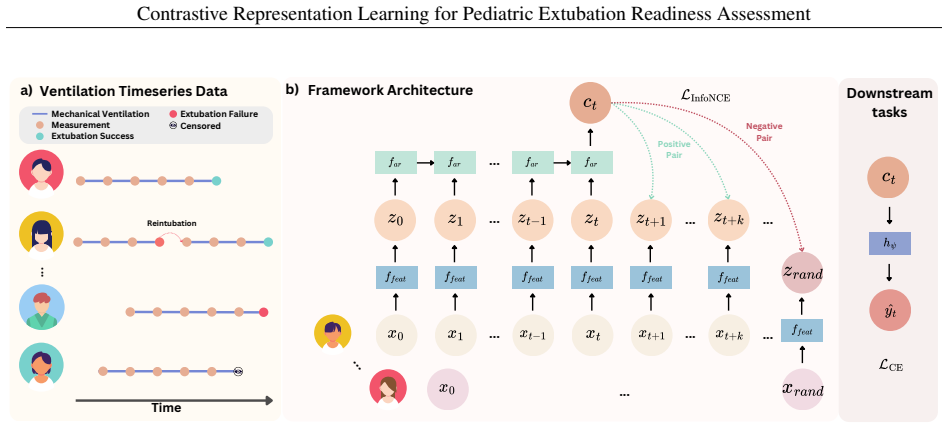
The central object is guided negative sampling inside the InfoNCE loss of Contrastive Predictive Coding. Standard CPC draws negative samples uniformly, while this framework biases negative pairs by clinical relevance $m(\cdot,\cdot)$, instantiated as time-to-extubation, so pre-training learns to separate clinically similar but physiologically distinct patients. The encoder $f_\theta$ is an MLP feature extractor plus a GRU autoregressive model, and the downstream adaptation is either full fine-tuning (FTF) or decoder-only fine-tuning (FTD) of this encoder with a task-specific linear head.
What would settle it
Run the same transfer protocol with guided negatives replaced by random negatives; if the AUROC advantage of CPC-FTF over target-only training at 5% data disappears or reverses, the claimed transfer benefit is an artifact of the guided sampling. A second check is to replace time-to-extubation by a clinically irrelevant similarity such as gender and see whether the gain persists.
Extended reading notes
Core claim
The paper claims that self-supervised contrastive pre-training on source-institution EHR time series, followed by fine-tuning all parameters, reduces the cross-institutional performance gap that direct transfer suffers. In the five-percent target-data regime, the pretrained and fully fine-tuned model outperforms training from scratch for point-of-care extubation risk (AUROC 0.736 vs 0.716, p<0.05), and in the window-identification task it reaches parity with target-only training at full data. Conversely, decoder-only fine-tuning fails in the data-poor regime (Task 1 AUROC drops to 0.510), showing that adapting the feature extractor matters. The paper interprets this pattern as evidence that general physiological representations transfer across institutions, but institution-specific decision thresholds do not.
Load-bearing premise
The argument depends on time-to-extubation being a valid measure of clinical similarity for choosing contrastive negatives, so that the pre-training objective encodes the same concept the downstream tasks test.
Editorial extensions
If this is right
- Smaller specialized units can train competitive models with very little local data by fine-tuning a source-ICU pretrained encoder.
- Decoder-only transfer with fixed representations is a poor default; feature extractors need to be updated for the target institution.
- Continuous monitoring-type tasks are the safer first deployment for cross-institutional clinical transfer.
- Direct source-to-target model deployment is not a viable shortcut for institutions with different patient populations.
- The transfer benefit is concentrated in low-data settings; at 30% and 100% target data, pretraining does not hurt but does not help much.
Reading between the lines
- Because the guided negative sampling uses time-to-extubation as a clinical similarity proxy, the reported 5%-data gain may partly reflect leakage of the task concept into pre-training; an ablation against standard CPC with random negatives is the natural test.
- The observed asymmetry between temporal progression and point-of-care decisions likely generalizes to other readiness prediction settings: trend and window prediction should be evaluated before high-stakes point decisions.
- Similarity-guided negative sampling could be ported to other clinical domains that have a natural clinical-stage proxy, such as time to sepsis onset or ICU length-of-stay.
- If representation quality scales with source diversity, pretraining on a larger multi-unit source cohort would further improve few-shot target performance.
Signed reviews
Editorial analysis
A structured set of objections, weighed in public.
Referee Report
Summary. The paper proposes a cross-institutional transfer learning framework for pediatric ventilation management, using contrastive predictive coding (CPC) pretrained on a general PICU and then fine-tuned on a smaller cardiac-focused PICU. Three learning strategies are compared (target-only, full fine-tuning FTF, and decoder-only fine-tuning FTD) at 100%, 30%, and 5% of the target training data, for two tasks: point-of-care extubation failure prediction (Task 1) and prospective 12-hour extubation-window identification (Task 2). The main empirical claim is that CPC with full fine-tuning (CPC-FTF) improves low-data transfer performance, with a reported Task 1 AUROC gain of 0.736 versus 0.716 at 5% target data, while the secondary claim is that temporal progression patterns transfer more readily than point-of-care decisions. The pretraining loss uses a time-to-extubation (TTE) similarity measure for guided negative sampling.
Significance. If the claims hold, the paper would provide practical evidence on how self-supervised representations can support model deployment across pediatric intensive care units with different patient populations, which is a clinically important and understudied problem. The use of two real PICUs, multiple data-regime comparisons, several metrics, and multiple random seeds are strengths. However, the headline result rests on a small reported AUROC difference and on a pretraining sampling scheme that is directly tied to the downstream extubation outcome; without an ablation isolating that design choice, the core mechanism behind the claimed transfer benefit remains unidentified. The secondary asymmetry claim also lacks a formal comparison across tasks.
major comments (4)
- [Section 2.4, Eqs. (3)-(4)] The TTE-guided negative sampling is a load-bearing design choice because TTE is not an outcome-free covariate: Task 2 labels extubation within the next 12 hours, a direct function of remaining ventilation time, and Task 1 predicts extubation failure, which is correlated with weaning timing. Thus the pretext task can encode the downstream target concept before fine-tuning, so the reported transfer gain may reflect auxiliary-label leakage rather than generally transferable representations. The paper does not ablate Eq. (3) against standard random-negative CPC, nor against a similarity measure built from non-outcome covariates (e.g., demographics, PIM score, diagnosis), so the active ingredient in the transfer benefit is unquantified. This needs to be addressed for the central claim to stand.
- [Section 3, Table 2, 5% data row] The headline Task 1 result of CPC-FTF (AUROC 0.736 ± 0.059) versus target-only (0.716 ± 0.047) has overlapping standard deviations, and the manuscript reports only a p-value threshold (p < 0.05) without describing the statistical test, whether it is paired across the five seeds, or how multiple comparisons over models, tasks, and data fractions are handled. With five seeds, a formal paired test and effect-size reporting are necessary to support the claim of significant improvement.
- [Section 3, 'Task-specific analysis'] The claim that temporal progression patterns (Task 2) transfer more readily than point-of-care decisions (Task 1) is based on descriptive comparisons of baseline performance and transfer gaps. No statistical test is provided for the difference in transfer benefit between tasks, and the asymmetry could partly reflect the different base rates, label definitions, or the leakage mechanism in the TTE-guided sampling. A formal interaction test or an ablation separating outcome-related leakage from representation quality is needed before this secondary claim can be accepted.
- [Section 2.2.1, inclusion criteria] Restricting the analysis to the first extubation attempt per admission is a defensible independence choice, but it may also change the case mix and the difficulty of Task 2 by removing subsequent weaning windows; the manuscript does not discuss how this selection affects the transfer conclusions or whether results are robust to including later episodes with appropriate clustering.
minor comments (5)
- [Section 3, first paragraph] The sentence reporting the direct transfer drop (AUROC from 0.785 to 0.709) cites p < 0.01 but does not specify the test or whether it compares Source-Only against Target-Only at 100% data; please clarify.
- [Section 2.3.2] The notation m(x_{\le t}, x'_{\le t}) is introduced but neither its exact functional form nor how it is computed from TTE is defined; the operationalization of the sampling probability in Eq. (3) should be stated explicitly.
- [Section 2.4 and Appendix Table 3] It is unclear how the temperature parameter beta in Eq. (3) was selected and whether it was tuned jointly with the other contrastive hyperparameters; please report the chosen value and its sensitivity.
- [Appendix Table 3] The hyperparameter table lists ranges but not the final selected configurations for the reported models; providing the actual settings would improve reproducibility.
- [General] The phrase 'significantly outperforms' in the discussion of the 5% Task 1 result is stronger than the evidence warrants given the overlapping standard deviations and the absent test description; please temper the language accordingly.
Circularity Check
CPC pre-training uses TTE-guided negative sampling (Eq. 3), and Task 2's label is the TTE<=12h event, so the low-data transfer benefit is partly forced by target leakage.
-
self definitional
[Section 2.4 / Eq. (3); Section 2.2.2 (Task 2); Section 2.3.2 (Eq. 4)]
"p(z′ | zs t ) ∝ exp(β · m(xs ≤t, x′s ≤t)) (Eq. 3); "The similarity-guided sampling leverages time-to-extubation (TTE) as the proxy measure m(·, ·)"; Task 2 "continuously assesses the probability of successful extubation over the subsequent 12-hour window"; "Censored cases ... were excluded from supervised training but utilized during contrastive pre-training.""
The guided negative-sampling distribution is made a function of TTE by Section 2.4. Task 2's downstream label is exactly the event TTE<=12h (successful extubation within the next 12 hours), and Task 1's extubation-failure label concerns the same extubation/weaning process. Thus the 'self-supervised' CPC loss in Eq. (4) is, by construction, trained to separate episodes by the outcome variable that the downstream tasks predict. The low-data transfer gain (Task 1 AUROC 0.736 vs 0.716 at 5% target data) can therefore be produced by auxiliary-label injection rather than by generic representation quality. No ablation against uniform random negatives or a non-outcome similarity measure is reported, so the claimed transfer benefit is not separated from this TTE leakage.
full rationale
The paper's derivation chain is: standard CPC (Eq. 2) is modified by Eq. (3) to draw negatives according to clinical similarity, and Section 2.4 sets that similarity to time-to-extubation (TTE). TTE is not a generic covariate; it is the remaining time until the extubation outcome that defines the downstream tasks. For Task 2, the label is literally the event TTE<=12h, so the 'unsupervised' pretext loss Eq. (4) is trained to encode exactly the concept the downstream task predicts. For Task 1, extubation failure is not identical to TTE, but the shared pre-training still injects extubation-timing information into the representation, and the reported benefit appears precisely in the low-data regime where pre-training dominates. The paper reports no ablation of Eq. (3) against uniform random negatives or against a similarity measure built from non-outcome covariates, so the active ingredient in the transfer advantage is unidentified. This is not a self-citation problem: the citations are external and not load-bearing. The circularity is partial rather than total: fine-tuning still uses target labels, and the Task 1 label is not a pure function of TTE, so the result is not strictly equivalent to the input by definition. However, the pre-training objective is, by construction, aligned with the downstream outcome, which inflates the apparent transferability and warrants a score of 7.
Assumptions & free parameters
free parameters (3)
- beta (sampling temperature) =
not reported
- K (number of future steps) =
4
- MLP/GRU architecture dimensions =
range
assumptions (5)
- domain assumption TTE is a valid measure of clinical relevance between two patient trajectories (m in Eq. 3)
- domain assumption The two PICUs' extracted features and outcome definitions (extubation failure = reintubation within 48h) are consistent
- domain assumption Hour-level aggregation with forward-fill up to 12h and nearest-neighbour imputation preserves clinically relevant information
- standard math InfoNCE objective and the CPC architecture from Oord et al. 2018 are valid for EHR time series
- domain assumption Censored episodes excluded from supervised training but included in pre-training do not introduce label leakage
Cite this review
Pith. "Pith review of Contrastive Representation Learning Helps Cross-institutional Knowledge Transfer: A Study in Pediatric Ventilation Management." pith.science (2026). https://pith.science/paper/FXZFR57R
@misc{pith2026250113587,
  author       = {Pith},
  title        = {Pith review of: Contrastive Representation Learning Helps Cross-institutional Knowledge Transfer: A Study in Pediatric Ventilation Management},
  year         = {2026},
  howpublished = {\url{https://pith.science/paper/FXZFR57R}},
  note         = {Machine review of arXiv:2501.13587}
}
read the original abstract
Clinical machine learning deployment across institutions faces significant challenges when patient populations and clinical practices differ substantially. We present a systematic framework for cross-institutional knowledge transfer in clinical time series, demonstrated through pediatric ventilation management between a general pediatric intensive care unit (PICU) and a cardiac-focused unit. Using contrastive predictive coding (CPC) for representation learning, we investigate how different data regimes and fine-tuning strategies affect knowledge transfer across institutional boundaries. Our results show that while direct model transfer performs poorly, CPC with appropriate fine-tuning enables effective knowledge sharing between institutions, with benefits particularly evident in limited data scenarios. Analysis of transfer patterns reveals an important asymmetry: temporal progression patterns transfer more readily than point-of-care decisions, suggesting practical pathways for cross-institutional deployment. Through a systematic evaluation of fine-tuning approaches and transfer patterns, our work provides insights for developing more generalizable clinical decision support systems while enabling smaller specialized units to leverage knowledge from larger centers.
Figures

Reference graph
Works this paper leans on
-
[1]
Guidelines for reinforcement learning in healthcare
Omer Gottesman, Fredrik Johansson, Matthieu Komorowski, Aldo Faisal, David Sontag, Finale Doshi-Velez, and Leo Anthony Celi. Guidelines for reinforcement learning in healthcare. Nature medicine, 25(1):16–18, 2019
work page 2019
-
[2]
Reproducibility in machine learning for health research: Still a ways to go
Matthew BA McDermott, Shirly Wang, Nikki Marinsek, Rajesh Ranganath, Luca Foschini, and Marzyeh Ghassemi. Reproducibility in machine learning for health research: Still a ways to go. Science Translational Medicine, 13 (586):eabb1655, 2021
work page 2021
-
[3]
On the opportunities and risks of foundation models
Rishi Bommasani, Drew A Hudson, Ehsan Adeli, Russ Altman, Simran Arora, Sydney von Arx, Michael S Bernstein, Jeannette Bohg, Antoine Bosselut, Emma Brunskill, et al. On the opportunities and risks of foundation models. arXiv preprint arXiv:2108.07258, 2021
arXiv 2021
-
[4]
Language models are few-shot learners
Tom B Brown. Language models are few-shot learners. arXiv preprint arXiv:2005.14165, 2020
arXiv 2005
-
[5]
Med-bert: pretrained contextualized embeddings on large-scale structured electronic health records for disease prediction
Laila Rasmy, Yang Xiang, Ziqian Xie, Cui Tao, and Degui Zhi. Med-bert: pretrained contextualized embeddings on large-scale structured electronic health records for disease prediction. NPJ digital medicine, 4(1):86, 2021
2021
-
[6]
Towards generalist biomedical ai
Tao Tu, Shekoofeh Azizi, Danny Driess, Mike Schaekermann, Mohamed Amin, Pi-Chuan Chang, Andrew Carroll, Charles Lau, Ryutaro Tanno, Ira Ktena, et al. Towards generalist biomedical ai. NEJM AI, 1(3):AIoa2300138, 2024
work page 2024
-
[7]
Ehrshot: An ehr benchmark for few-shot evaluation of foundation models
Michael Wornow, Rahul Thapa, Ethan Steinberg, Jason Fries, and Nigam Shah. Ehrshot: An ehr benchmark for few-shot evaluation of foundation models. Advances in Neural Information Processing Systems , 36:67125–67137, 2023
work page 2023
-
[8]
A comprehensive ehr timeseries pre-training benchmark
Matthew McDermott, Bret Nestor, Evan Kim, Wancong Zhang, Anna Goldenberg, Peter Szolovits, and Marzyeh Ghassemi. A comprehensive ehr timeseries pre-training benchmark. In Proceedings of the Conference on Health, Inference, and Learning, pages 257–278, 2021
work page 2021
Show all 19 references
-
[9]
Cardwell, and Peter O’Halloran
Bronagh Blackwood, Maeve Murray, Anthony Chisakuta, Chris R. Cardwell, and Peter O’Halloran. Protocolized versus non-protocolized weaning for reducing the duration of invasive mechanical ventilation in critically ill paediatric patients, 2013. ISSN 1469493X
2013
-
[10]
Baranwal
Amrit Kaur, Muralidharan Jayashree, Shankar Prinja, Ranjana Singh, and Arun K. Baranwal. Cost analysis of pediatric intensive care: a low-middle income country perspective. BMC Health Services Research , 21, 2021. ISSN 14726963. doi:10.1186/s12913-021-06166-0
2021 doi
-
[11]
Self-supervised contrastive learning for medical time series: A systematic review
Ziyu Liu, Azadeh Alavi, Minyi Li, and Xiang Zhang. Self-supervised contrastive learning for medical time series: A systematic review. Sensors, 23(9):4221, 2023
2023
-
[12]
Mimic-extract: A data extraction, preprocessing, and representation pipeline for mimic-iii
Shirly Wang, Matthew BA McDermott, Geeticka Chauhan, Marzyeh Ghassemi, Michael C Hughes, and Tristan Naumann. Mimic-extract: A data extraction, preprocessing, and representation pipeline for mimic-iii. In Proceedings of the ACM conference on health, inference, and learning , p...
2020
-
[13]
Out- comes of extubation failure in medical intensive care unit patients
Arnaud W Thille, Anatole Harrois, Frédérique Schortgen, Christian Brun-Buisson, and Laurent Brochard. Out- comes of extubation failure in medical intensive care unit patients. Critical care medicine, 39(12):2612–2618, 2011
2011
-
[14]
Self-supervised learning in medicine and healthcare
Rayan Krishnan, Pranav Rajpurkar, and Eric J Topol. Self-supervised learning in medicine and healthcare. Nature Biomedical Engineering, 6(12):1346–1352, 2022
2022
-
[15]
Unsupervised representation learning for time series with temporal neighborhood coding
Sana Tonekaboni, Danny Eytan, and Anna Goldenberg. Unsupervised representation learning for time series with temporal neighborhood coding. arXiv preprint arXiv:2106.00750, 2021
2021 arXiv
-
[16]
Som- cpc: Unsupervised contrastive learning with self-organizing maps for structured representations of high-rate time series
Iris AM Huijben, Arthur Andreas Nijdam, Sebastiaan Overeem, Merel M Van Gilst, and Ruud Van Sloun. Som- cpc: Unsupervised contrastive learning with self-organizing maps for structured representations of high-rate time series. In International Conference on Machine Learning , p...
2023
-
[17]
Representation learning with contrastive predictive coding
Aaron van den Oord, Yazhe Li, and Oriol Vinyals. Representation learning with contrastive predictive coding. arXiv preprint arXiv:1807.03748, 2018
2018 arXiv
-
[18]
Causal contrastive learning for counterfactual regression over time
Mouad El Bouchattaoui, Myriam Tami, Benoit Lepetit, and Paul-Henry Cournède. Causal contrastive learning for counterfactual regression over time. arXiv preprint arXiv:2406.00535, 2024
2024 arXiv
-
[19]
Self-supervised learning for time series analysis: Taxonomy, progress, and prospects
Kexin Zhang, Qingsong Wen, Chaoli Zhang, Rongyao Cai, Ming Jin, Yong Liu, James Y Zhang, Yuxuan Liang, Guansong Pang, Dongjin Song, et al. Self-supervised learning for time series analysis: Taxonomy, progress, and prospects. IEEE Transactions on Pattern Analysis and Machine In...
2024
Reviewed August 10, 2026 · model on record in the stance chip above.
Discussion (0). Continue with ORCID to comment.