REVIEW 5 major objections 5 minor 17 references
A dimensionality reduction technique based on the Gromov-Wasserstein distance
T0 review · 5 major / 5 minor · reviewed 2026-08-10 · deepseek-v4-flash
Pith's one-line read Replacing the MDS stress with the Gromov-Wasserstein distance between empirical measures of data and embedding yields embeddings whose pairwise distances correlate with the original distances as well as or better than MDS and Isomap.
desk verdict A clean but incremental GW-based DR method whose headline empirical claim is undercut by the metric it chose to report. read the letter →
The pith
A machine-rendered reading of the paper's core claim, the machinery that carries it, and where it could break.
The reading
What carries the argument
The central object is the Gromov-Wasserstein distance between empirical measures, a metric from optimal transport that compares two probability distributions supported on possibly different metric spaces by aligning their internal distance matrices. The load-bearing identity is the formal parallel between this distance and the MDS stress: $GW(\hat\mu,\hat\nu)=\sum_{i,j,k,\ell}(d_X(x_i,x_j)-d_Y(y_k,y_\ell))^2\pi^\star_{i,j}\pi^\star_{k,\ell}$ versus $\sigma=\sum_{i<j}(d_X(x_i,x_j)-d_Y(y_i,y_j))^2$, with the transport plan $\pi^\star$ doing the work that the fixed index pairing does in the stress. The algorithm that carries the argument is alternating minimization: solve the quadratic transport problem for $\pi$ with $Y$ fixed, then update $Y_{it+1}=Y_{it}-\eta\nabla_Y GW(\hat\mu,\hat\nu_{it})$ with $\pi$ fixed, a strategy whose theoretical justification is deferred to a cited reference rather than derived in the paper; the final alignment map $Y^\star_i\leftarrow n\sum_{j=1}^n\pi^\star_{ij}Y^\star_j$ re-establishes the correspondence between original points and their embedded images.
What would settle it
Compute the exact Gromov-Wasserstein transport plan between two uniform empirical measures of moderate size (for instance, 100 points sampled from a sphere or Swiss roll paired with their GW-MDS embeddings) and count the non-zero entries of $\pi^\star$: if the plan is dense rather than sparse, the paper's explanation that the GW objective reduces to a handful of local MDS-like comparisons does not hold. A second check is to run GW-MDS from the MDS solution as initialization and compare the resulting distance correlations with those reported for random initialization, which would separate the contribution of the GW objective from the contribution of the starting point.
Extended reading notes
Core claim
The paper's central claim is that the Gromov-Wasserstein distance, $GW(\hat\mu,\hat\nu)=\sum_{i,j,k,\ell}(d_X(x_i,x_j)-d_Y(y_k,y_\ell))^2\pi^\star_{i,j}\pi^\star_{k,\ell}$ evaluated at the optimal transport plan $\pi^\star$ coupling the empirical measures $\hat\mu=n^{-1}\sum_i\delta_{x_i}$ and $\hat\nu=n^{-1}\sum_j\delta_{y_j}$, is a workable objective for dimensionality reduction: minimizing it over the embedding coordinates $Y$ produces representations that preserve the geometry of the original data. The paper's justification is the formal resemblance between this objective and the MDS stress $\sum_{i<j}(d_X(x_i,x_j)-d_Y(y_i,y_j))^2$; where the stress compares distances over ordered pairs $i<j$, the GW objective compares all quadruples $(i,j,k,\ell)$, weighted by the transport plan, which the authors argue encodes local relationships between objects. The algorithm solves the nested problem by alternating an exact GW transport-plan computation with a gradient descent step $Y_{it+1}=Y_{it}-\eta\nabla_Y GW(\hat\mu,\hat\nu_{it})$, starting from a Gaussian or PCA initialization, and finishes with an alignment step $Y^\star_i\leftarrow n\sum_j\pi^\star_{ij}Y^\star_j$ that restores point-to-point correspondence between original points and their embedded images.
Load-bearing premise
The method works only if minimizing the Gromov-Wasserstein distance between the empirical measures of data and embedding is a faithful stand-in for preserving pairwise distances, only if the alternating transport-plan and gradient scheme reaches a good embedding, and only if the transport plan between two uniform empirical measures is sparse enough for the GW objective to behave like a local MDS cost, a sparsity claim the paper asserts in Section II.B without proof.
Editorial extensions
If this is right
- The transport-plan view gives a genuine alternative to the stress: on the reported benchmarks GW-MDS matches or beats MDS in distance correlation (MNIST 0.646 vs 0.643, Faces 0.904 vs 0.897, Sphere 0.826 vs 0.781), so minimizing $GW$ is at least as good a recipe for geometry-preserving embeddings as minimizing the stress.
- The geodesic variant extends the same prescription to manifold learning: it outscores Isomap on MNIST (0.7887 vs 0.7697), the Swiss roll (0.9993 vs 0.9986) and the S-curve (0.9993 vs 0.9988) in distance correlation, and trails Isomap only on Faces and Sphere.
- Because the objective aligns two distance matrices through a coupling rather than through a fixed labelling, the method outputs both an embedding and an explicit transport plan, and the final alignment step is what converts the plan back into a point-to-point map.
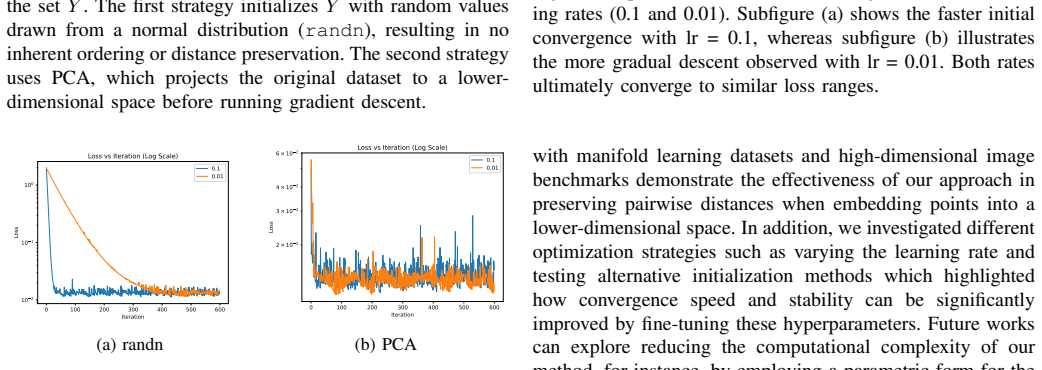
- The method is insensitive to initialization in the sense that both random and PCA starts converge to stable embeddings, with the PCA start converging faster in the reported loss curves.
- Each iteration costs an $O(n^3)$ transport-plan solve, so practical use is bounded to at most a few thousand points unless a parametric or minibatch variant is developed.
Reading between the lines
- Editorial inference: the sparsity assumption on exact GW plans is the fragile link; for uniform empirical measures the optimal plan is generically not sparse, so a direct count of non-zero entries in $\pi^\star$ on real runs would either confirm the local-structure story or push the method toward an entropically regularized plan.
- Editorial inference: because GW alignment is a correspondence between distance matrices rather than between points, the method is naturally a visualization and manifold-unfolding tool; using it where point identity matters would require checking that the posterior alignment step preserves rather than permutes identities.
- Editorial inference: the formal parallel between stress and GW suggests a recipe the paper touches without systematizing — any dissimilarity matrix can be dropped into the $d_X$ slot of the GW cost to generate a new DR method, with the geodesic variant here being one instance; testing other dissimilarities such as diffusion distances or learned affinities is a direct follow-up experiment.
Editorial analysis
A structured set of objections, weighed in public.
Referee Report
Summary. The paper proposes GW-MDS, a dimensionality reduction algorithm that minimizes the Gromov-Wasserstein distance between the empirical measure of the original high-dimensional data and the empirical measure of a low-dimensional embedding, using alternating optimization of the transport plan and gradient descent on the embedding. It also introduces a geodesic variant analogous to Isomap. The manuscript claims that these embeddings preserve pairwise distances better than MDS and Isomap, supported by Pearson correlation coefficients on toy manifolds, MNIST, and Faces.
Significance. The core idea of casting MDS as a Gromov-Wasserstein problem is interesting and connects two active research lines. The algorithm is simple to describe, and the experiments cover standard benchmark datasets. The manuscript does not ship code or proofs, and the empirical evidence as presented is not yet sufficient to support the headline claim; with additional experiments and corrected theoretical statements the approach could be a useful contribution.
major comments (5)
- [Section IV, Tables I and II] The text says distances are quantified through both the stress from Eq. (1) and Pearson correlation, but the tables report only Pearson correlations. Because Pearson correlation is invariant to any strictly monotone transformation of distances, high values do not establish pairwise-distance preservation, which is the paper's central claim. Since MDS and Isomap directly minimize stress-like objectives, reporting the stress defined in Eq. (1) is the decisive comparison; its omission leaves the main claim unsupported.
- [Section IV, Table I] GW-MDS is not consistently better than MDS in Table I: on Mobius it is lower (0.947 vs 0.952) and on Torus it ties (0.993). The text in Section IV states that GW-MDS 'consistently outperforms' MDS, which is contradicted by the table. The conclusion should be reworded or further evidence provided.
- [Section IV, Tables I and II] The tables report single correlation values without error bars, multiple runs, or significance tests, and no comparison is made with existing GW-based DR methods [16], [17] despite their being cited as related. Without these, the claimed advantage over the current state of the art is not established.
- [Section II.B] The statement that the transport plan matrix is sparse and 'boils down to a handful of non-zero elements' is not true in general for exact optimal transport with uniform empirical measures: the marginals only constrain row and column sums, and optimal GW plans can be dense. This claim is used to motivate a connection between GW and local stress, so it should be either proved under stated assumptions or removed.
- [Section III] The claim that the alternating minimization strategy is 'theoretically justified via [11]' is not supported. Reference [11] is a general paper on Lagrange multipliers and does not address convergence of alternating nonconvex GW minimization; the manuscript should either provide a self-contained convergence or stationarity statement with assumptions or soften the claim.
minor comments (5)
- [Figure 3 and Section IV] Figure 3's caption says distances are computed on the faces dataset, while the text says 'in the context of MNIST'; one of these is wrong.
- [Section IV, Table II] The text says the geodesic variant was tested on 'four distinct datasets,' but Table II lists seven datasets (MNIST, Faces, Swiss roll, S-Curve, Torus, Mobius, Sphere); the text and table should be reconciled.
- [Algorithm 1] Line 8, 'Y_i^* ← n ∑ π*_ij Y*_j', is ambiguous because the same symbol Y* is used for the output of gradient descent and for the aligned representation; use a different symbol and define the summation index.
- [Section II.B] Equation (5) defines GW using π* from Eq. (4); since Eq. (4) is itself a minimization, writing GW(μ,ν) = ... with π* is acceptable only if π* is a global minimizer. A brief clarification would avoid confusion.
- [Figure 1] The abbreviation EWCA appears in Figure 1 before its definition in Section IV; define it at first use.
Circularity Check
No significant circularity: GW-MDS optimizes a Gromov-Wasserstein objective that is not equal to the reported Pearson-correlation evaluation, and no load-bearing derivation reduces to its own inputs.
full rationale
The core derivation is Eq. (6), Y* = argmin_Y GW(mu, nu), a well-defined optimization problem whose objective, Eq. (5), is a transport-plan-weighted quadratic comparison of all distance pairs. The reported evidence, Tables I and II, uses the Pearson correlation coefficient, Eq. (7), which is invariant under monotone distance transformations. A minimizer of GW need not maximize Pearson, and high Pearson can coexist with poor GW loss, so the evaluation metric is not the optimized objective by construction. The paper also defines the MDS stress in Eq. (1) but never reports it; this is a missing-support problem for the claim that pairwise distances are better preserved, not a circularity. The alternating minimization strategy is justified by citing Afriat's classical 1971 Lagrange-theory paper, which is an independent external source, not a chain of self-citations. The one self-citation by a coauthor, Montesuma et al. [8], appears only as a general review pointer on optimal transport for machine learning and is not load-bearing for any stated result. The claim that the GW transport plan is sparse is an unverified assumption, but it does not identify any predicted quantity with a fitted input or define one variable in terms of another. Overall, the paper's central claim rests on empirical comparisons against MDS, Isomap, PCA, and EWCA, and those comparisons are not forced by the objective or by the citations. The correct criticism is that the decisive stress-based comparison is omitted, not that the derivation is circular.
Assumptions & free parameters
free parameters (4)
- Learning rate eta =
0.1 and 0.01
- Number of gradient descent iterations =
600 (used in figures)
- Number of neighbors k for geodesic variant =
Not specified
- Initialization strategy (randn or PCA) =
Both tested
assumptions (3)
- domain assumption Minimizing the GW distance between the empirical measure of the data and the empirical measure of the embedding yields a useful low-dimensional representation.
- ad hoc to paper The optimal transport plan is sparse, so GW 'boils down to a handful of non-zero elements.'
- standard math Gradient descent on the GW objective converges to a good local optimum.
Cite this review
Pith. "Pith review of A dimensionality reduction technique based on the Gromov-Wasserstein distance." pith.science (2026). https://pith.science/paper/3FPJ3GA2
@misc{pith2026250113732,
  author       = {Pith},
  title        = {Pith review of: A dimensionality reduction technique based on the Gromov-Wasserstein distance},
  year         = {2026},
  howpublished = {\url{https://pith.science/paper/3FPJ3GA2}},
  note         = {Machine review of arXiv:2501.13732}
}
read the original abstract
Analyzing relationships between objects is a pivotal problem within data science. In this context, Dimensionality reduction (DR) techniques are employed to generate smaller and more manageable data representations. This paper proposes a new method for dimensionality reduction, based on optimal transportation theory and the Gromov-Wasserstein distance. We offer a new probabilistic view of the classical Multidimensional Scaling (MDS) algorithm and the nonlinear dimensionality reduction algorithm, Isomap (Isometric Mapping or Isometric Feature Mapping) that extends the classical MDS, in which we use the Gromov-Wasserstein distance between the probability measure of high-dimensional data, and its low-dimensional representation. Through gradient descent, our method embeds high-dimensional data into a lower-dimensional space, providing a robust and efficient solution for analyzing complex high-dimensional datasets.
Figures


Figures from the paper (3 more)


Reference graph
Works this paper leans on
-
[16]
Hugues Van Assel, C ´edric Vincent-Cuaz, Nicolas Courty, R´emi Flamary, Pascal Frossard, and Titouan Vayer, “Distributional reduction: Unifying dimensionality reduction and clustering with gromov-wasserstein pro- jection,” arXiv preprint arXiv:2402.02239 , 2024
arXiv 2024
-
[17]
Generalized Dimension Reduction Using Semi-Relaxed Gromov-Wasserstein Distance
Ranthony A Clark, Tom Needham, and Thomas Weighill, “Generalized dimension reduction using semi-relaxed gromov-wasserstein distance,” arXiv preprint arXiv:2405.15959 , 2024
work page Pith review arXiv 2024
-
[11]
Theory of maxima and the method of lagrange,
SN Afriat, “Theory of maxima and the method of lagrange,” SIAM Journal on Applied Mathematics , vol. 20, no. 3, pp. 343–357, 1971
work page 1971
-
[1]
Ingwer Borg and Patrick JF Groenen, Modern multidimensional scaling: Theory and applications , Springer Science & Business Media, 2007
work page 2007
-
[2]
John A Lee, Michel Verleysen, et al., Nonlinear dimensionality reduc- tion, vol. 1, Springer, 2007
work page 2007
-
[3]
Gromov–wasserstein distances and the metric ap- proach to object matching,
Facundo M ´emoli, “Gromov–wasserstein distances and the metric ap- proach to object matching,” F oundations of computational mathematics, vol. 11, pp. 417–487, 2011
work page 2011
-
[4]
C ´edric Villani et al., Optimal transport: old and new , vol. 338, Springer, 2009
work page 2009
-
[5]
A probabilistic graph coupling view of dimension reduction,
Hugues Van Assel, Thibault Espinasse, Julien Chiquet, and Franck Picard, “A probabilistic graph coupling view of dimension reduction,” Advances in Neural Information Processing Systems , vol. 35, pp. 10696– 10708, 2022
work page 2022
Show all 17 references
-
[6]
Snekhorn: Dimension reduction with symmetric entropic affinities,
Hugues Van Assel, Titouan Vayer, R ´emi Flamary, and Nicolas Courty, “Snekhorn: Dimension reduction with symmetric entropic affinities,” Advances in Neural Information Processing Systems , vol. 36, 2024
2024
-
[7]
Visualizing data using t-sne.,
Laurens Van der Maaten and Geoffrey Hinton, “Visualizing data using t-sne.,” Journal of machine learning research , vol. 9, no. 11, 2008
2008
-
[8]
Recent advances in optimal transport for machine learn- ing,
Eduardo Fernandes Montesuma, Fred Ngole Mboula, and Antoine Souloumiac, “Recent advances in optimal transport for machine learn- ing,” arXiv preprint arXiv:2306.16156 , 2023
2023 arXiv
-
[9]
A global geometric framework for nonlinear dimensionality reduction,
Joshua B Tenenbaum, Vin de Silva, and John C Langford, “A global geometric framework for nonlinear dimensionality reduction,” science, vol. 290, no. 5500, pp. 2319–2323, 2000
2000
-
[10]
Computational optimal transport: With applications to data science,
Gabriel Peyr ´e, Marco Cuturi, et al., “Computational optimal transport: With applications to data science,” F oundations and Trends® in Machine Learning, vol. 11, no. 5-6, pp. 355–607, 2019
2019
-
[12]
Pytorch: An imperative style, high-performance deep learning library,
Adam Paszke, Sam Gross, Francisco Massa, Adam Lerer, James Brad- bury, Gregory Chanan, Trevor Killeen, Zeming Lin, Natalia Gimelshein, Luca Antiga, et al., “Pytorch: An imperative style, high-performance deep learning library,” Advances in neural information processing systems...
2019
-
[13]
Pot: Python optimal transport,
R ´emi Flamary, Nicolas Courty, Alexandre Gramfort, Mokhtar Z Alaya, Aur´elie Boisbunon, Stanislas Chambon, Laetitia Chapel, Adrien Corenf- los, Kilian Fatras, Nemo Fournier, et al., “Pot: Python optimal transport,” Journal of Machine Learning Research , vol. 22, no. 78, pp. 1–8, 2021
2021
-
[14]
En- tropic wasserstein component analysis,
Antoine Collas, Titouan Vayer, R ´emi Flamary, and Arnaud Breloy, “En- tropic wasserstein component analysis,” in 2023 IEEE 33rd International Workshop on Machine Learning for Signal Processing (MLSP) . IEEE, 2023, pp. 1–6
2023
-
[15]
The mnist database of handwritten digits,
Yann LeCun, “The mnist database of handwritten digits,” http://yann. lecun. com/exdb/mnist/ , 1998
1998
Reviewed August 10, 2026 · model on record in the stance chip above.
Discussion (0). Continue with ORCID to comment.