REVIEW 3 major objections 5 minor 14 references
Predictive Learning in Energy-based Models with Attractor Structures
T0 review · 3 major / 5 minor · reviewed 2026-08-10 · deepseek-v4-flash
Pith's one-line read A biologically plausible energy-based model predicts next observations with local Hebbian learning, matching backprop baselines in several tasks.
desk verdict Interesting biologically plausible world model with a genuine architecture contribution, but the theoretical derivation of the local learning rule has a gap that needs fixing. read the letter →
The pith
A machine-rendered reading of the paper's core claim, the machinery that carries it, and where it could break.
The reading
What carries the argument
The central machinery is a hierarchical Gaussian energy-based model coupled to a continuous attractor neural network (CANN), a recurrent network whose stable states form a continuous manifold for encoding variables such as position or head direction. Each layer $l$ models $p_\theta(s^l_t|s^{l+1}_t)$ as a Gaussian with mean $\theta^l f(s^{l+1}_t)$ and precision matrix $\Lambda^l$, so prediction errors appear in dedicated error neurons $e^l_t = s^l_t - \theta^l f(s^{l+1}_t)$. The layer-wise prediction bound $\frac{1}{2}(e^l_t)^\top \Lambda^l e^l_t + C$ converts into a Hebbian gradient rule, while Langevin dynamics implement sampling-based inference of the posterior. The CANN supplies the top-layer prior $p(s^L_t|m_t)$ and updates its state $m_t$ from the inferred top-layer activity and the action, enabling closed-loop prediction and imagination over multiple time steps.
What would settle it
On a trained model, compute the layer-wise loss of Eq. (17) under the exact expectation $\mathbb{E}_{s^l_t \sim p(s^l_t|s^{l+1}_t)}[-\log p(s^{l-1}_t|s^l_t)]$ with many Monte Carlo samples, and compare the resulting gradient to the Hebbian update of Eq. (15); if they differ appreciably, the local rule is not minimizing the stated prediction bound, or, alternatively, train a copy of the model with multi-sample gradient estimates and compare prediction error on the same benchmarks.
Extended reading notes
Core claim
The central claim is that prediction after an action can be implemented as an energy-based recurrent state-space model whose joint distribution factorizes as $p_\theta(o_t, s_t|m_t) = p_\theta(o_t|s_t)p(s_t|m_t)$, with learning driven by the upper bound $L = -\mathbb{E}_{o\sim p_{\rm true}}\mathbb{E}_{\hat{s}\sim p(s|m)} \log p_\theta(o|\hat{s})$ on the prediction cross-entropy. In the hierarchical Gaussian implementation, each layer's prediction bound takes the form $\frac{1}{2}(\hat{e}^l_t)^\top \Lambda^l \hat{e}^l_t + C$ with error neurons $\hat{e}^l_t = \hat{s}^l_t - \theta^l f(\hat{s}^{l+1}_t)$, and gradient descent on this bound produces a purely local Hebbian update. The memory is a continuous attractor neural network that keeps a compressed record of past states and actions. The paper presents this architecture as a biologically plausible way for the brain to perform predictive learning, and supports it with experiments on several visual prediction tasks.
Load-bearing premise
The load-bearing premise is that the layer-wise prediction loss equals the full expectation over the latent posterior, so that a single latent sample per observation makes the local Hebbian update the exact gradient of the objective.
Editorial extensions
If this is right
- Prediction in this class of world models can be learned fully online with local synaptic updates, eliminating backpropagation and backpropagation through time.
- Because the generative model is Markovian, the framework can be extended to model-based reinforcement learning by adding a reward signal, as the authors note.
- The attractor memory provides a natural substrate for cognitive maps, connecting the predictive model to hippocampal place-cell and grid-cell phenomena.
- If the bound holds, predictive coding becomes a normative implementation of energy-based prediction rather than an ad hoc approximation of backpropagation.
- The model gives a concrete, testable account of prediction, learning, and inference as neural dynamics that run in real time.
Reading between the lines
- Editorial: the layer-wise bound in Eq. (17) is treated as an equality with an expectation, so the Hebbian update is effectively a single-sample gradient estimate; a multi-sample Monte Carlo version of the same objective might reveal how much performance depends on this approximation.
- Editorial: since the paper does not ablate the CANN, one test the authors did not run is replacing the attractor memory with a non-attractor recurrent network of equal size; if prediction degrades, the attractor structure is doing the memory work claimed.
- Editorial: the approach suggests static predictive coding networks can be extended to temporal, action-conditioned prediction, potentially linking the predictive coding and world model literatures.
Editorial analysis
A structured set of objections, weighed in public.
Referee Report
Summary. The paper proposes an energy-based recurrent state-space model (RSSM) with a hierarchical Gaussian EBM and a continuous attractor neural network (CANN) memory. Prediction, learning, and inference are implemented via neural dynamics and local Hebbian updates, without backpropagation. Experiments cover eye movement on CIFAR-10/Fashion-MNIST, navigation in DeepMind Lab and Google Street View, and static observation on MNIST-rot/TaxiBJ, with comparisons to TransDreamer, tPCN, VPN, FRNN, and ST-ResNet. The central theoretical claim is that the layer-wise local update rules are gradients of a prediction-error upper bound, connecting the objective in Eq. (3) to the implemented algorithm.
Significance. The framework is timely and the breadth of tasks is a strength. If the theory were sound, the paper would offer a useful biologically plausible alternative to BPTT-based world models and a concrete link between predictive coding, EBMs, and CANN memory. The authors provide explicit algorithms (Algorithms 1 and 2), a correct Jensen upper bound in Eq. (3), and a genuine attempt at local Hebbian learning. However, the theoretical justification of the local learning rule contains a load-bearing gap, the CANN is underspecified, and the empirical comparisons lack error bars and code/data. The empirical results are suggestive but do not establish the theoretical claims.
major comments (3)
- [Section 4, Eqs. (14) and (17)] The equalities in these equations are not derivable from the definitions. Each L_t^l is defined as an expectation over a stochastic latent variable (s_t^1 under the prior in Eq. (14), and s_t^l under p(s_t^l | hat s_t^{l+1}) in Eq. (17)) of a negative log-likelihood, but the right-hand sides evaluate the quadratic form at a single point, replacing the expectation by its integrand. For a Gaussian conditional with precision Lambda^l, the expectation of the quadratic form differs from its value at the mean by a positive variance contribution, and the difference is amplified by the nonlinearity f(.). The equality would require either a delta prior or an explicit one-sample Monte Carlo approximation, and neither is stated. Also, in Eq. (17) the right-hand side uses the prior error ehat_t^l = s_t^l - theta^l f(hat s_t^{l+1}), while the left-hand side is the expected negative log-likelihood of the lower layer; the layer indices do not match. Since Eq. (15) is derived as the gradient of this bound, the local Hebbian update is not established as the gradient of the stated objective, and the claimed link between the upper bound L in Eq. (3) and the implemented learning rule is not established.
- [Appendix C, Eq. (35)] The CANN is the memory component that drives the prior p(s_t^L | m_t) and enables imagination, but its dynamics are underspecified: m_t is defined as H(I_t) with H(.) never defined, and the main text states that the transition m_{t+1} is a Dirac delta while Algorithm 2 and Appendix C describe a continuous ODE with adaptation. The relationship between the steady state of Eqs. (36)-(37) and the memory update in Eq. (8) must be stated, and H(.), W, alpha, beta need precise definitions, or the implementation cannot be reproduced as written.
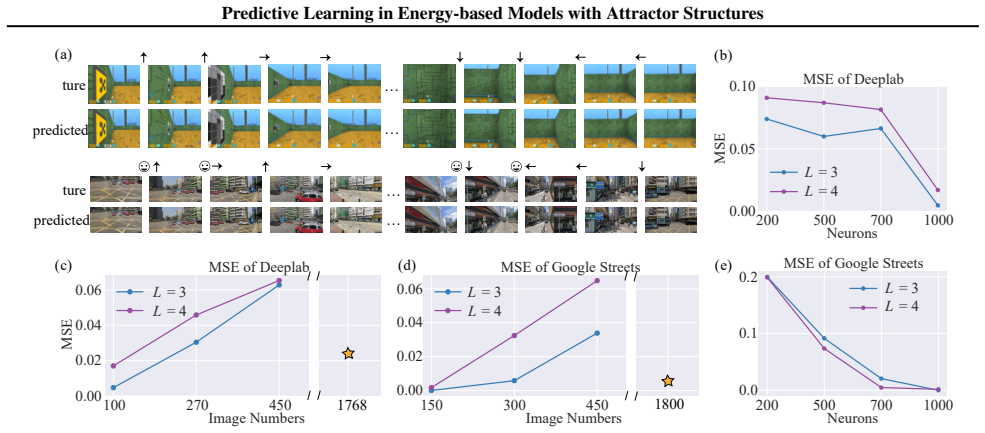
- [Section 5, Tables 1-3 and Figures 3-6] The empirical claim that the model 'matches the performances of machine learning methods' is supported only by point estimates of MSE. No error bars, number of seeds, or statistical tests are reported, and in Table 2 the differences between OURS and tPCN at long sequence lengths are small (e.g., 0.0087 vs 0.0151 for unseen sequences of length 1024). Without repeated-run variability, the comparisons in Tables 1-3 do not establish the claimed equivalence. The absence of code or data release (Appendix E) further limits verification.
minor comments (5)
- [Table 2] The column header 'T PC O URS' appears to be a typo for 'tPCN' and 'OURS'; this should be corrected.
- [Section 5, Figure 3(c)-(e)] The text and figure panels are inconsistent: the text refers to subfigure (d) for the layer-wise loss, but the figure panels show different arrangements of MSE versus epochs, initialized patches, and neuron numbers; the caption should be rewritten to match the actual panel labels.
- [Appendix A, Eqs. (19)-(26)] The derivation of the mutual information lower bound is not written in a standard form; Eq. (19) is not a valid inequality as stated, and the notation mixes p and q without clear definitions. Since the upper bound in Eq. (3) already follows from Jensen's inequality, this appendix should be corrected or removed.
- [Appendix E, Table 4] The hyperparameter table has formatting issues (for example, the entry '1253' appears to be a line break inside '125 3'), and no random seed is reported; a cleaned table with seeds and unambiguous column separators would improve reproducibility.
- [Appendix E] The statement that code 'will be open-sourced after publication' is not a substitute for an availability statement; for a journal submission, a repository link or a clear reason for withholding should be provided.
Circularity Check
No circularity: the EBM upper-bound objective and Hebbian updates are constructed from stated Gaussian conditionals, and the empirical claims are evaluated against external baselines.
full rationale
The derivation chain is self-contained rather than circular. The objective L in Eq. (3) is the Jensen upper bound on the cross-entropy H in Eq. (2), and Appendix A confirms the slack identity L = H + E[DKL(p(s|m)||ppost)]; nothing in L is defined from the predicted observations it is used to evaluate. The gradient in Eq. (5) follows from differentiating the EBM likelihood in Eq. (4), with the usual positive/negative phase structure; no fitted parameter is renamed as a prediction. The layer-wise objectives in Eqs. (14) and (17) and the Hebbian rule in Eq. (15) are the local (one-sample) quadratic objectives associated with the Gaussian conditionals of Eq. (10), so the update being local is by construction of the error neurons, not by importing the empirical result. The CANN memory is a separately specified dynamical system (Appendix C) and is not fit to the target outputs. The experiments compare against external machine-learning baselines (TransDreamer, tPCN, ST-ResNet, VPN, FRNN) and report prediction MSE on held-out sequences, so the central predictive claim is externally falsifiable. The self-citations (Dong and Wu 2023; Dong et al. 2022; Wu et al. 2008) are motivational or architectural and are not load-bearing: no uniqueness theorem is invoked to force the model choice. The Eqs. (14)/(17) expectation-to-point-evaluation equality is a mathematical approximation/error and is a correctness concern, not a circularity, because it does not make the output equal to the input by definition.
Assumptions & free parameters
free parameters (3)
- Per-dataset training hyperparameters (dt, T, 1/tau_theta, alpha, beta, epochs) =
varies by dataset (Table 4)
- Per-layer precision matrices Lambda^l =
not reported
- CANN recurrence strength alpha and adaptation beta =
0.5, 0.1, or 1.0 depending on dataset
assumptions (4)
- domain assumption The world is Markovian: the next moment is solely determined by the previous moment (Section 3, problem setup).
- domain assumption Neural activity is a sample of a random latent variable s_t (Section 3, context of Eq. 1).
- domain assumption Gaussian conditional distributions with constant partition function (Eq. 10) suffice to model the hierarchical latent process.
- domain assumption The memory transition is a Dirac delta function (Section 3: 'we take this transition probability as a Dirac delta function') with CANN dynamics implementing the deterministic map.
Cite this review
Pith. "Pith review of Predictive Learning in Energy-based Models with Attractor Structures." pith.science (2026). https://pith.science/paper/WLKLCMJV
@misc{pith2026250113997,
  author       = {Pith},
  title        = {Pith review of: Predictive Learning in Energy-based Models with Attractor Structures},
  year         = {2026},
  howpublished = {\url{https://pith.science/paper/WLKLCMJV}},
  note         = {Machine review of arXiv:2501.13997}
}
read the original abstract
Predictive models are highly advanced in understanding the mechanisms of brain function. Recent advances in machine learning further underscore the power of prediction for optimal representation in learning. However, there remains a gap in creating a biologically plausible model that explains how the neural system achieves prediction. In this paper, we introduce a framework that employs an energy-based model (EBM) to capture the nuanced processes of predicting observation after action within the neural system, encompassing prediction, learning, and inference. We implement the EBM with a hierarchical structure and integrate a continuous attractor neural network for memory, constructing a biologically plausible model. In experimental evaluations, our model demonstrates efficacy across diverse scenarios. The range of actions includes eye movement, motion in environments, head turning, and static observation while the environment changes. Our model not only makes accurate predictions for environments it was trained on, but also provides reasonable predictions for unseen environments, matching the performances of machine learning methods in multiple tasks. We hope that this study contributes to a deep understanding of how the neural system performs prediction.
Figures


Figures from the paper (3 more)


Reference graph
Works this paper leans on
-
[6]
Crafting papers on machine learning
Langley, P. Crafting papers on machine learning. In Langley, P. (ed.),Proceedings of the 17th International Conference on Machine Learning (ICML 2000), pp. 1207–1216, Stan- ford, CA,
2000
-
[9]
Ororbia, A. and Mali, A. Active predictive coding: Brain- inspired reinforcement learning for sparse reward robotic control problems. In 2023 IEEE International Confer- ence on Robotics and Automation (ICRA), pp. 3015–3021. IEEE,
work page 2023
-
[11]
to accelerate the programs. For the experiments depicted in our figures, each one takes 5-20 minutes, with the best performance on the DeepLab and Google Street datasets requiring about 10 hours. The code will be open-sourced after publication. For all stochastic differential equations, we employ the Euler method for simulation with a step size of dt. Bot...
work page 2000
-
[12]
R., Zholus, A., Rajendran, J., and Chandar, S
Samsami, M. R., Zholus, A., Rajendran, J., and Chandar, S. Mastering memory tasks with world models. arXiv preprint arXiv:2403.04253,
-
[13]
Sequential Memory with Temporal Predictive Coding
10 Predictive Learning in Energy-based Models with Attractor Structures Tang, M., Barron, H., and Bogacz, R. Sequential mem- ory with temporal predictive coding. arXiv preprint arXiv:2305.11982,
-
[1977]
Beattie, C., Leibo, J. Z., Teplyashin, D., Ward, T., Wain- wright, M., K¨uttler, H., Lefrancq, A., Green, S., Vald´es, V ., Sadik, A., et al. Deepmind lab. arXiv preprint arXiv:1612.03801,
-
[1995]
Transdreamer: Reinforcement learning with transformer world models
Chen, C., Wu, Y .-F., Yoon, J., and Ahn, S. Transdreamer: Reinforcement learning with transformer world models. arXiv preprint arXiv:2202.09481,
- [2000]
Show all 14 references
-
[2016]
Dream to control: Learning behaviors by latent imagination
Hafner, D., Lillicrap, T., Ba, J., and Norouzi, M. Dream to control: Learning behaviors by latent imagination. arXiv preprint arXiv:1912.01603, 2019a. Hafner, D., Lillicrap, T., Fischer, I., Villegas, R., Ha, D., Lee, H., and Davidson, J. Learning latent dynamics for planning ...
1912 arXiv
-
[2019]
Learning to generate reviews and discovering sentiment
Radford, A., Jozefowicz, R., and Sutskever, I. Learning to generate reviews and discovering sentiment. arXiv preprint arXiv:1704.01444,
-
[2020]
Mastering diverse domains through world models
Hafner, D., Pasukonis, J., Ba, J., and Lillicrap, T. Mastering diverse domains through world models. arXiv preprint arXiv:2301.04104,
-
[2021]
L., Lukasiewicz, T., Rao, R
Salvatori, T., Mali, A., Buckley, C. L., Lukasiewicz, T., Rao, R. P., Friston, K., and Ororbia, A. Brain-inspired computational intelligence via predictive coding. arXiv preprint arXiv:2308.07870,
-
[2022]
Predictive coding: Towards a future of deep learning beyond backpropagation? arXiv preprint arXiv:2202.09467,
Millidge, B., Salvatori, T., Song, Y ., Bogacz, R., and Lukasiewicz, T. Predictive coding: Towards a future of deep learning beyond backpropagation? arXiv preprint arXiv:2202.09467,
-
[2023]
net/forum?id=yft4JlxsRf
URL https://openreview. net/forum?id=yft4JlxsRf. Ha, D. and Schmidhuber, J. World models. arXiv preprint arXiv:1803.10122,
Reviewed August 10, 2026 · model on record in the stance chip above.
Discussion (0). Continue with ORCID to comment.