REVIEW 3 major objections 5 minor 39 references
Collaborating in a competitive world: Heterogeneous Multi-Agent Decision Making in Symbiotic Supply Chain Environments
T0 review · 3 major / 5 minor · reviewed 2026-08-10 · deepseek-v4-flash
Pith's one-line read In a two-echelon supply chain, decentralized per-node policies with local observations mitigate the bullwhip effect, while a single shared policy passes it on; the best algorithm and the controlling echelon depend on demand level.
desk verdict Useful empirical comparison of homogeneous vs heterogeneous MARL in a two-echelon supply chain, but the headline bullwhip claim is asserted without the variance-ratio measurement it depends on. read the letter →
The pith
A machine-rendered reading of the paper's core claim, the machinery that carries it, and where it could break.
The reading
What carries the argument
The central object is a two-echelon supply chain (one factory, one retailer) formulated as a hidden Markov decision process, in which each agent chooses an order quantity and a selling price each month. The manipulated variable is observability: homogeneous agents share a single joint observation and a single policy, while heterogeneous agents observe only their own inventory, backlog, stockout level, recent demand, and price, making each node's decision process hidden from the other. The reward function combines sales revenue, inventory holding cost, backlog cost, stockout cost, and purchasing cost, and the paper's reward shaping adds a penalty for the partner's stockout to induce collaboration without profit sharing. PPO and SAC are the two learning algorithms whose policies carry the comparison, and the bullwhip effect, measured as order oscillation between echelons, is the behaviour the architectures are shown to affect differently.
What would settle it
Train both architectures against a standard base-stock or order-up-to inventory policy as a control, measure the ratio of order variance to demand variance at the factory, and repeat with more seeds; if a shared-policy agent ever shows factory-level variance ratios as low as a heterogeneous agent, the bullwhip-mitigation claim is falsified.
Extended reading notes
Core claim
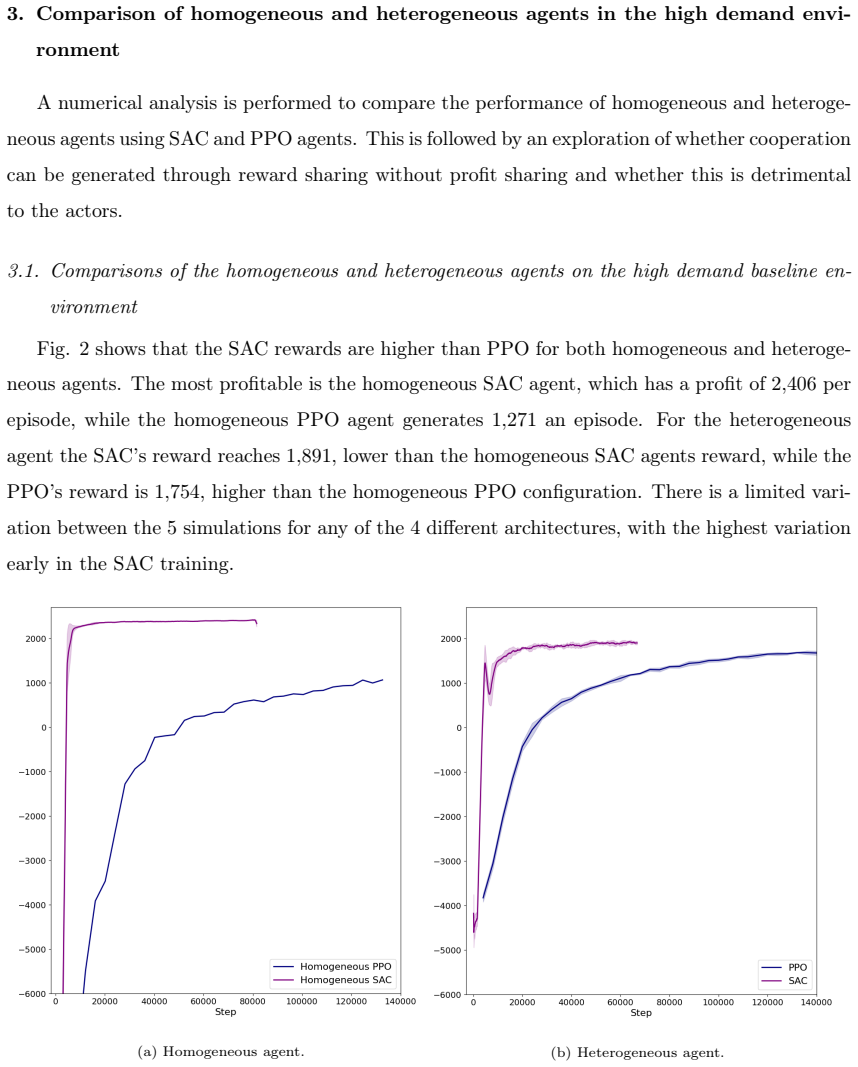
On the paper's own terms, the discovery is that homogeneous and heterogeneous agent architectures are not interchangeable in a two-echelon supply chain. A homogeneous agent, sharing one observation and action space across the retailer and factory, learns to keep the retailer inventory near capacity, incurring constant backlog penalties in exchange for avoiding costly stockouts, and its ordering strategy amplifies order variance between echelons. A heterogeneous configuration, where each node runs its own policy on only its own stock, backlog, stockout, recent demand, and price, learns a more moderate inventory strategy whose order oscillations shrink from retailer to factory, mitigating the bullwhip effect. The paper further claims that in the high-demand environment SAC agents outperform PPO agents and the factory out-earns the retailer, whereas in the low-demand environment homogeneous agents outperform heterogeneous agents and the retailer out-earns the factory by a wide margin, with the outcome tracking the agents' ability to charge higher prices. Reward shaping that penalizes an agent for its partner's stockout shifts inventory holdings without any profit sharing, but it does not overturn these architecture and demand effects.
Load-bearing premise
The load-bearing premise is that the PPO and SAC agents were trained to near-optimality with comparably tuned hyperparameters, so the reported differences in profit, inventory, backlog, and bullwhip come from architecture and demand rather than from uneven training or hyperparameter luck.
Editorial extensions
If this is right
- In high-demand symbiotic chains, decentralized per-node policies reduce order variance from retailer to factory while a single shared policy amplifies it.
- Demand level decides which echelon dominates: the factory in high demand and the retailer in low demand.
- SAC is the stronger algorithm in high demand; in low demand the homogeneous shared policy earns more, largely through setting higher prices.
- Reward shaping that penalizes a partner's stockout shifts inventory holdings toward the factory without requiring profit sharing, although the effect is modest and demand-dependent.
- Heterogeneous agents' retailer order quantities sit closer to the Economic Order Quantity than homogeneous agents', suggesting local policies produce more textbook-conventional ordering behaviour.
Reading between the lines
- Editorial inference: Because the paper tunes PPO and SAC separately and uses only five seeds, the demand-dependent reversal (SAC and factory win in high demand; homogeneous agents and retailer win in low demand) may be sensitive to tuning budgets, and a fair-randomization or regret-against-baseline comparison would settle it.
- Editorial inference: A natural testable extension is to vary the degree of observability between heterogeneous agents, for example sharing demand forecasts but not inventory levels, and to measure factory order variance; the paper's mechanism predicts monotone amplification as information sharing increases.
- Editorial inference: The finding that homogeneous agents charge higher prices in low demand may come from the shared observation giving the single policy coordinated market power; a counterfactual in which heterogeneous agents also see both demand streams would separate observability from architecture.
- Editorial inference: Extending the chain to three or more echelons should make the dampening effect of per-node policies more pronounced, since bullwhip amplification grows with chain length; this is the paper's own suggestion and remains untested.
Editorial analysis
A structured set of objections, weighed in public.
Referee Report
Summary. The paper studies a two-echelon supply chain (one factory, one retailer) under two agent architectures: homogeneous (a single shared policy controlling both nodes) and heterogeneous (separate policies with partial, hidden observations). Both PPO and SAC are trained in high- and low-demand settings, with and without a reward-shaping mechanism that penalizes each agent for the other's stockouts without sharing profits. The main reported findings are that heterogeneous agents adopt lower-inventory ordering strategies and mitigate the bullwhip effect, while homogeneous agents pass it on; that in high demand SAC outperforms PPO and the factory controls the chain; and that in low demand homogeneous agents outperform heterogeneous ones and the retailer controls the chain. The paper also claims, in Section 5, that heterogeneous retailer orders are closer to the EOQ than homogeneous orders.
Significance. The question of whether decentralized, separately learned node policies can outperform a single shared policy in a partially observable supply chain is well motivated and of genuine interest to the multi-agent RL and supply-chain communities. The paper combines two demand regimes, on-policy and off-policy algorithms, both stockout and backlog costs, and a reward-sharing mechanism that avoids profit sharing; it also releases its source code and reports hyperparameter tuning. If the behavioral claims were quantitatively supported, the comparison between homogeneous and heterogeneous architectures across demand regimes would be a useful empirical contribution. However, the headline claims currently rest partly on visual inspection of order traces rather than on the quantitative measures they require.
major comments (3)
- [Section 5, Figs. 15–18; Abstract and Conclusion] The central claim that heterogeneous agents mitigate the bullwhip effect while homogeneous agents do not is asserted from visual inspection of order plots, but no bullwhip measure is computed or reported. The paper should report a standard variance ratio, e.g., Var(Q_retailer)/Var(D_customer) and Var(Q_factory)/Var(D_customer), or the cumulative ratio across echelons. Because the factory's demand is the retailer's order, any smoothing of retailer orders automatically produces smoother upstream order traces; demonstrating bullwhip mitigation requires comparing order variance at each echelon against the external demand variance. Without such a computation, the abstract and conclusion overstate what the figures show.
- [Section 5, Eq. (16)] The statement that the heterogeneous retailer order quantity is closer to the Economic Order Quantity than the homogeneous order quantity is not supported by any computed EOQ value or distance metric. The surrounding text reports mean inventory levels as percentages of capacity, which do not determine order quantities. The authors should compute Q* from Eq. (16) using the stated demand, ordering cost, holding cost, and stockout cost, and compare it with the empirically observed mean order sizes for the heterogeneous and homogeneous agents. As written, this claim is unfalsifiable from the reported data.
- [Sections 3.1 and 4.1; Appendix Tables .5–.6] The comparative performance claims (SAC over PPO in high demand; homogeneous over heterogeneous in low demand) rest on only 5 seeds per configuration, with no convergence diagnostic and no classical inventory baseline. Since PPO and SAC use different tuned hyperparameter sets and may have different convergence speeds, the observed differences could partly reflect training quality rather than architectural or demand-driven effects. The authors should add a convergence check (e.g., evaluation reward over training with confidence bands, or a statistical test across seeds) and ideally a non-RL baseline policy (e.g., a fixed order-up-to policy), to make the architecture and demand-level comparisons load-bearing.
minor comments (5)
- [Throughout] The spelling of 'homogenous' is inconsistent with the standard 'homogeneous'; this appears in the abstract, Table 3, and several figure captions.
- [Eq. (1)] The objective in Eq. (1) mixes notation: the outer sum is over time t but the inner expression uses 'Sp_i × sum_i Q_i' for total nodal profit, whereas the per-node rewards in Eqs. (13)–(14) multiply price by demand or by the other node's order. Please clarify which expression is the actual per-step objective.
- [Eqs. (13)–(14)] The variable D in Eq. (13) and Q1 in Eq. (14) are not explicitly tied to the state transition in Eq. (11); for clarity, define D_{1,t} and D_{2,t} and state that D_{2,t} = Q_{1,t}.
- [Figs. 15–18] These figures are central to the bullwhip discussion but do not clearly label whether the plotted quantities are orders, inventory levels, or both. Please add explicit axis labels and legends.
- [Section 5, Eq. (16)] The ordering cost Oc in Eq. (16) is never defined in Table 2 or the text; please define all symbols used in the EOQ formula.
Circularity Check
No significant circularity: the architecture comparison and bullwhip conclusions are direct simulation outputs, not reductions to fitted inputs or self-cited premises.
full rationale
The paper's derivation chain is self-contained. The environment transitions (Eq. 11), reward functions (Eqs. 13-15), and agent architectures are given as inputs, and the reported profits, inventories, prices, and order traces are direct outputs of simulation rather than quantities constructed from a fitted parameter. The reward shaping in Eq. 15 is a fixed, a priori modification to the reward, not a parameter fitted to the measured behaviors; therefore the observed behavioral differences are not forced by construction. The bullwhip discussion in Section 5 and the conclusion is an interpretation of the simulated order traces; although no variance-based bullwhip ratio is computed, this is a measurement and validation weakness rather than a circularity. The only self-citations are to Wang et al. (2023) in the related-work enumeration (Sections 1 and 2), and no load-bearing conclusion rests on that citation; it does not provide a uniqueness theorem or an ansatz. Accordingly, there are no specific circular steps to report.
Assumptions & free parameters
free parameters (2)
- Reward shaping penalty weights =
70 (factory stockout) and 140 (retailer stockout) in Eq. 15
- Algorithm hyperparameters (SAC/PPO) =
Appendix Tables .5 and .6
assumptions (5)
- domain assumption Inventory evolves as I_{i,t+1}=I_{i,t}+Q_{i,t}-D_{i,t} with no upper bound enforcement and no lower bound; excess inventory above capacity is converted to backlog penalty and unmet demand to stockout penalty.
- domain assumption Customer demand is D~Poisson(10) in high demand and D~Normal(2,1) in low demand, sampled independently each period.
- domain assumption The reward functions in Eqs. 13-14 plus Eq. 15 reward shaping represent the true economic objective of each node.
- domain assumption In the heterogeneous setting, each agent's policy observes only its local state Eq. 6 and cannot observe the other node's decision; this hidden decision process is modeled as a POMDP.
- domain assumption RLlib's implementations of PPO and SAC, with the tuning budget and random seeds used, converge to representative policies.
Cite this review
Pith. "Pith review of Collaborating in a competitive world: Heterogeneous Multi-Agent Decision Making in Symbiotic Supply Chain Environments." pith.science (2026). https://pith.science/paper/FXJUGEPX
@misc{pith2026250114111,
  author       = {Pith},
  title        = {Pith review of: Collaborating in a competitive world: Heterogeneous Multi-Agent Decision Making in Symbiotic Supply Chain Environments},
  year         = {2026},
  howpublished = {\url{https://pith.science/paper/FXJUGEPX}},
  note         = {Machine review of arXiv:2501.14111}
}
read the original abstract
Supply networks require collaboration in a competitive environment. To achieve this, nodes in the network often form symbiotic relationships as they can be adversely effected by the closure of companies in the network, especially where products are niche. However, balancing support for other nodes in the network against profit is challenging. Agents are increasingly being explored to define optimal strategies in these complex networks. However, to date much of the literature focuses on homogeneous agents where a single policy controls all of the nodes. This isn't realistic for many supply chains as this level of information sharing would require an exceptionally close relationship. This paper therefore compares the behaviour of this type of agent to a heterogeneous structure, where the agents each have separate polices, to solve the product ordering and pricing problem. An approach to reward sharing is developed that doesn't require sharing profit. The homogenous and heterogeneous agents exhibit different behaviours, with the homogenous retailer retaining high inventories and witnessing high levels of backlog while the heterogeneous agents show a typical order strategy. This leads to the heterogeneous agents mitigating the bullwhip effect whereas the homogenous agents do not. In the high demand environment, the agent architecture dominates performance with the Soft Actor-Critic (SAC) agents outperforming the Proximal Policy Optimisation (PPO) agents. Here, the factory controls the supply chain. In the low demand environment the homogenous agents outperform the heterogeneous agents. Control of the supply chain shifts significantly, with the retailer outperforming the factory by a significant margin.
Figures


Figures from the paper (15 more)


Reference graph
Works this paper leans on
-
[1]
author Alamdar, P. F. , & author Seifi, A. ( year 2024 ). title A deep q-learning approach to optimize ordering and dynamic pricing decisions in the presence of strategic customers . journal International Journal of Production Economics \/ , volume 269 \/ , pages 109154
work page 2024
-
[2]
author Arifo g lu, K. , & author \"O zekici, S. ( year 2010 ). title Optimal policies for inventory systems with finite capacity and partially observed markov-modulated demand and supply processes . journal European Journal of Operational Research \/ , volume 204 \/ , pages 421--438
work page 2010
-
[3]
CHIRPs: Change-Induced Regret Proxy metrics for Lifelong Reinforcement Learning
author Birkbeck, J. , author Sobey, A. , author Cerutti, F. , author Heseltine Hurley Flynn, K. , & author Norman, T. ( year 2024 ). title Chirps: Change-induced regret proxy metrics for lifelong reinforcement learning . journal https://arxiv.org/abs/2409.03577 \/ ,
work page Pith review arXiv 2024
-
[4]
author Brintrup, A. ( year 2010 ). title Behaviour adaptation in the multi-agent, multi-objective and multi-role supply chain . journal Computers in Industry \/ , volume 61 \/ , pages 636--645
work page 2010
-
[5]
author Brockman, G. , author Cheung, V. , author Pettersson, L. , author Schneider, J. , author Schulman, J. , author Tang, J. , & author Zaremba, W. ( year 2016 ). title Openai gym . journal arXiv preprint arXiv:1606.01540 \/ ,
arXiv 2016
-
[6]
author Chen, B. ( year 2021 ). title Data-driven inventory control with shifting demand . journal Production and Operations Management \/ , volume 30 \/ , pages 1365--1385
work page 2021
-
[7]
author Ding, Y. , author Feng, M. , author Liu, G. , author Jiang, W. , author Zhang, C. , author Zhao, L. , author Song, L. , author Li, H. , author Jin, Y. , & author Bian, J. ( year 2022 ). title Multi-agent reinforcement learning with shared resources for inventory management . journal arXiv preprint arXiv:2212.07684 \/ ,
arXiv 2022
-
[8]
author Dogan, I. , & author G \"u ner, A. R. ( year 2015 ). title A reinforcement learning approach to competitive ordering and pricing problem . journal Expert Systems \/ , volume 32 \/ , pages 39--48
work page 2015
Show all 39 references
-
[9]
, author Boute, R
author Gijsbrechts, J. , author Boute, R. N. , author Van Mieghem, J. A. , & author Zhang, D. J. ( year 2022 ). title Can deep reinforcement learning improve inventory management? performance on lost sales, dual-sourcing, and multi-echelon problems . journal Manufacturing & Se...
2022
-
[10]
, author Chen, T
author Guo, Y. , author Chen, T. , author Boulaksil, Y. , author Xiao, L. , & author Allaoui, H. ( year 2023 ). title Collaborative planning of multi-tier sustainable supply chains: A reinforcement learning enhanced heuristic approach . journal Computers & Industrial Engineeri...
2023
-
[11]
, author van der Laan, E
author Hekimo g lu, M. , author van der Laan, E. , & author Dekker, R. ( year 2018 ). title Markov-modulated analysis of a spare parts system with random lead times and disruption risks . journal European Journal of Operational Research \/ , volume 269 \/ , pages 909--922
2018
-
[12]
author Hubbs, C. D. , author Perez, H. D. , author Sarwar, O. , author Sahinidis, N. V. , author Grossmann, I. E. , & author Wassick, J. M. ( year 2020 ). title Or-gym: A reinforcement learning library for operations research problems . journal arXiv preprint arXiv:2008.06319 \/ ,
2020 arXiv
-
[13]
, author Hu, J
author Jiang, J. , author Hu, J. , & author Peng, Y. ( year 2023 ). title Quantile-based deep reinforcement learning using two-timescale policy gradient algorithms . journal arXiv preprint arXiv:2305.07248 \/ ,
2023 arXiv
-
[14]
author Keskin, N. B. , author Li, Y. , & author Song, J.-S. ( year 2022 ). title Data-driven dynamic pricing and ordering with perishable inventory in a changing environment . journal Management Science \/ , volume 68 \/ , pages 1938--1958
2022
-
[15]
, author Kim, J
author Kim, B. , author Kim, J. G. , & author Lee, S. ( year 2024 ). title A multi-agent reinforcement learning model for inventory transshipments under supply chain disruption . journal IISE Transactions \/ , volume 56 \/ , pages 715--728
2024
-
[16]
author Kosasih, E. E. , & author Brintrup, A. ( year 2022 ). title Reinforcement learning provides a flexible approach for realistic supply chain safety stock optimisation . journal IFAC-PapersOnLine \/ , volume 55 \/ , pages 1539--1544
2022
-
[17]
author Lee, H. L. , author Padmanabhan, V. , & author Whang, S. ( year 1997 ). title The bullwhip effect in supply chains ,
1997
-
[18]
, author Kadoche, E
author Leluc, R. , author Kadoche, E. , author Bertoncello, A. , & author Gourv \'e nec, S. ( year 2023 ). title Marlim: Multi-agent reinforcement learning for inventory management . journal arXiv preprint arXiv:2308.01649 \/ ,
2023 arXiv
-
[19]
, author Liaw, R
author Liang, E. , author Liaw, R. , author Nishihara, R. , author Moritz, P. , author Fox, R. , author Goldberg, K. , author Gonzalez, J. , author Jordan, M. , & author Stoica, I. ( year 2018 ). title Rllib: Abstractions for distributed reinforcement learning . In booktitle I...
2018
-
[20]
, author Hu, M
author Liu, X. , author Hu, M. , author Peng, Y. , & author Yang, Y. ( year 2022 ). title Multi-agent deep reinforcement learning for multi-echelon inventory management . journal Available at SSRN \/ ,
2022
-
[21]
, author Nishihara, R
author Moritz, P. , author Nishihara, R. , author Wang, S. , author Tumanov, A. , author Liaw, R. , author Liang, E. , author Elibol, M. , author Yang, Z. , author Paul, W. , author Jordan, M. I. et al. ( year 2018 ). title Ray: A distributed framework for emerging \ AI \ appl...
2018
-
[22]
, author van de Berg, D
author Mousa, M. , author van de Berg, D. , author Kotecha, N. , author del Rio Chanona, E. A. , & author Mowbray, M. ( year 2024 ). title An analysis of multi-agent reinforcement learning for decentralized inventory control systems . journal Computers & Chemical Engineering \...
2024
-
[23]
, author Nazari, M
author Oroojlooyjadid, A. , author Nazari, M. , author Snyder, L. V. , & author Tak \'a c , M. ( year 2022 ). title A deep q-network for the beer game: Deep reinforcement learning for inventory optimization . journal Manufacturing & Service Operations Management \/ , volume 24...
2022
-
[24]
( year 2022 )
author Paine, J. ( year 2022 ). title Behaviorally grounded model-based and model free cost reduction in a simulated multi-echelon supply chain . journal arXiv preprint arXiv:2202.12786 \/ ,
2022 arXiv
-
[25]
, author Huang, M
author Qiao, W. , author Huang, M. , author Gao, Z. , & author Wang, X. ( year 2024 ). title Distributed dynamic pricing of multiple perishable products using multi-agent reinforcement learning . journal Expert Systems with Applications \/ , volume 237 \/ , pages 121252
2024
-
[26]
, author Chen, W
author Shi, C. , author Chen, W. , & author Duenyas, I. ( year 2016 ). title Nonparametric data-driven algorithms for multiproduct inventory systems with censored demand . journal Operations Research \/ , volume 64 \/ , pages 362--370
2016
-
[27]
, & author Stella, F
author Stranieri, F. , & author Stella, F. ( year 2022 ). title A deep reinforcement learning approach to supply chain inventory management . journal arXiv preprint arXiv:2204.09603 \/ ,
2022 arXiv
-
[28]
, author Stella, F
author Stranieri, F. , author Stella, F. , & author Kouki, C. ( year 2024 ). title Performance of deep reinforcement learning algorithms in two-echelon inventory control systems . journal International Journal of Production Research \/ , (pp. pages 1--16 )
2024
-
[29]
author Sultana, N. N. , author Meisheri, H. , author Baniwal, V. , author Nath, S. , author Ravindran, B. , & author Khadilkar, H. ( year 2020 ). title Reinforcement learning for multi-product multi-node inventory management in supply chains . journal arXiv preprint arXiv:2006...
2020 arXiv
-
[30]
, author Lu, M
author Tian, R. , author Lu, M. , author Wang, H. , author Wang, B. , & author Tang, Q. ( year 2024 ). title Iacppo: A deep reinforcement learning-based model for warehouse inventory replenishment . journal Computers & Industrial Engineering \/ , volume 187 \/ , pages 109829
2024
-
[31]
author Toomey, J. W. ( year 2000 ). title Inventory management: principles, concepts and techniques \/ volume volume 12 . publisher Springer Science & Business Media
2000
-
[32]
, author Gijsbrechts, J
author Vanvuchelen, N. , author Gijsbrechts, J. , & author Boute, R. ( year 2020 ). title Use of proximal policy optimization for the joint replenishment problem . journal Computers in Industry \/ , volume 119 \/ , pages 103239
2020
-
[33]
, & author Lin, L
author Wang, F. , & author Lin, L. ( year 2021 ). title Spare parts supply chain network modeling based on a novel scale-free network and replenishment path optimization with q learning . journal Computers & Industrial Engineering \/ , volume 157 \/ , pages 107312
2021
-
[34]
, author Wang, H
author Wang, W. , author Wang, H. , & author Sobey, A. J. ( year 2023 ). title Agent based modelling for continuously varying supply chains . journal arXiv preprint arXiv:2312.15502 \/ ,
2023 arXiv
-
[35]
, author Liu, Z
author Yang, X. , author Liu, Z. , author Jiang, W. , author Zhang, C. , author Zhao, L. , author Song, L. , & author Bian, J. ( year 2023 ). title A versatile multi-agent reinforcement learning benchmark for inventory management . journal arXiv preprint arXiv:2306.07542 \/ ,
2023 arXiv
-
[36]
, & author Kaya, O
author Yavuz, T. , & author Kaya, O. ( year 2024 ). title Deep reinforcement learning algorithms for dynamic pricing and inventory management of perishable products . journal Applied Soft Computing \/ , (p. pages 111864 )
2024
-
[37]
, author Zhou, Y
author Yu, C. , author Zhou, Y. , & author Zhang, Z. ( year 2020 ). title Multi-agent reinforcement learning for dynamic spare parts inventory control . In booktitle 2020 Global Reliability and Prognostics and Health Management (PHM-Shanghai) \/ (pp. pages 1--6 ). organization IEEE
2020
-
[38]
write newline
" write newline "" before.all 'output.state := FUNCTION n.dashify 't := "" t empty not t #1 #1 substring "-" = t #1 #2 substring "--" = not "--" * t #2 global.max substring 't := t #1 #1 substring "-" = "-" * t #2 global.max substring 't := while if t #1 #1 substring * t #2 gl...
-
[39]
write newline
" write newline "" before.all 'output.state := FUNCTION n.dashify 't := "" t empty not t #1 #1 substring "-" = t #1 #2 substring "--" = not "--" * t #2 global.max substring 't := t #1 #1 substring "-" = "-" * t #2 global.max substring 't := while if t #1 #1 substring * t #2 gl...
Reviewed August 10, 2026 · model on record in the stance chip above.
Discussion (0). Continue with ORCID to comment.