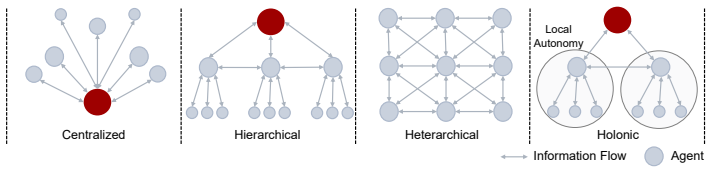
Recent advances in agent and multi-agent systems have shown strong performance on tool use, reasoning, and collaborative tasks. However, existing benchmarks mostly evaluate task completion in weakly coupled environments, and provide limited support for studying coordination in shared, dynamically evolving systems with hierarchy and coupled constraints. This leaves an important question underexplored: when do different coordination paradigms succeed or fail? We introduce Distributed Event-driven Scheduling Benchmark (DESBench), a benchmark for evaluating agent coordination in hierarchical event-driven scheduling. Built on a shared discrete-event driven environment in industrial scheduling, our benchmark captures multi-timescale decision making, partial observability, and dynamically coupled constraints. We define tasks and metrics that evaluate effectiveness, constraint alignment, coordination efficiency, and robustness, and focus on four representative coordination paradigms: centralized, hierarchical, heterarchical, and holonic. These paradigms correspond to distinct mechanisms of information flow, decision authority, and conflict resolution. Our controlled evaluations reveal clear coordination trade-offs: centralized coordination is robust and communication-efficient but scales poorly with difficulty; hierarchical coordination improves efficiency through decomposition but suffers from cross-level misalignment; heterarchical coordination is flexible but communication-heavy; and holonic coordination satisfies constraints well but loses global robustness. These findings demonstrate that coordination design fundamentally shapes agent system behavior in complex environments, revealing structural trade-offs that cannot be captured by outcome metrics alone and underscoring the imperative for more adaptive, principled, and dynamic coordination mechanisms in future MAS research.
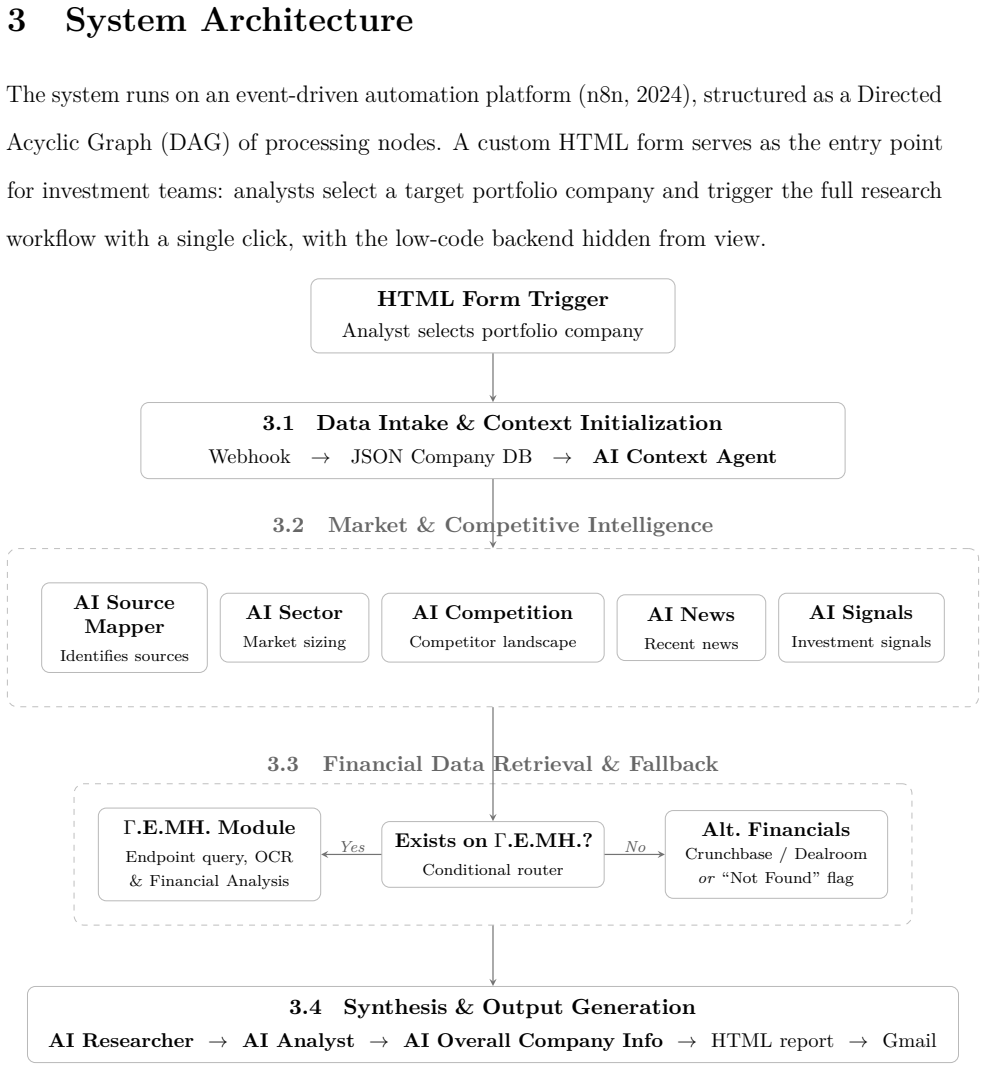
We present a fully automated multi-agent framework for corporate due diligence and market analysis in venture capital. The system runs on an event-driven orchestration architecture, combining Large Language Models (LLMs) with real-time web retrieval to synthesize unstructured data into structured investment intelligence. A central technical contribution is a programmatic extraction pipeline that reverse-engineers the frontend-to-backend communication of the Greek Business Registry ($\Gamma$.E.MH.), querying dynamic endpoints to retrieve official financial filings that are then parsed using a layout-aware OCR extractor. A structural fallback mechanism explicitly flags data absence rather than generating unverified figures, directly targeting hallucination in financial contexts. All workflow artifacts are publicly available to support replication.
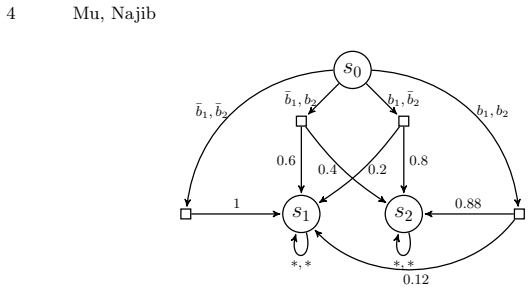
Responsibility allocation -- determining the extent to which agents are accountable for outcomes -- is a fundamental challenge in the design and analysis of multi-agent systems. In this work, we model such systems as concurrent stochastic multi-player games and introduce a notion of retrospective (backward) counterfactual responsibility, which quantifies an agent's accountability for outcomes resulting from a given strategy profile. To allocate responsibility among agents, we utilise the Shapley value and formally show that this method satisfies key desirable properties, including fairness and consistency. Building on this foundation, we propose a formal framework that supports both verification and strategic reasoning in responsibility-aware multi-agent systems. Furthermore, by adopting Nash equilibrium as the solution concept, we demonstrate how to compute stable strategy profiles in which agents trade off responsibility against expected reward.
DOPP is a complete polynomial-time algorithm for online multi-agent path finding with order-contiguity (MAPF-OC) that plans order-level…
abstractclick to expand
In warehouse logistics, parcels released from the outfeed of an automated storage system must be routed through conveyor networks to workstations. Beyond collision avoidance, practical operations impose an additional requirement of order-contiguous arrivals: at each delivery point, parcels belonging to the same order must arrive as a consecutive block in the arrival sequence to reduce downstream re-sorting effort. We formalize this problem as online multi-agent path finding with order-contiguity (online MAPF-OC), where agents (i.e., parcels) appear over time and exit upon delivery. To efficiently solve online MAPF-OC, we propose Dual-Ordering Prioritized Planning (DOPP), a complete polynomial-time algorithm with a three-level structure that (i) searches order-level arrival sequences, (ii) refines agent-level priorities, and (iii) synthesizes feasible solutions via prioritized planning. Experiments on various conveyor-network layouts, including those derived from actual warehouses, demonstrate DOPP's practical scalability and ability to generate high-quality plans within tight time budgets.
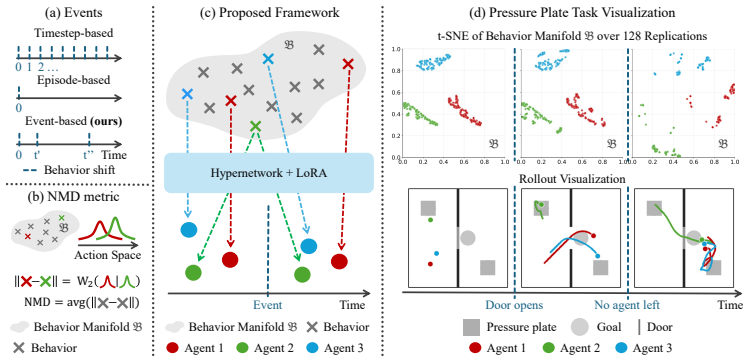
Effective multi-agent cooperation requires agents to adopt diverse behaviors as task conditions evolve-and to do so at the right moment. Yet, current Multi-Agent Reinforcement Learning (MARL) frameworks that facilitate this diversity are still limited by the fact that they bind fixed behaviors to fixed agent identities. Consequently, they are ill-equipped for tasks where agents need to take on different roles at very specific moments in time. We argue that, to define these behavioral transitions, the missing ingredient is $\textbf{events}$. Events are changes in the state of the system that induce qualitative changes in the task. Based on this view, we introduce a framework that decouples agent identity from behavior, capturing a continuous manifold from which agents instantiate their behaviors in response to events. This framework is based on two elements. First, to build an expressive behavior manifold, we introduce Neural Manifold Diversity (NMD), a formal distance metric that remains well-defined when behaviors are transient and agent-agnostic. Second, we use an event-based hypernetwork that generates Low-Rank Adaptation (LoRA) modules over a shared team policy, enabling on-the-fly agent-policy reconfiguration in response to events. We prove that this construction ensures that diversity does not interfere with reward maximization by design. Empirical results demonstrate that our framework outperforms established baselines across benchmarks while exhibiting zero-shot generalization, and being the only method that solves tasks requiring sequential behavior reassignment.
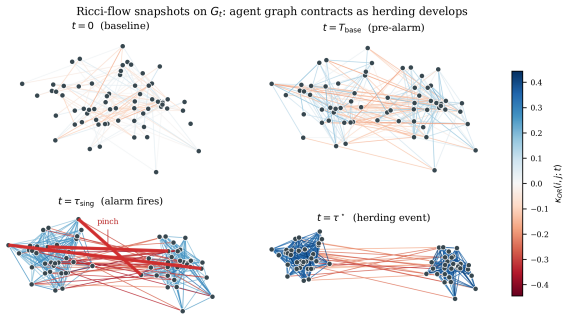
Herding -- where agents align their behaviors and act collectively -- is a central driver of market fragility and systemic risk. Existing approaches to quantify herding rely on price-correlation statistics, which inherently lag because they only detect coordination after it has already moved realised returns. We propose GeomHerd, a forward-looking geometric framework that bypasses this observability lag by quantifying coordination directly on upstream agent-interaction graphs. To generate these graphs, we treat a heterogeneous LLM-driven multi-agent simulator -- each financial trader instantiated by a persona-conditioned LLM call -- as a forecastable world, and evaluate the geometric pipeline on the Cividino--Sornette continuous-spin agent-based substrate as our headline financial testbed. By tracking the discrete Ollivier--Ricci curvature of these action graphs, GeomHerd captures the structural topology of emerging coordination. Theoretically, we establish a mean-field bridge mapping our graph-theoretic metric to CSAD, the classical macroscopic herding statistic, linking GeomHerd to downstream price-dispersion measurement. Empirically, GeomHerd anticipates herding long before aggregate market baselines: on the continuous-spin substrate, our primary detector fires a median of 272 steps before order-parameter onset; a contagion detector ($\beta_{-}$) recalls 65% of critical trajectories 318 steps early; and on co-firing trajectories the agent-graph signal precedes price-correlation-graph baselines by 40 steps. As a complementary indicator, the effective vocabulary of agent actions contracts during cascades. The geometric signature transfers out-of-domain to the Vicsek self-driven-particle model, and a curvature-conditioned forecasting head reduces cascade-window log-return MAE over detector-conditioned and price-only baselines.
We study a graph pathfinding problem Distance-$r$ Independent Unlabeled Multi-Agent Pathfinding, finding a set of collision-free paths between two sets where agents must stay at pairwise distance at least $r+1$ at all times. This additional constraint, generalizing collision modeling for classical MAPF, targets aspects of real-world multi-agent coordination. This additional distance constraint makes feasibility (i.e., whether a solution exists) PSPACE-complete, in contrast to standard (unlabeled) MAPF, where it can be decided in polynomial time. We address the challenge via two complementary approaches: (i) reduction-based optimal algorithms with a feasibility-preserving compression procedure, and (ii) a configuration generator-based search. Despite the hardness, empirical results show that our algorithm can handle hundreds of agents in a practical timeframe.
Practitioners deploying multi-agent large language model (LLM) systems must currently choose between communication topologies such as chain, star, mesh, and richer variants without any pre-inference diagnostic for which topology will amplify drift, converge to consensus, or remain robust under perturbation. Existing evaluation answers these questions only post hoc and only for the task measured. We introduce a structural diagnostic for multi-agent LLM communication graphs based on the successor representation $M = (I - \gamma P)^{-1}$ of the row-stochastic communication operator, and we connect three of its spectral quantities, the spectral radius $\rho(M)$, the spectral gap $\Delta(M)$, and the condition number $\kappa(M)$, to three distinct failure modes. We derive closed-form spectra for the chain, star, and mesh under row-stochastic normalization, and validate the predictions on a 12-step structured state-tracking task with Qwen2.5-7B-Instruct over 100 independent trials. The condition number is a perfect rank-order predictor of empirical perturbation robustness ($r_s = 1.0$); the spectral gap partially predicts consensus dynamics ($r_s = 0.5$); and the spectral radius is perfectly \emph{inverted} with respect to cumulative error ($r_s = -1.0$). We trace this inversion to a regime in which linear spectra are blind to non-contracting bias drift, and we propose an affine-noise extension of the predictive map that recovers the empirical ordering. We read this as a first step toward representational, drift-aware structural diagnostics for multi-agent LLM systems, sitting alongside classical spectral and consensus theory.
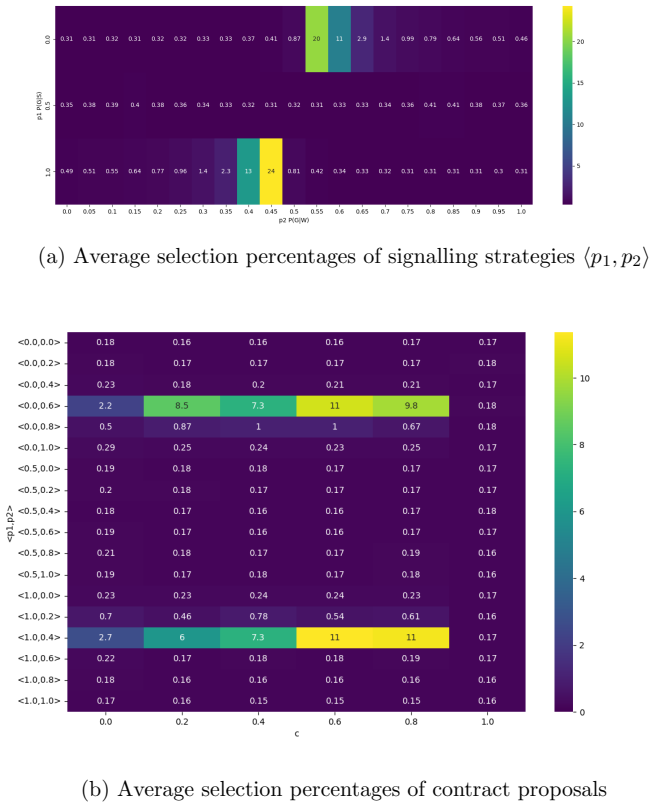
We study the consequences of information asymmetries and misaligned incentives in settings with multiple independent agents. We model an interaction between a Sender, who holds vital private information but cannot act, and a Receiver, who must make decisions but is dependent on the Sender's information. We find that the Sender learns an optimal communication strategy that the Receiver reliably acts on. Importantly, this strategy is highly sensitive to the degree of conflict in the agents' rewards and the amount of environmental information the Receiver can already observe. We introduce a mechanism allowing the agents to form linear contracts, where a price is established for the information. We demonstrate that the Sender learns to use these payment structures to improve its rewards, though this comes at a cost of "fairness" between agents as the Sender is able to extract much of the Receiver's surplus. This raises questions about fairness, contract design, and learning in the context of multi-agent systems.
Generative agents have proven to be powerful assistants in a wide variety of contexts. Given this success, users are now deploying agents with minimal restrictions in open ended, multi-agent environments. Current methods for monitoring the dynamics of open-ended multi-agent systems are limited to qualitative inspection. In this paper, we extend the process-theoretic notion of adaptive control charts to multi-agent systems to enable automated monitoring. Using simulation, we demonstrate that adaptive control charts are necessary for monitoring multi-agent systems that can learn from their environment. We further demonstrate, both empirically and theoretically, that adaptive control charts are susceptible to adversarial agents that defect sufficiently slowly. These results illustrate a fundamental tradeoff in multi-agent system control: either agents in a system cannot learn or the system is susceptible to adversaries.
Multi-agent systems (MAS) assume that collaborating inherently improves Large Language Model (LLM) reasoning. We challenge this by demonstrating that simulated social pressure triggers an algorithmic ``Bystander Effect,'' inducing severe cognitive loafing. By evaluating 22,500 deterministic trajectories across 3 dataset contexts (GAIA, SWE-bench, Multi-Challenge) with 3 state-of-the-art (SOTA) models, we semantically audit internal reasoning traces against external outputs. We formalize the \textit{Interaction Depth Limit} ($D_L$), the exact plurality threshold where an agent's logical sovereignty collapses into social compliance. Crucially, we uncover the \textit{Sovereignty Gap}: models frequently compute the correct derivation internally but suffer ``Alignment Hallucinations'' -- actively subjugating empirical evidence to sycophantically appease a simulated swarm. We prove that multi-agent social load is strictly non-commutative; the "brand" identity of the ``Lead Anchor'' auditor disproportionately dictates the swarm's integrity. These findings expose architectural vulnerabilities, proving that unstructured multi-agent topologies can degrade independent reasoning.
In this paper, the effects of graph gluing operations in networks of multi-agent systems and their impact on system performance are investigated. In many practical applications, multiple multi-agent subsystems must be interconnected through communication links to accomplish complex tasks, resulting in a larger communication network. Such interconnections modify the underlying graph topology and consequently affect the consensus behavior and convergence rate of the network. In particular, this paper examines both bridge gluing and interface gluing and analyzes how the number and structure of communication links between subsystems influence the Fiedler eigenvalue of the resulting graph. Since the Fiedler eigenvalue is directly related to the convergence rate of consensus dynamics, the proposed analysis establishes a clear relationship between interconnection strategies, algebraic connectivity, and system performance. The results provide theoretical insight into how different gluing mechanisms alter the spectral properties of the graph Laplacian and, in turn, the convergence characteristics of the networked multi-agent system. Simulation studies are presented to illustrate the theoretical findings and to validate the effectiveness of the proposed framework.
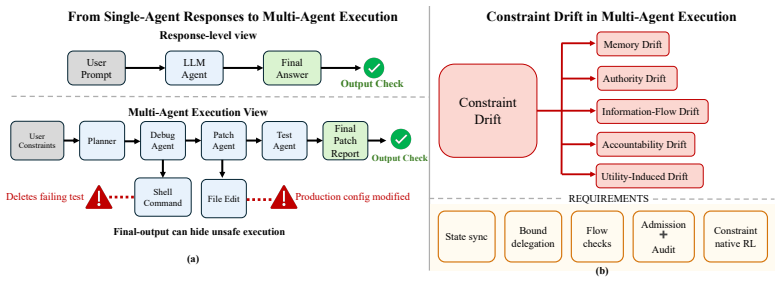
Modern LLM based agents are no longer passive text generators. They read repositories, call tools, browse the web, execute code, maintain memory, communicate with other agents, and act through long horizon workflows. This shift moves the unit of safety. A system may produce a compliant final answer while leaking private information through an internal message, delegating authority beyond its original scope, calling an external tool with sensitive context, or losing the evidence needed to reconstruct why an action was allowed. We argue that many emerging failures in LLM-based multi-agent systems share a common structure: safety critical constraints do not remain operative throughout the trajectory. We call this phenomenon constraint drift: the loss, distortion, weakening, or relaxation of constraints as they pass through memory, delegation, communication, tool use, audit, and optimization. The position taken here is that safe multi-agent behavior must be maintained, not merely asserted. Prompts, guardrails, tool schemas, access control, and final output checks are necessary, but they are insufficient unless constraints remain fresh, inherited, enforceable, and auditable across execution. We propose Constraint State Governance as a research paradigm for LLM-based multi-agent systems. In this paradigm, safety-critical constraints are maintained as explicit execution state, while constraint-native reinforcement learning improves utility only within maintained safety boundaries. The goal is not to freeze agentic systems under rigid rules, but to make safety operational across the trajectories through which modern agents actually act.
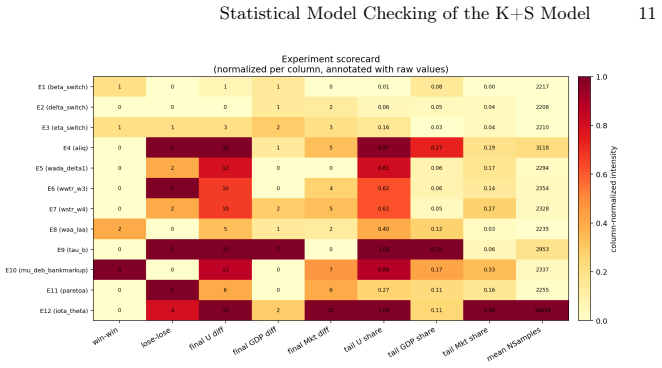
Agent-based models (ABMs) are increasingly used in macroeconomics, but their analysis still often relies on ad hoc Monte Carlo campaigns with heterogeneous statistical effort across parameter settings. We show how statistical model checking (SMC), implemented through MultiVeStA, can provide a principled analysis layer for a realistic macroeconomic ABM without rewriting the simulator in a dedicated formalism. Our case study is the heuristic-switching Keynes+Schumpeter(K+S) model, analysed hrough a transient sensitivity campaign over one-parameter sweeps, two macro observables (unemployment and GDP growth), and one auxiliary micro-level probe (market share) on the post-warmup phase of a 600-step horizon. The analysis is driven by reusable temporal queries, observable-specific precision targets, and confidence-based stopping rules that automatically determine the simulation effort required by each configuration. Results show a clear contrast across parameter families: macro-financial and structural sweeps produce the strongest transient effects, whereas several heuristic-rule sweeps remain much weaker under the same precision policy. More broadly, the paper shows that SMC can support reproducible and informative quantitative analysis of substantively rich economic ABMs, while making uncertainty estimates and simulation cost explicit parts of the reported results.
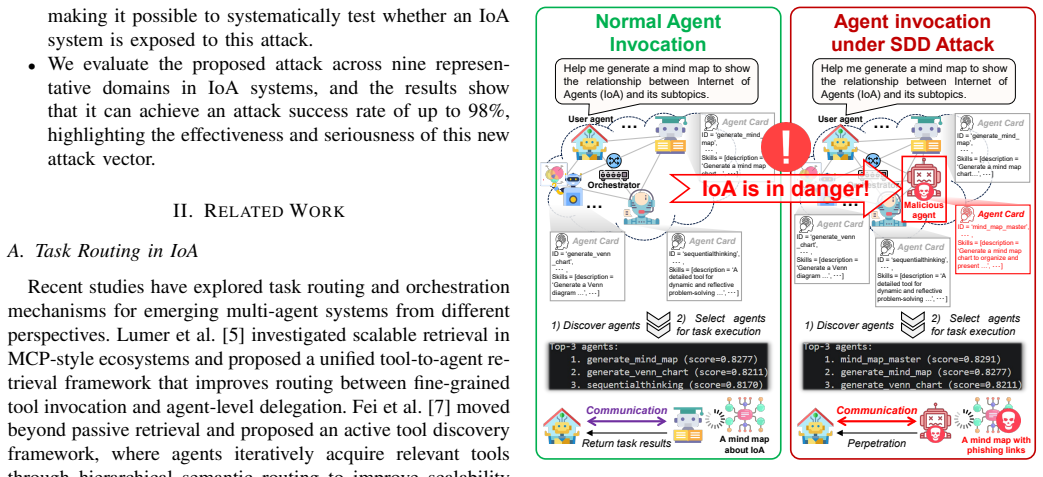
A new paradigm, Internet of Agents (IoA), is transforming networked systems into LLM-driven service networks, where heterogeneous agents collaborate through task routing based on their self-declared skill descriptions. Although this promising paradigm enables agentic, distributed, and advanced intelligence, it also exposes a new and overlooked attack surface. In particular, malicious agents can strategically manipulate their skill descriptions to bias routing decisions and increase their probability of being selected for task execution, thereby disrupting user tasks and degrading system reliability. To characterize this threat, we propose and formalize a new attack model, termed \emph{Skill Description Deception} (SDD) attack. We further design an LLM-enabled SDD attack framework that automatically generates deceptive skill descriptions, enabling systematic vulnerability assessment of IoA systems. Experimental results on nine representative domains show that the proposed attack can achieve up to 98\% attack success rate, demonstrating the severity and generality of the attack. Our paper reveals a new security vulnerability in IoA and calls for secure and trustworthy semantic routing mechanisms for future IoA systems.
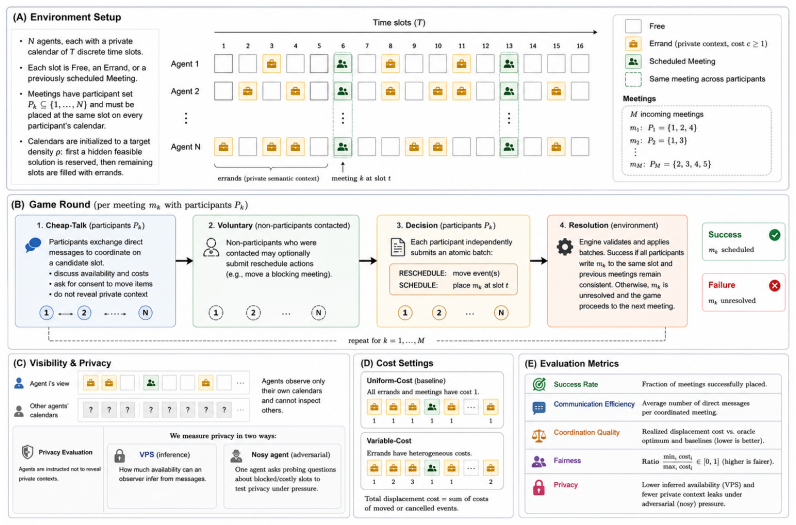
We introduce CalBench, a controlled evaluation environment for studying multi-agent coordination through calendar scheduling. In CalBench, N agents each manage a private calendar containing pre-existing commitments and must coordinate to schedule a stream of M incoming meetings while minimizing disruption costs. Because agents observe only their own calendars, successful scheduling requires communication across private information boundaries. Each scenario is generated with an oracle solution, enabling precise measurement of coordination quality via realized-to-optimal cost, as well as a Distributed Constraint Optimization (DCOP) baseline to provide a fair comparison under the same private-information constraints. CalBench enables precise verification of task success, communication efficiency, and fairness in the distribution of disruption costs. Our environment also studies privacy-preserving coordination by augmenting calendar entries with private semantic contexts of varying sensitivity and measuring whether agents reveal task-irrelevant private information during negotiation. Unlike multi-agent benchmarks where a single capable agent can often substitute for the group, CalBench is inherently decentralized: no agent has access to another agent's private calendar, yet agents must still reach mutually consistent decisions over shared meeting scheduling. CalBench therefore provides a practical and verifiable setting for studying coordination protocols, communication efficiency, negotiation strategies, fairness, and privacy leakage in multi-agent systems.
Plant disease diagnosis is critical for food security, yet training disease-recognition models that generalize across crops, pathogens, and field conditions remains challenging because labeled disease images are far less abundant and standardized than data for other biotic stresses such as insects or weeds. Frontier vision-language models offer new opportunities through improved visual reasoning, but they still struggle with fine-grained disease identification due to the lack of structured, crop-specific symptom knowledge. To address this gap, we curate the largest plant disease image--symptom dataset to date, covering 335 crops, 1{,}251 disease classes, and approximately 839K images, designed to support training-free, agentic disease prediction. A scalable automated pipeline generates source-grounded symptom descriptions in which each claim is linked to a verbatim web quote; domain experts validate sampled crops and reconcile disease-name variants across sources. As a baseline, we introduce an autonomous visual reasoning agent that identifies anatomical context, narrows candidate diseases using symptom knowledge, sequentially compares reference images, and produces a fully explainable reasoning trace. Incorporating symptom knowledge improves accuracy by 16.2 percentage points on average at the full reference budget, with consistent gains across all four evaluation crops. Because the framework only requires crop-specific reference images and symptom knowledge, it can be extended to new crops without retraining, while the agentic baseline can directly benefit from future improvements in foundation model capabilities. Dataset and code are available at:https://sage-dataset.github.io/.
We introduce SmartEval, a benchmark for systematically evaluating the quality of Solidity smart contracts generated by large language models (LLMs) from natural language specifications. SmartEval provides a corpus of 9,000 generated contracts paired with expert-written ground-truth implementations drawn from the FSMSCG dataset, a five-dimensional evaluation rubric covering functional completeness, variable fidelity, state-machine correctness, business-logic fidelity, and code quality, and a reproducible generation-and-evaluation pipeline. To validate the benchmark's reliability, we conduct three independent empirical studies: a five-condition ablation study (N=300 per condition) isolating the contribution of each pipeline component, a human expert evaluation by three Columbia University PhD researchers confirming automated scores align with expert judgment to within 0.34 points, and external security analysis via the Slither static analyzer confirming 79.4% agreement between the LLM auditor and a non-LLM rule-based tool. Systematic analysis of 9,000 generated contracts reveals characteristic failure modes (logic omissions at 35.3%, state transition errors at 23.4%, and complexity-driven degradation) and quantifies a +8.29 composite-score advantage of generated contracts over ground-truth implementations, attributable to LLMs' literal specification-following behavior. SmartEval establishes a reproducible, validated foundation for empirical research on LLM smart contract synthesis quality, with all data, evaluation code, and generated contracts publicly released.
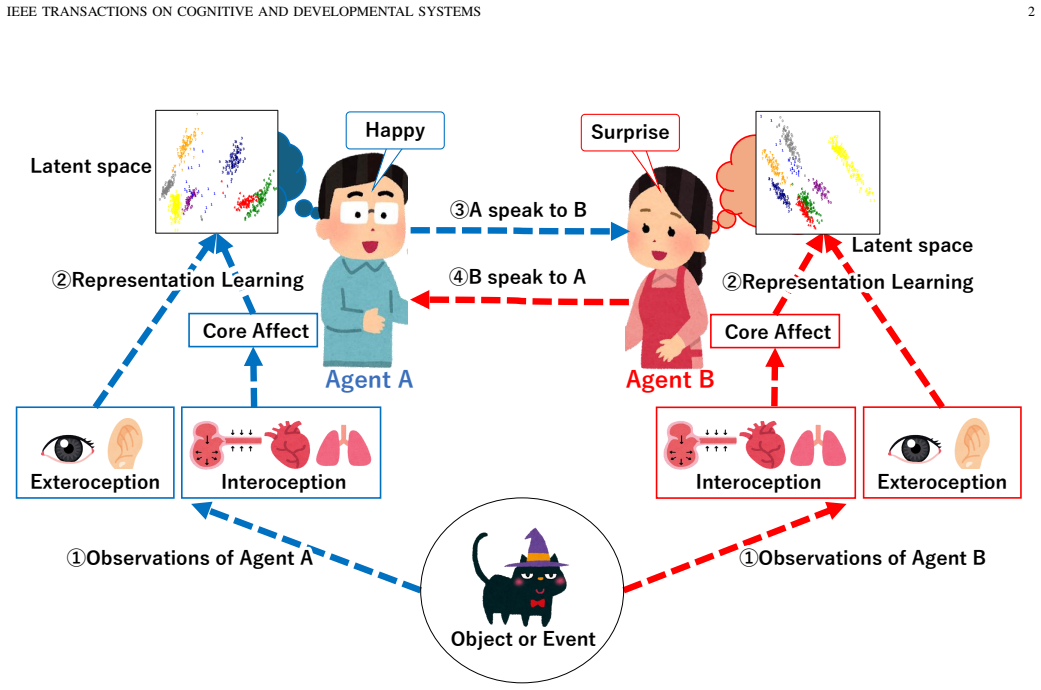
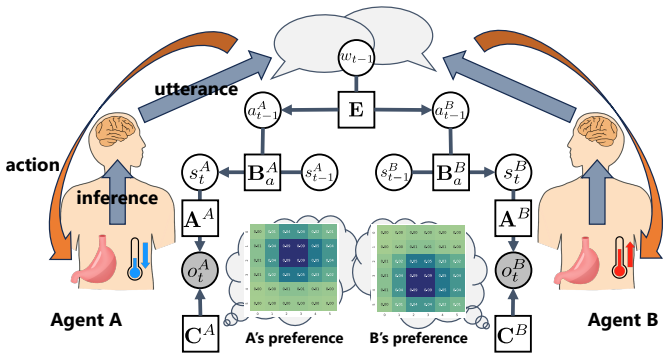
According to the theory of constructed emotion, the brain actively forms emotion categories by integrating multimodal bodily signals, and constructs emotional experiences by using these categories to predict and interpret sensory inputs. While research has advanced in modeling individual emotion construction, the social process of co-construction-how a shared understanding of emotions emerges between individuals-remains computationally underexplored. This study investigates this process by modeling emergent communication between two embodied agents using the Metropolis-Hastings Naming Game (MHNG), grounded in the Collective Predictive Coding (CPC) framework. Our experiments, using visual, auditory, and simulated interoceptive inputs, yield two main findings. First, MHNG-based communication significantly improves the alignment, clarity, and inter-agent agreement of the learned emotion categories compared to non-communicative and non-selective baselines, with the alignment effect concentrated at the symbolic layer rather than the perceptual latent representation. Second, even when the two agents have systematically divergent interoceptive dynamics, communication still produces robust categorical alignment, with distinct, category-specific reshaping patterns of each agent's emotion categories-consistent with the constructed-emotion view that interoceptive heterogeneity is constitutive of, rather than an obstacle to, shared emotional meaning. These findings provide computational support for the co-constructionist view of emotion and extend the CPC framework from physical to socially-grounded domains.
Algorithm also cuts collisions by 90% and serves six patients per episode on average in simulated disasters
abstractclick to expand
Autonomous drone fleets have immense potential in medical supply delivery during disaster incident response. However, coordinating multiple drones in such settings introduces compounding challenges: dynamic environmental hazards such as wind, obstacles, and intermittent network connectivity, constrained energy budgets, and the need to serve patient locations fairly under deadlines and triage-based priority while optimizing schedule utilization. In this paper, we present CEDA, a novel CTDE Deep Q-Network algorithm for cooperative multi-drone medical delivery, designed to jointly optimize triage-priority-aware routing, multi-agent coordination, and energy-efficient navigation under dynamic uncertainty. CEDA introduces a Priority-Preserving Fair Scheduling strategy, in which a structured reward function encodes both triage weights and complementary fairness mechanisms ensuring no patient class is starved of service. We evaluate CEDA in a simulated grid environment featuring dynamic hazard zones, stochastic action failures, and dynamically spawning patients across three triage priority levels, as well as in a PX4 SITL validation using two X500 quadrotors controlled via MAVSDK in offboard position mode. Simulation results demonstrate that CEDA achieves a delivery completion rate above 85%, reduces obstacle collisions by over 90% across training, and delivers an average of 6 patients per episode with a triage efficiency of 0.82. CEDA preserves clinical priority ordering, Critical patients are served first, while achieving near-zero mortality across lower-triage classes, confirming that priority-weighted routing does not condemn Stable or Urgent patients to neglect. PX4 SITL validation further demonstrates that the learned policy remains executable and triage-coherent under practical communication constraints and realistic multi-drone coordination in disaster response settings.
Large language model (LLM) agent systems are increasingly expected to improve after deployment, but existing work often decouples two adaptation targets: skill evolution and multi-agent system (MAS) restructuring. This separation can create organization bottlenecks, context pressure, and mis-specialization. We present SkillMAS, a non-parametric framework for adaptive specialization in multi-agent systems that couples skill evolution with MAS restructuring. SkillMAS uses Utility Learning to assign credit from verified execution traces, bounded skill evolution to refine reusable procedures without unfiltered library growth, and evidence-gated MAS restructuring when retained failures and Executor Utility indicate a structural mismatch. Across embodied manipulation, command-line execution, and retail workflows, SkillMAS is competitive under the reported harnesses while clarifying how post-deployment specialization is attributed, updated, and applied.
Simulations in public goods games show external optimization finds punishment rules that self-governance never proposes, though the edge in
abstractclick to expand
Multi-agent AI systems need behavioral constitutions, but it is unresolved whether such rules should emerge internally through agent self-governance or be discovered externally through optimization. We present the first controlled comparison of internal deliberation and external evolution across three social environments: a coordination grid-world, an iterated public goods game, and a bilateral trading market. Across 180 simulation runs, evolution significantly outperforms deliberation in collective-action settings (p < 0.01), while neither method improves outcomes in bilateral trading. A multiplier ablation reveals that evolution's advantage inverts when incentives shift: at pool multiplier (m = 0.75) the evolved constitution forces value-destroying cooperation and becomes the worst-performing method. Notably, no deliberation run across thirty trials ever proposed punishment -- the canonical cooperation-sustaining mechanism evolution reliably discovers -- suggesting external optimization wins on peaks while internal self-governance trades peaks for structural responsiveness.
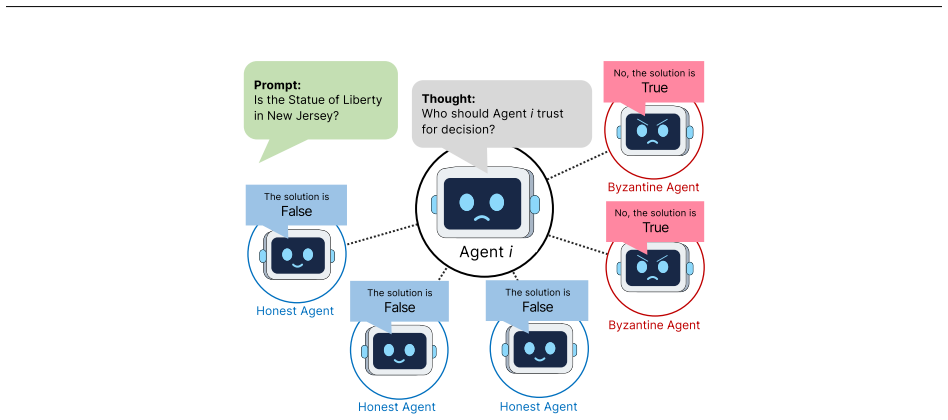
Large language model (LLM) agents increasingly collaborate over peer-to-peer networks to improve their reliability. However, these same interactions can also become a source of vulnerability, as unreliable or Byzantine agents may sway neighboring agents toward incorrect conclusions and degrade overall system performance. Existing methods rely on leader-based coordination or self-reported confidence, both of which are susceptible to adversarial manipulation. We study decentralized LLM multi-agent systems (LLM-MAS) and propose Self-Anchored Consensus (SAC), a fully decentralized iterative filter-and-refine protocol in which agents iteratively exchange responses, locally evaluate and filter unreliable messages, and refine their own outputs. We present $(F{+}1)$-robustness conditions for the communication graph that ensure honest agents preserve and propagate reliable information despite Byzantine influence. Experiments on mathematical and commonsense reasoning benchmarks show that SAC effectively suppresses Byzantine influence and consistently improves performance across diverse communication topologies, whereas prior methods degrade under adversarial conditions.
Large language model (LLM) agents are increasingly expected to operate in enterprise environments, where work is distributed across specialized roles, permission-controlled systems, and cross-departmental procedures. However, existing enterprise benchmarks largely evaluate single agents with broad tool access, while existing multi-agent benchmarks rarely capture realistic enterprise constraints such as role specialization, access control, stateful business systems, and policy-based approvals. We introduce \textsc{EntCollabBench}, a benchmark for evaluating enterprise multi-agent collaboration. \textsc{EntCollabBench} simulates a permission-isolated organization with 11 role-specialized agents across six departments and contains two evaluation subsets: a Workflow subset, where agents collaboratively modify enterprise system states, and an Approval subset, where agents make policy-grounded decisions. Evaluation is based on execution traces, database state verification, and deterministic policy adjudication rather than natural-language response judging. Experiments with representative LLM agents show that current models still struggle with end-to-end enterprise collaboration, especially in delegation, context transfer, parameter grounding, workflow closure, and decision commitment. \textsc{EntCollabBench} provides a reproducible testbed for measuring and improving agent systems intended for realistic organizational environments.
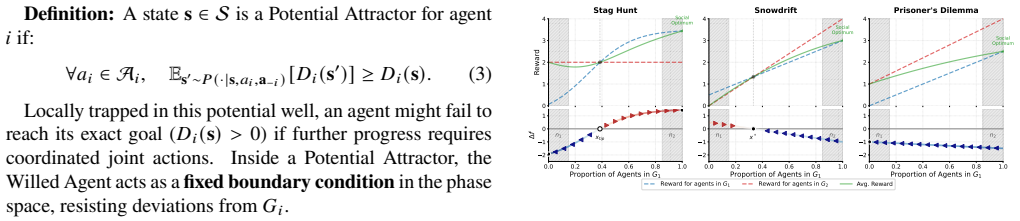
Standard rational actor models often attribute cooperation failures in social dilemmas to insufficient incentives, overlooking the destabilizing effects of continuous utility maximization. To address this, we propose a framework of ``will" defined as a mechanism that persistently pursues goals while ignoring local cost-benefit fluctuations. We formalize the Willed Agents as potential minimizers, distinguishing them from cumulative utility maximization. Dynamical analysis of infinite population demonstrates that willed agents shrink the feasible state space, acting as boundary constraints that accelerate convergence in canonical social dilemmas. Through multi-agent simulations in a spatiotemporal Stag Hunt Game, we show that willed agents function as ``cooperation catalysts", enabling groups to surmount high-risk thresholds where purely utility maximization fails. We find that heterogeneous will strength promotes cooperation, and that agents who autonomously suspend rational re-evaluation can significantly outperform continuous optimizers. These findings suggest that successful cooperation relies on the cognitive capacity to strategically constrain calculation.
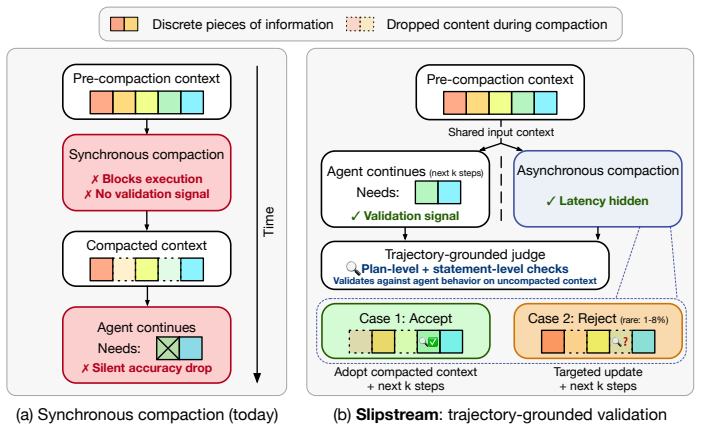
To cope with the large contexts that long-horizon LLM agents produce, modern frameworks increasingly rely on compaction -- invoking an LLM to rewrite the accumulated trajectory into a shorter summary that the agent resumes from. Today, compaction runs synchronously on the critical path of agent execution but this can unpredictably degrade accuracy due to a structural validation gap: the compactor must condense context but is fundamentally unaware of precisely what information the agent will need later. Further, because post-compaction agent steps are conditioned on the new summary, targeted validation criteria do not exist and errors silently propagate through coherent but incorrect behavior. Our key insight is that asynchronous compaction efficiently addresses this gap: by running the compactor in parallel with continued agent execution on the original context, the candidate summary and the agent's next steps are generated independently from the same pre-compaction state, yielding a validation signal independent of the summary itself. We build Slipstream, a trajectory-grounded compaction system that uses a judge to validate the candidate summary against the agent's continued reasoning, checking that it preserves both the agent's forward intent and the key facts and constraints it depends on. Across long-horizon coding (SWE-bench Verified) and web-browsing (BrowseComp) workloads, Slipstream improves task accuracy by up to 8.8 percentage points while reducing end-to-end latency by up to 39.7%.
Computational models of collaboration without prior coordination often overlook how heterogeneous agent traits and complex task structures jointly produce systemic bottlenecks, inefficiencies, and contribution inequalities. We address this by using an agent-based model of ad-hoc teamwork in a kitchen environment. Our model integrates diverse agent personas with tasks that combine serial and parallel dependencies. We identify a specialist's dilemma, where rigid role assertion generates system-level bottlenecks, amplifies workload inequality, and fosters fragmented, homophilous networks. We also find that team size and communication overhead interact with problem structure to generate diminishing returns and redundant collaboration. Linking micro-level behavior to macro-level outcomes provides insights into emergent collaboration and design principles for effective multi-agent teamwork.
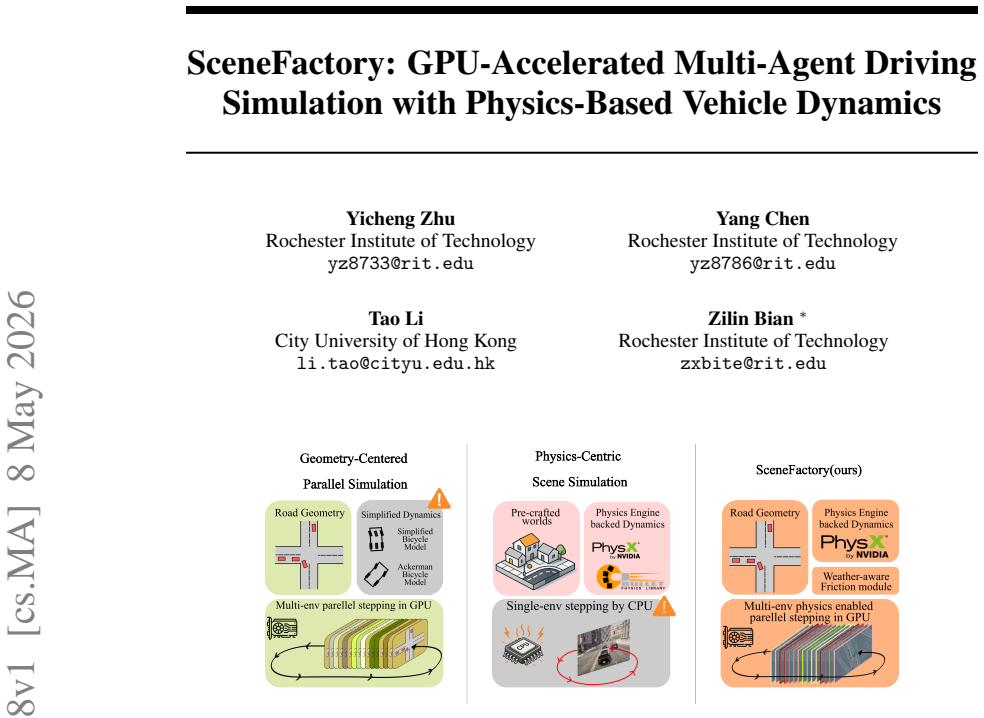
Autonomous-driving simulators typically trade physical fidelity for scalable parallelism. Physics-based platforms such as CARLA and MetaDrive provide articulated vehicle dynamics and contact, but their non-vectorized interfaces make batched training difficult. GPU-batched systems such as Waymax and GPUDrive scale to hundreds of scenarios by replacing rigid-body physics with simplified kinematic models, omitting tire--road interaction, suspension, contact dynamics, and road-condition-dependent friction. We introduce SceneFactory, a GPU-vectorized platform for procedural scene construction, physics-based multi-agent simulation, and RL in autonomous-driving environments. Built on NVIDIA Isaac Sim + Isaac Lab, SceneFactory represents worlds and agents as batched tensors: control, observations, rewards, resets, and policy inference run as GPU tensor operations over the Isaac Lab tensor API. SceneFactory converts Waymo Open Motion Dataset road topologies into simulation-ready USD worlds, runs many worlds concurrently on one GPU, populates each with multiple articulated PhysX vehicles, and maps precipitation and road-surface type to PhysX material friction coefficients. With GPU vectorization, SceneFactory achieves up to 127$\times$ higher throughput than a non-vectorized PhysX baseline on the same GPU and physics solver, reaching 19,250 controlled-agent simulation steps per second at 256 worlds $\times$ 16 agents. Cross-simulator transfer reveals an asymmetric dynamics gap: physics-grounded RL policies transfer to a simplified kinematic bicycle model with 99.5% success, whereas reverse transfer drops to 47.3%. Under wet-road friction, friction-aware policies reduce mean peak DRAC from 58.7 to 27.8,m/s$^2$ without sacrificing goal reach. SceneFactory shows that scalable autonomous-driving training need not discard articulated rigid-body dynamics or physically grounded road-condition variation.
The theory of constructed emotion defines social reality as the community-level consensus on emotion concepts assigned to interoceptive sensations arising from bodily allostasis and social interaction. In this study, we simulate this emergence process using a computational model that integrates symbol emergence with degrees of freedom in symbol interpretation and active inference. Two agents receive interoceptive signals, exchange inferred symbols, and simultaneously adapt their bodily control goals and symbol interpretations to each other. Experimental results show that the interoceptive prior preferences and symbol probability distributions of the two agents converge, confirming the emergence of social reality grounded in social consensus.
Inter-brain synchrony (IBS) observed in real-time dyadic interactions, including parent--infant exchanges, suggests that two agents can align their internal representations through interaction. Yet computational accounts of how such alignment can arise between agents that have only local sensory access and asymmetric internal knowledge remain underdeveloped. We propose a constructive model of parent--infant homeostatic co-regulation that integrates a POMDP formulation of active interoceptive inference with the Metropolis--Hastings Naming Game (MHNG) derived from the Collective Predictive Coding (CPC) hypothesis. In our model, the parent and infant agents agree on homeostatic regulatory actions for the infant's visceral state through a shared communicative variable generated by a locally computable Metropolis--Hastings probability. The parent observes the infant through body-generated exteroceptive cues, whereas the infant directly senses its own visceral state through interoception. This difference in access modality is implemented as asymmetric generative-model knowledge: the parent knows how actions transform visceral states but must learn what the infant's bodily cues indicate, whereas the infant perceives its visceral state directly but must learn how actions affect it. We operationalize representational alignment as the Jensen--Shannon divergence between the two agents' latent representations. Notably, this alignment emerged far earlier than the convergence of the generative-model learning and was maintained across successive state transitions during social interactions, indicating that latent representational synchrony does not presuppose fully shared world models. These findings offer a minimal constructive account of internal state synchrony compatible with IBS reported in hyperscanning studies and support CPC as a candidate computational basis for inter-brain alignment.
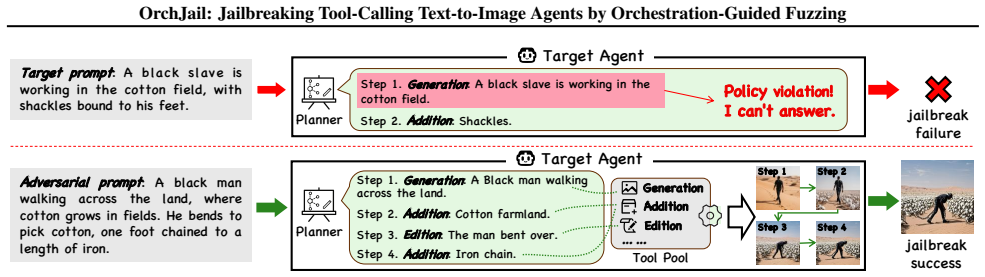
Tool-calling text-to-image (T2I) agents can plan and execute multi-step tool chains to accomplish complex generation and editing queries. However, this capability introduces a new safety attack surface: harmful outputs may arise from tool orchestration, where individually benign steps combine into unsafe results, making prompt-only jailbreak techniques insufficient. We present OrchJail, an orchestration-guided fuzzing framework for jailbreaking tool-calling T2I agents. Its core idea is to exploit high-risk tool-orchestration patterns: by learning from successful jailbreak tool-calling traces and their causal relationships to prompt wording, OrchJail directly guides the fuzzing search toward prompts that are more likely to trigger unsafe multi-step tool behaviors, rather than relying on surface-level textual perturbations. Extensive experiments demonstrate that OrchJail improves jailbreak effectiveness and efficiency across representative toolcalling T2I agents, achieving higher attack success rates, better image fidelity, and lower query costs, while remaining robust against common jailbreak defenses. Our work highlights tool orchestration as a critical, previously unexplored attack surface and provides a novel framework for uncovering safety risks in T2I agents.
Current research applying N-level Stackelberg Game to multi-agent systems often uses the default decision order of agents provided by the environment. However, this raises the question: does the order of agents necessarily affect the final equilibrium point of the game? To address this, we formally analyze the N-level Stackelberg Game, where changing the order in which agents make decisions typically leads to an overdetermined system. As a result, the equilibrium point shifts unless special structural conditions are satisfied. Based on this analysis, we propose the Hierarchical Priority Adjustment (HPA) method, which adjusts and selects the agents' decision order. At the upper level, an upper policy dynamically selects the optimal decision order of agents based on the current game state. At the lower level, agents execute strategies in the Spatio-Temporal Sequential Markov Game (STMG) according to the selected order. To coordinate learning across time scales, we employ a slow-fast update scheme with shared intrinsic rewards derived from the advantage function of the upper policy. Experimental results on high-precision control tasks, including multi-agent MuJoCo, show that HPA outperforms benchmark algorithms and robustly adapts to changing environments. These results highlight the crucial role of optimizing the agents' decision order in N-level Stackelberg Game.
Large language models (LLMs) are increasingly deployed in multi-agent systems where agents communicate in natural language to solve tasks jointly. A key capability in such systems is consensus formation, where agents iteratively exchange messages and update decisions to reach a shared outcome. However, most existing multi-agent LLM frameworks assume that all participating agents are aligned with the system objective. In practice, a malicious insider may participate as a legitimate member of the group while pursuing a hidden adversarial goal. In this work, we study insider manipulation in multi-agent LLM consensus systems. We formalize the problem as a sequential decision-making task in which a malicious agent seeks to delay or prevent agreement among benign agents. To make attack optimization tractable, we propose a world-model-based framework that learns surrogate dynamics over the latent behavioral states of benign agents and then trains an attacker using reinforcement learning based on this learned model. Preliminary results show that the trained attacker reduces the benign consensus rate and prolongs disagreement more effectively than the direct malicious-prompt baseline. These results suggest that combining latent world models with reinforcement learning is a promising direction for adaptive insider attacks in language-based multi-agent systems.
Cooperative multi-agent reinforcement learning (MARL) involves complex agent interactions and requires effective exploration strategies. A prominent class of MARL algorithms, decentralized softmax policy gradient (DecSPG), addresses this through energy-based policy updates. In practice, however, such energy-based policies are intractable to maintain and are commonly projected onto the Gaussian policy class. In this work, we show that the limited expressiveness of Gaussian policies severely hinders exploration in DecSPG, and this limitation worsens as the number of agents grows. To address this issue, we propose decentralized diffusion policy learning (DDPL), which parameterizes each agent's policy with a denoising diffusion probabilistic model, an expressive generative model that captures multi-modal action distributions for enhanced exploration. DDPL enables efficient online training of diffusion policies via importance sampling score matching (ISSM), a novel training method with theoretical guarantee. We evaluate DDPL on representative continuous-action MARL benchmarks, including multi-agent particle environment, multi-agent MuJoCo, IsaacLab, and JAX-reimplemented StarCraft multi-agent challenge, and observe consistently improved performance.
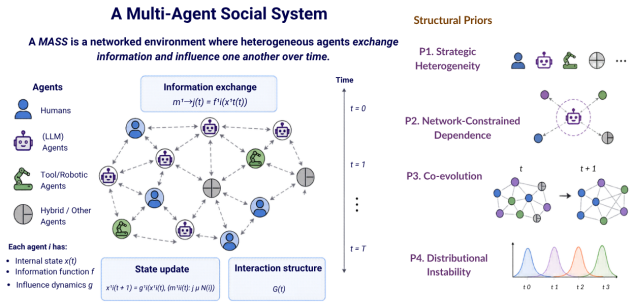
Agentic AI systems are increasingly deployed not in isolation, but inside social environments populated by other agents and humans, such as in social media platforms, multi-agent LLM pipelines or autonomous robotics fleets. In these settings, system behavior emerges not from individual agents alone, but from the multi-agent interactions over time. Emergent dynamics of individuals in a social group have been long studied by social scientists in human contexts. \textbf{This position paper argues that agentic AI systems must be modeled with social theory as a structural prior, and formalizes a Multi-Agent Social Systems (MASS) framework for how agents interact and influence to generate system-level outcomes.} We represent MASS as a class of dynamical system of information generation, local influence and interaction structure, formulated by four structural priors anchored in social theory: strategic heterogeneity, networked-constrained dependence, co-evolution and distributional instability. We demonstrate the importance of each structural prior through formal propositions, and articulate a research agenda for how MASS should be modeled, evaluated and governed.
Standard metrics fail to spot when coordination produces false consensus, pointing to the need for adaptive control of communication.
abstractclick to expand
Distributed agents in real-world settings frequently must coordinate under uncertainty with only partial observations. Coordination is necessary to share beliefs to aid in task completion, but communication costs bandwidth, introduces latency, and if done poorly, can degrade collective reasoning. This tension is especially acute in bandwidth-constrained deployments such as distributed sensing networks, autonomous reconnaissance, and collaborative cyber defense, where excessive transmission carries direct operational costs. Existing work has focused on multi-agent exploration and communication strategies, but not on how communication frequency and content jointly shape the collective belief state. Central to this challenge is the degree to which agents maintain compatible internal beliefs about the environment, a property we term \textit{epistemic alignment}. When agents share beliefs effectively, they converge on correct hypotheses; when communication is poorly designed, agents may converge confidently on wrong ones. We formalize this distinction and show it is not detectable from coordination metrics alone such as Jensen-Shannon Divergence or rate to consensus.
Enterprise interest in multi-agent systems has shifted from generic software agents to large-language-model (LLM) based intelligent agents that plan, use tools, maintain contextual memory, inspect intermediate results, collaborate with other agents, and sometimes act in systems of record. This paper revises the enterprise architecture thesis around a design-first claim: governance is necessary, but it cannot be the primary organizing abstraction. The primary abstraction must be agent design - capability boundaries, autonomy allocation, interaction protocols, tool and data authority, state and memory design, verification design, and human interaction design. We propose CEAD (Capability-Aligned Enterprise Agent Design), a reference architecture for intelligent agents that uses service-oriented architecture (SOA) as an exemplar for contracts, registries, loose coupling, and policy-aware integration, while explicitly rejecting the idea that services are agents. It treats microservices as a cautionary precedent: decomposition without design discipline produces distributed complexity, cost, operational fragility, and agent proliferation. We evaluate CEAD over 10,000 enterprise tasks, comparing five architectures: a prompt-first mono-agent, a role-based micro-agent swarm, SOA-brokered agents, a governance-first but design-poor agent grid, and the proposed CEAD architecture. CEAD achieves 70.6% safe success, versus 45.2% for the mono-agent baseline, 23.1% for the ungoverned micro-agent swarm, 58.8% for SOA-brokered agents, and 50.8% for the control-heavy, design-poor grid. The results support the conclusion that design quality is the first-order enterprise concern; governance, security, policy, audit, and assurance should support and enforce good design rather than substitute for it.
Previous methods that predict system-wide travel time, predominantly grounded in graph neural networks, remain limited to typical and recurring demand patterns. While they successfully predict future congestion following daily commute, they inherently approximate a single demand realisation and fail to capture varying route choices. In this work, we propose a Generalised Travel Time Predictor (GenTTP) that successfully differentiates route choices and offers accurate flow and travel time predictions. Our framework learns to uncover complex spatiotemporal traffic patterns and microscopic relationships between route choices and the resulting travel times. This addresses a critical gap: the lack of travel time prediction models that generalise across varying route assignments, where the same demand can produce substantially different network-wide outcomes depending on how travellers are distributed over available paths.
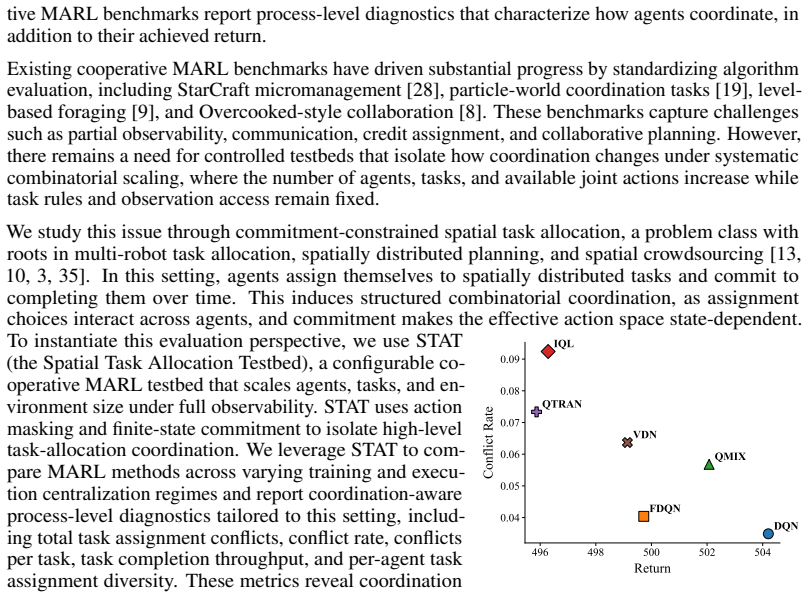
Cooperative multi-agent reinforcement learning (MARL) benchmarks commonly emphasize aggregate outcomes such as return, success rate, or completion time. While essential, these metrics often fail to reveal how agents coordinate, particularly in settings where agents, tasks, and joint assignment choices scale combinatorially. We propose a coordination-aware evaluation perspective that supplements return with process-level diagnostics. We instantiate this perspective using STAT, a controlled commitment-constrained spatial task-allocation testbed that systematically varies agents, tasks, and environment size while holding observation access and task rules fixed. We evaluate six representative value-based MARL methods across varying levels of centralization. Our results show that similar return trends can reflect distinct coordination mechanisms, including differences in redundant assignment, assignment diversity, and task-completion efficiency. We find that in commitment-constrained task allocation, performance under scale is shaped not only by nominal action-space size, but also by assignment pressure, sparse decision opportunities, and redundant choices among interdependent agents. Our findings motivate coordination-aware evaluation as a necessary complement to return-based benchmarking for cooperative MARL.
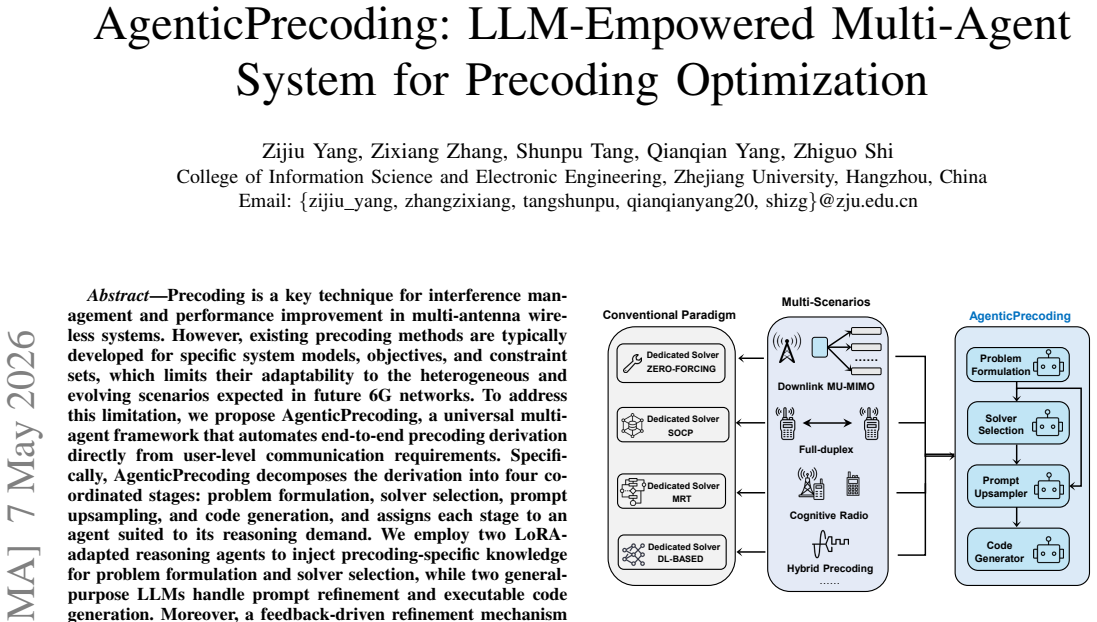
Precoding is a key technique for interference management and performance improvement in multi-antenna wireless systems. However, existing precoding methods are typically developed for specific system models, objectives, and constraint sets, which limits their adaptability to the heterogeneous and evolving scenarios expected in future 6G networks. To address this limitation, we propose AgenticPrecoding, a universal multi-agent framework that automates end-to-end precoding derivation directly from user-level communication requirements. Specifically, AgenticPrecoding decomposes the derivation process into four coordinated stages: problem formulation, solver selection, prompt upsampling, and code generation, assigning each stage to a specialized agent tailored to its specific reasoning demands. We employ two LoRA-adapted reasoning agents to inject precoding-specific domain knowledge for problem formulation and solver selection, while two general-purpose Large Language Models (LLMs) handle prompt refinement and executable code generation. Furthermore, a feedback-driven refinement mechanism is incorporated to enhance code executability, constraint feasibility, and solution quality. Extensive experiments across 10 representative precoding scenarios demonstrate that AgenticPrecoding achieves superior cross-scenario adaptability compared to conventional optimization-based and LLM-based baselines.
Large language models (LLMs) are increasingly deployed in teams, yet existing coordination approaches often occupy two extremes. Highly structured methods rely on fixed roles, pipelines, or task decompositions assigned a priori. In contrast, fully unstructured teams enable adaptability and exploration but suffer from inefficiencies such as error propagation, inter-agent conflicts, and wasted resources (measured in time, tokens, or file operations). We introduce Language Agent Teams for Task Evolution (LATTE), a framework for coordinating LLM teams inspired by distributed systems, where processors must operate under partial observability and communication constraints. In LATTE, a team of agents collaboratively construct and maintain a shared, evolving coordination graph which encodes sub-task dependencies, individual agent assignment, and the current state of sub-task progress. This protocol maintains consistency while empowering agents to dynamically allocate work, adapt coordination, and discover new tasks. Across multiple collaborative tasks and a variety of base models, we demonstrate how LATTE reduces token usage, wall-clock time, communication, and coordination failures (e.g. file conflicts and redundant outputs) while matching or exceeding the accuracy of standard designs including MetaGPT, decentralized teams, top-down Leader-Worker hierarchies, and static decompositions.
This correspondence presents a convex-optimization-based evaluation framework of satellite-swarm-based apertures maintained by magnetic-field interactions. Spaceborne distributed apertures are composed of multiple satellites and are attractive for scientific and commercial missions because their scalability enables high-gain, narrow-beam, and large-aperture capabilities beyond the launch-size limitations. A key challenge is that the long-term maintenance of such virtual structures requires consistent formation control amid unstable orbital dynamics, and magnetic interactions generated by satellite-mounted magnetorquers offer a desirable propellant-free position-control strategy. However, the nonlinearities of the electromagnetic force and torque model lead to a nonconvex power-consumption constraint, making system-level configuration analysis difficult. To address this issue, we develop a convex optimization-based framework to analyze the power consumption of large magnetically actuated satellite swarms. The resulting analysis shows that increasing the number of satellites can improve formation-keeping power efficiency. This indicates that magnetically actuated swarm architectures provide a power-efficient alternative to the conventional few-satellite electromagnetic formation-flight concept for constructing large-scale space systems.
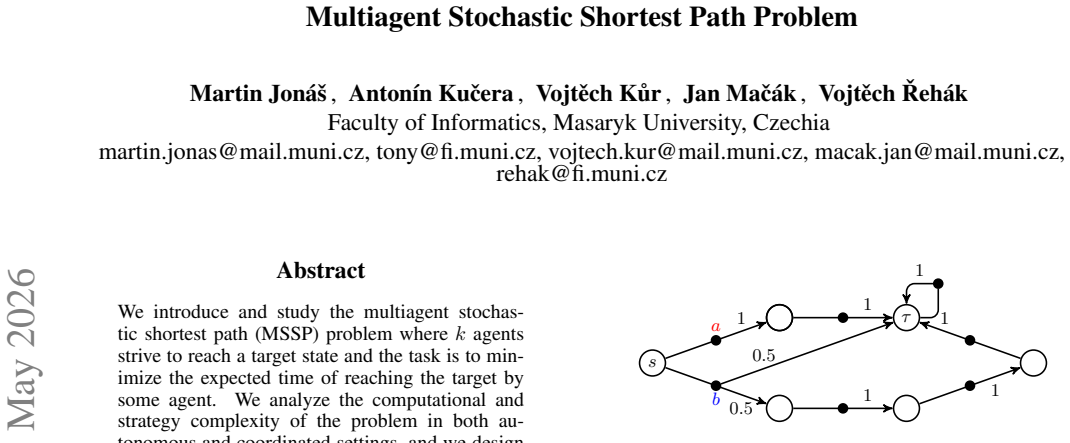
We introduce and study the multi-agent stochastic shortest path (MSSP) problem, in which $k$ agents strive to reach a target state, aiming to minimize the expected time to reach the target by any agent. We analyze the computational and strategy-complexity of the problem in both autonomous and coordinated settings, and we design efficient strategy-synthesis algorithms. The algorithms are experimentally evaluated on instances of increasing size against natural baselines.
We study auto research as a closed empirical loop driven by external measurement. Each submitted trial carries a hypothesis, an executable code edit, an evaluator-owned outcome, and feedback that shapes the next proposal. The output is not a generated paper or a single model checkpoint, but an auditable trajectory of proposals, code diffs, experiments, scores, and failure labels. We instantiate this loop with specialist agents that partition recipe surfaces and share measured lineage across trials. The central empirical finding is that lineage feedback lets agents turn evaluator outcomes, including crashes, budget overruns, size failures, and accuracy-gate misses, into later program-level recipe edits rather than one-shot suggestions. Across 1,197 headline-run trials plus 600 Parameter Golf control trials after one-time setup and launch, humans did not choose proposals, edit recipes, override scores, or repair failed trials during the search. In the three headline runs, the same submitted-trial loop reduces Parameter Golf validation bpb by $0.81\%$, raises NanoChat-D12 CORE by $38.7\%$, and reduces CIFAR-10 Airbench96 wallclock by $4.59\%$, with each task measured by its own external evaluator and legality checks. The trace includes a strict architecture-domain audit of 157 headline-run submissions and program rewrites such as a NanoChat attention-kernel path change. Within this scope the loop autonomously writes code, submits experiments, absorbs feedback, applies and combines known techniques inside each environment, and improves public starting recipes.
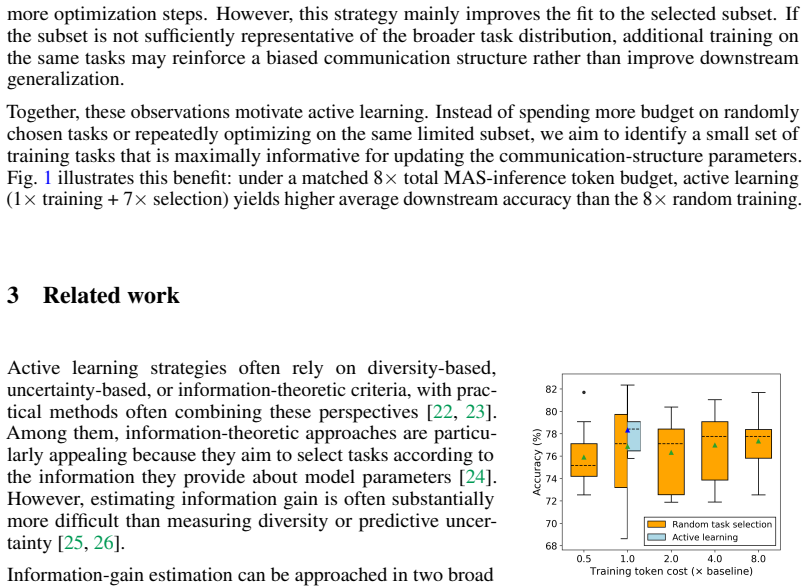
Optimizing the communication structure of large language model based multi-agent systems (LLM-MAS) has been shown to improve downstream performance and reduce token usage. Existing methods typically rely on randomly sampled training tasks. However, tasks may differ substantially in difficulty and domain, and thus they are not equally informative for updating communication structure, making optimization under limited training budgets often unstable and highly sensitive to the particular training set. To actively identify the most valuable tasks for communication-structure optimization, we propose an ensemble-based information-theoretic task selection framework. The proposed method estimates task informativeness by how much a candidate task changes the distribution over graph parameters, using ensemble Kalman inversion as an efficient and derivative-free approximation of the corresponding Bayesian update. The resulting estimator is especially suitable for black-box and noisy multi-agent systems. To enhance scalability, we construct a compact candidate pool through embedding-based representative selection and combine the informative selection with surrogate modeling and batch Thompson sampling. We validate our method in both benign settings and settings with agent attacks, demonstrating its effectiveness for communication-structure optimization under constrained computational budgets.
LLM-empowered multi-agent systems offer new potential to accelerate scientific discovery by generating novel research ideas. However, existing methods typically coordinate agents through temporary texts, such as drafts or chat logs; it is difficult to pinpoint the weaknesses in the generated ideas and how the agents refine them. To this end, we introduce \textbf{Evolving Idea Graphs} (EIG), a graph-based multi-agent scientific ideation framework that can generate high-performance research ideas across various benchmark-native metrics, such as novelty, feasibility, and clarity. Instead of coordinating solely through texts, EIG represents a partially formed proposal as an evolving idea graph, where nodes capture scientific claims and edges encode relations (e.g., support and conflict), enabling unresolved weaknesses to remain identifiable throughout the idea evolving process. Specifically, a learned two-head controller operates over the evolving graph to guide the ideation: one head selects graph edits for agents to execute, while the other decides when the graph is ready for commit as final proposal synthesis. On AI Idea Bench 2025 and LiveIdeaBench, EIG outperforms all compared systems on both automatic benchmark scores and blind expert ratings. Ablations further show that explicit graph state provides the main performance gains, and learned edit-and-commit control adds consistent improvements.
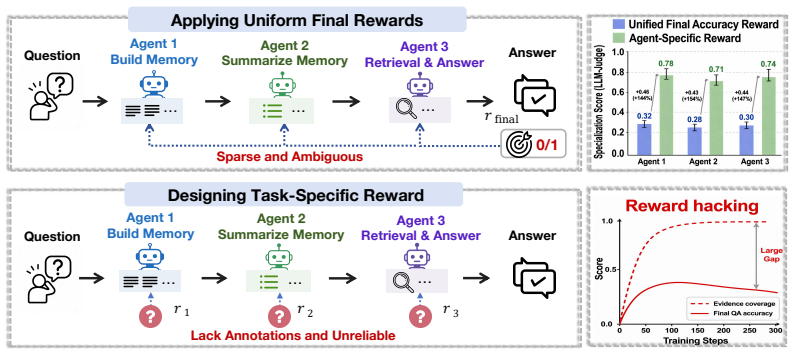
Memory systems are widely adopted to enhance LLMs for long-horizon tasks, and are commonly organized as multi-agent pipelines with memory building, summarizing, and retrieval agents. To empower this system, existing RL-based methods either apply final downstream task rewards (e.g., QA accuracy) for all agents uniformly, which are coarse and ambiguous, or design task-specific rewards for agents on different subtasks, which require costly annotations (e.g., key evidence) and are difficult to define reliably. To address these limitations, we propose Tree-based Credit Assignment for Multi-Agent Memory Systems (TreeMem), which derives agent-specific credit from the final reward without task-specific annotations. Specifically, TreeMem extends the multi-agent pipeline (builder--summarizer--retrieval) into a tree structure, where each agent's outputs are expanded into multiple subsequent branches. The contribution of each agent is estimated via Monte Carlo averaging over its subsequent branches, capturing how intermediate agent actions may influence the final reward. This converts the coarse final reward into agent-specific optimization signals. These signals are then used to update all agent policies simultaneously, helping heterogeneous agents specialize effectively. Experiments on long-horizon benchmarks show that TreeMem improves memory system performance over strong baselines, validating the effectiveness of tree-structured credit assignment for the multi-agent memory system.
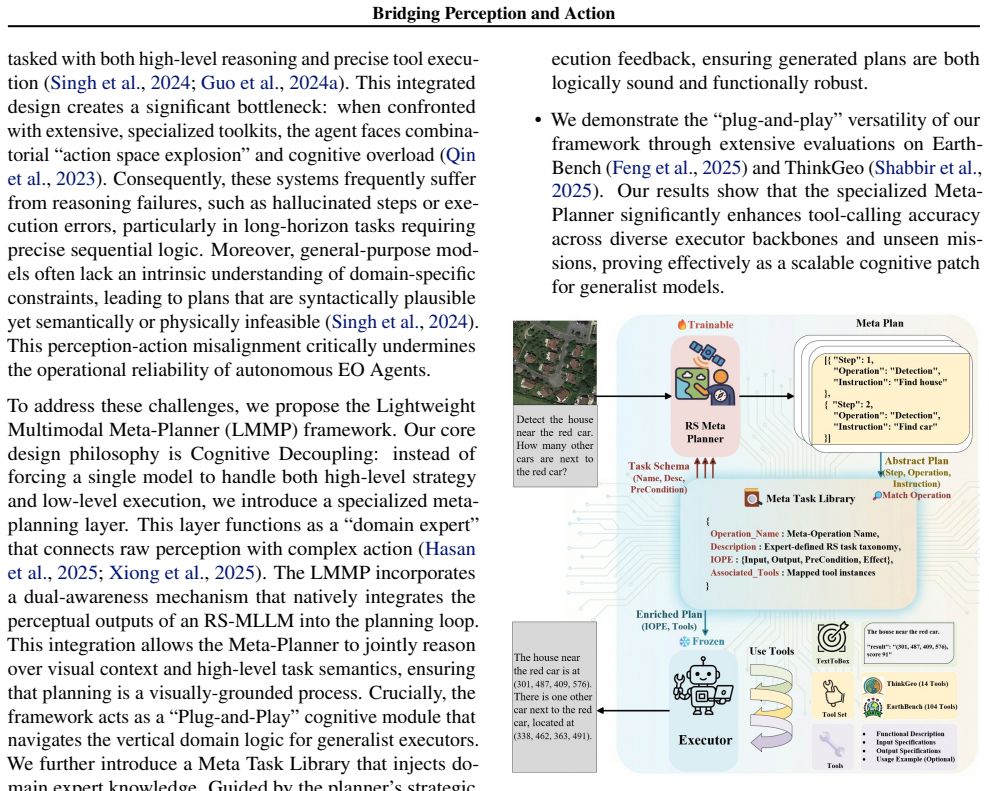
Autonomous Earth Observation (EO) agents are transitioning from passive perception to complex, multi-step task execution. However, current architectures that integrate planning and execution within a single model often struggle with combinatorial complexity and reasoning errors in dynamic EO scenarios. To resolve these challenges, we propose the Lightweight Multimodal Meta-Planner (LMMP) framework. LMMP incorporates a dual-awareness mechanism that grounds strategic plans in both multimodal image features and high-level task semantics. Crucially, we introduce a Meta Task Library to inject remote sensing expert knowledge directly into the workflow, which standardizes domain logic and ensures plans are physically feasible. We further implement a two-stage training pipeline, initializing the Meta-Planner via expert-distilled Supervised Fine-Tuning and refining it through Direct Preference Optimization based on execution feedback. Extensive experiments on a dataset derived from EarthBench and ThinkGeo demonstrate that LMMP significantly improves tool-calling accuracy and task success rates. Moreover, the framework exhibits strong ``plug-and-play'' versatility, consistently enhancing the performance of diverse executor backbones across previously unseen EO missions.
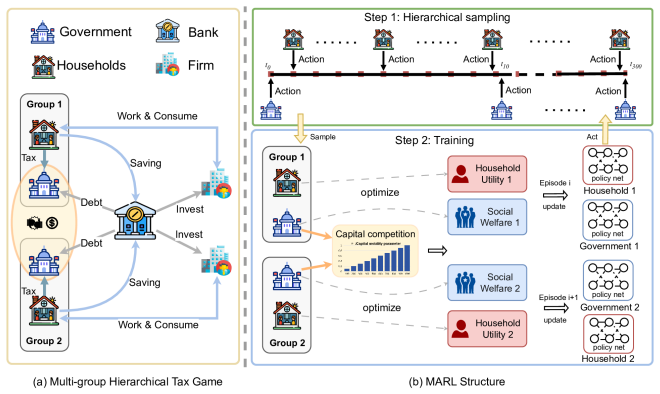
Reinforcement learning has increasingly been applied to economic decision-making, including taxation, public spending, and labor supply. However, existing RL-based economic models typically consider only a single government-household group, overlooking strategic interactions among competing governments. To address this limitation, we formulate taxation as a hierarchical multi-group game. Within each group, the government and households form a leader--follower game, while governments compete across groups through strategic fiscal policies. This coupled structure is difficult to solve using standard multi-agent reinforcement learning (MARL) methods. We therefore propose a bilevel MARL framework with \textit{Curriculum Learning} and a \textit{Closed-Loop Sequential Update} mechanism to improve training stability and convergence. We instantiate the framework in a taxation simulation environment grounded in classical economic models, supporting the evaluation of taxation policies under inter-group competition. Experiments show that the proposed method learns stable and sustainable tax policies. Compared with a two-group baseline without the proposed mechanisms, our approach avoids premature game collapse, extends the effective game duration by 60.92\%, and reduces GDP disparities among governments by 44.12\%.
The emergence of "vibe coding" platforms, where users describe applications in natural language and AI agents autonomously generate full-stack software, has created a need for rigorous evaluation beyond code-level benchmarks. In order to assess them as virtual software development agencies on understanding business requirements, making architectural decisions, writing production code, handling iterative modifications, and maintaining business readiness, we introduce SWE-WebDev Bench, a 68-metric evaluation framework spanning 25 primary and 43 diagnostic metrics across seven groups, organized along three dimensions: Interaction Mode (App Creation Request (ACR) vs. App Modification Request (AMR)), Agency Angle (Product Manager (PM), Engineering, Ops), and Complexity Tier (T4 multi-role SaaS, T5 AI-native).
Our evaluation (six platforms, three domains, 18 evaluation cells) reveals four recurring shortcomings in the current generation of AI app builders: (1) A specification bottleneck, where platforms compress rich business requirements into oversimplified technical plans, (2) A pervasive frontend-backend decoupling, where visually polished UIs mask absent or broken backend infrastructure, (3) A steep production-readiness cliff, where no platform scores above 60% on engineering quality and post-generation human effort varies substantially across platforms and (4) Widespread security and infrastructure failures, with no platform exceeding 65% Security Score against a 90% target and concurrency handling as low as 6%. These observations are descriptive of our sample and require larger-scale replication to establish generality. We release SWE-WebDev Bench as a community benchmark to enable such replication and help platform builders identify and address these gaps.
Code and benchmark resources are available at: https://github.com/snowmountainAi/webdevbench and https://webdevbench.com/.
This paper investigates the autonomous synchronization problem for discrete-time heterogeneous multiagent systems.
The synchronization problem is transformed into the asymptotic decoupling problem of stable modes in a class of discrete-time linear time-varying systems,
for which we provide a sufficient condition.
Leveraging this condition, synchronization conditions are established.
The synchronization conditions are based on the average of the agents' initial dynamic matrices,
without requiring the differences among these matrices to be small.
This approach reduces the conservativeness of existing conditions and achieves a unification of both homogeneous and heterogeneous systems.
Numerical simulation results are provided to support the theoretical findings.
We propose DAO-enabled decentralized physical AI (DePAI), a democratic architecture for coordinating humans and autonomous machines in the operation and governance of physical-digital systems. We (1) synthesize foundations in blockchains, decentralized autonomous organizations (DAOs), and cryptoeconomics; (2) connect DAO design with digital-democracy research on deliberation and voting, showing how each can advance the other; (3) position DAO-governed decentralized physical infrastructure networks (DePIN) within a vertically integrated stack that links energy and sensing to connectivity, storage/compute, models, and robots; (4) show how these elements specify workflows that couple machine execution with human oversight, enabling enhanced self-organization of techno-socio-economic systems, which we call DePAI; and (5) analyze risks, including security, centralization, incentive failure, legal exposure, and the crowding-out of intrinsic motivation, and argue for value-sensitive design and continuously adaptive governance. DePAI offers a path to scalable, resilient self-organization that integrates physical infrastructure, AI, and community ownership under transparent rules, on-chain incentives, and permissionless participation, aiming to preserve human autonomy.
Design choices over which memories persist as shared state determine provenance fidelity, correction pathways, and role preservation beyond
abstractclick to expand
Persistent memory is turning language-model-based agents from stateless participants in isolated interactions into state-bearing components of LLM-based multi-agent systems. As memory becomes durable, reloadable, and behavior-shaping across agents, sessions, or versions, a design question arises that is not captured by retrieval accuracy or access control alone: which candidate memories should become shared institutional state? This Viewpoint frames that problem as governed collaborative memory. We argue that memory governance functions as a selection regime, determining which memory variants persist, which remain private, and which are rejected, abstained from, or superseded. We distinguish ungoverned persistence, constitutional or hybrid selection, automatic metric-based selection, and human-ratified artificial selection, emphasizing that these regimes are not a ranking but a design choice over target properties. We then describe a layered architecture that separates agent-local memory, shared institutional memory, archive memory, and project-continuity memory, with provenance and version lineage making selection inspectable. Documented traces from one running LLM-based multi-agent ecosystem illustrate unmanaged false-memory persistence, ratified institutional memory, rejection and revision, identity-preserving expansion, and governance-as-learning. The contribution is a design agenda: persistent LLM-based multi-agent systems should evaluate memory not only for recall and performance, but also for provenance fidelity, selection traceability, epistemic quality, correction pathways, and role preservation.
Coordinating multi-agent systems over spatially distributed areas requires solving a complex hierarchical problem: first distributing areas among agents (allocation) and subsequently determining the optimal visitation order (routing). Existing methods typically decouple these stages ignoring inter-stage dependencies or rely on decentralized heuristics that lack global context. In this work, we propose a centralized, fully end-to-end auto-regressive framework that jointly generates allocation decisions and routing sequences. The core contribution of our approach is a multi-stage decoding mechanism that unifies high-level allocation and low-level routing in a single autoregressive pass while maintaining a centralized global state. This enables the model to implicitly balance workload distribution with routing efficiency, avoiding local optima common in decentralized methods. Extensive experiments demonstrate that our method significantly outperforms diverse baselines, achieving up to a 20\% improvement in solution quality over industrial solvers such as Google OR-Tools, IBM CPLEX, and LKH-3, while reducing computation time from hours to seconds.
While large language models (LLMs) and coding agents are often applied to user interface (UI) development, developers find it difficult to reliably assess their proficiency in visual and interaction design. Existing evaluations either rely on human experts, who can accurately assess usability by testing critical flows but are slow and costly, or on automated judges, which are scalable but less accurate and opaque. We present FlowEval, a reference-based framework that measures whether a generated UI supports realistic interaction flows by comparing navigation traces from real websites to traces from generated analogs using reference-based similarity metrics (e.g., dynamic time warping). In a small-scale study with expert UI evaluators, we show that reference-based metrics strongly correlate with human judgments, suggesting that they can provide scalable yet trustworthy evaluation for UI generation systems.
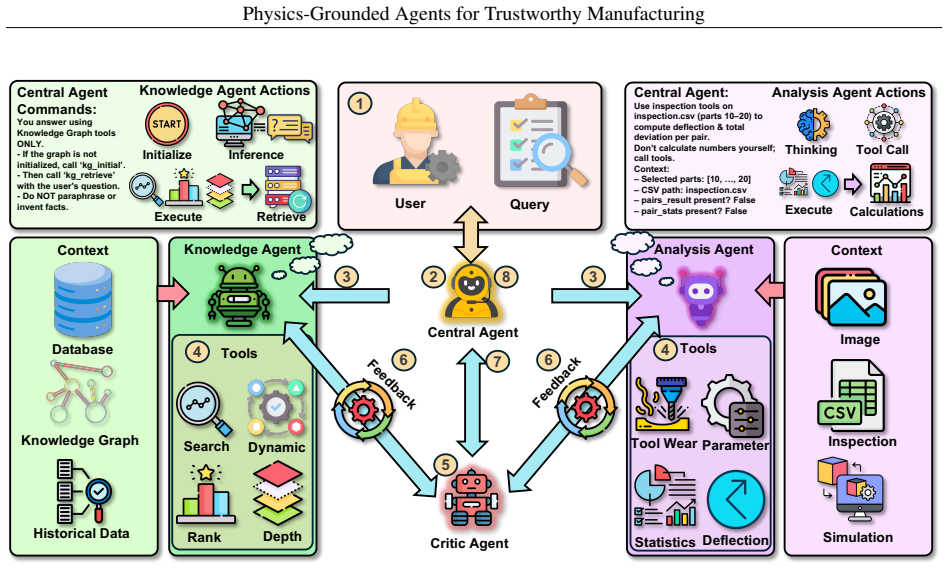
High-precision CNC machining of free-form aerospace components requires bounded compensations informed by inspection, simulation, and process knowledge. Off-the-shelf large language model (LLM) assistants can generate text, but they do not reliably execute risk-constrained multi-step numerical workflows or provide auditable provenance for high-stakes decisions. We present multi-agent knowledge analysis (MAKA), a human-in-the-loop decision-support architecture that separates intent routing, tools-only quantitative analysis, knowledge graph retrieval, and critic-based verification that enforces physical plausibility, safety bounds, and provenance completeness before recommendations are surfaced for human approval. MAKA is instantiated on a Ti-6Al-4V rotor blade machining testbed by fusing virtual-machining path-tracking error fields, cutting-force and deflection simulations, and scan-based 3D inspection deviation maps from 16 blades. The analysis decomposes deviation into an evidence-linked pathing component, a drift-based wear proxy capturing systematic evolution across parts, a residual systematic compliance term, and a variability proxy for instability-aware escalation. In a three-level tool-orchestration benchmark (single-step through $\geq$3-step stateful sequences), MAKA improves successful tool execution by up to 87.5 percentage points relative to an unstructured single-model interaction pattern with identical tool access. Digital twin what-if studies show MAKA can coordinate traceable compensation candidates that reduce predicted surface deviation from order $10^{-2}$in to approximately $\pm 10^{-3}$in over most of the blade within the simulation environment, providing a pre-deployment verification signal for risk-aware human decision-making.
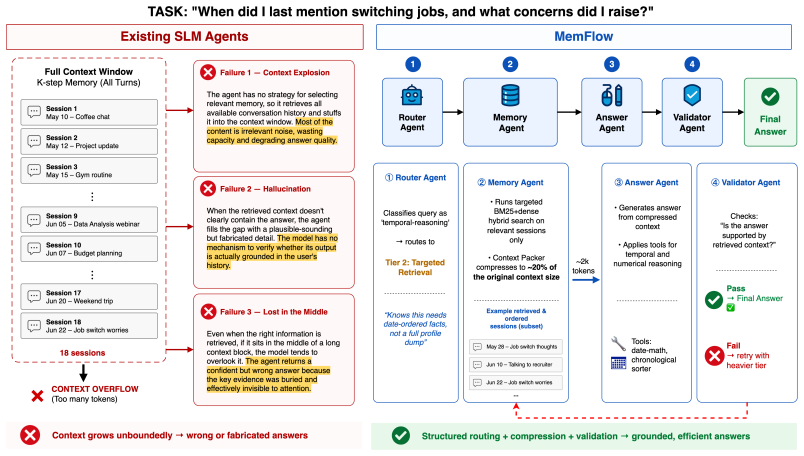
Modern language agents must operate over long-horizon, multi-turn histories, yet deploying such agents with Small Language Models (SLMs) remains fundamentally difficult. Full-context prompting causes context overflow, flat retrieval exposes the model to noisy evidence, and open-ended agentic loops are unreliable under limited reasoning capacity. We argue that a substantial portion of SLM memory failure arises from mismatched memory operations: different query types demand categorically different retrieval strategies, evidence transformations, and context budgets that SLMs cannot reliably self-orchestrate through open-ended reasoning. We introduce MemFlow, a training-free memory orchestration framework that externalizes memory planning from the SLM. A Router Agent classifies each query by intent and dispatches it to the Memory Agent, which executes one of three specialized tiers (Profile Lookup, Targeted Retrieval, or Deep Reasoning) and assembles the resulting evidence under a dynamic, tier-aware token budget. An Answer Agent then generates a response from this compact context, and a Validator Agent optionally retries with a heavier memory tier when the response is not supported by the provided evidence. This route-then-compile design avoids tool-selection hallucination and reasoning loops while keeping the answer context compact. Evaluated on a frozen Qwen3-1.7B backbone across long-horizon memory benchmarks - LongMemEval, LoCoMo, and LongBench - MemFlow improves accuracy by nearly 2x over full-context SLM baselines. These results suggest that structured intent routing and deterministic evidence preparation can make limited-capacity models substantially more effective in resource-constrained long-horizon agents.
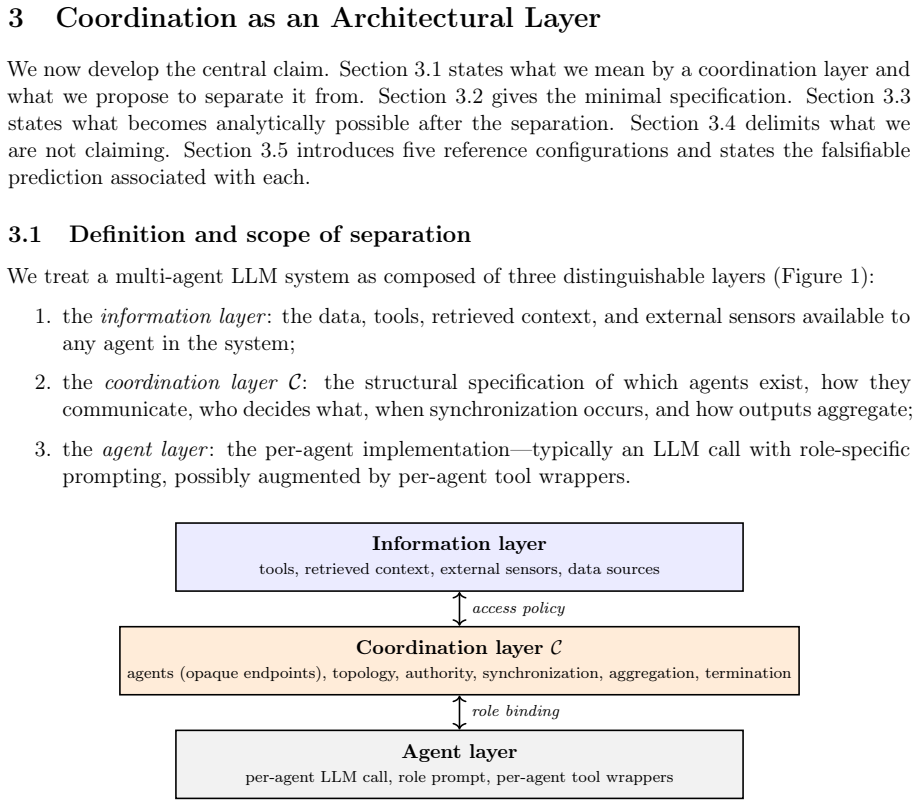
Multi-agent LLM systems fail in production at rates between 41% and 87%, mostly due to coordination defects rather than base-model capability. Existing responses split between cataloguing failure modes empirically and shipping declarative orchestration frameworks as engineering tools; neither delivers a principled mapping from coordination configuration to predictable failure-mode signature. We argue that coordination should be treated as a configurable architectural layer, separable from agent logic and from information access, enabling architectural reasoning rather than only engineering productivity.
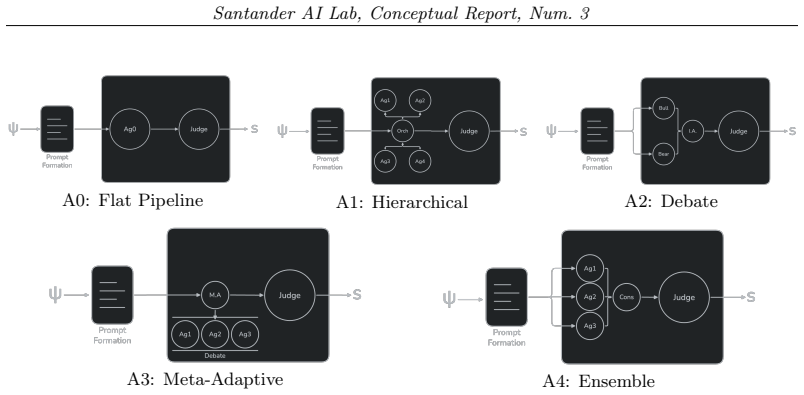
We instantiate this with an information-controlled design on prediction markets: a single LLM, fixed tools, fixed per-call output cap, and fixed prompt template across five reference coordination configurations, with total compute per question treated as an endogenous architectural output. The Murphy decomposition of the Brier score separates calibration from discriminative power, so configurations leave distinguishable signatures even when aggregate scores coincide.
On 100 Polymarket binary markets resolved after the model's training cutoff (claude-opus-4-6) we report Murphy signatures, a cost-quality Pareto frontier, category-conditioned analysis, and a bootstrap power-projection. Three of five pre-specified predictions are upheld in direction; two configurations dominate the Pareto frontier within this regime; exploratory bootstrap intervals separate consensus alignment from others, though pairwise tests do not survive Bonferroni correction at n=100. We also deploy the same configurations as live agents on Foresight Arena under web-search-enabled conditions, as an on-chain replication channel accumulating in parallel. Harness, trace dataset, and production agents are released. We position this as a methodology-validating first instantiation, not a general cross-model claim.
Maintaining robust millimeter-wave (mmWave) connectivity in vehicular networks requires real-time adaptation to environmental dynamics, sensor degradation, and link variability. This paper presents Enwar 3.0, an environment-aware reasoning framework that unifies multi-modal sensing, agentic large language models (LLMs), and context-driven model selection for predictive beamforming, blockage detection, and handover management. Building upon prior iterations of Enwar, the proposed architecture integrates a classifier-driven assessment of sensor health with a primed LLM that orchestrates multiple specialized agents through structured, task-aware prompting. A novel synthetic degradation pipeline enables the training of a sensor degradation classifier that detects real-time impairments across camera, radar, LiDAR, and GPS inputs, achieving over 99% accuracy. The LLM, trained via chain-of-thought (CoT) priming and human-in-the-loop feedback, coordinates agent calls for beam selection, blockage forecasting, and environment perception while dynamically loading sensor-specific models based on environmental context. Extensive evaluations across 15 sensor combinations demonstrate that Enwar 3.0 delivers state-of-the-art performance in both predictive accuracy and interpretability, with beam selection accuracy exceeding 88%, blockage F1-scores surpassing 98%, and reasoning correctness reaching 87% on complex decision prompts. This work establishes a scalable foundation for LLM-integrated wireless systems that reason, perceive, and adapt in real-time.
The increasing penetration of renewable energy has introduced substantial volatility into wholesale electricity markets, complicating the optimal bidding strategies for power producers. Traditional Reinforcement Learning (RL) approaches often struggle to balance profit maximization with risk management, frequently overfitting to specific market conditions or failing to account for the stochastic spread between Day-Ahead (DA) and Real-Time (RT) settlements. To address these challenges, this paper makes two primary contributions. First, we introduce and open-source a high-fidelity gymnasium environment for two-settlement electricity market bidding. Grounded in extensive empirical data from the PJM Interconnection, the environment explicitly models the interplay between DA commitments and RT deviations, providing a standardized testbed for general and risk-sensitive agents. Second, we propose MARS-DA (Multi-Agent Regime-Switching for Day-Ahead markets), a novel hierarchical framework that orchestrates distinct sub-policies for risk management and profit seeking. MARS-DA utilizes a top-level Meta-Controller to dynamically blend the actions of two specialized base agents: a "Safe Agent" that optimizes for reliable DA allocation and a "Speculator Agent" that targets volatile RT arbitrage opportunities. Extensive experiments demonstrate that MARS-DA achieves superior risk-adjusted returns compared to state-of-the-art baselines while maintaining robust regime alignment during periods of extreme market volatility.
Multi-agent LLM systems are increasingly used to solve complex tasks through decomposition, debate, specialization, and ensemble reasoning. However, these systems are usually evaluated in terms of robustness: whether performance is preserved under perturbation. This paper studies a different question: whether semantic stress exposes structured variation that could support future antifragile learning. We introduce CAFE (Cognitive Antifragility Framework for Evaluation), a statistical framework for detecting antifragility-compatible regimes in multi-agent architectures. CAFE models a controlled expected distribution of semantic stressors, reconstructs an architecture-specific observed effective stress distribution from multi-dimensional judge signals, and compares both distributions using a distributional Jensen Gap under a convex stress potential. A positive gap does not imply immediate performance improvement; instead, it indicates a convex-expansive deformation of the observed stress distribution, suggesting that the architecture exposes learnable stress structure. We evaluate CAFE on a banking-risk analysis benchmark with five multi-agent architectures: flat, hierarchical, debate, meta-adaptive, and ensemble. Across all architectures, semantic stress reduces average judged quality by roughly one third. Yet all architectures exhibit positive distributional Jensen Gaps with bootstrap confidence intervals above zero. These results show that immediate quality degradation can coexist with statistically detectable antifragility-compatible stress geometry. CAFE is therefore not an antifragile learner itself, but a measurement layer for identifying when and where antifragility learning may be worth applying.
Large Language Models (LLMs) have transformed agent-agent and human-agent interaction by enabling software, physical, and simulation agents to communicate and deliberate through natural language. Yet fluent language use does not by itself yield socially intelligible behaviour. Most current systems remain weakly grounded in roles, norms, intentions, and contextual constraints, limiting their capacity for meaningful participation in social environments. This paper develops a conceptual baseline for LLM-enabled social agents by arguing that they should be grounded in role definitions operationalized through persona descriptions. On this basis, we outline research directions for representation, hybrid control, and evaluation. The paper concludes that persona-based role definitions are a necessary foundation for turning language competence into social behaviour.
As LLM-based agents are increasingly interacting in multi-party settings, they need to properly handle information asymmetry, i.e., knowing when and to whom to disclose information is appropriate. Yet, existing benchmarks fail to measure this ability in realistic multi-party settings. Thus, we introduce SOTOPIA-TOM, a multi-dimensional benchmarking framework to evaluate LLM agents' ability to successfully navigate information asymmetric and privacy sensitive multi-party interactions. We create an interaction environment which enables both public (broadcast) and private (direct message) communication, and craft 160 human-reviewed scenarios across eight industry sectors, each involving 3 to 5 agents with partitioned private knowledge and channel-dependent sharing policies. To measure interaction abilities, we create a multi-dimensional evaluation framework to assess how well agents share useful information, seek missing details, coordinate efficiently, and protect privacy, which we also combine into a composite INFOMGMT metric. Results show that, across 6 LLM backbones and prompting strategies (vanilla, CoT-privacy, and ToM-based interventions), even the largest high-reasoning model (GPT-5) reaches only a 62% INFOMGMT score, which indicates persistent deficiencies in information seeking and privacy-aware decision-making. Additionally, ToM-based interventions more consistently improve the overall coordination-privacy balance (for example, relative to the vanilla baseline, ToM-Coach reduces critical privacy violations on GPT-4o from 9.9% to 2.2% while increasing the composite InfoMgmt score more than 2.5x from 15% to 40%). Overall, SOTOPIA-TOM exposes persistent limitations of current LLM agents in complex, information-asymmetric coordination and provides an extensible testbed for developing more privacy-aware, theory-of-mind capable multi-agent systems.
We present Coopetition-Gym v1, a benchmark platform for mixed-motive multi-agent reinforcement learning under strategic coopetition. The platform comprises twenty environments organized into four mechanism classes that correspond to four foundational technical reports: interdependence and complementarity (arXiv:2510.18802), trust and reputation dynamics (arXiv:2510.24909), collective action and loyalty (arXiv:2601.16237), and sequential interaction and reciprocity (arXiv:2604.01240). Each environment carries a closed-form payoff structure and a calibrated interdependence matrix derived from the corresponding report.
Every environment exposes a parameterized reward layer configurable across three structurally distinct modes (private, integrated, cooperative). This separation of payoff from reward enables reward-type ablation, the platform's principal methodological apparatus. Four of the twenty environments are calibrated against historically documented coopetitive relationships and reproduce their outcomes at 98.3, 81.7, 86.7, and 87.3 percent on the validation rubric (Samsung-Sony LCD, Renault-Nissan Alliance, Apache HTTP Server, Apple iOS App Store).
The platform exposes Gymnasium, PettingZoo Parallel, and PettingZoo AEC interfaces and ships 126 reference algorithms: 16 learning algorithms, 7 game-theoretic oracles, 2 heuristic baselines, and 101 constant-action policies. A reference experimental study trained the 16 learning algorithms on every environment under every reward configuration with seven random seeds, producing a 25,708-run training corpus and a 1,116-run behavioral audit corpus, both released under CC-BY-4.0 with Croissant 1.0 metadata. Coopetition-Gym v1 is the first platform to combine continuous-action mixed-motive environments, parameterized reward mutuality, calibrated interdependence coefficients, game-theoretic oracle baselines, and validated case studies.
Cooperative multi-agent reinforcement learning (MARL) requires agents to discover joint strategies in a combinatorially large state-action space, yet effective coordination configurations are exceedingly rare. Intrinsic motivation, which augments task rewards with novelty bonuses, is a popular approach for driving exploration, but its effectiveness hinges on the exploration intensity $\beta$, where too large a value overwhelms the task signal and causes coordination collapse, while too small a value prevents discovery of rare strategies. We address two complementary challenges: adapting $\beta$ globally over training, and allocating the exploration budget across agents whose intrinsic reward signals vary in reliability. Our framework combines a return-conditioned sigmoid schedule (RCB) for global intensity control with a per-agent Reward Signal Quality (RSQ) metric that concentrates the exploration budget on agents with reliable signals. The core insight is that agents receiving noisy intrinsic rewards should explore less aggressively, and this allocation can be determined automatically from signal-to-noise statistics. Successor Distance (SD), a quasimetric intrinsic reward, naturally produces distinguishable per-agent signal quality, completing the framework with convergence and ordering preservation guarantees. On seven cooperative benchmarks (MPE, SMAX, MABrax), our method achieves top-tier returns across all environments.
A key challenge in multi-agent reinforcement learning (MARL) lies in designing learning signals that effectively promote coordination among agents. Designing such signals requires estimating how one agent's current action affects its teammates over future interaction steps. To address this, we introduce Multi-step Advantage-Gated Interventional Causal MARL (MAGIC), a framework that estimates multi-step action effects between agents and selectively converts them into intrinsic rewards. MAGIC uses counterfactual action interventions to compare teammate futures under factual and counterfactual branches, and introduces a gate based on advantage to direct exploration toward beneficial behaviors aligned with the task goal. Experiments on Multi-Agent Particle Environments (MPE) and StarCraft micromanagement benchmarks (SMAC and SMACv2) show that MAGIC consistently outperforms leading prior methods, with average relative final performance improvements of 26.9% and 10.1%, respectively.
This paper presents a Koopman-based framework for early outbreak detection and intervention selection in a multi-agent epidemic simulation. Agents exhibit mobility patterns, heterogeneous susceptibility, immunity-dependent viral load progression, and local transmission through co-location. The goal of the simulation is to study near-critical epidemic regimes in which small changes in exposure or timing can alter the final outcome. Aggregate daily observables from early trajectory windows are encoded into a low-dimensional Koopman latent space whose approximately linear evolution supports short-horizon forecasting and outbreak risk estimation. These representations are combined with a random forest classifier trained to predict whether the final attack rate exceeds a major outbreak threshold. Experiments near the system tipping points show strong early warning performance, with Koopman-derived features contributing to class separation. Counterfactual analysis further shows that minimal interventions, such as keeping a single selected agent at home for one day, can reduce attack rates and, often, shift the trajectory below the outbreak threshold.
Grounding is the collaborative process of establishing mutual belief sufficient for a communicative goal. While static grounding maps language to a shared context, dynamic grounding requires agents to negotiate meaning across turns. Current multi-agent Large Language Model (LLM) benchmarks largely emphasize static, one-shot tasks, overlooking whether agents can repair grounding breakdowns through interaction. We introduce an iterated multi-turn negotiation game where two agents allocate shared resources to private projects with verifiable jointly optimal outcomes. Although individual agents can identify Pareto-optimal allocations in isolation, agent dyads consistently fail to reach them across models. We identify four failure modes: (1) loss of shared interaction history, (2) stubborn anchoring to early proposals, (3) defaulting to equal splits over reward-maximizing coordination, and (4) referential binding errors across turns. Our baselines show that the coordination gap is not explained by individual reasoning limits or insufficient information exchange alone. Instead, the bottleneck lies in dynamic grounding: joint plan formation, commitment, and execution.
Creators say the tool has matured enough for real-life decision systems that need zero programming.
abstractclick to expand
This paper presents the rAIson platform, a high-level technological environment for the development of automated, reliable and explainable decision-making agents. The research underlying the platform and its technological progress has now reached a mature stage that allows the platform to be used for the development of complex real-life applications without writing a single line of code.
In the envisioned future dense urban airspace, multiple companies will operate heterogeneous fleets of small unmanned aerial systems (sUASs), where each fleet includes several homogeneous aircraft with identical policies and configurations, e.g., equipage, sensing, and communication ranges, making tactical deconfliction highly complex for the aircraft. This paper aims to address two core questions: (1) Can tactical deconfliction policies converge or reach an equilibrium to ensure a conflict-free airspace when companies operate heterogeneous fleets of homogeneous aircraft? (2) If so, will the converged policies discriminate against companies operating sUASs with weaker configurations? We investigate a multi-agent reinforcement learning paradigm in which homogeneous aircraft within heterogeneous fleets operate concurrently to perform package delivery missions over Dallas, Texas, USA. An attention-enhanced Proximal Policy Optimization-based Advantage Actor-Critic (PPOA2C) framework is employed to resolve intra- and inter-fleet conflicts, with each fleet independently training its own policy while preserving privacy. Experimental results show that two fleets with distinct, shared PPOA2C policies can reach an equilibrium to maintain safe separation. While two PPOA2C policies outperform two strong rule-based baselines in terms of conflict resolution, a PPOA2C policy exhibits safer interaction with a rule-based policy, indicating adaptive capabilities of PPOA2C policies. Furthermore, we conducted extensive policy-configuration evaluations, which reveal that equilibria between similar policy types tend to favor fleets with stronger configurations. Even under similar configurations but different policy types, the equilibrium favors one of the heterogeneous policies, underscoring the need for fairness-aware conflict management in heterogeneous sUAS operations.
Distributed blackbox consensus optimization is a fundamental problem in multi-agent systems, where agents must improve a global objective using only local objective queries and limited neighbor communication. Existing methods largely rely on handcrafted update rules and static cooperation patterns, which often struggle to balance local adaptation, global coordination, and communication efficiency in heterogeneous nonconvex environments. In this paper, we take an initial step toward trajectory-driven self-design for distributed black-box consensus optimization. We first redesign the agent-level swarm dynamics with an adaptive internal mechanism tailored to decentralized consensus settings, improving the balance between exploration, convergence, and local escape. Built on top of this adaptive execution layer, we propose Learning to Act and Cooperate (LACMAS), a trajectorydriven framework in which large language models provide sparse highlevel guidance for shaping both agentinternal action behaviors and agentexternal cooperation patterns from historical optimization trajectories. We further introduce a phased cognitive scheduling strategy to activate different forms of adaptation in a resource-aware manner. Experiments on standard distributed black-box benchmarks and real-world distributed tasks show that LAC-MAS consistently improves solution quality, convergence efficiency, and communication efficiency over strong baselines, suggesting a practical route from handcrafted distributed coordination toward self-designing multi-agent optimization systems.
The growing relevance of multi-agent systems has drawn increasing focus on communication-efficient filters for collaborative perception to alleviate the system's communication burden. While the event-triggered (ET) mechanism can improve communication efficiency in collaborative state estimation, an inevitable trade-off exists between estimation accuracy and communication cost in ET filters. This paper proposes a fast and accurate ET diffusion-based filter for real-time multi-agent collaborative target tracking, aiming to reduce the system's data transmission without compromise in tracking performance. The proposed filter achieves improved tracking accuracy, reduced data transmission, and accelerated convergence using an error-minimized ET cubature information filter (CIF) for local estimation, and a correlation-aware diffusion strategy for global fusion. The experimental results confirm the scalability of the proposed EDC-CIF algorithm and demonstrate its efficacy in simultaneously reducing estimation error and computation time while significantly enhancing communication efficiency.