REVIEW 3 major objections 5 minor 101 references
Mining Evidence about Your Symptoms: Mitigating Availability Bias in Online Self-Diagnosis
T0 review · 3 major / 5 minor · reviewed 2026-08-10 · deepseek-v4-flash
Pith's one-line read This paper claims that chatbot symptom checkers that ask users to justify their symptoms with concrete evidence, or to think about times the symptom is absent, can counteract the symptom overestimation that follows exposure to relatable…
desk verdict A genuinely interesting counterintuitive finding about neutral content and availability bias, wrapped in a study whose central intervention claim relies on unverified chatbot behavior. read the letter →
The pith
A machine-rendered reading of the paper's core claim, the machinery that carries it, and where it could break.
The reading
What carries the argument
The load-bearing mechanism is a conversational symptom checker built on GPT-4 that asks follow-up questions instead of presenting a fixed form. Evidence Reflection prompts the user, when they report a symptom, to describe the specific circumstances and concrete details supporting that report, until sufficient context is provided. Counterfactual Thinking prompts the user who says a symptom occurs to also consider how often and under what circumstances it does not occur, forcing them to compare against absence. Both strategies shift the user from System 1 heuristics, where whatever comes to mind dominates, to System 2 analytical reasoning, which is the theorized route through which availability bias is interrupted. The plain chatbot without these strategies served as a control to isolate the effect of conversation itself.
What would settle it
Record and code the actual chatbot turns: if an audit shows that the Evidence Reflection bot rarely asked for concrete evidence, or that the Counterfactual Thinking bot rarely posed absence-of-symptom questions, then the observed reductions in social-media influence and the absence of inattention-score inflation cannot be attributed to those cognitive interventions; they could be due to conversational engagement or longer time on task.
Extended reading notes
Core claim
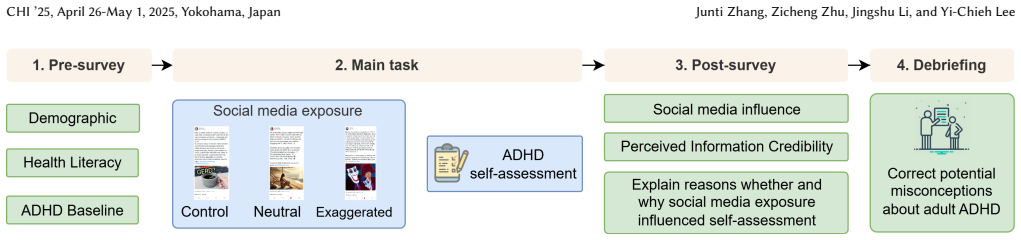
On the paper's own terms, the central discovery is that availability bias in online self-diagnosis is triggered primarily by content resonance rather than exaggeration, and that the bias can be reversed at the point of self-assessment by cognitive-intervention question strategies. In Study 1, participants who read neutral, relatable social media posts about adult ADHD reported stronger social media influence on their symptom assessment and produced significantly higher inattention and hyperactivity scores than controls; participants who read exaggerated posts did not differ from controls. Qualitative responses showed the mechanism: resonant posts made people recognize their own experiences and recall similar symptoms, causing them to disregard their own evidence. In Study 2, a chatbot with an Evidence Reflection strategy and a chatbot with a Counterfactual Thinking strategy both significantly reduced the self-reported influence of social media relative to a static questionnaire, and eliminated the significant baseline-to-post increase in inattention scores that appeared in the static-questionnaire and plain-chatbot conditions. The authors conclude that CSCs with cognitive intervention strategies mitigate availability bias by guiding users into evidence-based reflective thinking.
Load-bearing premise
The central claim breaks if the GPT-4 chatbots did not actually follow their evidence-reflection and counterfactual-thinking scripts, since the study provides no transcript-level check of what the bots said.
Editorial extensions
If this is right
- Static questionnaire symptom checkers are a vulnerable format: in this study they left social-media-induced inattention-score inflation intact, so designers should not assume a well-validated scale alone protects users.
- A plain conversational wrapper is not enough; only the two chatbots with active cognitive-intervention questions reduced social media influence and removed the inattention-score jump, pointing to the question design as the active ingredient.
- Evidence Reflection and Counterfactual Thinking can be added to existing chatbot symptom checkers without changing the underlying medical questions, making them a cheap bias-mitigation layer for online self-diagnosis.
- The bias reduction came with higher self-reported mental effort, so these designs will face a usability trade-off: slower, more demanding reflection versus faster but more biased self-assessment.
Reading between the lines
- An extension the authors leave implicit: recommendation algorithms that surface accurate, relatable health stories should be treated as a distinct bias risk, because Study 1 suggests resonance, not exaggeration, is what inflates self-assessed symptoms.
- I would predict the same two chatbot strategies will suppress availability bias for other ambiguous, common conditions such as chronic Lyme, migraine, or irritable bowel syndrome, since the mechanism is the ease-of-recall heuristic rather than anything ADHD-specific.
- A stricter test of the claimed mechanism would track whether the chatbot's follow-up questions change downstream behavior, such as actual symptom diaries or healthcare visits, rather than relying only on self-report scales, which can be affected by wanting to appear thoughtful to the bot.
Editorial analysis
A structured set of objections, weighed in public.
Referee Report
Summary. The paper addresses availability bias in online self-diagnosis. Study 1 (N=104) compares a control condition with exposure to neutral and exaggerated social media posts about adult ADHD, finding that neutral content increases self-reported social media influence and symptom overestimation, while exaggerated content does not. Study 2 (N=100) compares a static questionnaire, a plain chatbot-based symptom checker (CSC), a CSC with an Evidence Reflection strategy, and a CSC with a Counterfactual Thinking strategy, reporting that the two cognitive-intervention CSCs reduce self-reported social media influence and prevent significant increases in inattention scores. The authors interpret these results as evidence that CSCs with cognitive interventions mitigate availability bias, and they discuss design implications for online diagnostic tools and social media platforms.
Significance. If the results hold, the paper makes a practical contribution to the design of chatbot-based symptom checkers and provides useful evidence about how resonant social media content triggers availability bias. The work has clear strengths: explicit hypotheses, power calculations, established instruments (SNAP-IV, ASRS, NVS, SRIS, NASA-TLX), manipulation checks, inter-coder reliability for qualitative coding, and two complementary studies. The finding that neutral, relatable content can be more influential than exaggerated content is interesting and well supported by the qualitative data. However, the central quantitative claims are currently weakened by several internal statistical inconsistencies, and the attribution of Study 2's effects to the specific cognitive interventions rests on an unverified assumption about chatbot fidelity.
major comments (3)
- [§4.2 and Table 1] The text and Table 1 report conflicting p-values for the pairwise comparisons that support H1.a and H2.a. In §4.2, the Control-vs-Neutral comparison for social media influence is reported as p = 0.22* with Cohen's D = -0.65, while Table 1 gives p = 0.022 for the same comparison; these values lead to opposite conclusions at the 0.05 level. In §4.3.1, the Control-vs-Neutral inattention comparison is reported as p < 0.001 in the text but p = 0.012 in Table 1, and the hyperactivity comparison is reported as p = 0.05* in the text but p = 0.47 in Table 1. Because the support for H1.a and H2.a depends directly on these comparisons, the authors must reconcile the reported statistics and restate which hypotheses are actually supported. The same issue appears in the §4.1 manipulation checks (p = 0.008 vs p = 0.004 for accuracy; p = 0.016 vs p = 0.009 for trustworthiness).
- [§6, first paragraph; §5.1.3 and §5.1.4] The claim that the Evidence Reflection and Counterfactual Thinking strategies, rather than the general conversational properties of the chatbot, drove the observed reductions in social media influence rests on the single assertion that "the AI agent adhered to our instructions." No transcripts, fidelity coding, deviation counts, or inter-rater assessment of dialogue behavior are provided. Because the ER and CT conditions also changed the length, structure, and required response format of the interaction compared with the plain CSC, the intended cognitive mechanisms are confounded with conversational style and effort. The authors should provide a fidelity audit of a sample of conversations (for example, adherence rates per strategy component and representative transcripts in an appendix), or explicitly weaken the causal attribution to the specific strategies.
- [§6.2] The conclusion that ER and CT "were effective in addressing the overestimation of inattention scores" is based on the absence of a statistically significant within-group increase in those conditions, not on a significant difference from the control or plain CSC conditions. A null result in paired tests of this size is weak evidence of effectiveness, especially when the comparable between-condition comparisons are not reported. The authors should either report equivalence bounds or Bayes factors for the pre-post changes, or soften the claim to state that no significant overestimation was detected rather than that the interventions were effective.
minor comments (5)
- [§3.6] The sentence "To compare the outcomes of the four types of health information" appears to refer to the three experimental conditions in Study 1; please correct the count.
- [§4.3.1] The heading "Exaggerated content did not led to overestimation of symptoms" contains a grammatical error; "led" should be "lead."
- [§5.1.1] The phrase "an diagnostic result" should be "a diagnostic result."
- [§6.2] The sentence "This indicates that both treatments with cognitive strategy was effective" has subject-verb agreement problems; it should read "both treatments with cognitive strategies were effective."
- [Throughout] Effect sizes are reported inconsistently as "Cohen's D" in some places and "Cohen's d" in others; please standardize the notation and use the same form in text, tables, and figures.
Circularity Check
No significant circularity: the paper reports two independent empirical studies; no parameters are fitted, no derivation is reduced to its inputs, and the disconfirmed hypotheses H1.b/H2.b indicate the analysis is not constructed after the fact.
full rationale
This is an empirical HCI paper, not a derivation or prediction-from-model paper. Study 1 tests how neutral versus exaggerated social media content affects self-assessment; Study 2 tests three chatbot designs against a static questionnaire. There is no fitted parameter renamed as a prediction, no equation whose output is identical to its input, and no load-bearing self-citation chain: the authors cite their own prior work (Lee et al. 2020) only as background motivation for chatbot self-disclosure, not as the evidence for the current findings. The Study 2 interventions are informed by Study 1's qualitative themes, but the evaluation uses new participants, new outcome measures, and pre-specified comparisons, so the design-informed-by-prior-study relationship is not circular. The fact that H1.b and H2.b were not supported further shows the results were not constructed to match expectations. The only flagged concern, that Section 6 asserts 'the AI agent adhered to our instructions' without transcript-level fidelity auditing, is a validity and reproducibility limitation about whether the chatbot implemented the intended cognitive strategies; it does not make the empirical claim equivalent to its inputs by definition or by self-citation, so it does not constitute circularity under the specified criteria.
Assumptions & free parameters
assumptions (4)
- domain assumption The ASRS and adapted SRIS self-report instruments validly measure ADHD symptoms and social media influence, respectively.
- domain assumption Exposure to five simulated social media posts in a lab setting produces an availability bias comparable to real-world repeated exposure.
- ad hoc to paper The researcher-defined criteria for neutral and exaggerated posts are valid and produce stimuli that differ only in the intended way.
- ad hoc to paper GPT-4-based chatbots implemented the Evidence Reflection and Counterfactual Thinking interventions faithfully according to the prompts.
Cite this review
Pith. "Pith review of Mining Evidence about Your Symptoms: Mitigating Availability Bias in Online Self-Diagnosis." pith.science (2026). https://pith.science/paper/WH76NHF7
@misc{pith2026250115028,
  author       = {Pith},
  title        = {Pith review of: Mining Evidence about Your Symptoms: Mitigating Availability Bias in Online Self-Diagnosis},
  year         = {2026},
  howpublished = {\url{https://pith.science/paper/WH76NHF7}},
  note         = {Machine review of arXiv:2501.15028}
}
read the original abstract
People frequently exposed to health information on social media tend to overestimate their symptoms during online self-diagnosis due to availability bias. This may lead to incorrect self-medication and place additional burdens on healthcare providers to correct patients' misconceptions. In this work, we conducted two mixed-method studies to identify design goals for mitigating availability bias in online self-diagnosis. We investigated factors that distort self-assessment of symptoms after exposure to social media. We found that availability bias is pronounced when social media content resonated with individuals, making them disregard their own evidences. To address this, we developed and evaluated three chatbot-based symptom checkers designed to foster evidence-based self-reflection for bias mitigation given their potential to encourage thoughtful responses. Results showed that chatbot-based symptom checkers with cognitive intervention strategies mitigated the impact of availability bias in online self-diagnosis.
Figures


Figures from the paper (5 more)


Reference graph
Works this paper leans on
-
[1]
Elie Abdelnour, Madeline O Jansen, and Jessica A Gold. 2022. ADHD diagnostic trends: increased recognition or overdiagnosis? Missouri medicine 119, 5 (2022), 467
2022
-
[2]
Ramez M Alkoudmani, Guat See Ooi, and Mei Lan Tan. 2023. Implementing a chatbot on Facebook to reach and collect data from thousands of health care providers: PharmindBot as a case.Journal of the American Pharmacists Association 63, 5 (2023), 1634–1642
2023
-
[3]
Darren Scott Appling, Erica J Briscoe, and Clayton J Hutto. 2015. Discriminative models for predicting deception strategies. InProceedings of the 24th international conference on world wide web . 947–952
2015
-
[4]
Nancy D Berkman, Terry C Davis, and Lauren McCormack. 2010. Health literacy: what is it? Journal of health communication 15, S2 (2010), 9–19
2010
-
[5]
Joseph Biederman, Stephen V Faraone, Thomas J Spencer, Eric Mick, Michael C Monuteaux, Megan Aleardi, et al. 2006. Functional impairments in adults with self- reports of diagnosed ADHD: A controlled study of 1001 adults in the community. Journal of Clinical Psychiatry 67, 4 (2006), 524–540
2006
-
[6]
Nattapat Boonprakong, Xiuge Chen, Catherine Davey, Benjamin Tag, and Tilman Dingler. 2023. Bias-Aware Systems: Exploring Indicators for the Occurrences of Cognitive Biases When Facing Different Opinions. In Proceedings of the 2023 CHI Conference on Human Factors in Computing Systems . 1–19
2023
-
[7]
Zana Buçinca, Maja Barbara Malaya, and Krzysztof Z Gajos. 2021. To trust or to think: cognitive forcing functions can reduce overreliance on AI in AI-assisted decision-making. Proceedings of the ACM on Human-computer Interaction 5, CSCW1 (2021), 1–21
2021
-
[8]
Maria Caiata-Zufferey and Peter J Schulz. 2012. Physicians’ communicative strategies in interacting with Internet-informed patients: results from a qualitative study. Health communication 27, 8 (2012), 738–749
2012
Show all 101 references
-
[9]
JN Cappella, M Fishbein, R Hornik, RK Ahern, and S Sayeed. 2001. Using theory to select messages in antidrug media campaigns: Reasoned action and media priming. Public communication campaigns 3 (2001), 213–30
2001
-
[10]
E Moulton Carol-anne, Glenn Regehr, Maria Mylopoulos, and Helen M MacRae
-
[11]
Chunlei Chang, Benjamin Bach, Tim Dwyer, and Kim Marriott. 2017. Evaluating perceptually complementary views for network exploration tasks. In Proceedings of the 2017 CHI conference on human factors in computing systems . 1397–1407
2017
-
[12]
Jiawei Chen, Hande Dong, Xiang Wang, Fuli Feng, Meng Wang, and Xiangnan He. 2023. Bias and debias in recommender system: A survey and future directions. ACM Transactions on Information Systems 41, 3 (2023), 1–39
2023
-
[13]
Kevin Corti and Alex Gillespie. 2016. Co-constructing intersubjectivity with artificial conversational agents: People are more likely to initiate repairs of misunderstandings with agents represented as human. Computers in Human Behavior 58 (2016), 431–442
2016
-
[14]
Pat Croskerry. 2003. Cognitive forcing strategies in clinical decision making. Annals of emergency medicine 41, 1 (2003), 110–120
2003
-
[15]
Pat Croskerry. 2003. The importance of cognitive errors in diagnosis and strate- gies to minimize them. Academic medicine 78, 8 (2003), 775–780
2003
-
[16]
C Daigre, JA Ramos-Quiroga, S Valero, R Bosch, C Roncero, B Gonzalvo, M Nogueira, and M Casas. 2009. Adult ADHD Self-Report Scale (ASRS-v1. 1) symptom checklist in patients with substance use disorders. Actas españolas de psiquiatría 37, 6 (2009), 299–305
2009
-
[17]
Valdemar Danry, Pat Pataranutaporn, Yaoli Mao, and Pattie Maes. 2023. Don’t just tell me, ask me: Ai systems that intelligently frame explanations as questions improve human logical discernment accuracy over causal ai explanations. In Proceedings of the 2023 CHI Conference on ...
2023
-
[18]
Shai Davidai and Thomas Gilovich. 2016. The headwinds/tailwinds asymmetry: An availability bias in assessments of barriers and blessings.Journal of personality and social psychology 111, 6 (2016), 835
2016
-
[19]
Tilman Dingler, Ashris Choudhury, and Vassilis Kostakos. 2018. Biased Bots: Conversational Agents to Overcome Polarization. In Proceedings of the 2018 ACM International Joint Conference and 2018 International Symposium on Pervasive and Ubiquitous Computing and Wearable Compute...
2018
-
[20]
John W Ely, Mark L Graber, and Pat Croskerry. 2011. Checklists to reduce diagnostic errors. Academic Medicine 86, 3 (2011), 307–313
2011
-
[21]
Adam M Enders, Joseph E Uscinski, Casey Klofstad, and Justin Stoler. 2020. The different forms of COVID-19 misinformation and their consequences. The Harvard Kennedy School Misinformation Review (2020)
2020
-
[22]
Annabel Farnood, Bridget Johnston, and Frances S Mair. 2020. A mixed methods systematic review of the effects of patient online self-diagnosing in the ‘smart- phone society’on the healthcare professional-patient relationship and medical authority. BMC Medical Informatics and D...
2020
-
[23]
Andrew J Flanagin and Miriam J Metzger. 2000. Perceptions of Internet infor- mation credibility. Journalism & mass communication quarterly 77, 3 (2000), 515–540
2000
-
[24]
Susan Shur-Fen Gau, Chien-Ho Lin, Fu-Chang Hu, Chi-Yung Shang, James M Swanson, Yu-Chih Liu, and Shih-Kai Liu. 2009. Psychometric properties of the Chinese version of the Swanson, Nolan, and Pelham, version IV scale-Teacher Form. Journal of pediatric psychology 34, 8 (2009), 850–861
2009
-
[25]
X Gocko, P Tattevin, and C Lemogne. 2021. Genesis and dissemination of a controversial disease: Chronic Lyme. Infectious Diseases Now 51, 1 (2021), 86–89
2021
-
[26]
Lisa Neal Gualtieri. 2009. The doctor as the second opinion and the internet as the first. In CHI ’09 Extended Abstracts on Human Factors in Computing Systems (Boston, MA, USA) (CHI EA ’09) . Association for Computing Machinery, New York, NY, USA, 2489–2498. https://doi.org/10...
2009
-
[27]
Sandra G Hart. 2006. NASA-task load index (NASA-TLX); 20 years later. In Proceedings of the human factors and ergonomics society annual meeting , Vol. 50. Sage publications Sage CA: Los Angeles, CA, 904–908
2006
-
[28]
Andrew F Hayes and Jacob J Coutts. 2020. Use omega rather than Cronbach’s alpha for estimating reliability. But. . . .Communication Methods and Measures 14, 1 (2020), 1–24
2020
-
[29]
Beth L Hoffman, Elizabeth M Felter, Kar-Hai Chu, Ariel Shensa, Chad Hermann, Todd Wolynn, Daria Williams, and Brian A Primack. 2019. It’s not all about autism: The emerging landscape of anti-vaccination sentiment on Facebook. Vaccine 37, 16 (2019), 2216–2223
2019
-
[30]
Robert C Hornik. 2002. Exposure: Theory and evidence about all the ways it matters. Social Marketing Quarterly 8, 3 (2002), 31–37
2002
-
[31]
Kathleen Hall Jamieson and Dolores Albarracin. 2020. The relation between media consumption and misinformation at the outset of the SARS-CoV-2 pandemic in the US. The Harvard Kennedy School Misinformation Review (2020)
2020
-
[32]
James Johnson. 2022. Counterfactual thinking & nuclear risk in the digital age: The role of uncertainty, complexity, chance, and human psychology. Journal for Peace and Nuclear Disarmament 5, 2 (2022), 394–421
2022
-
[33]
Daniel Kahneman. 2011. Thinking, fast and slow . macmillan
2011
-
[34]
Daniel Kahneman. 2014. Varieties of counterfactual thinking. In What might have been. Psychology Press, 387–408
2014
-
[35]
Naveena Karusala and Richard Anderson. 2022. Towards Conviviality in Navigat- ingHealth Information on Social Media. In Proceedings of the 2022 CHI Conference on Human Factors in Computing Systems . 1–14
2022
-
[36]
Soomin Kim, Joonhwan Lee, and Gahgene Gweon. 2019. Comparing data from chatbot and web surveys: Effects of platform and conversational style on survey response quality. In Proceedings of the 2019 CHI conference on human factors in computing systems. 1–12
2019
-
[37]
Holly Korda and Zena Itani. 2013. Harnessing social media for health promotion and behavior change. Health promotion practice 14, 1 (2013), 15–23
2013
-
[38]
Liliana Laranjo, Amaël Arguel, Ana L Neves, Aideen M Gallagher, Ruth Kaplan, Nathan Mortimer, Guilherme A Mendes, and Annie YS Lau. 2015. The influence of social networking sites on health behavior change: a systematic review and meta-analysis. Journal of the American Medical ...
2015
-
[39]
LMDS Lavorgna, Manuela De Stefano, Maddalena Sparaco, Marcello Moccia, Gianmarco Abbadessa, Patrizia Montella, Daniela Buonanno, Sabrina Esposito, Marinella Clerico, Cristina Cenci, et al. 2018. Fake news, influencers and health- related professional participation on the Web: ...
2018
-
[40]
I hear you, I feel you
Yi-Chieh Lee, Naomi Yamashita, Yun Huang, and Wai Fu. 2020. " I hear you, I feel you": encouraging deep self-disclosure through a chatbot. In Proceedings of the 2020 CHI conference on human factors in computing systems . 1–12
2020
-
[41]
Brenna Li. 2024. Designing Conversational Agents to Facilitate Patient-Physician Communication and Clinical Consultation. In Extended Abstracts of the CHI Conference on Human Factors in Computing Systems . 1–5
2024
-
[42]
Brenna Li, Ofek Gross, Noah Crampton, Mamta Kapoor, Saba Tauseef, Mohit Jain, Khai N Truong, and Alex Mariakakis. 2024. Beyond the Waiting Room: Patient’s Perspectives on the Conversational Nuances of Pre-Consultation Chatbots. In Proceedings of the CHI Conference on Human Fac...
2024
-
[43]
Ping Li, Zi yan Cheng, and Gui lin Liu. 2020. Availability bias causes misdiagnoses by physicians: direct evidence from a randomized controlled trial. Internal Medicine 59, 24 (2020), 3141–3146
2020
-
[44]
Yuelin Li, Zhenjia Fan, Xiaojun Yuan, and Xiu Zhang. 2022. Recognizing fake information through a developed feature scheme: a user study of health misin- formation on social media in China. Information Processing & Management 59, 1 (2022), 102769
2022
-
[45]
Sahil Loomba, Alexandre De Figueiredo, Simon J Piatek, Kristen De Graaf, and Heidi J Larson. 2021. Measuring the impact of COVID-19 vaccine misinformation on vaccination intent in the UK and USA. Nature human behaviour 5, 3 (2021), 337–348
2021
-
[46]
Romain Lutaud, Pierre Verger, Patrick Peretti-Watel, and Carole Eldin. 2022. When the patient is making the (wrong?) diagnosis: a biographical approach to patients consulting for presumed Lyme disease. Family Practice (2022)
2022
-
[47]
Xiya Ma, Dominique Vervoort, and Jessica GY Luc. 2020. When misinformation goes viral: access to evidence-based information in the COVID-19 pandemic. Journal of Global Health Science 2, 1 (2020)
2020
-
[48]
Sílvia Mamede, Marco Antonio de Carvalho-Filho, Rosa Malena Delbone de Faria, Daniel Franci, Maria do Patrocinio Tenorio Nunes, Ligia Maria Cayres Ribeiro, Julia Biegelmeyer, Laura Zwaan, and Henk G Schmidt. 2020. ‘Immunis- ing’physicians against availability bias in diagnosti...
2020
-
[49]
SÝlvia Mamede, Tamara van Gog, Kees van den Berge, Remy MJP Rikers, Jan LCM van Saase, Coen van Guldener, and Henk G Schmidt. 2010. Effect of availability bias and reflective reasoning on diagnostic accuracy among internal medicine residents. Jama 304, 11 (2010), 1198–1203
2010
-
[50]
Sílvia Mamede, Tamara Van Gog, Kees Van Den Berge, Jan LCM Van Saase, and Henk G Schmidt. 2014. Why do doctors make mistakes? A study of the role of salient distracting clinical features. Academic Medicine 89, 1 (2014), 114–120
2014
-
[51]
Julian N Marewski and Gerd Gigerenzer. 2012. Heuristic decision making in medicine. Dialogues in clinical neuroscience 14, 1 (2012), 77–89
2012
-
[52]
I was right about vaccination
Corine S Meppelink, Edith G Smit, Marieke L Fransen, and Nicola Diviani. 2019. “I was right about vaccination”: Confirmation bias and health literacy in online health information seeking. Journal of health communication 24, 2 (2019), 129– 140
2019
-
[53]
Ashley ND Meyer, Traber D Giardina, Christiane Spitzmueller, Umber Shahid, Taylor MT Scott, and Hardeep Singh. 2020. Patient perspectives on the usefulness of an artificial intelligence–assisted symptom checker: cross-sectional survey study. Journal of medical Internet researc...
2020
-
[54]
Michael L Millenson, Jessica L Baldwin, Lorri Zipperer, and Hardeep Singh. 2018. Beyond Dr. Google: the evidence on consumer-facing digital tools for diagnosis. Diagnosis 5, 3 (2018), 95–105
2018
-
[55]
Shravika Mittal and Munmun De Choudhury. 2023. Moral framing of mental health discourse and its relationship to stigma: a comparison of social media and news. In Proceedings of the 2023 CHI Conference on Human Factors in Computing Systems. 1–19
2023
-
[56]
Joao Luis Zeni Montenegro, Cristiano André da Costa, and Rodrigo da Rosa Righi
-
[57]
Sydney Morris. 2021. The Museum of Misinformation: An Interactive Exhibit Illuminating the Effects of Social Media Algorithms on Cognitive Bias and the Spread of Misinformation. (2021)
2021
-
[58]
Anwesha Mukherjee, Vagner Figueredo De Santana, and Alexis Baria. 2023. ImpactBot: Chatbot Leveraging Language Models to Automate Feedback and Promote Critical Thinking Around Impact Statements. In Extended Abstracts of the 2023 CHI Conference on Human Factors in Computing Sys...
2023
-
[59]
Robin L Nabi and Abby Prestin. 2016. Unrealistic hope and unnecessary fear: Exploring how sensationalistic news stories influence health behavior motivation. Health communication 31, 9 (2016), 1115–1126
2016
-
[60]
Clifford Nass, Jonathan Steuer, and Ellen R. Tauber. 1994. Computers are social actors. In Proceedings of the SIGCHI Conference on Human Factors in Computing Systems (Boston, Massachusetts, USA) (CHI ’94) . Association for Computing Machinery, New York, NY, USA, 72–78. https:/...
1994
-
[61]
Vikas N O’Reilly-Shah. 2017. Factors influencing healthcare provider respondent fatigue answering a globally administered in-app survey. PeerJ 5 (2017), e3785
2017
-
[62]
Erik Parens and Josephine Johnston. 2009. Facts, values, and attention-deficit hyperactivity disorder (ADHD): an update on the controversies. Child and adolescent psychiatry and mental health 3 (2009), 1–17
2009
-
[63]
Katrina L Pariera. 2012. Information literacy on the web: How college students use visual and textual cues to assess credibility on health websites. Communications in Information Literacy 6, 1 (2012), 4
2012
-
[64]
Royal Pathak, Francesca Spezzano, and Maria Soledad Pera. 2023. Understanding the contribution of recommendation algorithms on misinformation recommen- dation and misinformation dissemination on social networks. ACM Transactions on the Web 17, 4 (2023), 1–26
2023
-
[65]
Richard Paul. 1991. Critical thinking: What every person needs to survive in a changing world. Nassp Bulletin 75, 533 (1991), 120–122
1991
-
[66]
Md Abdur Rahman. 2023. A Survey on Security and Privacy of Multimodal LLMs-Connected Healthcare Perspective. In 2023 IEEE Globecom Workshops (GC Wkshps). IEEE, 1807–1812
2023
-
[67]
James B Reilly, Alexis R Ogdie, Joan M Von Feldt, and Jennifer S Myers. 2013. Teaching about how doctors think: a longitudinal curriculum in cognitive bias and diagnostic error for residents. BMJ quality & safety 22, 12 (2013), 1044–1050
2013
-
[68]
Paul Resnick, Neophytos Iacovou, Mitesh Suchak, Peter Bergstrom, and John Riedl. 1994. Grouplens: An open architecture for collaborative filtering of netnews. In Proceedings of the 1994 ACM conference on Computer supported cooperative work. 175–186
1994
-
[69]
Emily Saltz, Claire R Leibowicz, and Claire Wardle. 2021. Encounters with visual misinformation and labels across platforms: An interview and diary study to inform ecosystem approaches to misinformation interventions. In Extended Abstracts of the 2021 CHI Conference on Human F...
2021
-
[70]
Laura D Scherer, Jon McPhetres, Gordon Pennycook, Allison Kempe, Larry A Allen, Christopher E Knoepke, Channing E Tate, and Daniel D Matlock. 2021. Who is susceptible to online health misinformation? A test of four psychosocial hypotheses. Health Psychology 40, 4 (2021), 274
2021
-
[71]
Norbert Schwarz, Herbert Bless, Fritz Strack, Gisela Klumpp, Helga Rittenauer- Schatka, and Annette Simons. 1991. Ease of retrieval as information: Another look at the availability heuristic. Journal of Personality and Social psychology 61, 2 (1991), 195
1991
-
[72]
Hannah L Semigran, Jeffrey A Linder, Courtney Gidengil, and Ateev Mehrotra
-
[73]
Hyunjin Seo, Matthew Blomberg, Darcey Altschwager, and Hong Tien Vu. 2021. Vulnerable populations and misinformation: A mixed-methods approach to un- derserved older adults’ online information assessment. New Media & Society 23, 7 (2021), 2012–2033
2021
-
[74]
Paul J Silvia. 2022. The self-reflection and insight scale: Applying item response theory to craft an efficient short form. Current Psychology 41, 12 (2022), 8635– 8645
2022
-
[75]
Yuan Sun and S Shyam Sundar. 2022. Exploring the effects of interactive dialogue in improving user control for explainable online symptom checkers. In CHI Conference on Human Factors in Computing Systems Extended Abstracts . 1–7
2022
-
[76]
Nalina Suresh, Nkandu Mukabe, Valerianus Hashiyana, Anton Limbo, and Aina Hauwanga. 2021. Career Counseling Chatbot on Facebook Messenger using AI. In Proceedings of the International Conference on Data Science, Machine Learning and Artificial Intelligence. 65–73
2021
-
[77]
Thitaree Tanprasert, Sidney S Fels, Luanne Sinnamon, and Dongwook Yoon. 2024. Debate Chatbots to Facilitate Critical Thinking on YouTube: Social Identity and Conversational Style Make A Difference. In Proceedings of the CHI Conference on Human Factors in Computing Systems . 1–24
2024
-
[78]
Philip E Tetlock and Jae I Kim. 1987. Accountability and judgment processes in a personality prediction task. Journal of personality and social psychology 52, 4 (1987), 700
1987
-
[79]
Robert L Trowbridge. 2008. Twelve tips for teaching avoidance of diagnostic errors. Medical teacher 30, 5 (2008), 496–500
2008
-
[80]
Chun-Hua Tsai, Yue You, Xinning Gui, Yubo Kou, and John M Carroll. 2021. Exploring and promoting diagnostic transparency and explainability in online symptom checkers. In Proceedings of the 2021 CHI Conference on Human Factors in Computing Systems. 1–17
2021
-
[81]
Ronny E Turner, Charles Edgley, and Glen Olmstead. 1975. Information control in conversations: Honesty is not always the best policy. Kansas Journal of Sociology (1975), 69–89
1975
-
[82]
Amos Tversky and Daniel Kahneman. 1973. Availability: A heuristic for judging frequency and probability. Cognitive psychology 5, 2 (1973), 207–232
1973
-
[83]
Amos Tversky and Daniel Kahneman. 1974. Judgment under Uncertainty: Heuris- tics and Biases: Biases in judgments reveal some heuristics of thinking under uncertainty. science 185, 4157 (1974), 1124–1131
1974
-
[84]
Svitlana Volkova and Jin Yea Jang. 2018. Misleading or falsification: Inferring deceptive strategies and types in online news and social media. In Companion Proceedings of the The Web Conference 2018 . 575–583
2018
-
[85]
Soroush Vosoughi, Deb Roy, and Sinan Aral. 2018. The spread of true and false news online. science 359, 6380 (2018), 1146–1151
2018
-
[86]
Peter C Wason and J St BT Evans. 1974. Dual processes in reasoning? Cognition 3, 2 (1974), 141–154
1974
-
[87]
Brian E Weeks, Daniel S Lane, Dam Hee Kim, Slgi S Lee, and Nojin Kwak. 2017. Incidental exposure, selective exposure, and political information sharing: In- tegrating online exposure patterns and expression on social media. Journal of computer-mediated communication 22, 6 (201...
2017
-
[88]
Barry D Weiss, Mary Z Mays, William Martz, Kelley Merriam Castro, Darren A DeWalt, Michael P Pignone, Joy Mockbee, and Frank A Hale. 2005. Quick as- sessment of literacy in primary care: the newest vital sign. The Annals of Family Medicine 3, 6 (2005), 514–522
2005
-
[89]
Caroline Wellbery. 2011. Flaws in clinical reasoning: a common cause of diag- nostic error. American family physician 84, 9 (2011), 1042–1048
2011
-
[90]
Ziang Xiao, Michelle X Zhou, Q Vera Liao, Gloria Mark, Changyan Chi, Wenxi Chen, and Huahai Yang. 2020. Tell me about yourself: Using an AI-powered chatbot to conduct conversational surveys with open-ended questions. ACM Transactions on Computer-Human Interaction (TOCHI) 27, 3...
2020
-
[91]
Yue You and Xinning Gui. 2021. Self-diagnosis through AI-enabled chatbot-based symptom checkers: user experiences and design considerations. In AMIA Annual Symposium Proceedings, Vol. 2020. 1354
2021
-
[92]
Yue You, Chun-Hua Tsai, Yao Li, Fenglong Ma, Christopher Heron, and Xinning Gui. 2023. Beyond self-diagnosis: how a chatbot-based symptom checker should respond. ACM Transactions on Computer-Human Interaction 30, 4 (2023), 1–44
2023
-
[93]
Brahim Zarouali, Evert Van den Broeck, Michel Walrave, and Karolien Poels
-
[94]
Lexia Zhan, Dingrong Guo, Gang Chen, and Jiongjiong Yang. 2018. Effects of repetition learning on associative recognition over time: Role of the hippocampus and prefrontal cortex. Frontiers in human neuroscience 12 (2018), 277
2018
-
[95]
Shuai Zhang, Feicheng Ma, Yunmei Liu, and Wenjing Pian. 2022. Identifying features of health misinformation on social media sites: an exploratory analysis. Library Hi Tech 40, 5 (2022), 1384–1401
2022
-
[96]
Yuehua Zhao and Jin Zhang. 2017. Consumer health information seeking in social media: a literature review. Health Information & Libraries Journal 34, 4 (2017), 268–283
2017
-
[97]
Rojin Ziaei and Samuel Schmidgall. 2023. Language models are suscepti- ble to incorrect patient self-diagnosis in medical applications. arXiv preprint arXiv:2309.09362 (2023)
2023 arXiv
-
[2007]
Slowing down when you should: a new model of expert judgment.Academic Short Title CHI ’25, April 26-May 1, 2025, Yokohama, Japan Medicine 82, 10 (2007), S109–S116
2007
-
[2015]
bmj 351 (2015)
Evaluation of symptom checkers for self diagnosis and triage: audit study. bmj 351 (2015)
2015
-
[2018]
Cyberpsychology, Behavior, and Social Networking 21, 8 (2018), 491–497
Predicting consumer responses to a chatbot on Facebook. Cyberpsychology, Behavior, and Social Networking 21, 8 (2018), 491–497
2018
-
[2019]
Expert Systems with Applications 129 (2019), 56–67
Survey of conversational agents in health. Expert Systems with Applications 129 (2019), 56–67. CHI ’25, April 26-May 1, 2025, Yokohama, Japan Junti Zhang, Zicheng Zhu, Jingshu Li, and Yi-Chieh Lee
2019
Reviewed August 10, 2026 · model on record in the stance chip above.
Discussion (0). Continue with ORCID to comment.