REVIEW 3 major objections 7 minor 47 references
SpatioTemporal Learning for Human Pose Estimation in Sparsely-Labeled Videos
T0 review · 3 major / 7 minor · reviewed 2026-08-10 · deepseek-v4-flash
Pith's one-line read STDPose claims that jointly modeling multi-frame visual features and pose heatmaps with a Dynamic-Aware Mask sets new state-of-the-art results for video pose propagation and estimation, reducing the need for dense manual annotation.
desk verdict Solid engineering with a real backbone confound and an un-implementable MI term; the pseudo-label result is the best part. read the letter →
The pith
A machine-rendered reading of the paper's core claim, the machinery that carries it, and where it could break.
The reading
What carries the argument
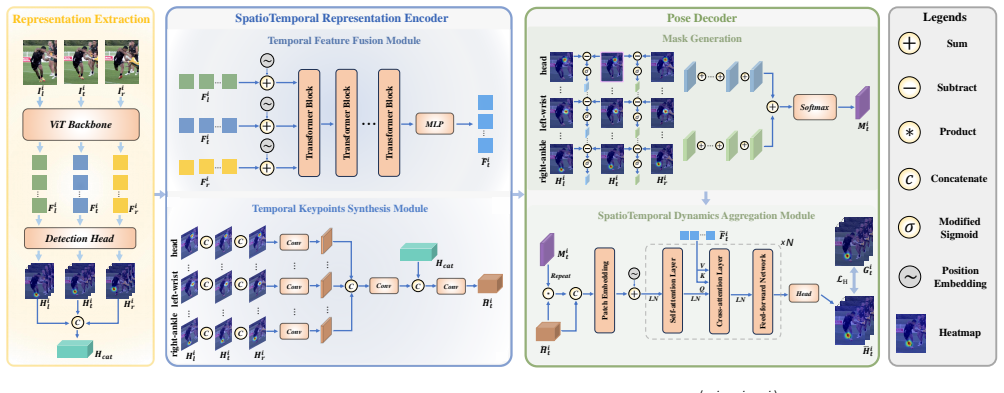
The load-bearing mechanism is the Dynamic-Aware Mask together with the cross-attention aggregation in STDA. The mask is computed from heatmap residuals between auxiliary and key frames, passed through a modified sigmoid $\text{Sigm}(x,k,\theta)=1/(1+e^{-k(|x|-\theta)})$ that responds equally to positive and negative residuals, then compressed and softmax-normalized; this highlights where joints actually moved. STDA multiplies the merged heatmaps $\tilde H_t$ by this mask, concatenates the result with $\tilde H_t$, embeds it into tokens, and applies self- and cross-attention against the fused visual feature $\tilde F_t$. The mutual-information objective, approximated as $I(y_t;\tilde F_t)-I(\tilde F_t;F_t)$ and similarly for heatmaps, supervises that the fused representations add label-relevant information beyond the key-frame features.
What would settle it
Train the strongest baselines (PoseWarper, DCPose, FAMI-Pose) with the same ViT backbone and input resolution, or train STDPose with HRNet; if the mAP gaps on PoseTrack2017 (2.2, 1.0, and so on) disappear or reverse, the central SOTA claim is largely a backbone artifact.
Extended reading notes
Core claim
On its own terms, the paper's discovery is that coupling temporal heatmap synthesis with motion-aware attention improves sparse-label video pose estimation. The SpatioTemporal Representation Encoder fuses features from key and auxiliary frames with transformer blocks (TFF) and merges per-joint heatmaps over time with convolutions (TKS), while the Dynamic-Aware Mask is built from forward and backward heatmap residuals. The STDA module then lets the masked heatmaps attend to the fused features via cross-attention, and a mutual-information loss filters task-irrelevant temporal information. With this design, STDPose reports 90.9 mAP for pose propagation and 87.4 mAP for pose estimation on PoseTrack2017, with the largest gains on wrists and ankles, and claims competitive sparse-label performance.
Load-bearing premise
The reported gains are credited to the proposed modules, but every comparison uses a COCO-pretrained Vision Transformer for STDPose and HRNet for the baselines, with no backbone-controlled experiment, so the modules' contribution is not isolated.
Editorial extensions
If this is right
- If the reported results hold, a pose model can be trained from every 7th labeled frame and still reach 90.9 mAP on PoseTrack2017, so annotation cost drops sharply.
- Pseudo-labels produced by propagation give 84.3 mAP with 26.7% manually labeled frames, close to the 84.8 mAP of a fully labeled baseline, meaning dense manual annotation may become unnecessary.
- The largest improvements on wrist and ankle joints suggest the motion-aware mask helps exactly the joints most affected by blur and occlusion.
- Replacing deformable convolutions with cross-attention means the model no longer relies on local receptive fields, which the paper claims addresses global spatial correlations.
Reading between the lines
- A controlled backbone swap would separate the contributions of the modules from the ViT backbone, since all reported comparisons pair STDPose's ViT against HRNet baselines.
- The Dynamic-Aware Mask could be reused as a motion-attention module in other video tasks like action recognition or object segmentation, since it only requires heatmap-like residuals.
- Learning the sigmoid parameters $k$ and $\theta$ instead of fixing them might adapt the mask to videos with different motion speeds, given the paper's own ablation shows flat sensitivity.
- Iterative pseudo-label self-training beyond one propagation round could push sparse-label accuracy closer to full supervision.
Editorial analysis
A structured set of objections, weighed in public.
Referee Report
Summary. The paper proposes STDPose, a transformer-based framework for video pose propagation and pose estimation from sparsely-labeled videos. STDPose consists of a SpatioTemporal Representation Encoder (STRE) with temporal feature fusion (TFF) and temporal keypoint synthesis (TKS), a Dynamic-Aware Mask (DAM), a SpatioTemporal Dynamics Aggregation (STDA) module, and a mutual-information-based loss. The authors report state-of-the-art results on three PoseTrack datasets for both pose propagation (90.9 mAP on PoseTrack2017) and pose estimation (87.4 mAP on PoseTrack2017), along with a pseudo-label training experiment that achieves 84.3 mAP with 26.7% labeled frames and 85.2 mAP with 50% labeled frames.
Significance. If the results hold, the framework would be a meaningful step toward reducing annotation cost in video pose estimation while improving accuracy under occlusion and blur. The paper provides a reasonably complete ablation study (Table 4), a parameter analysis for the modified sigmoid (Table 5), and experiments at multiple input resolutions (Table 6), and the tables are internally consistent. However, two load-bearing issues prevent verification of the central claims: the SOTA comparisons are confounded by the backbone choice (ViT vs. HRNet), and the mutual-information objective is not implementable as written. The backbone issue is particularly serious because the margins over strong baselines in Table 2 are only 0.5-1.0 mAP.
major comments (3)
- [Sec. 4.2-4.3, Tables 1-3 and Appendix Table 6] The state-of-the-art comparisons are confounded by the backbone. STDPose uses a COCO-pretrained ViT at 256x192, whereas all compared methods use HRNet-based backbones, some at 384x288. Table 4(a) provides a ViT+head baseline of 86.8 mAP for the propagation task, which partially controls for the propagation claim, but no ViT-backed baseline is reported for the pose-estimation protocol in Table 2 or for the pseudo-label experiment in Table 3. Since the gains over DiffPose and TDMI in Table 2 are only 0.5-1.0 mAP, the central SOTA claim for pose estimation is not established. Please provide either an HRNet-backed version of STDPose or ViT-backed versions of the baselines for all three protocols, or explicitly qualify the claim as a backbone-plus-method result.
- [Appendix A, Eqs. (8)-(11); Sec. 3.1, Eq. (2)] The mutual-information objective is not implementable as written. Eq. (11) is a difference of intractable mutual-information terms, and the paper provides no variational estimator, surrogate bound, sampling procedure, or code. The simplification in Eqs. (9) and (10) drops I(F;F|y) and I(H;H|y) based on the unverified assumption that these conditional MI terms become negligible after sufficient training. Because Table 4(f) attributes a 0.6 mAP improvement to this loss term, the reader cannot reproduce the result. Please specify a tractable estimator (e.g., a variational bound or a contrastive loss) and, ideally, release code for this component.
- [Tables 1-3] The reported improvements over the strongest baselines are small, and no uncertainty quantification is provided. For example, on PoseTrack2017 pose estimation, STDPose achieves 87.4 mAP versus 86.4 for DiffPose; on PoseTrack2018, it achieves 84.5 versus 83.6 for TDMI. Without multiple runs, standard deviations, or significance tests, it is unclear whether these margins are meaningful. Please report variance across seeds or otherwise justify the stability of the results.
minor comments (7)
- [Tables 3 and 4] The relationship between T and the labeled-frame ratio is not explained. If one frame is labeled every T frames, the ratio should be approximately 1/T (e.g., 14.3% for T=7 and 25% for T=4), but the tables list 16.7% and 26.7%. Please state how these percentages are computed, including any effect of the 'only 30 consecutive frames' restriction described in Appendix C.
- [Sec. 4.4] The phrase 'nearly matching a 100% ideal precision of manual annotation' in the discussion of Table 4 is not supported by a ceiling experiment; no result is reported for training with full manual annotations under the same protocol. Please rephrase or provide such a baseline.
- [Figure 2] Figure 2 is very dense and difficult to read; the font sizes and arrow labels are small. A cleaner, higher-level diagram would help readers understand the data flow.
- [Sec. 1, first paragraph] There is a typo in the Introduction: 'spatiotemporal representatons' should be 'spatiotemporal representations.'
- [Table 5 and Sec. 3.3] The parameter sensitivity of the modified sigmoid is reported, but the hyperparameters α and β in Eq. (2) are not ablated. Since α and β are set to 0.1 and 0.01 without tuning, it would be informative to show how the MI loss contribution varies with these weights, especially given that the MI term is not reproducible as written.
- [Sec. 4.3] The comparison with methods that use four auxiliary frames (TDMI, DSTA) vs. STDPose's two auxiliary frames is useful, but the paper should clarify whether the cited numbers for those methods were obtained with their original four-frame setting; if so, the comparison is not fully controlled.
- [Appendix A, Eq. (6)] The notation in Eq. (6) is confusing, particularly the use of H^{i,j} without defining the superscript j and the concatenation of multiple Conv outputs. Please add explicit dimensions and a clearer description of the temporal keypoint synthesis.
Circularity Check
No load-bearing circularity: benchmark claims rest on external PoseTrack evaluations and compositional ablations; the score reflects only minor non-load-bearing self-citations and two evidence gaps that are correctness/reproducibility risks, not circular reductions.
full rationale
STDPose's headline claims are empirical SOTA results on PoseTrack2017/2018/2021. Pose propagation (Table 1), pose estimation (Table 2), and pseudo-label training (Table 3) are all evaluated against external validation sets, so the reported numbers are not derived from the method's own definitions. The ablation in Table 4 includes a stripped ViT+head baseline (86.8 mAP) and adds TFF, TKS, STDA, DAM, and MI one at a time; this is an internal contribution analysis, not a circular reduction. Pseudo-label generation is a standard self-training pipeline: a propagation model produces labels for unlabeled frames, and a separate pose-estimation model is trained and tested on held-out validation data; nothing here is statistically forced by construction. The few self-citations (Liu et al. 2022a for MI inspiration/difficulty, Wu et al. 2024a as a recent-methods example) are not load-bearing: no central claim rests on an unverified result from the authors' own prior work. Two genuine evidence gaps should be noted as correctness/reproducibility risks rather than circularity: (1) Appendix Eq. (11) writes LMI with intractable mutual-information terms and no variational estimator, so the 0.6 mAP MI gain in Table 4(f) is not independently reproducible from the paper; (2) Tables 2-3 compare STDPose (ViT backbone) with HRNet-based baselines without a backbone-matched control, so part of the SOTA margin could reflect backbone strength. Neither gap makes a 'prediction' equal to its input by construction. Overall circularity burden is low; score 2 reflects only minor non-load-bearing self-citation and the flagged evidence gaps, not a circular derivation.
Assumptions & free parameters
free parameters (4)
- alpha =
0.1
- beta =
0.01
- k =
1.5
- theta =
0.5
assumptions (4)
- ad hoc to paper The dropped conditional mutual information terms I(F̃;F|y) and I(H̃;H|y) become negligible after sufficient training.
- domain assumption A COCO-pretrained Vision Transformer backbone is directly comparable to the HRNet backbones used by all compared methods.
- domain assumption An external object detector provides correct person crops for the top-down pose estimation pipeline.
- standard math Mutual information identities used for the MI objective simplification are standard.
Cite this review
Pith. "Pith review of SpatioTemporal Learning for Human Pose Estimation in Sparsely-Labeled Videos." pith.science (2026). https://pith.science/paper/DVUDIUAC
@misc{pith2026250115073,
  author       = {Pith},
  title        = {Pith review of: SpatioTemporal Learning for Human Pose Estimation in Sparsely-Labeled Videos},
  year         = {2026},
  howpublished = {\url{https://pith.science/paper/DVUDIUAC}},
  note         = {Machine review of arXiv:2501.15073}
}
read the original abstract
Human pose estimation in videos remains a challenge, largely due to the reliance on extensive manual annotation of large datasets, which is expensive and labor-intensive. Furthermore, existing approaches often struggle to capture long-range temporal dependencies and overlook the complementary relationship between temporal pose heatmaps and visual features. To address these limitations, we introduce STDPose, a novel framework that enhances human pose estimation by learning spatiotemporal dynamics in sparsely-labeled videos. STDPose incorporates two key innovations: 1) A novel Dynamic-Aware Mask to capture long-range motion context, allowing for a nuanced understanding of pose changes. 2) A system for encoding and aggregating spatiotemporal representations and motion dynamics to effectively model spatiotemporal relationships, improving the accuracy and robustness of pose estimation. STDPose establishes a new performance benchmark for both video pose propagation (i.e., propagating pose annotations from labeled frames to unlabeled frames) and pose estimation tasks, across three large-scale evaluation datasets. Additionally, utilizing pseudo-labels generated by pose propagation, STDPose achieves competitive performance with only 26.7% labeled data.
Figures


Figures from the paper (2 more)


Reference graph
Works this paper leans on
-
[1]
Andriluka, M.; Iqbal, U.; Insafutdinov, E.; Pishchulin, L.; Milan, A.; Gall, J.; and Schiele, B. 2018. Posetrack: A benchmark for human pose estimation and tracking. In Proceedings of the IEEE conference on computer vision and pattern recognition, 5167--5176
work page 2018
-
[2]
Artacho, B.; and Savakis, A. 2020. Unipose: Unified human pose estimation in single images and videos. In Proceedings of the IEEE/CVF conference on computer vision and pattern recognition, 7035--7044
work page 2020
-
[3]
Bertasius, G.; Feichtenhofer, C.; Tran, D.; Shi, J.; and Torresani, L. 2019. Learning temporal pose estimation from sparsely-labeled videos. Advances in neural information processing systems, 32
work page 2019
-
[4]
Chen, X.; Wang, X.; Zhou, J.; Qiao, Y.; and Dong, C. 2023. Activating more pixels in image super-resolution transformer. In Proceedings of the IEEE/CVF conference on computer vision and pattern recognition, 22367--22377
2023
-
[5]
Dai, J.; Qi, H.; Xiong, Y.; Li, Y.; Zhang, G.; Hu, H.; and Wei, Y. 2017. Deformable convolutional networks. In Proceedings of the IEEE international conference on computer vision, 764--773
2017
-
[6]
Deng, J.; Dong, W.; Socher, R.; Li, L.-J.; Li, K.; and Fei-Fei, L. 2009. Imagenet: A large-scale hierarchical image database. In 2009 IEEE conference on computer vision and pattern recognition, 248--255. Ieee
2009
-
[7]
Doering, A.; Chen, D.; Zhang, S.; Schiele, B.; and Gall, J. 2022. Posetrack21: A dataset for person search, multi-object tracking and multi-person pose tracking. In Proceedings of the IEEE/CVF Conference on Computer Vision and Pattern Recognition, 20963--20972
work page 2022
-
[8]
Dosovitskiy, A.; Beyer, L.; Kolesnikov, A.; Weissenborn, D.; Zhai, X.; Unterthiner, T.; Dehghani, M.; Minderer, M.; Heigold, G.; Gelly, S.; et al. 2020. An image is worth 16x16 words: Transformers for image recognition at scale. arXiv preprint arXiv:2010.11929
arXiv 2020
Show all 47 references
-
[9]
Farneb \"a ck, G. 2003. Two-frame motion estimation based on polynomial expansion. In Image Analysis: 13th Scandinavian Conference, SCIA 2003 Halmstad, Sweden, June 29--July 2, 2003 Proceedings 13, 363--370. Springer
2003
-
[10]
Feng, R.; Gao, Y.; Ma, X.; Tse, T. H. E.; and Chang, H. J. 2023 a . Mutual information-based temporal difference learning for human pose estimation in video. In Proceedings of the IEEE/CVF Conference on Computer Vision and Pattern Recognition, 17131--17141
2023
-
[11]
Feng, R.; Gao, Y.; Tse, T. H. E.; Ma, X.; and Chang, H. J. 2023 b . DiffPose: SpatioTemporal diffusion model for video-based human pose estimation. In Proceedings of the IEEE/CVF International Conference on Computer Vision, 14861--14872
2023
-
[12]
He, J.; and Yang, W. 2024. Video-Based Human Pose Regression via Decoupled Space-Time Aggregation. arXiv preprint arXiv:2403.19926
2024 arXiv
-
[13]
D.; Fedorov, A.; Lavoie-Marchildon, S.; Grewal, K.; Bachman, P.; Trischler, A.; and Bengio, Y
Hjelm, R. D.; Fedorov, A.; Lavoie-Marchildon, S.; Grewal, K.; Bachman, P.; Trischler, A.; and Bengio, Y. 2018. Learning deep representations by mutual information estimation and maximization. arXiv preprint arXiv:1808.06670
2018 arXiv
-
[14]
Ilg, E.; Mayer, N.; Saikia, T.; Keuper, M.; Dosovitskiy, A.; and Brox, T. 2017. Flownet 2.0: Evolution of optical flow estimation with deep networks. In Proceedings of the IEEE conference on computer vision and pattern recognition, 2462--2470
2017
-
[15]
Iqbal, U.; Milan, A.; and Gall, J. 2017. Posetrack: Joint multi-person pose estimation and tracking. In Proceedings of the IEEE Conference on Computer Vision and Pattern Recognition, 2011--2020
2017
-
[16]
Jin, K.-M.; Lee, G.-H.; and Lee, S.-W. 2022. OTPose: occlusion-aware transformer for pose estimation in sparsely-labeled videos. In 2022 IEEE International Conference on Systems, Man, and Cybernetics (SMC), 3255--3260. IEEE
2022
-
[17]
C.; Lo, W.-Y.; et al
Kirillov, A.; Mintun, E.; Ravi, N.; Mao, H.; Rolland, C.; Gustafson, L.; Xiao, T.; Whitehead, S.; Berg, A. C.; Lo, W.-Y.; et al. 2023. Segment anything. In Proceedings of the IEEE/CVF International Conference on Computer Vision, 4015--4026
2023
-
[18]
Lin, T.-Y.; Maire, M.; Belongie, S.; Hays, J.; Perona, P.; Ramanan, D.; Doll \'a r, P.; and Zitnick, C. L. 2014. Microsoft coco: Common objects in context. In Computer Vision--ECCV 2014: 13th European Conference, Zurich, Switzerland, September 6-12, 2014, Proceedings, Part V 1...
2014
-
[19]
Liu, Z.; Chen, H.; Feng, R.; Wu, S.; Ji, S.; Yang, B.; and Wang, X. 2021 a . Deep dual consecutive network for human pose estimation. In Proceedings of the IEEE/CVF conference on computer vision and pattern recognition, 525--534
2021
-
[20]
Liu, Z.; Feng, R.; Chen, H.; Wu, S.; Gao, Y.; Gao, Y.; and Wang, X. 2022 a . Temporal feature alignment and mutual information maximization for video-based human pose estimation. In Proceedings of the IEEE/CVF conference on computer vision and pattern recognition, 11006--11016
2022
-
[21]
Liu, Z.; Lin, Y.; Cao, Y.; Hu, H.; Wei, Y.; Zhang, Z.; Lin, S.; and Guo, B. 2021 b . Swin transformer: Hierarchical vision transformer using shifted windows. In Proceedings of the IEEE/CVF international conference on computer vision, 10012--10022
2021
-
[22]
Liu, Z.; Mao, H.; Wu, C.-Y.; Feichtenhofer, C.; Darrell, T.; and Xie, S. 2022 b . A convnet for the 2020s. In Proceedings of the IEEE/CVF conference on computer vision and pattern recognition, 11976--11986
2022
-
[23]
Liu, Z.; Wu, S.; Xu, C.; Wang, X.; Zhu, L.; Wu, S.; and Feng, F. 2022 c . Copy motion from one to another: Fake motion video generation. arXiv preprint arXiv:2205.01373
2022 arXiv
-
[24]
Newell, A.; Yang, K.; and Deng, J. 2016. Stacked hourglass networks for human pose estimation. In Computer Vision--ECCV 2016: 14th European Conference, Amsterdam, The Netherlands, October 11-14, 2016, Proceedings, Part VIII 14, 483--499. Springer
2016
-
[25]
Pfister, T.; Charles, J.; and Zisserman, A. 2015. Flowing convnets for human pose estimation in videos. In Proceedings of the IEEE international conference on computer vision, 1913--1921
2015
-
[26]
Rombach, R.; Blattmann, A.; Lorenz, D.; Esser, P.; and Ommer, B. 2022. High-resolution image synthesis with latent diffusion models. In Proceedings of the IEEE/CVF conference on computer vision and pattern recognition, 10684--10695
2022
-
[27]
Sapp, B.; Toshev, A.; and Taskar, B. 2010. Cascaded models for articulated pose estimation. In Computer Vision--ECCV 2010: 11th European Conference on Computer Vision, Heraklion, Crete, Greece, September 5-11, 2010, Proceedings, Part II 11, 406--420. Springer
2010
-
[28]
Schmidtke, L.; Vlontzos, A.; Ellershaw, S.; Lukens, A.; Arichi, T.; and Kainz, B. 2021. Unsupervised human pose estimation through transforming shape templates. In Proceedings of the IEEE/CVF Conference on Computer Vision and Pattern Recognition, 2484--2494
2021
-
[29]
Shuai, C.; Zhong, J.; Wu, S.; Lin, F.; Wang, Z.; Ba, Z.; Liu, Z.; Cavallaro, L.; and Ren, K. 2023. Locate and verify: A two-stream network for improved deepfake detection. In Proceedings of the 31st ACM International Conference on Multimedia, 7131--7142
2023
-
[30]
Su, P.; Liu, Z.; Wu, S.; Zhu, L.; Yin, Y.; and Shen, X. 2021. Motion prediction via joint dependency modeling in phase space. In Proceedings of the 29th ACM international conference on multimedia, 713--721
2021
-
[31]
Sun, K.; Xiao, B.; Liu, D.; and Wang, J. 2019. Deep high-resolution representation learning for human pose estimation. In Proceedings of the IEEE/CVF conference on computer vision and pattern recognition, 5693--5703
2019
-
[32]
Tian, X.; Zhang, Z.; Lin, S.; Qu, Y.; Xie, Y.; and Ma, L. 2021. Farewell to mutual information: Variational distillation for cross-modal person re-identification. In Proceedings of the IEEE/CVF Conference on Computer Vision and Pattern Recognition, 1522--1531
2021
-
[33]
Tse, T. H. E.; Kim, K. I.; Leonardis, A.; and Chang, H. J. 2022. Collaborative learning for hand and object reconstruction with attention-guided graph convolution. In Proceedings of the IEEE/CVF Conference on Computer Vision and Pattern Recognition, 1664--1674
2022
-
[34]
N.; Kaiser, .; and Polosukhin, I
Vaswani, A.; Shazeer, N.; Parmar, N.; Uszkoreit, J.; Jones, L.; Gomez, A. N.; Kaiser, .; and Polosukhin, I. 2017. Attention is all you need. Advances in neural information processing systems, 30
2017
-
[35]
Wang, M.; Tighe, J.; and Modolo, D. 2020. Combining detection and tracking for human pose estimation in videos. In Proceedings of the IEEE/CVF Conference on Computer Vision and Pattern Recognition, 11088--11096
2020
-
[36]
Wang, Y.; Li, K.; Li, Y.; He, Y.; Huang, B.; Zhao, Z.; Zhang, H.; Xu, J.; Liu, Y.; Wang, Z.; et al. 2022. Internvideo: General video foundation models via generative and discriminative learning. arXiv preprint arXiv:2212.03191
2022 arXiv
-
[37]
Wei, S.-E.; Ramakrishna, V.; Kanade, T.; and Sheikh, Y. 2016. Convolutional pose machines. In Proceedings of the IEEE conference on Computer Vision and Pattern Recognition, 4724--4732
2016
-
[38]
Wu, S.; Chen, H.; Yin, Y.; Hu, S.; Feng, R.; Jiao, Y.; Yang, Z.; and Liu, Z. 2024 a . Joint-Motion Mutual Learning for Pose Estimation in Video. In Proceedings of the 32nd ACM International Conference on Multimedia, 8962--8971
2024
-
[39]
Wu, S.; Liu, Z.; Zhang, B.; Zimmermann, R.; Ba, Z.; Zhang, X.; and Ren, K. 2024 b . Do as I Do: Pose Guided Human Motion Copy. IEEE Transactions on Dependable and Secure Computing
2024
-
[40]
Xiao, B.; Wu, H.; and Wei, Y. 2018. Simple baselines for human pose estimation and tracking. In Proceedings of the European conference on computer vision (ECCV), 466--481
2018
-
[41]
Xiu, Y.; Li, J.; Wang, H.; Fang, Y.; and Lu, C. 2018. Pose Flow: Efficient online pose tracking. arXiv preprint arXiv:1802.00977
2018 arXiv
-
[42]
Xu, Y.; Zhang, J.; Zhang, Q.; and Tao, D. 2022. Vitpose: Simple vision transformer baselines for human pose estimation. Advances in Neural Information Processing Systems, 35: 38571--38584
2022
-
[43]
Yang, Y.; Chen, H.; Liu, Z.; Lyu, Y.; Zhang, B.; Wu, S.; Wang, Z.; and Ren, K. 2023. Action recognition with multi-stream motion modeling and mutual information maximization. arXiv preprint arXiv:2306.07576
2023 arXiv
-
[44]
Zhang, X.; Li, C.; Tong, X.; Hu, W.; Maybank, S.; and Zhang, Y. 2009. Efficient human pose estimation via parsing a tree structure based human model. In 2009 IEEE 12th International Conference on Computer Vision, 1349--1356. IEEE
2009
-
[45]
Zhu, X.; Hu, H.; Lin, S.; and Dai, J. 2019. Deformable convnets v2: More deformable, better results. In Proceedings of the IEEE/CVF conference on computer vision and pattern recognition, 9308--9316
2019
-
[46]
, " * write output.state after.block = add.period write newline
ENTRY address archivePrefix author booktitle chapter edition editor eid eprint howpublished institution isbn journal key month note number organization pages publisher school series title type volume year label extra.label sort.label short.list INTEGERS output.state before.all...
-
[47]
write newline
" write newline "" before.all 'output.state := FUNCTION n.dashify 't := "" t empty not t #1 #1 substring "-" = t #1 #2 substring "--" = not "--" * t #2 global.max substring 't := t #1 #1 substring "-" = "-" * t #2 global.max substring 't := while if t #1 #1 substring * t #2 gl...
Reviewed August 10, 2026 · model on record in the stance chip above.
Discussion (0). Continue with ORCID to comment.