REVIEW 4 major objections 5 minor 1 cited by
CD-Lamba: Boosting Remote Sensing Change Detection via a Cross-Temporal Locally Adaptive State Space Model
T0 review · 4 major / 5 minor · reviewed 2026-08-10 · deepseek-v4-flash
Pith's one-line read CD-Lamba claims that making the state-space scan locally adaptive to change-rich windows improves remote sensing change detection accuracy while keeping linear complexity, achieving state-of-the-art F1 on four benchmarks.
desk verdict Solid empirical architecture paper for SSM-based remote sensing change detection; the adaptive-locality mechanism is plausible and consistently improves over prior SSM baselines, though the selection signal is not fully isolated from auxiliary components. read the letter →
The pith
A machine-rendered reading of the paper's core claim, the machinery that carries it, and where it could break.
The reading
What carries the argument
The load-bearing object is the Locally Adaptive State-Space Scan (LASS) strategy inside the Cross-Temporal Locally Adaptive State-Space Scan (CT-LASS) module. LASS partitions the bi-temporal feature difference into 4x4 windows, scores them with average pooling plus Gumbel softmax, selects the top-$k$ windows, merges adjacent connected windows, and builds the scan sequence as background-first followed by each connected change-region window; the Cross-Temporal State-Space Scan (CTSS) then fuses the two time steps by interleaving their tokens pixel-by-pixel before the S6 scan, and the Window Shifting and Perception (WSP) mechanism repeats the module five times with 1/8-length shifts in four diagonal directions so boundaries between windows are not isolated. These three pieces together are what let the model retain Mamba's global perception and linear complexity while giving change regions a locally coherent representation.
What would settle it
On a variant of CLCD where illumination and seasonal differences are amplified so pseudo changes fill the top-$k$ windows while target changes sit outside them, CD-Lamba's F1 should drop toward or below ChangeMamba's 70.00; if it does not, the window selection is more robust to pseudo changes than the paper's own caveat suggests, and if it does, the conceded weakness is the bottleneck.
Extended reading notes
Core claim
The central discovery is that locality in Mamba-based change detection is not a fixed architectural property but a routing decision: after splitting the feature difference map into 4x4 windows, CD-Lamba scores each window by average pooling, applies Gumbel softmax, keeps the top-6 windows, merges their connected components, and scans each merged region separately while flattening the remaining windows as one background sequence. This locally adaptive scan (LASS) keeps global perception because the background is still seen in a single pass, and it restores spatial coherence because the pixels of one change region sit close together in the sequence. Combined with pixel-wise cross-temporal scanning (CTSS) and a five-direction window-shifting and perception mechanism (WSP), the architecture reports F1 of 92.51, 82.66, 71.66, and 78.06 on WHU-CD, SYSU-CD, DSIFN-CD, and CLCD respectively, exceeding ChangeMamba by 2.43, 3.28, 5.75, and 8.06 F1 points with 28.74M parameters and 15.26G FLOPs.
Load-bearing premise
The load-bearing premise is that the top-scoring 4x4 windows of the average-pooled bi-temporal difference actually contain the change regions, so concentrating the scan there helps; the paper itself concedes in Section 6 that the model still has a gap between real changes and pseudo changes when choosing those windows.
Editorial extensions
If this is right
- On the four tested benchmarks (WHU-CD, SYSU-CD, DSIFN-CD, CLCD), CD-Lamba sets the highest F1 among the compared methods, with gains of 2.43, 3.28, 5.75, and 8.06 F1 points over ChangeMamba.
- The gains are achieved with 28.74M parameters and 15.26G FLOPs, which is about 59% of ChangeMamba's parameters and 40% of its compute at 256x256 input, so the improvement does not come from a larger model.
- Ablation on CLCD shows the full LASS scan (78.06 F1) beats both VMamba's flat scan (76.46) and LocalMamba's fixed windows (77.56), and the complete five-direction WSP configuration (78.06) beats no shifting (76.82).
- Pixel-by-pixel cross-temporal scanning (CTSS) outperforms concatenate-then-scan (CDS, 77.04) and row-by-row alternating scan (RRS, 76.73), supporting the claim that temporal fusion should align bi-temporal tokens at the same spatial position.
Reading between the lines
- The paper does not explore making the top-k window selection itself trainable end-to-end; a natural extension would be a soft, differentiable routing over windows, which could reduce sensitivity to the pseudo changes the authors concede remain a gap.
- Because the gain over ChangeMamba grows on the more complex datasets (5.75 and 8.06 F1 points), the locality mechanism may matter most when change targets are small or heterogeneous; a testable prediction is that gains shrink on datasets with large contiguous change regions.
- The same scan strategy could be dropped into other SSM-based dense prediction backbones for large images, since any task with locally coherent objects suffers the same flattening-induced locality loss.
Editorial analysis
A structured set of objections, weighed in public.
Referee Report
Summary. The paper proposes CD-Lamba, an SSM-based remote sensing change detection model that aims to overcome the locality loss caused by directly flattening images in Mamba-style scans. The method introduces a Locally Adaptive State-Space Scan (LASS) strategy that selects top-k average-pooled windows from the bi-temporal feature difference, merges connected components, and scans the selected windows separately while treating the rest as one global sequence. This is combined with a Cross-Temporal State-Space Scan (CTSS) for pixel-wise bi-temporal fusion and a Window Shifting and Perception (WSP) mechanism for cross-window interaction, all integrated into a multi-scale CT-LASS module with a Siamese backbone and a lightweight change detector. Experiments on WHU-CD, SYSU-CD, DSIFN-CD, and CLCD report state-of-the-art F1 scores (92.51, 82.66, 71.66, and 78.06 respectively) with 28.74M parameters and 15.26G FLOPs, outperforming ChangeMamba by 2.43, 3.28, 5.75, and 8.06 F1 points.
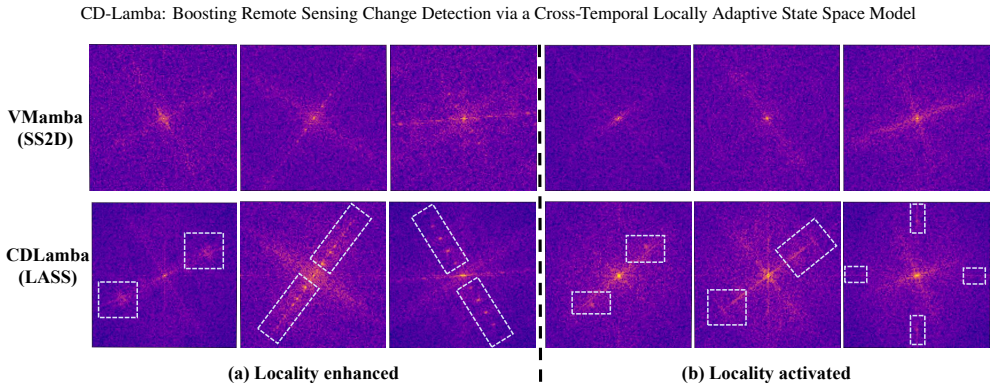
Significance. If the reported gains hold, the paper addresses a genuine limitation of SSM-based change detection: the loss of spatial locality when images are flattened into 1D sequences. The adaptive scanning idea is timely and the code is publicly available, which are explicit strengths. The efficiency-accuracy trade-off is also favorable. However, the claim of state-of-the-art performance rests on single-run comparisons without error bars, and the central mechanism—adaptive locality via top-k window selection—is not isolated from the other auxiliary components in the ablations. The spectral analysis in Figures 2 and 3 is illustrative but self-referential and does not by itself establish that the selection signal targets real changes. These caveats make the significance conditional on additional validation, but the core idea is promising and the empirical trends are consistent across four datasets.
major comments (4)
- [§4.3.1, Eq. (7)] The merging operation Merge↑ in Eq. (7) is not specified: the paper does not define how connected components are detected among the top-k 4x4 score windows, how the number k' is determined, or how the upsampled Loc_wins map is constructed. Because LASS is the core novelty and the connected-component merging is claimed to adapt to varying shapes and sizes of change regions, this omission prevents reproduction and leaves the central mechanism under-specified.
- [§5.3.1, Table 4] The scan-strategy ablation compares CT-LASS against VMamba and LocalMamba while keeping CTSS and the rest of the pipeline intact, but it does not isolate the quality of the top-k selection signal. A control using randomly selected windows or fixed windows with the same number of selected windows would be needed to show that the gains come from the adaptive selection rather than from the auxiliary components or from scanning fewer windows separately. As it stands, the experiment supports the overall CT-LASS design but not the claim that the locality window selection itself is responsible for the improvement.
- [§6 and §4.4, Eqs. (6) and (14)] The paper's own conclusion concedes that CD-Lamba 'has a gap in distinguishing between actual changes of interest and pseudo changes when obtaining locality windows.' This is directly related to the load-bearing step: the score window in Eq. (6) is computed from the raw bi-temporal feature difference (Eq. (14)) before any supervision or cross-temporal filtering, so pseudo-changes from lighting, season, or registration noise can dominate the top-k windows. The authors acknowledge this limitation, but the manuscript does not provide any experiment that quantifies how often the selected windows overlap with ground-truth change regions or how the result degrades when the selection is misdirected. A simple oracle-window or random-window comparison would clarify the extent of this risk.
- [§5.2, Tables 2 and 3] All results are reported as single runs without error bars or statistical significance tests. Given that the CLCD test set contains only 120 images and the reported gains over ChangeMamba are 8.06 F1 points, while on WHU-CD the gain is 2.43 points, the reader cannot assess whether these differences are stable across training runs. The authors should report mean and standard deviation over at least three seeds, or otherwise justify the absence of variance information.
minor comments (5)
- [§4.3.1, Eq. (8)] In Eq. (8), the concatenation index is written as ⨁_{k}_{i=0} S_i, but the number of connected components is k', not k. The notation should be corrected to ⨁_{i=0}^{k'} S_i to be consistent with Eq. (7).
- [§4.4] The text alternates between 'Window Shifting and Perception' and 'WSP' in a way that sometimes calls the mechanism 'WindowShift and Padding' (in Eq. (13) and the sentence preceding it). The acronym should be defined once and used consistently.
- [Abstract and §1] The model is named 'CD-Lamba' throughout most of the paper, but the contributions section and the conclusion use 'CD-Lambda' and 'CD-Mamba' in several places (e.g., 'CD-Lambda model' and 'Our CD-Mamba model' in §4.6). The naming should be made consistent.
- [§5.2.1] The text says 'state-of-the-art performance on the five change detection datasets', but only four datasets are evaluated. This should be corrected to 'four'.
- [§3.2, Figures 2 and 3] The spectral analysis caption states that 'frequencies closer to the center represent higher frequencies,' which is the opposite of the usual convention for centered Fourier spectra (where the center is the DC/low-frequency component). The description should be aligned with the actual convention used in the figures.
Circularity Check
No significant circularity: reported gains are held-out benchmark measurements, not outputs of fitted parameters or self-cited constraints.
full rationale
I traced the claimed derivation chain: LASS, CTSS, and WSP define a forward architecture (Eqs. 6-20), and the central claims are F1 numbers measured on held-out test partitions of WHU-CD, SYSU-CD, DSIFN-CD, and CLCD (Tables 2 and 3). Nothing in those tables is produced by fitting a parameter and then predicting the same quantity; the only tunable choices (top-k, WSP shifts) are ablated on CLCD and reported as ablations (Tables 6-7), which is standard model selection rather than construction of the test result. The window-selection signal (Eqs. 6 and 14) uses the bi-temporal feature difference, but that is an internal routing mechanism, not a definition of the change mask; the final mask comes from the LCD (Eqs. 21-24) supervised by CE+Dice loss (Eq. 25). The spectral plots in Figs. 2-3 are illustrative post-hoc analyses, not part of the accuracy computation. The only author-overlapping citation ([29], Zhao et al.) is used as an example of SSM vision applications and carries no argumentative weight. Section 6's admitted limitation — "CD-Lamba currently has a gap in distinguishing between actual changes of interest and pseudo changes when obtaining locality windows" — is a correctness/robustness concern about the window-selection mechanism, not a circular step: it does not make any reported number equal to an input by construction. I therefore find no self-definitional, fitted-input-as-prediction, or self-citation-load-bearing circularity.
Assumptions & free parameters
free parameters (4)
- Top-k (number of locality windows) =
6
- WSP shift iteration set =
{0,1,2,3,4}
- Loss weights lambda_ce and lambda_dice =
not reported
- Score-window pooling kernel =
(1/4, 1/4)
assumptions (6)
- standard math Zero-order hold discretization of continuous SSM (Eq. 2) and the S6 selective scan (Eq. 4, Section 3.1.3) are correct and inherited without re-derivation.
- standard math Gumbel Softmax (Eq. 6) provides a differentiable approximation to the top-k discrete selection and preserves gradients for end-to-end training.
- domain assumption Change regions in RSCD are spatially localized and are well captured by a small number of 4x4 coarse windows derived from average-pooled bi-temporal feature differences.
- domain assumption Bi-temporal RS images are co-registered, so pixel-wise cross-scanning (Eq. 9) aligns corresponding spatial positions across time.
- domain assumption The four public benchmark datasets and their standard splits are reliable, and reported baseline numbers are comparable under the same protocol.
- ad hoc to paper The spectral analysis in Section 3.2 is sufficient evidence that LASS enhances locality relative to SS2D.
Cite this review
Pith. "Pith review of CD-Lamba: Boosting Remote Sensing Change Detection via a Cross-Temporal Locally Adaptive State Space Model." pith.science (2026). https://pith.science/paper/VHETUB53
@misc{pith2026250115455,
  author       = {Pith},
  title        = {Pith review of: CD-Lamba: Boosting Remote Sensing Change Detection via a Cross-Temporal Locally Adaptive State Space Model},
  year         = {2026},
  howpublished = {\url{https://pith.science/paper/VHETUB53}},
  note         = {Machine review of arXiv:2501.15455}
}
read the original abstract
Mamba, with its advantages of global perception and linear complexity, has been widely applied to identify changes of the target regions within the remote sensing (RS) images captured under complex scenarios and varied conditions. However, existing remote sensing change detection (RSCD) approaches based on Mamba frequently struggle to effectively perceive the inherent locality of change regions as they direct flatten and scan RS images (i.e., the features of the same region of changes are not distributed continuously within the sequence but are mixed with features from other regions throughout the sequence). In this paper, we propose a novel locally adaptive SSM-based approach, termed CD-Lamba, which effectively enhances the locality of change detection while maintaining global perception. Specifically, our CD-Lamba includes a Locally Adaptive State-Space Scan (LASS) strategy for locality enhancement, a Cross-Temporal State-Space Scan (CTSS) strategy for bi-temporal feature fusion, and a Window Shifting and Perception (WSP) mechanism to enhance interactions across segmented windows. These strategies are integrated into a multi-scale Cross-Temporal Locally Adaptive State-Space Scan (CT-LASS) module to effectively highlight changes and refine changes' representations feature generation. CD-Lamba significantly enhances local-global spatio-temporal interactions in bi-temporal images, offering improved performance in RSCD tasks. Extensive experimental results show that CD-Lamba achieves state-of-the-art performance on four benchmark datasets with a satisfactory efficiency-accuracy trade-off. Our code is publicly available at https://github.com/xwmaxwma/rschange.
Figures


Figures from the paper (11 more)


Forward citations
Cited by 1 Pith paper
-
AtrousMamaba: An Atrous-Window Scanning Visual State Space Model for Remote Sensing Change Detection
An atrous-window scanning strategy improves Mamba-based change detection on six remote sensing benchmarks, showing visual state space models can capture fine local details alongside global context.
Reference graph
Works this paper leans on
-
[1]
A. Singh, Review article digital change detection techniques using remotely-sensed data, International journal of remote sensing 10 (6) (1989) 989–1003
work page 1989
- [2]
-
[3]
P. P. De Bem, O. A. de Carvalho Junior, R. Fontes Guimarães, R. A. Trancoso Gomes, Change detection of deforestation in the brazilian Z.Wu et al.:Preprint submitted to Elsevier Page 16 of 19 CD-Lamba: Boosting Remote Sensing Change Detection via a Cross-Temporal Locally Adaptive State Space Model amazonusinglandsatdataandconvolutionalneuralnetworks,Remote...
work page 2020
-
[4]
Y. Hu, Y. Dong, et al., An automatic approach for land-change de- tectionandlandupdatesbasedonintegratedndvitiminganalysisand thecvapsmethodwithgeesupport,ISPRSjournalofphotogrammetry and remote sensing 146 (2018) 347–359
work page 2018
-
[5]
S. Mahdavi, B. Salehi, W. Huang, M. Amani, B. Brisco, A polsar change detection index based on neighborhood information for flood mapping, Remote Sensing 11 (16) (2019) 1854
work page 2019
-
[6]
Y.Feng,J.Jiang,H.Xu,J.Zheng,Changedetectiononremotesensing images using dual-branch multilevel intertemporal network, IEEE Transactions on Geoscience and Remote Sensing 61 (2023) 1–15
work page 2023
-
[7]
M.Noman,M.Fiaz,H.Cholakkal,S.Narayan,R.M.Anwer,S.Khan, F. S. Khan, Remote sensing change detection with transformers trained from scratch, IEEE Transactions on Geoscience and Remote Sensing (2024)
work page 2024
-
[8]
L.Wang,M.Zhang,X.Gao,W.Shi,Advancesandchallengesindeep learning-basedchangedetectionforremotesensingimages:Areview through various learning paradigms, Remote Sensing 16 (5) (2024). doi:10.3390/rs16050804. URL https://www.mdpi.com/2072-4292/16/5/804
Show all 77 references
-
[10]
S.Fang,K.Li,J.Shao,Z.Li,Snunet-cd:Adenselyconnectedsiamese network for change detection of vhr images, IEEE Geoscience and Remote Sensing Letters 19 (2021) 1–5
2021
-
[12]
T. Lei, X. Geng, H. Ning, Z. Lv, M. Gong, Y. Jin, A. K. Nandi, Ul- tralightweightspatial–spectralfeaturecooperationnetworkforchange detectioninremotesensingimages,IEEETransactionsonGeoscience and Remote Sensing 61 (2023) 1–14
2023
-
[13]
Y.Ye,M.Wang,L.Zhou,G.Lei,J.Fan,Y.Qin,Adjacent-levelfeature cross-fusion with 3d cnn for remote sensing image change detection, IEEE Transactions on Geoscience and Remote Sensing (2023)
2023
-
[15]
207– 210
W.G.C.Bandara,V.M.Patel,Atransformer-basedsiamesenetwork for change detection, in: IGARSS 2022-2022 IEEE International Geoscience and Remote Sensing Symposium, IEEE, 2022, pp. 207– 210
2022
-
[16]
Chen, J.-W
C.-P. Chen, J.-W. Hsieh, P.-Y. Chen, Y.-K. Hsieh, B.-S. Wang, Saras- net: scale and relation aware siamese network for change detection, in: Proceedings of the AAAI Conference on Artificial Intelligence, Vol. 37, 2023, pp. 14187–14195
2023
-
[17]
W. Shi, M. Zhang, R. Zhang, S. Chen, Z. Zhan, Change detection based on artificial intelligence: State-of-the-art and challenges, Re- mote Sensing 12 (10) (2020) 1688
2020
-
[18]
J. Chen, Z. Yuan, J. Peng, L. Chen, H. Huang, J. Zhu, Y. Liu, H.Li,Dasnet:Dualattentivefullyconvolutionalsiamesenetworksfor change detection in high-resolution satellite images, IEEE Journal of Selected Topics in Applied Earth Observations and Remote Sensing 14 (2020) 1194–1206
2020
-
[19]
H.Chen,Z.Shi,Aspatial-temporalattention-basedmethodandanew dataset for remote sensing image change detection, Remote Sensing 12 (10) (2020) 1662
2020
-
[20]
M.Zhang,W.Shi,Afeaturedifferenceconvolutionalneuralnetwork- based change detection method, IEEE Transactions on Geoscience and Remote Sensing 58 (10) (2020) 7232–7246
2020
-
[21]
Y. Liu, Y. Tian, Y. Zhao, H. Yu, L. Xie, Y. Wang, Q. Ye, Y. Liu, Vmamba:Visualstatespacemodel,arXivpreprintarXiv:2401.10166 (2024)
2024 arXiv
-
[22]
T.Huang,X.Pei,S.You,F.Wang,C.Qian,C.Xu,Localmamba:Vi- sual state space model with windowed selective scan, arXiv preprint arXiv:2403.09338 (2024)
2024 arXiv
-
[23]
A. Gu, K. Goel, C. Ré, Efficiently modeling long sequences with structured state spaces, arXiv preprint arXiv:2111.00396 (2021)
2021 arXiv
-
[24]
A.Gu,T.Dao,Mamba:Linear-timesequencemodelingwithselective state spaces, arXiv preprint arXiv:2312.00752 (2023)
2023 arXiv
-
[25]
L.Zhu,B.Liao,Q.Zhang,X.Wang,W.Liu,X.Wang,Visionmamba: Efficient visual representation learning with bidirectional state space model, arXiv preprint arXiv:2401.09417 (2024)
2024 arXiv
-
[26]
Behrouz, F
A. Behrouz, F. Hashemi, Graph mamba: Towards learning on graphs with state space models, arXiv preprint arXiv:2402.08678 (2024)
2024 arXiv
-
[27]
J. Liu, H. Yang, H.-Y. Zhou, Y. Xi, L. Yu, Y. Yu, Y. Liang, G. Shi, S. Zhang, H. Zheng, et al., Swin-umamba: Mamba-based unet with imagenet-basedpretraining,arXivpreprintarXiv:2402.03302(2024)
2024 arXiv
-
[28]
X. Pei, T. Huang, C. Xu, Efficientvmamba: Atrous selective scan for light weight visual mamba, arXiv preprint arXiv:2403.09977 (2024)
2024 arXiv
-
[29]
M. Zhao, M. Ma, X. Li, X. Ma, W. Zhang, S. Song, Supervised detail-guidedmulti-scalestatespacemodelforpan-sharpening,IEEE Transactions on Geoscience and Remote Sensing (2024)
2024
-
[30]
S. Zhao, H. Chen, X. Zhang, P. Xiao, L. Bai, W. Ouyang, Rs-mamba for large remote sensing image dense prediction, arXiv preprint arXiv:2404.02668 (2024)
2024 arXiv
-
[31]
H.Chen,J.Song,C.Han,J.Xia,N.Yokoya,Changemamba:Remote sensing change detection with spatio-temporal state space model, arXiv preprint arXiv:2404.03425 (2024)
2024 arXiv
-
[32]
10012–10022
Z.Liu,Y.Lin,Y.Cao,H.Hu,Y.Wei,Z.Zhang,S.Lin,B.Guo,Swin transformer: Hierarchical vision transformer using shifted windows, in: Proceedings of the IEEE/CVF international conference on com- puter vision, 2021, pp. 10012–10022
2021
-
[33]
A.Gu,I.Johnson,K.Goel,K.Saab,T.Dao,A.Rudra,C.Ré,Combin- ing recurrent, convolutional, and continuous-time models with linear statespacelayers,Advancesinneuralinformationprocessingsystems 34 (2021) 572–585
2021
-
[34]
J. T. Smith, A. Warrington, S. W. Linderman, Simplified state spacelayersforsequencemodeling,arXivpreprintarXiv:2208.04933 (2022)
2022 arXiv
-
[35]
Arjovsky, A
M. Arjovsky, A. Shah, Y. Bengio, Unitary evolution recurrent neural networks, in: International conference on machine learning, PMLR, 2016, pp. 1120–1128
2016
-
[36]
S. Bai, J. Z. Kolter, V. Koltun, An empirical evaluation of generic convolutional and recurrent networks for sequence modeling, arXiv preprint arXiv:1803.01271 (2018)
2018 arXiv
-
[37]
Katharopoulos, A
A. Katharopoulos, A. Vyas, N. Pappas, F. Fleuret, Transformers are rnns: Fast autoregressive transformers with linear attention, in: In- ternational conference on machine learning, PMLR, 2020, pp. 5156– 5165
2020
-
[38]
A.Gu,T.Dao,S.Ermon,A.Rudra,C.Ré,Hippo:Recurrentmemory withoptimalpolynomialprojections,Advancesinneuralinformation processing systems 33 (2020) 1474–1487
2020
-
[39]
Voelker, I
A. Voelker, I. Kajić, C. Eliasmith, Legendre memory units: Continuous-time representation in recurrent neural networks, Ad- vances in neural information processing systems 32 (2019)
2019
-
[40]
A. Gu, K. Goel, A. Gupta, C. Ré, On the parameterization and initialization of diagonal state space models, Advances in Neural Information Processing Systems 35 (2022) 35971–35983
2022
-
[41]
Gupta, A
A. Gupta, A. Gu, J. Berant, Diagonal state spaces are as effective as structured state spaces, Advances in Neural Information Processing Systems 35 (2022) 22982–22994
2022
-
[42]
Hasani, M
R. Hasani, M. Lechner, T.-H. Wang, M. Chahine, A. Amini, D. Rus, Liquid structural state-space models, arXiv preprint arXiv:2209.12951 (2022)
2022 arXiv
-
[43]
D.Y.Fu,T.Dao,K.K.Saab,A.W.Thomas,A.Rudra,C.Ré,Hungry hungry hippos: Towards language modeling with state space models, arXiv preprint arXiv:2212.14052 (2022)
2022 arXiv
-
[44]
X. Ma, C. Zhou, X. Kong, J. He, L. Gui, G. Neubig, J. May, L. Zettlemoyer, Mega: moving average equipped gated attention, arXiv preprint arXiv:2209.10655 (2022). Z.Wu et al.:Preprint submitted to Elsevier Page 17 of 19 CD-Lamba: Boosting Remote Sensing Change Detection via a C...
2022 arXiv
-
[45]
H.Mehta,A.Gupta,A.Cutkosky,B.Neyshabur,Longrangelanguage modeling via gated state spaces, arXiv preprint arXiv:2206.13947 (2022)
2022 arXiv
-
[46]
Nguyen, K
E. Nguyen, K. Goel, A. Gu, G. Downs, P. Shah, T. Dao, S. Baccus, C.Ré,S4nd:Modelingimagesandvideosasmultidimensionalsignals withstatespaces,Advancesinneuralinformationprocessingsystems 35 (2022) 2846–2861
2022
-
[47]
Singh, Change detection in the tropical forest environment of northeastern india using landsat, Remote sensing and tropical land management 44 (1986) 273–254
A. Singh, Change detection in the tropical forest environment of northeastern india using landsat, Remote sensing and tropical land management 44 (1986) 273–254
1986
-
[48]
W. J. Todd, Urban and regional land use change detected by using landsat data, J. Res. US Geol. Surv 5 (5) (1977) 529–534
1977
-
[49]
Y. Sun, L. Lei, X. Tan, D. Guan, J. Wu, G. Kuang, Structured graph based image regression for unsupervised multimodal change detection, ISPRS Journal of Photogrammetry and Remote Sensing 185 (2022) 16–31
2022
-
[50]
T. Celik, Unsupervised change detection in satellite images using principal component analysis and 𝑘-means clustering, IEEE geo- science and remote sensing letters 6 (4) (2009) 772–776
2009
-
[51]
S. Saha, F. Bovolo, L. Bruzzone, Unsupervised deep change vector analysis for multiple-change detection in vhr images, IEEE Transac- tions on Geoscience and Remote Sensing 57 (6) (2019) 3677–3693
2019
-
[52]
E.P.Crist,Atmtasseledcapequivalenttransformationforreflectance factor data, Remote sensing of Environment 17 (3) (1985) 301–306
1985
-
[53]
Suthaharan, S
S. Suthaharan, S. Suthaharan, Support vector machine, Machine learning models and algorithms for big data classification: thinking with examples for effective learning (2016) 207–235
2016
-
[54]
D. K. Seo, Y. H. Kim, Y. D. Eo, M. H. Lee, W. Y. Park, Fusion of sar and multispectral images using random forest regression for change detection, ISPRS International Journal of Geo-Information 7 (10) (2018) 401
2018
-
[55]
Lebedev, Y
M. Lebedev, Y. V. Vizilter, O. Vygolov, V. A. Knyaz, A. Y. Rubis, Change detection in remote sensing images using conditional adver- sarial networks, The International Archives of the Photogrammetry, Remote Sensing and Spatial Information Sciences 42 (2018) 565– 571
2018
-
[56]
D. Peng, Y. Zhang, H. Guan, End-to-end change detection for high resolution satellite images using improved unet++, Remote Sensing 11 (11) (2019) 1382
2019
-
[57]
C.Zhang,L.Wang,S.Cheng,Y.Li,Swinsunet:Puretransformernet- work for remote sensing image change detection, IEEE Transactions on Geoscience and Remote Sensing 60 (2022) 1–13
2022
-
[58]
T. Liu, M. Gong, D. Lu, Q. Zhang, H. Zheng, F. Jiang, M. Zhang, Building change detection for vhr remote sensing images via local– global pyramid network and cross-task transfer learning strategy, IEEE Transactions on Geoscience and Remote Sensing 60 (2021) 1– 17
2021
-
[59]
Z. Li, C. Tang, L. Wang, A. Y. Zomaya, Remote sensing change detection via temporal feature interaction and guided refinement, IEEE Transactions on Geoscience and Remote Sensing 60 (2022) 1– 11
2022
-
[61]
X. Song, Z. Hua, J. Li, Remote sensing image change detection transformer network based on dual-feature mixed attention, IEEE Transactions on Geoscience and Remote Sensing 60 (2022) 1–16
2022
-
[62]
H. Chen, Z. Qi, Z. Shi, Remote sensing image change detection with transformers,IEEETransactionsonGeoscienceandRemoteSensing 60 (2021) 1–14
2021
-
[63]
R. Liu, M. Kuffer, C. Persello, The temporal dynamics of slums employing a cnn-based change detection approach, Remote sensing 11 (23) (2019) 2844
2019
-
[64]
Nemoto, R
K. Nemoto, R. Hamaguchi, M. Sato, A. Fujita, T. Imaizumi, S. Hikosaka, Building change detection via a combination of cnns using only rgb aerial imageries, in: Remote sensing technologies and applications in urban environments II, Vol. 10431, SPIE, 2017, pp. 107–118
2017
-
[65]
Zhang, G
M. Zhang, G. Xu, K. Chen, M. Yan, X. Sun, Triplet-based semantic relation learning for aerial remote sensing image change detection, IEEEGeoscienceandRemoteSensingLetters16(2)(2018)266–270
2018
-
[66]
Y. Liu, C. Pang, Z. Zhan, X. Zhang, X. Yang, Building change detection for remote sensing images using a dual-task constrained deep siamese convolutional network model, IEEE Geoscience and Remote Sensing Letters 18 (5) (2020) 811–815
2020
-
[68]
X.Peng,R.Zhong,Z.Li,Q.Li,Opticalremotesensingimagechange detection based on attention mechanism and image difference, IEEE TransactionsonGeoscienceandRemoteSensing59(9)(2020)7296– 7307
2020
-
[69]
Y. Feng, H. Xu, J. Jiang, H. Liu, J. Zheng, Icif-net: Intra-scale cross-interaction and inter-scale feature fusion network for bitempo- ral remote sensing images change detection, IEEE Transactions on Geoscience and Remote Sensing 60 (2022) 1–13
2022
-
[70]
Q. Wan, Z. Huang, J. Lu, G. Yu, L. Zhang, Seaformer: Squeeze- enhanced axial transformer for mobile semantic segmentation, arXiv preprint arXiv:2301.13156 (2023)
2023 arXiv
-
[71]
R. C. Daudt, B. Le Saux, A. Boulch, Fully convolutional siamese networks for change detection, in: 2018 25th IEEE International ConferenceonImageProcessing(ICIP),IEEE,2018,pp.4063–4067
2018
-
[72]
15193–15202
Z.Zheng,A.Ma,L.Zhang,Y.Zhong,Changeiseverywhere:Single- temporal supervised object change detection in remote sensing im- agery, in: Proceedings of the IEEE/CVF international conference on computer vision, 2021, pp. 15193–15202
2021
-
[73]
T. Liu, M. Gong, D. Lu, Q. Zhang, H. Zheng, F. Jiang, M. Zhang, Building change detection for vhr remote sensing images via local– global pyramid network and cross-task transfer learning strategy, IEEE Transactions on Geoscience and Remote Sensing 60 (2022) 1– 17
2022
-
[74]
S. Ren, D. Zhou, S. He, J. Feng, X. Wang, Shunted self-attention via multi-scale token aggregation, in: Proceedings of the IEEE/CVF conference on computer vision and pattern recognition, 2022, pp. 10853–10862
2022
-
[75]
R. R. Selvaraju, M. Cogswell, A. Das, R. Vedantam, D. Parikh, D. Batra, Grad-cam: Visual explanations from deep networks via gradient-basedlocalization,in:ProceedingsoftheIEEEinternational conference on computer vision, 2017, pp. 618–626
2017
-
[76]
Milletari, N
F. Milletari, N. Navab, S.-A. Ahmadi, V-net: Fully convolutional neuralnetworksforvolumetricmedicalimagesegmentation,in:2016 fourth international conference on 3D vision (3DV), Ieee, 2016, pp. 565–571
2016
-
[77]
S. Ji, S. Wei, M. Lu, Fully convolutional networks for multisource buildingextractionfromanopenaerialandsatelliteimagerydataset, IEEETransactionsonGeoscienceandRemoteSensing57(1)(2018) 574–586
2018
-
[78]
Q.Shi,M.Liu,S.Li,X.Liu,F.Wang,L.Zhang,Adeeplysupervised attention metric-based network and an open aerial image dataset for remote sensing change detection, IEEE transactions on geoscience and remote sensing 60 (2021) 1–16
2021
-
[79]
Zhang, P
C. Zhang, P. Yue, D. Tapete, L. Jiang, B. Shangguan, L. Huang, G. Liu, A deeply supervised image fusion network for change de- tection in high resolution bi-temporal remote sensing images, ISPRS JournalofPhotogrammetryandRemoteSensing166(2020)183–200
2020
-
[80]
M. Liu, Z. Chai, H. Deng, R. Liu, A cnn-transformer network with multi-scale context aggregation for fine-grained cropland change de- tection, IEEE Journal of Selected Topics in Applied Earth Observa- tions and Remote Sensing (2022)
2022
-
[81]
Zheng, Y
Z. Zheng, Y. Zhong, J. Wang, A. Ma, Foreground-aware relation network for geospatial object segmentation in high spatial resolution remotesensingimagery,in:ProceedingsoftheIEEE/CVFconference on computer vision and pattern recognition, 2020, pp. 4096–4105. Z.Wu et al.:Preprint ...
2020
-
[82]
X. Song, Z. Hua, J. Li, Remote sensing image change detection transformer network based on dual-feature mixed attention, IEEE Transactions on Geoscience and Remote Sensing 60 (2022) 1–16. Z.Wu et al.:Preprint submitted to Elsevier Page 19 of 19
2022
Reviewed August 10, 2026 · model on record in the stance chip above.
Discussion (0). Continue with ORCID to comment.