REVIEW 3 major objections 4 minor 45 references
Rate Distortion Approach to Joint Communication and Sensing With Markov States: Open Loop Case
T0 review · 3 major / 4 minor · reviewed 2026-08-10 · deepseek-v4-flash
Pith's one-line read Open-loop joint communication and sensing with a Markov state has a capacity-distortion limit given by a maximized sum of conditional mutual informations, with Bayesian filtering as the optimal estimator.
desk verdict The beam-switching capacity bounds are the real contribution, but Theorem 2 rests on an unstated decoder-knows-Γ assumption and a backwards inequality, so the advertised bounds need major repair before they can be trusted. read the letter →
The pith
A machine-rendered reading of the paper's core claim, the machinery that carries it, and where it could break.
The reading
What carries the argument
The load-bearing identity is Theorem 1's capacity formula, in which the rate is an average of single-letter conditional mutual informations $I(X_i;Y_i|S_i)$, and the distortion constraint enters only through the set $\mathcal{P}_D^{(n)}$ of input distributions whose expected sensing cost $c(x^n)=\mathbb{E}[d_{0,n}(S_0^n, g^*(X^n,Z^n))|X^n=x^n]$ stays below $D$. The mechanism that makes the result work is the causal Bayesian estimator of Lemma 1: because the state is Markov and the estimator is causal, the optimal per-symbol estimate is the minimizer of the per-letter expected distortion, so the sensing cost becomes a functional of the input distribution alone, decoupled from the communication code. For the beam examples, this machinery collapses to the error-covariance recursion of an intermittent or steady-state Kalman filter, and the feasible $\lambda$ or $\gamma_0$ sets are read off from algebraic Riccati equations.
What would settle it
A direct falsifier is to implement the beam-switching scheme on the simulated Gauss-Markov target with $A=-1.15$, set $\lambda$ below the critical sensing probability predicted by the intermittent Kalman filter analysis, and check whether the sample mean-square error diverges; if distortion stays bounded, the inner bound's distortion guarantee fails.
Extended reading notes
Core claim
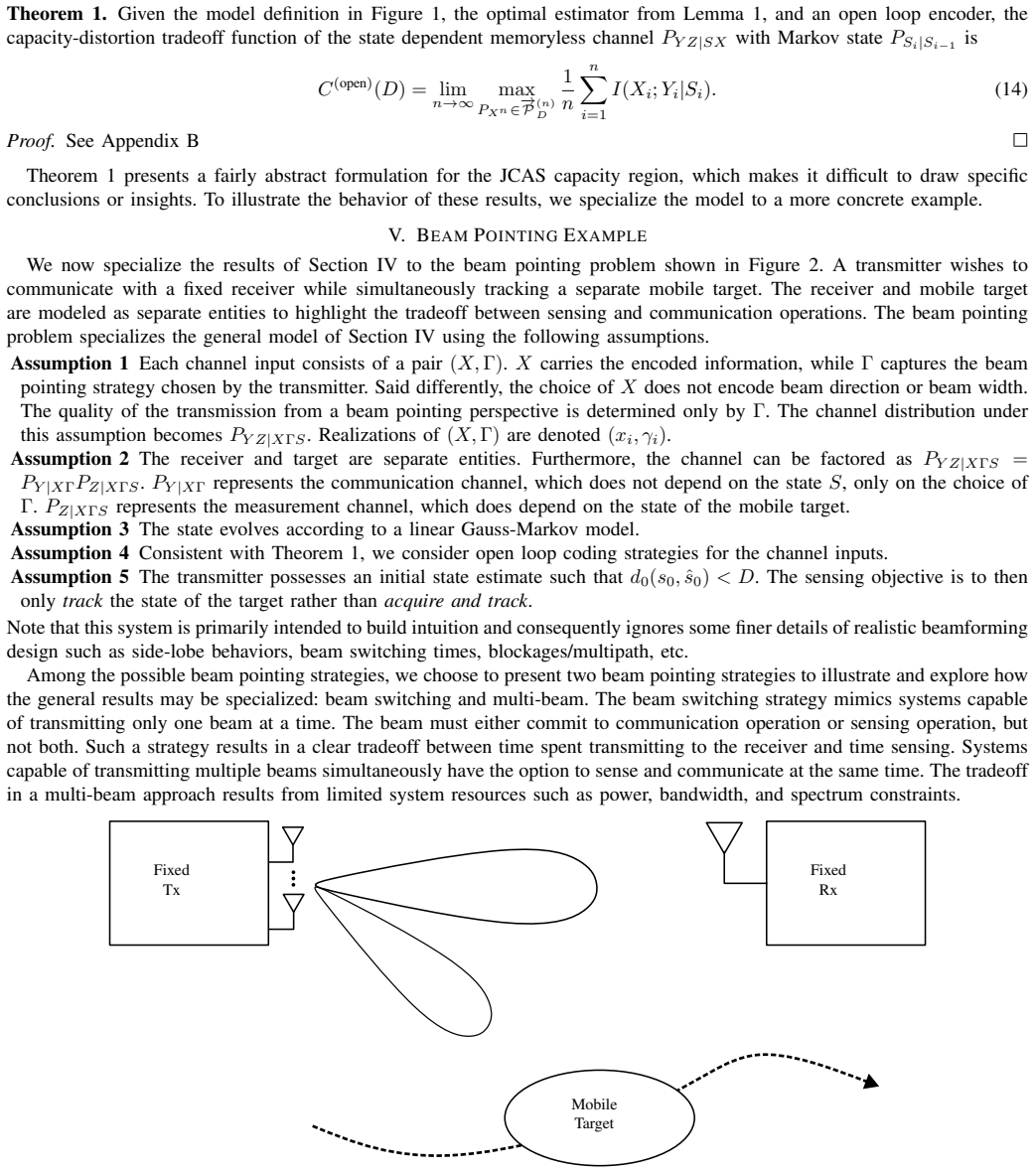
The central claim is Theorem 1: with the state evolving as a first-order Markov chain and the encoder operating open loop, the capacity-distortion tradeoff is $C^{\mathrm{open}}(D) = \lim_{n\to\infty} \max_{P_{X^n} \in \mathcal{P}_D^{(n)}} \frac{1}{n}\sum_{i=1}^n I(X_i;Y_i|S_i)$, where the feasible input set $\mathcal{P}_D^{(n)}$ is defined by the requirement that the average per-block distortion using the optimal estimator stays below $D$. Lemma 1 supplies that estimator: the optimal causal estimate at each time is the Bayes estimator $g_i^*(X^i,Z^i) = \arg\min_{\hat{s}} \mathbb{E}[d_i(S_i,\hat{s})|X^i,Z^i]$, which in the Gauss-Markov beam example becomes a Kalman filter. The paper then specializes the general formula to two beam-pointing schemes: beam switching, where sensing and communication time-share and the capacity is bracketed by $(1-\lambda)I(X;Y)$ evaluated at inner and outer distortion-feasible values of $\lambda$, and multi-beam, where a constant power-sharing parameter $\gamma_0$ yields $C_{\mathrm{mb}}(D) = \max I(X;Y|\Gamma=\gamma_0)$ over $\gamma_0$ satisfying the distortion constraint. The numerical comparison shows multi-beam dominating beam switching, especially for unstable target dynamics.
Load-bearing premise
The beam-switching theorems rest on modeling sensing intervals as erasures the receiver can detect without being told the beam schedule; if the receiver must know $\Gamma^n$ to interpret $Y^n$, the stated rates need rework.
Editorial extensions
If this is right
- Any open-loop JCAS system with a Markov state has an asymptotically optimal rate-versus-distortion tradeoff given by Theorem 1, provided the optimal estimator can be evaluated.
- For beam switching, the capacity lies between $(1-\lambda)I(X;Y)$ evaluated at the two distortion-derived thresholds $\lambda_S$ and $\lambda_V$, so the sensing schedule can be optimized at the level of the switching probability.
- For multi-beam, the tradeoff is fully determined by the power-sharing parameter $\gamma_0$ through a steady-state Riccati equation, so no codebook optimization beyond the usual channel capacity is needed.
- When the target dynamics are unstable, beam switching has a critical sensing probability below which distortion diverges, while multi-beam degrades more gracefully at high communication rates.
- The results extend the i.i.d.-state rate-distortion JCAS framework to predictive tracking, so the same analysis can be reused when the state evolves by any known dynamical model.
Reading between the lines
- Editorial extension: if Theorem 1 is right, the same limit formula should extend to closed-loop encoders only when feedback does not change the state posterior faster than the Bayesian filter; otherwise new terms coupling past estimates to future inputs must appear.
- Editorial extension: the beam-switching bounds suggest a testable design rule: allocate sensing time only up to the point where the Kalman error covariance saturates, since additional measurements beyond that point buy no communication-rate reduction.
- Editorial extension: the exact multi-beam characterization could serve as a benchmark for adaptive beamforming; if an adaptive strategy outperforms the constant-$\gamma_0$ optimum, it must be exploiting state prediction in a way the open-loop formula does not capture.
- Editorial extension: the paper's Remark 2 points toward a stronger per-step distortion constraint that would guarantee target tracking is never lost; combining that constraint with Theorem 1 would yield a rate-loss tradeoff with guaranteed tracking, which the average-distortion result does not address.
Signed reviews
Editorial analysis
A structured set of objections, weighed in public.
Referee Report
Summary. The paper studies a joint communication and sensing system in which the state evolves as a first-order Markov chain. A transmitter sends codewords over a memoryless state-dependent channel while also producing causal state estimates from channel measurements. Lemma 1 identifies the optimal causal estimator as the per-letter Bayesian estimator, and Theorem 1 states that the open-loop capacity-distortion trade-off is the limit of a maximized sum of conditional mutual informations under a distortion constraint. The paper then specializes the model to a beam-pointing problem with a linear Gauss-Markov target: Theorem 2 gives inner and outer bounds for a beam-switching strategy, Theorem 3 gives a formula for a multi-beam strategy, and numerical comparisons are provided. The authors note in the introduction that Lemma 1 and Theorem 1 coincide with results in [26].
Significance. The paper's main conceptual contribution is the extension of the rate-distortion JCAS framework from i.i.d. states to Markov states, and the authors correctly emphasize that single-letter formulas are not generally available. The use of the intermittent Kalman filter to convert a distortion constraint into a constraint on the sensing probability lambda, and the comparison between beam-switching and multi-beam strategies, are useful and clearly presented. The numerical section illustrates a meaningful qualitative difference between stable and unstable targets. The authors are transparent about the overlap with [26]. However, the distinctive beam-switching result is currently not proven under the stated model because the receiver is not given the beam-schedule sequence, and the proof of the general capacity formula relies on unstated finite-alphabet and information-stability restrictions.
major comments (3)
- [Section III, Appendix E, Theorem 2] Section III defines the decoder as h: Y^n x S^n -> M, so the receiver is not given the beam-schedule sequence Gamma^n. The achievability proof of Theorem 2 in Appendix E nevertheless models Gamma_i as a symbol erasure and decodes by joint typicality of (X^n,Y^n), which is valid only when the decoder knows which positions were erased. If Gamma^n is unknown to the receiver, the channel from X to Y is a channel with an unobserved state and its capacity is generally strictly smaller than (1-lambda)I(X;Y). For example, for a noiseless binary channel with Y=X in the communicating state and Y=0 in the sensing state and lambda=1/2, the claimed lower bound (1-lambda)I(X;Y)=1/2 bit per symbol, whereas the capacity of the averaged channel is max_p [h_2(p(1-lambda))-p h_2(1-lambda)] approximately 0.322 bits per symbol. The model should be amended to state that Gamma^n is known to the receiver (in which case a simple time-sharing argument gives the claimed lower bound), or the achievable rate should be computed for the true unknown-state channel.
- [Appendix E, eqs. (82)-(86)] The converse chain contains a reversed inequality. From I(X_i,Gamma_i;Y_i|S_i) = I(Gamma_i;Y_i|S_i) + I(X_i;Y_i|S_i,Gamma_i) it follows that I(X_i,Gamma_i;Y_i|S_i) >= I(X_i;Y_i|S_i,Gamma_i), not the <= displayed in (83). Thus the displayed argument does not establish the upper bound in Theorem 2. A correct converse would need to upper-bound R directly in terms of I(X_i;Y_i|S_i,Gamma_i), typically by starting from nR <= I(W;Y^n|S^n,Gamma^n), which again requires Gamma^n to be available at the decoder. The same inequality appears in Appendix F but is harmless there because Gamma is constant.
- [Appendix B, Theorem 1] The achievability proof for Theorem 1 fixes an i.i.d. product distribution P_{X^n} = prod p_X(x_i) and additionally assumes |Y| < infinity and an information-stability/concentration condition. The theorem statement, however, maximizes over arbitrary P_{X^n} in the cost-constrained set, and the numerical beam-pointing specialization uses Gaussian outputs (Section V.D). No argument is given that the optimum over block distributions is attained by an i.i.d. codebook, nor that the finite-alphabet information-stability argument extends to continuous alphabets and Markov states with unbounded log-likelihood ratios. Since Appendices E and F rely on the achievability analysis of Appendix B, this gap affects Theorems 2 and 3 as well.
minor comments (4)
- [Appendix C, eq. (75)] The indicator in (75) appears to use x_i where gamma_i is intended: the expression 1{x_i in X_s} should presumably be 1{gamma_i is in the sensing mode}, and the set X_s is never defined.
- [Section V.B, eq. (27)] The notation P_Lambda_S(D) and P_Lambda_V(D) is defined as a set but the dependence on D is dropped in the surrounding text; writing the argument explicitly and denoting the sets as functions of D would improve readability.
- [Section III, Assumption 1] The formal encoding functions are defined as f_i: M x Z^{i-1} -> X, while Assumption 1 makes the beam-pointing channel input the pair (X_i,Gamma_i); the model should state explicitly whether Gamma_i is a second encoder output, an exogenous random variable, or a known schedule, since the proofs of Theorems 2 and 3 treat it differently.
- [Section V.D, eqs. (33)-(34)] The symbols C_mb and C_bs are used for the numerical rate expressions while C_mb(D) and C_bs(D) denote the capacity-distortion functions; using distinct names or a sentence clarifying the distinction would avoid confusion.
Circularity Check
No significant circularity: the capacity-distortion results are derived from standard coding arguments and external filtering results, with the overlap to [26] disclosed.
full rationale
The paper's central Theorem 1 is established by a standard converse (Appendix B, bounding nR by Σ I(X_i; Y_i | S_i) via Fano and single-letterization) and a random-coding achievability proof with joint typicality, a finite-alphabet information-stability argument, and a Hoeffding bound for Markov chains [29]; the distortion analysis invokes the Bayesian estimator from Lemma 1, whose form is proved by minimizing conditional expected per-letter distortion rather than assumed. Lemma 1 is a direct consequence of conditioning, not a fitted or self-imported input. Theorem 2 and Theorem 3 are specializations that use external intermittent-Kalman-filter bounds [28] to sandwich tr(E[P_n]) and then apply the same coding argument; λ and γ0 are model parameters, not fitted to the predicted rate-distortion curve. The paper explicitly discloses that Lemma 1 and Theorem 1 coincide with [26], and no load-bearing claim relies on an unverified self-citation by the authors; [22]-[23] are background only. The possible modeling ambiguity about whether the receiver knows the beam schedule Γ^n is a correctness/assumption question, not a circularity, because it does not make any derived quantity equal to an input by construction.
Assumptions & free parameters
free parameters (1)
- Numerical system parameters A, Q, C, R =
A=-1.15 or -0.95, Q=0.2, C=1, R=1.5
assumptions (8)
- domain assumption The state sequence is a first-order Markov chain (Section III).
- domain assumption The channel is memoryless state-dependent P_YZ|XS (Section III).
- domain assumption The decoder knows the state sequence S^n (Section III, code definition).
- ad hoc to paper The achievability proof assumes information stability and a concentration inequality for the Markov chain (Appendix B).
- ad hoc to paper The achievability proof restricts to finite output alphabets |Y| < ∞ (Appendix B).
- domain assumption In beam-switching, γ_i is a random variable with P(γ_i=1)=λ and P(γ_i=σ)=1-λ, with σ→∞ (equation (19)).
- domain assumption In multi-beam, γ_i is constant γ0 (Section V-C).
- domain assumption The channel factors as P_Y|XΓ P_Z|XΓS (Assumption 2).
Cite this review
Pith. "Pith review of Rate Distortion Approach to Joint Communication and Sensing With Markov States: Open Loop Case." pith.science (2026). https://pith.science/paper/56XZEZTV
@misc{pith2026250115652,
  author       = {Pith},
  title        = {Pith review of: Rate Distortion Approach to Joint Communication and Sensing With Markov States: Open Loop Case},
  year         = {2026},
  howpublished = {\url{https://pith.science/paper/56XZEZTV}},
  note         = {Machine review of arXiv:2501.15652}
}
read the original abstract
We investigate a joint communication and sensing (JCAS) framework in which a transmitter concurrently transmits information to a receiver and estimates a state of interest based on noisy observations. The state is assumed to evolve according to a known dynamical model. Past state estimates may then be used to inform current state estimates. We show that Bayesian filtering constitutes the optimal sensing strategy. We analyze JCAS performance under an open loop encoding strategy with results presented in terms of the tradeoff between asymptotic communication rate and expected per-block distortion of the state. We illustrate the general result by specializing the analysis to a beam-pointing model with mobile state tracking. Our results shed light on the relative performance of two beam control strategies, beam-switching and multi-beam.
Figures


Figures from the paper (1 more)

Reference graph
Works this paper leans on
-
[26]
A memory-based reinforcement learning approach to integrated sensing and communication,
H. Nikbakht, M. Wigger, S. S. Shitz, and H. V . Poor, “A memory-based reinforcement learning approach to integrated sensing and communication,” in 2024 58th Asilomar Conference on Signals, Systems, and Computers . IEEE, 2024, pp. 433–437
work page 2024
-
[1]
Integrated Sensing and Communications: Toward Dual-Functional Wireless Networks for 6G and Beyond,
F. Liu, Y . Cui, C. Masouros, J. Xu, T. X. Han, Y . C. Eldar, and S. Buzzi, “Integrated Sensing and Communications: Toward Dual-Functional Wireless Networks for 6G and Beyond,” IEEE Journal on Selected Areas in Communications , vol. 40, no. 6, pp. 1728–1767, Jun. 2022
work page 2022
-
[2]
A Survey on Fundamental Limits of Integrated Sensing and Communication,
A. Liu, Z. Huang, M. Li, Y . Wan, W. Li, T. X. Han, C. Liu, R. Du, D. K. P. Tan, J. Lu, Y . Shen, F. Colone, and K. Chetty, “A Survey on Fundamental Limits of Integrated Sensing and Communication,” IEEE Communications Surveys & Tutorials , vol. 24, no. 2, pp. 994–1034, 2022
work page 2022
-
[3]
Full-Duplex OFDM Radar With LTE and 5G NR Waveforms: Challenges, Solutions, and Measurements,
C. Baquero Barneto, T. Riihonen, M. Turunen, L. Anttila, M. Fleischer, K. Stadius, J. Ryynänen, and M. Valkama, “Full-Duplex OFDM Radar With LTE and 5G NR Waveforms: Challenges, Solutions, and Measurements,” IEEE Transactions on Microwave Theory and Techniques , vol. 67, no. 10, pp. 4042–4054, Oct. 2019
work page 2019
-
[4]
Optimized Waveforms for 5G-6G Communication With Sensing: Theory, Simulations and Experiments,
S. D. Liyanaarachchi, T. Riihonen, C. B. Barneto, and M. Valkama, “Optimized Waveforms for 5G-6G Communication With Sensing: Theory, Simulations and Experiments,” IEEE Transactions on Wireless Communications , vol. 20, no. 12, pp. 8301–8315, Dec. 2021
work page 2021
-
[5]
J. Wang, X.-D. Liang, L.-Y . Chen, L.-N. Wang, and K. Li, “First Demonstration of Joint Wireless Communication and High-Resolution SAR Imaging Using Airborne MIMO Radar System,” IEEE Transactions on Geoscience and Remote Sensing , vol. 57, no. 9, pp. 6619–6632, Sep. 2019
work page 2019
-
[6]
IEEE 802.22 passive radars: multistatic detection and velocity profiler,
P. Stinco, M. S. Greco, F. Gini, and B. Himed, “IEEE 802.22 passive radars: multistatic detection and velocity profiler,” IEEE Transactions on Aerospace and Electronic Systems , vol. 52, no. 5, pp. 2298–2313, Oct. 2016
work page 2016
-
[7]
Signal Processing for Passive Radar Using OFDM Waveforms,
C. R. Berger, B. Demissie, J. Heckenbach, P. Willett, and S. Zhou, “Signal Processing for Passive Radar Using OFDM Waveforms,” IEEE Journal of Selected Topics in Signal Processing , vol. 4, no. 1, pp. 226–238, Feb. 2010
work page 2010
Show all 45 references
-
[8]
Detection in Passive MIMO Radar Networks,
D. E. Hack, L. K. Patton, B. Himed, and M. A. Saville, “Detection in Passive MIMO Radar Networks,” IEEE Transactions on Signal Processing, vol. 62, no. 11, pp. 2999–3012, Jun. 2014
2014
-
[9]
LoRadar: Enabling Concurrent Radar Sensing and LoRa Communication,
Q. Huang, Z. Luo, J. Zhang, W. Wang, and Q. Zhang, “LoRadar: Enabling Concurrent Radar Sensing and LoRa Communication,” IEEE Transactions on Mobile Computing , vol. 21, no. 6, pp. 2045–2057, Jun. 2022
2022
-
[10]
Power Minimization-Based Robust OFDM Radar Waveform Design for Radar and Communication Systems in Coexistence,
C. Shi, F. Wang, M. Sellathurai, J. Zhou, and S. Salous, “Power Minimization-Based Robust OFDM Radar Waveform Design for Radar and Communication Systems in Coexistence,” IEEE Transactions on Signal Processing , vol. 66, no. 5, pp. 1316–1330, Mar. 2018
2018
-
[11]
Toward Dual-functional Radar-Communication Systems: Optimal Waveform Design,
F. Liu, L. Zhou, C. Masouros, A. Li, W. Luo, and A. Petropulu, “Toward Dual-functional Radar-Communication Systems: Optimal Waveform Design,” IEEE Transactions on Signal Processing , vol. 66, no. 16, pp. 4264–4279, Aug. 2018
2018
-
[12]
Secure Radar-Communication Systems With Malicious Targets: Integrating Radar, Communications and Jamming Functionalities,
N. Su, F. Liu, and C. Masouros, “Secure Radar-Communication Systems With Malicious Targets: Integrating Radar, Communications and Jamming Functionalities,” IEEE Transactions on Wireless Communications , vol. 20, no. 1, pp. 83–95, Jan. 2021
2021
-
[13]
Secrecy Rate Optimizations for MIMO Communication Radar,
A. Deligiannis, A. Daniyan, S. Lambotharan, and J. A. Chambers, “Secrecy Rate Optimizations for MIMO Communication Radar,” IEEE Transactions on Aerospace and Electronic Systems , vol. 54, no. 5, pp. 2481–2492, Oct. 2018
2018
-
[14]
Transmitter actions for secure integrated sensing and communication,
T. Welling, O. Günlü, and A. Yener, “Transmitter actions for secure integrated sensing and communication,” in 2024 IEEE International Symposium on Information Theory (ISIT) . IEEE, 2024, pp. 2580–2585
2024
-
[15]
Low-latency secure integrated sensing and communication with transmitter actions,
——, “Low-latency secure integrated sensing and communication with transmitter actions,” in 2024 IEEE 25th International Workshop on Signal Processing Advances in Wireless Communications (SPAWC) . IEEE, 2024, pp. 351–355
2024
-
[16]
Deterministic-Random Tradeoff of Integrated Sensing and Communications in Gaussian Channels: A Rate-Distortion Perspective,
F. Liu, Y . Xiong, K. Wan, T. X. Han, and G. Caire, “Deterministic-Random Tradeoff of Integrated Sensing and Communications in Gaussian Channels: A Rate-Distortion Perspective,” Jan. 2023, arXiv:2212.10897 [cs, eess, math]. [Online]. Available: http://arxiv.org/abs/2212.10897
2023 arXiv
-
[17]
Joint transmission and state estimation: A constrained channel coding approach,
W. Zhang, S. Vedantam, and U. Mitra, “Joint transmission and state estimation: A constrained channel coding approach,” IEEE Transactions on Information Theory, vol. 57, no. 10, pp. 7084–7095, 2011
2011
-
[18]
An Information-Theoretic Approach to Joint Sensing and Communication,
M. Ahmadipour, M. Kobayashi, M. Wigger, and G. Caire, “An Information-Theoretic Approach to Joint Sensing and Communication,” IEEE Transactions on Information Theory , pp. 1–1, 2022
2022
-
[19]
An information-theoretic approach to collaborative integrated sensing and communication for two-transmitter systems,
M. Ahmadipour and M. Wigger, “An information-theoretic approach to collaborative integrated sensing and communication for two-transmitter systems,” IEEE Journal on Selected Areas in Information Theory , vol. 4, pp. 112–127, 2023
2023
-
[20]
On the Capacity and State Estimation Error of
S. Li and G. Caire, “On the Capacity and State Estimation Error of "Beam-Pointing" Channels: The Binary Case,” IEEE Transactions on Information Theory, pp. 1–1, 2023
2023
-
[21]
On the capacity of gaussian “beam-pointing
S. Li, F. Pedraza, and G. Caire, “On the capacity of gaussian “beam-pointing” channels with block memory and feedback,” in 2024 IEEE International Symposium on Information Theory (ISIT) . IEEE, 2024, pp. 2371–2376
2024
-
[22]
Rate and detection-error exponent tradeoff for joint communication and sensing of fixed channel states,
M.-C. Chang, S.-Y . Wang, T. Erdo ˘gan, and M. R. Bloch, “Rate and detection-error exponent tradeoff for joint communication and sensing of fixed channel states,” IEEE Journal on Selected Areas in Information Theory , vol. 4, pp. 245–259, 2023
2023
-
[23]
Sequential Joint Communication and Sensing of Fixed Channel States,
M.-C. Chang, S.-Y . Wang, and M. R. Bloch, “Sequential Joint Communication and Sensing of Fixed Channel States,” in 2023 IEEE Information Theory Workshop (ITW). Saint-Malo, France: IEEE, Apr. 2023, pp. 462–467
2023
-
[24]
Joint communication and binary state detection,
H. Joudeh and F. M. Willems, “Joint communication and binary state detection,” IEEE Journal on Selected Areas in Information Theory , vol. 3, no. 1, pp. 113–124, 2022
2022
-
[25]
Joint communication and channel discrimination,
H. Wu and H. Joudeh, “Joint communication and channel discrimination,” Entropy, vol. 26, no. 12, p. 1089, 2024
2024
-
[27]
Särkkä and L
S. Särkkä and L. Svensson, Bayesian filtering and smoothing . Cambridge university press, 2023, vol. 17
2023
-
[28]
Kalman Filtering With Intermittent Observations,
B. Sinopoli, L. Schenato, M. Franceschetti, K. Poolla, M. Jordan, and S. Sastry, “Kalman Filtering With Intermittent Observations,” IEEE Transactions on Automatic Control , vol. 49, no. 9, pp. 1453–1464, Sep. 2004
2004
-
[29]
Hoeffding’s inequality for general markov chains and its applications to statistical learning,
J. Fan, B. Jiang, and Q. Sun, “Hoeffding’s inequality for general markov chains and its applications to statistical learning,” Journal of Machine Learning Research, vol. 22, no. 139, pp. 1–35, 2021. APPENDIX A PROOF OF LEMMA 1 (O PTIMAL ESTIMATOR ) By definition of the per-blo...
2021
-
[30]
,2nR} and xn ∼ Qn i=1 pX (xi)
Codebook generation: Randomly generate 2nR sequences {xn(m)}2nR m=1 where m ∈ {1, . . . ,2nR} and xn ∼ Qn i=1 pX (xi). These sequences constitute the codebook C. Reveal the codebook to the encoder and decoder
-
[32]
If such a unique ˆm does not exist, then return a pre-defined arbitrary m0
Decoding: After observing the sequences Y n = yn and Sn = sn, the decoder searches for a unique message ˆm such that (xn( ˆm), yn, sn) ∈ Aα. If such a unique ˆm does not exist, then return a pre-defined arbitrary m0. This defines h(yn, sn) = ˆm
-
[33]
ˆsn = g∗(xn, zn) = g∗ 1(x1, z1), g∗ 2(x2, z2),
Estimation: Assuming the input sequence xn and measurement sequence zn, the encoder computes estimates via the optimal estimator from Lemma 1. ˆsn = g∗(xn, zn) = g∗ 1(x1, z1), g∗ 2(x2, z2), . . . , g∗ n(xn, zn) (55)
-
[34]
Analysis of Probability of Error: Using threshold decoding, the expected probability of error over all length n codebooks Cn is known to be E[Pe(Cn)] ≤ PPXn PSn PY n |Xn Sn ((X n, Yn, Sn) ̸∈ An α) + M 2−α. (56) In the most general sense, any rate R is achievable if R < sup {PX...
-
[35]
Analysis of Expected Distortion: Consider the following upper bound of the expected distortion (averaged over the random codebook). ∆(n) = E[d0,n(sn 0 , ˆsn 0 )] (67) = ECn [E[d0,n(sn 0 , ˆsn 0 )| ˆm] (68) = E[d0,n(sn 0 , ˆsn 0 )| ˆm = m]P ( ˆm = m) + E[d0,n(sn 0 , ˆsn 0 )| ˆm...
-
[36]
These sequences constitute the codebook C
Codebook generation: Randomly generate 2nR sequences {xn(m)}2nR m=1 where xn ∼ Qn i=1 pX (x). These sequences constitute the codebook C. Reveal the codebook to the encoder and decoder. Under the beam switching model, the sequence γn ∼ Qn i=1 p(γi) represents a symbol erasure, ...
-
[38]
After observing the sequence Y n = yn, the decoder searches for a message ˆm such that (xn( ˆm), yn) ∈ A(n) ε (PXY ) (92)
Decoding: Let A(n) ε (PXY ) be the set of jointly-typical sequences of X and Y . After observing the sequence Y n = yn, the decoder searches for a message ˆm such that (xn( ˆm), yn) ∈ A(n) ε (PXY ) (92)
-
[39]
ˆsn = (ˆs1|1(γ1, z1), ˆs2|2(γ2, z2) · · ·ˆsn|n(γn, zn)) (93)
Estimation: Assuming the input sequence γn and measurement sequence zn, the encoder computes estimates via the intermittent Kalman filter. ˆsn = (ˆs1|1(γ1, z1), ˆs2|2(γ2, z2) · · ·ˆsn|n(γn, zn)) (93)
-
[40]
We define the following communication error events
Analysis of Probability of Error: By the symmetry of the code, we restrict our attention to m = 1. We define the following communication error events. E1 = {(X n(1), Yn) ̸∈ A(n) ε } (94) E2 = {(X n(m′), Yn) ∈ A(n) ε , m′ ̸= 1} (95) Note that the state sequence Sn is not includ...
-
[41]
(97) By construction of the beam pointing problem, Dmax is finite
Analysis of Expected Distortion: From the achievability proof of Theorem 1, we have ∆(n) ≤ E[d0,n(sn 0 , ˆsn 0 )| ˆm = 1] + DmaxPe. (97) By construction of the beam pointing problem, Dmax is finite. By Lemma 3, ∆(n) ≤ E[d0,n(sn 0 , ˆsn 0 )| ˆm = 1] + DmaxPe (98) = tr(E[Pn]) + ...
-
[42]
These sequences constitute the codebook C
Codebook generation: Randomly generate 2nR sequences {xn(m)}2nR m=1 where xn ∼ Qn i=1 pX (x). These sequences constitute the codebook C. Reveal the codebook to the encoder and decoder. Under the multi-beam model, γ0 is a known gain that parameterizes the channel model
-
[43]
Encoding: To send the message m ∈ M, the encoder transmits xn(m)
-
[44]
Decoding: After observing the sequence Y n = yn, the decoder searches for a message ˆm such that (xn( ˆm), yn) ∈ A(n) ε (PXY ) (111) where A(n) ε (PXY ) is again the set of jointly typical inputs and outputs
-
[45]
ˆsn = (ˆs1|1(z1), ˆs2|2(z2) · · ·ˆsn|n(zn)) (112)
Estimation: Assuming the known gain γ0 and measurement sequence zn, the encoder computes estimates via the standard Kalman filter. ˆsn = (ˆs1|1(z1), ˆs2|2(z2) · · ·ˆsn|n(zn)) (112)
-
[46]
We define the following communication error events
Analysis of Probability of Error: By the symmetry of the code, we restrict our attention to m = 1. We define the following communication error events. E1 = {(X n(1), Yn) ̸∈ A(n) ε } (113) E2 = {(X n(m′), Yn) ∈ A(n) ε , m′ ̸= 1} (114) Note that the state sequence Sn is not incl...
-
[47]
(116) By construction of the beam pointing problem, Dmax is finite
Analysis of Expected Distortion: From the achievability proof of Theorem 1, we have ∆(n) ≤ E[d0,n(sn 0 , ˆsn 0 )| ˆm = 1] + DmaxPe. (116) By construction of the beam pointing problem, Dmax is finite. Continuing, we have, ∆(n) ≤ E[d0,n(sn 0 , ˆsn 0 )| ˆm = 1] + DmaxPe (117) = t...
Reviewed August 10, 2026 · model on record in the stance chip above.
Discussion (0). Continue with ORCID to comment.