REVIEW 3 major objections 5 minor 44 references
StagFormer: Time Staggering Transformer Decoding for RunningLayers In Parallel
T0 review · 3 major / 5 minor · reviewed 2026-08-10 · deepseek-v4-flash
Pith's one-line read StagFormer matches a 36-layer model while running two 18-layer stacks in parallel.
desk verdict A genuinely new way to trade one token of context for depth-parallel decoding, with surprisingly clean quality results at 300B tokens, but the latency headline is a simulation that drops inter-chip communication. read the letter →
The pith
A machine-rendered reading of the paper's core claim, the machinery that carries it, and where it could break.
The reading
What carries the argument
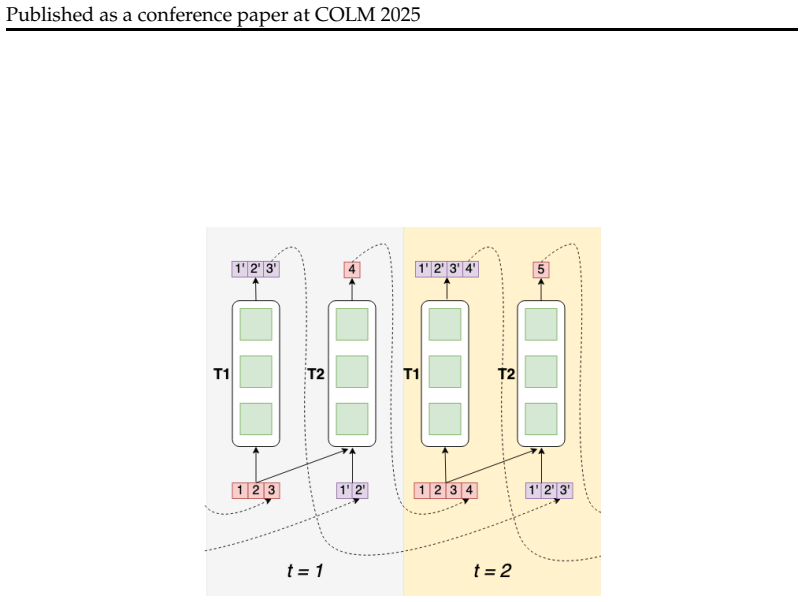
The central mechanism is the staggered dependency between stacks. With two stacks, the first stack processes the current token normally, but the second stack computes its representation from the token embedding plus cross-attention to the first stack's representations of tokens up to i-1, never to the current token's first-stack representation. This removes the data dependency that forces layers to run sequentially, because while the second stack finishes predicting the next token, the first stack is already computing representations for that token. The price is extra cross-attention parameters and a 50 percent larger KV cache for separate weights, and a tripled KV cache for shared weights.
What would settle it
Run the two stacks on two physical accelerators and measure end-to-end tokens per second including cross-stack activation transfer and duplicated embedding and softmax tables; if the observed per-token latency is not close to roughly half the baseline's, the paper's central latency claim fails. Separately, train a variant that removes the one-step lag by letting the upper stack attend to the current token's first-stack representation; if that variant is markedly better, the claimed quality parity is partly a product of the added cross-attention parameters rather than the stagger itself.
Extended reading notes
Core claim
The central claim is that the usual all-layers-before-next-token dependency is not necessary for quality: a Transformer can be partitioned into stacks that cross-attend to the previous stack's activations with a one-time-step lag, and this staggering makes decoding depth-parallel while staying quality neutral. In the paper's main comparison, a separate-weights StagFormer with two 18-layer stacks reaches 3.756 Pile perplexity versus 3.780 for the 36-layer baseline and a 47.0 average downstream score versus 45.0, with strong gains on SQuADv2, Lambada, and HellaSwag and neutral results on SuperGLUE. The same idea extends to shared weights, where two passes through one 18-layer network close much of the gap between the 18-layer and 36-layer baselines at roughly the 18-layer parameter count, and to local cross-attention, where a window of 512 keeps quality while a window of 1 collapses it.
Load-bearing premise
The headline latency gain assumes the two stacks can run in parallel with negligible inter-chip communication; if copying activations and duplicated tables between chips is slow, the speedup shrinks even though quality parity may survive.
Editorial extensions
If this is right
- A StagFormer with two stacks can be decoded with wall-clock latency closer to a model with half the layers when the stacks run on separate chips, because at each time step the two halves work simultaneously.
- The one-step cross-stack delay is not fatal for quality: the separate-weights model surpasses the same-depth baseline on most measured tasks, so the added cross-attention can substitute for the missing same-token representation.
- With shared weights, StagFormer becomes a parameter-efficient way to add effective depth, closing much of the quality gap an 18-layer Transformer has against a 36-layer one while adding only about 0.2 billion parameters.
- Bounded cross-attention windows are a workable memory-latency knob: a window of 512 preserves quality, but a window of 1 degrades it sharply, so the upper stack needs multi-position context.
- Scaling to more than two stacks lowers quality, though learning a linear combination of each stack's output lets p=3 and p=4 models stay competitive on some tasks.
Reading between the lines
- One implication the authors leave implicit is that the same staggering recipe could be applied to unequally sized stacks or to individual layer groups, enabling finer-grained pipeline parallelism with adjustable delay budgets.
- The quality parity suggests a testable hypothesis about Transformer internals: the lower layers' representation of the current token may be largely redundant for next-token prediction once prior-token hidden states are available.
- On real distributed hardware the speedup is bounded by inter-chip transfer and single-program-multiple-data overhead; a fair comparison should measure end-to-end tokens per second with the model sharded across two devices, including activation copies and duplicated embedding and softmax tables.
- The recurrent shared-weights variant points toward a middle path between Transformers and recurrent networks; a natural extension would train with a fixed-size compressed hidden state instead of a growing cross-attention KV cache.
Editorial analysis
A structured set of objections, weighed in public.
Referee Report
Summary. The paper proposes StagFormer, a decoder-only Transformer whose layers are partitioned into p stacks; the upper stacks receive token embeddings for the current position and cross-attend to the previous stack's representations only up to position i-1, thereby breaking the per-token sequential dependency along depth. At decode time the stacks can execute in parallel at the cost of a one-token delay in cross-stack information. The authors pretrain separate-weights (2.9B) and shared-weights (1.8B) variants on The Pile for roughly 300B tokens and report that the p=2 separate-weights model matches or slightly outperforms a 2.8B 36-layer baseline on Pile perplexity and downstream tasks, while a simulated latency benchmark shows decoding gains. Extensions include local cross-attention, p>2 staggering with learned stack mixing, and a recurrent inference approximation for the shared-weights variant.
Significance. If the quality-neutrality result holds, StagFormer offers a genuinely different way to parallelize decoding along the depth axis, complementary to speculative decoding and attention sparsification. The paper's quality evidence is substantial: large-scale pretraining against external baselines, with algorithms specified and no circular fitting. The central speedup claim, however, rests entirely on a simulation that explicitly ignores inter-chip communication and SPMD overhead; because the architecture's raison d'être is wall-clock latency, the contribution is not fully established until this is measured or modeled. The quality result is interesting enough to warrant a revision rather than rejection.
major comments (3)
- [Section 2, 'Quantifying the Latency Benefits'; Section 5] The speedup claim is based on a simulation that 'ignore[s] the inter-chip communication cost between the first and second stacks,' and Section 5 admits that this communication 'prevents one from realizing the full theoretical latency benefit' and that SPMD execution requires duplicating token embeddings and softmax tables. Since the central claimed benefit is wall-clock decoding speedup, a real two-device measurement, or at least a quantitative model of communication and SPMD overhead, is needed to establish the result. As written, Figure 3 reports an upper-bound scenario, not an achieved speedup. The comparison should also include a tensor-parallel baseline that uses the same two chips without any architectural change, to isolate the benefit of StagFormer.
- [Algorithm 1, Step 2; Algorithm 4, Step 2] The assignment 'u = 0 when j = h+1 and u = j otherwise' is not executable: for j = h+2, the representation t^{1,...,i}_j has not yet been computed when layer L'_j is applied. The correct recurrence is u = j-1, as written in Algorithm 2. The same typo appears in Algorithm 4 for the p>2 variant. As printed, the core pseudocode cannot be run, so the experiments as described do not correspond to an executable algorithm; this must be fixed for reproducibility.
- [Section 3.2 and Figure 3] The text says 'The analysis is presented in Table 3,' but Table 3 reports shared-weights recurrent inference quality results, not latency; Figure 3 is the latency plot. This cross-reference error obscures the only latency evidence in the paper. Please correct the reference and describe the simulation setup (chip model, arithmetic intensity, batch size, communication assumptions) in the main text rather than referring to a table that does not contain the latency analysis.
minor comments (5)
- [Figure 3 caption] The caption reads 'StagFormer is able to decode 2,048 tokens than baseline'; a word such as 'faster' is missing.
- [Section 4.3] 'imploring a simple change' should be 'employing a simple change'.
- [Tables 1, 2, 4-7] All quality numbers appear to come from single training runs with no error bars or seeds. Reporting variance or at least stating that these are single runs would help the reader assess the 'match or outperform' claim.
- [Section 3.2] The phrase 'latency benchmarking results on accelerator hardware' overstates what is presented; the results are from a simulation that ignores inter-chip communication. Please rephrase to 'simulated latency benchmarking'.
- [Section 5] The limitation discussion is candid and welcome, but it should be moved earlier or at least echoed where the latency speedup is first claimed, so that the reader does not encounter the unqualified speedup claim in the Introduction and Section 2 without the caveat.
Circularity Check
No circular derivation: quality is externally benchmarked and the latency savings are an analytical FLOP bound with clearly disclosed communication-cost caveats.
full rationale
The paper's central claims are supported by external empirical benchmarks and explicit arithmetic, not by definitions or fitted inputs. Quality neutrality rests on Table 1, where StagFormer p=2 is compared against independently trained 18-layer and 36-layer baselines on Pile perplexity and standard downstream tasks (HellaSwag, ARC, WinoGrande, SuperGLUE, SQuADv2, GEM-XSum); these are measured outcomes, not parameters fitted to guarantee the conclusion. The latency analysis in Section 2 is an analytical FLOP count: the baseline forward pass is 2e + l(m+a) FLOPs and the StagFormer total is 2e + 3l(m+a)/2, with parallel execution reducing the wall-clock equivalent to 2e + l(m+a)/2 in an ideal scenario. This is a mathematical upper-bound calculation, not a prediction manufactured from StagFormer's own outputs. The paper explicitly discloses that the latency simulation 'ignore[s] the inter-chip communication cost between the first and second stacks' and Section 5 concedes that communication 'prevents one from realizing the full theoretical latency benefit'; this is a stated limitation of an empirical/simulated speedup claim, not a circular step. The learnable coefficients alpha and the extra cross-attention weights are trained model parameters, and their existence does not by construction produce the reported quality or latency numbers. Self-citations (Baykal et al. 2024, Panigrahi et al. 2024, Gatmiry et al. 2024, Saunshi et al. 2025) appear only in related-work or comparison contexts and are not load-bearing for the architecture's claimed validity. No step in the paper reduces, by definition or by self-citation, to its own inputs.
Assumptions & free parameters
free parameters (3)
- Stack-output mixing coefficients alpha_k (p > 2 variant) =
learned during pretraining
- Cross-attention projection weights in upper stacks =
learned during pretraining
- Local cross-attention window size =
chosen by authors (512, 128, 1)
assumptions (5)
- domain assumption Standard Transformer layer behavior (self-attention, feed-forward, residual connections, layer norm, causal masking) is as described.
- ad hoc to paper Two stacks can be executed in parallel on separate accelerators with negligible inter-chip communication cost.
- domain assumption A one-step delay in cross-stack attention does not degrade quality beyond what extra cross-attention parameters can offset.
- domain assumption Sequential training with causal masking on the cross-attention path transfers to parallel decoding at inference.
- domain assumption The Pile dataset and the chosen downstream benchmarks are sufficient measures of language modeling quality.
Cite this review
Pith. "Pith review of StagFormer: Time Staggering Transformer Decoding for RunningLayers In Parallel." pith.science (2026). https://pith.science/paper/NLJYUII4
@misc{pith2026250115665,
  author       = {Pith},
  title        = {Pith review of: StagFormer: Time Staggering Transformer Decoding for RunningLayers In Parallel},
  year         = {2026},
  howpublished = {\url{https://pith.science/paper/NLJYUII4}},
  note         = {Machine review of arXiv:2501.15665}
}
abstract
Decoding in a Transformer based language model is inherently sequential as a token's embedding needs to pass through all the layers in the network before the generation of the next token can begin. In this work, we propose a new architecture StagFormer (Staggered Transformer), which staggers execution along the sequence axis and thereby enables parallelizing the decoding process along the depth of the model. We achieve this by breaking the dependency of the token representation at time step $i$ in layer $l$ upon the representations of tokens until time step $i$ from layer $l-1$. Instead, we stagger the execution and only allow a dependency on token representations until time step $i-1$. The later sections of the Transformer still get access to the "rich" representations from the prior section but only from those token positions which are one time step behind. StagFormer allows for different sections of the model to be executed in parallel yielding a potential speedup in decoding while being quality neutral in our simulations. We also explore many natural extensions of this idea. We present how weight-sharing across the different sections being staggered can be more practical in settings with limited memory. We explore the efficacy of using a bounded window attention to pass information from one section to another which helps drive further latency gains for some applications. We also explore the scalability of the staggering idea over more than 2 sections of the Transformer. Finally, we show how one can approximate a recurrent model during inference using weight-sharing. This variant can lead to substantial gains in quality for short generations while being neutral in its latency impact.
Figures


Figures from the paper (2 more)


Reference graph
Works this paper leans on
-
[1]
write newline
" write newline "" before.all 'output.state := FUNCTION n.dashify 't := "" t empty not t #1 #1 substring "-" = t #1 #2 substring "--" = not "--" * t #2 global.max substring 't := t #1 #1 substring "-" = "-" * t #2 global.max substring 't := while if t #1 #1 substring * t #2 global.max substring 't := if while FUNCTION format.date year duplicate empty "emp...
-
[2]
Alternating updates for efficient transformers
Cenk Baykal, Dylan Cutler, Nishanth Dikkala, Nikhil Ghosh, Rina Panigrahy, and Xin Wang. Alternating updates for efficient transformers. Advances in Neural Information Processing Systems, 36, 2024
work page 2024
-
[3]
Iz Beltagy, Matthew E. Peters, and Arman Cohan. Longformer: The long-document transformer, 2020. URL https://arxiv.org/abs/2004.05150
arXiv 2020
-
[4]
Tom B. Brown, Benjamin Mann, Nick Ryder, Melanie Subbiah, Jared Kaplan, Prafulla Dhariwal, Arvind Neelakantan, Pranav Shyam, Girish Sastry, Amanda Askell, Sandhini Agarwal, Ariel Herbert-Voss, Gretchen Krueger, Tom Henighan, Rewon Child, Aditya Ramesh, Daniel M. Ziegler, Jeffrey Wu, Clemens Winter, Christopher Hesse, Mark Chen, Eric Sigler, Mateusz Litwin...
arXiv 2020
-
[5]
Medusa: Simple llm inference acceleration framework with multiple decoding heads
Tianle Cai, Yuhong Li, Zhengyang Geng, Hongwu Peng, Jason D Lee, Deming Chen, and Tri Dao. Medusa: Simple llm inference acceleration framework with multiple decoding heads. arXiv preprint arXiv:2401.10774, 2024
arXiv 2024
-
[6]
Palm: Scaling language modeling with pathways
Aakanksha Chowdhery, Sharan Narang, Jacob Devlin, Maarten Bosma, Gaurav Mishra, Adam Roberts, Paul Barham, Hyung Won Chung, Charles Sutton, Sebastian Gehrmann, et al. Palm: Scaling language modeling with pathways. arXiv preprint arXiv:2204.02311, 2022
arXiv 2022
-
[7]
Zihang Dai, Zhilin Yang, Yiming Yang, Jaime Carbonell, Quoc V. Le, and Ruslan Salakhutdinov. Transformer-xl: Attentive language models beyond a fixed-length context, 2019. URL https://arxiv.org/abs/1901.02860
arXiv 2019
-
[8]
Mostafa Dehghani, Stephan Gouws, Oriol Vinyals, Jakob Uszkoreit, and ukasz Kaiser. Universal transformers. arXiv preprint arXiv:1807.03819, 2018
arXiv 2018
Show all 44 references
-
[9]
Bert: Pre-training of deep bidirectional transformers for language understanding, 2019
Jacob Devlin, Ming-Wei Chang, Kenton Lee, and Kristina Toutanova. Bert: Pre-training of deep bidirectional transformers for language understanding, 2019. URL https://arxiv.org/abs/1810.04805
2019 arXiv
-
[10]
The pile: An 800gb dataset of diverse text for language modeling, 2020
Leo Gao, Stella Biderman, Sid Black, Laurence Golding, Travis Hoppe, Charles Foster, Jason Phang, Horace He, Anish Thite, Noa Nabeshima, Shawn Presser, and Connor Leahy. The pile: An 800gb dataset of diverse text for language modeling, 2020. URL https://arxiv.org/abs/2101.00027
2020 arXiv
-
[11]
Reddi, Stefanie Jegelka, and Sanjiv Kumar
Khashayar Gatmiry, Nikunj Saunshi, Sashank J. Reddi, Stefanie Jegelka, and Sanjiv Kumar. Can looped transformers learn to implement multi-step gradient descent for in-context learning? In Ruslan Salakhutdinov, Zico Kolter, Katherine Heller, Adrian Weller, Nuria Oliver, Jonatha...
2024
-
[12]
Lee, and Dimitris Papailiopoulos
Angeliki Giannou, Shashank Rajput, Jy yong Sohn, Kangwook Lee, Jason D. Lee, and Dimitris Papailiopoulos. Looped transformers as programmable computers, 2023. URL https://arxiv.org/abs/2301.13196
2023 arXiv
-
[13]
Mamba: Linear-time sequence modeling with selective state spaces, 2024
Albert Gu and Tri Dao. Mamba: Linear-time sequence modeling with selective state spaces, 2024. URL https://arxiv.org/abs/2312.00752
2024 arXiv
-
[14]
Efficiently modeling long sequences with structured state spaces, 2022
Albert Gu, Karan Goel, and Christopher Ré. Efficiently modeling long sequences with structured state spaces, 2022. URL https://arxiv.org/abs/2111.00396
2022 arXiv
-
[15]
Training compute-optimal large language models
Jordan Hoffmann, Sebastian Borgeaud, Arthur Mensch, Elena Buchatskaya, Trevor Cai, Eliza Rutherford, Diego de Las Casas, Lisa Anne Hendricks, Johannes Welbl, Aidan Clark, et al. Training compute-optimal large language models. arXiv preprint arXiv:2203.15556, 2022
2022 arXiv
-
[16]
Block-recurrent transformers, 2022
DeLesley Hutchins, Imanol Schlag, Yuhuai Wu, Ethan Dyer, and Behnam Neyshabur. Block-recurrent transformers, 2022. URL https://arxiv.org/abs/2203.07852
2022 arXiv
-
[17]
Staircase attention for recurrent processing of sequences
Da Ju, Stephen Roller, Sainbayar Sukhbaatar, and Jason E Weston. Staircase attention for recurrent processing of sequences. Advances in Neural Information Processing Systems, 35: 0 13203--13213, 2022
2022
-
[18]
Matryoshka representation learning
Aditya Kusupati, Gantavya Bhatt, Aniket Rege, Matthew Wallingford, Aditya Sinha, Vivek Ramanujan, William Howard-Snyder, Kaifeng Chen, Sham Kakade, Prateek Jain, et al. Matryoshka representation learning. Advances in Neural Information Processing Systems, 35: 0 30233--30249, 2022
2022
-
[19]
Albert: A lite bert for self-supervised learning of language representations
Zhenzhong Lan, Mingda Chen, Sebastian Goodman, Kevin Gimpel, Piyush Sharma, and Radu Soricut. Albert: A lite bert for self-supervised learning of language representations. arXiv preprint arXiv:1909.11942, 2019
1909 arXiv
-
[20]
Fast inference from transformers via speculative decoding, 2023
Yaniv Leviathan, Matan Kalman, and Yossi Matias. Fast inference from transformers via speculative decoding, 2023. URL https://arxiv.org/abs/2211.17192
2023 arXiv
-
[21]
Sci-cot: Leveraging large language models for enhanced knowledge distillation in small models for scientific qa, 2023
Yuhan Ma, Haiqi Jiang, and Chenyou Fan. Sci-cot: Leveraging large language models for enhanced knowledge distillation in small models for scientific qa, 2023. URL https://arxiv.org/abs/2308.04679
2023 arXiv
-
[22]
Efficient stagewise pretraining via progressive subnetworks
Abhishek Panigrahi, Nikunj Saunshi, Kaifeng Lyu, Sobhan Miryoosefi, Sashank Reddi, Satyen Kale, and Sanjiv Kumar. Efficient stagewise pretraining via progressive subnetworks. arXiv preprint arXiv:2402.05913, 2024
2024 arXiv
-
[23]
Efficiently scaling transformer inference, 2022
Reiner Pope, Sholto Douglas, Aakanksha Chowdhery, Jacob Devlin, James Bradbury, Anselm Levskaya, Jonathan Heek, Kefan Xiao, Shivani Agrawal, and Jeff Dean. Efficiently scaling transformer inference, 2022. URL https://arxiv.org/abs/2211.05102
2022 arXiv
-
[24]
Improving language understanding by generative pre-training
Alec Radford. Improving language understanding by generative pre-training. 2018
2018
-
[25]
Colin Raffel, Noam Shazeer, Adam Roberts, Katherine Lee, Sharan Narang, Michael Matena, Yanqi Zhou, Wei Li, and Peter J. Liu. Exploring the limits of transfer learning with a unified text-to-text transformer, 2023. URL https://arxiv.org/abs/1910.10683
2023 arXiv
-
[26]
Know what you don't know: Unanswerable questions for squad, 2018
Pranav Rajpurkar, Robin Jia, and Percy Liang. Know what you don't know: Unanswerable questions for squad, 2018. URL https://arxiv.org/abs/1806.03822
2018 arXiv
-
[27]
Winogrande: An adversarial winograd schema challenge at scale, 2019
Keisuke Sakaguchi, Ronan Le Bras, Chandra Bhagavatula, and Yejin Choi. Winogrande: An adversarial winograd schema challenge at scale, 2019. URL https://arxiv.org/abs/1907.10641
2019 arXiv
-
[28]
Accelerating transformer inference for translation via parallel decoding
Andrea Santilli, Silvio Severino, Emilian Postolache, Valentino Maiorca, Michele Mancusi, Riccardo Marin, and Emanuele Rodol \`a . Accelerating transformer inference for translation via parallel decoding. arXiv preprint arXiv:2305.10427, 2023
2023 arXiv
-
[29]
Reasoning with latent thoughts: On the power of looped transformers
Nikunj Saunshi, Nishanth Dikkala, Zhiyuan Li, Sanjiv Kumar, and Sashank J Reddi. Reasoning with latent thoughts: On the power of looped transformers. arXiv preprint arXiv:2502.17416, 2025
2025 arXiv
-
[30]
Blockwise parallel decoding for deep autoregressive models, 2018
Mitchell Stern, Noam Shazeer, and Jakob Uszkoreit. Blockwise parallel decoding for deep autoregressive models, 2018. URL https://arxiv.org/abs/1811.03115
2018 arXiv
-
[31]
Roformer: Enhanced transformer with rotary position embedding, 2023
Jianlin Su, Yu Lu, Shengfeng Pan, Ahmed Murtadha, Bo Wen, and Yunfeng Liu. Roformer: Enhanced transformer with rotary position embedding, 2023. URL https://arxiv.org/abs/2104.09864
2023 arXiv
-
[32]
Spectr: Fast speculative decoding via optimal transport
Ziteng Sun, Ananda Theertha Suresh, Jae Hun Ro, Ahmad Beirami, Himanshu Jain, and Felix Yu. Spectr: Fast speculative decoding via optimal transport. Advances in Neural Information Processing Systems, 36, 2024
2024
-
[33]
Efficient transformers: A survey, 2022
Yi Tay, Mostafa Dehghani, Dara Bahri, and Donald Metzler. Efficient transformers: A survey, 2022. URL https://arxiv.org/abs/2009.06732
2022 arXiv
-
[34]
Attention is all you need
Ashish Vaswani, Noam Shazeer, Niki Parmar, Jakob Uszkoreit, Llion Jones, Aidan N Gomez, ukasz Kaiser, and Illia Polosukhin. Attention is all you need. In Advances in Neural Information Processing Systems, volume 30, 2017. URL https://proceedings.neurips.cc/paper/2017/file/3f5e...
2017
-
[35]
Alex Wang, Yada Pruksachatkun, Nikita Nangia, Amanpreet Singh, Julian Michael, Felix Hill, Omer Levy, and Samuel R. Bowman. Superglue: A stickier benchmark for general-purpose language understanding systems, 2020. URL https://arxiv.org/abs/1905.00537
2020 arXiv
-
[36]
Smoothquant: Accurate and efficient post-training quantization for large language models
Guangxuan Xiao, Ji Lin, Mickael Seznec, Hao Wu, Julien Demouth, and Song Han. Smoothquant: Accurate and efficient post-training quantization for large language models. In International Conference on Machine Learning, pp.\ 38087--38099. PMLR, 2023
2023
-
[37]
A survey on knowledge distillation of large language models
Xiaohan Xu, Ming Li, Chongyang Tao, Tao Shen, Reynold Cheng, Jinyang Li, Can Xu, Dacheng Tao, and Tianyi Zhou. A survey on knowledge distillation of large language models. arXiv preprint arXiv:2402.13116, 2024
2024 arXiv
-
[38]
Gspmd: General and scalable parallelization for ml computation graphs, 2021
Yuanzhong Xu, HyoukJoong Lee, Dehao Chen, Blake Hechtman, Yanping Huang, Rahul Joshi, Maxim Krikun, Dmitry Lepikhin, Andy Ly, Marcello Maggioni, Ruoming Pang, Noam Shazeer, Shibo Wang, Tao Wang, Yonghui Wu, and Zhifeng Chen. Gspmd: General and scalable parallelization for ml c...
2021 arXiv
-
[39]
Physics of language models: Part 2.1, grade-school math and the hidden reasoning process
Tian Ye, Zicheng Xu, Yuanzhi Li, and Zeyuan Allen-Zhu. Physics of language models: Part 2.1, grade-school math and the hidden reasoning process. arXiv preprint arXiv:2407.20311, 2024
2024 arXiv
-
[40]
Hellaswag: Can a machine really finish your sentence?, 2019
Rowan Zellers, Ari Holtzman, Yonatan Bisk, Ali Farhadi, and Yejin Choi. Hellaswag: Can a machine really finish your sentence?, 2019. URL https://arxiv.org/abs/1905.07830
2019 arXiv
-
[41]
Are more layers beneficial to graph transformers? In The Eleventh International Conference on Learning Representations, 2023
Haiteng Zhao, Shuming Ma, Dongdong Zhang, Zhi-Hong Deng, and Furu Wei. Are more layers beneficial to graph transformers? In The Eleventh International Conference on Learning Representations, 2023. URL https://openreview.net/forum?id=uagC-X9XMi8
2023
-
[42]
@esa (Ref
\@ifxundefined[1] #1\@undefined \@firstoftwo \@secondoftwo \@ifnum[1] #1 \@firstoftwo \@secondoftwo \@ifx[1] #1 \@firstoftwo \@secondoftwo [2] @ #1 \@temptokena #2 #1 @ \@temptokena \@ifclassloaded agu2001 natbib The agu2001 class already includes natbib coding, so you should ...
-
[43]
\@lbibitem[] @bibitem@first@sw\@secondoftwo \@lbibitem[#1]#2 \@extra@b@citeb \@ifundefined br@#2\@extra@b@citeb \@namedef br@#2 \@nameuse br@#2\@extra@b@citeb \@ifundefined b@#2\@extra@b@citeb @num @parse #2 @tmp #1 NAT@b@open@#2 NAT@b@shut@#2 \@ifnum @merge>\@ne @bibitem@firs...
-
[44]
hidden state
@open @close @open @close and [1] URL: #1 \@ifundefined chapter * \@mkboth \@ifxundefined @sectionbib * \@mkboth * \@mkboth\@gobbletwo \@ifclassloaded amsart * \@ifclassloaded amsbook * \@ifxundefined @heading @heading NAT@ctr thebibliography [1] @ \@biblabel @NAT@ctr \@bibset...
Reviewed August 10, 2026 · model on record in the stance chip above.
Discussion (0). Continue with ORCID to comment.