REVIEW 3 major objections 5 minor 39 references
ClearSight: Human Vision-Inspired Solutions for Event-Based Motion Deblurring
T0 review · 3 major / 5 minor · reviewed 2026-08-10 · deepseek-v4-flash
Pith's one-line read This paper proposes BDHNet, a dual-drive ANN-SNN network that reaches state-of-the-art event-based motion deblurring by reconfiguring spiking neurons and masking blurry regions before cross-modal attention.
desk verdict A solid hybrid SNN/ANN deblurrer with a real GoPro gain, but the real-world SOTA claim rests on a 0.04 dB margin and a missing MS-RBD table. read the letter →
The pith
A machine-rendered reading of the paper's core claim, the machinery that carries it, and where it could break.
The reading
What carries the argument
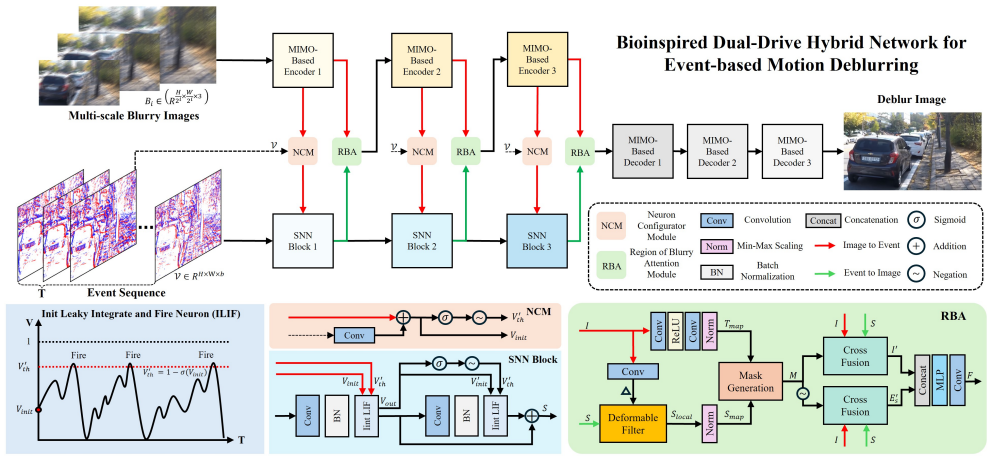
The central mechanism is a dual-drive enhancement inserted after each encoder layer. The Neuron Configurator Module (NCM) computes $V_{\mathrm{init}} = \varphi_{\mathrm{init}}(B) + \psi_{\mathrm{init}}(E)$ and sets the LIF firing threshold to $V'_{\mathrm{th}} = 1 - \sigma(V_{\mathrm{init}})$, replacing the vanilla scalar threshold with a per-pixel tensor that persists across timesteps. The Region of Blurry Attention Module (RBAM) sums spikes over time, applies a deformable convolution whose biases are predicted from image features, min-max normalizes the result into $S_{\mathrm{map}}$, binarizes it against an image-derived threshold map $T_{\mathrm{map}}$, and uses the resulting mask $M$ to gate multi-head cross-attention between image features and event features. These two mechanisms carry the paper's claim that sparse-event blurry regions can be made to fire and that the resulting motion clues can be directed to the right spatial locations during fusion.
What would settle it
Run the identical training configuration on GoPro with BDHNet and the top baselines (EFNet, EIFNet, STCNet, MAENet) across several random seeds and report mean and standard deviation of PSNR; if BDHNet's advantage over MAENet and STCNet shrinks below its 0.2 to 0.6 dB margins or reverses, the state-of-the-art claim would not survive. An additional event-sparsity sweep that removes NCM should show a growing performance gap as events become sparser; if the gap stays flat, the module is not doing the claimed work.
Extended reading notes
Core claim
The core claim is that the main obstacle in event-based motion deblurring is not the capacity of the network but the mismatch between non-uniform, redundant event data and uniform neuron and synaptic processing. BDHNet addresses this with two complementary mechanisms: the Neuron Configurator Module uses image features to set each neuron's initial membrane potential and threshold per pixel and per timestep, effectively lowering the firing barrier in blurry regions where events are sparse; the Region of Blurry Attention Module aggregates spike features with a deformable filter, compares the normalized spike map to an image-derived threshold map to produce an unsupervised blurry mask, and uses that mask to gate cross-modal attention between image and event features. With these mechanisms, the model reports state-of-the-art results on three benchmarks and shows stronger cross-dataset generalization without fine-tuning.
Load-bearing premise
The state-of-the-art claim rests on the assumption that the baseline comparisons are fair, meaning the reported differences in PSNR and SSIM come from the architecture rather than from differences in training protocol, event preprocessing, or random seeds.
Editorial extensions
If this is right
- On GoPro, the full model reaches 37.04 PSNR and 0.977 SSIM, ahead of the best compared event-based methods, STCNet at 36.45 and MAENet at 36.07.
- On REBlur with fine-tuning it reaches 38.50 PSNR and 0.978 SSIM, and without fine-tuning it still reaches 36.01 PSNR and 0.967 SSIM, the best among event-based methods in that setting.
- The pixel-level threshold configuration in NCM lets neurons fire even where event density is low, so motion cues in blurry, low-contrast regions are not lost.
- The mask-guided cross-modal attention in RBAM improves performance by 0.44 dB over using plain addition for fusion, according to the ablation study.
- The hybrid design preserves temporal event structure through the SNN branch while the ANN branch retains color and structure details needed for pixel-level restoration.
Reading between the lines
- Because NCM only changes how neuron states are initialized and thresholds are set, the same mechanism could be dropped into other SNN-based restoration or recognition pipelines where event density is uneven, though the paper does not test this transfer.
- The unsupervised blurry mask produced by RBAM could serve as a motion or blur localization signal for other tasks such as blur estimation or segmentation, but the paper does not pursue those applications.
- The reported margin over MAENet on REBlur is only 0.04 dB; without repeated-seed error bars, part of the claimed advantage may be training noise, so a fair test would include statistical replicates.
- A direct stress test of the two modules would artificially sparsify event streams: if NCM is doing the claimed work, its benefit should grow as events become sparser, but the paper does not report such a sweep.
Editorial analysis
A structured set of objections, weighed in public.
Referee Report
Summary. The manuscript introduces BDHNet, a hybrid ANN-SNN encoder-decoder for event-based motion deblurring. It proposes a Neuron Configurator Module (NCM) that uses image features to set per-pixel membrane potentials and thresholds in SNN blocks, and a Region of Blurry Attention Module (RBAM) that generates an unsupervised blurry-region mask from aggregated spike features and image-based threshold maps, then uses the mask to gate cross-modal attention. Experiments compare against image-only and event-based methods on GoPro, REBlur, and MS-RBD, with ablations on GoPro. The paper claims state-of-the-art performance on all three datasets, with particularly strong claims for real-world generalization.
Significance. If the results are reproducible, the core architectural ideas are plausible and useful: replacing global LIF thresholds with image-conditioned per-pixel configurations and using an event-derived blur mask to gate fusion directly target the non-uniform event distribution problem. The GoPro results show a non-trivial margin (37.04 vs 36.45 PSNR over STCNet), and the GoPro ablations attribute consistent gains to NCM (+0.22 dB) and RBAM (+0.33-0.44 dB). The paper does not ship code or checkpoints, but the derivation in Section 3.1 is correct and the ablations are internally consistent. However, the real-world SOTA claim currently rests on a 0.04 dB REBlur margin and on qualitative MS-RBD evidence only; the manuscript would be materially strengthened by multi-seed statistics and by quantitative MS-RBD evaluation.
major comments (3)
- [§4.3, Table 1, Contributions, Conclusion] The contribution list and the conclusion state that BDHNet achieves SOTA on MS-RBD, but Section 4 provides no quantitative comparison on MS-RBD: Table 1 reports only GoPro and REBlur, and MS-RBD appears only in qualitative Figures 5 and 6. Either add a PSNR/SSIM table for MS-RBD with all compared baselines, or revise the SOTA claim to cover only the datasets with quantitative results.
- [§4.3, Table 1] On fine-tuned REBlur, BDHNet's PSNR is 38.50 versus MAENet's 38.46, a 0.04 dB difference, and the paper reports no standard deviation, confidence interval, or repeated-seed runs. Since seed-level variation in image restoration is typically larger than 0.04 dB, this margin does not by itself establish superiority in real-world conditions. The same concern applies to the no-fine-tune REBlur margin (36.01 vs 35.75 for EIFNet). Please provide multi-seed mean and standard deviation (or equivalent statistics) and avoid the phrase 'significantly outperforms' unless a statistical test supports it.
- [§4.3] The baseline evaluation protocol is under-specified. The text says methods without open-source checkpoints were trained 'under the optimal parameter settings as specified in the respective papers,' but it does not document the event voxel representation, number of temporal bins, optimizer, learning rate schedule, epochs, crop size, or random seeds used for those baselines on REBlur. Without this information or released code/checkpoints, the fairness of the 0.04 dB comparison cannot be independently verified.
minor comments (5)
- [Abstract and Introduction] There are several grammatical slips, for example 'dynamically adjusts' should be 'dynamically adjust' and 'has achieved SOTA in varying blurry conditions' is not a complete construction; a careful proofread is needed.
- [§3.2.2] In Equation (14), the spike feature S is written as S(x, y, t) after the SNN output was denoted S; please clarify the spatial and temporal indexing and the exact tensor shape that is summed over time.
- [§4.2] The text mentions a 'PSNR Loss' with citation [8], but PSNR is normally used as a metric rather than a training loss; please specify the actual loss function (for example L1 or MSE) and how PSNR enters the training objective.
- [Figure 7] Figure 7 is described as showing training loss under different neuron configurations, but the curves are not labeled in a way that lets the reader identify which configuration corresponds to which curve; please add a legend or a text description of each curve.
- [§4.3] The sentence 'all event-based methods are all based on the raw event data produced by EFNet' is ambiguous; it should state explicitly which event representation and preprocessing each baseline and the proposed method use.
Circularity Check
No significant circularity: BDHNet is trained and evaluated on external benchmarks; its modules are architectural components, and self-citations are background only.
full rationale
The paper's derivation chain is not circular. The problem formulation (Eqs. 4-8) defines blur as a temporal average and events as log-intensity changes, then correctly notes that direct inversion (Eq. 7) is unstable and that a learned deblurring function (Eq. 8) is used instead; this is a standard learning formulation, not a prediction derived from its own inputs. The two proposed modules are architectural: NCM sets initial membrane potential and threshold from image and event features (Eqs. 9-13), and RBAM generates a thresholded mask from spike and image features (Eqs. 14-18) to gate cross-attention (Eq. 19). These are internal attention and feature-modulation mechanisms, not fitted constants masquerading as predictions. The mask is derived from the same features it gates, but that is typical attention design rather than a circular scientific claim; it is not validated against ground-truth blur maps and does not constitute a benchmark prediction. The reported results are PSNR/SSIM on external benchmarks (GoPro, REBlur, MS-RBD), evaluated against published baselines, so the central SOTA claim is empirically testable rather than forced by construction. The paper cites its own prior work ([15], [22], [25]) only in related-work discussion of SNN capabilities; those citations are not load-bearing for the architecture's validity or for the benchmark numbers. The skeptic's concerns about Section 4.3's statement that 'our method significantly outperforms others in both datasets' are real but non-circular: Table 1 reports only GoPro and REBlur, MS-RBD has only qualitative figures, and the REBlur margin over MAENet is 0.04 dB with no error bars. Those are evidentiary and reproducibility issues, not circularity, and are outside the circularity definition in the reviewing rules. No self-definitional, fitted-input-as-prediction, or self-citation-chain reduction was found.
Assumptions & free parameters
free parameters (2)
- Event voxel temporal bins b =
12
- Learning rate schedule =
Initial 1e-4, decay at epochs 60 and 80
assumptions (6)
- domain assumption Blurred image is the temporal average of sharp frames (Eq. 4)
- domain assumption Events follow the log-intensity contrast model where a constant threshold c triggers events (Eq. 5)
- domain assumption The MIMO encoder-decoder from Cho et al. [9] is a suitable backbone for image restoration
- domain assumption Voxel representation with b=12 temporal bins preserves the necessary event information
- ad hoc to paper A deformable convolution with image-conditioned offsets can aggregate spike features into a reliable blur-region indicator
- domain assumption LIF neuron model with surrogate gradient is trainable for this multi-modal task
Cite this review
Pith. "Pith review of ClearSight: Human Vision-Inspired Solutions for Event-Based Motion Deblurring." pith.science (2026). https://pith.science/paper/WIEMFTT2
@misc{pith2026250115808,
  author       = {Pith},
  title        = {Pith review of: ClearSight: Human Vision-Inspired Solutions for Event-Based Motion Deblurring},
  year         = {2026},
  howpublished = {\url{https://pith.science/paper/WIEMFTT2}},
  note         = {Machine review of arXiv:2501.15808}
}
read the original abstract
Motion deblurring addresses the challenge of image blur caused by camera or scene movement. Event cameras provide motion information that is encoded in the asynchronous event streams. To efficiently leverage the temporal information of event streams, we employ Spiking Neural Networks (SNNs) for motion feature extraction and Artificial Neural Networks (ANNs) for color information processing. Due to the non-uniform distribution and inherent redundancy of event data, existing cross-modal feature fusion methods exhibit certain limitations. Inspired by the visual attention mechanism in the human visual system, this study introduces a bioinspired dual-drive hybrid network (BDHNet). Specifically, the Neuron Configurator Module (NCM) is designed to dynamically adjusts neuron configurations based on cross-modal features, thereby focusing the spikes in blurry regions and adapting to varying blurry scenarios dynamically. Additionally, the Region of Blurry Attention Module (RBAM) is introduced to generate a blurry mask in an unsupervised manner, effectively extracting motion clues from the event features and guiding more accurate cross-modal feature fusion. Extensive subjective and objective evaluations demonstrate that our method outperforms current state-of-the-art methods on both synthetic and real-world datasets.
Figures


Figures from the paper (5 more)


Reference graph
Works this paper leans on
-
[1]
A hybrid ann-snn architecture for low- power and low-latency visual perception
Asude Aydin, Mathias Gehrig, Daniel Gehrig, and Da- vide Scaramuzza. A hybrid ann-snn architecture for low- power and low-latency visual perception. InProceedings of the IEEE/CVF Conference on Computer Vision and Pattern Recognition, pages 5701–5711, 2024
work page 2024
-
[2]
Non-uniform blind deblurring by reblurring
Yuval Bahat, Netalee Efrat, and Michal Irani. Non-uniform blind deblurring by reblurring. InProceedings of the IEEE international conference on computer vision, pages 3286– 3294, 2017
work page 2017
-
[3]
Maxence Bouvier, Alexandre Valentian, Thomas Mesquida, Francois Rummens, Marina Reyboz, Elisa Vianello, and Edith Beigne. Spiking neural networks hardware implemen- tations and challenges: A survey.ACM Journal on Emerg- ing Technologies in Computing Systems (JETC), 15(2):1–35, 2019
work page 2019
-
[4]
A 240×180 130 db 3µs latency global shutter spatiotemporal vision sensor.IEEE Journal of Solid-State Circuits, 49(10):2333–2341, 2014
Christian Brandli, Raphael Berner, Minhao Yang, Shih-Chii Liu, and Tobi Delbruck. A 240×180 130 db 3µs latency global shutter spatiotemporal vision sensor.IEEE Journal of Solid-State Circuits, 49(10):2333–2341, 2014
2014
-
[5]
Chengzhi Cao, Xueyang Fu, Yurui Zhu, Zhijing Sun, and Zheng-Jun Zha. Event-driven video restoration with spiking- convolutional architecture.IEEE Transactions on Neural Networks and Learning Systems, 2023
work page 2023
-
[6]
Motion deblur by learning residual from events.IEEE Transactions on Multimedia, 2024
Kang Chen and Lei Yu. Motion deblur by learning residual from events.IEEE Transactions on Multimedia, 2024
work page 2024
-
[7]
Simple baselines for image restoration
Liangyu Chen, Xiaojie Chu, Xiangyu Zhang, and Jian Sun. Simple baselines for image restoration. InEuropean confer- ence on computer vision, pages 17–33. Springer, 2022
work page 2022
-
[8]
Hinet: Half instance normalization network for image restoration
Liangyu Chen, Xin Lu, Jie Zhang, Xiaojie Chu, and Cheng- peng Chen. Hinet: Half instance normalization network for image restoration. InProceedings of the IEEE/CVF confer- ence on computer vision and pattern recognition, pages 182– 192, 2021
2021
Show all 39 references
-
[9]
Rethinking coarse-to-fine approach in sin- gle image deblurring
Sung-Jin Cho, Seo-Won Ji, Jun-Pyo Hong, Seung-Won Jung, and Sung-Jea Ko. Rethinking coarse-to-fine approach in sin- gle image deblurring. InProceedings of the IEEE/CVF inter- national conference on computer vision, pages 4641–4650, 2021
2021
-
[10]
Deep residual learning in spiking neural networks.Advances in Neural Information Processing Systems, 34:21056–21069, 2021
Wei Fang, Zhaofei Yu, Yanqi Chen, Tiejun Huang, Timoth´ee Masquelier, and Yonghong Tian. Deep residual learning in spiking neural networks.Advances in Neural Information Processing Systems, 34:21056–21069, 2021
2021
-
[11]
Self-supervised non-uniform kernel estimation with flow-based motion prior for blind im- age deblurring
Zhenxuan Fang, Fangfang Wu, Weisheng Dong, Xin Li, Jin- jian Wu, and Guangming Shi. Self-supervised non-uniform kernel estimation with flow-based motion prior for blind im- age deblurring. InProceedings of the IEEE/CVF conference on computer vision and pattern recognition, pag...
2023
-
[12]
Removing camera shake from a sin- gle photograph
Rob Fergus, Barun Singh, Aaron Hertzmann, Sam T Roweis, and William T Freeman. Removing camera shake from a sin- gle photograph. InAcm Siggraph 2006 Papers, pages 787–
2006
-
[13]
Event-driven heteroge- neous network for video deraining.International Journal of Computer Vision, pages 1–21, 2024
Xueyang Fu, Chengzhi Cao, Senyan Xu, Fanrui Zhang, Kunyu Wang, and Zheng-Jun Zha. Event-driven heteroge- neous network for video deraining.International Journal of Computer Vision, pages 1–21, 2024
2024
-
[14]
Event-based vision: A survey.IEEE transactions on pattern analysis and machine intelligence, 44(1):154–180, 2020
Guillermo Gallego, Tobi Delbr ¨uck, Garrick Orchard, Chiara Bartolozzi, Brian Taba, Andrea Censi, Stefan Leutenegger, Andrew J Davison, J ¨org Conradt, Kostas Daniilidis, et al. Event-based vision: A survey.IEEE transactions on pattern analysis and machine intelligence, 44(1):...
2020
-
[15]
Clif: Com- plementary leaky integrate-and-fire neuron for spiking neu- ral networks
Yulong Huang, LIN Xiaopeng, Hongwei Ren, FU Haotian, Yue Zhou, LIU Zunchang, Bojun Cheng, et al. Clif: Com- plementary leaky integrate-and-fire neuron for spiking neu- ral networks. InForty-first International Conference on Ma- chine Learning
-
[16]
Visual attention: in- sights from brain imaging.Nature reviews neuroscience, 1(2):91–100, 2000
Nancy Kanwisher and Ewa Wojciulik. Visual attention: in- sights from brain imaging.Nature reviews neuroscience, 1(2):91–100, 2000
2000
-
[17]
Adam: A method for stochastic optimization.arXiv preprint arXiv:1412.6980, 2014
Diederik P Kingma and Jimmy Ba. Adam: A method for stochastic optimization.arXiv preprint arXiv:1412.6980, 2014
2014 arXiv
-
[18]
Learning degradation rep- resentations for image deblurring
Dasong Li, Yi Zhang, Ka Chun Cheung, Xiaogang Wang, Hongwei Qin, and Hongsheng Li. Learning degradation rep- resentations for image deblurring. InEuropean conference on computer vision, pages 736–753. Springer, 2022
2022
-
[19]
Real-world deep local motion deblur- ring
Haoying Li, Ziran Zhang, Tingting Jiang, Peng Luo, Huajun Feng, and Zhihai Xu. Real-world deep local motion deblur- ring. InProceedings of the AAAI Conference on Artificial Intelligence, volume 37, pages 1314–1322, 2023
2023
-
[20]
Adaptive window prun- ing for efficient local motion deblurring
Haoying Li, Jixin Zhao, Shangchen Zhou, Huajun Feng, Chongyi Li, and Chen Change Loy. Adaptive window prun- ing for efficient local motion deblurring. InThe Twelfth In- ternational Conference on Learning Representations, 2024
2024
-
[21]
Image de-occlusion via event-enhanced multi-modal fusion hybrid network.Ma- chine Intelligence Research, 19(4):307–318, 2022
Si-Qi Li, Yue Gao, and Qiong-Hai Dai. Image de-occlusion via event-enhanced multi-modal fusion hybrid network.Ma- chine Intelligence Research, 19(4):307–318, 2022
2022
-
[22]
Event- based motion deblurring via multi-temporal granularity fu- sion.arXiv preprint arXiv:2412.11866, 2024
Xiaopeng Lin, Hongwei Ren, Yulong Huang, Zunchang Liu, Yue Zhou, Haotian Fu, Biao Pan, and Bojun Cheng. Event- based motion deblurring via multi-temporal granularity fu- sion.arXiv preprint arXiv:2412.11866, 2024
2024 arXiv
-
[23]
Motion-oriented hy- brid spiking neural networks for event-based motion deblur- ring.IEEE Transactions on Circuits and Systems for Video Technology, 2023
Zhaoxin Liu, Jinjian Wu, Guangming Shi, Wen Yang, Weisheng Dong, and Qinghang Zhao. Motion-oriented hy- brid spiking neural networks for event-based motion deblur- ring.IEEE Transactions on Circuits and Systems for Video Technology, 2023
2023
-
[24]
Bringing a blurry frame alive at high frame-rate with an event camera
Liyuan Pan, Cedric Scheerlinck, Xin Yu, Richard Hartley, Miaomiao Liu, and Yuchao Dai. Bringing a blurry frame alive at high frame-rate with an event camera. InProceed- ings of the IEEE/CVF Conference on Computer Vision and Pattern Recognition, pages 6820–6829, 2019
2019
-
[25]
Spikepoint: An efficient point-based spiking neural network for event cam- eras action recognition.arXiv preprint arXiv:2310.07189, 2023
Hongwei Ren, Yue Zhou, Yulong Huang, Haotian Fu, Xi- aopeng Lin, Jie Song, and Bojun Cheng. Spikepoint: An efficient point-based spiking neural network for event cam- eras action recognition.arXiv preprint arXiv:2310.07189, 2023
-
[26]
Learning a spiking neural network for efficient image deraining.arXiv preprint arXiv:2405.06277, 2024
Tianyu Song, Guiyue Jin, Pengpeng Li, Kui Jiang, Xiang Chen, and Jiyu Jin. Learning a spiking neural network for efficient image deraining.arXiv preprint arXiv:2405.06277, 2024
2024 arXiv
-
[27]
Event-based fusion for motion deblurring with cross- modal attention
Lei Sun, Christos Sakaridis, Jingyun Liang, Qi Jiang, Kailun Yang, Peng Sun, Yaozu Ye, Kaiwei Wang, and Luc Van Gool. Event-based fusion for motion deblurring with cross- modal attention. InEuropean conference on computer vision, pages 412–428. Springer, 2022
2022
-
[28]
Motion aware event representation-driven image deblurring
Zhijing Sun, Xueyang Fu, Longzhuo Huang, Aiping Liu, and Zheng-Jun Zha. Motion aware event representation-driven image deblurring. InEuropean Conference on Computer Vi- sion, pages 418–435. Springer, 2025
2025
-
[29]
Scale-recurrent network for deep image deblurring
Xin Tao, Hongyun Gao, Xiaoyong Shen, Jue Wang, and Ji- aya Jia. Scale-recurrent network for deep image deblurring. InProceedings of the IEEE conference on computer vision and pattern recognition, pages 8174–8182, 2018
2018
-
[30]
General- ized leaky integrate-and-fire models classify multiple neuron types.Nature communications, 9(1):709, 2018
Corinne Teeter, Ramakrishnan Iyer, Vilas Menon, Nathan Gouwens, David Feng, Jim Berg, Aaron Szafer, Nicholas Cain, Hongkui Zeng, Michael Hawrylycz, et al. General- ized leaky integrate-and-fire models classify multiple neuron types.Nature communications, 9(1):709, 2018
2018
-
[31]
Stripformer: Strip transformer for fast image deblurring
Fu-Jen Tsai, Yan-Tsung Peng, Yen-Yu Lin, Chung-Chi Tsai, and Chia-Wen Lin. Stripformer: Strip transformer for fast image deblurring. InEuropean conference on computer vi- sion, pages 146–162. Springer, 2022
2022
-
[32]
Event enhanced high-quality image recovery
Bishan Wang, Jingwei He, Lei Yu, Gui-Song Xia, and Wen Yang. Event enhanced high-quality image recovery. InCom- puter Vision–ECCV 2020: 16th European Conference, Glas- gow, UK, August 23–28, 2020, Proceedings, Part XIII 16, pages 155–171. Springer, 2020
2020
-
[33]
Spatio-temporal backpropagation for training high- performance spiking neural networks.Frontiers in neuro- science, 12:331, 2018
Yujie Wu, Lei Deng, Guoqi Li, Jun Zhu, and Luping Shi. Spatio-temporal backpropagation for training high- performance spiking neural networks.Frontiers in neuro- science, 12:331, 2018
2018
-
[34]
Event-based motion deblurring with modality-aware decomposition and recomposition
Wen Yang, Jinjian Wu, Leida Li, Weisheng Dong, and Guangming Shi. Event-based motion deblurring with modality-aware decomposition and recomposition. InPro- ceedings of the 31st ACM International Conference on Mul- timedia, pages 8327–8335, 2023
2023
-
[35]
Learning for motion deblurring with hybrid frames and events
Wen Yang, Jinjian Wu, Jupo Ma, Leida Li, Weisheng Dong, and Guangming Shi. Learning for motion deblurring with hybrid frames and events. InProceedings of the 30th ACM International Conference on Multimedia, pages 1396–1404, 2022
2022
-
[36]
Motion deblurring via spatial-temporal collaboration of frames and events
Wen Yang, Jinjian Wu, Jupo Ma, Leida Li, and Guangming Shi. Motion deblurring via spatial-temporal collaboration of frames and events. InProceedings of the AAAI Confer- ence on Artificial Intelligence, volume 38, pages 6531–6539, 2024
2024
-
[37]
Restormer: Efficient transformer for high-resolution image restoration
Syed Waqas Zamir, Aditya Arora, Salman Khan, Mu- nawar Hayat, Fahad Shahbaz Khan, and Ming-Hsuan Yang. Restormer: Efficient transformer for high-resolution image restoration. InProceedings of the IEEE/CVF conference on computer vision and pattern recognition, pages 5728–5739, 2022
2022
-
[38]
Unifying motion deblurring and frame interpolation with events
Xiang Zhang and Lei Yu. Unifying motion deblurring and frame interpolation with events. InProceedings of the IEEE/CVF Conference on Computer Vision and Pattern Recognition, pages 17765–17774, 2022
2022
-
[39]
Generalizing event-based motion deblurring in real-world scenarios
Xiang Zhang, Lei Yu, Wen Yang, Jianzhuang Liu, and Gui- Song Xia. Generalizing event-based motion deblurring in real-world scenarios. InProceedings of the IEEE/CVF In- ternational Conference on Computer Vision, pages 10734– 10744, 2023
2023
Reviewed August 10, 2026 · model on record in the stance chip above.
Discussion (0). Continue with ORCID to comment.