REVIEW 4 major objections 4 minor 39 references
Isotropic randomization for one-sample testing in metric spaces
T0 review · 4 major / 4 minor · reviewed 2026-08-10 · deepseek-v4-flash
Pith's one-line read Randomizing with fixed-point isometries tests Fréchet means.
desk verdict A promising new randomization framework for Fréchet mean testing, but the theoretical guarantees promised in the abstract are not actually delivered—the paper itself admits this. read the letter →
The pith
A machine-rendered reading of the paper's core claim, the machinery that carries it, and where it could break.
The reading
What carries the argument
The load-bearing object is the isotropy group $G_\mu$, the subgroup of the metric space's isometry group consisting of all isometries that fix the hypothesized mean $\mu$. An admissible randomization is a random isometry whose support is a subgroup of $G_\mu$ and that does not almost surely fix any other point; this admissibility condition is what keeps the test from confusing the null with alternatives such as antipodal points on the circle. The argument is carried by Proposition 3.1 (mean and distance-moment preservation), Proposition 3.2 (the variance inequality that yields power), and Theorem 3.1 (asymptotic normality of the empirical Fréchet variance), with the randomization test itself following the standard randomization-hypothesis construction.
What would settle it
Simulate $n$ observations on the circle from a distribution whose Fréchet mean is exactly $\mu$ but whose law is not invariant under reflection about $\mu$—for example an unequal mixture of two von Mises components arranged so the mean is $\mu$—and run the isotropic test with the reflection randomization at level 0.05. If the rejection rate over many replications stays above 0.05 for large $n$, the test does not control size without full distributional invariance.
Extended reading notes
Core claim
On the paper's own terms, the central claim is that a one-sample Fréchet-mean test can be built in any metric space whose hypothesized point admits enough isometries. The construction starts from the isotropy group $G_\mu$ of all isometries fixing the hypothesized mean $\mu$; a random isometry supported on a subgroup of $G_\mu$ is called admissible if no other point is almost surely fixed by every map in its support. Proposition 3.1 shows that randomizing $X$ by such an isometry preserves both the Fréchet mean and all distance moments, and Proposition 3.2 shows that the Fréchet variance of $g\cdot X$ is at least that of $X$, with equality only when $\mathbb{E}[X]=\mu$. Together with the asymptotic normality of the empirical Fréchet variance (Theorem 3.1), this justifies rejecting the null when the observed empirical variance falls below the lower tail of the randomization distribution. The intended conclusion is that the test has correct size and power against whatever alternatives the isotropy group can separate, although the paper explicitly leaves a proof of size control under the null for future work.
Load-bearing premise
For the test to have the promised false-rejection rate, the data's whole probability distribution—not just its Fréchet mean and distance moments—must be unchanged by the randomizing isometries; the paper proves the mean and moments are preserved but never proves this distributional invariance, and its conclusion states that a proof of correct size under the null remains open.
Editorial extensions
If this is right
- For any metric space where the hypothesized point has a nontrivial isotropy group, the same algorithm applies: sample isometries from a subgroup of $G_\mu$, recompute the Fréchet variance, and reject when the observed variance is too small.
- The test is fully nonparametric in the sense that it requires no parametric family and no tangent-space normality assumption, only a choice of isometry subgroup and the ability to compute distances.
- Admissibility becomes a concrete design criterion: a randomization subgroup is usable exactly when its common fixed points reduce to the hypothesized mean, preventing the antipodal ambiguity seen on the circle.
- For radially symmetric distributions, Lemma 3.1 supplies conditions under which the symmetry point is the Fréchet mean, giving a natural class of null models where the isotropic test applies.
- The wind-direction case study shows that inverting the test over a grid yields a confidence interval for a mean direction, with the caveat that antipodal points can produce a second interval component.
Reading between the lines
- A testable extension the paper leaves implicit: if the null distribution is not invariant under the chosen isotropy subgroup, the rejection rate should exceed the nominal level; a simulation with a non-symmetric distribution whose Fréchet mean is exactly $\mu$ would isolate whether full distributional invariance is required for size control.
- Because the paper proves only invariance of the mean and distance moments, not of the full law, the method's validity for non-symmetric nulls may hold only asymptotically or only for the specific statistic used; this distinction could be probed by comparing rejection rates across different test statistics under the same non-symmetric null.
- In spaces with a rich isotropy group, a larger admissible subgroup should give more power without breaking admissibility, so comparing subgroups of $G_\mu$ is a practical way to tune the test; the paper does not explore this trade-off.
Editorial analysis
A structured set of objections, weighed in public.
Referee Report
Summary. The paper proposes a randomization test for the null hypothesis that the Fréchet mean of a distribution on a metric space equals a prespecified value. It extends the classical Euclidean randomization idea by using random isometries that fix the hypothesized mean, first on Riemannian manifolds via exponential/logarithm maps and then on general metric spaces via what the authors call admissible randomizations. The paper defines admissible randomizations, proves a population-level variance inequality (Proposition 3.2), introduces a group-action-based notion of radial symmetry, and reports simulations on the circle, on an SPD matrix space with Bures-Wasserstein distance, and on a booklet space, together with a wind-direction data application. The abstract and conclusion claim theoretical guarantees, including correct size and power against alternatives.
Significance. If the claimed guarantees were established, the paper would offer a reasonably general nonparametric approach to one-sample Fréchet mean testing that avoids tangent-space coordinates and works directly with the metric. The paper has several genuine strengths: it formulates a clean notion of admissible randomization; Proposition 3.2 is a correct and useful population-level observation; the numerical experiments cover three structurally different metric spaces; the code is publicly available; and the real-data application illustrates a practical workflow. However, the central theoretical claim, that the proposed test has the advertised size, is not proved and is in fact explicitly disclaimed in the text. Because the method's validity as stated depends on an unstated distributional invariance assumption, the paper's main advertised contribution is currently unsupported. The framework may be salvageable by restricting the scope to radially symmetric distributions and proving exact level under that condition, but the present text does not do so.
major comments (4)
- [Section 3.2 / Algorithm 1] The claim that the test has correct size is not proved and is contradicted by the text itself. After presenting the randomization procedure, the paper states 'While no proof of the consistency of the test is available here', and Section 6 repeats 'it remains to prove that the randomization scheme is consistent under the null hypothesis, which would provide a theoretical guarantee that the test has the correct size.' Yet the Abstract claims 'We establish theoretical guarantees for our testing procedure' and Section 6 calls admissible randomization the key contribution that 'ensures that the resulting test has correct size.' A formal level control argument is the core of any hypothesis test; its absence is a load-bearing gap, not a presentational issue.
- [Section 3.2 / Proposition 3.1] The validity of a randomization test requires that, under the null, the distribution of the randomized sample matches the null distribution of the sample (or at least that the test statistic's null distribution is preserved). The paper does not state or prove such an invariance for the general metric-space test. Proposition 3.1 only shows that a random isotropy of the Fréchet mean preserves the Fréchet mean and the distance moments, which is a much weaker property than distributional invariance. The Euclidean construction in Section 2.2 explicitly assumes distributions symmetric about the tested mean, but Algorithm 1 and the surrounding theory in Section 3.2 drop that assumption. Without an invariance or exchangeability condition, the randomization distribution used to compute the p-value is not a valid null distribution. If the intended scope is radially symmetric distributions (Definition 3.2), that restriction must be stated in the theorem and the level property proved under it; the current text does neither.
- [Section 3.2 / Proposition 3.2] Proposition 3.2 does not establish power for the finite-sample test. The inequality Var[X*] ≥ Var[X] is a statement about population variances, whereas the test compares the empirical Fréchet variance of the observed sample to the empirical distribution of variances obtained under random resampling. No argument shows that, under an alternative, the observed empirical variance is stochastically larger than the randomization quantile. The admissibility condition only rules out equality in the population inequality; it does not yield a stochastic ordering or a consistency statement for the rejection rule. The heuristic sentence 'This, together with the following theorem, suggests...' is not a proof, and Theorem 3.1 is a CLT for the original-sample variance, not a statement about the randomization distribution.
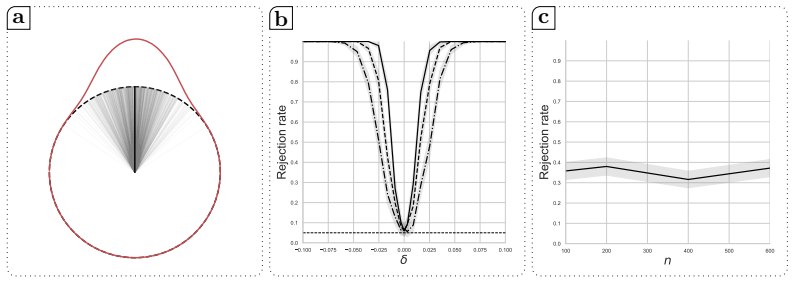
- [Section 4.1 / Figure 4] The simulation claiming 'correct size' for the non-symmetric mixture of von Mises distributions is not justified by any theoretical result in the paper. For this distribution, the null hypothesis E[X]=μ holds at the true mean, but the distribution is not invariant under the isotropy group of that mean, so the randomization test's level is not covered by the framework even under the radial-symmetry reading. The paper should either restrict such empirical claims to the symmetric case or provide a different argument for why the level is controlled in this non-symmetric setting.
minor comments (4)
- [Throughout] There are several typos and misspellings: 'progresively' in the Abstract, 'Riemmanian' in Section 3.1, 'Lebegues' in Section 3.3, and 'Assuption' in Theorem 3.1. The manuscript would benefit from a careful proofreading pass.
- [Section 3.3 / Definition 3.2] The definition of radial symmetry via invariance under the full isotropy group Gμ is clear, but the paper does not connect it to the level of Algorithm 1 in a formal proposition. A short lemma showing that, when X is radially symmetric around μ, the randomized sample (g_i X_i) has the same joint distribution as (X_i) under the null would make the intended scope precise.
- [Section 4 / General] Theorem 3.1 assumes a bounded metric space, but the SPD matrix example in Section 4.2 uses the full space S2+ with the Bures-Wasserstein distance. The authors do not verify that the boundedness condition holds or explain why the CLT still applies. This deserves at least a remark.
- [Figure 7 / Section 5] The application is interesting, but the comparison with the naive t-test on raw angles is not particularly informative because the t-test is applied to a circular variable in an inappropriate way. The comparison with the score test is more relevant and could be given more prominence.
Circularity Check
No significant circularity: the derivation rests on external CLT results and elementary isometry arguments; the unproved size guarantee is a support gap, not a circular reduction.
full rationale
The paper's derivation chain is largely self-contained and external. Proposition 3.1 is proved directly from the isometry/isotropy definitions; Theorem 3.1 is an external CLT (Dubey and Müller); Proposition 3.2 is a direct calculation from the Fréchet variance, Assumption 2.1, and the admissibility condition; Lemma 3.1 uses an external equivariance result from McCormack and Hoff. There is no fitted parameter later presented as a prediction, no load-bearing self-citation, and no uniqueness theorem imported from the authors' own prior work. The definition of admissible randomization is tailored so that the equality case in Proposition 3.2 is clean, but Proposition 3.2 is still a proved consequence of stated assumptions rather than an input renamed as an output. The main advertised guarantee that the test has correct size is not actually proved: the paper itself states in Section 6 that 'it remains to prove that the randomization scheme is consistent under the null hypothesis', and Section 3.2 says 'no proof of the consistency of the test is available here'. That is an honest limitation and a correctness/support gap, not a circular step. The finite-sample power evidence is simulation-based and independent of the definitions. Therefore no specific circular reduction is exhibited, and the circularity score is 0.
Assumptions & free parameters
assumptions (4)
- domain assumption Unique and well-separated Fréchet mean (Assumption 2.1)
- domain assumption Metric space complexity control via covering numbers (Assumption 2.2)
- ad hoc to paper Existence of an admissible randomization for the space of interest
- domain assumption Distributional invariance under the randomization subgroup (unstated)
Cite this review
Pith. "Pith review of Isotropic randomization for one-sample testing in metric spaces." pith.science (2026). https://pith.science/paper/MNMBO567
@misc{pith2026250115945,
  author       = {Pith},
  title        = {Pith review of: Isotropic randomization for one-sample testing in metric spaces},
  year         = {2026},
  howpublished = {\url{https://pith.science/paper/MNMBO567}},
  note         = {Machine review of arXiv:2501.15945}
}
read the original abstract
We address the problem of testing hypotheses about a specific value of the Fr\'echet mean in metric spaces, extending classical mean testing from Euclidean spaces to more general settings. We extend an Euclidean testing procedure progresively, starting with test construction in Riemannian manifolds, leveraging their natural geometric structure through exponential and logarithm maps, and then extend to general metric spaces through the introduction of admissible randomization techniques. This approach preserves essential geometric properties required for valid statistical inference while maintaining broad applicability. We establish theoretical guarantees for our testing procedure and demonstrate its effectiveness through numerical experiments across different metric spaces and distributional settings. The practical utility of our method is further illustrated through an application to wind data in western Denmark, showcasing its relevance for real-world statistical analysis.
Figures


Figures from the paper (4 more)


Reference graph
Works this paper leans on
-
[1]
Computing Medians and Means in Hadamard Spaces
Miroslav Baˇ c´ ak. Computing Medians and Means in Hadamard Spaces. SIAM Journal on Optimization , 24(3):1542–1566, January 2014. Pub- lisher: Society for Industrial and Applied Mathematics
work page 2014
-
[2]
Riemannian geometry and matrix geometric means
Rajendra Bhatia and John Holbrook. Riemannian geometry and matrix geometric means. Linear Algebra and its Applications , 413(2):594–618, March 2006
work page 2006
-
[3]
On the Bu- res–Wasserstein distance between positive definite matrices
Rajendra Bhatia, Tanvi Jain, and Yongdo Lim. On the Bu- res–Wasserstein distance between positive definite matrices. Exposi- tiones Mathematicae, 37(2):165–191, June 2019
work page 2019
-
[4]
Omnibus Clts for Fr´ echet Means and Nonparametric Inference on Non-Euclidean Spaces
Rabi Bhattacharya and Lizhen Lin. Omnibus Clts for Fr´ echet Means and Nonparametric Inference on Non-Euclidean Spaces. Proceedings of the American Mathematical Society , 145(1):413–428, 2017. Publisher: American Mathematical Society
work page 2017
-
[5]
Concentration of empirical barycenters in metric spaces
Victor-Emmanuel Brunel and Jordan Serres. Concentration of empirical barycenters in metric spaces, March 2023. arXiv:2303.01144 [math, stat]
work page Pith review arXiv 2023
-
[6]
An Autoregressive Model for Time Series of Random Objects, September 2024
Matthieu Bult´ e and Helle Sørensen. An Autoregressive Model for Time Series of Random Objects, September 2024. arXiv:2405.03778
arXiv 2024
-
[7]
Medoid splits for efficient random forests in metric spaces
Matthieu Bult´ e and Helle Sørensen. Medoid splits for efficient random forests in metric spaces. Computational Statistics & Data Analysis , 198:107995, October 2024
work page 2024
-
[8]
Isaac Chavel. Cambridge studies in advanced mathematics: Riemannian geometry: A modern introduction series number 98 . Cambridge stud- ies in advanced mathematics. Cambridge University Press, Cambridge, England, 2 edition, April 2006. 27
work page 2006
Show all 39 references
-
[9]
Sinho Chewi, Tyler Maunu, Philippe Rigollet, and Austin J. Stromme. Gradient descent algorithms for Bures-Wasserstein barycenters. In Pro- ceedings of Thirty Third Conference on Learning Theory , pages 1276–
-
[10]
Fr´ echet analysis of variance for random objects
Paromita Dubey and Hans-Georg M¨ uller. Fr´ echet analysis of variance for random objects. Biometrika, 106(4):803–821, December 2019
2019
-
[11]
Fr´ echet change-point detec- tion
Paromita Dubey and Hans-Georg M¨ uller. Fr´ echet change-point detec- tion. The Annals of Statistics , 48(6):3312–3335, December 2020. Pub- lisher: Institute of Mathematical Statistics
2020
-
[12]
Huckemann
Benjamin Eltzner and Stephan F. Huckemann. A Smeary Central Limit Theorem for Manifolds with Application to High Dimensional Spheres, January 2018. arXiv:1801.06581
2018 arXiv
-
[13]
Les ´ el´ ements al´ eatoires de nature quelconque dans un espace distanci´ e
Maurice Fr´ echet. Les ´ el´ ements al´ eatoires de nature quelconque dans un espace distanci´ e. In Annales de l’institut Henri Poincar´ e, volume 10, pages 215–310, 1948. Issue: 4
1948
-
[14]
Uni- versal Bayes consistency in metric spaces
Steve Hanneke, Aryeh Kontorovich, Sivan Sabato, and Roi Weiss. Uni- versal Bayes consistency in metric spaces. The Annals of Statistics , 49(4):2129–2150, August 2021. Publisher: Institute of Mathematical Statistics
2021
-
[15]
Differential geometry, lie groups and symmetric spaces
Sigurdur Helgason. Differential geometry, lie groups and symmetric spaces. Graduate studies in mathematics. American Mathematical So- ciety, Providence, RI, June 2001
2001
-
[16]
Huckemann
Shayan Hundrieser, Benjamin Eltzner, and Stephan F. Huckemann. A Lower Bound for Estimating Fr´ echet Means, February 2024. arXiv:2402.12290 [math, stat]
2024 arXiv
-
[17]
Testing serial indepen- dence of object-valued time series
Feiyu Jiang, Hanjia Gao, and Xiaofeng Shao. Testing serial indepen- dence of object-valued time series. Biometrika, page asad069, November 2023
2023
-
[18]
Wilfrid S. Kendall. Probability, Convexity, and Harmonic Maps with Small Image I: Uniqueness and Fine Existence. Proceedings of the London Mathematical Society , s3-61(2):371–406, 1990. eprint: https://onlinelibrary.wiley.com/doi/pdf/10.1112/plms/s3-61.2.371. 28
1990 doi
-
[19]
Robust Signal Recovery in Hadamard Spaces, July 2023
Georg K¨ ostenberger and Thomas Stark. Robust Signal Recovery in Hadamard Spaces, July 2023. arXiv:2307.06057 [math, stat]
2023 arXiv
-
[20]
On the Consistency of Procrustean Mean Shapes
Huiling Le. On the Consistency of Procrustean Mean Shapes. Advances in Applied Probability, 30(1):53–63, 1998. Publisher: Applied Probabil- ity Trust
1998
-
[21]
Testing statistical hypotheses
E L Lehmann and Joseph P Romano. Testing statistical hypotheses . Springer texts in statistics. Springer Nature, Cham, Switzerland, 4 edi- tion, June 2022
2022
-
[22]
Wasserstein Riemannian geometry of Gaussian densities
Luigi Malag` o, Luigi Montrucchio, and Giovanni Pistone. Wasserstein Riemannian geometry of Gaussian densities. Information Geometry , 1(2):137–179, December 2018
2018
-
[23]
Directional statistics
Kanti V Mardia and Peter E Jupp. Directional statistics. John Wiley & Sons, 2009
2009
-
[24]
Equivariant estimation of Fr´ echet means
A McCormack and P D Hoff. Equivariant estimation of Fr´ echet means. Biometrika, page asad014, February 2023
2023
-
[25]
The Stein effect for Fr´ echet means
Andrew McCormack and Peter Hoff. The Stein effect for Fr´ echet means. The Annals of Statistics , 50(6):3647–3676, December 2022. Publisher: Institute of Mathematical Statistics
2022
-
[26]
Panaretos and Yoav Zemel
Victor M. Panaretos and Yoav Zemel. An Invitation to Statistics in Wasserstein Space . SpringerBriefs in Probability and Mathematical Statistics. Springer International Publishing, Cham, 2020
2020
-
[27]
Frechet regression for ran- dom objects with Euclidean predictors
Alexander Petersen and Hans-Georg Muller. Frechet regression for ran- dom objects with Euclidean predictors. page 29, 2019
2019
-
[28]
Functional data analysis for density functions by transformation to a Hilbert space
Alexander Petersen and Hans-Georg M¨ uller. Functional data analysis for density functions by transformation to a Hilbert space. The Annals of Statistics , 44(1), February 2016. arXiv: 1601.02869
2016 arXiv
-
[29]
J. O. Ramsay and B. W. Silverman. Functional data analysis . Springer series in statistics. Springer, New York, 2nd ed edition, 2005. 29
2005
-
[30]
Convergence rates for the generalized Fr´ echet mean via the quadruple inequality
Christof Sch¨ otz. Convergence rates for the generalized Fr´ echet mean via the quadruple inequality. Electronic Journal of Statistics , 13(2):4280– 4345, January 2019. Publisher: Institute of Mathematical Statistics and Bernoulli Society
2019
-
[31]
Anuj Srivastava and Eric P. Klassen. Functional and Shape Data Anal- ysis. Springer Series in Statistics. Springer New York, New York, NY, 2016
2016
-
[32]
Probability measures on metric spaces of non- positive curvature
Karl-Theodor Sturm. Probability measures on metric spaces of non- positive curvature. In Pascal Auscher, Thierry Coulhon, and Alexander Grigor’yan, editors, Contemporary Mathematics, volume 338, pages 357–
-
[33]
Theoretically and Computation- ally Convenient Geometries on Full-Rank Correlation Matrices
Yann Thanwerdas and Xavier Pennec. Theoretically and Computation- ally Convenient Geometries on Full-Rank Correlation Matrices. SIAM Journal on Matrix Analysis and Applications , 43(4):1851–1872, Decem- ber 2022. Publisher: Society for Industrial and Applied Mathematics
2022
-
[34]
J. R. Toggweiler. Shifting westerlies. Science, 323(5920):1434–1435, 2009
2009
-
[35]
A. W. van der Vaart. Asymptotic statistics . Cambridge series in statis- tical and probabilistic mathematics. Cambridge University Press, Cam- bridge, UK ; New York, NY, USA, 1998
1998
-
[36]
Bayes Hilbert Spaces
Karl Gerald van den Boogaart, Juan Jos´ e Egozcue, and Vera Pawlowsky- Glahn. Bayes Hilbert Spaces. Australian & New Zealand Journal of Statistics, 56(2):171–194, June 2014
2014
-
[37]
Law of large numbers in CAT(1)-spaces of small radii
Takumi Yokota. Law of large numbers in CAT(1)-spaces of small radii. Calculus of Variations and Partial Differential Equations , 57(2):35, February 2018. 30
2018
-
[390]
American Mathematical Society, Providence, Rhode Island, 2003
2003
-
[1304]
ISSN: 2640-3498
PMLR, July 2020. ISSN: 2640-3498
2020
Reviewed August 10, 2026 · model on record in the stance chip above.
Discussion (0). Continue with ORCID to comment.