REVIEW 1 major objections 5 minor 37 references
Non-ergodicity for the noisy majority vote process on trees
T0 review · 1 major / 5 minor · reviewed 2026-08-10 · deepseek-v4-flash
Pith's one-line read The noisy majority vote process on the infinite d-regular tree is non-ergodic for every d ≥ 3 and small enough noise: starting from all plus, any fixed vertex stays plus with probability uniformly above 1/2.
desk verdict Solid new proof for d=3,4 non-ergodicity on trees; the only real gap is a standard compactness step that the authors should spell out. read the letter →
The pith
A machine-rendered reading of the paper's core claim, the machinery that carries it, and where it could break.
The reading
What carries the argument
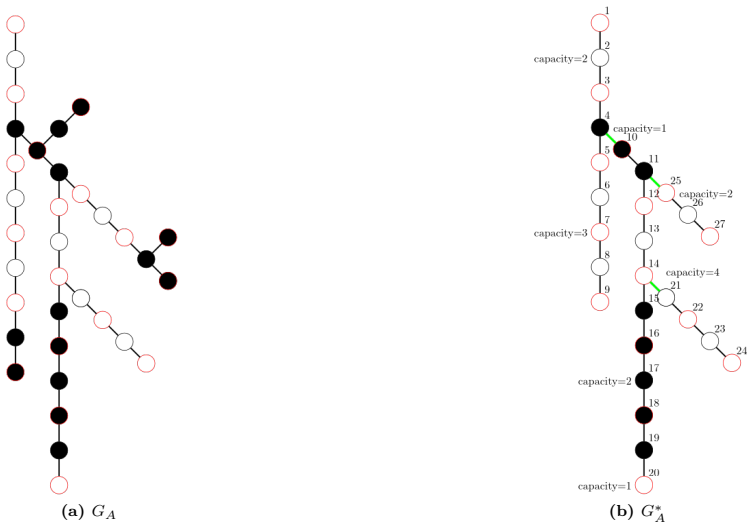
The argument is an induction on time using update histories, in which past minus vertices responsible for a current minus cluster are traced backward. The load-bearing identity is Lemma 2.15: for an odd cluster $A$ and a minimal set $B$ of even vertices that can vote it down, $\xi^*(A,B) + |\Prr(A,B)| \le |B| - r$, where $r$ is the number of connected components of $B$, $\Prr(A,B)$ is the set of vertices of $A$ with at least two neighbors in $B$, and $\xi^*$ counts single and double trifurcations with weight $p-2$. This inequality produces the extra $\epsilon^{\xi^*}$ factor that lets the induction close in the single-cluster case. Two enumeration lemmas bound the number of possible past configurations by reducing each cluster to its depth-first-search order and recording capacities of black and white components; together these turn the probability estimate into a convergent counting problem.
What would settle it
Test Lemma 2.15 directly on a small example: take an odd cluster $A$ in $\mathbb{T}_3$ and enumerate all minimal even sets $B$ with $\Prr(A,B) \neq \emptyset$; any instance with $\xi^*(A,B)+|\Prr(A,B)| > |B|-r$ would refute the lemma. Alternatively, for $d=3$ and a small fixed $\epsilon$, compute the supremum over $t$ of $\mathbb{P}(\sigma_v(t)=-1)$ starting from all plus; a value at or above $1/2$ would falsify Theorem 1.2.
Extended reading notes
Core claim
The central claim is Theorem 1.1: for every $d \ge 3$ there is an $\epsilon_0(d) > 0$ such that for $0 < \epsilon \le \epsilon_0$ the noisy majority vote process on $\mathbb{T}_d$ is not ergodic. The engine is Theorem 1.2, which shows for the minus biased vote process -- a dominated variant where a vertex turns minus if at least two neighbors are minus or a noise event occurs -- that $\mathbb{P}(\sigma_v(t) = -1) \le c < 0.5$ for every vertex $v$ and every time $t$, with $c$ depending only on $d$. Since the original noisy majority vote process dominates this minus biased process, the same uniform upper bound holds for the original process. The proof is an induction on time over the probability that a collection of vertices is minus, and the induction closes because a key combinatorial inequality supplies an extra factor of $\epsilon$ small enough to absorb all counting constants.
Load-bearing premise
The entire induction rests on Lemma 2.15's tree-specific inequality, which says that for a minimal set $B$ of past minus votes against an odd cluster $A$, the weighted count of branching vertices plus the number of $A$-vertices with two or more neighbors in $B$ is at most $|B|$ minus the number of connected components of $B$.
Editorial extensions
If this is right
- For every $d \ge 3$ there is a positive-noise window in which the noisy majority vote process on $\mathbb{T}_d$ has multiple equilibrium measures, with the all-plus initial configuration retaining a strict plus bias in the limit.
- The remaining open regular-tree cases $d = 3$ and $d = 4$ are closed, matching the known $d \ge 5$ result and the $d = 2$ unique-equilibrium result.
- Because the original process dominates the minus biased process, the uniform minus-probability bound transfers directly, so the conclusion concerns the original noisy majority vote dynamics and not only the auxiliary variant.
- The same uniform bound holds for any infinite tree of maximal degree $d$, giving a quantitative statement beyond regular trees.
- The ergodic/non-ergodic threshold in degree is thereby pinned between $d=2$ and $d=3$: unique equilibrium on the line, multiple equilibria on $\mathbb{T}_d$ for all $d \ge 3$.
Reading between the lines
- A natural testable extension the authors do not pursue is locating the actual noise threshold $\epsilon_d$ on $\mathbb{T}_3$; the proof gives an explicit but extremely small lower bound, and simulation could show the true threshold is far larger.
- The tree-specific inequality in Lemma 2.15 should extend to any infinite tree with minimum degree at least 3, even without regularity, which would upgrade Theorem 1.3 into a non-ergodicity statement for all such trees.
- The trifurcation-counting mechanism is likely portable to other monotone noisy consensus rules on trees, where 'at least two minus neighbors' is replaced by 'at least $k$ minus neighbors', by adapting the weight $p-2$ in the definition of $\xi^*$.
Signed reviews
Editorial analysis
A structured set of objections, weighed in public.
Referee Report
Summary. The paper proves that the noisy majority vote process on the infinite d-regular tree T_d is not ergodic for every d≥3 and sufficiently small noise ε, extending Bramson and Gray's earlier result for d≥5. The main technical result is Theorem 1.2: for the dominated "minus biased" process started from all plus, P(σ_v(t)=-1)≤c<1/2 uniformly in v and t. This is obtained through the inductive bound in Theorem 2.8, whose proof is carried by explicit combinatorial estimates and enumeration lemmas (notably Lemmas 2.15, 2.21, 2.22). The paper asserts that Theorem 1.1 follows from Theorem 1.2 by domination, and that a version for arbitrary trees of maximal degree d (Theorem 1.3) follows similarly.
Significance. If correct, the result closes the d=3,4 gap for a natural opinion-formation model on trees and provides a genuinely new proof strategy. The core induction is detailed, self-contained, and does not rely on the authors' prior results or on numerically fitted parameters; the constants c1,c2,c3 are chosen after the estimates are derived, and the central closing inequality (2.19) and the multi-cluster bound (2.45) are explicit. The main weakness is not in the induction itself but in the transition from the one-point bound to the advertised non-ergodicity conclusion, which is currently asserted rather than proved. That transition is a standard compactness argument and is readily fixable.
major comments (1)
- [Section 1.4, paragraph after Theorem 1.2] The assertion that Theorem 1.1 follows from Theorem 1.2 directly is incomplete. Theorem 1.2 is a uniform bound on one-point marginals at finite times, whereas non-ergodicity means the existence of at least two distinct invariant measures. A compactness step is required and should be written out. Since {−1,1}^V is compact and the process is Feller, the Cesàro means (1/T)Σ_{t=0}^{T-1} P(σ(t) ∈ ·) starting from the all-plus configuration have a subsequential limit μ_+; any such limit is invariant, and the bound P(σ_v(t)=-1)≤c passes to the limit, giving μ_+(σ_v=-1)≤c. Starting from the all-minus configuration and using global spin-flip symmetry yields an invariant measure μ_- with μ_-(σ_v=-1)≥1-c>1/2, so μ_+ and μ_- are distinct. Without this argument the advertised conclusion of non-ergodicity is not proved.
minor comments (5)
- [Section 1.3] The statement that "the probability of a vertex being 1 has a limit strictly bigger than 1/2, as t→∞" is stronger than what is established: Theorem 1.2 gives only a uniform upper bound away from 1/2 for all t, not convergence. Please rephrase this as a bound on liminf or as a uniform-in-time bound, and note that convergence is not needed for Theorem 1.1.
- [Section 1.4, Theorem 1.3] The sentence "the minus biased vote process on T dominates the minus biased vote process on T_d" appears to have the domination direction reversed: a tree of maximal degree d has no more neighbors at each vertex than T_d, so fewer minus votes are available and the process on T is dominated by, rather than dominates, the process on T_d. The claimed conclusion is still correct, but the wording should be fixed.
- [Section 2.3, first paragraph] The sentence "Our goal is to bound the probability that σ_v(T)=1 for all v∈A" should read σ_v(T)=-1; the surrounding computation works with the event that A is updated to all minuses.
- [Lemma 2.24] Lemma 2.24 states the bounds for "any r1,r2≥0", but the quantity F(r1,r2) is defined by binomial coefficients (m_i−1 choose r_i−1) and is used only for r1+r2≥1. Please state the quantifier as r1+r2≥1 to avoid division by zero in the binomial convention.
- [Equation (2.19)] The geometric-series simplification leading to (2.19) requires explicit smallness conditions such as 32(d−1)^2 ε<1 and 16(d−1)^2 ε<1; it would help to state these before the formula rather than only saying "ε small enough" afterwards.
Circularity Check
No significant circularity: the proof is a self-contained induction with constants chosen after the estimates and no load-bearing self-citation.
full rationale
The paper's central derivation is a self-contained inductive bound. Theorem 2.8 postulates inequality (2.1) for arbitrary odd clusters A, verifies it at t=1 from the all-plus initial condition, and propagates it through the update-history decomposition (2.2), the minimal-set reduction Lemma 2.11, the combinatorial Lemma 2.15 giving the extra epsilon^{xi*} factor, and the enumeration bounds Lemmas 2.21 and 2.22. The constants c1, c2, c3 are chosen only after the estimates are derived (see the ends of Sections 2.3 and 2.5), depend only on d, and are not fitted to the quantity being bounded; this is the opposite of a fitted-input-called-prediction structure. No step imports a uniqueness theorem or an ansatz from the authors' prior work: references [12] and [26] are external results used for context or comparison, and the paper's own earlier papers appear only in the related-works survey, not in the proof. The induction hypothesis is a proposition to be established, not an assumption containing the conclusion. The terse claim that Theorem 1.1 follows from Theorem 1.2 'directly' via domination omits the standard compactness argument passing the one-point bound to Cesaro limits of finite-time laws, but an omitted proof step is a correctness or exposition concern, not a circular reduction: Theorem 1.1 is not equivalent by construction to Theorem 1.2, and the bound is proved independently of the non-ergodicity conclusion. Accordingly, no circular step is exhibited, and the honest finding is score 0.
Assumptions & free parameters
free parameters (3)
- c1 =
> 8(d-1)^2 (chosen in Section 2.4)
- c2 =
≥ (d-1)^{2(d+6)} c3 (chosen in Section 2.4)
- c3 =
≥ (d-1)^{2(d+6)} (chosen in Section 2.4)
assumptions (3)
- domain assumption The infinite d-regular tree T_d is bipartite, so odd and even vertices update alternately.
- standard math The spin configuration space {−1,1}^V is compact and the process is Feller, so Cesàro subsequential limits are invariant measures.
- domain assumption The noisy majority process started at all plus dominates the minus biased process in the stochastic order.
Cite this review
Pith. "Pith review of Non-ergodicity for the noisy majority vote process on trees." pith.science (2026). https://pith.science/paper/S6N7TAGJ
@misc{pith2026250116202,
  author       = {Pith},
  title        = {Pith review of: Non-ergodicity for the noisy majority vote process on trees},
  year         = {2026},
  howpublished = {\url{https://pith.science/paper/S6N7TAGJ}},
  note         = {Machine review of arXiv:2501.16202}
}
abstract
We consider the noisy majority vote process on infinite regular trees with degree $d\geq 3$, and we prove the non-ergodicity, i.e., there exist multiple equilibrium measures. Our work extends a result of Bramson and Gray (2021) for $d\geq 5$.
Figures


Figures from the paper (6 more)




Reference graph
Works this paper leans on
-
[1]
M. Aizenman, M. Harel, and R. Peled. Exponential decay of correlations in the 2D random field Ising model. J. Stat. Phys. , 180(1-6):304–331, 2020
work page 2020
-
[2]
M. Aizenman and R. Peled. A power-law upper bound on the correlations in the 2 D random field Ising model. Comm. Math. Phys. , 372(3):865–892, 2019
work page 2019
-
[3]
M. Aizenman and J. Wehr. Rounding of first-order phase transitions in systems with quenched disorder. Phys. Rev. Lett. , 62(21):2503–2506, 1989
work page 1989
-
[4]
M. Aizenman and J. Wehr. Rounding effects of quenched randomness on first-order phase transitions. Comm. Math. Phys. , 130(3):489–528, 1990
work page 1990
-
[5]
L.-P. Arguin and M. Damron. On the number of ground states of the Edwards-Anderson spin glass model. Ann. Inst. Henri Poincar´ e Probab. Stat., 50(1):28–62, 2014
work page 2014
- [6]
-
[7]
L.-P. Arguin and J. Hanson. On absence of disorder chaos for spin glasses on Zd. Electron. Commun. Probab., 25:Paper No. 32, 12, 2020
work page 2020
- [8]
Show all 37 references
-
[9]
Arguin, C
L.-P. Arguin, C. M. Newman, and D. L. Stein. Ground state stability in two spin glass models. In In and out of equilibrium 3. Celebrating Vladas Sidoravicius , volume 77 of Progr. Probab., pages 17–25. Birkh¨ auser/Springer, Cham, [2021]©2021
2021
-
[10]
Arguin, C
L.-P. Arguin, C. M. Newman, D. L. Stein, and J. Wehr. Fluctuation bounds for interface free energies in spin glasses. J. Stat. Phys. , 156(2):221–238, 2014
2014
-
[11]
Arguin, C
L.-P. Arguin, C. M. Newman, D. L. Stein, and J. Wehr. Zero-temperature fluctuations in short-range spin glasses. J. Stat. Phys. , 163(5):1069–1078, 2016
2016
-
[12]
Bramson and L
M. Bramson and L. F. Gray. The majority vote process and other consensus processes on trees. Ann. Appl. Probab., 31(1):169–198, 2021
2021
-
[13]
Bricmont and A
J. Bricmont and A. Kupiainen. Phase transition in the 3d random field Ising model. Comm. Math. Phys., 116(4):539–572, 1988
1988
-
[14]
Chatterjee
S. Chatterjee. On the decay of correlations in the random field Ising model. Comm. Math. Phys. , 362(1):253–267, 2018
2018
-
[15]
Chatterjee
S. Chatterjee. Spin glass phase at zero temperature in the edwards-anderson model. arXiv preprint arXiv:2301.04112, 2023
2023 arXiv
-
[16]
Crawford and W
N. Crawford and W. M. Ruszel. Random field induced order in two dimensions. Ann. Inst. Henri Poincar´ e Probab. Stat., 60(1):242–280, 2024
2024
-
[17]
Dario, M
P. Dario, M. Harel, and R. Peled. Quantitative disorder effects in low-dimensional spin systems.Comm. Math. Phys. , 405(9):Paper No. 212, 66, 2024
2024
-
[18]
J. Ding, F. Huang, and A. Xia. A phase transition and critical phenomenon for the two-dimensional random field ising model. arXiv preprint arXiv:2310.12141 , 2023
2023 arXiv
-
[19]
J. Ding, Y. Liu, and A. Xia. Long range order for three-dimensional random field Ising model through- out the entire low temperature regime. Invent. Math. , 238(1):247–281, 2024
2024
-
[20]
Ding and M
J. Ding and M. Wirth. Correlation length of the two-dimensional random field Ising model via greedy lattice animal. Duke Math. J. , 172(9):1781–1811, 2023. 35
2023
-
[21]
Ding and J
J. Ding and J. Xia. Exponential decay of correlations in the two-dimensional random field Ising model. Invent. Math. , 224(3):999–1045, 2021
2021
-
[22]
J. Ding, P. Yang, and Z. Zhuang. Dynamical random field ising model at zero temperature. arXiv preprint arXiv:2410.20457, 2024
2024
-
[23]
Ding and Z
J. Ding and Z. Zhuang. Long range order for random field Ising and Potts models. Comm. Pure Appl. Math., 77(1):37–51, 2024
2024
-
[24]
P. G´ acs. Reliable computation with cellular automata. J. Comput. System Sci. , 32(1):15–78, 1986
1986
-
[25]
P. G´ acs. Reliable cellular automata with self-organization. J. Statist. Phys. , 103(1-2):45–267, 2001
2001
-
[26]
L. F. Gray. The positive rates problem for attractive nearest neighbor spin systems on Z. Z. Wahrsch. Verw. Gebiete, 61(3):389–404, 1982
1982
-
[27]
J. Z. Imbrie. The ground state of the three-dimensional random-field Ising model. Comm. Math. Phys., 98(2):145–176, 1985
1985
-
[28]
Imry and S.-K
Y. Imry and S.-K. Ma. Random-field instability of the ordered state of continuous symmetry. Physical Review Letters, 35(21):1399, 1975
1975
-
[29]
C. M. Newman and D. Stein. Multiple states and thermodynamic limits in short-ranged ising spin-glass models. Physical Review B , 46(2):973, 1992
1992
-
[30]
C. M. Newman and D. L. Stein. Thermodynamic chaos and the structure of short-range spin glasses. In Mathematical aspects of spin glasses and neural networks , volume 41 of Progr. Probab., pages 243–287. Birkh¨ auser Boston, Boston, MA, 1998
1998
-
[31]
C. M. Newman and D. L. Stein. Are there incongruent ground states in 2D Edwards-Anderson spin glasses? Comm. Math. Phys. , 224(1):205–218, 2001. Dedicated to Joel L. Lebowitz
2001
-
[32]
C. M. Newman and D. L. Stein. Ordering and broken symmetry in short-ranged spin glasses. Journal of Physics: Condensed Matter , 15(32):R1319, 2003
2003
-
[33]
Panchenko
D. Panchenko. The Sherrington-Kirkpatrick model . Springer Monographs in Mathematics. Springer, New York, 2013
2013
-
[34]
Talagrand
M. Talagrand. Mean field models for spin glasses. Volume I , volume 54 of Ergebnisse der Mathematik und ihrer Grenzgebiete. 3. Folge. A Series of Modern Surveys in Mathematics [Results in Mathematics and Related Areas. 3rd Series. A Series of Modern Surveys in Mathematics] . S...
-
[35]
Talagrand
M. Talagrand. Mean field models for spin glasses. Volume II , volume 55 of Ergebnisse der Mathematik und ihrer Grenzgebiete. 3. Folge. A Series of Modern Surveys in Mathematics [Results in Mathematics and Related Areas. 3rd Series. A Series of Modern Surveys in Mathematics] . ...
-
[36]
A. L. Toom. Stable and attractive trajectories in multicomponent systems. In Multicomponent random systems, volume 6 of Adv. Probab. Related Topics, pages 549–575. Dekker, New York, 1980. 36
1980
-
[2011]
Advanced replica-symmetry and low temperature
Reviewed August 10, 2026 · model on record in the stance chip above.
Discussion (0). Continue with ORCID to comment.