REVIEW 4 major objections 5 minor 149 references
Gravitational wave inference of star cluster properties from intermediate-mass black hole mergers
T0 review · 4 major / 5 minor · reviewed 2026-08-10 · deepseek-v4-flash
Pith's one-line read This paper shows that a single intermediate-mass black hole merger can fix the formation redshift of its host star clusters, though not their mass or radius.
desk verdict Solid feasibility study with a useful closed-form IMBH growth model, but the narrow formation-redshift posteriors are mostly the assumed Δt_g prior, not new information from the data. read the letter →
The pith
A machine-rendered reading of the paper's core claim, the machinery that carries it, and where it could break.
The reading
What carries the argument
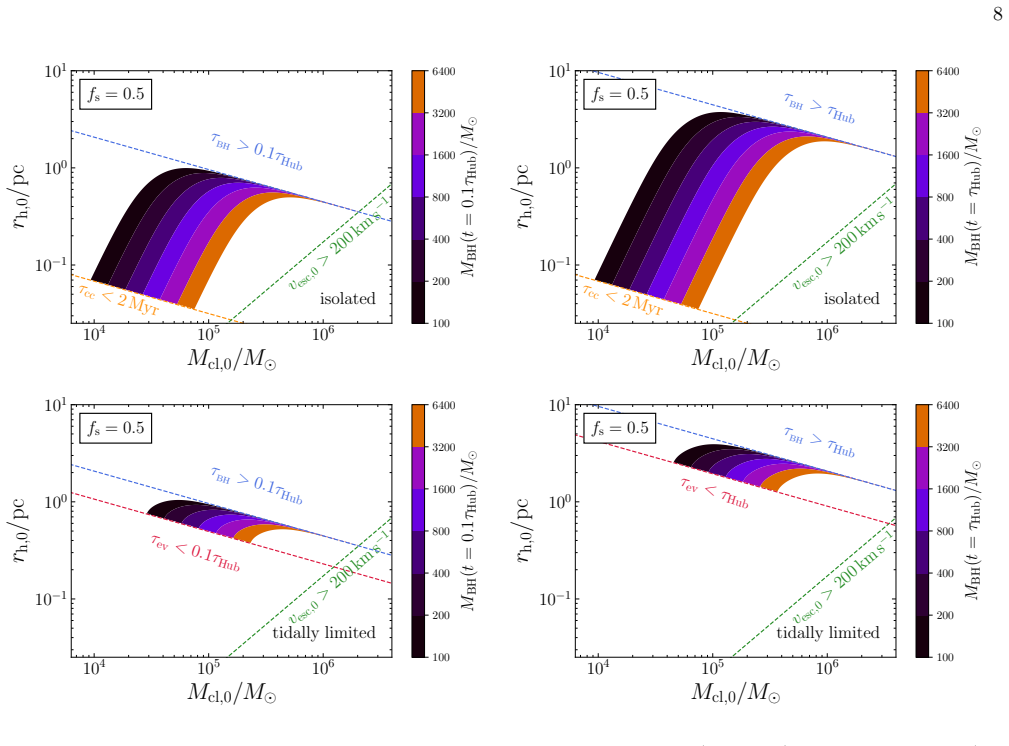
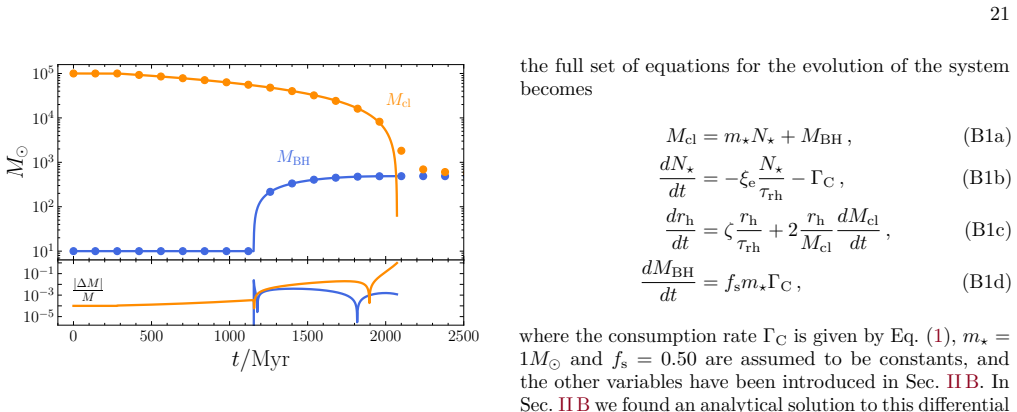
The load-bearing object is the forward map $F:\lambda\to\theta$ of Eq. (17), tying the measured IMBH component masses and merger redshift to the cluster initial conditions through the analytic black-hole growth law Eq. (10) -- the closed-form solution of the tidal-disruption consumption equation $\mathrm{d}M_{\mathrm{BH}}/\mathrm{d}t = f_s m_\star \Gamma_C$ -- together with the cluster evolution model of Eqs. (3) and the delay-time chain $\tau_{\rm delay} = \tau_{\rm df} + \tau_{\rm har} + \tau_{\rm gw}$. The inversion samples the five-dimensional preimage $F^{-1}(\theta)$ and reweights samples by the inverse Jacobian $|\mathrm{d}\theta/\mathrm{d}\lambda|^{-1}$, equal to the product of TDE rates at cluster merger. The narrow $z_{\rm cl,0}$ posteriors trace back to the growth-time prior $p(\Delta t_g|M_{\rm cl,0})\propto M_{\rm cl,0}/\sqrt{\Delta t_g}$ of Eq. (20), which encodes the preference, from a singular isothermal sphere and dynamical friction, for clusters that sink to the center quickly.
What would settle it
Take a well-measured IMBH merger whose host cluster formation redshift is independently known (for example from a strongly lensed star cluster or an electromagnetic counterpart) and check whether the inferred $z_{\rm cl,0}$ posterior contains the true value; a systematic miss would show the growth-time prior or delay model is wrong. A cleaner model-level test is to redo the inference with a different growth-time prior (flat or calibrated to simulated cluster populations) and see whether the $z_{\rm cl,0}$ posteriors broaden or shift substantially.
Extended reading notes
Core claim
The paper's central discovery is a forward map, $F:\lambda\to\theta$ in Eq. (17), relating the initial conditions of two parent clusters -- initial mass $M_{\mathrm{cl},0}$, half-mass radius $r_{\mathrm{h},0}$, formation redshift $z_{\mathrm{cl},0}$, and growth time $\Delta t_g$ -- to the measured binary parameters $(m_1,m_2,z_m)$. The map is built from the closed-form tidal-disruption growth law Eq. (10), the cluster evolution equations, and a delay-time model $\tau_{\mathrm{delay}}$ that spans dynamical friction, binary hardening, and gravitational-wave inspiral. Inverting this map on full Bayesian posteriors for six simulated IMBH binaries, the paper finds that $M_{\mathrm{cl},0}$ and $r_{\mathrm{h},0}$ follow broad, degenerate contours, while $z_{\mathrm{cl},0}$ peaks near the merger redshift with variance much smaller than the prior. The conclusion is that individual IMBH mergers will not measure cluster mass or radius, yet the formation-redshift constraint is informative enough that a catalog of such events could trace the star-cluster formation history.
Load-bearing premise
The central fragile premise is the assumed distribution of the time each cluster spends growing before it merges, which the paper takes as $p(\Delta t_g|M_{\rm cl,0})\propto M_{\rm cl,0}/\sqrt{\Delta t_g}$; the reported narrow formation-redshift peaks are tied to that choice and to the modeled merger delay, so a different true growth-time distribution would shift the inferred formation redshifts.
Editorial extensions
If this is right
- A single loud IMBH-IMBH detection will not determine the initial mass or half-mass radius of the host clusters; those posteriors stay broad across the prior domain.
- The formation redshift of each host cluster is the recoverable quantity, with posteriors concentrated near the measured merger redshift.
- Measuring many IMBH mergers across redshift could reconstruct the cosmic history of star cluster formation, provided the delay-time model is correct.
- Higher-redshift systems require denser, more compact cluster progenitors, so the population should show a systematic trend of smaller $r_{\rm h,0}$ at larger $z_m$.
- The total time from cluster formation to merger is dominated by the post-coalescence delay $\tau_{\rm delay}$, so population inference must marginalize over that timescale.
Reading between the lines
- Editorial extension: since the paper itself attributes the narrow $z_{\rm cl,0}$ peaks to the $\Delta t_g$ prior, re-running the inference with a flat or empirically calibrated growth-time prior would show how much of the claimed constraining power is astrophysical rather than assumed.
- Editorial extension: the mass-radius degeneracy is a line of constant asymptotic IMBH mass in the $M_{\rm cl,0}$--$r_{\rm h,0}$ plane, so a population with well-measured masses alone will not break it; adding spins, eccentricity, or an electromagnetic redshift anchor for one host could.
- Editorial extension: the model's prediction that TDE-grown IMBH spins asymptote to zero suggests a clean discriminator -- a high-spin IMBH in the same mass range would favor gas accretion or repeated black-hole mergers over the channel studied here.
- Editorial extension: the factor-of-five agreement with N-body tidal-disruption rates implies systematic calibration uncertainty in the absolute mass scale, so hierarchical population analyses should marginalize over this calibration rather than trust the analytic rate exactly.
Editorial analysis
A structured set of objections, weighed in public.
Referee Report
Summary. The paper develops an analytic model for the growth of an intermediate-mass black hole (IMBH) by repeated tidal disruption events in evolving star clusters, couples this to a delay-time model for the merger of two clusters and the subsequent IMBH-IMBH merger, and uses it to map gravitational-wave source parameters (m1, m2, zm) onto the initial masses, half-mass radii, and formation redshifts of the two progenitor clusters. The mapping is applied to six simulated IMBH binaries with parameter-estimation runs for a three-detector next-generation network. The authors find that the cluster structural parameters are poorly constrained because of a degeneracy in the forward model, while the marginalized posteriors on cluster formation redshift are relatively narrow. They conclude that single-event measurements cannot determine cluster mass or radius, but that a population of IMBH mergers may still constrain the cluster formation history.
Significance. The negative result on structural parameters is a useful and credible warning for future XG observations: it is based on standard PE tools, an explicit forward model, and a range of binary configurations. The analytic closed-form growth law, the public code, and the direct comparison with N-body simulations in Sec. IVE are strengths that make the degeneracy claim reasonably robust. The positive claim about cluster formation redshift is potentially important, but it is not yet supported because, as the paper itself states in Sec. IIIB1, the narrow zcl,0 posteriors are largely produced by the chosen prior on the growth time in Eq. (20). Unless the sensitivity of the zcl,0 inference to that prior and to the delay-time prescription is quantified, the abstract's statement that it may be possible to infer cluster formation history goes beyond what the analysis demonstrates.
major comments (4)
- [Sec. IIIB1, Eq. (20), Figs. 8-9] The narrow zcl,0 posteriors, which are the main positive result, are driven by the assumed prior p(Delta tg|Mcl,0) proportional to Mcl,0/sqrt(Delta tg) derived from a singular isothermal sphere and dynamical friction. The text in Sec. IIIB1 states explicitly: 'This is due to the choice of prior on Delta tg.' The paper does not test the robustness of the zcl,0 inference to this prior. Since the conclusion that cluster formation history can be inferred rests entirely on these narrow posteriors, please add a prior-sensitivity study, for example by repeating the inference with a flat or log-uniform prior on Delta tg, or with a different dynamical-friction scaling such as tau_df proportional to Rg^alpha Mcl,0^beta, and show how the zcl,0 posteriors change. Without such a test, the positive claim in the abstract is unsupported.
- [Sec. IIE and Eq. (17c)] The formation-redshift inference also depends on the model-dependent delay time tau_delay = tau_df + tau_har + tau_gw, which enters the time constraint in Eq. (17c). The components of tau_delay involve several approximations, including the dynamical-friction formula of Eq. (13), the hardening prescription of Eq. (14), and the assumed Bahcall-Wolf profile. The paper varies the cluster evolutionary scenario and fs, but does not vary the tau_delay prescription. Because tau_delay directly connects zm to zcl,0, please quantify how the zcl,0 posterior shifts under reasonable variations of tau_delay, for instance by multiplying the delay by factors of order 2 or by using an alternative hardening-rate formula. This is essential before claiming that zcl,0 is a measurable cluster property rather than a reflection of the assumed time-delay model.
- [Sec. IIIA1-IIIA2] The Jacobian reweighting in the inverse mapping from source parameters to cluster parameters is under-specified. The text says samples are reweighed with the inverse Jacobian factor |dtheta/dlambda|^{-1}, but the standard probability transformation p(lambda)dlambda = p(theta)dtheta requires multiplication by |dtheta/dlambda| (or, for a many-to-one map, a clear proposal density and a well-defined integration over the fiber). It is not obvious that the described procedure, combined with the prior reweighing by pastro(theta)/pPE(theta), yields samples from p(lambda|d). Please clarify the direction of the Jacobian, state the proposal density on the inverse submanifold, and validate the procedure on a known injection, for example by checking that the resulting cluster posterior reproduces the forward-model likelihood when re-mapped to source parameters.
- [Sec. IVE] The comparison with the N-body simulations of Ref. [25] shows agreement only to within a factor of about 5, with the analytic model tending to overestimate the TDE rate. This systematic uncertainty is not propagated into the cluster posterior or into the claimed zcl,0 constraint. At minimum, the paper should discuss how a factor-of-5 uncertainty in the growth rate maps into biases in Mcl,0, rh,0, and zcl,0. The structural-degeneracy conclusion is probably robust to this uncertainty, but the claimed narrow width of the zcl,0 posterior is not, because the growth time derived from Eq. (17a)-(17b) scales inversely with the TDE rate.
minor comments (5)
- [Sec. IIIA3 and Fig. 6] The high-redshift cluster-formation prior used for binary F and shown as the dashed curve in Fig. 6 is never defined in the text; Sec. IIIA3 only specifies the low-redshift Gaussian with mean zcl,0 = 3.2 and sigma = 1.5. Please give the parameters of the high-redshift prior.
- [Eq. (10)] The closed-form solution in Eq. (10) is very hard to read: the hypergeometric function's arguments are split across multiple lines and the integration variable x is reintroduced without a clear definition. Please rewrite this equation with a displayed definition of x and, if possible, break it into a main equation plus a definition of the integral term.
- [Sec. IVE, first paragraph] In the sentence describing Fig. 10, the phrase 'can be compared with Fig. 13 of Ref. [25]' is missing a verb or auxiliary; please rephrase to 'can be compared with Fig. 13 of Ref. [25]' or similar.
- [Sec. IIIA1] The inverse sampling procedure says that log10(Mcl,0) and log10(rh,0) are drawn uniformly, but the astrophysical prior on Mcl,0 in Eq. (21) is p(Mcl,0) proportional to Mcl,0^{-2}, which is not flat in log10(Mcl,0). If the correct prior is instead imposed through the reweighing step, please state this explicitly so the reader can follow the computation.
- [Fig. 7] The corner plot is dense because it combines two evolutionary scenarios and two values of fs with four colors. Consider presenting the fs = 0.5 and fs = 0.03 cases in separate figures, or explicitly labeling each panel with the color code, to improve readability.
Circularity Check
No significant circularity: the analytic forward model is self-contained, and the prior-dominated z_cl,0 posteriors are explicitly admitted as such rather than presented as independent measurements.
full rationale
The central derivation chain is the forward map of Eqs. (17) built on the analytic BH growth law Eq. (10), which is obtained from the TDE rate Eq. (1) and cluster evolution Eqs. (3)-(6), then validated against the N-body simulations of Ref. [25] in Fig. 10. The inference of cluster parameters from GW data is a standard Bayesian inversion with an astrophysical prior; nothing in this chain redefines the target quantity in terms of the input. The main candidate for circularity is the narrow z_cl,0 posterior, which the paper itself attributes to the choice of prior on Δt_g (Sec. IIIB1: 'This is due to the choice of prior on Δt_g'). This is not a circular step: p(Δt_g|M_cl,0) ∝ M_cl,0/√Δt_g in Eq. (20) is derived from an independent dynamical-friction/SIS model, not fitted to the GW events, and the posterior for z_cl,0 is the ordinary Bayesian consequence of that prior combined with the well-measured merger redshift through Eq. (17c). The paper flags the resulting model dependence as a limitation (Sec. IV, Conclusions), rather than presenting z_cl,0 as a pure data-driven measurement. Self-citations (e.g., Refs. [9], [23], [48], [72]) are methodological or numerical tools and are not used as load-bearing proof of any uniqueness or of the central result. Therefore no circular step can be exhibited.
Assumptions & free parameters
free parameters (2)
- fs =
0.5 and 0.03 (representative)
- beta =
2.0 (chosen)
assumptions (5)
- domain assumption Balanced evolution (Hénon's principle) for cluster energy generation
- domain assumption Isothermal, single-mass cluster with Bahcall-Wolf cusp gamma = 7/4
- domain assumption Full loss-cone model with instantaneous repopulation
- ad hoc to paper Growth-time prior p(Delta tg|Mcl,0) proportional to Mcl,0/sqrt(Delta tg)
- domain assumption Delay-time model as sum of dynamical friction, binary hardening, and GW timescales
Cite this review
Pith. "Pith review of Gravitational wave inference of star cluster properties from intermediate-mass black hole mergers." pith.science (2026). https://pith.science/paper/EQTGTOMD
@misc{pith2026250116422,
  author       = {Pith},
  title        = {Pith review of: Gravitational wave inference of star cluster properties from intermediate-mass black hole mergers},
  year         = {2026},
  howpublished = {\url{https://pith.science/paper/EQTGTOMD}},
  note         = {Machine review of arXiv:2501.16422}
}
read the original abstract
Next-generation ground-based gravitational wave observatories will observe mergers of intermediate-mass black holes (IMBHs) out to high redshift. Such IMBHs can form through runaway tidal encounters in the cores of dense stellar clusters. In this paper, we ask if the gravitational wave observation of a single merger event between two IMBHs, occurring in the aftermath of the coalescence of the clusters in which they formed, can be used to infer the properties of their host clusters, such as mass, redshift, and half-mass radius. We implement an astrophysically motivated analytic model for cluster evolution and IMBH growth, and we perform IMBH binary parameter estimation using a network of three next-generation detectors. We find that inferring the structural properties of clusters in this way is challenging due to model degeneracy. However, the posteriors on the cluster formation redshifts have relatively narrow peaks, and it may still be possible to infer the cluster formation history by measuring a whole population of IMBH binary merger events.
Figures


Figures from the paper (13 more)




Reference graph
Works this paper leans on
-
[25]
Karl Gebhardt, R. Michael Rich, and Luis C. Ho, “An Intermediate-mass black hole in the globular cluster G1: Improved significance from new Keck and Hubble Space Telescope observations,” Astrophys. J.634, 1093–1102 (2005), arXiv:astro-ph/0508251
arXiv 2005
-
[1]
If formed in pairs, such stars may form BH binaries with both components masses above∼ 150M⊙, as suggested by population synthesis codes [90, 91]
Population III remnants The first stars (known as Pop III stars) are believed to have weaker winds and their collapse will lead to heavier remnants [89]. If formed in pairs, such stars may form BH binaries with both components masses above∼ 150M⊙, as suggested by population synthesis codes [90, 91]. While the stellar winds of very massive stars are uncert...
-
[2]
Marginalized cluster posteriors forfs = 0.5 In this section, we present the marginalized one- dimensional posterior distributions of the cluster param- eters and describe their features. In Fig. 8 we show the marginalized distributions for binaries A–E (rows two to six) computed assuming the low-redshift prior onzcl,0 for all of them (cf. Fig. 6). In Fig....
-
[3]
Runaway stellar collisions Stars with masses ≳ 200M⊙ formed through run- away stellar collisions may also lead to the formation of IMBHs [24, 40, 94–96]. However, the mass growth rate of the runaway star may be too strong for a very massive star to even form in a metal-rich environment [43, 44], 17 so this formation scenario may only be relevant in low- m...
-
[4]
IID, star clusters with a sufficiently high escape velocity undergo runaway BH mergers (see also [42, 71, 102])
Repeated BH mergers As discussed in Sec. IID, star clusters with a sufficiently high escape velocity undergo runaway BH mergers (see also [42, 71, 102]). The simulations shown in the right panel of Fig. 5 suggest that the formation of two IMBHs with masses between 200M⊙ and 1000M⊙ within the same stellar environment, while possible, is unlikely (see also,...
-
[5]
worst case scenario
Gas accretion Observational data imply that, despite being dry stel- lar systems, globular clusters contain some gas in their centers, resulting from stellar winds of low-mass stars and ionized by ambient white dwarfs. For instance, Ref. [107] inferred a density of gas particlesne = 0.23 cm−3 using the dissipative effects that the gas would have on the em...
-
[6]
B. P. Abbottet al.(LIGO Scientific, Virgo), “GWTC-1: A Gravitational-Wave Transient Catalog of Compact Binary Mergers Observed by LIGO and Virgo during the First and Second Observing Runs,” Phys. Rev. X9, 031040 (2019), arXiv:1811.12907 [astro-ph.HE]
arXiv 2019
-
[7]
R. Abbott et al. (LIGO Scientific, Virgo), “GWTC-2: Compact Binary Coalescences Observed by LIGO and Virgo During the First Half of the Third Observing Run,” Phys. Rev. X11, 021053 (2021), arXiv:2010.14527 [gr- qc]
arXiv 2021
Show all 149 references
-
[8]
GWTC-3: Compact Binary Coalescences Observed by LIGO and Virgo during the Second Part of the Third Observing Run,
R. Abbottet al.(KAGRA, VIRGO, LIGO Scientific), “GWTC-3: Compact Binary Coalescences Observed by LIGO and Virgo during the Second Part of the Third Observing Run,” Phys. Rev. X13, 041039 (2023), arXiv:2111.03606 [gr-qc]
2023 arXiv
-
[9]
The Einstein Telescope: A third- generationgravitationalwaveobservatory,
M. Punturo et al., “The Einstein Telescope: A third- generationgravitationalwaveobservatory,”Class.Quant. Grav. 27, 194002 (2010)
2010
-
[10]
A Horizon Study for Cosmic Ex- plorer: Science, Observatories, and Community,
Matthew Evanset al., “A Horizon Study for Cosmic Ex- plorer: Science, Observatories, and Community,” (2021), arXiv:2109.09882 [astro-ph.IM]
2021 arXiv
-
[11]
Science with the Einstein Tele- scope: a comparison of different designs,
Marica Branchesiet al., “Science with the Einstein Tele- scope: a comparison of different designs,” JCAP07, 068 (2023), arXiv:2303.15923 [gr-qc]
2023 arXiv
-
[12]
Characterizing gravitational wave detector networks: from A♯ to cosmic explorer,
Ish Gupta et al., “Characterizing gravitational wave detector networks: from A♯ to cosmic explorer,” Class. Quant. Grav. 41, 245001 (2024), arXiv:2307.10421 [gr- qc]
2024 arXiv
-
[13]
Identifying heavy stellar black holes at cosmological distances with next-generation gravitational-wave observatories,
Stephen Fairhurst, Cameron Mills, Monica Colpi, Raf- faella Schneider, Alberto Sesana, Alessandro Trinca, and Rosa Valiante, “Identifying heavy stellar black holes at cosmological distances with next-generation gravitational-wave observatories,” Mon. Not. Roy. As- tron. Soc. 5...
2024 arXiv
-
[14]
Intermediate-mass black hole binary parame- ter estimation with next-generation ground-based de- tector networks,
Luca Reali, Roberto Cotesta, Andrea Antonelli, Kon- stantinos Kritos, Vladimir Strokov, and Emanuele Berti, “Intermediate-mass black hole binary parame- ter estimation with next-generation ground-based de- tector networks,” Phys. Rev. D 110, 103002 (2024), arXiv:2406.01687 [gr-qc]
2024 arXiv
-
[15]
The Formation and Evolution of Massive Black Holes,
Marta Volonteri, “The Formation and Evolution of Massive Black Holes,” Science 337, 544 (2012), arXiv:1208.1106 [astro-ph.CO]
2012 arXiv
-
[16]
Intermediate-Mass Black Holes,
Jenny E. Greene, Jay Strader, and Luis C. Ho, “Intermediate-Mass Black Holes,” Annu. Rev. Astron. Astrophys. 58, 257–312 (2020), arXiv:1911.09678 [astro- ph.GA]
2020 arXiv
-
[17]
Dwarf Galaxies with Optical Signatures of Active Massive Black Holes,
Amy E. Reines, Jenny E. Greene, and Marla Geha, “Dwarf Galaxies with Optical Signatures of Active Massive Black Holes,” Astrophys. J.775, 116 (2013), arXiv:1308.0328 [astro-ph.CO]
2013 arXiv
-
[18]
A 10,000-solar-mass black hole in the nucleus of a bulgeless dwarf galaxy,
Jong-Hak Woo, Hojin Cho, Elena Gallo, Edmund Hodges-Kluck, Huynh Anh N. Le, Jaejin Shin, Donghoon Son, and John C. Horst, “A 10,000-solar-mass black hole in the nucleus of a bulgeless dwarf galaxy,” Nat. Astron. 3, 755–759 (2019), arXiv:1905.00145 [astro-ph.GA]
2019 arXiv
-
[19]
Observational evidence for intermediate- mass black holes,
Mar Mezcua, “Observational evidence for intermediate- mass black holes,” Int. J. Mod. Phys. D26, 1730021 (2017), arXiv:1705.09667 [astro-ph.GA]
2017 arXiv
-
[20]
A 400-solar-mass black hole in the galaxy M82,
Dheeraj R. Pasham, Tod E. Strohmayer, and Richard F. Mushotzky, “A 400-solar-mass black hole in the galaxy M82,” Nature 513, 74–76 (2014), arXiv:1501.03180 [astro-ph.HE]
2014 arXiv
-
[21]
A broadband X-ray spectral study of the intermediate-mass black hole candidate M82 X-1 with NuSTAR, Chandra and Swift,
Murray Brightmanet al., “A broadband X-ray spectral study of the intermediate-mass black hole candidate M82 X-1 with NuSTAR, Chandra and Swift,” Astrophys. J. 829, 28 (2016), arXiv:1607.03903 [astro-ph.HE]
2016 arXiv
-
[22]
An intermediate- mass black hole of over 500 solar masses in the galaxy ESO243-49,
Sean A. Farrell, Natalie A. Webb, Didier Barret, Olivier Godet, and Joana M. Rodrigues, “An intermediate- mass black hole of over 500 solar masses in the galaxy ESO243-49,” Nature460, 73–75 (2009), arXiv:1001.0567 [astro-ph.HE]
2009 arXiv
-
[23]
A Young Massive Stellar Population around the Intermediate-mass Black Hole ESO 243- 49 HLX-1,
S. A. Farrell, M. Servillat, J. Pforr, T. J. Mac- carone, C. Knigge, O. Godet, C. Maraston, N. A. Webb, D. Barret, A. J. Gosling, R. Belmont, and K. Wiersema, “A Young Massive Stellar Population around the Intermediate-mass Black Hole ESO 243- 49 HLX-1,” Astrophys. J. Lett. 74...
2012 arXiv
-
[24]
The MAVERIC Survey: Still No Evidence for Accreting Intermediate-mass Black HolesinGlobularClusters,
Evangelia Tremouet al., “The MAVERIC Survey: Still No Evidence for Accreting Intermediate-mass Black HolesinGlobularClusters,”Astrophys.J. 862,16(2018), arXiv:1806.00259 [astro-ph.HE]
2018 arXiv
-
[26]
Fast-moving stars around an intermediate-mass black hole in Omega Centauri,
Maximilian Häberle, Nadine Neumayer, Anil Seth, Andrea Bellini, Mattia Libralato, Holger Baumgardt, Matthew Whitaker, Antoine Dumont, Mayte Alfaro Cuello, Jay Anderson, Callie Clontz, Nikolay Kacharov, Sebastian Kamann, Anja Feldmeier-Krause, Antonino Milone, Maria Selina Nits...
2024 arXiv
-
[27]
A high- velocity star recently ejected by an intermediate-mass black hole in M15,
Yang Huang, Qingzheng Li, Jifeng Liu, Xiaobo Dong, Huawei Zhang, Youjun Lu, and Cuihua Du, “A high- velocity star recently ejected by an intermediate-mass black hole in M15,” (2024), arXiv:2406.00923 [astro- ph.GA]
2024 arXiv
-
[28]
Black hole growth through hierarchical black hole merg- ers in dense star clusters: implications for gravitational wave detections,
Fabio Antonini, Mark Gieles, and Alessia Gualandris, “Black hole growth through hierarchical black hole merg- ers in dense star clusters: implications for gravitational wave detections,” Mon. Not. Roy. Astron. Soc. 486, 5008–5021 (2019), arXiv:1811.03640 [astro-ph.HE]
2019 arXiv
-
[29]
The Formation of massive black holes through collision run- away in dense young star clusters,
Simon F. Portegies Zwart, Holger Baumgardt, Piet Hut, Junichiro Makino, and Stephen L. W. McMillan, “The Formation of massive black holes through collision run- away in dense young star clusters,” Nature428, 724 (2004), arXiv:astro-ph/0402622
2004 arXiv
-
[30]
The growth of intermediate mass black holes through tidal captures and tidal disruption events,
Francesco Paolo Rizzuto, Thorsten Naab, Antti Rantala, Peter H. Johansson, Jeremiah P. Ostriker, Nicholas C. Stone, Shihong Liao, and Dimitrios Irodotou, “The growth of intermediate mass black holes through tidal captures and tidal disruption events,” Mon. Not. Roy. Astron. So...
2023 arXiv
-
[31]
Missing link found? – the “runaway
Toshikazu Ebisuzaki, Junichiro Makino, Takeshi Go Tsuru, Yoko Funato, Simon F. Portegies Zwart, Piet 26 Hut, Steve McMillan, Satoki Matsushita, Hironori Mat- sumoto, and Ryohei Kawabe, “Missing link found? – the “runaway” path to supermassive black holes,” Astrophys. J. Lett. ...
2001 arXiv
-
[32]
Mergers of globular clusters in the Galactic disc: intermediate mass black hole coalescence and im- plications for gravitational waves detection,
Manuel Arca Sedda and Alessandra Mastrobuono- Battisti, “Mergers of globular clusters in the Galactic disc: intermediate mass black hole coalescence and im- plications for gravitational waves detection,” (2019), arXiv:1906.05864 [astro-ph.GA]
2019 arXiv
-
[33]
Formation of supermassive black holes in galactic nuclei - I. Delivering seed intermediate-mass black holes in massive stellar clusters,
Abbas Askar, Melvyn B. Davies, and Ross P. Church, “Formation of supermassive black holes in galactic nuclei - I. Delivering seed intermediate-mass black holes in massive stellar clusters,” Mon. Not. R. Astron. Soc.502, 2682–2700 (2021), arXiv:2006.04922 [astro-ph.GA]
2021 arXiv
-
[34]
Origin and growth of nuclear star clus- ters around massive black holes,
Fabio Antonini, “Origin and growth of nuclear star clus- ters around massive black holes,” Astrophys. J.763, 62 (2013), arXiv:1207.6589 [astro-ph.GA]
2013 arXiv
-
[36]
Co-Evolution of Galactic Nuclei and Glob- ular Cluster Systems,
Oleg Y. Gnedin, Jeremiah P. Ostriker, and Scott Tremaine, “Co-Evolution of Galactic Nuclei and Glob- ular Cluster Systems,” Astrophys. J. 785, 71 (2014), arXiv:1308.0021 [astro-ph.CO]
2014 arXiv
-
[37]
Gravi- tational wave sources from inspiralling globular clus- ters in the Galactic Centre and similar environments,
Manuel Arca-Sedda and Alessia Gualandris, “Gravi- tational wave sources from inspiralling globular clus- ters in the Galactic Centre and similar environments,” Mon. Not. R. Astron. Soc. 477, 4423–4442 (2018), arXiv:1804.06116 [astro-ph.GA]
2018 arXiv
-
[38]
A Black Hole in the Galactic Center Complex IRS 13E?
R. Schödel, A. Eckart, C. Iserlohe, R. Genzel, and T. Ott, “A Black Hole in the Galactic Center Complex IRS 13E?” Astrophys. J. Lett.625, L111–L114 (2005), arXiv:astro-ph/0504474 [astro-ph]
2005 arXiv
-
[39]
A new type of compact stellar population: dark star clusters,
Sambaran Banerjee and Pavel Kroupa, “A new type of compact stellar population: dark star clusters,” Astro- phys. J. Lett.741, L12 (2011), arXiv:1110.4103 [astro- ph.GA]
2011 arXiv
-
[40]
GW190521 from the Merger of Ultradwarf Galaxies,
Antonella Palmese and Christopher J. Conselice, “GW190521 from the Merger of Ultradwarf Galaxies,” Phys. Rev. Lett.126, 181103 (2021), arXiv:2009.10688 [astro-ph.GA]
2021 arXiv
-
[41]
FROST-CLUSTERS – I. Hierarchical star cluster as- sembly boosts intermediate-mass black hole formation,
Antti Rantala, Thorsten Naab, and Natalia Lahén, “FROST-CLUSTERS – I. Hierarchical star cluster as- sembly boosts intermediate-mass black hole formation,” (2024), arXiv:2403.10602 [astro-ph.GA]
2024 arXiv
-
[42]
Feedback-regulated seed black hole growth in star- forming molecular clouds and galactic nuclei,
Yanlong Shi, Kyle Kremer, and Philip F. Hopkins, “Feedback-regulated seed black hole growth in star- forming molecular clouds and galactic nuclei,” Astron. Astrophys. 691, A24 (2024), arXiv:2405.12164 [astro- ph.GA]
2024 arXiv
-
[43]
Extremely efficient mergers of intermediate-mass black hole binaries in nucleated dwarf galaxies,
Fazeel Mahmood Khan and Kelly Holley-Bockelmann, “Extremely efficient mergers of intermediate-mass black hole binaries in nucleated dwarf galaxies,” Mon. Not. Roy. Astron. Soc. 508, 1174–1188 (2021), arXiv:2109.12129 [astro-ph.GA]
2021 arXiv
-
[44]
MOCCA code for star cluster simulations - IV. A new scenario for in- termediate mass black hole formation in globular clus- ters,
Mirek Giersz, Nathan Leigh, Arkadiusz Hypki, Nora Lützgendorf, and Abbas Askar, “MOCCA code for star cluster simulations - IV. A new scenario for in- termediate mass black hole formation in globular clus- ters,” Mon. Not. R. Astron. Soc.454, 3150–3165 (2015), arXiv:1506.05234 ...
2015 arXiv
-
[45]
Massive black hole binaries from collisional runaways,
M. Atakan Gurkan, John M. Fregeau, and Frederic A. Rasio, “Massive black hole binaries from collisional runaways,” Astrophys. J. Lett.640, L39–L42 (2006), arXiv:astro-ph/0512642
2006 arXiv
-
[46]
Concurrent formation of supermassive stars and globular clusters: implications for early self-enrichment,
Mark Gieles, Corinne Charbonnel, Martin G. H. Krause, Vincent Hénault-Brunet, Oscar Agertz, Henny J. G. L. M. Lamers, Nathan Bastian, Alessia Gualan- dris, Alice Zocchi, and James A. Petts, “Concurrent formation of supermassive stars and globular clusters: implications for ear...
2018 arXiv
-
[47]
Massive black hole assembly in nuclear star clusters,
Konstantinos Kritos, Emanuele Berti, and Joseph Silk, “Massive black hole assembly in nuclear star clusters,” Phys. Rev. D 108, 083012 (2023), arXiv:2212.06845 [astro-ph.HE]
2023 arXiv
-
[48]
Massive black hole binaries from runaway collisions: the impact of metallicity,
Michela Mapelli, “Massive black hole binaries from runaway collisions: the impact of metallicity,” Mon. Not. Roy. Astron. Soc. 459, 3432–3446 (2016), arXiv:1604.03559 [astro-ph.GA]
2016 arXiv
-
[49]
The evolution of runaway stellar collision products,
E. Glebbeek, E. Gaburov, S. E. de Mink, O. R. Pols, and S. F. Portegies Zwart, “The evolution of runaway stellar collision products,” Astron. Astrophys. 497, 255–264 (2009), arXiv:0902.1753 [astro-ph.SR]
2009 arXiv
-
[50]
Gravitational Wave Recoil and the Retention of Intermediate Mass Black Holes,
Kelly Holley-Bockelmann, Kayhan Gultekin, Deirdre Shoemaker, and Nico Yunes, “Gravitational Wave Recoil and the Retention of Intermediate Mass Black Holes,” Astrophys. J. 686, 829 (2008), arXiv:0707.1334 [astro- ph]
2008 arXiv
-
[51]
Formation of Massive Black Holes in Galactic Nuclei: Runaway Tidal Encounters,
Nicholas C. Stone, Andreas H. W. Küpper, and Jeremiah P. Ostriker, “Formation of Massive Black Holes in Galactic Nuclei: Runaway Tidal Encounters,” Mon. Not. Roy. Astron. Soc. 467, 4180–4199 (2017), arXiv:1606.01909 [astro-ph.GA]
2017 arXiv
-
[52]
Gravitational waves as a probe of globular cluster formation and evolution,
Isobel M. Romero-Shaw, Kyle Kremer, Paul D. Lasky, Eric Thrane, and Johan Samsing, “Gravitational waves as a probe of globular cluster formation and evolution,” Mon. Not. Roy. Astron. Soc. 506, 2362–2372 (2021), arXiv:2011.14541 [astro-ph.HE]
2021 arXiv
-
[53]
Single-event likelihood of star cluster properties with LIGO-Virgo- Kagra binary black hole observations,
Ken K. Y. Ng, Konstantinos Kritos, Andrea Antonelli, Roberto Cotesta, and Emanuele Berti, “Single-event likelihood of star cluster properties with LIGO-Virgo- Kagra binary black hole observations,” Phys. Rev. D 108, 083015 (2023), arXiv:2307.03227 [astro-ph.HE]
2023 arXiv
-
[54]
Globular clus- ter formation histories, masses, and radii inferred from gravitational waves,
Maya Fishbach and Giacomo Fragione, “Globular clus- ter formation histories, masses, and radii inferred from gravitational waves,” Mon. Not. Roy. Astron. Soc.522, 5546–5557 (2023), arXiv:2303.02263 [astro-ph.GA]
2023 arXiv
-
[55]
The Initial mass function of stars: Evi- dence for uniformity in variable systems,
Pavel Kroupa, “The Initial mass function of stars: Evi- dence for uniformity in variable systems,” Science295, 82–91 (2002), arXiv:astro-ph/0201098
2002 arXiv
-
[56]
Evaluating the merger rate of binary black holes from direct captures and third-body soft interactions using the Milky Way globular clusters,
Konstantinos Kritos and Ilias Cholis, “Evaluating the merger rate of binary black holes from direct captures and third-body soft interactions using the Milky Way globular clusters,” Phys. Rev. D102, 083016 (2020), arXiv:2007.02968 [astro-ph.GA]
2020 arXiv
-
[57]
Random Grav- itational Encounters and the Evolution of Spherical Sys- tems. I. Method,
Jr. Spitzer, Lyman and Michael H. Hart, “Random Grav- itational Encounters and the Evolution of Spherical Sys- tems. I. Method,” Astrophys. J.164, 399 (1971)
1971
-
[58]
Merritt,Dynamics and Evolution of Galactic Nuclei (Princeton University Press, 41 William Street, Prince- ton, New Jersey 08540, 2013)
D. Merritt,Dynamics and Evolution of Galactic Nuclei (Princeton University Press, 41 William Street, Prince- ton, New Jersey 08540, 2013)
2013
-
[59]
Tidal capture formation of binary systems and X-ray sources in globular clusters
A. C. Fabian, J. E. Pringle, and M. J. Rees, “Tidal capture formation of binary systems and X-ray sources in globular clusters.” Mon. Not. R. Astron. Soc.172, 15 (1975)
1975
-
[60]
On formation of close 27 binaries by two-body tidal capture
W. H. Press and S. A. Teukolsky, “On formation of close 27 binaries by two-body tidal capture.” Astrophys. J.213, 183–192 (1977)
1977
-
[61]
Effects of massive black holes on dense stellar systems
J. Frank and M. J. Rees, “Effects of massive black holes on dense stellar systems.” Mon. Not. R. Astron. Soc. 176, 633–647 (1976)
1976
-
[62]
The distribution and consumption rate of stars around a massive, collapsed object
A. P. Lightman and S. L. Shapiro, “The distribution and consumption rate of stars around a massive, collapsed object.” Astrophys. J.211, 244–262 (1977)
1977
-
[63]
The dissolution of globular clusters con- taining massive black holes
S. L. Shapiro, “The dissolution of globular clusters con- taining massive black holes.” Astrophys. J.217, 281–286 (1977)
1977
-
[64]
Star distribution around a massive black hole in a globular cluster
J. N. Bahcall and R. A. Wolf, “Star distribution around a massive black hole in a globular cluster.” Astrophys. J. 209, 214–232 (1976)
1976
-
[65]
N- body growth of a Bahcall-Wolf cusp around a black hole,
Miguel Preto, David Merritt, and Rainer Spurzem, “N- body growth of a Bahcall-Wolf cusp around a black hole,” Astrophys. J. Lett.613, L109 (2004), arXiv:astro- ph/0406324
2004
-
[66]
Population synthe- sis of black hole binary mergers from star clusters,
Fabio Antonini and Mark Gieles, “Population synthe- sis of black hole binary mergers from star clusters,” Mon. Not. Roy. Astron. Soc. 492, 2936–2954 (2020), arXiv:1906.11855 [astro-ph.HE]
2020 arXiv
-
[67]
The life cycle of star cluster in a tidal field,
Mark Gieles, Douglas C. Heggie, and HongSheng Zhao, “The life cycle of star cluster in a tidal field,” Mon. Not. Roy. Astron. Soc. 413, 2509–2524 (2011), arXiv:1101.1821 [astro-ph.GA]
2011 arXiv
-
[68]
A prescription and fast code for the long-term evolution of star clusters - III. Unequal masses and stellar evolution,
Poul E. R. Alexander, Mark Gieles, Henny J. G. L. M. Lamers, and Holger Baumgardt, “A prescription and fast code for the long-term evolution of star clusters - III. Unequal masses and stellar evolution,” Mon. Not. R. Astron. Soc.442, 1265–1285 (2014), arXiv:1405.1086 [astro-ph.GA]
2014 arXiv
-
[69]
On the dynamics of open clus- ters,
V. A. Ambartsumian, “On the dynamics of open clus- ters,” inDynamics of Star Clusters, Vol. 113, edited by J. Goodman and P. Hut (D. Reidel Publishing Company, Dordrecht/Boston/Lancaster, 1985) p. 521
1985
-
[70]
Lifetimes of tidally lim- ited star clusters with different radii,
M. Gieles and H. Baumgardt, “Lifetimes of tidally lim- ited star clusters with different radii,” Mon. Not. Roy. Astron. Soc.389, L28 (2008), arXiv:0806.2327 [astro-ph]
2008 arXiv
-
[71]
TheRunawaygrowthofintermediate-massblackholesin dense star clusters,
Simon F. Portegies Zwart and Steve L. W. McMillan, “TheRunawaygrowthofintermediate-massblackholesin dense star clusters,” Astrophys. J.576, 899–907 (2002), arXiv:astro-ph/0201055
2002 arXiv
-
[72]
Dynamical evolution of black hole sub-systems in idealised star clusters,
Philip G. Breen and Douglas C. Heggie, “Dynamical evolution of black hole sub-systems in idealised star clusters,” Mon. Not. Roy. Astron. Soc.432, 2779 (2013), arXiv:1304.3401 [astro-ph.GA]
2013 arXiv
-
[73]
Tidal disruption of stars by black holes of 106-108 solar masses in nearby galaxies,
Martin J. Rees, “Tidal disruption of stars by black holes of 106-108 solar masses in nearby galaxies,” Nature333, 523–528 (1988)
1988
-
[74]
A bright year for tidal disruptions,
Brian D. Metzger and Nicholas C. Stone, “A bright year for tidal disruptions,” Mon. Not. Roy. Astron. Soc.461, 948–966 (2016), arXiv:1506.03453 [astro-ph.HE]
2016 arXiv
-
[75]
Escape speed of stellar clusters from multiple-generation black-hole merg- ers in the upper mass gap,
Davide Gerosa and Emanuele Berti, “Escape speed of stellar clusters from multiple-generation black-hole merg- ers in the upper mass gap,” Phys. Rev. D100, 041301 (2019), arXiv:1906.05295 [astro-ph.HE]
2019 arXiv
-
[76]
Avoiding a Cluster Catastrophe: Retention Efficiency and the Binary Black Hole Mass Spectrum,
Michael Zevin and Daniel E. Holz, “Avoiding a Cluster Catastrophe: Retention Efficiency and the Binary Black Hole Mass Spectrum,” Astrophys. J. Lett. 935, L20 (2022), arXiv:2205.08549 [astro-ph.HE]
2022 arXiv
-
[77]
Dynamical formation of black hole binaries in dense star clusters: Rapid clus- ter evolution code,
Konstantinos Kritos, Vladimir Strokov, Vishal Baib- hav, and Emanuele Berti, “Dynamical formation of black hole binaries in dense star clusters: Rapid clus- ter evolution code,” Phys. Rev. D110, 043023 (2024), arXiv:2210.10055 [astro-ph.HE]
2024 arXiv
-
[78]
Nonlinear quasinormal mode detectabil- ity with next-generation gravitational wave detectors,
Sophia Yi, Adrien Kuntz, Enrico Barausse, Emanuele Berti, Mark Ho-Yeuk Cheung, Konstantinos Kritos, and Andrea Maselli, “Nonlinear quasinormal mode detectabil- ity with next-generation gravitational wave detectors,” Phys. Rev. D109, 124029 (2024), arXiv:2403.09767 [gr- qc]
2024 arXiv
-
[79]
Constraining the high redshift formation of black hole seeds in nuclear star clusters with gas inflows,
Alessandro Lupi, Monica Colpi, Bernadetta Devecchi, Giorgio Galanti, and Marta Volonteri, “Constraining the high redshift formation of black hole seeds in nuclear star clusters with gas inflows,” Mon. Not. Roy. Astron. Soc. 442, 3616–3626 (2014), arXiv:1406.2325 [astro-ph.GA]
2014 arXiv
-
[80]
James Binney and Scott Tremaine,Galactic Dynamics (Princeton University Press, Princeton, NJ, 1988)
1988
-
[81]
The dynamical evolution of mas- sive black hole binaries - I. hardening in a fixed stellar background,
Gerald D. Quinlan, “The dynamical evolution of mas- sive black hole binaries - I. hardening in a fixed stellar background,” New Astron.1, 35–56 (1996), arXiv:astro- ph/9601092
1996
-
[82]
Chaotic Loss Cones and Black Hole Fueling,
David Merritt and M. Y. Poon, “Chaotic Loss Cones and Black Hole Fueling,” Astrophys. J.606, 788–798 (2004), arXiv:astro-ph/0302296
2004 arXiv
-
[83]
Lecture notes on black hole binary astrophysics,
Marco Celoria, Roberto Oliveri, Alberto Sesana, and Michela Mapelli, “Lecture notes on black hole binary astrophysics,” (2018) arXiv:1807.11489 [astro-ph.GA]
2018 arXiv
-
[84]
Scattering experiments meet N-body – I. A practical recipe for the evolution of massive black hole binaries in stellar environments,
Alberto Sesana and Fazeel Mahmood Khan, “Scattering experiments meet N-body – I. A practical recipe for the evolution of massive black hole binaries in stellar environments,” Mon. Not. Roy. Astron. Soc.454, L66– L70 (2015), arXiv:1505.02062 [astro-ph.GA]
2015 arXiv
-
[85]
An Accurate Analytical Fit to the Gravitational-wave Inspiral Duration for Eccentric Bina- ries,
Ilya Mandel, “An Accurate Analytical Fit to the Gravitational-wave Inspiral Duration for Eccentric Bina- ries,” Res. Notes AAS5, 223 (2021), arXiv:2110.09254 [astro-ph.HE]
2021 arXiv
-
[86]
Planck 2018 results. VI. Cosmological parameters,
N. Aghanimet al. (Planck), “Planck 2018 results. VI. Cosmological parameters,” Astron. Astrophys.641, A6 (2020), [Erratum: Astron.Astrophys. 652, C4 (2021)], arXiv:1807.06209 [astro-ph.CO]
2020 arXiv
-
[87]
The Structure and environment of young stellar clusters in spiral galaxies,
Soeren S. Larsen, “The Structure and environment of young stellar clusters in spiral galaxies,” Astron. Astro- phys. 416, 537–553 (2004), arXiv:astro-ph/0312338
2004 arXiv
-
[88]
Star Clusters Across Cosmic Time,
Mark R. Krumholz, Christopher F. McKee, and Joss Bland-Hawthorn, “Star Clusters Across Cosmic Time,” Annu. Rev. Astron. Astrophys. 57, 227–303 (2019), arXiv:1812.01615 [astro-ph.GA]
2019 arXiv
-
[89]
Globular cluster formation in the context of galaxy formation and evolution,
J. M. Diederik Kruijssen, “Globular cluster formation in the context of galaxy formation and evolution,” Class. Quantum Grav. 31, 244006 (2014), arXiv:1407.2953 [astro-ph.GA]
2014 arXiv
-
[90]
The formation and hierarchical assembly of globular cluster popula- tions,
Kareem El-Badry, Eliot Quataert, Daniel R. Weisz, Nick Choksi, and Michael Boylan-Kolchin, “The formation and hierarchical assembly of globular cluster popula- tions,” Mon. Not. R. Astron. Soc.482, 4528–4552 (2019), arXiv:1805.03652 [astro-ph.GA]
2019 arXiv
-
[91]
Introducing EMP-Pathfinder: modelling the simultaneous formation and evolution of stellar clusters in their host galaxies,
Marta Reina-Campos, Benjamin W. Keller, J. M. Diederik Kruijssen, Jindra Gensior, Sebas- tian Trujillo-Gomez, Sarah M. R. Jeffreson, Joel L. Pfeffer, and Alison Sills, “Introducing EMP-Pathfinder: modelling the simultaneous formation and evolution of stellar clusters in their ...
2022 arXiv
-
[92]
The cosmic 28 evolution of binary black holes in young, globular, and nuclear star clusters: rates, masses, spins, and mixing fractions,
Michela Mapelli, Yann Bouffanais, Filippo Santoliquido, Manuel Arca Sedda, and M. Celeste Artale, “The cosmic 28 evolution of binary black holes in young, globular, and nuclear star clusters: rates, masses, spins, and mixing fractions,” Mon. Not. Roy. Astron. Soc.511, 5797–581...
2022 arXiv
-
[93]
Kinematic masses of super star clusters in m82 from high-resolution near-infrared spectroscopy,
Nate McCrady, Andrea M. Gilbert, and James R. Gra- ham, “Kinematic masses of super star clusters in m82 from high-resolution near-infrared spectroscopy,” Astro- phys. J. 596, 240–252 (2003), arXiv:astro-ph/0306373
2003 arXiv
-
[94]
Massive black holes as Population III remnants,
Piero Madau and Martin J. Rees, “Massive black holes as Population III remnants,” Astrophys. J. Lett.551, L27–L30 (2001), arXiv:astro-ph/0101223
2001 arXiv
-
[95]
Merger rate of stellar black hole binaries above the pair instability mass gap,
Alberto Mangiagli, Matteo Bonetti, Alberto Sesana, and Monica Colpi, “Merger rate of stellar black hole binaries above the pair instability mass gap,” Astrophys. J. Lett. 883, L27 (2019), arXiv:1907.12562 [astro-ph.HE]
2019 arXiv
-
[96]
On the pop- ulation III binary black hole mergers beyond the pair- instability mass gap,
Kotaro Hijikawa, Ataru Tanikawa, Tomoya Kinugawa, Takashi Yoshida, and Hideyuki Umeda, “On the pop- ulation III binary black hole mergers beyond the pair- instability mass gap,” Mon. Not. Roy. Astron. Soc.505, L69–L73 (2021), arXiv:2104.13384 [astro-ph.HE]
2021 arXiv
-
[97]
Probing multiple populations of compact binaries with third-generation gravitational- wave detectors,
Ken K. Y. Ng, Salvatore Vitale, Will M. Farr, and Carl L. Rodriguez, “Probing multiple populations of compact binaries with third-generation gravitational- wave detectors,” Astrophys. J. Lett. 913, L5 (2021), arXiv:2012.09876 [astro-ph.CO]
2021 arXiv
-
[98]
“Super-kilonovae
Daniel M. Siegel, Aman Agarwal, Jennifer Barnes, Brian D. Metzger, Mathieu Renzo, and V. Ashley Villar, ““Super-kilonovae” from Massive Collapsars as Signa- tures of Black Hole Birth in the Pair-instability Mass Gap,” Astrophys. J.941, 100 (2022), arXiv:2111.03094 [astro-ph.HE]
2022 arXiv
-
[99]
Star cluster ecol- ogy. 3. Runaway collisions in young compact star clus- ters,
Simon F. Portegies Zwart, Junichiro Makino, Stephen L. W. McMillan, and Piet Hut, “Star cluster ecol- ogy. 3. Runaway collisions in young compact star clus- ters,” Astron. Astrophys.348, 117 (1999), arXiv:astro- ph/9812006
1999
-
[100]
Intermediate-mass Black Hole Progenitors from Stellar Collisions in Dense Star Clusters,
Elena González Prieto, Newlin C. Weatherford, Gia- como Fragione, Kyle Kremer, and Frederic A. Rasio, “Intermediate-mass Black Hole Progenitors from Stellar Collisions in Dense Star Clusters,” Astrophys. J.969, 29 (2024), arXiv:2404.11646 [astro-ph.GA]
2024 arXiv
-
[101]
Simu- lations predict intermediate-mass black hole for- mation in globular clusters,
Michiko S. Fujii, Long Wang, Ataru Tanikawa, Yutaka Hirai, and Takayuki R. Saitoh, “Simu- lations predict intermediate-mass black hole for- mation in globular clusters,” Science 0, eadi4211, https://www.science.org/doi/pdf/10.1126/science.adi4211
-
[102]
An Upper limit to the masses of stars,
Donald F. Figer, “An Upper limit to the masses of stars,” Nature 434, 192 (2005), arXiv:astro-ph/0503193
2005 arXiv
-
[103]
Intermediate-mass Black Holes on the Run from Young Star Clusters,
Elena González Prieto, Kyle Kremer, Giacomo Fragione, Miguel A. S. Martinez, Newlin C. Weatherford, Michael Zevin, and Frederic A. Rasio, “Intermediate-mass Black Holes on the Run from Young Star Clusters,” Astrophys. J. 940, 131 (2022), arXiv:2208.07881 [astro-ph.HE]
2022 arXiv
-
[104]
Rates and Characteristics of Intermediate-Mass-Ratio Inspirals Detectable by Ad- vanced LIGO,
Ilya Mandel, Duncan A. Brown, Jonathan R. Gair, and M. Coleman Miller, “Rates and Characteristics of Intermediate-Mass-Ratio Inspirals Detectable by Ad- vanced LIGO,” Astrophys. J.681, 1431–1447 (2008), arXiv:0705.0285 [astro-ph]
2008 arXiv
-
[105]
Nu- clear star clusters,
Nadine Neumayer, Anil Seth, and Torsten Boeker, “Nu- clear star clusters,” Astron. Astrophys. Rev.28, 4 (2020), arXiv:2001.03626 [astro-ph.GA]
2020 arXiv
-
[106]
Hyper-velocity and tidal stars from binaries disrupted by a massive Galactic black hole,
J. G. Hills, “Hyper-velocity and tidal stars from binaries disrupted by a massive Galactic black hole,” Nature331, 687–689 (1988)
1988
-
[107]
Growing black holes through suc- cessive mergers in galactic nuclei – I. Methods and first results,
Dany Atallah, Alessandro A. Trani, Kyle Kremer, Newlin C. Weatherford, Giacomo Fragione, Mario Spera, and Frederic A. Rasio, “Growing black holes through suc- cessive mergers in galactic nuclei – I. Methods and first results,” Mon. Not. Roy. Astron. Soc.523, 4227–4250 (2023), ...
2023 arXiv
-
[108]
Repeated Mergers, Mass-gap Black Holes, and Formation of Intermediate-mass Black Holes in Dense Massive Star Clusters,
Giacomo Fragione, Bence Kocsis, Frederic A. Rasio, and Joseph Silk, “Repeated Mergers, Mass-gap Black Holes, and Formation of Intermediate-mass Black Holes in Dense Massive Star Clusters,” Astrophys. J.927, 231 (2022), arXiv:2107.04639 [astro-ph.GA]
2022 arXiv
-
[109]
Black hole mass and spin coevolution by mergers,
Scott A. Hughes and Roger D. Blandford, “Black hole mass and spin coevolution by mergers,” Astrophys. J. Lett. 585, L101–L104 (2003), arXiv:astro-ph/0208484
2003 arXiv
-
[110]
The Evolution of Black Hole Mass and Spin in Active Galactic Nuclei,
A. R. King, J. E. Pringle, and J. A. Hofmann, “The Evolution of Black Hole Mass and Spin in Active Galactic Nuclei,” Mon. Not. Roy. Astron. Soc.385, 1621 (2008), arXiv:0801.1564 [astro-ph]
2008 arXiv
-
[111]
Cosmological black hole spin evolution by mergers and accretion,
Emanuele Berti and Marta Volonteri, “Cosmological black hole spin evolution by mergers and accretion,” As- trophys. J. 684, 822–828 (2008), arXiv:0802.0025 [astro- ph]
2008 arXiv
-
[112]
In- ternal gas models and central black hole in 47 Tucanae using millisecond pulsars,
F. Abbate, A. Possenti, A. Ridolfi, P. C. C. Freire, F. Camilo, R. N. Manchester, and N. D’Amico, “In- ternal gas models and central black hole in 47 Tucanae using millisecond pulsars,” Mon. Not. Roy. Astron. Soc. 481, 627–638 (2018), arXiv:1808.06621 [astro-ph.HE]
2018 arXiv
-
[113]
A new channel to form IMBHs throughout cosmic time,
Priyamvada Natarajan, “A new channel to form IMBHs throughout cosmic time,” Mon. Not. Roy. Astron. Soc. 501, 1413–1425 (2021), arXiv:2009.09156 [astro-ph.GA]
2021 arXiv
-
[114]
The core radius of a star cluster containing a massive black hole,
Douglas C. Heggie, Piet Hut, Shin Mineshige, Jun Makino, and Holger Baumgardt, “The core radius of a star cluster containing a massive black hole,” Publ. As- tron. Soc. Jap.59, 507 (2007), arXiv:astro-ph/0611950
2007 arXiv
-
[115]
Strong mass segre- gation around a massive black hole,
Tal Alexander and Clovis Hopman, “Strong mass segre- gation around a massive black hole,” Astrophys. J.697, 1861–1869 (2009), arXiv:0808.3150 [astro-ph]
2009 arXiv
-
[116]
The mass-loss rates of star clusters with stellar-mass black holes: implications for the globular cluster mass function,
Mark Gieles and Oleg Y. Gnedin, “The mass-loss rates of star clusters with stellar-mass black holes: implications for the globular cluster mass function,” Mon. Not. R. Astron. Soc. 522, 5340–5357 (2023), arXiv:2303.03791 [astro-ph.GA]
2023 arXiv
-
[117]
The missing link in gravitational-wave astronomy: discoveries waiting in the decihertz range,
Manuel Arca Sedda et al., “The missing link in gravitational-wave astronomy: discoveries waiting in the decihertz range,” Class. Quant. Grav.37, 215011 (2020), arXiv:1908.11375 [gr-qc]
2020 arXiv
-
[118]
Possible LISA follow-on mission scientific objec- tives,
Peter L. Bender, Mitchell C. Begelman, and Jonathan R. Gair, “Possible LISA follow-on mission scientific objec- tives,” Class. Quant. Grav.30, 165017 (2013)
2013
-
[119]
Space Based Gravitational Wave Astronomy Beyond LISA,
John Baker et al., “Space Based Gravitational Wave Astronomy Beyond LISA,” Bull. Am. Astron. Soc.51, 243 (2019), arXiv:1907.11305 [astro-ph.IM]
2019 arXiv
-
[120]
The status of DECIGO,
Shuichi Satoet al., “The status of DECIGO,” J. Phys. Conf. Ser. 840, 012010 (2017)
2017
-
[121]
Current status of space gravita- tional wave antenna DECIGO and B-DECIGO,
Seiji Kawamuraet al., “Current status of space gravita- tional wave antenna DECIGO and B-DECIGO,” PTEP 2021, 05A105 (2021), arXiv:2006.13545 [gr-qc]
2021 arXiv
-
[122]
Gravitational-Wave Lu- nar Observatory for Cosmology,
Karan Jani and Abraham Loeb, “Gravitational-Wave Lu- nar Observatory for Cosmology,” (2020), 10.1088/1475- 7516/2021/06/044, arXiv:2007.08550 [gr-qc]
2020 arXiv
-
[123]
The Lunar Gravitational- wave Antenna: mission studies and science case,
Parameswaran Ajithet al., “The Lunar Gravitational- wave Antenna: mission studies and science case,” JCAP 01, 108 (2025), arXiv:2404.09181 [gr-qc]
2025
-
[124]
Lunar Gravitational-Wave De- 29 tection,
Marica Branchesiet al., “Lunar Gravitational-Wave De- 29 tection,” Space Sci. Rev.219, 67 (2023)
2023
-
[125]
AEDGE: Atomic Experiment for Dark Matter and Gravity Ex- ploration in Space,
Yousef Abou El-Neaj et al. (AEDGE), “AEDGE: Atomic Experiment for Dark Matter and Gravity Ex- ploration in Space,” EPJ Quant. Technol.7, 6 (2020), arXiv:1908.00802 [gr-qc]
2020 arXiv
-
[126]
AION: An Atom Interferome- ter Observatory and Network,
L. Badurina et al., “AION: An Atom Interferome- ter Observatory and Network,” JCAP05, 011 (2020), arXiv:1911.11755 [astro-ph.CO]
2020 arXiv
-
[127]
Gravitational Waves in the Mid-band with Atom Interferometry,
Jason Hogan, Emanuele Berti, Swapan Chattopadhyay, Jonathon Coleman, Savas Dimopoulos, Stephen Geer, Peter W. Graham, Roni Harnik, Marc Kamionkowski, David E. Kaplan, Vicky Kalogera, Mark A. Kasevich, Tim Kovachy, John March-Russell, John C. Mather, Robert Plunkett, Surjeet Ra...
2019
-
[128]
Exploring gravity with the MIGA large scale atom interferometer,
B. Canuel, A. Bertoldi, L. Amand, E. Pozzo di Borgo, T. Chantrait, C. Danquigny, M. Dovale Álvarez, B. Fang, A. Freise, R. Geiger, J. Gillot, S. Henry, J. Hinderer, D. Holleville, J. Junca, G. Lefèvre, M. Merzougui, N. Mi- elec, T. Monfret, S. Pelisson, M. Prevedelli, S. Reyna...
2018 arXiv
-
[129]
ELGAR—a European Laboratory for Gravitation and Atom-interferometric Research,
B. Canuel et al., “ELGAR—a European Laboratory for Gravitation and Atom-interferometric Research,” Class. Quant. Grav.37, 225017 (2020), arXiv:1911.03701 [physics.atom-ph]
2020 arXiv
-
[130]
ZAIGA: Zhaoshan long-baseline atom interferometer gravitation antenna,
Ming-Sheng Zhan, Jin Wang, Wei-Tou Ni, Dong-Feng Gao, Gang Wang, Ling-Xiang He, Run-Bing Li, Lin Zhou, Xi Chen, Jia-Qi Zhong, Biao Tang, Zhan-Wei Yao, Lei Zhu, Zong-Yuan Xiong, Si-Bin Lu, Geng-Hua Yu, Qun-Feng Cheng, Min Liu, Yu-Rong Liang, Peng Xu, Xiao-Dong He, Min Ke, Zheng...
2020 arXiv
-
[131]
A Huge drop in x-ray luminosity of the non-active galaxy RXJ 1242.6-1119A, and first post - flare spectrum - test- ing the tidal disruption scenario,
Stefanie Komossa, Jules Halpern, Norbert Schartel, Gun- ther Hasinger, Maria Santos-Lleo, and Peter Predehl, “A Huge drop in x-ray luminosity of the non-active galaxy RXJ 1242.6-1119A, and first post - flare spectrum - test- ing the tidal disruption scenario,” Astrophys. J. Le...
2004 arXiv
-
[132]
A search for intermediate-mass black holes in compact stellar sys- tems through optical emissions from tidal disruption events,
Richard T. Pomeroy and Mark A. Norris, “A search for intermediate-mass black holes in compact stellar sys- tems through optical emissions from tidal disruption events,” Mon. Not. R. Astron. Soc. (2024), 10.1093/mn- ras/stae960, arXiv:2404.09144 [astro-ph.GA]
2024 arXiv
-
[133]
AluminousX-rayoutburstfromanintermediate- mass black hole in an off-centre star cluster,
Dacheng Lin, Jay Strader, Eleazar R. Carrasco, Dany Page, Aaron J. Romanowsky, Jeroen Homan, Jimmy A. Irwin, Ronald A. Remillard, Olivier Godet, Natalie A. Webb, Holger Baumgardt, Rudy Wijnands, Didier Bar- ret, Pierre-Alain Duc, Jean P. Brodie, and Stephen D. J. Gwyn,“Alumino...
2018 arXiv
-
[134]
Tidal Disruption Events,
Suvi Gezari, “Tidal Disruption Events,” Ann. Rev. As- tron. Astrophys. 59, 21–58 (2021), arXiv:2104.14580 [astro-ph.HE]
2021 arXiv
-
[135]
Bound star clusters observed in a lensed galaxy 460 Myr after the Big Bang,
Angela Adamo, Larry D. Bradley, Eros Vanzella, Adélaïde Claeyssens, Brian Welch, Jose M Diego, Guil- laume Mahler, Masamune Oguri, Keren Sharon, Ab- durro’uf, Tiger Yu-Yang Hsiao, Xinfeng Xu, Matteo Messa, Augusto E. Lassen, Erik Zackrisson, Gabriel Brammer, Dan Coe, Vasily Ko...
2024 arXiv
-
[136]
JWST/NIRCam Probes Young Star Clusters in the Reionization Era Sunrise Arc,
Eros Vanzella, Adélaïde Claeyssens, Brian Welch, Angela Adamo, Dan Coe, Jose M. Diego, Guillaume Mahler, Gourav Khullar, Vasily Kokorev, Masamune Oguri, Swara Ravindranath, Lukas J. Furtak, Tiger Yu-Yang Hsiao, Abdurro’uf, Nir Mandelker, Gabriel Brammer, Larry D. Bradley, Maru...
2023 arXiv
-
[137]
Un- veiling the Cosmic Gems Arc atz∼ 10.2 with JWST,
Larry D. Bradley, Angela Adamo, Eros Vanzella, Keren Sharon, Gabriel Brammer, Dan Coe, Jose M. Diego, Vasily Kokorev, Guillaume Mahler, Masamune Oguri, Abdurro’uf, Rachana Bhatawdekar, Lise Christensen, Seiji Fujimoto, Takuya Hashimoto, Tiger Y. -Y Hsiao, Akio K. Inoue, Yoland...
2024
-
[138]
https://github.com/Kkritos/Star_clusters_from_ IMBH_mergers/tree/main
-
[139]
https://www.arch.jhu.edu/
-
[140]
Quick method for calculating energy dissipation in tidal interaction,
S. F. Portegies Zwart and A. T. Meinen, “Quick method for calculating energy dissipation in tidal interaction,” Astron. Astrophys. 280, 174–176 (1993)
1993
-
[141]
A reinvestigation of the standard model for the dynamics of a massive black hole in a globular cluster,
D. N. C. Lin and S. Tremaine, “A reinvestigation of the standard model for the dynamics of a massive black hole in a globular cluster,” Astrophys. J.242, 789–798 (1980)
1980
-
[142]
Advanced Virgo: a second- generation interferometric gravitational wave detector,
F. Acerneseet al.(VIRGO), “Advanced Virgo: a second- generation interferometric gravitational wave detector,” Class. Quant. Grav.32, 024001 (2015), arXiv:1408.3978 [gr-qc]
2015 arXiv
-
[143]
Computationally efficient models for the dominant and subdominant harmonic modes of precessing binary black holes,
Geraint Prattenet al., “Computationally efficient models for the dominant and subdominant harmonic modes of precessing binary black holes,” Phys. Rev. D103, 104056 (2021), arXiv:2004.06503 [gr-qc]
2021 arXiv
-
[144]
Numerical relativity injection analysis of signals from generically spinning intermediate mass black hole binaries in Advanced LIGO data,
Koustav Chandra, V. Gayathri, Juan Calderon Bustillo, and Archana Pai, “Numerical relativity injection analysis of signals from generically spinning intermediate mass black hole binaries in Advanced LIGO data,” Phys. Rev. D 102, 044035 (2020), arXiv:2002.10666 [astro-ph.CO]
2020 arXiv
-
[145]
BILBY: A user-friendly Bayesian inference library for gravitational-wave astronomy,
Gregory Ashtonet al., “BILBY: A user-friendly Bayesian inference library for gravitational-wave astronomy,” As- trophys. J. Suppl. 241, 27 (2019), arXiv:1811.02042 [astro-ph.IM]
2019 arXiv
-
[146]
Accelerated parameter estimation in Bilby with relative binning,
Kruthi Krishna, Aditya Vijaykumar, Apratim Ganguly, Colm Talbot, Sylvia Biscoveanu, Richard N. George, Natalie Williams, and Aaron Zimmerman, “Accelerated parameter estimation in Bilby with relative binning,” 30 (2023), arXiv:2312.06009 [gr-qc]
2023 arXiv
-
[147]
Measuring the spins of heavy bi- nary black holes,
Sylvia Biscoveanu, Maximiliano Isi, Vijay Varma, and Salvatore Vitale, “Measuring the spins of heavy bi- nary black holes,” Phys. Rev. D104, 103018 (2021), arXiv:2106.06492 [gr-qc]
2021 arXiv
-
[148]
Kerr Metric Black Holes,
James M. Bardeen, “Kerr Metric Black Holes,” Nature 226, 64–65 (1970)
1970
-
[149]
J. B. Hartle, Gravity: An introduction to Einstein’s general relativity(Addison-Wesley, San Francisco, CA, 2003)
2003
-
[150]
Observational Constraints on Black Hole Spin,
Christopher S. Reynolds, “Observational Constraints on Black Hole Spin,” Ann. Rev. Astron. Astrophys.59, 117–154 (2021), arXiv:2011.08948 [astro-ph.HE]
2021 arXiv
Reviewed August 10, 2026 · model on record in the stance chip above.
Discussion (0). Continue with ORCID to comment.