REVIEW 4 major objections 4 minor 93 references
Searching for GEMS: Discovery and Characterization of Two Brown Dwarfs Around M Dwarfs
T0 review · 4 major / 4 minor · reviewed 2026-08-10 · deepseek-v4-flash
Pith's one-line read Two transiting brown dwarfs around M dwarfs, plus first statistical sign of a short-period brown-dwarf desert.
desk verdict Two solid brown dwarf discoveries with a statistical dearth claim that is post-hoc and not yet robust. read the letter →
The pith
A machine-rendered reading of the paper's core claim, the machinery that carries it, and where it could break.
The reading
What carries the argument
The argument rests on two pieces of machinery. First, a joint Bayesian fit (EXOFASTv2) of four transit light curves plus near-infrared radial velocities for each target, with stellar parameter priors from spectroscopy and spectral energy distributions, yields the companion masses, radii, eccentricities, and orbital geometries. Second, the population claim is carried by a Monte Carlo treatment of the comparison sample: for the two short-period and six long-period systems that have only minimum masses $M \sin i$, random orbital inclinations are drawn to synthesize 1,000 cumulative mass distributions, and Kolmogorov-Smirnov and Anderson-Darling tests quantify the difference between the short-period ($P < 13$ days) and longer-period ($13 < P < 2000$ days) subsets. The dividing mass ratio $q < 0.1$, equivalent to $M_{\rm BD} < 40$ Jupiter masses around these hosts, is the quantity the paper finds to be deficient at short periods.
What would settle it
A larger, bias-corrected census of M-dwarf brown-dwarf companions would settle it: if a sample with comparable completeness at periods under 13 days and between 13 and 2000 days finds a low-mass (13-to-40 Jupiter-mass) fraction among close companions that matches the wider sample (roughly 50 percent rather than 15 percent), the claimed dearth would disappear.
Extended reading notes
Core claim
On the paper's own terms, the discovery is that TOI-5389Ab and TOI-5610b are two bona fide transiting brown dwarfs around early M dwarf hosts: TOI-5389Ab has mass $68.0^{+2.2}_{-2.2}$ Jupiter masses, period $10.40046 \pm 0.00002$ days, radius $0.824^{+0.033}_{-0.031}$ Jupiter radii, low eccentricity $0.096$, and a companion-to-host mass ratio $q = 0.150$ that places it near the hydrogen-burning limit; TOI-5610b has mass $40.4^{+1.0}_{-1.0}$ Jupiter masses, period $7.95346 \pm 0.00002$ days, radius $0.887^{+0.031}_{-0.031}$ Jupiter radii, and moderate eccentricity $0.354$. The paper further claims a first statistical result: comparing 25 M-dwarf/brown-dwarf systems with periods under 2000 days split at $P = 13$ days, only 2 of 13 short-period systems have companion masses in the 13-to-40 Jupiter-mass range, versus 6 of 12 longer-period systems, with two-sample tests giving $p = 0.03$ and $p = 0.02$. This is presented as tentative first evidence that M-dwarf primaries show the same brown-dwarf desert seen around solar-type stars, with close, low-mass-ratio ($q < 0.1$) brown-dwarf companions being rare.
Load-bearing premise
The statistical claim assumes the 25 known M-dwarf brown-dwarf systems are a fair, unbiased sample of what actually exists at these orbital periods and masses, even though they were found by different search methods.
Editorial extensions
If this is right
- The two new systems add well-characterized transiting brown dwarfs to the small census around M dwarfs, including one of the most extreme companion-to-host mass ratios known ($q = 0.150$).
- If the statistical dearth is real, close-in M-dwarf brown-dwarf companions are predominantly massive, so the brown-dwarf desert observed around solar-type stars also operates around M dwarfs at short periods.
- The observed mass and period distributions are consistent with formation by disk or core fragmentation followed by inward migration through a gaseous disk, during which companions accrete mass.
- Both brown dwarfs should show shallow secondary eclipses in the near-infrared (roughly 500 and 200 parts per million in K band), giving an observational test of their temperatures and eccentric orbits.
- The derived ages from brown-dwarf evolutionary models, about 8 Gyr for TOI-5389Ab and 1.5 Gyr for TOI-5610b, place these systems among the older known transiting brown dwarfs.
Reading between the lines
- A testable extension is that uniform radial-velocity surveys of M dwarfs should find a deficit of 13-to-40-Jupiter-mass companions inside 13-day orbits while longer-period surveys do not; if the deficit persists in a larger sample, the transition mass below which close companions are rare may also shift with host mass.
- The paper's reasoning that transit depth is nearly mass-independent for brown dwarfs implies that the observed preference for high masses is not a photometric selection effect; a direct test would be to compare detection rates of low- versus high-mass transiting brown dwarfs in a homogeneous sample from the same survey.
- The predicted K-band secondary eclipses offer a concrete follow-up: a single well-sampled eclipse of TOI-5389Ab would independently confirm the brown-dwarf temperature and the fitted eccentricity, and would also probe the evolutionary models used for the age estimates.
- TOI-5389A's wide white-dwarf companion could serve as an independent age anchor for the system, letting future work test whether the brown dwarf's evolutionary age agrees with the white-dwarf cooling age.
Editorial analysis
A structured set of objections, weighed in public.
Referee Report
Summary. The paper reports the discovery and characterization of two transiting brown dwarfs around M dwarfs using TESS and ground-based photometry plus HPF near-infrared radial velocities: TOI-5389Ab (P = 10.40 days, M = 68.0 MJ, R ≈ 0.78–0.82 RJ) and TOI-5610b (P = 7.95 days, M = 40.4 MJ, R = 0.887 RJ). The large RV semi-amplitudes (K ≈ 6–11 km/s) make the companion masses secure. The paper also presents a statistical analysis of 25 M-dwarf/BD systems, claiming a dearth of 13–40 MJ companions at short orbital periods (P < 13 days) compared with slightly wider systems, interpreting this as a low-mass-star analogue of the brown-dwarf desert. The discovery and characterization are accompanied by stellar parameter estimates, gyrochronology and WD-based age constraints, Sonora model comparisons, and secondary-eclipse depth predictions.
Significance. If the population result holds, it would be the first evidence of a period-dependent mass distribution among M-dwarf brown-dwarf companions, with implications for formation and migration mechanisms. The two individual systems, especially TOI-5389Ab with its extreme mass ratio q = 0.150, are valuable additions to the small census of transiting brown dwarfs around M dwarfs, and the RV amplitudes are large enough that the companion masses are not in doubt. However, the statistical claim is currently supported only by a small and heterogeneous literature sample with a post-hoc period split, and the paper contains internal inconsistencies that need correction. The discovery content is solid, but the headline population claim is not yet demonstrated at the strength stated in the abstract.
major comments (4)
- [Section 4.1, Figure 9] The period cutoff at P < 13 days is chosen post-hoc to split the 25-system sample into 13 short-period and 12 long-period systems, and both newly discovered BDs fall in the short-period bin. No sensitivity analysis is shown for the cutoff value or for the exclusion of TOI-5389Ab and TOI-5610b. The reported p-values (KS p = 0.03, AD p = 0.02) are not corrected for the multiple choices made in defining the two populations. Please provide a robustness test that varies the period cutoff (e.g., 8, 10, 15, 20 days) and repeats the test after removing the two new objects; if the dearth does not persist, the claim should be downgraded to a tentative trend rather than stated as a first-time discovery.
- [Section 4.1] The comparison sample mixes transiting, RV-only, and astrometric detections with very different selection functions. The Monte Carlo cos(i) correction for m sin i systems does not account for the period- and mass-dependent sensitivity of RV surveys, nor for the geometric and depth selection of transit surveys. The paper's own statement that the sample 'cannot be considered unbiased or complete' is in tension with the abstract's 'reveals for the first time'. Please either add a quantitative discussion of these selection effects or soften the abstract and conclusion wording to match the level of evidence actually presented.
- [Table 7 vs. abstract and Section 3.5] The radius of TOI-5389Ab is reported as 0.824+0.033-0.031 RJ in the abstract and in Section 3.5, but Table 7 gives 0.776+0.035-0.033 RJ. These values differ by about 0.05 RJ, which is larger than the quoted uncertainties. Reconcile the table with the text and abstract, and verify which value was used in the Sonora age estimate (Figure 10) and in the secondary-eclipse depth predictions (Section 4.3).
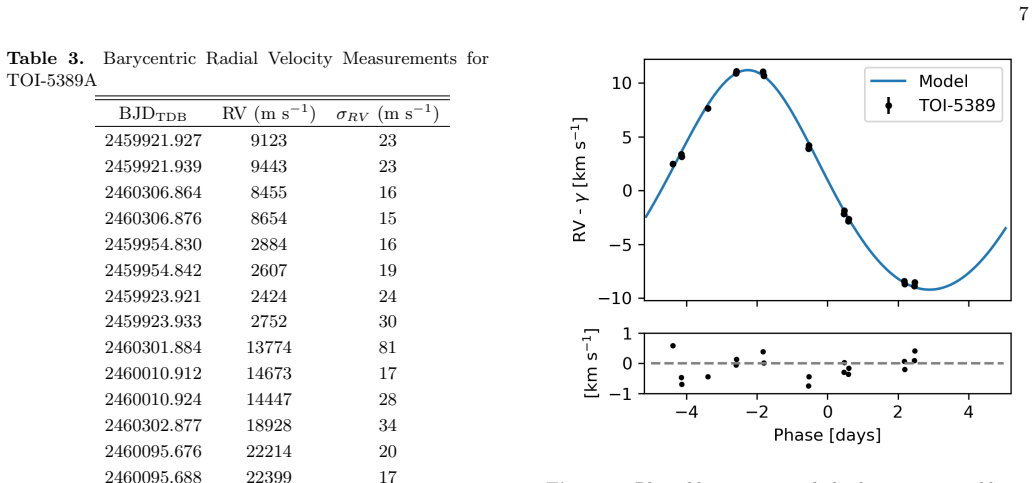
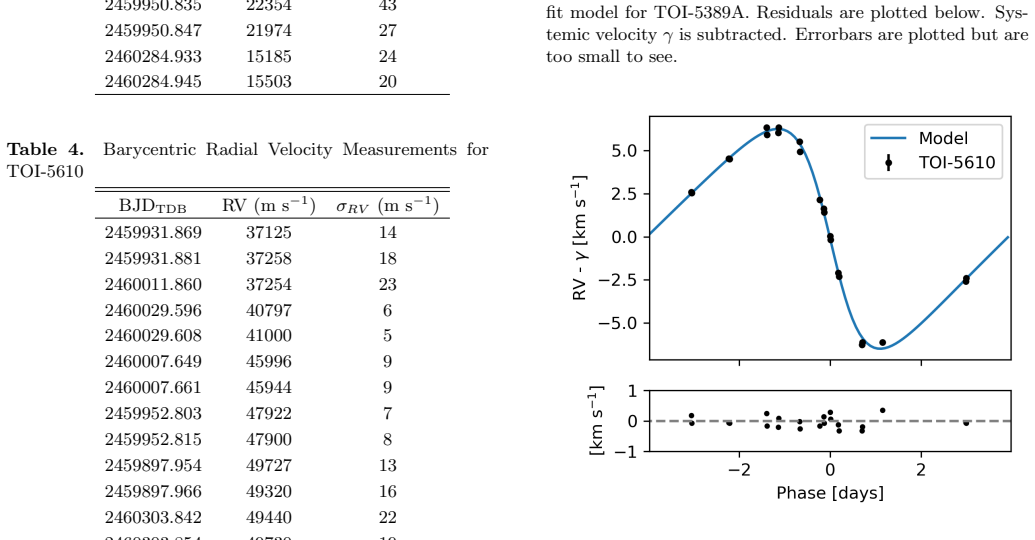
- [Table 7 vs. Tables 3 and 4] The reported systemic velocities are gamma = -11300 +/- 100 m/s for TOI-5389A and gamma = -43387 +/- 65 m/s for TOI-5610, while the measured barycentric RVs in Tables 3 and 4 are all positive (roughly +2 to +22 km/s and +37 to +50 km/s). A systemic velocity should lie near the mean of the measured RVs, so the sign appears to be reversed in the fit or in the table. Please check the sign convention in the EXOFASTv2 fit and correct Table 7 and Figures 5-6 accordingly. Even if K and the derived masses are unaffected, the quoted gamma values are physically implausible as stated.
minor comments (4)
- [Section 4.1] The word 'fragmentated' in the sentence 'Close companions originally fragmentated on large protostellar disk or molecular core scales' should be 'fragmented'.
- [Figures 5 and 6] The y-axis labels and captions do not explicitly state the units of the radial velocity (m/s or km/s); please add the units for clarity.
- [Section 3.5] The list of fitted parameters in the text omits the occultation depth in Johnson K band that appears in Table 7; consider including it for completeness.
- [Section 2.4] The abbreviation 'RV' is used without being defined at first use; please define 'radial velocity (RV)' explicitly.
Circularity Check
No circularity in the derivations: the two BD parameters come from independent joint photometry+RV fits, and the population dearth claim is a tentative literature comparison with acknowledged systematics; only minor non-load-bearing self-citations are present.
full rationale
The central characterization claims are self-contained against the data: TOI-5389Ab and TOI-5610b masses, radii, and orbital parameters are obtained by jointly modeling the TESS and RBO transit light curves and HPF radial velocities with EXOFASTv2 (Section 3.5), using stellar priors from SED fits (Section 3.1). The Sonora-Bobcat temperatures are assigned after the fit from the fitted mass and radius (Section 4.2) and are then used only to predict secondary-eclipse depths (Section 4.3), so no fitted parameter is renamed as a prediction. The claimed period-dependent dearth (Section 4.1) is a comparison of 25 literature systems, not a fit to the two new objects; the authors explicitly note that "this sample size is still small and combines different detection techniques, and so could have unknown systematics." The post-hoc P<13-day split and inclusion of the two new high-mass BDs in the short-period bin raise statistical robustness concerns, but those concerns are not circularity: the statistical conclusion is not equivalent to an input by construction. Self-citations to the GEMS survey (Kanodia et al. 2024) and to HPF analysis pipelines are contextual or software references and are not load-bearing premises used to force any result.
Assumptions & free parameters
free parameters (3)
- Period cutoff for short-period subset =
P < 13 days
- Companion mass window for dearth claim =
13-40 MJ (q < 0.1)
- Sonora model ages for secondary eclipse temperature =
8 Gyr (TOI-5389Ab), 1.5 Gyr (TOI-5610b)
assumptions (5)
- domain assumption Stellar evolutionary models (MIST/NextGen) accurately convert photometry, parallax, and spectroscopic Teff/logg/[Fe/H] into stellar mass and radius.
- domain assumption Sonora Bobcat brown dwarf models provide reliable radius-mass-age relations.
- domain assumption The literature comparison sample of M-dwarf/BD systems is sufficiently complete and unbiased for the CDF comparison.
- domain assumption Non-transiting systems with only m sin i have random orbital orientations (cos i uniform).
- domain assumption The RV variations are caused by the transiting companion in a single-Keplerian orbit.
Cite this review
Pith. "Pith review of Searching for GEMS: Discovery and Characterization of Two Brown Dwarfs Around M Dwarfs." pith.science (2026). https://pith.science/paper/O3CIT3RO
@misc{pith2026250116554,
  author       = {Pith},
  title        = {Pith review of: Searching for GEMS: Discovery and Characterization of Two Brown Dwarfs Around M Dwarfs},
  year         = {2026},
  howpublished = {\url{https://pith.science/paper/O3CIT3RO}},
  note         = {Machine review of arXiv:2501.16554}
}
abstract
Brown dwarfs bridge the gap between stars and planets, providing valuable insight into both planetary and stellar formation mechanisms. Yet the census of transiting brown dwarf companions, in particular around M dwarf stars, remains incomplete. We report the discovery of two transiting brown dwarfs around low-mass hosts using a combination of space- and ground-based photometry along with near-infrared radial velocities. We characterize TOI-5389Ab ($68.0^{+2.2}_{-2.2} \ \mj$) and TOI-5610b ($40.4^{+1.0}_{-1.0} \ \mj$), two moderately massive brown dwarfs orbiting early M dwarf hosts ($\teff = 3569 \pm 59 \ K$ and $3618 \pm 59 \ K$, respectively). For TOI-5389Ab, the best fitting parameters are period $P=10.40046 \pm 0.00002$ days, radius $R_{\rm BD}=0.824^{+0.033}_{-0.031}$~\rj, and low eccentricity $e=0.0962^{+0.0027}_{-0.0046}$. In particular, this constitutes one of the most extreme substellar-stellar companion-to-host mass ratios of $q=0.150$. For TOI-5610b, the best fitting parameters are period $P=7.95346 \pm 0.00002$ days, radius $R_{\rm BD}=0.887^{+0.031}_{-0.031}$ \rj, and moderate eccentricity $e=0.354^{+0.011}_{-0.012}$. Both targets are expected to have shallow but potentially observable secondary transits: $\lesssim 500$ ppm in Johnson K band for both. A statistical analysis of M-dwarf/BD systems reveals for the first time that those at short orbital periods ($P < 13$ days) exhibit a dearth of $13 \mj < M_{\rm BD} < 40 \mj$ companions ($q$ $<$ 0.1) compared to those at slightly wider separations.
Figures


Figures from the paper (7 more)



Reference graph
Works this paper leans on
-
[1]
Allard, F., Homeier, D., & Freytag, B. 2012, Philosophical Transactions of the Royal Society of London Series A, 370, 2765, doi: 10.1098/rsta.2011.0269
arXiv 2012
-
[2]
Andrews, S. M., Rosenfeld, K. A., Kraus, A. L., & Wilner, D. J. 2013, ApJ, 771, 129, doi: 10.1088/0004-637X/771/2/129
-
[3]
Bate, M. R. 2009, MNRAS, 392, 590, doi: 10.1111/j.1365-2966.2008.14106.x
arXiv 2009
-
[4]
Bate, M. R., Bonnell, I. A., & Bromm, V. 2002a, MNRAS, 332, L65, doi: 10.1046/j.1365-8711.2002.05539.x —. 2002b, MNRAS, 336, 705, doi: 10.1046/j.1365-8711.2002.05775.x B´ edard, A., Bergeron, P., Brassard, P., & Fontaine, G. 2020, ApJ, 901, 93, doi: 10.3847/1538-4357/abafbe
arXiv 2002
-
[5]
Bellm, E. C., Kulkarni, S. R., Graham, M. J., et al. 2019, PASP, 131, 018002, doi: 10.1088/1538-3873/aaecbe
-
[6]
2020, MNRAS, 496, 1922, doi: 10.1093/mnras/staa1522
Belokurov, V., Penoyre, Z., Oh, S., et al. 2020, MNRAS, 496, 1922, doi: 10.1093/mnras/staa1522
-
[7]
Benni, P., Burdanov, A. Y., Krushinsky, V. V., et al. 2021, MNRAS, 505, 4956, doi: 10.1093/mnras/stab1567
-
[8]
Blouin, S., Dufour, P., & Allard, N. F. 2018, ApJ, 863, 184, doi: 10.3847/1538-4357/aad4a9
Show all 93 references
-
[9]
2013, A&A, 549, A109, doi: 10.1051/0004-6361/201014704
Bonfils, X., Delfosse, X., Udry, S., et al. 2013, A&A, 549, A109, doi: 10.1051/0004-6361/201014704
2013 doi
-
[10]
Boss, A. P. 1997, Science, 276, 1836, doi: 10.1126/science.276.5320.1836 —. 2006, ApJ, 643, 501, doi: 10.1086/501522
1997
-
[11]
S., von Braun, K., van Belle, G., et al
Boyajian, T. S., von Braun, K., van Belle, G., et al. 2012, ApJ, 757, 112, doi: 10.1088/0004-637X/757/2/112
2012 doi
-
[12]
M., Bayliss, D., & Van Eylen, V
Bryant, E. M., Bayliss, D., & Van Eylen, V. 2023, MNRAS, 521, 3663, doi: 10.1093/mnras/stad626
2023 doi
-
[13]
B., Lunine, J
Burrows, A., Hubbard, W. B., Lunine, J. I., & Liebert, J. 2001, Reviews of Modern Physics, 73, 719, doi: 10.1103/RevModPhys.73.719 Ca˜ nas, C. I., Mahadevan, S., Bender, C. F., et al. 2022, AJ, 163, 89, doi: 10.3847/1538-3881/ac415f
2001 doi
-
[14]
2014, in Protostars and Planets VI, ed
Chabrier, G., Johansen, A., Janson, M., & Rafikov, R. 2014, in Protostars and Planets VI, ed. H. Beuther, R. S
2014
-
[15]
Klessen, C. P. Dullemond, & T. Henning, 619–642, doi: 10.2458/azu uapress 9780816531240-ch027
- [16]
-
[17]
2016, ApJ, 823, 102, doi: 10.3847/0004-637X/823/2/102
Choi, J., Dotter, A., Conroy, C., et al. 2016, ApJ, 823, 102, doi: 10.3847/0004-637X/823/2/102
2016 doi
-
[18]
A., Kielkopf, J
Collins, K. A., Kielkopf, J. F., Stassun, K. G., & Hessman, F. V. 2017, AJ, 153, 77, doi: 10.3847/1538-3881/153/2/77
2017 doi
-
[19]
2015, A&A, 584, A13, doi: 10.1051/0004-6361/201526763
Csizmadia, S., Hatzes, A., Gandolfi, D., et al. 2015, A&A, 584, A13, doi: 10.1051/0004-6361/201526763
2015 doi
-
[20]
2016, ApJS, 222, 8, doi: 10.3847/0067-0049/222/1/8
Dotter, A. 2016, ApJS, 222, 8, doi: 10.3847/0067-0049/222/1/8
2016 doi
-
[21]
D., & Charbonneau, D
Dressing, C. D., & Charbonneau, D. 2015, ApJ, 807, 45, doi: 10.1088/0004-637X/807/1/45
2015 doi
-
[22]
Eastman, J., Siverd, R., & Gaudi, B. S. 2010, PASP, 122, 935, doi: 10.1086/655938
2010 doi
- [23]
-
[24]
El-Badry, K., Rix, H.-W., & Heintz, T. M. 2021, MNRAS, 506, 2269, doi: 10.1093/mnras/stab323
2021 doi
-
[25]
G., & Guinan, E
Engle, S. G., & Guinan, E. F. 2018, Research Notes of the American Astronomical Society, 2, 34, doi: 10.3847/2515-5172/aab1f8 Fouqu´ e, P., Moutou, C., Malo, L., et al. 2018, MNRAS, 475, 1960, doi: 10.1093/mnras/stx3246 Gaia Collaboration, Prusti, T., de Bruijne, J. H. J., et ...
2018 doi
-
[26]
X., Wang, S., et al
Gan, T., Wang, S. X., Wang, S., et al. 2023, AJ, 165, 17, doi: 10.3847/1538-3881/ac9b12
2023 doi
-
[27]
2020, MNRAS, 491, 5216, doi: 10.1093/mnras/stz3364
Giacobbe, P., Benedetto, M., Damasso, M., et al. 2020, MNRAS, 491, 5216, doi: 10.1093/mnras/stz3364
2020 doi
-
[28]
Grether, D., & Lineweaver, C. H. 2006, ApJ, 640, 1051, doi: 10.1086/500161
2006 doi
-
[29]
2017, MNRAS, 467, 4264, doi: 10.1093/mnras/stx334
Grieves, N., Ge, J., Thomas, N., et al. 2017, MNRAS, 467, 4264, doi: 10.1093/mnras/stx334
2017 doi
-
[30]
2021, A&A, 652, A127, doi: 10.1051/0004-6361/202141145
Grieves, N., Bouchy, F., Lendl, M., et al. 2021, A&A, 652, A127, doi: 10.1051/0004-6361/202141145
2021 doi
-
[31]
Han, T., & Brandt, T. D. 2023, AJ, 165, 71, doi: 10.3847/1538-3881/acaaa7
2023 doi
-
[32]
K., Cushing, M
Hardegree-Ullman, K. K., Cushing, M. C., Muirhead, P. S., & Christiansen, J. L. 2019, AJ, 158, 75, doi: 10.3847/1538-3881/ab21d2
2019 doi
- [33]
-
[34]
A., Casewell, S
Henderson, B. A., Casewell, S. L., Goad, M. R., et al. 2024, NGTS-28Ab: A short period transiting brown dwarf. https://arxiv.org/abs/2402.09943
2024 arXiv
-
[35]
A., Casewell, S
Henderson, B. A., Casewell, S. L., Goad, M. R., et al. 2024, MNRAS, 530, 318, doi: 10.1093/mnras/stae508
2024 doi
-
[36]
J., Jao, W.-C., Subasavage, J
Henry, T. J., Jao, W.-C., Subasavage, J. P., et al. 2006, AJ, 132, 2360, doi: 10.1086/508233
2006 doi
-
[37]
J., Lee, H., MacQueen, P
Hill, G. J., Lee, H., MacQueen, P. J., et al. 2021, AJ, 162, 298, doi: 10.3847/1538-3881/ac2c02
2021 doi
-
[38]
B., & Bergeron, P
Holberg, J. B., & Bergeron, P. 2006, AJ, 132, 1221, doi: 10.1086/505938 16
2006 doi
-
[39]
2009, A&A, 501, 941, doi: 10.1051/0004-6361/200811191
Holmberg, J., Nordstr¨ om, B., & Andersen, J. 2009, A&A, 501, 941, doi: 10.1051/0004-6361/200811191
2009 doi
-
[40]
Ciardi, D. R. 2011, AJ, 142, 19, doi: 10.1088/0004-6256/142/1/19
2011 doi
-
[41]
C., Ford, E
Hsu, D. C., Ford, E. B., & Terrien, R. 2020, MNRAS, 498, 2249, doi: 10.1093/mnras/staa2391
2020 doi
-
[42]
O., Wende-von Berg, S., Dreizler, S., et al
Husser, T. O., Wende-von Berg, S., Dreizler, S., et al. 2013, A&A, 553, A6, doi: 10.1051/0004-6361/201219058
2013 doi
-
[43]
Hwang, H.-C., & Zakamska, N. L. 2020, MNRAS, 493, 2271, doi: 10.1093/mnras/staa400
2020 doi
-
[44]
M., Twicken, J
Jenkins, J. M., Twicken, J. D., McCauliff, S., et al. 2016, in Society of Photo-Optical Instrumentation Engineers (SPIE) Conference Series, Vol. 9913, Software and Cyberinfrastructure for Astronomy IV, ed. G. Chiozzi & J. C. Guzman, 99133E, doi: 10.1117/12.2233418
2016 doi
-
[45]
A., Aller, K
Johnson, J. A., Aller, K. M., Howard, A. W., & Crepp, J. R. 2010, PASP, 122, 905, doi: 10.1086/655775
2010 doi
-
[46]
2018, Research Notes of the American Astronomical Society, 2, 4, doi: 10.3847/2515-5172/aaa4b7
Kanodia, S., & Wright, J. 2018, Research Notes of the American Astronomical Society, 2, 4, doi: 10.3847/2515-5172/aaa4b7
2018 doi
-
[47]
W., et al
Kanodia, S., Mahadevan, S., Ramsey, L. W., et al. 2018, in Society of Photo-Optical Instrumentation Engineers (SPIE) Conference Series, Vol. 10702, Ground-based and Airborne Instrumentation for Astronomy VII, ed. C. J
2018
- [48]
-
[49]
I., Mahadevan, S., et al
Kanodia, S., Ca˜ nas, C. I., Mahadevan, S., et al. 2024, AJ, 167, 161, doi: 10.3847/1538-3881/ad27cb
2024 doi
-
[50]
H., Ellis, T
Kasper, D. H., Ellis, T. G., Yeigh, R. R., et al. 2016, PASP, 128, 105005, doi: 10.1088/1538-3873/128/968/105005
2016 doi
-
[51]
2021, A&A, 645, A7, doi: 10.1051/0004-6361/202039168
Kiefer, F., H´ ebrard, G., Lecavelier des Etangs, A., et al. 2021, A&A, 645, A7, doi: 10.1051/0004-6361/202039168
2021 doi
-
[52]
D., Faherty, J
Kiman, R., Brandt, T. D., Faherty, J. K., & Popinchalk, M. 2024, arXiv e-prints, arXiv:2406.00229, doi: 10.48550/arXiv.2406.00229
2024 doi
-
[53]
F., Blanc, G
Kollmeier, J., Anderson, S. F., Blanc, G. A., et al. 2019, in Bulletin of the American Astronomical Society, Vol. 51, 274
2019
- [54]
-
[55]
2022, ApJS, 259, 33, doi: 10.3847/1538-4365/ac5688 Lecavelier des Etangs, A., & Lissauer, J
Kunimoto, M., Daylan, T., Guerrero, N., et al. 2022, ApJS, 259, 33, doi: 10.3847/1538-4365/ac5688 Lecavelier des Etangs, A., & Lissauer, J. J. 2022, NewAR, 94, 101641, doi: 10.1016/j.newar.2022.101641
2022
-
[56]
2012, in Society of Photo-Optical Instrumentation Engineers (SPIE) Conference Series, Vol
Mahadevan, S., Ramsey, L., Bender, C., et al. 2012, in Society of Photo-Optical Instrumentation Engineers (SPIE) Conference Series, Vol. 8446, Ground-based and Airborne Instrumentation for Astronomy IV, ed. I. S
2012
-
[57]
McLean, S. K. Ramsay, & H. Takami, 84461S, doi: 10.1117/12.926102
-
[58]
W., Terrien, R., et al
Mahadevan, S., Ramsey, L. W., Terrien, R., et al. 2014, in Society of Photo-Optical Instrumentation Engineers (SPIE) Conference Series, Vol. 9147, Ground-based and Airborne Instrumentation for Astronomy V, ed. S. K
2014
-
[59]
Ramsay, I. S. McLean, & H. Takami, 91471G, doi: 10.1117/12.2056417
-
[60]
2017, A&A, 602, A38, doi: 10.1051/0004-6361/201630120
Maldonado, J., & Villaver, E. 2017, A&A, 602, A38, doi: 10.1051/0004-6361/201630120
2017 doi
-
[61]
S., Saumon, D., Visscher, C., et al
Marley, M. S., Saumon, D., Visscher, C., et al. 2021, ApJ, 920, 85, doi: 10.3847/1538-4357/ac141d
2021 doi
-
[62]
J., Laher, R
Masci, F. J., Laher, R. R., Rusholme, B., et al. 2019, PASP, 131, 018003, doi: 10.1088/1538-3873/aae8ac
2019 doi
-
[63]
1980, Progress of Theoretical Physics, 64, 544, doi: 10.1143/PTP.64.544
Mizuno, H. 1980, Progress of Theoretical Physics, 64, 544, doi: 10.1143/PTP.64.544
1980 doi
-
[64]
Moe, M., & Kratter, K. M. 2018, ApJ, 854, 44, doi: 10.3847/1538-4357/aaa6d2
2018 doi
-
[65]
D., Pascucci, I., & Apai, D
Mulders, G. D., Pascucci, I., & Apai, D. 2015, ApJ, 814, 130, doi: 10.1088/0004-637X/814/2/130
2015 doi
-
[66]
J., Moe, M., Kurtz, D
Murphy, S. J., Moe, M., Kurtz, D. W., et al. 2018, MNRAS, 474, 4322, doi: 10.1093/mnras/stx3049
2018 doi
-
[67]
L., De Rosa, R
Nielsen, E. L., De Rosa, R. J., Macintosh, B., et al. 2019, AJ, 158, 13, doi: 10.3847/1538-3881/ab16e9
2019 doi
-
[68]
P., Bender, C
Ninan, J. P., Bender, C. F., Mahadevan, S., et al. 2018, in Society of Photo-Optical Instrumentation Engineers (SPIE) Conference Series, Vol. 10709, High Energy, Optical, and Infrared Detectors for Astronomy VIII, ed. A. D. Holland & J. Beletic, 107092U, doi: 10.1117/12.2312787
2018 doi
-
[69]
2024, AJ, 167, 109, doi: 10.3847/1538-3881/ad1a18
Page, E., Pepper, J., Wright, D., et al. 2024, AJ, 167, 109, doi: 10.3847/1538-3881/ad1a18
2024 doi
-
[70]
J., et al
Pascucci, I., Testi, L., Herczeg, G. J., et al. 2016, ApJ, 831, 125, doi: 10.3847/0004-637X/831/2/125
2016 doi
-
[71]
M., Bello-Garc ´ ıa, A., Ordieres-Mer´ e, J., et al
Passegger, V. M., Bello-Garc ´ ıa, A., Ordieres-Mer´ e, J., et al. 2022, A&A, 658, A194, doi: 10.1051/0004-6361/202141920
2022 doi
-
[72]
Koposov, S. E. 2020, MNRAS, 495, 321, doi: 10.1093/mnras/staa1148
2020 doi
-
[73]
B., Hubickyj, O., Bodenheimer, P., et al
Pollack, J. B., Hubickyj, O., Bodenheimer, P., et al. 1996, Icarus, 124, 62, doi: 10.1006/icar.1996.0190 Prˇ sa, A., Conroy, K. E., Horvat, M., et al. 2016, ApJS, 227, 29, doi: 10.3847/1538-4365/227/2/29 17
1996
-
[74]
W., Adams, M
Ramsey, L. W., Adams, M. T., Barnes, T. G., et al. 1998, in Society of Photo-Optical Instrumentation Engineers (SPIE) Conference Series, Vol. 3352, Advanced Technology Optical/IR Telescopes VI, ed. L. M. Stepp, 34–42, doi: 10.1117/12.319287 Reyl´ e, C., Jardine, K., Fouqu´ e, ...
1998 doi
-
[75]
Ricker, G. R. 2015, in AAS/Division for Extreme Solar Systems Abstracts, Vol. 47, AAS/Division for Extreme Solar Systems Abstracts, 503.01
2015
- [76]
-
[77]
2011, A&A, 525, A95, doi: 10.1051/0004-6361/201015427
Sahlmann, J., S´ egransan, D., Queloz, D., et al. 2011, A&A, 525, A95, doi: 10.1051/0004-6361/201015427
2011 doi
-
[78]
2016, A&A, 587, A64, doi: 10.1051/0004-6361/201527329
Santerne, A., Moutou, C., Tsantaki, M., et al. 2016, A&A, 587, A64, doi: 10.1051/0004-6361/201527329
2016 doi
-
[79]
C., Adibekyan, V., Figueira, P., et al
Santos, N. C., Adibekyan, V., Figueira, P., et al. 2017, A&A, 603, A30, doi: 10.1051/0004-6361/201730761
2017 doi
-
[80]
Schlaufman, K. C. 2018, ApJ, 853, 37, doi: 10.3847/1538-4357/aa961c
2018 doi
-
[81]
P., Schlaufman, K
Schmidt, S. P., Schlaufman, K. C., Ding, K., et al. 2023, AJ, 166, 225, doi: 10.3847/1538-3881/ad0135 Sch¨ onrich, R., Binney, J., & Dehnen, W. 2010, MNRAS, 403, 1829, doi: 10.1111/j.1365-2966.2010.16253.x
2023
-
[82]
J., Howell, S
Scott, N. J., Howell, S. B., Horch, E. P., & Everett, M. E. 2018, PASP, 130, 054502, doi: 10.1088/1538-3873/aab484
2018 doi
-
[83]
J., Prieto, J
Shappee, B. J., Prieto, J. L., Grupe, D., et al. 2014, ApJ, 788, 48, doi: 10.1088/0004-637X/788/1/48
2014 doi
-
[84]
2014, ApJ, 793, 51, doi: 10.1088/0004-637X/793/1/51
Sharma, S., Bland-Hawthorn, J., Binney, J., et al. 2014, ApJ, 793, 51, doi: 10.1088/0004-637X/793/1/51
2014 doi
-
[85]
F., Cutri, R
Skrutskie, M. F., Cutri, R. M., Stiening, R., et al. 2006, AJ, 131, 1163, doi: 10.1086/498708
2006 doi
-
[86]
2016, ApJ, 833, 175, doi: 10.3847/1538-4357/833/2/175
Stefansson, G., Hearty, F., Robertson, P., et al. 2016, ApJ, 833, 175, doi: 10.3847/1538-4357/833/2/175
2016 doi
-
[87]
2020, The Astronomical Journal, 159, 100, doi: 10.3847/1538-3881/ab5f15
Stefansson, G., Ca˜ n as, C., Wisniewski, J., et al. 2020, The Astronomical Journal, 159, 100, doi: 10.3847/1538-3881/ab5f15
2020 doi
-
[88]
T., Haswell, C
Stevenson, A. T., Haswell, C. A., Barnes, J. R., & Barstow, J. K. 2023, MNRAS, 526, 5155, doi: 10.1093/mnras/stad3041
2023 doi
-
[89]
2020, MNRAS, 491, 5158, doi: 10.1093/mnras/stz3299
Tokovinin, A., & Moe, M. 2020, MNRAS, 491, 5158, doi: 10.1093/mnras/stz3299
2020 doi
-
[90]
E., Bergeron, P., & Gianninas, A
Tremblay, P. E., Bergeron, P., & Gianninas, A. 2011, ApJ, 730, 128, doi: 10.1088/0004-637X/730/2/128
2011 doi
-
[91]
Wagner, K., Apai, D., & Kratter, K. M. 2019, ApJ, 877, 46, doi: 10.3847/1538-4357/ab1904
2019 doi
-
[92]
L., Eisenhardt, P
Wright, E. L., Eisenhardt, P. R. M., Mainzer, A. K., et al. 2010, AJ, 140, 1868, doi: 10.1088/0004-6256/140/6/1868
2010 doi
- [93]
Reviewed August 10, 2026 · model on record in the stance chip above.
Discussion (0). Continue with ORCID to comment.