REVIEW 3 major objections 4 minor 38 references
SliceOcc: Indoor 3D Semantic Occupancy Prediction with Vertical Slice Representation
T0 review · 3 major / 4 minor · reviewed 2026-08-10 · deepseek-v4-flash
Pith's one-line read Vertical slice representation enables RGB-based indoor 3D occupancy prediction at 15.45% mIoU.
desk verdict A useful incremental representation with a SOTA claim undercut by unmatched input views; deserves review with view-matched baselines. read the letter →
The pith
A machine-rendered reading of the paper's core claim, the machinery that carries it, and where it could break.
The reading
What carries the argument
The vertical slice representation is the central object: the scene is divided uniformly along the vertical axis into $S$ parts, and each part is represented by a floor-plane query and a ceiling-plane query. Any spatial point is reconstructed by projecting its feature onto the nearest plane pair and interpolating. Two deformable-attention blocks carry the method: SSCA samples pillar-shaped 3D reference points around each plane, projects them into the input images, and applies multi-scale deformable attention to pull image features onto the slice; PCA applies deformable attention between the floor and ceiling queries of the same slice to enforce vertical consistency. Slice queries are initialized by grid-sampling image features at 3D anchor positions and adding learnable height embeddings for each slice level.
What would settle it
Evaluate SliceOcc on an indoor subset containing many staircases, ramps, sloped ceilings, or leaning objects and compare its per-class mIoU against a full-voxel or tri-perspective baseline; if the slice-based model degrades disproportionately on those classes while the baseline does not, the slice representation is the limiting factor.
Extended reading notes
Core claim
SliceOcc's central claim is that full 3D semantic occupancy of an indoor scene can be recovered from multi-view RGB images by representing the scene as $S$ stacked horizontal slices, each captured by a pair of parallel plane feature maps (floor and ceiling), and by trilinearly interpolating between adjacent planes to form voxel features. With 16 slices at $40\times40$ resolution and 20 input views, the model attains 15.45% mIoU across 81 classes on EmbodiedScan, beating the RGB baselines OccNet, SurroundOcc, and EmbodiedScan (including a re-implemented 20-view EmbodiedScan at 14.52%) and matching the depth-input Mink-ResNet34. The authors attribute the gain to the slice representation itself and to the two attention blocks, sliced spatial cross-attention (SSCA) and planar cross-attention (PCA), which let each plane query exchange information with image features and with its paired plane.
Load-bearing premise
The load-bearing premise is that indoor objects mostly have horizontal surfaces and consistent vertical orientation, so a fixed set of horizontal slices with interpolation between plane features can faithfully reconstruct the full 3D occupancy.
Editorial extensions
If this is right
- Camera-only indoor occupancy prediction reaches accuracy comparable to depth-based models, so depth sensors may not be necessary for dense indoor scene understanding.
- Performance improves monotonically with the number of slices in the tested range (12.13% at $S=2$, 14.57% at $S=8$, 15.45% at $S=16$), showing that vertical resolution is a key capacity lever.
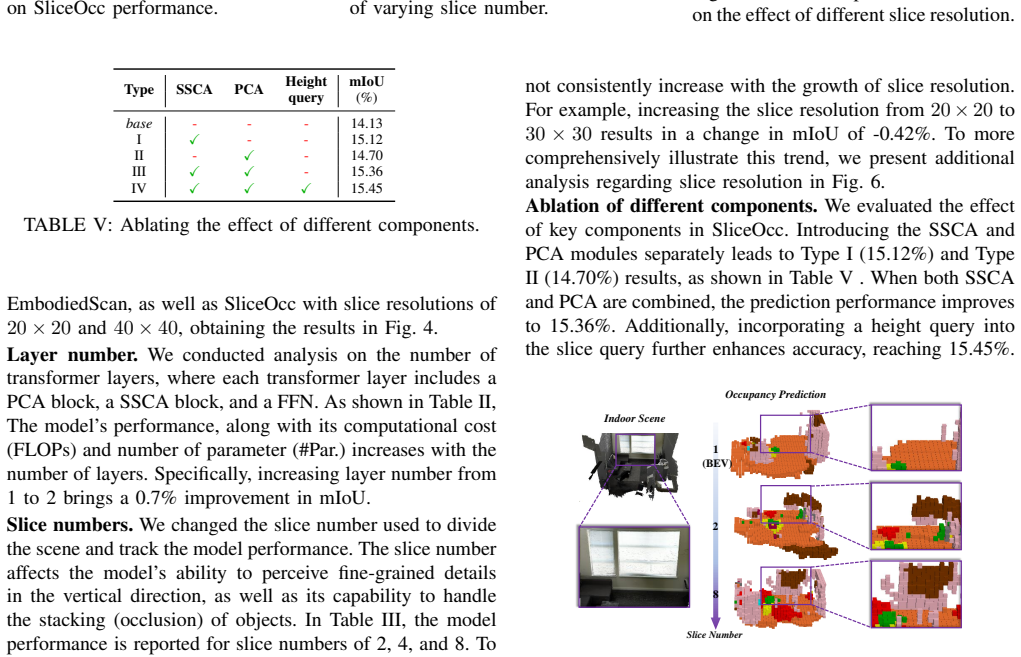
- Ablations show SSCA and PCA are complementary: 15.12% with SSCA alone, 14.70% with PCA alone, 15.36% combined, and 15.45% with the height query added.
- The method generalizes across the three indoor datasets in the EmbodiedScan benchmark (ScanNet, Matterport3D, 3RScan), since training and testing draw on all of them.
Reading between the lines
- The paper does not test this, but if the vertical slice representation is responsible for the gain, its performance should drop on scenes dominated by slanted surfaces such as staircases and ramps; an evaluation on such a subset would isolate the representation's contribution from the attention modules' contribution.
- A natural extension the paper leaves implicit is adaptive slice placement: concentrating more slices near the floor, where most indoor objects sit, could improve mIoU at the same computational budget.
- Beyond the paper, the slicing argument is tied to indoor geometry; applying the same method outdoors along the gravity axis would likely yield smaller gains because outdoor scenes have fewer consistent horizontal surfaces.
- The paper's comparison to depth-based models is single-benchmark; whether the gap stays closed on unseen scenes or irregular object shapes is an open question the paper does not address.
Signed reviews
Editorial analysis
A structured set of objections, weighed in public.
Referee Report
Summary. SliceOcc proposes a camera-only indoor 3D semantic occupancy prediction method based on a vertical slice representation. The scene is divided along the vertical axis into S slices, each represented by floor and ceiling plane queries; sliced spatial cross-attention and planar cross-attention update these queries from multi-view images, and voxel features are reconstructed by interpolating between neighboring slice planes. On the EmbodiedScan benchmark, SliceOcc reports 15.45% mIoU across 81 categories, outperforming reported RGB baselines and approaching the depth-based Mink-ResNet34. The paper includes ablations of slice number, slice resolution, layer number, input view count, and the main attention components.
Significance. If the empirical results hold under a properly controlled comparison, the vertical slice representation is a plausible and effective inductive bias for indoor occupancy prediction, where horizontal surfaces and vertical consistency are common. The paper has several strengths: it releases code, re-implements a baseline (EmbodiedScan†) with the same input view count, explicitly studies the effect of input views, and provides component-wise ablations. The central assumption about indoor geometry is stated transparently in the introduction. However, the headline state-of-the-art claim currently rests on a comparison in which only one RGB baseline is view-matched, and no variance estimates are reported; these issues must be addressed before the main claim is convincing.
major comments (3)
- [Table I; Fig. 4] The state-of-the-art claim is undercut by an input-view mismatch. SliceOcc uses N=20 input views (Section IV-B), and Table I reports OccNet (8.07) and SurroundOcc (9.10) without stating that they were re-run with 20 views; the only baseline described as view-matched is EmbodiedScan† (14.52). Because Fig. 4 shows that increasing the input views from 10 to 20 improves SliceOcc's mIoU, the reported gap over OccNet and SurroundOcc may be partly explained by the richer input rather than by the vertical slice representation. Please re-run OccNet and SurroundOcc under the same 20-view protocol (and ideally the same training schedule and image resolution), or clearly qualify the claim as based on a protocol-inconsistent comparison.
- [Tables I–V] All quantitative results are single-run numbers without error bars or multiple seeds. The main improvement over the view-matched baseline is 0.93 mIoU (15.45 vs 14.52), and many category-level differences are within a few points; without variance estimates these differences cannot be distinguished from training noise. Please report the mean and standard deviation over at least three independent runs for the main comparison and for the core ablations (slice number, slice resolution, and component ablations).
- [Section IV-E; Table V] The paper motivates the vertical slice representation by contrasting it with planar representations (BEV and TPV), but it never evaluates a TPV-based method under the same experimental protocol. The slice-number-1 single-plane variant is not a full BEV model, and the baselines OccNet and SurroundOcc are not TPV methods. Thus the contribution claim that vertical slices are superior to prior planar representations is not directly supported. Adding a view-matched TPV-style baseline (e.g., a TPVFormer variant on EmbodiedScan) or explicitly limiting the claim to the evaluated baselines would strengthen the paper.
minor comments (4)
- [Section III-C] The voxel-feature reconstruction step is described only as "interpolating its neighboring ceiling slice feature Qc_s and floor slice feature Qf_s using tri-linear methods." Since each slice feature is a W×L planar map, the operation is bilinear interpolation within each plane followed by linear interpolation along height; the term "tri-linear" is imprecise. The text should also specify how points near the bottom and top scene boundaries are handled and how the interpolation weight is normalized by slice height.
- [Section IV-C] The re-implementation of EmbodiedScan† is described only as "optimized with the same input view number as ours." To make the view-matched baseline reproducible and trustworthy, please report the other training settings used for this re-implementation (e.g., backbone, image resolution, training epochs, data augmentation, and loss function).
- [Section I] The motivating assumption that indoor objects "mostly have horizontal surfaces and consistent vertical orientation" is stated clearly, but the paper does not discuss or analyze failure cases such as slanted walls, stairs, ramps, or overhanging objects. A brief limitation discussion or a small qualitative analysis of such scenes would make the scope of the representation claim more precise.
- [Section IV-D] There is an inconsistency in naming: the text refers to "OCCNet" while Table I uses "OccNet"; please unify the terminology. In addition, Eq. (8) uses β ∈ {0, 1/2} without stating which value corresponds to the floor query and which to the ceiling query.
Circularity Check
No circular derivation: SliceOcc is an empirical architecture paper; the vertical-slice representation is an inductive design choice, not a result forced by its own definitions or self-citations.
full rationale
The paper's central claim is empirical: SliceOcc reaches 15.45% mIoU on the EmbodiedScan benchmark. The vertical-slice representation is introduced as an inductive bias motivated by the observation that indoor objects 'mostly have horizontal surfaces and consistent vertical orientation,' and the slice-to-voxel interpolation is an architectural mechanism. There is no equation in which a predicted quantity is identical by construction to an input or fitted parameter: the occupancy head is trained against ground-truth semantic occupancy labels, and the reported test mIoU is a genuine evaluation. Self-citations (e.g., TPVFormer, SurroundOcc, EmbodiedOcc) appear only as related work and baselines, and none of them supplies a load-bearing premise such as a uniqueness theorem for the slice representation. Hyperparameters such as slice number, slice resolution, and layer count are tuned through ablations, which is standard practice rather than a renamed prediction. The only notable concern, that the SOTA comparison in Table I mixes input-view counts (OccNet and SurroundOcc are not re-run at SliceOcc's 20-view setting), is an experimental-control or fairness issue, not circularity. The derivation chain is therefore self-contained, and no circular step is exhibited.
Assumptions & free parameters
free parameters (5)
- slice_number (S) =
16
- slice_resolution (W x L) =
40 x 40
- transformer_layer_number =
3
- input_view_number (N) =
20
- number_of_3d_reference_points (Nr3d) =
4
assumptions (4)
- domain assumption Indoor objects tend to have horizontal surfaces and consistent vertical orientation, so slicing along the vertical axis is an appropriate representation.
- domain assumption Voxel features can be reconstructed by interpolating between adjacent slice-plane features (trilinear interpolation).
- standard math Deformable attention as defined in Deformable DETR supports the projection and interaction operations used in SSCA and PCA.
- domain assumption The EmbodiedScan dataset labels are accurate and consistent across the three source datasets (ScanNet, Matterport3D, 3RScan).
Cite this review
Pith. "Pith review of SliceOcc: Indoor 3D Semantic Occupancy Prediction with Vertical Slice Representation." pith.science (2026). https://pith.science/paper/7CF7RE3L
@misc{pith2026250116684,
  author       = {Pith},
  title        = {Pith review of: SliceOcc: Indoor 3D Semantic Occupancy Prediction with Vertical Slice Representation},
  year         = {2026},
  howpublished = {\url{https://pith.science/paper/7CF7RE3L}},
  note         = {Machine review of arXiv:2501.16684}
}
read the original abstract
3D semantic occupancy prediction is a crucial task in visual perception, as it requires the simultaneous comprehension of both scene geometry and semantics. It plays a crucial role in understanding 3D scenes and has great potential for various applications, such as robotic vision perception and autonomous driving. Many existing works utilize planar-based representations such as Bird's Eye View (BEV) and Tri-Perspective View (TPV). These representations aim to simplify the complexity of 3D scenes while preserving essential object information, thereby facilitating efficient scene representation. However, in dense indoor environments with prevalent occlusions, directly applying these planar-based methods often leads to difficulties in capturing global semantic occupancy, ultimately degrading model performance. In this paper, we present a new vertical slice representation that divides the scene along the vertical axis and projects spatial point features onto the nearest pair of parallel planes. To utilize these slice features, we propose SliceOcc, an RGB camera-based model specifically tailored for indoor 3D semantic occupancy prediction. SliceOcc utilizes pairs of slice queries and cross-attention mechanisms to extract planar features from input images. These local planar features are then fused to form a global scene representation, which is employed for indoor occupancy prediction. Experimental results on the EmbodiedScan dataset demonstrate that SliceOcc achieves a mIoU of 15.45% across 81 indoor categories, setting a new state-of-the-art performance among RGB camera-based models for indoor 3D semantic occupancy prediction. Code is available at https://github.com/NorthSummer/SliceOcc.
Figures


Figures from the paper (2 more)

Reference graph
Works this paper leans on
-
[1]
Tri-perspective view for vision-based 3d semantic occupancy prediction,
Y . Huang, W. Zheng, Y . Zhang, J. Zhou, and J. Lu, “Tri-perspective view for vision-based 3d semantic occupancy prediction,” in CVPR, 2023, pp. 9223–9232
work page 2023
-
[2]
Openoccupancy: A large scale benchmark for surrounding semantic occupancy perception,
X. Wang, Z. Zhu, W. Xu, Y . Zhang, Y . Wei, X. Chi, Y . Ye, D. Du, J. Lu, and X. Wang, “Openoccupancy: A large scale benchmark for surrounding semantic occupancy perception,” in ICCV, 2023, pp. 17 850–17 859
work page 2023
-
[3]
Surroundocc: Multi-camera 3d occupancy prediction for autonomous driving,
Y . Wei, L. Zhao, W. Zheng, Z. Zhu, J. Zhou, and J. Lu, “Surroundocc: Multi-camera 3d occupancy prediction for autonomous driving,” in ICCV, 2023, pp. 21 729–21 740
2023
-
[4]
Occformer: Dual-path transformer for vision-based 3d semantic occupancy prediction,
Y . Zhang, Z. Zhu, and D. Du, “Occformer: Dual-path transformer for vision-based 3d semantic occupancy prediction,” in ICCV, 2023, pp. 9433–9443
work page 2023
-
[5]
Pointocc: Cylindrical tri-perspective view for point-based 3d semantic occupancy predic- tion,
S. Zuo, W. Zheng, Y . Huang, J. Zhou, and J. Lu, “Pointocc: Cylindrical tri-perspective view for point-based 3d semantic occupancy predic- tion,” arXiv preprint arXiv:2308.16896 , 2023
arXiv 2023
-
[6]
Sparseocc: Rethinking sparse latent representation for vision-based semantic occupancy prediction,
P. Tang, Z. Wang, G. Wang, J. Zheng, X. Ren, B. Feng, and C. Ma, “Sparseocc: Rethinking sparse latent representation for vision-based semantic occupancy prediction,” in CVPR, 2024, pp. 15 035–15 044
work page 2024
-
[7]
Fastocc: Accelerating 3d occupancy prediction by fusing the 2d bird’s-eye view and perspective view,
J. Hou, X. Li, W. Guan, G. Zhang, D. Feng, Y . Du, X. Xue, and J. Pu, “Fastocc: Accelerating 3d occupancy prediction by fusing the 2d bird’s-eye view and perspective view,” in ICRA, 2024, pp. 16 425– 16 431
work page 2024
-
[8]
Occworld: Learning a 3d occupancy world model for autonomous driving,
W. Zheng, W. Chen, Y . Huang, B. Zhang, Y . Duan, and J. Lu, “Occworld: Learning a 3d occupancy world model for autonomous driving,” in ECCV. Springer, 2025, pp. 55–72
work page 2025
Show all 38 references
-
[9]
Gaussianformer: Scene as gaussians for vision-based 3d semantic occupancy predic- tion,
Y . Huang, W. Zheng, Y . Zhang, J. Zhou, and J. Lu, “Gaussianformer: Scene as gaussians for vision-based 3d semantic occupancy predic- tion,” in ECCV. Springer, 2025, pp. 376–393
2025
-
[10]
Lift, splat, shoot: Encoding images from arbi- trary camera rigs by implicitly unprojecting to 3d,
J. Philion and S. Fidler, “Lift, splat, shoot: Encoding images from arbi- trary camera rigs by implicitly unprojecting to 3d,” in ECCV , Glasgow, UK, August 23–28, 2020, Proceedings, Part XIV 16 . Springer, 2020, pp. 194–210
2020
-
[11]
Bevdet: High- performance multi-camera 3d object detection in bird-eye-view,
J. Huang, G. Huang, Z. Zhu, Y . Ye, and D. Du, “Bevdet: High- performance multi-camera 3d object detection in bird-eye-view,” arXiv preprint arXiv:2112.11790, 2021
2021 arXiv
-
[12]
Bevdepth: Acquisition of reliable depth for multi-view 3d object detection,
Y . Li, Z. Ge, G. Yu, J. Yang, Z. Wang, Y . Shi, J. Sun, and Z. Li, “Bevdepth: Acquisition of reliable depth for multi-view 3d object detection,” in AAAI, vol. 37, no. 2, 2023, pp. 1477–1485
2023
-
[13]
Time will tell: New outlooks and a baseline for temporal multi-view 3d object detection,
J. Park, C. Xu, S. Yang, K. Keutzer, K. M. Kitani, M. Tomizuka, and W. Zhan, “Time will tell: New outlooks and a baseline for temporal multi-view 3d object detection,” in ICLR, 2022
2022
-
[14]
Bev- san: Accurate bev 3d object detection via slice attention networks,
X. Chi, J. Liu, M. Lu, R. Zhang, Z. Wang, Y . Guo, and S. Zhang, “Bev- san: Accurate bev 3d object detection via slice attention networks,” in CVPR, 2023, pp. 17 461–17 470
2023
-
[15]
Bevformer: Learning bird’s-eye-view representation from multi-camera images via spatiotemporal transformers,
Z. Li, W. Wang, H. Li, E. Xie, C. Sima, T. Lu, Y . Qiao, and J. Dai, “Bevformer: Learning bird’s-eye-view representation from multi-camera images via spatiotemporal transformers,” in ECCV. Springer, 2022, pp. 1–18
2022
-
[16]
Petr: Position embed- ding transformation for multi-view 3d object detection,
Y . Liu, T. Wang, X. Zhang, and J. Sun, “Petr: Position embed- ding transformation for multi-view 3d object detection,” in ECCV. Springer, 2022, pp. 531–548
2022
-
[17]
Exploring object- centric temporal modeling for efficient multi-view 3d object detection,
S. Wang, Y . Liu, T. Wang, Y . Li, and X. Zhang, “Exploring object- centric temporal modeling for efficient multi-view 3d object detection,” in ICCV, 2023, pp. 3621–3631
2023
-
[18]
Pet-neus: Positional encod- ing tri-planes for neural surfaces,
Y . Wang, I. Skorokhodov, and P. Wonka, “Pet-neus: Positional encod- ing tri-planes for neural surfaces,” in CVPR, 2023, pp. 12 598–12 607
2023
-
[19]
Alto: Alternating latent topologies for implicit 3d reconstruction,
Z. Wang, S. Zhou, J. J. Park, D. Paschalidou, S. You, G. Wetzstein, L. Guibas, and A. Kadambi, “Alto: Alternating latent topologies for implicit 3d reconstruction,” in CVPR, 2023, pp. 259–270
2023
-
[20]
Otavatar: One-shot talking face avatar with controllable tri-plane rendering,
Z. Ma, X. Zhu, G.-J. Qi, Z. Lei, and L. Zhang, “Otavatar: One-shot talking face avatar with controllable tri-plane rendering,” in CVPR, 2023, pp. 16 901–16 910
2023
-
[21]
Triplane meets gaussian splatting: Fast and generalizable single-view 3d reconstruction with transformers,
Z.-X. Zou, Z. Yu, Y .-C. Guo, Y . Li, D. Liang, Y .-P. Cao, and S.- H. Zhang, “Triplane meets gaussian splatting: Fast and generalizable single-view 3d reconstruction with transformers,” in CVPR, 2024, pp. 10 324–10 335
2024
-
[22]
Occupancy networks: Learning 3d reconstruction in function space,
L. Mescheder, M. Oechsle, M. Niemeyer, S. Nowozin, and A. Geiger, “Occupancy networks: Learning 3d reconstruction in function space,” in CVPR, 2019, pp. 4460–4470
2019
-
[23]
Convolutional occupancy networks,
S. Peng, M. Niemeyer, L. Mescheder, M. Pollefeys, and A. Geiger, “Convolutional occupancy networks,” in ECCV , Glasgow, UK, August 23–28, 2020, Proceedings, Part III 16 . Springer, 2020, pp. 523–540
2020
-
[24]
Renderocc: Vision-centric 3d occupancy prediction with 2d rendering supervision,
M. Pan, J. Liu, R. Zhang, P. Huang, X. Li, H. Xie, B. Wang, L. Liu, and S. Zhang, “Renderocc: Vision-centric 3d occupancy prediction with 2d rendering supervision,” in ICRA. IEEE, 2024, pp. 12 404–12 411
2024
-
[25]
Selfocc: Self- supervised vision-based 3d occupancy prediction,
Y . Huang, W. Zheng, B. Zhang, J. Zhou, and J. Lu, “Selfocc: Self- supervised vision-based 3d occupancy prediction,” in CVPR, 2024, pp. 19 946–19 956
2024
-
[26]
Hybridocc: Nerf en- hanced transformer-based multi-camera 3d occupancy prediction,
X. Zhao, B. Chen, M. Sun, D. Yang, Y . Wang, X. Zhang, M. Li, D. Kou, X. Wei, and L. Zhang, “Hybridocc: Nerf en- hanced transformer-based multi-camera 3d occupancy prediction,” IEEE Robotics and Automation Letters , 2024
2024
-
[27]
Embodiedscan: A holistic multi-modal 3d perception suite towards embodied ai,
T. Wang, X. Mao, C. Zhu, R. Xu, R. Lyu, P. Li, X. Chen, W. Zhang, K. Chen, T. Xue et al. , “Embodiedscan: A holistic multi-modal 3d perception suite towards embodied ai,” in CVPR, 2024, pp. 19 757– 19 767
2024
-
[28]
Monocular occupancy prediction for scalable indoor scenes,
H. Yu, Y . Wang, Y . Chen, and Z. Zhang, “Monocular occupancy prediction for scalable indoor scenes,” (accepted by) ECCV , 2024
2024
-
[29]
Embod- iedocc: Embodied 3d occupancy prediction for vision-based online scene understanding,
Y . Wu, W. Zheng, S. Zuo, Y . Huang, J. Zhou, and J. Lu, “Embod- iedocc: Embodied 3d occupancy prediction for vision-based online scene understanding,” arXiv preprint arXiv:2412.04380 , 2024
2024 arXiv
-
[30]
Deformable detr: Deformable transformers for end-to-end object detection,
X. Zhu, W. Su, L. Lu, B. Li, X. Wang, and J. Dai, “Deformable detr: Deformable transformers for end-to-end object detection,” ICLR, 2021
2021
-
[31]
Monoscene: Monocular 3d semantic scene completion,
A.-Q. Cao and R. De Charette, “Monoscene: Monocular 3d semantic scene completion,” in CVPR, 2022, pp. 3991–4001
2022
-
[32]
Scannet: Richly-annotated 3d reconstructions of indoor scenes,
A. Dai, A. X. Chang, M. Savva, M. Halber, T. Funkhouser, and M. Nießner, “Scannet: Richly-annotated 3d reconstructions of indoor scenes,” in CVPR, 2017, pp. 5828–5839
2017
-
[33]
Matterport3d: Learning from rgb-d data in indoor environments,
A. Chang, A. Dai, T. Funkhouser, M. Halber, M. Niessner, M. Savva, S. Song, A. Zeng, and Y . Zhang, “Matterport3d: Learning from rgb-d data in indoor environments,” arXiv preprint arXiv:1709.06158, 2017
2017 arXiv
-
[34]
Rio: 3d object instance re-localization in changing indoor environments,
J. Wald, A. Avetisyan, N. Navab, F. Tombari, and M. Nießner, “Rio: 3d object instance re-localization in changing indoor environments,” in ICCV, 2019, pp. 7658–7667
2019
-
[35]
Scene as occupancy,
W. Tong, C. Sima, T. Wang, L. Chen, S. Wu, H. Deng, Y . Gu, L. Lu, P. Luo, D. Lin et al., “Scene as occupancy,” in ICCV, 2023, pp. 8406– 8415
2023
-
[36]
Search- ing efficient 3d architectures with sparse point-voxel convolution,
H. Tang, Z. Liu, S. Zhao, Y . Lin, J. Lin, H. Wang, and S. Han, “Search- ing efficient 3d architectures with sparse point-voxel convolution,” in ECCV. Springer, 2020, pp. 685–702
2020
-
[37]
Cylindrical and asymmetrical 3d convolution networks for lidar segmentation,
X. Zhu, H. Zhou, T. Wang, F. Hong, Y . Ma, W. Li, H. Li, and D. Lin, “Cylindrical and asymmetrical 3d convolution networks for lidar segmentation,” in CVPR, 2021, pp. 9939–9948
2021
-
[38]
4d spatio-temporal convnets: Minkowski convolutional neural networks,
C. Choy, J. Gwak, and S. Savarese, “4d spatio-temporal convnets: Minkowski convolutional neural networks,” in CVPR, 2019, pp. 3075– 3084
2019
Reviewed August 10, 2026 · model on record in the stance chip above.
Discussion (0). Continue with ORCID to comment.