REVIEW 5 major objections 5 minor 23 references
Post-Training Quantization for Vision Mamba with k-Scaled Quantization and Reparameterization
T0 review · 5 major / 5 minor · reviewed 2026-08-10 · deepseek-v4-flash
Pith's one-line read This paper claims that Vision Mamba's SSM hidden state can be smoothed by a rank-1 reparameterization so that full 8-bit post-training quantization of all linear, convolutional, and SSM layers loses at most 1.2% top-1 accuracy on…
desk verdict First PTQ for Vision Mamba that quantizes the SSM hidden state via exact reparameterization; good ImageNet numbers, but thin empirical support and an undefined factor formula for negative representatives. read the letter →
The pith
A machine-rendered reading of the paper's core claim, the machinery that carries it, and where it could break.
The reading
What carries the argument
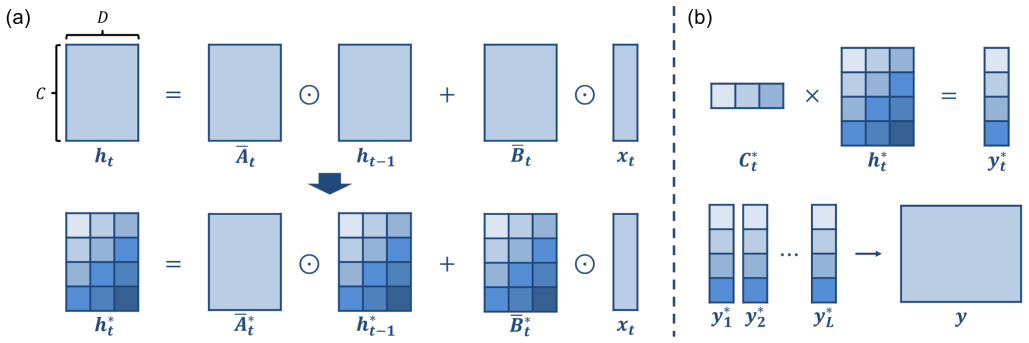
The load-bearing identity is the rank-1 factorization of the hidden state, $h \approx r_C \otimes r_L \otimes r_D$, where $r_C \in \mathbb{R}^C$, $r_L \in \mathbb{R}^L$, and $r_D \in \mathbb{R}^D$. This defines a smoothed hidden state $h^* = h/(r_C \otimes r_L \otimes r_D)$, and the paper reparameterizes $\bar{A}$, $\bar{B}$, and $C$ so that the quantized recurrence runs on $h^*$ without extra per-step multiplications; the final output is recovered by one multiplication by $r_C$ (Eqs. 18–21). The second piece is k-scaled token-wise quantization, which clusters the token dimension into $k$ groups and gives each group a power-of-two-related scale so that token outliers do not dominate the quantization range.
What would settle it
Quantize a second SSM-based vision backbone with a larger state dimension $D$ and a different scan order, and check whether the accuracy gap stays within the reported 0.8–1.2% range; if it grows, the rank-1 smoothing is the fragile piece. More directly, measure the relative reconstruction error $\|h - r_C \otimes r_L \otimes r_D\| / \|h\|$ across layers and tokens, and check whether the difference between quantized and floating-point $h^*$ stays flat over the recurrent steps — if the error grows linearly with $t$ even after reparameterization, the smoothing has failed.
Extended reading notes
Core claim
The paper's central discovery is that the error that destroys accuracy under naive 8-bit PTQ of ViM comes from two separable sources: extreme token outliers in linear projection layers, and the compounding quantization of the recurrent hidden state of the SSM. The authors show the hidden-state tensor $h \in \mathbb{R}^{C \times L \times D}$ is approximately rank-one with respect to scale variation along each dimension, $h \approx r_C \otimes r_L \otimes r_D$, which lets them divide it into a smoother version $h^*$ before quantizing. Because the smoothing factors can be absorbed into $\bar{A}$, $\bar{B}$, and $C$ and then fused into the preceding linear projections, the reparameterization adds almost no recurrent computation. They further select the factors by weighting per-dimension representatives with normalized dispersion. The result is that all linear, convolutional, and SSM layers run at 8 bits with only a 0.8–1.2% top-1 accuracy degradation on ImageNet-1k.
Load-bearing premise
The claim stands on the assumption that the SSM hidden state's value pattern is well approximated by a rank-1 outer product of three vectors, an approximation the paper itself calls "not strictly correct" — if that regularity fails, the smoothing that keeps recurrent quantization error small disappears.
Editorial extensions
If this is right
- 8-bit PTQ of all linear, convolutional, and SSM layers keeps 74.9% top-1 accuracy on ViM-T and 79.7% on ViM-S, versus 76.1% and 80.5% at full precision.
- The SSM reparameterization removes the need for extra per-step divisions and multiplications during recurrent inference, so the quantization gain does not come with a runtime penalty.
- The combination of similarity-based scale search and k-scaled token-wise scales recovers most of the accuracy lost by MinMax quantization of the conv1d and out_proj layers.
- A calibration set of 256 ImageNet training samples is enough to determine the scales and factors, preserving PTQ's low-overhead promise.
Reading between the lines
- The rank-1 regularity of $h$ is likely testable on other Mamba-based vision backbones, such as VMamba or MambaVision; if the reconstruction error stays low, this reparameterization recipe would transfer without retraining.
- The token-wise scale assignment relies on the fixed token length of image inputs, so applying the same method to variable-length inputs, such as video or high-resolution images, would require a new clustering or scale assignment.
- The factor-selection rule (a representative weighted by dispersion) is heuristic; an alternative would be to choose $r_C, r_L, r_D$ to directly minimize expected quantization error over calibration data, potentially improving results further.
- The paper only reports 8-bit results; testing 4-bit would reveal how much of the gain comes from the smoothing itself versus the relatively generous bit width.
Editorial analysis
A structured set of objections, weighed in public.
Referee Report
Summary. The paper proposes a post-training quantization (PTQ) pipeline for Vision Mamba (ViM) at 8-bit weights/activations. Three components are introduced: similarity-based scale search combined with k-scaled token-wise quantization for linear and convolutional layers, a reparameterization of the SSM hidden state that divides h by a rank-1 outer-product approximation before quantization, and a factor-determination rule based on representative and dispersion statistics. Experiments on ImageNet-1k report 74.9% for ViM-T (FP 76.1%) and 79.7% for ViM-S (FP 80.5%), against MinMax baselines of 12.2% and 51.6%, respectively. The central claim is that the proposed method limits PTQ degradation to 0.8–1.2% while quantizing all linear, convolutional, and SSM layers.
Significance. If the reported results are reproducible, the paper would be a useful first demonstration of PTQ for ViM, with a clean and exact reparameterization algebra (Eqs. 15–21), a hardware-motivated scale design, and an explicit focus on SSM hidden-state quantization that prior Mamba PTQ works did not address. The ablation in Table I for the linear/convolutional components is informative, and the paper is honest about the approximate nature of the rank-1 assumption. However, the empirical evidence is narrow: two model sizes on one dataset, no variance reporting, no code, and no comparison with existing Mamba-specific PTQ methods adapted to ViM. The load-bearing SSM smoothing assumption is not directly quantified, and two equations (Eqs. 8 and 29–31) are problematic as written. These issues prevent acceptance in the current form but are addressable within the manuscript's scope.
major comments (5)
- [Section IV-B, Eq. (10)-(12), Fig. 7] The reparameterization algebra in Eqs. (15)-(21) is exact for arbitrary nonzero factors, so the real question is whether h* is smoother and easier to quantize than h. The paper itself states that Eq. (9) is "not strictly correct," but it provides no quantitative evidence for the rank-1 approximation: no relative residual norm of h - rC⊗rL⊗rD, no comparison of the dynamic range or 8-bit quantization error of h versus h*, and no plot of h*'s distribution over recurrent steps. Table II ablates different Rep/Disp choices but does not include a no-reparameterization row with the same linear-layer methods, so Table III's improvement cannot be attributed to the SSM reparameterization alone. Please add a direct evaluation of the smoothing assumption, e.g., per-layer rank-1 residual and quantization SNR of h* versus h.
- [Section IV-C, Eqs. (29)-(31)] The factor formula rC = pow(rC0, Disp(rC0)/Dispsum) is undefined when rC0 contains negative or zero entries, because a fractional power of a negative real number is not real. Since rC0 is a mean/median of hidden-state values over dimensions, negative entries are expected in practice. As written, the method is not reproducible without a rule for handling negative or zero representatives. Please specify a sign-preserving or clamped variant and verify that the chosen rule is what produced Table III.
- [Section III-C, Eq. (8)] The hardware-friendly scale redefinition s*_i = s1 >> floor(log(s_i/s1)) uses a negative shift amount whenever s_i < s1, because log(s_i/s1) is negative. Right-shifting by a negative value is undefined in standard integer arithmetic (and the logarithm base is not specified). If the intent is to approximate smaller scales by powers of two, the formula should be s1 >> floor(log2(s1/s_i)) or an equivalent left-shift/rounding scheme. Please correct the equation and clarify the base of the logarithm.
- [Section V, Table III and Experimental Setups] The central accuracy claim rests on single runs on ImageNet-1k with no standard deviations or repeated calibration draws, and the experiments do not compare against existing Mamba-specific PTQ methods (Mamba-PTQ [13], Quamba [14]) adapted to ViM, nor against general ViT PTQ methods such as SmoothQuant or RepQ-ViT applied to the same layers. Because the reported degradation is only 0.8–1.2%, the claim of effectiveness needs at least one strong adapted baseline and some indication of run-to-run variability to be convincing.
- [Section IV-B and Section V-A] The manuscript says it quantizes "the SSM block" and reports 8/8 W/A in Table III, but the method description only specifies quantization of the hidden state h* and reparameterization of A, B, and C. It is not stated which of A*, B*, C*, x, y, and D are quantized, with which quantizers, and which values remain floating-point. Without this information, Table III is not reproducible even if the rank-1 and factor issues are resolved.
minor comments (5)
- [Section IV-C, Eq. (26)] The sentence preceding Eq. (26) contains a missing expression: "compute the representative of h along each corresponding dimension as , where Rep is..." The formula or definition is absent. Please fill in the missing text.
- [Section II-A and Section IV-B] The tensor shapes are inconsistent: Eq. (13) states h ∈ R^{C×L×D}, but the recurrence h_t = A_t h_{t-1} + B_t x_t treats h_t as a slice over one token with dimension C×D. Please define all dimensions (C, L, D) and the per-token shapes of A_t, B_t, C_t, x_t, and y_t explicitly.
- [Section III-C and Figure 3] The k-scaled token-wise method is underspecified: the k-means clustering is applied to the token dimension, but the paper does not state the number of clusters (other than the global k=4), the number of calibration iterations, or how a token is assigned to a scale during inference (fixed token-index groups or per-input clustering).
- [Section IV-B, Fig. 7] Figure 7 shows "error propagation in SSM recurrent process" but lacks labeled axes and numeric units, so the reader cannot assess the magnitude of the effect being claimed. Please add axis labels and report the quantitative difference at selected steps.
- [References] Reference [10] is listed as "Yu-Shan Tai et al." without a complete author list or venue information; please provide the full citation for MPTQ-ViT.
Circularity Check
No significant circularity; the paper's results are empirical PTQ outcomes with calibration-time fits, and the rank-1 reparameterization is an explicitly stated approximation, not a self-referential derivation.
full rationale
The paper does not claim to derive a first-principles prediction from an input; it proposes a post-training quantization recipe and reports ImageNet-1k measurements. All quantization scales and reparameterization factors are fitted to calibration data by design (Eqs. 5-8 and 26-31), which is standard PTQ practice and not a disguised prediction. The SSM reparameterization in Eqs. (15)-(21) is exact algebra for any nonzero factors; the rank-1 model h ≈ rC⊗rL⊗rD is explicitly labeled 'not strictly correct' and 'reflects the relationship identified through observation' in Section IV-B, so the paper is transparent that the smoothing benefit is an empirical assumption rather than a derived theorem. Self-citations (refs. 6 and 10, from the same group) appear only as background for k-scaled and two-scaled quantization concepts; they are not the source of the reported accuracy values, and no load-bearing argument is outsourced to them. No equation is shown to reduce to its own input by construction, and no fitted parameter is renamed as an independent prediction. The strongest caveat—whether the rank-1 approximation holds for other models, scales, or datasets—is a generalizability risk, not circularity.
Assumptions & free parameters
free parameters (4)
- k (number of k-scaled groups) =
4
- Rep/Disp choice for reparameterization factors =
mean / standard deviation
- Per-layer similarity-based quantization scales =
optimized per layer on calibration data
- SSM reparameterization factors rC, rL, rD =
computed from calibration hidden states
assumptions (3)
- domain assumption The SSM hidden state h is approximately rank-1, h ≈ rC ⊗ rL ⊗ rD.
- domain assumption Tensor outputs in ViM linear layers have outliers that consistently fall in middle tokens and are stable across images.
- domain assumption A 256-image calibration set is representative enough to set all quantization scales and reparameterization factors.
Cite this review
Pith. "Pith review of Post-Training Quantization for Vision Mamba with k-Scaled Quantization and Reparameterization." pith.science (2026). https://pith.science/paper/L6AH7I7B
@misc{pith2026250116738,
  author       = {Pith},
  title        = {Pith review of: Post-Training Quantization for Vision Mamba with k-Scaled Quantization and Reparameterization},
  year         = {2026},
  howpublished = {\url{https://pith.science/paper/L6AH7I7B}},
  note         = {Machine review of arXiv:2501.16738}
}
read the original abstract
The Mamba model, utilizing a structured state-space model (SSM), offers linear time complexity and demonstrates significant potential. Vision Mamba (ViM) extends this framework to vision tasks by incorporating a bidirectional SSM and patch embedding, surpassing Transformer-based models in performance. While model quantization is essential for efficient computing, existing works have focused solely on the original Mamba model and have not been applied to ViM. Additionally, they neglect quantizing the SSM layer, which is central to Mamba and can lead to substantial error propagation by naive quantization due to its inherent structure. In this paper, we focus on the post-training quantization (PTQ) of ViM. We address the issues with three core techniques: 1) a k-scaled token-wise quantization method for linear and convolutional layers, 2) a reparameterization technique to simplify hidden state quantization, and 3) a factor-determining method that reduces computational overhead by integrating operations. Through these methods, the error caused by PTQ can be mitigated. Experimental results on ImageNet-1k demonstrate only a 0.8-1.2\% accuracy degradation due to PTQ, highlighting the effectiveness of our approach.
Figures


Figures from the paper (4 more)



Reference graph
Works this paper leans on
-
[13]
Mamba-ptq: Outlier channels in recurrent large language models,
Alessandro Pierro and Steven Abreu, “Mamba-ptq: Outlier channels in recurrent large language models,” arXiv preprint arXiv:2407.12397 , 2024
arXiv 2024
-
[14]
Quamba: A post-training quantization recipe for selective state space models,
Hung-Yueh Chiang, Chi-Chih Chang, Natalia Frumkin, Kai-Chiang Wu, and Diana Marculescu, “Quamba: A post-training quantization recipe for selective state space models,” arXiv preprint arXiv:2410.13229 , 2024
arXiv 2024
-
[1]
Vision mamba: Efficient visual represen- tation learning with bidirectional state space model,
Lianghui Zhu, Bencheng Liao, Qian Zhang, Xinlong Wang, Wenyu Liu, and Xinggang Wang, “Vision mamba: Efficient visual represen- tation learning with bidirectional state space model,” arXiv preprint arXiv:2401.09417, 2024
arXiv 2024
-
[2]
Mamba: Linear-time sequence modeling with selective state spaces,
Albert Gu and Tri Dao, “Mamba: Linear-time sequence modeling with selective state spaces,” arXiv preprint arXiv:2312.00752 , 2023
arXiv 2023
-
[3]
Integer quantization for deep learning inference: Principles and empirical evaluation,
Hao Wu, Patrick Judd, Xiaojie Zhang, Mikhail Isaev, and Paulius Mi- cikevicius, “Integer quantization for deep learning inference: Principles and empirical evaluation,” arXiv preprint arXiv:2004.09602 , 2020
arXiv 2004
-
[4]
Ptq4vit: Post-training quantization for vision transformers with twin uniform quantization,
Zhihang Yuan, Chenhao Xue, Yiqi Chen, Qiang Wu, and Guangyu Sun, “Ptq4vit: Post-training quantization for vision transformers with twin uniform quantization,” in European conference on computer vision . Springer, 2022, pp. 191–207
work page 2022
-
[5]
Fq-vit: Post-training quantization for fully quantized vision trans- former,
Yang Lin, Tianyu Zhang, Peiqin Sun, Zheng Li, and Shuchang Zhou, “Fq-vit: Post-training quantization for fully quantized vision trans- former,” arXiv preprint arXiv:2111.13824 , 2021
arXiv 2021
-
[6]
Tsptq-vit: Two- scaled post-training quantization for vision transformer,
Yu-Shan Tai, Ming-Guang Lin, and An-Yeu Andy Wu, “Tsptq-vit: Two- scaled post-training quantization for vision transformer,” in ICASSP 2023-2023 IEEE International Conference on Acoustics, Speech and Signal Processing (ICASSP) . IEEE, 2023, pp. 1–5
work page 2023
Show all 23 references
-
[7]
Smoothquant: Accurate and efficient post-training quantization for large language models,
Guangxuan Xiao, Ji Lin, Mickael Seznec, Hao Wu, Julien Demouth, and Song Han, “Smoothquant: Accurate and efficient post-training quantization for large language models,” in International Conference on Machine Learning . PMLR, 2023, pp. 38087–38099
2023
-
[8]
Awq: Activation-aware weight quantization for on-device llm compression and acceleration,
Ji Lin, Jiaming Tang, Haotian Tang, Shang Yang, Wei-Ming Chen, Wei- Chen Wang, Guangxuan Xiao, Xingyu Dang, Chuang Gan, and Song Han, “Awq: Activation-aware weight quantization for on-device llm compression and acceleration,” Proceedings of Machine Learning and Systems, vol. 6...
2024
-
[9]
Repq-vit: Scale reparameterization for post-training quantization of vision transformers,
Zhikai Li, Junrui Xiao, Lianwei Yang, and Qingyi Gu, “Repq-vit: Scale reparameterization for post-training quantization of vision transformers,” in Proceedings of the IEEE/CVF International Conference on Computer Vision, 2023, pp. 17227–17236
2023
-
[10]
Mptq-vit: Mixed-precision post-training quantiza- tion for vision transformer,
Yu-Shan Tai et al., “Mptq-vit: Mixed-precision post-training quantiza- tion for vision transformer,” arXiv preprint arXiv:2401.14895 , 2024
2024 arXiv
-
[11]
Vmamba: Visual state space model,
Yue Liu, Yunjie Tian, Yuzhong Zhao, Hongtian Yu, Lingxi Xie, Yaowei Wang, Qixiang Ye, and Yunfan Liu, “Vmamba: Visual state space model,” arXiv preprint arXiv:2401.10166 , 2024
2024 arXiv
-
[12]
Mambavision: A hybrid mamba- transformer vision backbone,
Ali Hatamizadeh and Jan Kautz, “Mambavision: A hybrid mamba- transformer vision backbone,” arXiv preprint arXiv:2407.08083 , 2024
2024 arXiv
-
[15]
Transformers are ssms: Generalized models and efficient algorithms through structured state space duality,
Tri Dao and Albert Gu, “Transformers are ssms: Generalized models and efficient algorithms through structured state space duality,” arXiv preprint arXiv:2405.21060, 2024
2024 arXiv
-
[16]
Imagenet: A large-scale hierarchical image database,
Jia Deng, Wei Dong, Richard Socher, Li-Jia Li, Kai Li, and Li Fei-Fei, “Imagenet: A large-scale hierarchical image database,” in 2009 IEEE conference on computer vision and pattern recognition . Ieee, 2009, pp. 248–255
2009
-
[17]
Efficiently model- ing long sequences with structured state spaces,
Albert Gu, Karan Goel, and Christopher R ´e, “Efficiently model- ing long sequences with structured state spaces,” arXiv preprint arXiv:2111.00396, 2021
2021 arXiv
-
[18]
An image is worth 16x16 words: Transformers for image recognition at scale,
Alexey Dosovitskiy, “An image is worth 16x16 words: Transformers for image recognition at scale,” arXiv preprint arXiv:2010.11929 , 2020
2010 arXiv
-
[19]
Quantization and training of neural networks for efficient integer- arithmetic-only inference,
Benoit Jacob, Skirmantas Kligys, Bo Chen, Menglong Zhu, Matthew Tang, Andrew Howard, Hartwig Adam, and Dmitry Kalenichenko, “Quantization and training of neural networks for efficient integer- arithmetic-only inference,” in Proceedings of the IEEE conference on computer vision...
2018
-
[20]
Up or down? adaptive rounding for post- training quantization,
Markus Nagel, Rana Ali Amjad, Mart Van Baalen, Christos Louizos, and Tijmen Blankevoort, “Up or down? adaptive rounding for post- training quantization,” in International Conference on Machine Learn- ing. PMLR, 2020, pp. 7197–7206
2020
-
[21]
Low- bit quantization of neural networks for efficient inference,
Yoni Choukroun, Eli Kravchik, Fan Yang, and Pavel Kisilev, “Low- bit quantization of neural networks for efficient inference,” in 2019 IEEE/CVF International Conference on Computer Vision Workshop (ICCVW). IEEE, 2019, pp. 3009–3018
2019
-
[22]
Easyquant: Post-training quantization via scale optimization,
Di Wu, Qi Tang, Yongle Zhao, Ming Zhang, Ying Fu, and Debing Zhang, “Easyquant: Post-training quantization via scale optimization,” arXiv preprint arXiv:2006.16669, 2020
2006 arXiv
-
[23]
Efficientvmamba: Atrous selective scan for light weight visual mamba,
Xiaohuan Pei, Tao Huang, and Chang Xu, “Efficientvmamba: Atrous selective scan for light weight visual mamba,” arXiv preprint arXiv:2403.09977, 2024
2024 arXiv
Reviewed August 10, 2026 · model on record in the stance chip above.
Discussion (0). Continue with ORCID to comment.