REVIEW 4 major objections 6 minor 62 references
FedEFM: Federated Endovascular Foundation Model with Unseen Data
T0 review · 4 major / 6 minor · reviewed 2026-08-10 · deepseek-v4-flash
Pith's one-line read FedEFM claims that a federated distillation algorithm using differentiable Earth Mover's Distance lets each silo learn from data types it never sees, and that the resulting weights fine-tune into top-performing endovascular models.
desk verdict FedEFM's core EMD formulation is ill-defined and the headline results are internally inconsistent, so the paper should be returned for major revision despite a real problem and a useful dataset. read the letter →
The pith
A machine-rendered reading of the paper's core claim, the machinery that carries it, and where it could break.
The reading
What carries the argument
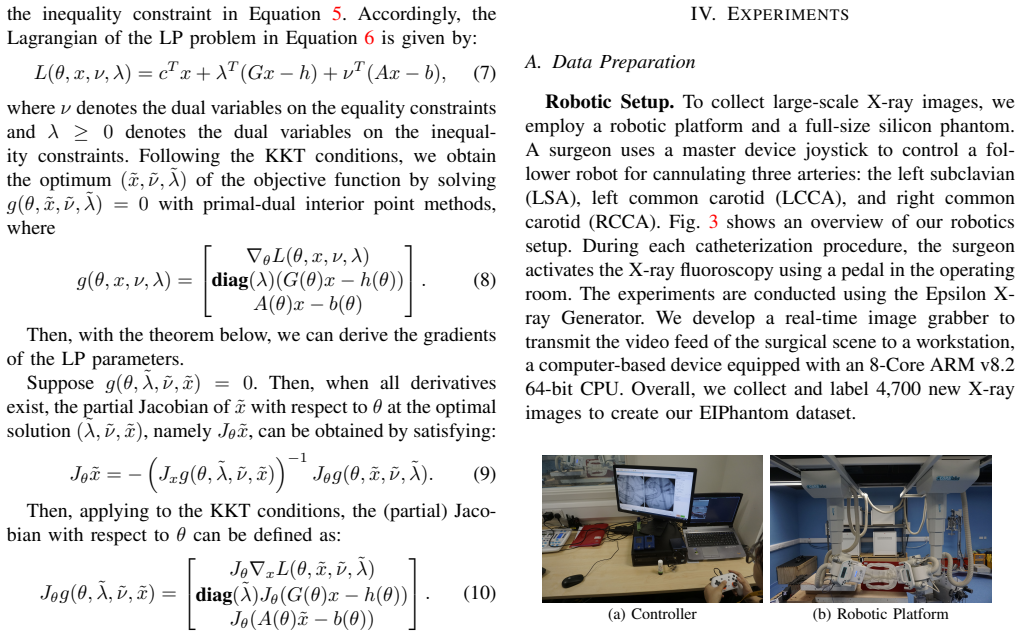
The central object is a differentiable Earth Mover's Distance computed between two dense feature maps $U$ and $V$ of the same input produced by the local student and the transferred teacher. It solves a linear program that transports mass between the feature vectors, with unit cost $c_{pq} = 1 - u_p^T v_q / (\|u_p\|\|v_q\|)$, and then uses the KKT conditions and a Jacobian argument to differentiate the optimal transport plan with respect to the model parameters. The resulting scalar $EMD(\theta_i, \hat{\theta}_{i\to j})$ scales the distillation gradient in the local update, so a silo trusts a neighbor's transferred weights more when the two feature distributions align and less when they diverge; this gating is what the paper credits for stable learning under unseen data.
What would settle it
Replace the EMD scalar in the update rule with a constant, or with a random permutation of the same scalar values, keeping all other training conditions identical; if accuracy on the 100% unseen-data setting stays near 98%, the transport-based weighting is not what carries the result.
Extended reading notes
Core claim
On the paper's own terms, the discovery is that the divergence that normally breaks federated training when silos hold disjoint data types can be tamed by weighting each distillation gradient with the Earth Mover's Distance between the local model's feature map and the feature map of the neighbor-trained 'overseas expert.' With that weighting, FedEFM maintains high accuracy even when 100% of each silo's data are unseen elsewhere, whereas the federated baselines collapse. Fine-tuning the federated weights also improves segmentation and classification over existing foundation models, which the paper takes as evidence that the federated training has produced genuinely reusable knowledge rather than a task-specific compromise.
Load-bearing premise
The whole mechanism depends on the Earth Mover's Distance between the local and transferred feature maps being a meaningful measure of task-relevant agreement; if that distance does not track what the neighbor actually knows, the gradient weighting is just an arbitrary scaling and the unseen-data robustness claim has no foundation.
Editorial extensions
If this is right
- Federated foundation-model training no longer requires silos to share a common label set, because the EMD weighting operates on feature distributions rather than on matching labels.
- Hospitals can contribute human, animal, phantom, and simulation X-ray data while sharing only weights, which directly addresses the privacy barrier that the paper identifies as blocking medical foundation models.
- The trained weights are reusable initializations: fine-tuning U-Net, TransUNet, SwinUNet, or ViT from FedEFM weights improves downstream segmentation and classification relative to training from scratch.
- The paper's ablation shows the EMD weighting matters: removing it drops accuracy from 98.2% to 84.7% in client-server and from 97.5% to 72.4% in decentralized settings.
Reading between the lines
- A testable extension the paper does not run is to replace the EMD scalar with a constant or a simpler similarity measure; if accuracy is unchanged, the specific transport geometry would not be the active ingredient, only some form of gradient scaling.
- Because the method exchanges only weights, the same EMD-gated distillation could be carried to other privacy-sensitive medical imaging domains where hospitals hold disjoint or partially overlapping label sets, such as pathology or endoscopic video.
- The reported gains are on phantom, simulation, and benchmark classification data; live clinical fluoroscopy would be the stronger test of whether the learned representations survive motion blur, low contrast, and unseen anatomy.
Signed reviews
Editorial analysis
A structured set of objections, weighed in public.
Referee Report
Summary. The paper proposes FedEFM, a federated learning scheme for training an endovascular foundation model. In each communication round, a silo's weights are transmitted to a neighbor, trained locally on the neighbor's data as an 'overseas expert,' and transferred back; the returned weights are then used as knowledge-distillation teachers at the original silo, with the distillation gradient scaled by a differentiable Earth Mover's Distance (EMD) between feature representations (Eqs. 2-11). The authors claim state-of-the-art classification accuracy (98.2% in centralized-style federated learning, 97.5% in decentralized federated learning) and improved downstream segmentation and classification over CLIP, SAM, and LVM-Med, together with robustness to unseen data.
Significance. If the proposed mechanism were well defined and the evaluations were sound, the idea of training a domain-specific foundation model across hospital silos without sharing raw data would be valuable for privacy-sensitive medical imaging. The paper also contributes a new robotic phantom dataset (EIPhantom) and labels for simulation data, which are potentially useful assets. However, the central EMD-based update is not defined by the equations as written, the headline accuracies are internally inconsistent, and the experimental corpora do not support the claimed endovascular X-ray setting. These issues prevent the result from being evaluated as stated, so the contribution cannot currently be accepted on the basis of the manuscript.
major comments (4)
- [Section III-B, Eqs. (3)-(5), (9)] The EMD coefficient that scales the distillation gradient in Eq. (2) is not a well-defined quantity as written. In Eq. (5), u_p and v_q are C-dimensional embeddings, so the constraints sum_p x_pq = v_q and sum_q x_pq = u_p equate scalar decision variables with vectors; if instead u_p and v_q are intended to be scalar masses, this is never stated and contradicts the definition U,V in R^{H x W x C}. Even in the scalar-mass reading, feasibility requires sum_p u_p = sum_q v_q, which will generically fail for representations from two independently trained networks on the same input. In addition, Eq. (3) defines the reported EMD as sum_{p,q} (1 - c_pq) x_tilde_pq, while Eq. (5) minimizes sum_{p,q} c_pq x_tilde_pq; a single optimal flow cannot simultaneously maximize one objective and minimize its complement. Finally, Eq. (9) requires invertibility of J_x g, for which no argument is given and which fails for infeasible or degenerate linear programs. Since Eq. (2) multiplies the entire distillation gradient by this scalar, the proposed learning-from-neighbors mechanism has no stated implementation.
- [Table II vs. Fig. 4] The numerical claim for the 100% unseen-data setting is internally inconsistent. Section IV-B states that the default setup is maintained at 100% unseen label corpus, and Table II reports FedEFM accuracy of 98.2% for CFL and 97.5% for DFL. Section IV-D, discussing Fig. 4, describes the same 100% unseen condition and reports an accuracy of 84.9% for 'our approach.' No explanation is offered for this large discrepancy, and no experimental details (task, dataset split, number of silos, evaluation metric) are given for Fig. 4, so the reader cannot tell which number is correct or what was actually measured.
- [Section IV-A, Table I, Table III] The training corpora do not match the paper's characterization. Table I labels all corpora as 'X-ray datasets related to endovascular intervention,' but VESSEL12 is lung CT vessel segmentation, DRIVE is retinal fundus photography, SenNet is phase-contrast tomography of human organs, and Medical Decathlon contains multiple modalities (including CT and MRI) unrelated to endovascular X-ray. More importantly, EISimulation appears both in the 'Federated Foundation Training' column of Table I and as a downstream fine-tuning benchmark in Table III and Fig. 5, directly contradicting the statement in Section IV-A that 'the datasets used to train the foundation model are not being used in downstream endovascular understanding tasks.' This makes the EISimulation downstream results circular for evaluating the foundation model.
- [Section IV-B, Table II] The experimental protocol is too underspecified to support the headline claim. The paper does not state the number of hospital silos, the dataset partition used to create the 100% unseen condition, the number of communication rounds K, the hyperparameters beta and T, or the evaluation split for the accuracy numbers. Given that the central claim is a new state-of-the-art result, these missing details are not merely presentational; they prevent the reader from checking whether the comparisons in Table II are fair or whether the reported numbers reflect the proposed method as defined.
minor comments (6)
- [Section IV-A, Table I] The entry 'Drive [49] 8.028' appears to be a typo for 8,028 frames; if not, the frame count should be clarified.
- [Author affiliation] The first affiliation contains the typo 'Deparment' instead of 'Department.'
- [Section II] The sentence about FW-Net contains a duplicated word: 'the authors in in [25] proposed...' should be 'the authors in [25] proposed...'.
- [Section III-C, Eq. (12)] The displayed softmax formula appears garbled: it should read Q^tau_k = exp(l_k/T) / sum_k exp(l_k/T), with an explicit division and summation.
- [Fig. 4] The figure caption and text do not specify which task and metric are reported, nor whether these are classification accuracies on a single split; error bars or standard deviations over multiple runs should be provided.
- [References [57] and [58]] The citation for STAR [57] points to a paper on betweenness centrality, which does not appear to correspond to the STAR federated learning method; please verify the reference.
Circularity Check
Mild evaluation circularity: EISimulation is used in both foundation training and downstream fine-tuning benchmarks, contradicting the paper's own statement; the EMD distillation derivation itself is otherwise independent.
-
fitted input called prediction
[Section IV-A (Table I) vs Section IV-C (Table III and Table IV)]
"We note that the datasets used to train the foundation model are not being used in downstream endovascular understanding tasks."
Table I lists EISimulation (ours, 1,683 frames) under 'Federated Foundation Training', while Table III and Table IV report fine-tuned segmentation results on EISimulation as a downstream benchmark. The quoted sentence says training datasets are not used downstream, which is contradicted by the paper's own tables. Therefore the EISimulation column is not an unseen-data evaluation: the foundation weights were pretrained on exactly this dataset, so the reported gains (82.9 Dice vs 70.9 for LVM-Med) partly reflect memorization of the training distribution rather than independent generalization. The other downstream benchmarks (EIPhantom, CathAnimal, RANZCR) remain unseen, so this is a mild evaluative circularity, not a collapse of the central federated claim.
full rationale
FedEFM's central mechanism is the differentiable EMD weighting in Eq. 2, computed from feature maps via Eqs. 3-5 and differentiated through the KKT system (Eq. 9). This module is imported from the cited DeepEMD framework rather than being redefined as a fitted constant, and the paper's own ablation ('FedEFM w/o EMD') provides an independent contrast that makes the central empirical claim falsifiable. The distillation loss (Eq. 11) is standard knowledge distillation and is not derived from the claim being made. The main self-citations ([45], [14], [53]) are prior datasets, baselines, or earlier methods rather than load-bearing uniqueness arguments, so no self-citation chain forces the conclusion. The only genuine circularity is evaluative: EISimulation appears in both the foundation-training set and the downstream evaluation set, directly contradicting the sentence 'We note that the datasets used to train the foundation model are not being used in downstream endovascular understanding tasks.' Because three other downstream benchmarks are unseen, the central claims retain independent content. The Eq. 5 dimensional infeasibility and Eq. 9 invertibility questions are correctness risks rather than circularity, and are not scored here.
Assumptions & free parameters
free parameters (4)
- beta (β) =
not reported
- temperature T =
not reported
- learning rate α_k =
not reported
- communication rounds K =
not reported
assumptions (4)
- standard math The LP solution for optimal matching flow in Eq 5 is differentiable and J_x g is invertible at the optimum.
- domain assumption Feature maps U and V satisfy the EMD mass constraints sum_p x_pq = v_q and sum_q x_pq = u_p.
- domain assumption Transmitting model weights to neighbor silos and training them on neighbor data preserves patient privacy.
- domain assumption All training datasets in Table I are endovascular X-ray images with labels suitable for a shared classification task.
Cite this review
Pith. "Pith review of FedEFM: Federated Endovascular Foundation Model with Unseen Data." pith.science (2026). https://pith.science/paper/2OYCPBKG
@misc{pith2026250116992,
  author       = {Pith},
  title        = {Pith review of: FedEFM: Federated Endovascular Foundation Model with Unseen Data},
  year         = {2026},
  howpublished = {\url{https://pith.science/paper/2OYCPBKG}},
  note         = {Machine review of arXiv:2501.16992}
}
read the original abstract
In endovascular surgery, the precise identification of catheters and guidewires in X-ray images is essential for reducing intervention risks. However, accurately segmenting catheter and guidewire structures is challenging due to the limited availability of labeled data. Foundation models offer a promising solution by enabling the collection of similar domain data to train models whose weights can be fine-tuned for downstream tasks. Nonetheless, large-scale data collection for training is constrained by the necessity of maintaining patient privacy. This paper proposes a new method to train a foundation model in a decentralized federated learning setting for endovascular intervention. To ensure the feasibility of the training, we tackle the unseen data issue using differentiable Earth Mover's Distance within a knowledge distillation framework. Once trained, our foundation model's weights provide valuable initialization for downstream tasks, thereby enhancing task-specific performance. Intensive experiments show that our approach achieves new state-of-the-art results, contributing to advancements in endovascular intervention and robotic-assisted endovascular surgery, while addressing the critical issue of data sharing in the medical domain.
Figures


Figures from the paper (2 more)


Reference graph
Works this paper leans on
-
[1]
A survey of catheter tracking concepts and methodologies,
A. Ramadani, M. Bui, T. Wendler, H. Schunkert, P. Ewert, and N. Navab, “A survey of catheter tracking concepts and methodologies,” Medical Image Analysis , 2022
work page 2022
-
[2]
Cathsim: an open- source simulator for endovascular intervention,
T. Jianu, B. Huang, M. N. Vu, M. E. Abdelaziz, S. Fichera, C.-Y . Lee, P. Berthet-Rayne, F. R. y Baena, and A. Nguyen, “Cathsim: an open- source simulator for endovascular intervention,” IEEE Transactions on Medical Robotics and Bionics , 2024
work page 2024
-
[3]
Use of ultrasound to confirm guidewire position in hemodialysis catheter implantation,
G. M. Pereira Junior, A. Souza Alvarenga, C. R. Almeida Fe- lipe, A. Vale Monteiro, L. R. Rezende, and M. G. Moreira Guimar˜aes Penido, “Use of ultrasound to confirm guidewire position in hemodialysis catheter implantation,” Nephrology, 2022
work page 2022
-
[4]
Detecting the sensing area of a laparoscopic probe in minimally invasive cancer surgery,
B. Huang, Y . Hu, A. Nguyen, S. Giannarou, and D. S. Elson, “Detecting the sensing area of a laparoscopic probe in minimally invasive cancer surgery,” in MICCAI, 2023
work page 2023
-
[5]
Foundation model for endoscopy video analysis via large-scale self-supervised pre-train,
Z. Wang, C. Liu, S. Zhang, and Q. Dou, “Foundation model for endoscopy video analysis via large-scale self-supervised pre-train,” in MICCAI, 2023
work page 2023
-
[6]
Text-guided foundation model adaptation for pathological image classification,
Y . Zhang, J. Gao, M. Zhou, et al. , “Text-guided foundation model adaptation for pathological image classification,” in MICCAI, 2023
work page 2023
-
[7]
Learning transferable visual models from natural language supervision,
A. Radford, J. W. Kim, C. Hallacy, et al., “Learning transferable visual models from natural language supervision,” in ICML, 2021
work page 2021
-
[8]
Scaling up visual and vision-language representation learning with noisy text supervision,
C. Jia, Y . Yang, Y . Xia, Y .-T. Chen, Z. Parekh, H. Pham, Q. Le, Y .-H. Sung, Z. Li, and T. Duerig, “Scaling up visual and vision-language representation learning with noisy text supervision,” in ICML, 2021
2021
Show all 62 references
-
[9]
Lvm-med: Learning large-scale self-supervised vision models for medical imaging via second-order graph matching,
D. M. Nguyen, H. Nguyen, N. T. Diep, et al. , “Lvm-med: Learning large-scale self-supervised vision models for medical imaging via second-order graph matching,” arXiv, 2023
2023
-
[10]
Secure, privacy-preserving and federated machine learning in medical imaging,
G. A. Kaissis, M. R. Makowski, D. R ¨uckert, and R. F. Braren, “Secure, privacy-preserving and federated machine learning in medical imaging,” Nature Machine Intelligence , 2020
2020
-
[11]
Simultaneous depth estimation and surgical tool segmentation in laparoscopic images,
B. Huang, A. Nguyen, S. Wang, Z. Wang, E. Mayer, D. Tuch, K. Vyas, S. Giannarou, and D. S. Elson, “Simultaneous depth estimation and surgical tool segmentation in laparoscopic images,” IEEE transactions on medical robotics and bionics , 2022
2022
-
[12]
Harmofl: Harmonizing local and global drifts in federated learning on heterogeneous medical images,
M. Jiang, Z. Wang, and Q. Dou, “Harmofl: Harmonizing local and global drifts in federated learning on heterogeneous medical images,” in AAAI, 2022
2022
-
[13]
Fedcontrast-gpa: Heterogeneous federated optimization via local contrastive learning and global process-aware aggregation,
Q. Zhou and G. Zheng, “Fedcontrast-gpa: Heterogeneous federated optimization via local contrastive learning and global process-aware aggregation,” in MICCAI, 2023
2023
-
[14]
Cathaction: A benchmark for endovascular intervention understanding,
B. Huang, T. V o, C. Kongtongvattana, G. Dagnino, D. Kundrat, W. Chi, M. Abdelaziz, T. Kwok, T. Jianu, T. Do, et al., “Cathaction: A benchmark for endovascular intervention understanding,” arXiv preprint arXiv:2408.13126, 2024
2024 arXiv
-
[15]
Guide-wire tracking during endovascular interventions,
S. A. Baert, M. A. Viergever, and W. J. Niessen, “Guide-wire tracking during endovascular interventions,” IEEE Transactions on Medical Imaging, vol. 22, no. 8, pp. 965–972, 2003
2003
-
[16]
A real-time multifunctional framework for guidewire morpho- logical and positional analysis in interventional x-ray fluoroscopy,
Y .-J. Zhou, X.-L. Xie, X.-H. Zhou, S.-Q. Liu, G.-B. Bian, and Z.-G. Hou, “A real-time multifunctional framework for guidewire morpho- logical and positional analysis in interventional x-ray fluoroscopy,” IEEE Transactions on Cognitive and Developmental Systems , vol. 13, no. ...
2020
-
[17]
Catheter segmentation in x-ray fluoroscopy using synthetic data and transfer learning with light u-nets,
M. Gherardini, E. Mazomenos, A. Menciassi, and D. Stoyanov, “Catheter segmentation in x-ray fluoroscopy using synthetic data and transfer learning with light u-nets,” Computer Methods and Programs in Biomedicine, vol. 192, p. 105420, 2020
2020
-
[18]
Mri-guided congenital cardiac catheterization and interven- tion: The future?
P. Moore, “Mri-guided congenital cardiac catheterization and interven- tion: The future?” Catheterization and cardiovascular interventions , vol. 66, no. 1, pp. 1–8, 2005
2005
-
[19]
Factors influencing fluoroscopy time in endovascular treatment of abdominal aneurysms: a retrospective study,
F. O. Efthymiou, S. K. Kakkos, V . I. Metaxas, C. P. Dimitroukas, K. G. Moulakakis, S. I. Papadoulas, N. K. Kouri, A. L. Tsimpoukis, K. M. Nikolakopoulos, C. P. Papageorgopoulou, et al., “Factors influencing fluoroscopy time in endovascular treatment of abdominal aneurysms: a ...
2023
-
[20]
Multiple device segmen- tation for fluoroscopic imaging using multi-task learning,
K. Breininger, T. W ¨urfl, T. Kurzendorfer, S. Albarqouni, M. Pfister, M. Kowarschik, N. Navab, and A. Maier, “Multiple device segmen- tation for fluoroscopic imaging using multi-task learning,” in In- travascular Imaging and Computer Assisted Stenting and Large-Scale Annotati...
2018
-
[21]
Intraoperative stent segmentation in x-ray fluoroscopy for endovascular aortic repair,
K. Breininger, S. Albarqouni, T. Kurzendorfer, M. Pfister, M. Kowarschik, and A. Maier, “Intraoperative stent segmentation in x-ray fluoroscopy for endovascular aortic repair,” International journal of computer assisted radiology and surgery , vol. 13, pp. 1221–1231, 2018
2018
-
[22]
A tensor-based catheter and wire detection and tracking framework and its clinical applications,
Y . Ma, D. Zhou, L. Ye, R. J. Housden, A. Fazili, and K. S. Rhode, “A tensor-based catheter and wire detection and tracking framework and its clinical applications,” IEEE Transactions on Biomedical Engi- neering, vol. 69, no. 2, pp. 635–644, 2021
2021
-
[23]
Aiareseg: Catheter detection and segmentation in interventional ultrasound using transformers,
A. Ranne, Y . Velikova, N. Navab, et al., “Aiareseg: Catheter detection and segmentation in interventional ultrasound using transformers,” arXiv preprint arXiv:2309.14492 , 2023
2023 arXiv
-
[24]
Real time detection and tracking of guide wire/catheter for interventional embolization robot based on deep learning,
Z. Mei, H. Wang, S. Pan, H. Chen, J. Wei, Q. Zhang, J. Mao, G. Liu, and Y . Zhao, “Real time detection and tracking of guide wire/catheter for interventional embolization robot based on deep learning,” in 2023 IEEE International Conference on Mechatronics and Automation (ICMA)...
2023
-
[25]
Guidewire endpoint detection based on pixel-adjacent relation during robot-assisted intravascular catheterization: In vivo mammalian models,
W. Du, G. Yi, O. M. Omisore, W. Duan, X. Chen, T. Akinyemi, J. Liu, B.-G. Lee, and L. Wang, “Guidewire endpoint detection based on pixel-adjacent relation during robot-assisted intravascular catheterization: In vivo mammalian models,” Advanced Intelligent Systems, vol. 6, no. ...
2024
-
[26]
End-to-end real-time catheter segmentation with optical flow-guided warping during en- dovascular intervention,
A. Nguyen, D. Kundrat, G. Dagnino, W. Chi, E. Abdelaziz, Y . Guo, Y . Ma, T. Kwok, C. Riga, and G.-Z. Yang, “End-to-end real-time catheter segmentation with optical flow-guided warping during en- dovascular intervention,” in ICRA, 2020
2020
-
[27]
Medclip: Contrastive learning from unpaired medical images and text,
Z. Wang, Z. Wu, D. Agarwal, and J. Sun, “Medclip: Contrastive learning from unpaired medical images and text,” arXiv preprint arXiv:2210.10163, 2022
2022 arXiv
-
[28]
Segment anything in medical images,
J. Ma, Y . He, F. Li, L. Han, C. You, and B. Wang, “Segment anything in medical images,” Nature Communications, vol. 15, pp. 1–9, 2024
2024
-
[29]
Medclip- sam: Bridging text and image towards universal medical image seg- mentation,
T. Koleilat, H. Asgariandehkordi, H. Rivaz, and Y . Xiao, “Medclip- sam: Bridging text and image towards universal medical image seg- mentation,” arXiv preprint arXiv:2403.20253 , 2024
2024 arXiv
-
[30]
Federated learning: Opportunities and challenges,
P. M. Mammen, “Federated learning: Opportunities and challenges,” arXiv preprint arXiv:2101.05428 , 2021
2021 arXiv
-
[31]
Client-level differential privacy via adaptive intermediary in federated medical imaging,
M. Jiang, Y . Zhong, A. Le, X. Li, and Q. Dou, “Client-level differential privacy via adaptive intermediary in federated medical imaging,” inIn- ternational Conference on Medical Image Computing and Computer- Assisted Intervention. Springer, 2023, pp. 500–510
2023
-
[32]
Feddat: An approach for foundation model finetuning in multi-modal heteroge- neous federated learning,
H. Chen, Y . Zhang, D. Krompass, J. Gu, and V . Tresp, “Feddat: An approach for foundation model finetuning in multi-modal heteroge- neous federated learning,” in Proceedings of the AAAI Conference on Artificial Intelligence, vol. 38, no. 10, 2024, pp. 11 285–11 293
2024
-
[33]
Fedfms: Exploring federated foun- dation models for medical image segmentation,
Y . Liu, G. Luo, and Y . Zhu, “Fedfms: Exploring federated foun- dation models for medical image segmentation,” arXiv preprint arXiv:2403.05408, 2024
2024 arXiv
-
[34]
Differ- entially private federated learning with an adaptive noise mechanism,
R. Xue, K. Xue, B. Zhu, X. Luo, T. Zhang, Q. Sun, and J. Lu, “Differ- entially private federated learning with an adaptive noise mechanism,” IEEE Transactions on Information Forensics and Security , 2023
2023
-
[35]
Differentially private federated multi-task learning framework for enhancing human- to-virtual connectivity in human digital twin,
S. D. Okegbile, J. Cai, H. Zheng, J. Chen, and C. Yi, “Differentially private federated multi-task learning framework for enhancing human- to-virtual connectivity in human digital twin,” IEEE Journal on Selected Areas in Communications , 2023
2023
-
[36]
Heteroge- neous differential-private federated learning: Trading privacy for utility truthfully,
X. Lin, J. Wu, J. Li, C. Sang, S. Hu, and M. J. Deen, “Heteroge- neous differential-private federated learning: Trading privacy for utility truthfully,” IEEE Transactions on Dependable and Secure Computing , vol. 20, no. 6, pp. 5113–5129, 2023
2023
-
[37]
Towards personalized federated learning via heterogeneous model reassembly,
J. Wang, X. Yang, S. Cui, L. Che, L. Lyu, D. D. Xu, and F. Ma, “Towards personalized federated learning via heterogeneous model reassembly,” Advances in Neural Information Processing Systems , vol. 36, 2024
2024
-
[38]
Feddg: Fed- erated domain generalization on medical image segmentation via episodic learning in continuous frequency space,
Q. Liu, C. Chen, J. Qin, Q. Dou, and P.-A. Heng, “Feddg: Fed- erated domain generalization on medical image segmentation via episodic learning in continuous frequency space,” in Proceedings of the IEEE/CVF conference on computer vision and pattern recognition, 2021, pp. 1013–1023
2021
-
[39]
Funavg: Federated uncertainty weighted averaging for datasets with diverse labels,
M. T ¨olle, F. Navarro, S. Eble, I. Wolf, B. Menze, and S. Engelhardt, “Funavg: Federated uncertainty weighted averaging for datasets with diverse labels,” arXiv preprint arXiv:2407.07488 , 2024
2024 arXiv
-
[40]
Distilling the knowledge in a neural network,
G. Hinton, O. Vinyals, and J. Dean, “Distilling the knowledge in a neural network,” arXiv, 2015
2015
-
[41]
Communication-efficient on-device machine learning: Federated dis- tillation and augmentation under non-iid private data,
E. Jeong, S. Oh, H. Kim, J. Park, M. Bennis, and S.-L. Kim, “Communication-efficient on-device machine learning: Federated dis- tillation and augmentation under non-iid private data,” arXiv preprint arXiv:1811.11479, 2018
2018 arXiv
-
[42]
Deepemd: Few-shot image classification with differentiable earth mover’s distance and structured classifiers,
C. Zhang, Y . Cai, G. Lin, and C. Shen, “Deepemd: Few-shot image classification with differentiable earth mover’s distance and structured classifiers,” in Proceedings of the IEEE/CVF conference on computer vision and pattern recognition , 2020, pp. 12 203–12 213
2020
-
[43]
Differential earth mover’s distance with its applications to visual tracking,
Q. Zhao, Z. Yang, and H. Tao, “Differential earth mover’s distance with its applications to visual tracking,” IEEE Transactions on Pattern Analysis and Machine Intelligence , vol. 32, no. 2, pp. 274–287, 2008
2008
-
[44]
Throughput-optimal topology design for cross-silo federated learning,
O. Marfoq, C. Xu, G. Neglia, and R. Vidal, “Throughput-optimal topology design for cross-silo federated learning,” NIPS, 2020
2020
-
[45]
Addressing non-iid problem in federated autonomous driving with contrastive divergence loss,
T. Do, B. X. Nguyen, H. Nguyen, E. Tjiputra, Q. D. Tran, and A. Nguyen, “Addressing non-iid problem in federated autonomous driving with contrastive divergence loss,” in ICRA, 2024
2024
-
[46]
Au- tonomous navigation in complex environments with deep multimodal fusion network,
A. Nguyen, N. Nguyen, K. Tran, E. Tjiputra, and Q. Tran, “Au- tonomous navigation in complex environments with deep multimodal fusion network,” in IROS, 2020
2020
-
[47]
The ”wake-sleep
G. E. Hinton, P. Dayan, B. J. Frey, and R. M. Neal, “The ”wake-sleep” algorithm for unsupervised neural networks,” Science, 1995
1995
-
[48]
Comparing algorithms for automated vessel segmentation in computed tomogra- phy scans of the lung: the vessel12 study,
R. D. Rudyanto, S. Kerkstra, E. M. Van Rikxoort, et al., “Comparing algorithms for automated vessel segmentation in computed tomogra- phy scans of the lung: the vessel12 study,” Medical image analysis , 2014
2014
-
[49]
Ridge-based vessel segmentation in color images of the retina,
J. Staal, M. D. Abr `amoff, M. Niemeijer, M. A. Viergever, and B. Van Ginneken, “Ridge-based vessel segmentation in color images of the retina,” TMI, 2004
2004
-
[50]
Imaging intact human organs with local resolution of cellular structures using hierarchical phase-contrast tomography,
C. Walsh, P. Tafforeau, W. Wagner, et al. , “Imaging intact human organs with local resolution of cellular structures using hierarchical phase-contrast tomography,” Nature methods, 2021
2021
-
[51]
The medical segmentation decathlon,
M. Antonelli, A. Reinke, et al., “The medical segmentation decathlon,” Nature communications, 2022
2022
-
[52]
Radiographic assessment of cvc malpositioning: How can ai best support clinicians?
L. Hansen, M. Sieren, M. Hobe, et al., “Radiographic assessment of cvc malpositioning: How can ai best support clinicians?” in Medical Imaging with Deep Learning , 2021
2021
-
[53]
Shape-sensitive loss for catheter and guidewire segmentation,
C. Kongtongvattana, B. Huang, J. Kang, H. Nguyen, O. Olufemi, and A. Nguyen, “Shape-sensitive loss for catheter and guidewire segmentation,” arXiv, 2023
2023
-
[54]
Communication-efficient learning of deep networks from decentral- ized data,
B. McMahan, E. Moore, D. Ramage, S. Hampson, and B. A. y Arcas, “Communication-efficient learning of deep networks from decentral- ized data,” in Artificial intelligence and statistics , 2017
2017
-
[55]
Segment anything,
A. Kirillov, E. Mintun, N. Ravi, et al. , “Segment anything,” arXiv, 2023
2023
-
[56]
Model-contrastive federated learning,
Q. Li, B. He, and D. Song, “Model-contrastive federated learning,” in Proceedings of the IEEE/CVF conference on computer vision and pattern recognition, 2021, pp. 10 713–10 722
2021
-
[57]
On variants of shortest-path betweenness centrality and their generic computation,
U. Brandes, “On variants of shortest-path betweenness centrality and their generic computation,” Social networks, 2008
2008
-
[58]
Matcha: Speeding up decentralized sgd via matching decomposition sampling,
J. Wang, A. K. Sahu, Z. Yang, G. Joshi, and S. Kar, “Matcha: Speeding up decentralized sgd via matching decomposition sampling,” in 2019 Sixth Indian Control Conference (ICC) . IEEE, 2019, pp. 299–300
2019
-
[59]
An image is worth 16x16 words: Transformers for image recognition at scale,
A. Dosovitskiy, L. Beyer, A. Kolesnikov, et al. , “An image is worth 16x16 words: Transformers for image recognition at scale,” ICLR, 2021
2021
-
[60]
U-net: Convolutional networks for biomedical image segmentation,
O. Ronneberger, P. Fischer, and T. Brox, “U-net: Convolutional networks for biomedical image segmentation,” in MICCAI, 2015
2015
-
[61]
Transunet: Transformers make strong encoders for medical image segmentation,
J. Chen, Y . Lu, Q. Yu, et al. , “Transunet: Transformers make strong encoders for medical image segmentation,” arXiv, 2021
2021
-
[62]
Swin-unet: Unet-like pure transformer for medical image segmentation,
H. Cao, Y . Wang, J. Chen, D. Jiang, X. Zhang, Q. Tian, and M. Wang, “Swin-unet: Unet-like pure transformer for medical image segmentation,” in ECCV, 2022
2022
Reviewed August 10, 2026 · model on record in the stance chip above.
Discussion (0). Continue with ORCID to comment.