REVIEW 3 major objections 5 minor 112 references
eaSEL: Promoting Social-Emotional Learning and Parent-Child Interaction through AI-Mediated Content Consumption
T0 review · 3 major / 5 minor · reviewed 2026-08-10 · deepseek-v4-flash
Pith's one-line read This paper claims that AI-generated reflection activities inserted into children's video watching make children retell stories with more emotion words, and that parents see the generated prompts as scaffolding for deeper conversations.
desk verdict A well-put-together system paper whose user study supports eaSEL as a whole, but does not isolate the SEL component; worth a serious referee. read the letter →
The pith
A machine-rendered reading of the paper's core claim, the machinery that carries it, and where it could break.
The reading
What carries the argument
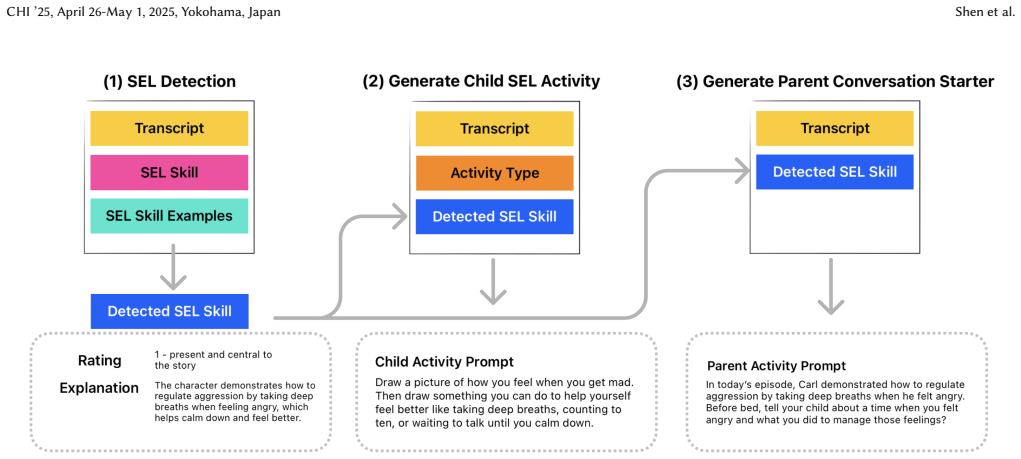
The machinery is a pipelined prompting chain built on a large language model using in-context learning. Automatic speech transcription converts each episode into a transcript; the model then rates whether each of ten skills drawn from the standard five-competency social-emotional learning framework appears in a central plot moment, with positive and negative examples for each skill. Next, conditioned on the detected skill and moment, the model generates one of four activity types for the child (drawing, creative story play, personal storytelling, role play) and a separate parent-child conversation starter that asks the parent to share a personal experience tied to the same skill. The quantitative outcome that carries the user-study claim is the proportion of affect words in children's story retellings, measured with an automated emotion-word lexicon and compared across conditions with a Wilcoxon signed-rank test.
What would settle it
A direct test would run the same two episodes with three conditions: no activity, an eaSEL activity, and an equally engaging non-SEL activity (for example, drawing a favorite scene or retelling the plot). If the non-SEL condition produces the same emotion-word increase as eaSEL, the effect is not specific to social-emotional content; if a different child vocabulary instrument fails to reproduce the difference, the measure may be driving the result.
Extended reading notes
Core claim
On the paper's own terms, the discovery is that an LLM-driven pipeline can turn a children's video transcript into a teachable social-emotional moment and a developmentally plausible activity, and that completing such an activity measurably shifts a child's own language about the story. In a within-subjects study with 20 parent-child dyads, children's retellings contained a higher proportion of affect words (e.g., 'feel,' 'kind,' 'angry') after the eaSEL condition than after the no-activity condition, and this difference was significant by a Wilcoxon signed-rank test. Child-produced drawings and recordings showed that 16 of 20 children gave substantive, reflective answers, often by linking the story to personal experience or by adopting a character's perspective. Parents reported that the child activity encouraged active reflection and regular practice of emotional vocabulary, and that the parent-facing summary, artifact, and conversation starter could scaffold conversations they would not otherwise have had. The technical evaluation found strong relevance of generated activities to the detected SEL skill and moment, with the weakest areas being detection of 'social skills' moments and use of child-appropriate language.
Load-bearing premise
The causal reading of the user study rests on the assumptions that the two video episodes are emotionally comparable and that a higher proportion of emotion words in a 5-8 year old's retelling actually reflects social-emotional reflection rather than, say, general talkativeness or a task-related priming effect.
Editorial extensions
If this is right
- If the effect holds, video-watching time can be converted into a low-cost, at-home SEL practice without requiring parents to watch the same content.
- The pipeline's transcript-based detection means the approach could attach reflection activities to any children's show, not just a curated set of episodes.
- Parents can receive conversation starters and artifacts without co-viewing, which addresses the time constraint that makes joint media engagement impractical for many families.
- The technical evaluation identifies two bottlenecks for deployment: social-skill moments are often missed, and generated language is sometimes too advanced for 5-8 year olds, so content selection and child-appropriate rewrites are needed.
- The paper's own limitation list says the single-session, homogeneous sample means longitudinal learning outcomes and actual parent-child conversations remain untested.
Reading between the lines
- Because the Activity factor only contrasts no activity with eaSEL, the design cannot rule out that any interactive post-viewing task—not the SEL content—drives the affect-word increase; a non-SEL active control would isolate the mechanism.
- If the emotion-word measure is a valid proxy, a longer-term deployment could test whether repeated eaSEL sessions grow children's emotion vocabulary beyond the study session and whether parent-child conversations triggered by the starters actually happen and deepen.
- The same detect-and-generate pipeline could be extended to audiobooks, games, or other passively consumed children's media, where a parent-facing artifact might be even more valuable because there is no visual record of the experience.
- The paper's out-of-scope note about inappropriate source content implies a deployment decision: the system should probably refuse to generate activities for content parents would find objectionable, or let parents set boundaries on which lessons are acceptable.
Editorial analysis
A structured set of objections, weighed in public.
Referee Report
Summary. The paper presents eaSEL, an LLM-based pipeline that (1) detects social-emotional learning (SEL) moments in children's video transcripts, (2) generates child-facing reflection activities tied to those moments, and (3) produces parent-facing conversation starters intended to scaffold parent-child discussion without co-viewing. The technical evaluation uses human gold labels from two annotators (Krippendorff's alpha 0.64, 0.88 overall agreement) and ratings from five parent annotators on 59 generated child activities and 59 conversation starters; the authors report high relevance and reflection-promotion scores for activities, with weaker child-appropriateness results, and high relevance for conversation starters. The user study is a one-way within-subjects experiment with N=20 dyads comparing an eaSEL Activity condition with a No Activity condition on children's use of affect words in story retellings, plus qualitative analysis of child artifacts and parent interviews. The paper reports a significant increase in general affect-word proportion (p=0.02, Cliff's d=0.27) and positive parent perceptions. The central claimed contribution is that eaSEL promotes children's SEL reflection during independent media consumption and scaffolds parent-child engagement.
Significance. If the central claim is supported, the contribution is useful and timely: it addresses independent media consumption, a realistic context that joint-media-engagement systems do not cover, and it connects LLM-generated activities to established SEL curricula. Strengths of the manuscript include the transparency of the pipeline (full prompts in the appendix), the use of external human judgments for the technical evaluation, the explicit analysis of SEL detection failure modes (e.g., the R2 social-skills category), and the qualitative coding of child artifacts and parent interviews. The work is not circular: system outputs are judged against human gold labels and the user-study hypothesis was not used to set system parameters. However, the user study's design does not support the specific causal claim that the SEL content of eaSEL activities, rather than any interactive post-viewing activity or episode differences, drove the observed affect-word increase. The main quantitative result is therefore underdetermined, and the paper's headline interpretation is stronger than the evidence.
major comments (3)
- [Sections 5.1, 6.1, and 7.4] The user study does not include an active control condition. The single factor, Activity, has only two levels: No Activity and eaSEL Activity. Any interactive post-viewing task—generic comprehension questions, retelling to a puppet, or drawing a favorite character—could increase reflective talk and affect-word use simply by prompting additional engagement with the video. The observed p=0.02, Cliff's d=0.27 for general affect words therefore does not isolate the SEL-specific component of eaSEL, which is the paper's central contribution. In addition, each child watched one of two fixed episodes per condition; counterbalancing order across participants does not remove the episode-activity confound because episode content (including emotional salience) is not matched or varied independently of the activity factor. Section 7.4 lists limitations but does not mention this active-control gap. To support H1 as stated, the authors should add an active control condition matched for modality, duration, and adult attention, or should substantially weaken the causal claims in the abstract and discussion.
- [Sections 5.4 and 6.1] The outcome measure itself needs justification for this age group and analysis approach. LIWC15 is an adult-text lexicon and has not been validated for 5-8-year-old children; words such as 'kind' and 'hugged' are counted as affect words, and coverage may differ across the two episodes and across activity conditions in ways unrelated to SEL reflection. The manuscript also tests three LIWC outcome families (general affect, positive emotion, negative emotion) without multiple-comparison correction; only the general affect proportion is significant at p=0.02. The reported effect size is small (Cliff's d=0.27). At minimum, the authors should report adjusted p-values or pre-specify a single primary outcome, and should provide evidence or a reasoned argument that LIWC15's affect lexicon is appropriate for child retellings.
- [Section 5.4] The metric used for retellings is described as 'affect word proportions (number of unique emotion words / unique words in full re-telling)' but Figure 6 is labeled 'Emotion word counts' and the text elsewhere refers to 'frequency of positive or negative emotion words.' This ambiguity matters because the hypothesis concerns 'more emotional language,' which could mean token counts, unique types, or proportions. Please clarify the exact metric used for each comparison and ensure the figure and text are consistent. If the analysis used unique-word proportions, the interpretation in terms of 'using more emotional language' requires an assumption that lexical diversity is the relevant construct; that assumption should be stated and justified.
minor comments (5)
- [Section 5.2] The sample is described as ages 5-8, but the participant table shows only one 5-year-old; the effective age range is mostly 6-8. This should be acknowledged when discussing generalizability to the full stated age range.
- [Section 5.3] The two video episodes are not described in terms of their emotional content, length, or narrative complexity. Since episode and condition are confounded, the manuscript should at least report basic properties of the two episodes and ideally provide the episode titles or scripts for reproducibility.
- [Section 4.3.2] The statement that 74% of activities 'do not contain yes or no questions' means 26% do; the paper then says this was 'not harmful,' but no data are presented to support that conclusion. Either provide evidence or soften the claim.
- [Section 4.2.2] The average Sentence-BERT cosine similarity of 0.36 is interpreted as 'weak similarity' but the qualitative examples show semantically similar explanations. The authors should note that cosine similarity on this embedding space is not a calibrated measure of semantic equivalence for short, explanatory texts.
- [Section 7.3] The 'fail-safes' scenario ('if a child chooses to skip or skimp on an activity, a parent might notice') is speculative; no data in the study address skipping behavior. Consider labeling this as a design vision rather than a finding.
Circularity Check
No significant circularity: the technical evaluations use external human gold labels and established lexicons, and the user-study hypothesis is not used to set any model parameters.
full rationale
This paper contains no mathematical derivation or fitted-parameter chain, so the classical circularity patterns do not apply. The technical evaluation compares GPT-4 outputs against independently produced human gold labels (Section 4.2.1), human annotator ratings for child activities (Section 4.3.1), and human annotator ratings for parent conversation starters (Section 4.4.1). The user study hypothesis H1 (Section 5.1) is tested by measuring LIWC15 affect-word proportions in children's retellings (Section 5.4); LIWC15 is an external, pre-existing lexicon, and the reported p-value and effect size are computed from observed transcripts, not from any parameter fit to the outcome. The self-citations that appear, notably Smith et al. ContextQ [76] for question-quality rubrics and Shen et al. [69] for social-reasoning limitations, are used as prior-work context and evaluation rubrics rather than as load-bearing uniqueness theorems or forced ansatz justifications. The lack of an active control condition is a real threat to causal interpretation, but it is an experimental-design confound, not circularity: the observed increase in affect words is not equivalent by construction to the SEL content of the activity. Overall, the central claims are self-contained empirical findings, so the circularity score is 0.
Assumptions & free parameters
assumptions (5)
- domain assumption The CASEL five-competency framework and the derived 10-skill taxonomy are a valid target model for children's social-emotional learning.
- domain assumption LIWC15 affect-word counts in 5-8 year olds' retellings index emotional reflection.
- domain assumption The two videos used in the user study are comparable in emotional content and emotional density.
- domain assumption Whisper transcripts of the Creative Commons videos are accurate enough for GPT-4 to detect SEL moments.
- domain assumption GPT-4 with in-context learning and the provided prompts reliably performs SEL detection and activity generation.
Cite this review
Pith. "Pith review of eaSEL: Promoting Social-Emotional Learning and Parent-Child Interaction through AI-Mediated Content Consumption." pith.science (2026). https://pith.science/paper/6QJ7VGLR
@misc{pith2026250117819,
  author       = {Pith},
  title        = {Pith review of: eaSEL: Promoting Social-Emotional Learning and Parent-Child Interaction through AI-Mediated Content Consumption},
  year         = {2026},
  howpublished = {\url{https://pith.science/paper/6QJ7VGLR}},
  note         = {Machine review of arXiv:2501.17819}
}
read the original abstract
As children increasingly consume media on devices, parents look for ways this usage can support learning and growth, especially in domains like social-emotional learning. We introduce eaSEL, a system that (a) integrates social-emotional learning (SEL) curricula into children's video consumption by generating reflection activities and (b) facilitates parent-child discussions around digital media without requiring co-consumption of videos. We present a technical evaluation of our system's ability to detect social-emotional moments within a transcript and to generate high-quality SEL-based activities for both children and parents. Through a user study with N=20 parent-child dyads, we find that after completing an eaSEL activity, children reflect more on the emotional content of videos. Furthermore, parents find that the tool promotes meaningful active engagement and could scaffold deeper conversations around content. Our work paves directions in how AI can support children's social-emotional reflection of media and family connections in the digital age.
Figures


Figures from the paper (4 more)


Reference graph
Works this paper leans on
-
[1]
Yasmin I. Ahmadzadeh, Kathryn J. Lester, Bonamy R. Oliver, and Tom A. McAdams. 2020. The Parent Play Questionnaire: Development of a parent questionnaire to assess parent–child play and digital media use. Social De- velopment 29, 4 (2020), 945–963. https://doi.org/10.1111/sode.12450 _eprint: https://onlinelibrary.wiley.com/doi/pdf/10.1111/sode.12450
-
[2]
Simran Arora, Avanika Narayan, Mayee Chen, Laurel Orr, Neel Guha, Kush Bhatia, Ines Chami, and Christopher Ré. 2023. ASK ME ANYTHING: A SIMPLE STRATEGY FOR PROMPTING LANGUAGE MODELS. (2023)
2023
-
[3]
Elias (Eds.)
Reuven Bar-On, Kobus Maree, and Maurice J. Elias (Eds.). 2007.Educating people to be emotionally intelligent . Praeger Publishers, Westport, Conn
2007
-
[4]
Jay Belsky. 1984. The determinants of parenting: A process model. Child Development 55, 1 (1984), 83–96. https://doi.org/10.2307/1129836 Place: United Kingdom Publisher: Blackwell Publishing
-
[5]
Virginia Braun and Victoria Clarke. 2006. Using thematic analysis in psychology. Qualitative Research in Psychology 3, 2 (Jan. 2006), 77–101. https://doi.org/10.1191/1478088706qp063oa Publisher: Routledge _eprint: https://www.tandfonline.com/doi/pdf/10.1191/1478088706qp063oa
-
[6]
John Bridgeland, Mary Bruce, and Arya Hariharan. 2013. The Missing Piece: A National Teacher Survey on How Social and Emotional Learning Can Empower Children and Transform Schools. A Report for CASEL . Technical Report. Civic En- terprises. https://eric.ed.gov/?id=ED558068 Publication Title: Civic Enterprises ERIC Number: ED558068
2013
-
[7]
Tom B. Brown, Benjamin Mann, Nick Ryder, Melanie Subbiah, Jared Kaplan, Prafulla Dhariwal, Arvind Neelakantan, Pranav Shyam, Girish Sastry, Amanda Askell, Sandhini Agarwal, Ariel Herbert-Voss, Gretchen Krueger, Tom Henighan, Rewon Child, Aditya Ramesh, Daniel M. Ziegler, Jeffrey Wu, Clemens Winter, Christopher Hesse, Mark Chen, Eric Sigler, Mateusz Litwin...
arXiv 2005
-
[8]
Laura E. Brumariu and Kathryn A. Kerns. 2015. Mother-child emotion commu- nication and childhood anxiety symptoms. Cognition & Emotion 29, 3 (2015), 416–431. https://doi.org/10.1080/02699931.2014.917070
Show all 112 references
-
[10]
Cameron Tyler Cassidy, Isabela Figueira, Sohyeon Park, Jin Seo Kim, Emory James Edwards, and Stacy Marie Branham. 2024. Cuddling Up With a Print-Braille Book: How Intimacy and Access Shape Parents’ Reading Practices with Children. In Proceedings of the CHI Conference on Human ...
2024
-
[11]
Rosalind Charlesworth. [n. d.]. Developmentally Appropriate Practice is for Everyone. ([n. d.]). https://www.tandfonline.com/doi/abs/10.1080/00094056. CHI ’25, April 26-May 1, 2025, Yokohama, Japan Shen et al. 1998.10521951 Publisher: Taylor & Francis Group
2025
-
[12]
Lynn Schofield Clark. 2011. Parental Mediation Theory for the Digital Age.Com- munication Theory 21, 4 (2011), 323–343. https://doi.org/10.1111/j.1468-2885. 2011.01391.x _eprint: https://onlinelibrary.wiley.com/doi/pdf/10.1111/j.1468- 2885.2011.01391.x
2011 arXiv
-
[13]
Darling, Deborah Seok, Patti Banghart, Kerensa Nagle, Marybeth Todd, and Nadia S
Kristen E. Darling, Deborah Seok, Patti Banghart, Kerensa Nagle, Marybeth Todd, and Nadia S. Orfali. [n. d.]. Social and emotional learning for parents through Conscious Discipline. 12, 1 ([n. d.]), 85–99. https://doi.org/10.1108/JRIT- 01-2019-0017 Publisher: Emerald Publishin...
-
[14]
Plays Nice With Others
Susanne A. Denham and Chavaughn Brown. 2010. “Plays Nice With Others”: Social–Emotional Learning and Academic Success. Early Education and Develop- ment 21, 5 (Oct. 2010), 652–680. https://doi.org/10.1080/10409289.2010.497450 Publisher: Routledge _eprint: https://doi.org/10.10...
2010
-
[15]
Griffin Dietz, Jimmy K Le, Nadin Tamer, Jenny Han, Hyowon Gweon, Elizabeth L Murnane, and James A Landay. 2021. Storycoder: Teaching computational thinking concepts through storytelling in a voice-guided app for children. In Proceedings of the 2021 CHI Conference on Human Fact...
2021
-
[16]
Judy Dunn, Jane Brown, and Lynn Beardsall. 1991. Family talk about feeling states and children’s later understanding of others’ emotions. Developmental Psychology 27, 3 (1991), 448–455. https://doi.org/10.1037/0012-1649.27.3.448 Place: US Publisher: American Psychological Association
1991 doi
-
[17]
Durlak, Joseph L
Joseph A. Durlak, Joseph L. Mahoney, and Alaina E. Boyle. 2022. What we know, and what we need to find out about universal, school-based social and emotional learning programs for children and adolescents: A review of meta-analyses and directions for future research. Psycholog...
2022 doi
-
[18]
Nicole Elbertson, Marc Brackett, and Roger Weissberg. 2009. School-Based Social and Emotional Learning (SEL) Programming: Current Perspectives. In Second International Handbook of Educational Change . 1017–1032. https://doi. org/10.1007/978-90-481-2660-6_57 Journal Abbreviatio...
2009 doi
-
[19]
Elias, Joseph E
Maurice J. Elias, Joseph E. Zins, Roger P. Weissberg, Karin S. Frey, Mark T. Green- berg, Norris M. Haynes, Rachael Kessler, Mary E. Schwab-Stone, and Timothy P. Shriver. 1997. Promoting Social and Emotional Learning: Guidelines for Educa- tors. Association for Supervision and...
1997
-
[20]
Carrie A Ewin, Andrea E Reupert, Louise A McLean, and Christopher J Ewin
-
[21]
Shalom M. Fisch. 2004. Children’s Learning From Educational Television: Sesame Street and Beyond. Routledge, New York. https://doi.org/10.4324/9781410610553
2004 doi
-
[22]
Robyn Fivush. 1994. Constructing narrative, emotion, and self in parent–child conversations about the past. In The Remembering Self: Construction and Accu- racy in the Self-Narrative, Robyn Fivush and Ulric Neisser (Eds.). Cambridge Uni- versity Press, Cambridge, 136–157. http...
1994 doi
-
[23]
Collaborative for Academic Social and Emotional Learning. [n. d.]. Safe and Sound: An Educational Leader’s Guide to Evidence-Based Social and Emotional Learning (SEL) Programs. https://casel.org/safe-and-sound-guide-to-sel- programs/
-
[24]
Yue Fu, Mingrui Zhang, Lynn K Nguyen, Yifan Lin, Rebecca Michelson, Tala June Tayebi, and Alexis Hiniker. 2023. Self-Talk with Superhero Zip: Supporting Children’s Socioemotional Learning with Conversational Agents. InProceedings of the 22nd Annual ACM Interaction Design and C...
2023
-
[25]
LaViola Jr, and Pamela J
Arup Kumar Ghosh, Karla Badillo-Urquiola, Shion Guha, Joseph J. LaViola Jr, and Pamela J. Wisniewski. [n. d.]. Safety vs. Surveillance: What Children Have to Say about Mobile Apps for Parental Control. In Proceedings of the 2018 CHI Conference on Human Factors in Computing Sys...
2018
-
[26]
Hughes, and Pamela J
Arup Kumar Ghosh, Charles E. Hughes, and Pamela J. Wisniewski. 2020. Circle of Trust: A New Approach to Mobile Online Safety for Families. In Proceedings of the 2020 CHI Conference on Human Factors in Computing Systems . ACM, Honolulu HI USA, 1–14. https://doi.org/10.1145/3313...
2020
-
[27]
Graham Gibbs. 1988. Learning by Doing : A Guide to Teaching and Learn- ing Methods. Further Education Unit (1988). https://cir.nii.ac.jp/crid/ 1571417125052979584 Publisher: Oxford Polytechnic
1988
-
[28]
P. Heyward. 2010. Emotional Engagement through Drama: Strategies to Assist Learning through Role-Play. The International Journal of Teaching and Learning in Higher Education (2010). https://www.semanticscholar. org/paper/Emotional-Engagement-through-Drama%3A-Strategies-to- Hey...
2010
-
[29]
Alexis Hiniker, Hyewon Suh, Sabina Cao, and Julie A. Kientz. [n. d.]. Screen Time Tantrums: How Families Manage Screen Media Experiences for Toddlers and Preschoolers. In Proceedings of the 2016 CHI Conference on Human Factors in Computing Systems (New York, NY, USA, 2016-05-0...
2016
-
[30]
Educational
Kathy Hirsh-Pasek, Jennifer M Zosh, Roberta Michnick, James H Gray, Michael B Robb, and Jordy Kaufman. [n. d.]. Putting Education in “Educational” Apps: Lessons From the Science of Learning. ([n. d.])
-
[32]
Molly Carter Imhoff and Lynne Baker-Ward. 1999. Preschoolers’ Suggestibility: Effects of Developmentally Appropriate Language and Interviewer Supportive- ness. Journal of Applied Developmental Psychology 20, 3 (July 1999), 407–429. https://doi.org/10.1016/S0193-3973(99)00022-2
1999 doi
-
[33]
Hee Jhee Jiow, Sun Sun Lim, and Julian Lin. 2017. Level Up! Refreshing Parental Mediation Theory for Our Digital Media Landscape. Communica- tion Theory 27, 3 (2017), 309–328. https://doi.org/10.1111/comt.12109 _eprint: https://onlinelibrary.wiley.com/doi/pdf/10.1111/comt.12109
2017 doi
-
[34]
Stephanie Jones, Katharine Brush, Rebecca Bailey, Gretchen Brion-Meisels, Joseph McIntyre, Jennifer Kahn, Bryan Nelson, and Laura Stickle. [n. d.]. NAVI- GATING SEL FROM THE INSIDE OUT. ([n. d.])
-
[35]
Kabali, Matilde M
Hilda K. Kabali, Matilde M. Irigoyen, Rosemary Nunez-Davis, Jennifer G. Bu- dacki, Sweta H. Mohanty, Kristin P. Leister, and Robert L. Bonner. 2015. Exposure and Use of Mobile Media Devices by Young Children. Pediatrics 136, 6 (Dec. 2015), 1044–1050. https://doi.org/10.1542/pe...
2015 doi
-
[36]
Muhammad Rafsan Kabir, Rafeed Mohammad Sultan, Ihsanul Haque Asif, Jawad Ibn Ahad, Fuad Rahman, Mohammad Ruhul Amin, Nabeel Mohammed, and Shafin Rahman. [n. d.]. Beyond Labels: Aligning Large Language Models with Human-like Reasoning. arXiv:2408.11879 [cs] http://arxiv.org/abs...
-
[37]
Marina Krcmar and Drew Cingel. 2014. Parent–Child Joint Reading in Tra- ditional and Electronic Formats. Media Psychology 17 (July 2014). https: //doi.org/10.1080/15213269.2013.840243
2014
-
[38]
Taeahn Kwon, Minkyung Jeong, Eon-Suk Ko, and Youngki Lee. 2022. Captivate! Contextual Language Guidance for Parent–Child Interaction. In Proceedings of the 2022 CHI Conference on Human Factors in Computing Systems (CHI ’22) . Association for Computing Machinery, New York, NY, ...
2022
-
[39]
Richard Landis and Gary G
J. Richard Landis and Gary G. Koch. [n. d.]. The Measurement of Observer Agreement for Categorical Data. 33, 1 ([n. d.]), 159–174. https://doi.org/10. 2307/2529310 Publisher: [Wiley, International Biometric Society]
-
[40]
Lawson, Meghan E
Gwendolyn M. Lawson, Meghan E. McKenzie, Kimberly D. Becker, Lisa Selby, and Sharon A. Hoover. [n. d.]. The Core Components of Evidence-Based Social Emotional Learning Programs. 20, 4 ([n. d.]), 457–467. https://doi.org/10.1007/ s11121-018-0953-y
-
[41]
Shaomei Li, Yu Tang, and Yuxin Zheng. 2023. How the home learning envi- ronment contributes to children’s social–emotional competence: A moderated mediation model. Frontiers in Psychology 14 (Feb. 2023). https://doi.org/10. 3389/fpsyg.2023.1065978 Publisher: Frontiers
2023
-
[42]
Lindquist
Kristen A. Lindquist. [n. d.]. Language and Emotion: Introduction to the Special Issue. 2, 2 ([n. d.]), 91–98. https://doi.org/10.1007/s42761-021-00049-7 20 citations (Crossref) [2024-11-08]
2024 doi
-
[43]
McCormick, Elise Cappella, Erin O’Connor, Jennifer L
Meghan P. McCormick, Elise Cappella, Erin O’Connor, Jennifer L. Hill, and Sandee McClowry. [n. d.]. Do Effects of Social-Emotional Learning Programs Vary by Level of Parent Participation? Evidence From the Randomized Trial of IN- SIGHTS. 9, 3 ([n. d.]), 364–394. https://doi.or...
-
[44]
Common Sense Media. 2020. The Common Sense Census: Me- dia Use by Kids Age Zero to Eight, 2020 | Common Sense Media. https://www.commonsensemedia.org/research/the-common-sense-census- media-use-by-kids-age-zero-to-eight-2020
2020
-
[45]
Miller, Judith Mintz, Lisa Hoogstra, Heidi Fung, and Randolph Potts
Peggy J. Miller, Judith Mintz, Lisa Hoogstra, Heidi Fung, and Randolph Potts
-
[46]
Anwesha Mukherjee, Vagner Figueredo De Santana, and Alexis Baria. 2023. ImpactBot: Chatbot Leveraging Language Models to Automate Feedback and Promote Critical Thinking Around Impact Statements. In Extended Abstracts of the 2023 CHI Conference on Human Factors in Computing Sys...
2023
-
[47]
Munson, Debra Lauterbach, Mark W
Sean A. Munson, Debra Lauterbach, Mark W. Newman, and Paul Resnick. 2010. Happier Together: Integrating a Wellness Application into a Social Network Site. eaSEL: Promoting Social-Emotional Learning and Parent-Child Interaction through AI-Mediated Content Consumption CHI ’25, A...
2010 doi
-
[48]
Nabi and Lara N
Robin L. Nabi and Lara N. Wolfers. 2022. Does Digital Media Use Harm Chil- dren’s Emotional Intelligence? A Parental Perspective. Media and Communica- tion 10, 1 (March 2022), 350–360. https://doi.org/10.17645/mac.v10i1.4731
2022 doi
-
[49]
Andrew Jordan Nance. 2018. Mindful Arts in the Classroom: Stories and Creative Activities for Social and Emotional Learning . Parallax Press. Google-Books-ID: lWc_DwAAQBAJ
2018
-
[50]
Dr Michelle M Neumann. 2015. Young children and screen time: Creating a mindful approach to digital technology. (2015)
2015
-
[51]
Neumann, Guy Merchant, and Cathy Burnett
Michelle M. Neumann, Guy Merchant, and Cathy Burnett. 2020. Young children and tablets: the views of parents and teachers.Early Child Development and Care 190, 11 (Aug. 2020), 1750–1761. https://doi.org/10.1080/03004430.2018.1550083 Publisher: Routledge _eprint: https://doi.or...
2020
-
[52]
J. W. Payton, D. M. Wardlaw, P. A. Graczyk, M. R. Bloodworth, C. J. Tompsett, and R. P. Weissberg. 2000. Social and emotional learning: a framework for promoting mental health and reducing risk behavior in children and youth. The Journal of School Health 70, 5 (May 2000), 179–...
2000
-
[53]
James Pennebaker, Martha Francis, and Roger Booth. 1999. Linguistic inquiry and word count (LIWC). (Jan. 1999)
1999
-
[54]
flashbulb
David B. Pillemer. 1992. Remembering personal circumstances: A functional analysis. In Affect and accuracy in recall: Studies of "flashbulb" memories . Cam- bridge University Press, New York, NY, US, 236–264. https://doi.org/10.1017/ CBO9780511664069.013
1992
-
[55]
Radesky, Elizabeth Peacock-Chambers, Barry Zuckerman, and Michael Silverstein
Jenny S. Radesky, Elizabeth Peacock-Chambers, Barry Zuckerman, and Michael Silverstein. 2016. Use of Mobile Technology to Calm Upset Children: Associa- tions With Social-Emotional Development. JAMA Pediatrics 170, 4 (April 2016), 397–399. https://doi.org/10.1001/jamapediatrics...
2016
-
[56]
Alec Radford, Jong Wook Kim, Tao Xu, Greg Brockman, Christine McLeavey, and Ilya Sutskever. [n. d.]. Robust Speech Recognition via Large-Scale Weak Supervision. ([n. d.])
-
[57]
Eric E Rasmussen, Autumn Shafer, Malinda J Colwell, Shawna White, Narissra Punyanunt-Carter, Rebecca L Densley, and Holly Wright. 2016. Relation between active mediation, exposure to Daniel Tiger’s Neighborhood, and US preschoolers’ social and emotional development. Journal of...
2016
-
[58]
Nils Reimers and Iryna Gurevych. [n. d.]. Sentence-BERT: Sentence Embeddings using Siamese BERT-Networks. arXiv:1908.10084 [cs] http://arxiv.org/abs/1908. 10084 Number: arXiv:1908.10084
1908 arXiv
-
[59]
Rice and Linda Woodsmall
Mabel L. Rice and Linda Woodsmall. [n. d.]. Lessons from Television: Children’s Word Learning When Viewing. 59, 2 ([n. d.]), 420–429. https://doi.org/10.2307/ 1130321 Publisher: [Wiley, Society for Research in Child Development]
-
[60]
Carolyn Saarni. 1999. The development of emotional competence . Guilford Press, New York, NY, US. Pages: xviii, 381
1999
-
[61]
Ofir Sadka and Alissa Antle. 2022. Interactive Technologies for Emotion Regu- lation Training: A Scoping Review. International Journal of Human-Computer Studies 168 (Dec. 2022), 102906. https://doi.org/10.1016/j.ijhcs.2022.102906
2022
- [62]
-
[63]
Kyle-Althea Santos, Ethel Ong, and Ron Resurreccion. 2020. Therapist vibe: children’s expressions of their emotions through storytelling with a chat- bot. In Proceedings of the Interaction Design and Children Conference (IDC ’20). Association for Computing Machinery, New York,...
2020
-
[64]
Maarten Sap, Ronan LeBras, Daniel Fried, and Yejin Choi. 2022. Neural Theory- of-Mind? On the Limits of Social Intelligence in Large LMs. arXiv:2210.13312 [cs] http://arxiv.org/abs/2210.13312 arXiv:2210.13312 [cs]
2022 arXiv
-
[65]
Maarten Sap, Hannah Rashkin, Derek Chen, Ronan LeBras, and Yejin Choi. [n. d.]. SocialIQA: Commonsense Reasoning about Social Interactions. arXiv:1904.09728 [cs] http://arxiv.org/abs/1904.09728
1904 arXiv
-
[66]
Saywitz, Rebecca Nathanson, and Lynn S
Karen J. Saywitz, Rebecca Nathanson, and Lynn S. Snyder. 1993. Credibility of child witnesses: The role of communicative competence. Topics in Language Disorders 13, 4 (Aug. 1993), 59–78. https://doi.org/10.1097/00011363-199308000- 00009
1993 doi
-
[67]
Saywitz, Lynn Snyder, and Rebecca Nathanson
Karen J. Saywitz, Lynn Snyder, and Rebecca Nathanson. 1999. Facilitating the Communicative Competence of the Child Witness. Applied Developmental Science 3, 1 (March 1999), 58–68. https://doi.org/10.1207/s1532480xads0301_7
1999 doi
-
[68]
Woosuk Seo, Chanmo Yang, and Young-Ho Kim. 2024. ChaCha: Leveraging Large Language Models to Prompt Children to Share Their Emotions about Personal Events. In Proceedings of the CHI Conference on Human Factors in Computing Systems (CHI ’24) . Association for Computing Machiner...
2024
-
[69]
Jocelyn Shen, Maarten Sap, Pedro Colon-Hernandez, Hae Park, and Cynthia Breazeal. 2023. Modeling Empathic Similarity in Personal Narratives. In Pro- ceedings of the 2023 Conference on Empirical Methods in Natural Language Processing. Association for Computational Linguistics, ...
2023 doi
-
[70]
Stop. I See a Conflict Happen- ing
Solace Shen, Petr Slovak, and Malte Jung. 2018. "Stop. I See a Conflict Happen- ing. " A Robot Mediator for Young Children’s Interpersonal Conflict Resolution. https://doi.org/10.1145/3171221.3171248
2018
-
[71]
Ji Youn Shin, Minjin Rheu, Jina Huh-Yoo, and Wei Peng. 2021. Designing Technologies to Support Parent-Child Relationships: A Review of Current Findings and Suggestions for Future Directions. Proceedings of the ACM on Human-Computer Interaction 5, CSCW2 (Oct. 2021), 441:1–441:3...
2021 doi
-
[72]
Petr Slovak, Alissa Antle, Nikki Theofanopoulou, Claudia Daudén Roquet, James Gross, and Katherine Isbister. 2023. Designing for Emotion Regula- tion Interventions: An Agenda for HCI Theory and Research. ACM Transac- tions on Computer-Human Interaction 30, 1 (March 2023), 13:1...
2023 doi
-
[73]
Petr Slovák and Geraldine Fitzpatrick. 2015. Teaching and Developing Social and Emotional Skills with Technology. ACM Transactions on Computer-Human Interaction 22, 4 (July 2015), 1–34. https://doi.org/10.1145/2744195
2015 doi
-
[74]
Petr Slovák, Ran Gilad-Bachrach, and Geraldine Fitzpatrick. 2015. Designing Social and Emotional Skills Training: The Challenges and Opportunities for Technology Support. In Proceedings of the 33rd Annual ACM Conference on Human Factors in Computing Systems. ACM, Seoul Republi...
2015
-
[75]
Petr Slovák, Kael Rowan, Christopher Frauenberger, Ran Gilad-Bachrach, Mia Doces, Brian Smith, Rachel Kamb, and Geraldine Fitzpatrick. 2016. Scaffolding the scaffolding: Supporting children’s social-emotional learning at home. In Proceedings of the 19th ACM Conference on Compu...
2016
-
[76]
Davidson, Leah Findlater, and R
Griffin Dietz Smith, Siddhartha Prasad, Matt J. Davidson, Leah Findlater, and R. Benjamin Shapiro. 2024. ContextQ: Generated Questions to Support Meaning- ful Parent-Child Dialogue While Co-Reading. https://doi.org/10.1145/3628516. 3655809 arXiv:2405.03889 [cs]
2024 arXiv
-
[77]
Byrne-Houser
Samantha Speer, Emily Hamner, Michael Tasota, Lauren Zito, and Sarah K. Byrne-Houser. 2021. MindfulNest: Strengthening Emotion Regulation with Tangible User Interfaces. In Proceedings of the 2021 International Conference on Multimodal Interaction (ICMI ’21) . Association for C...
2021
-
[78]
Abigale Stangl, Joanna Weidler-Lewis, Carlye Lauff, Emily Price, and Eric Fauble
-
[79]
Carolin Stock, Sarah Mares, and Gary Robinson. 2012. Telling and Re-telling Stories: The Use of Narrative and Drawing in a Group Intervention with Parents and Children in a Remote Aboriginal Community. Australian and New Zealand Journal of Family Therapy 33, 2 (June 2012), 157...
2012
-
[80]
Shichao Sun, Ruifeng Yuan, Ziqiang Cao, Wenjie Li, and Pengfei Liu. 2024. Prompt Chaining or Stepwise Prompt? Refinement in Text Summarization. http://arxiv.org/abs/2406.00507 arXiv:2406.00507 [cs]
2024 arXiv
-
[81]
Lori Takeuchi, Reed Stevens, Ashley Fenwick-Naditch, Shalom Fisch, Rebecca Herr-Stephenson, Carlin Llorente, Siri Mehus, Shelley Pasnik, William Penuel, and Glenda Revelle. 2011. the new coviewing. The Joan Ganz Cooney Center at Sesame Workshop and LIFE Center New York, NY
2011
-
[82]
Yilin Tang, Liuqing Chen, Ziyu Chen, Wenkai Chen, Yu Cai, Yao Du, Fan Yang, and Lingyun Sun. 2024. EmoEden: Applying Generative Artificial Intelligence to Emotional Learning for Children with High-Function Autism. In Proceedings of the CHI Conference on Human Factors in Comput...
2024
-
[83]
Thitaree Tanprasert, Sidney S Fels, Luanne Sinnamon, and Dongwook Yoon
-
[84]
They Don’t Come With a Handbook
Nikki Theofanopoulou, Alissa N. Antle, and Petr Slovak. 2024. "They Don’t Come With a Handbook": Exploring Design Opportunities for Supporting Parent- Child Interaction around Emotions in the Family Context. Proceedings of the ACM on Human-Computer Interaction 8, CSCW1 (April ...
2024 doi
-
[85]
Nikki Theofanopoulou and Petr Slovak. 2022. Exploring Technology-Mediated Parental Socialisation of Emotion: Leveraging an Embodied, In-situ Intervention for Child Emotion Regulation. InCHI Conference on Human Factors in Computing Systems. ACM, New Orleans LA USA, 1–16. https:...
2022 doi
-
[86]
Carol Thompson. 2021. Reflective Practice for Professional Development: A Guide for Teachers (1 ed.). Routledge, London. https://doi.org/10.4324/9781003056812
2021 doi
-
[87]
Torre and Matthew D
Jared B. Torre and Matthew D. Lieberman. [n. d.]. Putting Feelings Into Words: Affect Labeling as Implicit Emotion Regulation. 10, 2 ([n. d.]), 116–124. https: CHI ’25, April 26-May 1, 2025, Yokohama, Japan Shen et al. //doi.org/10.1177/1754073917742706 Publisher: SAGE Publications
2025 doi
-
[88]
Georgene Troseth, Gabrielle Strouse, Israel Flores, Zachary Stuckelman, and Colleen Johnson. 2019. An Enhanced eBook Facilitates Parent-Child Talk During Shared Reading by Families of Low Socioeconomic Status. Early Childhood Research Quarterly 50 (Feb. 2019). https://doi.org/...
2019 doi
-
[89]
Ali Uslu and Nilüfer Atman Uslu. 2021. Improving Primary School Students’ Creative Writing and Social-Emotional Learning Skills through Collaborative Digital Storytelling. Acta Educationis Generalis 11, 2 (Aug. 2021), 1–18. https: //doi.org/10.2478/atd-2021-0009
2021 doi
-
[90]
Instructive mediation,
Patti M. Valkenburg, Marina Krcmar, Allerd L. Peeters, and Nies M. Mar- seille. 1999. Developing a scale to assess three styles of television medi- ation: “Instructive mediation, ” “restrictive mediation, ” and “social coview- ing”. Journal of Broadcasting & Electronic Media 4...
1999
-
[91]
Ashvini Varatharaj, Janet C Read, Matthew Horton, Mark Lochrie, and Laurel Brehm. 2024. Children As Evaluators: Understanding Emotion Language Acqui- sition. In Proceedings of the 23rd Annual ACM Interaction Design and Children Conference (IDC ’24) . Association for Computing ...
2024
-
[92]
Yvonne Vezzoli, Sara Kalantari, Natalia Kucirkova, and Asimina Vasalou. 2020. Exploring the Design Space for Parent-Child Reading. In Proceedings of the 2020 CHI Conference on Human Factors in Computing Systems . ACM, Honolulu HI USA, 1–12. https://doi.org/10.1145/3313831.3376696
2020
-
[93]
Mahesh Viswanathan and Madhubalan Viswanathan. [n. d.]. Measuring speech quality for text-to-speech systems: development and assessment of a modified mean opinion score (MOS) scale. 19, 1 ([n. d.]), 55–83. https://doi.org/10.1016/j. csl.2003.12.001
-
[94]
Claudia Vlaicu. 2014. The Importance of Role Play for Children's De- velopment of Socio-Emotional Competencies. LOGOS, UNIVERSALITY, MEN- TALITY, EDUCATION, NOVELTY. Section Social Sciences III, 1 (2014), 157–167. https://www.ceeol.com/search/article-detail?id=287966 Publi...
2014
-
[95]
https://doi.org/10.1080/08838159909364474 Publisher: Routledge _eprint: https://doi.org/10.1080/08838159909364474
-
[96]
Boshi Wang, Xiang Deng, and Huan Sun. 2022. Iteratively Prompt Pre-trained Language Models for Chain of Thought. http://arxiv.org/abs/2203.08383 arXiv:2203.08383 [cs]
2022 arXiv
-
[97]
Ka Wong, Praveen Paritosh, and Lora Aroyo. [n. d.]. Cross-replication Reliability - An Empirical Approach to Interpreting Inter-rater Reliability. In Proceedings of the 59th Annual Meeting of the Association for Computational Linguistics and the 11th International Joint Confer...
2021 doi
-
[98]
Tongshuang Wu, Ellen Jiang, Aaron Donsbach, Jeff Gray, Alejandra Molina, Michael Terry, and Carrie J Cai. 2022. PromptChainer: Chaining Large Language Model Prompts through Visual Programming. In CHI Conference on Human Factors in Computing Systems Extended Abstracts . ACM, Ne...
2022
-
[99]
Junnan Yu, Xiang Qi, and Siqi Yang. 2024. Parent-Child Joint Media Engagement Within HCI: A Scoping Analysis of the Research Landscape. In Proceedings of the CHI Conference on Human Factors in Computing Systems . ACM, Honolulu HI USA, 1–21. https://doi.org/10.1145/3613904.3642307
2024
-
[100]
Garner, and Julie E
Badiyyah Waajid, Pamela W. Garner, and Julie E. Owen. 2013. Infusing Social Emotional Learning into the Teacher Education Curriculum. International Journal of Emotional Education 5, 2 (Nov. 2013), 31–48. https://eric.ed.gov/?id= EJ1085617 Publisher: Centre for Resilience and S...
2013
-
[101]
Mohd Zafaren Zakaria, Faridah Yunus, and Suziyani Mohamed. 2021. Drawing activities enhance preschoolers socio emotional development. Southeast Asia Early Childhood Journal 10, 1 (Jan. 2021), 18–27. https://doi.org/10.37134/saecj. vol10.1.2.2021 Number: 1
2021 doi
-
[102]
Li Zhang, Marco Gillies, Kulwant Dhaliwal, Amanda Gower, Dale Robertson, and Barry Crabtree. 2009. E-Drama: Facilitating Online Role-play using an AI Actor and Emotionally Expressive Characters. International Journal of Artificial Intelli- gence in Education 19, 1 (Jan. 2009),...
2009
-
[103]
Zheng Zhang, Ying Xu, Yanhao Wang, Bingsheng Yao, Daniel Ritchie, Tong- shuang Wu, Mo Yu, Dakuo Wang, and Toby Jia-Jun Li. 2022. StoryBuddy: A Human-AI Collaborative Chatbot for Parent-Child Interactive Storytelling with Flexible Parental Involvement. In Proceedings of the 202...
2022
-
[104]
Chao Zhao, Faeze Brahman, Kaiqiang Song, Wenlin Yao, Dian Yu, and Snigdha Chaturvedi. [n. d.]. NarraSum: A Large-Scale Dataset for Abstractive Narrative Summarization. arXiv:2212.01476 [cs] http://arxiv.org/abs/2212.01476
-
[105]
Deniz Yucel and Anastasia Vogt Yuan. 2015. Do Siblings Matter? The Effect of Siblings on Socio-Emotional Development and Educational Aspirations among Early Adolescents. Child Indicators Research 8, 3 (Sept. 2015), 671–697. https: //doi.org/10.1007/s12187-014-9268-0
2015 doi
-
[106]
Hanqing Zhou, Anastasia Nikolova, and Pengcheng An. 2024. ’My lollipop dropped... ’–Probing Design Opportunities for SEL Agents through Children’s Peer Co-Creation of Social-Emotional Stories. In Extended Abstracts of the 2024 CHI Conference on Human Factors in Computing Syste...
2024
-
[107]
Frederick J Zimmerman, Jill Gilkerson, Jeffrey A Richards, Dimitri A Christakis, Dongxin Xu, Sharmistha Gray, and Umit Yapanel. 2009. Teaching by listening: The importance of adult-child conversations to language development.Pediatrics 124, 1 (2009), 342–349
2009
-
[108]
Frog saw Toad’s ice cream looked more delicious, so he ran over and stole Toad’s ice cream
Joseph E. Zins and Maurice J. Elias. 2007. Social and Emotional Learning: Promoting the Development of All Students. Journal of Educational and Psychological Consultation 17, 2-3 (July 2007), 233–255. https://doi.org/10.1080/10474410701413152 Publisher: Routledge _eprint: http...
2007 doi
-
[110]
Denny Zhou, Nathanael Schärli, Le Hou, Jason Wei, Nathan Scales, Xuezhi Wang, Dale Schuurmans, Claire Cui, Olivier Bousquet, Quoc Le, and Ed Chi
-
[1992]
Merrill-Palmer Quarterly 38, 1 (1992), 45–67
The Narrated Self: Young Children’s Construction of Self in Relation to Others in Conversational Stories of Personal Experience. Merrill-Palmer Quarterly 38, 1 (1992), 45–67. https://www.jstor.org/stable/23087275 Publisher: Wayne State University Press
1992
-
[2017]
In Proceedings of the 2017 Conference on Interaction Design and Children (IDC ’17)
The SEL Transition Wheel: Designing for Early Childhood Social Emo- tional Learning. In Proceedings of the 2017 Conference on Interaction Design and Children (IDC ’17). Association for Computing Machinery, New York, NY, USA, 334–339. https://doi.org/10.1145/3078072.3079746
2017
-
[2021]
Human Behavior and Emerging Technologies 3, 2 (2021), 230–254
The impact of joint media engagement on parent–child interactions: A systematic review. Human Behavior and Emerging Technologies 3, 2 (2021), 230–254
2021
- [2023]
-
[2024]
InProceedings of the CHI Conference on Human Factors in Computing Systems (CHI ’24)
Debate Chatbots to Facilitate Critical Thinking on YouTube: Social Identity and Conversational Style Make A Difference. InProceedings of the CHI Conference on Human Factors in Computing Systems (CHI ’24) . Association for Computing Machinery, New York, NY, USA, 1–24. https://d...
Reviewed August 10, 2026 · model on record in the stance chip above.
Discussion (0). Continue with ORCID to comment.