REVIEW 4 major objections 5 minor 46 references
Learning Prosumer Behavior in Energy Communities: Integrating Bilevel Programming and Online Learning
T0 review · 4 major / 5 minor · reviewed 2026-08-10 · deepseek-v4-flash
Pith's one-line read Dynamic pricing can learn each household's energy assets from observed price responses, eliminating the need for pre-existing datasets.
desk verdict A solid first integration of bilevel pricing with Thompson sampling, honestly scoped; the numerical evidence is a self-consistency check, so the practical claim rests on an unexamined misspecification assumption. read the letter →
The pith
A machine-rendered reading of the paper's core claim, the machinery that carries it, and where it could break.
The reading
What carries the argument
The load-bearing mechanism is the linear signature-response model $y_n = P_n \theta_n + \epsilon$: a prosumer's observed daily profile is a weighted sum of $K$ pre-specified power signatures, and the unknown weights $\theta_n$ are what the manager must infer. On that model sits a Thompson-sampling loop in which Gaussian priors over $\theta_n$ are sampled daily, the samples feed the bilevel price-setting problem BiPS, and Bayesian linear regression updates (16)-(17) refine the posterior after each day's metered responses. The bilevel problem itself is turned into a single-level MILP by replacing the prosumers' lower-level linear programs with their KKT conditions and using strong duality to linearize the bilinear price-response terms, so the whole price-setting step is solvable at each iteration.
What would settle it
Run the algorithm on a simulated prosumer whose true asset is deliberately absent from the candidate signature set (for example, an EV with a fourth driving pattern) and check whether the posterior weights converge to any fixed combination and whether cumulative regret stays bounded; the paper's own Section 5 identifies this test as uninvestigated, and a result showing persistent regret would undermine the claim that individual characteristics are inferred.
Extended reading notes
Core claim
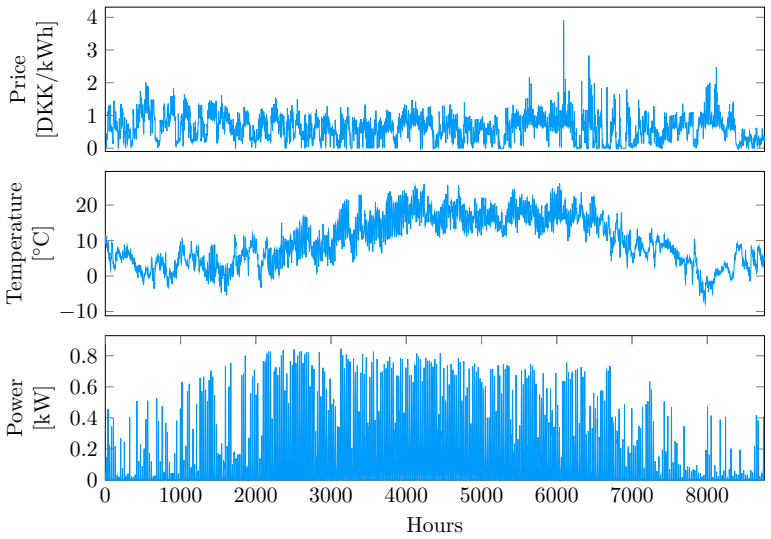
The paper's central claim is that this is the first framework to embed bilevel programming inside an online learning loop, enabling individual-level learning of prosumer behavior rather than aggregate-level learning. Each prosumer's daily load is modeled as a weighted sum of a finite set of candidate 'signatures' (flexible baseload, PV, battery, heat pump, and EV with specified usage patterns), with unknown weights; the manager maintains a Gaussian posterior over these weights, samples them each day, solves a bilevel price-setting problem (reformulated as the mixed-integer linear program BiPS via KKT conditions, strong duality, and the Fortuny-Amat big-M reformulation), and updates the posterior by Bayesian linear regression after observing true metered responses. In a 25-prosumer simulation with 10 signatures per prosumer over one year of Danish price, weather, and PV data, the algorithm achieves near-zero cumulative regret after about 100 days, learns the high-power asset signatures (EVs and batteries) within about five days, and restores learning after a non-stationary change in weights if the prior is reset.
Load-bearing premise
The whole learning loop assumes that each prosumer's true response is exactly a weighted sum of the finite set of candidate signatures; if a household's actual assets or habits are not captured by any of these signatures, the learned weights and the prices derived from them need not be correct.
Editorial extensions
If this is right
- A community manager can offer capacity-limitation services to a DSO without asking households for private usage data; observing responses to prices suffices.
- High-power assets (EVs and batteries) are identified within about five days, removing the largest early risk of exceeding the grid capacity limit.
- Near-zero cumulative regret after 100 days means the learned prices eventually match the prices a clairvoyant manager with full knowledge would set.
- If a prosumer's actual behavior changes, resetting the prior distribution restores learning within roughly the same time frame as the original learning.
- Individual-level price setting follows from individual-level learning, enabling more tailored demand response than aggregate-level pricing.
Reading between the lines
- If the claim holds, the same learning loop could be applied beyond capacity limitation to any flexibility service where a leader sets prices and observes followers' responses, a generalizability the paper itself notes.
- The strongest practical risk the paper leaves open is misspecification of the signature set: if a household's real assets cannot be expressed as a weighted sum of the candidate signatures, the learned weights need not reflect reality, and the numerical guarantees would not carry over.
- Because the learned weights encode occupancy and driving habits, the framework turns smart-meter data into inferred private information, making privacy-preserving variants like differential privacy or federated learning a natural next step.
- The paper provides numerical evidence but not theoretical regret bounds; a proof of Bayesian regret for this bilevel Thompson-sampling setup would strengthen the claim of general applicability.
Editorial analysis
A structured set of objections, weighed in public.
Referee Report
Summary. The paper proposes a framework that combines bilevel price-setting optimization with online learning via Thompson sampling to learn individual prosumer behavior in an energy community. The manager solves a bilevel program (BiPS) each day, using sampled signature weights, then observes prosumer responses and updates Gaussian posterior distributions through Bayesian linear regression. The authors claim this is the first integration of bilevel programming into an online learning framework, with individual-level rather than aggregate-level learning. Numerical experiments with 25 prosumers and 10 signatures report near-zero cumulative regret after 100 days, fast learning of high-power assets within 5 days, and a prior-reset mechanism for non-stationary changes in signature weights.
Significance. If the central claim is supported, the paper offers a useful combination of two mature tools: KKT-based reformulation of lower-level LPs into a MILP, and Thompson sampling with conjugate Gaussian updates. The formulation is standard and the derivations are plausible: lower-level problems are linear, KKT conditions are sufficient, and the Fortuny-Amat reformulation is a recognized technique. The numerical case study is clearly described and the authors provide a code repository, which aids reproducibility. The main significance is the proposed integration itself and the demonstration that, under the exact linear-mixture model, the learner can recover signature weights and reduce regret quickly. However, the evidence for the practical claim of learning real prosumer behavior is limited by the self-consistent nature of the simulation, as detailed in the major comments.
major comments (4)
- [Section 4.1 and Algorithm 1, Step 4] The numerical evaluation is a self-consistency check rather than a test of learning under model misspecification. In Algorithm 1, Step 4, the 'true' response is generated as y = P θ* + ε, where P is computed from the same signature lower-level problems (Section 3.1.2) that BiPS embeds, and Section 4.1 uses exactly these ten signatures to generate the true prosumer responses. The paper's central claim that the community manager can infer individual prosumer behavior is therefore only demonstrated when the observation model coincides with the learner's model. Section 5 explicitly states that 'specifying incorrect sets of signatures' is not investigated. This is load-bearing: a real household with an asset or habit not represented by any candidate signature, or with a nonlinear price response, violates the linear-mixture assumption of Equation (2), and the posterior update (16)-(17) is not guaranteed to be meaningful under misspecification. The authors should add misspecification experiments (e.g., true prosumers whose assets are not in the signature set, or whose response is nonlinear in price) or an analysis of when the linear model remains adequate.
- [Section 3.3] The paper gives no theoretical regret bound. The central quantitative evidence is the empirical regret curve in Figure 5, but Section 3.3 explicitly says 'This paper does not discuss or analyze the theoretical bounds of regret under Thompson sampling.' Without any bound or even a stylized analysis, the claim that the algorithm achieves 'near-zero regret after 100 days' is an anecdotal observation from one simulation setup. At minimum, the authors should provide a regret analysis for a simplified version of the problem (e.g., a linear quadratic setting) or carefully qualify the claim as empirical and parameter-dependent.
- [Section 3.1.3] The MILP reformulation via the Fortuny-Amat approach is not fully specified. The paper states that the MPEC is reformulated using big-M, but it does not report the values of the big-M constants, the solver used, tolerances, or any validation that the complementarity conditions are satisfied at the reported solutions. Since the numerical results depend on the MILP being solved correctly, the omission of these details affects reproducibility. The authors should provide the big-M values or a systematic procedure for choosing them, and report solver settings.
- [Section 2.2 and Equation (2)] The identifiability of the signature weights is not discussed. Even under the exact linear-mixture model, observations y_n = P_n θ_n + ε may not uniquely determine θ_n if the columns of P_n are linearly dependent or if the price signals do not sufficiently excite the different signatures. The numerical study uses a specific set of signatures and prices, but no analysis is given for when the learning problem is well-posed. The authors should state conditions under which the posterior converges to the true weights, or acknowledge that the observed convergence may rely on particular features of the case study.
minor comments (5)
- [Section 4.4] There is a typo in 'does not necessaneed to have perfectly learned' which should read 'does not need to have perfectly learned.'
- [Figure 6 caption] The caption says 'Each row of four subplots' and 'Each column of three subplots,' which is inconsistent with the actual layout; it should say three rows of four subplots or similar.
- [Equation (15)] The notation θ_k is used in the dual reformulation but the index k is not explicitly tied to prosumer n; the equation should clarify that these are the weights for the relevant prosumer, matching the definition in Equation (2).
- [References] The reference list contains a typo 'Bejing' for Beijing in the Gopalan et al. entry.
- [Section 3.2] The update equations (16)-(17) are written with Σ_{n,d} and R_n, but the covariance matrix of the response noise is introduced in Section 3.2 without an explicit definition of how R_n is chosen; a brief statement of the prior hyperparameters would improve reproducibility.
Circularity Check
No significant circularity: the learning update follows from a stated Bayesian linear model, and the numerical study is a self-consistency check rather than a fitted prediction.
full rationale
The derivation is self-contained. The learning update (16)-(17) is standard Bayesian linear regression derived from the stated linear likelihood yn = Pn θn + ε (Eq. 2) and a Gaussian prior; no fitted parameter is used to produce the paper's predictions. The bilevel price-setting model (BiPS) is a direct strong-duality/KKT reformulation of the stated upper- and lower-level problems, and the regret metric compares against a clairvoyant solution using the true θ*. The numerical case study is an internal consistency test: Algorithm 1, Step 4 generates observations from the same signature matrix Pn and linear mixture model that the learner assumes in Eq. (2), so posterior convergence is expected under the maintained model. Section 5 explicitly acknowledges the unexamined assumption that the signature set is correct ("specifying incorrect sets of signatures" is deferred to future work), and Section 3.3 states that regret bounds are not analyzed; these are limitations on external validity, not circular reductions. The self-citations (Tucker et al. 2020; Moradipari et al. 2018; Hutchinson et al. 2024) are literature-review pointers and a non-load-bearing reference for regret bounds; they do not define the model or the result. No circular step can be exhibited.
Assumptions & free parameters
free parameters (2)
- Prior distribution hyperparameters for signature weights =
mean 0.5, std 0.15
- Response noise covariance R_n
assumptions (5)
- domain assumption The true aggregated demand of each prosumer is an exact convex combination of a known finite set of candidate signature profiles (Eq. 2, Section 2.2)
- domain assumption Each prosumer responds to prices by solving its own linear cost-minimization problem optimally (Eq. 4)
- domain assumption The community manager knows the candidate signature models and can compute each signature's optimal response to any price (lower-level problems in Section 3.1.2)
- standard math Strong duality holds for the lower-level LPs, so the bilinear payment terms can be replaced by linear dual expressions (Section 3.1.3)
- domain assumption Observation noise is independent Gaussian
Cite this review
Pith. "Pith review of Learning Prosumer Behavior in Energy Communities: Integrating Bilevel Programming and Online Learning." pith.science (2026). https://pith.science/paper/UELK3J23
@misc{pith2026250118017,
  author       = {Pith},
  title        = {Pith review of: Learning Prosumer Behavior in Energy Communities: Integrating Bilevel Programming and Online Learning},
  year         = {2026},
  howpublished = {\url{https://pith.science/paper/UELK3J23}},
  note         = {Machine review of arXiv:2501.18017}
}
read the original abstract
Dynamic pricing through bilevel programming is widely used for demand response but often assumes perfect knowledge of prosumer behavior, which is unrealistic in practical applications. This paper presents a novel framework that integrates bilevel programming with online learning, specifically Thompson sampling, to overcome this limitation. The approach dynamically sets optimal prices while simultaneously learning prosumer behaviors through observed responses, eliminating the need for extensive pre-existing datasets. Applied to an energy community providing capacity limitation services to a distribution system operator, the framework allows the community manager to infer individual prosumer characteristics, including usage patterns for photovoltaic systems, electric vehicles, home batteries, and heat pumps. Numerical simulations with 25 prosumers, each represented by 10 potential signatures, demonstrate rapid learning with low regret, with most prosumer characteristics learned within five days and full convergence achieved in 100 days.
Figures


Figures from the paper (5 more)


Reference graph
Works this paper leans on
-
[1]
write newline
" write newline "" before.all 'output.state := FUNCTION n.dashify 't := "" t empty not t #1 #1 substring "-" = t #1 #2 substring "--" = not "--" * t #2 global.max substring 't := t #1 #1 substring "-" = "-" * t #2 global.max substring 't := while if t #1 #1 substring * t #2 global.max substring 't := if while FUNCTION word.in bbl.in ":" * " " * FUNCTION f...
-
[2]
write newline
" write newline "" before.all 'output.state := FUNCTION n.dashify 't := "" t empty not t #1 #1 substring "-" = t #1 #2 substring "--" = not "--" * t #2 global.max substring 't := t #1 #1 substring "-" = "-" * t #2 global.max substring 't := while if t #1 #1 substring * t #2 global.max substring 't := if while FUNCTION word.in bbl.in ":" * " " * FUNCTION f...
-
[3]
write newline
" write newline "" before.all 'output.state := FUNCTION n.dashify 't := "" t empty not t #1 #1 substring "-" = t #1 #2 substring "--" = not "--" * t #2 global.max substring 't := t #1 #1 substring "-" = "-" * t #2 global.max substring 't := while if t #1 #1 substring * t #2 global.max substring 't := if while FUNCTION word.in bbl.in ":" * " " * FUNCTION f...
-
[4]
author Alves, M.J. , author Antunes, C.H. , author Soares, I. , year 2020 . title Optimizing prices and periods in time-of-use electricity tariff design using bilevel programming , in: booktitle Evolutionary Computation in Combinatorial Optimization , organization Springer . pp. pages 1--17
work page 2020
-
[5]
author Andersen, F.M. , author Baldini, M. , author Hansen, L.G. , author Jensen, C.L. , year 2017 . title Households’ hourly electricity consumption and peak demand in D enmark . journal Applied Energy volume 208 , pages 607--619
work page 2017
-
[6]
author Charbonnier, F. , author Morstyn, T. , author McCulloch, M.D. , year 2022 . title Coordination of resources at the edge of the electricity grid: Systematic review and taxonomy . journal Applied Energy volume 318 , pages 119188
work page 2022
-
[7]
author Chen, X. , author Li, Y. , author Shimada, J. , author Li, N. , year 2021 a. title Online learning and distributed control for residential demand response . journal IEEE Transactions on Smart Grid volume 12 , pages 4843--4853
work page 2021
-
[8]
author Chen, X. , author Nie, Y. , author Li, N. , year 2021 b. title Online residential demand response via contextual multi-armed bandits . journal IEEE Control Systems Letters volume 5 , pages 433--438
work page 2021
Show all 46 references
-
[9]
, year 2025
author Crowley, B. , year 2025 . title Online appendix -- Learning prosumer behavior in energy communities: Integrating bilevel programming and online learning . https://github.com/bewcro/learning-prosumer-behavior
2025
-
[10]
title Climate data
author Danish Meteorological Institute , year 2024 . title Climate data . https://opendatadocs.dmi.govcloud.dk/Data/Climate_Data
2024
-
[11]
, author haeng Lee, K
author Dinh, H.T. , author haeng Lee, K. , author Kim, D. , year 2022 . title Supervised-learning-based hour-ahead demand response for a behavior-based home energy management system approximating MILP optimization . journal Applied Energy volume 321 , pages 119382
2022
-
[12]
title Elspot prices
author Energinet , year 2024 . title Elspot prices . https://www.energidataservice.dk/tso-electricity/Elspotprices
2024
-
[13]
, author Sergici, S
author Faruqui, A. , author Sergici, S. , year 2010 . title Household response to dynamic pricing of electricity: A survey of 15 experiments . journal Journal of Regulatory Economics volume 38 , pages 193--225
2010
-
[14]
, author Mannor, S
author Gopalan, A. , author Mannor, S. , author Mansour, Y. , year 2014 . title Thompson sampling for complex online problems , in: booktitle Proceedings of the 31st International Conference on Machine Learning , publisher PMLR , address Bejing, China . pp. pages 100--108
2014
-
[15]
, author Chertkov, M
author Gómez, V. , author Chertkov, M. , author Backhaus, S. , author Kappen, H.J. , year 2012 . title Learning price-elasticity of smart consumers in power distribution systems , in: booktitle 2012 IEEE Third International Conference on Smart Grid Communications (SmartGridCom...
2012
-
[16]
, author Sanandaji, B.M
author Hao, H. , author Sanandaji, B.M. , author Poolla, K. , author Vincent, T.L. , year 2015 . title Aggregate flexibility of thermostatically controlled loads . journal IEEE Transactions on Power Systems volume 30 , pages 189--198
2015
-
[17]
, author de Vries , L.J
author Hennig, R.J. , author de Vries , L.J. , author Tindemans, S.H. , year 2023 . title Congestion management in electricity distribution networks: Smart tariffs, local markets and direct control . journal Utilities Policy volume 85 , pages 101660
2023
-
[18]
, author Turan, B
author Hutchinson, S. , author Turan, B. , author Alizadeh, M. , year 2024 . title Safe pricing mechanisms for distributed resource allocation with bandit feedback . journal IEEE Transactions on Control of Network Systems note . Forthcoming
2024
-
[19]
, author Tong, L
author Jia, L. , author Tong, L. , year 2016 . title Dynamic pricing and distributed energy management for demand response . journal IEEE Transactions on Smart Grid volume 7 , pages 1128--1136
2016
-
[20]
, author Tong, L
author Jia, L. , author Tong, L. , author Zhao, Q. , year 2014 . title An online learning approach to dynamic pricing for demand response . http://arxiv.org/abs/1404.1325 arXiv:1404.1325
2014 arXiv
-
[21]
, author Rajagopal, R
author Kalathil, D. , author Rajagopal, R. , year 2015 . title Online learning for demand response , in: booktitle 2015 53rd Annual Allerton Conference on Communication, Control, and Computing (Allerton) , pp. pages 218--222
2015
-
[22]
, author Bitar, E
author Khezeli, K. , author Bitar, E. , year 2018 . title Risk-sensitive learning and pricing for demand response . journal IEEE Transactions on Smart Grid volume 9 , pages 6000--6007
2018
-
[23]
, year 2020
author Kim, Y.J. , year 2020 . title A supervised-learning-based strategy for optimal demand response of an HVAC system in a multi-zone office building . journal IEEE Transactions on Smart Grid volume 11 , pages 4212--4226
2020
-
[24]
, author Taylor, J.A
author Lesage-Landry, A. , author Taylor, J.A. , year 2017 . title Learning to shift thermostatically controlled loads , in: booktitle Proceedings of the 50th Hawaii International Conference on System Sciences , pp. pages 3017--3024
2017
-
[25]
, author Hu, Q
author Li, Y. , author Hu, Q. , author Li, N. , year 2020 . title A reliability-aware multi-armed bandit approach to learn and select users in demand response . journal Automatica volume 119 , pages 109015
2020
-
[26]
, author Ho, Y
author Luh, P. , author Ho, Y. , author Muralidharan, R. , year 1982 . title Load adaptive pricing: An emerging tool for electric utilities . journal IEEE Transactions on Automatic Control volume 27 , pages 320--329
1982
-
[27]
, author Gao, Y
author Luo, Y. , author Gao, Y. , author Fan, D. , year 2023 . title Real-time demand response strategy base on price and incentive considering multi-energy in smart grid: A bi-level optimization method . journal International Journal of Electrical Power & Energy Systems volum...
2023
-
[28]
, author Thomson, M
author McKenna, E. , author Thomson, M. , author Barton, J. , year 2020 . title CREST demand model . https://repository.lboro.ac.uk/articles/dataset/CREST_Demand_Model_v2_0/2001129
2020
-
[29]
, author Dvorkin, Y
author Mieth, R. , author Dvorkin, Y. , year 2020 a. title Distribution electricity pricing under uncertainty . journal IEEE Transactions on Power Systems volume 35 , pages 2325--2338
2020
-
[30]
, author Dvorkin, Y
author Mieth, R. , author Dvorkin, Y. , year 2020 b. title Online learning for network constrained demand response pricing in distribution systems . journal IEEE Transactions on Smart Grid volume 11 , pages 2563--2575
2020
-
[31]
, author Lesage-Landry, A
author Mohamed, A. , author Lesage-Landry, A. , author Taylor, J.A. , year 2017 . title Dispatching thermostatically controlled loads for frequency regulation using adversarial multi-armed bandits , in: booktitle 2017 IEEE Electrical Power and Energy Conference (EPEC) , pp. pages 1--6
2017
-
[32]
, author Silva, C
author Moradipari, A. , author Silva, C. , author Alizadeh, M. , year 2018 . title Learning to dynamically price electricity demand based on multi-armed bandits , in: booktitle 2018 IEEE Global Conference on Signal and Information Processing (GlobalSIP) , pp. pages 917--921
2018
-
[33]
, author Rawat, T
author Pandey, V.C. , author Rawat, T. , author Ospina, J. , author Dvorkin, Y. , author Konstantinou, C. , year 2025 . title A tri-level distribution locational marginal price-based demand response framework . journal Electric Power Systems Research volume 241 , pages 111398
2025
-
[34]
, year 2018
author Papavasiliou, A. , year 2018 . title Analysis of distribution locational marginal prices . journal IEEE Transactions on Smart Grid volume 9 , pages 4872--4882
2018
-
[35]
, author Staffell, I
author Pfenninger, S. , author Staffell, I. , year 2016 . title Long-term patterns of E uropean PV output using 30 years of validated hourly reanalysis and satellite data . journal Energy volume 114 , pages 1251--1265
2016
-
[36]
title Januar og februar: Elkunder har sparet og flyttet millioner kilowatttimer fra spidsbelastningstimerne
author Radius , year 2023 . title Januar og februar: Elkunder har sparet og flyttet millioner kilowatttimer fra spidsbelastningstimerne . howpublished https://radiuselnet.dk/januar-og-februar-elkunder-har-sparet-og-flyttet-millioner-kilowatttimer-fra-spidsbelastningstimerne/
2023
-
[37]
, author Roy, B.V
author Russo, D. , author Roy, B.V. , author Kazerouni, A. , author Osband, I. , author Wen, Z. , year 2020 . title A tutorial on T hompson sampling . http://arxiv.org/abs/1707.02038 arXiv:1707.02038
2020 arXiv
-
[38]
, author Roozbehani, M
author Schneider, I. , author Roozbehani, M. , author Dahleh, M. , year 2022 . title An online learning framework for targeting demand response customers . journal IEEE Transactions on Smart Grid volume 13 , pages 293--301
2022
-
[39]
, author Vignolo, J
author Sotkiewicz, P. , author Vignolo, J. , year 2006 . title Nodal pricing for distribution networks: Efficient pricing for efficiency enhancing DG . journal IEEE Transactions on Power Systems volume 21 , pages 1013--1014
2006
-
[40]
, author Ramos Gutierrez , A.I
author Spiliotis, K. , author Ramos Gutierrez , A.I. , author Belmans, R. , year 2016 . title Demand flexibility versus physical network expansions in distribution grids . journal Applied Energy volume 182 , pages 613--624
2016
-
[41]
, author Frederiks, E.R
author Stenner, K. , author Frederiks, E.R. , author Hobman, E.V. , author Cook, S. , year 2017 . title Willingness to participate in direct load control: The role of consumer distrust . journal Applied Energy volume 189 , pages 76--88
2017
-
[42]
, author Aghaebrahimi, M.R
author Taherian, H. , author Aghaebrahimi, M.R. , author Baringo, L. , author Goldani, S.R. , year 2021 . title Optimal dynamic pricing for an electricity retailer in the price-responsive environment of smart grid . journal International Journal of Electrical Power & Energy Sy...
2021
-
[43]
, author Mathieu, J.L
author Taylor, J.A. , author Mathieu, J.L. , year 2014 . title Index policies for demand response . journal IEEE Transactions on Power Systems volume 29 , pages 1287--1295
2014
-
[44]
, author Moradipari, A
author Tucker, N. , author Moradipari, A. , author Alizadeh, M. , year 2020 . title Constrained T hompson sampling for real-time electricity pricing with grid reliability constraints . journal IEEE Transactions on Smart Grid volume 11 , pages 4971--4983
2020
-
[45]
, author Hug, G
author Venkatraman, A. , author Hug, G. , author Schaffner, C. , author Vayá, M.G. , year 2022 . title Optimal design of time-of-use tariffs using bilevel optimization , in: booktitle 2022 IEEE PES Innovative Smart Grid Technologies Conference Europe (ISGT-Europe) , pp. pages 1--5
2022
-
[46]
, author Wu, Q
author Wei, C. , author Wu, Q. , author Xu, J. , author Wang, Y. , author Sun, Y. , year 2022 . title Bi-level retail pricing scheme considering price-based demand response of multi-energy buildings . journal International Journal of Electrical Power & Energy Systems volume 13...
2022
Reviewed August 10, 2026 · model on record in the stance chip above.
Discussion (0). Continue with ORCID to comment.