REVIEW 2 major objections 5 minor 1 cited by
Universal description of the Neutron Star's surface and its key global properties: A Machine Learning Approach for nonrotating and rapidly rotating stellar models
T0 review · 2 major / 5 minor · reviewed 2026-08-09 · deepseek-v4-flash
Pith's one-line read One set of formulas and neural networks describes neutron-star surfaces across 70 equations of state.
desk verdict Careful and useful new fits, but the 'universal' claim is under-tested because the validation never leaves the 70-EoS ensemble. read the letter →
The pith
A machine-rendered reading of the paper's core claim, the machinery that carries it, and where it could break.
The reading
What carries the argument
The load-bearing object is the normalized surface description. For each star, the circumferential radius $R(\mu)$ is mapped to $(R(\mu)-R_{\rm pole})/(R_{\rm eq}-R_{\rm pole})$, the logarithmic derivative is divided by its maximum, and the effective gravity is mapped to $(g(\mu)-g_{\rm pole})/(g_{\rm eq}-g_{\rm pole})$, so every configuration lives in the unit interval and the ensemble collapses onto a near-universal surface parameterized by compactness $C$, reduced spin $\sigma$, eccentricity $e$ (or ratio $R$), and the angular coordinate $\mu=\cos\theta$. The fits come from least-squares polynomial regression with leave-one-out cross-validation for the global relations, and from a five-hidden-layer feed-forward ANN with LeakyReLU activations and a sigmoid output, trained on Hermite-interpolated surface data. This machinery converts an apparently equation-of-state-dependent stellar shape into a single universal hyperstructure that can be evaluated without solving the field equations.
What would settle it
Hold out one complete equation of state, retrain the ANN and polynomial fits on the remaining 69, and evaluate on the held-out equation of state; if the maximum error on that equation exceeds the reported $0.25\%$ for $R(\mu)$, $0.91\%$ for $g(\mu)$, or $2.79\%$/$4.57\%$ for the global relations, the universality claim fails for truly unseen equations of state. A second check is observational: a sub-percent X-ray measurement of the surface radius or effective gravity that departs from Eqs. (31) or (36) by more than the quoted maxima would contradict the fits.
Extended reading notes
Core claim
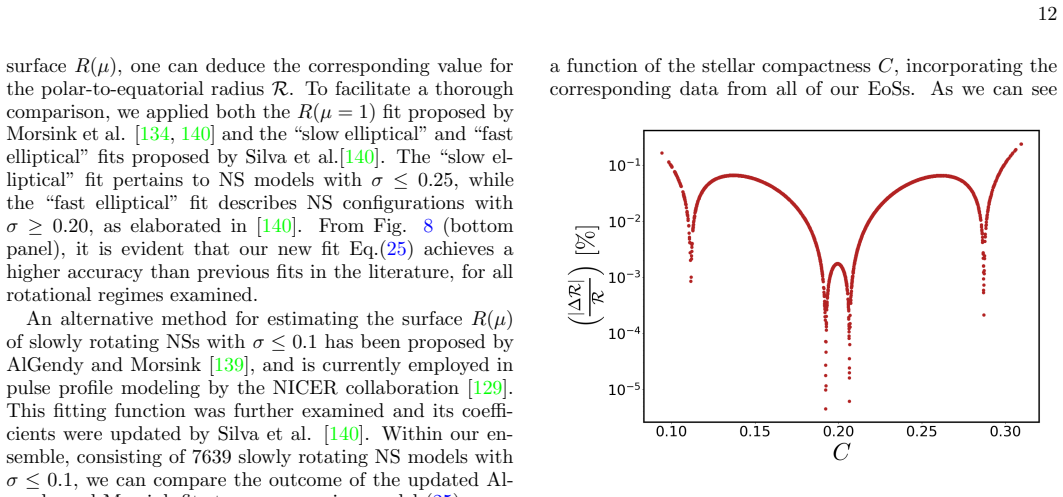
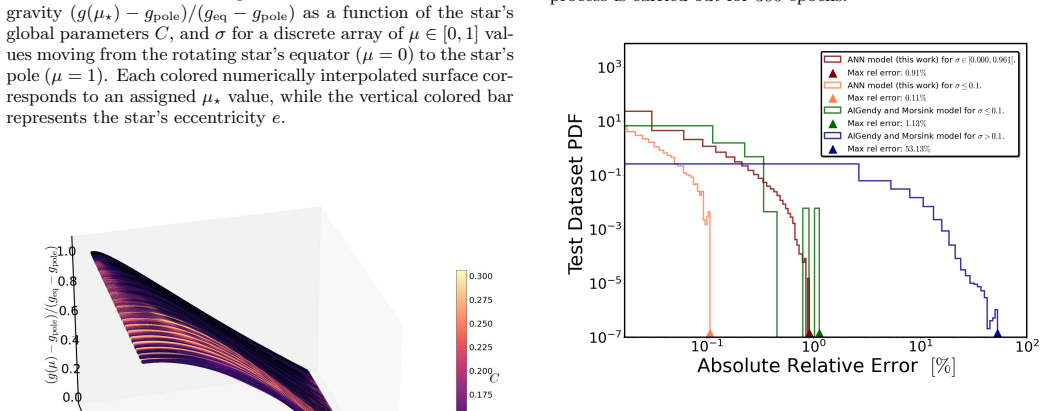
On the paper's own terms, the central discovery is that the oblate surface of a neutron star is a nearly equation-of-state-independent hyperstructure once it is described in the right variables. The paper proposes that the polar-to-equatorial radius ratio $R(C,\sigma)$, the eccentricity $e(C,\sigma)$, the maximum logarithmic derivative $(d\log R(\mu)/d\theta)_{\max}(C,\sigma,R)$, and the effective gravity at the pole and equator follow low-order polynomial fits in compactness $C=M/R_{\rm eq}$ and reduced spin $\sigma=\Omega^2R_{\rm eq}^3/GM$, with maximum relative errors of $2.79\%$, $4.57\%$, $3.21\%$, $3.07\%$, and $4.26\%$. The full surface is then captured by ANN fits that normalize $R(\mu)$ between $R_{\rm pole}$ and $R_{\rm eq}$, the logarithmic derivative by its maximum, and $g(\mu)$ between $g_{\rm pole}$ and $g_{\rm eq}$; this normalization maps every star onto a common universal plane and lets the network reach test-set errors below $0.25\%$ for $R(\mu)$, a residual below $8.36\times10^{-3}$ for the derivative, and $0.91\%$ for $g(\mu)$. The paper also shows these fits outperform previous surface and gravity formulas from the literature, especially for rapid rotation, and that the synthetic surface data satisfy the enthalpy condition $H(P)=0$ to high precision.
Load-bearing premise
The central claim that these fits are universal depends on the 70 tabulated equations of state being representative of all physically plausible neutron-star matter and on the random 20% test split, which shares equation-of-state families with the training set, measuring true generalization to a new equation of state.
Editorial extensions
If this is right
- Given a star's mass, equatorial radius, and spin, Eq. (31) yields the full surface radius $R(\mu)$ to better than $0.25\%$ without any equation-of-state input, which is enough to fix the oblate geometry used in pulse-profile ray tracing.
- Eq. (27) supplies the maximum of the logarithmic derivative from $(C,\sigma,R)$, so Eq. (34) can produce the surface slope needed for beaming-angle and light-curve calculations at arbitrary rotation.
- Eqs. (28) and (29) give the polar and equatorial effective gravity, and Eq. (36) interpolates $g(\mu)$ to $0.91\%$, a quantity that hydrogen-atmosphere models of X-ray hot spots depend on.
- The new fits outperform previous surface and gravity formulas in the test-set comparisons shown, with the largest advantage at high spin, and remain accurate at low spin, so they can replace those formulas in existing analysis pipelines.
- When measurements of these surface observables reach the reported precision, deviations from the fits would translate directly into constraints on the equation of state of dense matter.
Reading between the lines
- The reported test errors come from a random 20% split within the same 70 equations of state, so the fits have not been tested on an equation of state completely absent from training; a leave-one-equation-of-state-out evaluation would be the sharper test of true EoS insensitivity.
- The same min-max normalization strategy could be carried over to other global parameters, such as moment of inertia or tidal deformability, or to differentially rotating stars, whenever a similar low-dimensional hyperstructure exists.
- If future X-ray observations measure $R(\mu)$ or $g(\mu)$ at sub-percent precision, comparing them to Eqs. (31) and (36) is a direct consistency check: a deviation larger than the quoted maxima would signal either a new class of dense-matter equation of state or the breakdown of universality beyond the sampled ensemble.
- The paper leaves open why such a universal hyperstructure exists; a theoretical derivation from the homologous-enthalpy structure of rotating stars would turn these empirical fits into a physical law.
Editorial analysis
A structured set of objections, weighed in public.
Referee Report
Summary. The paper constructs a large dataset of 42,694 relativistic neutron-star equilibrium models (40,015 rotating) from 70 tabulated CompOSE equations of state, extracts the surface radius R(µ), its logarithmic derivative d log R/dθ, and the effective surface gravity g(µ), and proposes a set of EoS-insensitive relations. These include polynomial fits for the polar-to-equatorial radius ratio R(C,σ) (Eq. 25), eccentricity e(C,σ) (Eq. 26), maximum logarithmic derivative (Eq. 27), and polar and equatorial effective gravity (Eqs. 28 and 29), as well as feed-forward neural-network fits for R(µ) (Eq. 31), d log R(µ)/dθ (Eq. 34), and g(µ) (Eq. 36). The authors report test-set accuracies of 0.25% for R(µ), a maximum residual of 8.36e-3 for the logarithmic derivative, and 0.91% for g(µ), and they compare these fits against existing formulas from Morsink et al., AlGendy and Morsink, and Silva et al.
Significance. If the proposed relations hold for equations of state outside the training ensemble, they would be practically valuable for pulse-profile modeling, atmospheric modeling, and future X-ray missions, and the paper would offer a substantial improvement in accuracy over existing surface fits for rapidly rotating stars. The analysis has several genuine strengths: a large and diverse numerical dataset, careful leave-one-out cross-validation for polynomial model selection, explicit consistency checks of the enthalpy-based surface localization, construction of synthetic surface data with verified accuracy, and detailed comparison with prior fits in the literature. The central weakness is that the universality claim is not validated against unseen equations of state: every EoS in the ensemble appears in the training set, so the reported accuracies measure interpolation within known EoS families rather than extrapolation to new microphysics.
major comments (2)
- [Sec. V and Appendix A] The validation protocol does not test the central EoS-universality claim. In Appendix A, the test set is formed by randomly selecting 20% of configurations for each EoS (footnote 3), so every EoS family appears in the training set; the polynomial LOOCV in Sec. IV is leave-one-observation-out over individual stellar models, not leave-one-EoS-out. The reported accuracies (0.25% for R(µ), 8.36e-3 residual for d log R/dθ, 0.91% for g(µ), and the 2.79%–4.57% maxima for Eqs. (25)–(29)) therefore measure interpolation among configurations of already-seen EoSs. Because the defining feature of a universal relation is that it holds for equations of state not used in the fit, I request leave-one-EoS-out cross-validation (or at least a holdout of entire EoS families) with per-EoS error reporting, or a clear statement that the relations are conditional on the 70 selected EoSs being representative of all physically plausible neutron-star matter.
- [Sec. V A-C, Eqs. (30)-(36)] The ANN targets are normalized by endpoint quantities (Rpole, Req, (d log R/dθ)max, gpole, geq) that are not directly observable and must be supplied by the polynomial fits (25)–(29). The reported test errors are for the normalized quantities with exact endpoints. Because the endpoint fits carry maximum errors of 2.79% for R, 3.21% for the logarithmic-derivative maximum, 3.07% for gpole, and 4.26% for geq, the end-to-end surface and gravity errors will be larger than the reported 0.25% and 0.91%. This is a pipeline dependency rather than a circularity, but it should be quantified: either report errors when the endpoints are estimated from Eqs. (25)–(29), or state explicitly that the quoted accuracies assume exact knowledge of the endpoints.
minor comments (5)
- [Appendix A, Eq. (A5)] Equation (A5) contains a typo: the denominator reads "max(xi) - mix(xi)" and should read "max(xi) - min(xi)".
- [Sec. IV B] In the two paragraphs following Eq. (29), the text refers to "our regression model (28)" when discussing the equatorial-gravity fit; the intended equation is (29) in both places.
- [Fig. 15 caption] The caption of Fig. 15 states that the bottom panel uses "regression formula (27)", but the panel shows the equatorial effective gravity geq(C, σ, e); it should cite Eq. (29).
- [Appendix A and Sec. V] The description of the train/test split is ambiguous about whether it is performed separately per EoS. The text in Sec. V says "For the NS models associated with each EoS, we partition 80% of the data for training" and the footnote mentions a random selection for each EoS, but this should be stated directly in the main text so the reader immediately knows that every EoS contributes to both training and test sets.
- [Tables XIII and XV] The dmax columns in Tables XIII and XV are reported as percentages (the text quotes 0.25% and 0.91%), while Eq. (A7) defines dmax as a dimensionless fraction. Please state the units in the table headers or convert the values consistently.
Circularity Check
No significant circularity: the universal relations are empirical fits to independent numerical data, with no definitional reduction or load-bearing self-citation.
full rationale
The paper derives polynomial and ANN fits for surface-related quantities from an independently generated ensemble of 42,694 RNS equilibrium models across 70 CompOSE EoSs. The claimed relations, e.g., Eq. (25) for R(C,σ), Eq. (26) for e(C,σ), Eq. (27) for (d log R/dθ)_max, Eqs. (28)-(29) for g_pole and g_eq, and the ANN fits (31), (34), (36), are regression functions fitted to numerical data with LOOCV or an 80/20 train/test split. Nothing in the derivation defines the fitted target in terms of the fitted predictor: R, e, the logarithmic derivative, and the effective gravity are computed directly from the enthalpy-based surface localization, Eq. (15), and the metric functions, Eqs. (8), (17), (24), before any fitting is performed. The ANN normalization (30) uses R_pole and R_eq as interval endpoints, and Eq. (31) reconstructs R(µ) from those endpoints plus a learned shape function; this is a physically motivated boundary-condition decomposition, not a tautology, because the shape in between is still learned from data. The same holds for the max-scaled derivative fit (32)-(34) and the gravity fit (35)-(36). The paper's self-citations, e.g., to Papigkiotis and Pappas (2023) for previous ML-based universal relations or for acceptability conditions, are contextual and not load-bearing for any uniqueness claim. The main scientific limitation is that the test split is within EoS families rather than leave-one-EoS-out, so the reported accuracies are interpolation among already-seen EoSs rather than demonstrated extrapolation to a new EoS; however, this is a validation and generalizability concern, not circular reasoning. No quoted step exhibits a reduction of a prediction to its own input by construction, so the circularity score is 0.
Assumptions & free parameters
free parameters (9)
- Polynomial coefficients A_nm for R(C,σ) (Eq. 25) =
15 coefficients listed in Table IV
- Polynomial coefficients B_nm for e(C,σ) (Eq. 26) =
21 coefficients listed in Table VI
- Polynomial coefficients C_nmq for (d log R/dθ)max (Eq. 27) =
20 coefficients listed in Table VIII
- Polynomial coefficients D_nm for gpole(C,σ) (Eq. 28) =
15 coefficients listed in Table X
- Polynomial coefficients E_nmq for geq(C,σ,e) (Eq. 29) =
20 coefficients listed in Table XII
- ANN weights for R(µ) model =
Not listed in paper; promised on GitHub
- ANN weights for d log R/dθ model =
Not listed in paper; promised on GitHub
- ANN weights for g(µ) model =
Not listed in paper; promised on GitHub
- ANN hyperparameters (layer sizes, learning rates, LeakyReLU slope) =
Layers 200-100-50-25-10; learning rates 3e-3 to 1e-4; β=0.1
assumptions (7)
- domain assumption The RNS code accurately solves the Einstein field equations for stationary, axisymmetric, uniformly rotating perfect-fluid neutron stars.
- domain assumption Matter in the neutron star is a perfect fluid in β-equilibrium at zero temperature, described by a barotropic EoS.
- standard math The stellar surface is correctly located by the condition H(P)=0, solved via Eq. (15).
- ad hoc to paper The 70 selected EoS models from CompOSE are representative of all physically plausible neutron-star matter.
- ad hoc to paper A random 20% test split within the same EoS models measures generalization to new EoSs.
- domain assumption The numerical grid (261x521) and finite-difference schemes yield converged surface quantities.
- domain assumption Hermite-interpolated midpoints are valid additional surface points.
Cite this review
Pith. "Pith review of Universal description of the Neutron Star's surface and its key global properties: A Machine Learning Approach for nonrotating and rapidly rotating stellar models." pith.science (2026). https://pith.science/paper/5SJ3NOQV
@misc{pith2026250118544,
  author       = {Pith},
  title        = {Pith review of: Universal description of the Neutron Star's surface and its key global properties: A Machine Learning Approach for nonrotating and rapidly rotating stellar models},
  year         = {2026},
  howpublished = {\url{https://pith.science/paper/5SJ3NOQV}},
  note         = {Machine review of arXiv:2501.18544}
}
abstract
Neutron stars provide an ideal theoretical framework for exploring fundamental physics when nuclear matter surpasses densities encountered within atomic nuclei. Despite their paramount importance, uncertainties in the equation of state (EoS) have shrouded their internal structure. For rotating neutron stars, the shape of their surface is contingent upon the EoS and the rotational dynamics. This work proposes new universal relations regarding the star's surface, employing machine-learning techniques for regression. More specifically, we developed highly accurate universal relations for a neutron star's eccentricity, the star's ratio of the polar to the equatorial radius, and the effective gravitational acceleration at both the pole and the equator. Furthermore, we propose an accurate theoretical formula for $(d\log R(\mu)/d\theta)_{\max}$. This research addresses key astronomical aspects by utilizing these global parameters as features for the training phase of a neural network. Along the way, we introduce new effective parameterizations for each star's global surface characteristics. Our regression methodology enables accurate estimations of the star's surface $R(\mu)$, its corresponding logarithmic derivative $d\log R(\mu)/d\theta$, and its effective acceleration due to gravity $g(\mu)$ with accuracy better than $1 \%$. The analysis is performed for an extended sample of rotating configurations constructed using a large ensemble of 70 tabulated hadronic, hyperonic, and hybrid EoS models that obey the current multimessenger constraints and cover a wide range of stiffnesses. Above all, the suggested relations could provide an accurate framework for the star's surface estimation using data acquired from the NICER X-ray telescope or future missions, and constrain the EoS of nuclear matter when measurements of the relevant observables become available.
Figures


Figures from the paper (29 more)






Forward citations
Cited by 1 Pith paper
-
Combining simulation-based inference and universal relations for precise and accurate neutron star science
A machine-learning simulator trained on 1,491 simulated equations of state discovers a neutron-star radius relation R(M,f,p1), predicting radii to tens of meters with calibrated error bars.
Reference graph
Works this paper leans on
-
[1]
LEARNING FROM DA T A ML has emerged as a potent tool, revolutionizing the way we analyze and interpret vast amounts of data. By facili- tating the development of algorithms capable of discerning intricate patterns in complex datasets, ML allows us to ex- tract meaningful insights, make accurate predictions, and discover hidden data patterns that might rem...
-
[2]
De- pending on the case, this mathematical model might be either a polynomial function or a neural network
TRAINING AND TESTING We now define the mathematical framework employed to adjust the best-fit function that describes the data. De- pending on the case, this mathematical model might be either a polynomial function or a neural network. For nonlinear polynomial functions, we use the linear least-squares regression method to identify the most ac- curate dat...
-
[3]
F ractional difference distributions for R(µ) In this subsection, we analyze the sources of relative deviation for the regression model (31) related to the star’s surface on the test set, considering both overall EoS categories and individual EoSs within each category. Fig. 34 concludes this analysis by presenting violin plots that depict the distribution...
-
[4]
Residual error distributions for d log R(µ)/dθ In this subsection, we present the sources of relative error in the regression model (34) on the test set, examining both overall EoS categories and individual EoSs within each cat- egory. Fig. 35 concludes the analysis by presenting violin plots that illustrate the distribution of absolute residuals, | (d lo...
-
[5]
F ractional difference distributions for g(µ) In this subsection, we examine the sources of relative deviation in the regression model (36) related to the star’s effective gravity on the surface, evaluating both overall EoS categories and individual EoSs within each category. Fig. 36 finalizes the analysis by showcasing violin plots that 36 TABLE XXI. Hyb...
-
[6]
Rezzolla, P
L. Rezzolla, P. Pizzochero, D. I. Jones, N. Rea, and I. Vida˜ na,The physics and astrophysics of neutron stars, vol. 457. Springer, 2018
2018
-
[7]
The equation of state from observed masses and radii of neu- tron stars,
A. W. Steiner, J. M. Lattimer, and E. F. Brown, “The equation of state from observed masses and radii of neu- tron stars,” The Astrophysical Journal, vol. 722, no. 1, p. 33, 2010
2010
-
[8]
Neutron stars and the dense matter equa- tion of state,
J. M. Lattimer, “Neutron stars and the dense matter equa- tion of state,” Astrophysics and Space Science, vol. 336, no. 1, pp. 67–74, 2011
2011
Show all 260 references
-
[9]
Masses, Radii, and Equation of State of Neutron Stars,
F. Ozel and P. Freire, “Masses, Radii, and Equation of State of Neutron Stars,” Annual Review of Astronomy and Astrophysics, vol. 54, no. 1, pp. 401–440, 2016
2016
-
[10]
A modern view of the equation of state in nuclear and neutron star matter,
G. F. Burgio, H.-J. Schulze, I. Vida˜ na, and J.-B. Wei, “A modern view of the equation of state in nuclear and neutron star matter,” Symmetry, vol. 13, no. 3, p. 400, 2021
2021
-
[11]
Pre- merger Phenomena in Neutron Star Binary Coalescences,
A. G. Suvorov, H.-J. Kuan, and K. D. Kokkotas, “Pre- merger Phenomena in Neutron Star Binary Coalescences,” Universe, vol. 10, no. 12, p. 441, 2024
2024
-
[12]
CompOSE reference manual: Ver- sion 3.01, CompStar Online Supernovæ Equations of State,“harmonising the concert of nuclear physics and as- trophysics
C. C. Team, S. Typel, M. Oertel, T. Kl¨ ahn, D. Chat- terjee, V. Dexheimer, C. Ishizuka, M. Mancini, J. No- vak, H. Pais, et al., “CompOSE reference manual: Ver- sion 3.01, CompStar Online Supernovæ Equations of State,“harmonising the concert of nuclear physics and as- trophys...
2022
-
[13]
Equa- tions of state for supernovae and compact stars,
M. Oertel, M. Hempel, T. Kl¨ ahn, and S. Typel, “Equa- tions of state for supernovae and compact stars,” Reviews of Modern Physics, vol. 89, no. 1, p. 015007, 2017
2017
-
[14]
Neutron stars and the nuclear matter equa- tion of state,
J. Lattimer, “Neutron stars and the nuclear matter equa- tion of state,” Annual Review of Nuclear and Particle Science, vol. 71, no. 1, pp. 433–464, 2021
2021
-
[15]
Neu- tron stars and the dense matter equation of state: from microscopic theory to macroscopic observations,
K. Chatziioannou, H. Cromartie, S. Gandolfi, I. Tews, D. Radice, A. W. Steiner, and A. L. Watts, “Neu- tron stars and the dense matter equation of state: from microscopic theory to macroscopic observations,” arXiv preprint arXiv:2407.11153, 2024
2024
-
[16]
Psr j0030+ 0451 mass and radius from nicer data and implications for the proper- ties of neutron star matter,
M. Miller, F. K. Lamb, A. Dittmann, S. Bogdanov, Z. Ar- zoumanian, K. C. Gendreau, S. Guillot, A. Harding, W. Ho, J. Lattimer, et al., “Psr j0030+ 0451 mass and radius from nicer data and implications for the proper- ties of neutron star matter,” The Astrophysical Journal Lett...
2019
-
[17]
The radius of psr j0740+ 6620 from nicer and xmm-newton data,
M. C. Miller, F. Lamb, A. Dittmann, S. Bogdanov, Z. Ar- zoumanian, K. Gendreau, S. Guillot, W. Ho, J. Lattimer, M. Loewenstein, et al., “The radius of psr j0740+ 6620 from nicer and xmm-newton data,” The Astrophysical Journal Letters, vol. 918, no. 2, p. L28, 2021
2021
-
[19]
Equation of state constraints from multi- messenger observations of neutron star mergers,
A. Bauswein, “Equation of state constraints from multi- messenger observations of neutron star mergers,” Annals of Physics, vol. 411, p. 167958, 2019. 37 FIG. 34. Violin plots illustrating the distribution of absolute fractional difference 100% × (R(µ)fit − R(µ))/R(µ), across ...
2019
-
[20]
Limiting masses and radii of neutron stars and their implications,
C. Drischler, S. Han, J. M. Lattimer, M. Prakash, S. Reddy, and T. Zhao, “Limiting masses and radii of neutron stars and their implications,” Physical Review C, vol. 103, no. 4, p. 045808, 2021
2021
-
[21]
Numerical relativity simulations of prompt collapse mergers: Threshold mass and phe- nomenological constraints on neutron star properties af- ter GW170817,
R. Kashyap, A. Das, D. Radice, S. Padamata, A. Prakash, D. Logoteta, A. Perego, D. A. Godzieba, S. Bernuzzi, I. Bombaci, et al., “Numerical relativity simulations of prompt collapse mergers: Threshold mass and phe- nomenological constraints on neutron star properties af- ter G...
2022
-
[22]
Nuclear physics multimes- senger astrophysics constraints on the neutron star equa- tion of state: adding NICER’s PSR J0740+ 6620 measure- ment,
P. T. Pang, I. Tews, M. W. Coughlin, M. Bulla, C. Van Den Broeck, and T. Dietrich, “Nuclear physics multimes- senger astrophysics constraints on the neutron star equa- tion of state: adding NICER’s PSR J0740+ 6620 measure- ment,” The Astrophysical Journal, vol. 922, no. 1, p. 14, 2021
2021
-
[23]
Implications of comprehensive nuclear and astrophysics data on the equations of state of neutron star matter,
S. M. A. Imam, T. Malik, C. Providˆ encia, and B. Agrawal, “Implications of comprehensive nuclear and astrophysics data on the equations of state of neutron star matter,” Physical Review D, vol. 109, no. 10, p. 103025, 2024
2024
-
[24]
Surface emission from neutron stars and im- plications for the physics of their interiors,
F. ¨Ozel, “Surface emission from neutron stars and im- plications for the physics of their interiors,” Reports on Progress in Physics, vol. 76, no. 1, p. 016901, 2012
2012
-
[25]
Observational con- straints on neutron star masses and radii,
M. Coleman Miller and F. K. Lamb, “Observational con- straints on neutron star masses and radii,” The European Physical Journal A, vol. 52, pp. 1–20, 2016
2016
-
[26]
Re- fined mass and geometric measurements of the high-mass psr j0740+ 6620,
E. Fonseca, H. T. Cromartie, T. T. Pennucci, P. S. Ray, A. Y. Kirichenko, S. M. Ransom, P. B. Demorest, I. H. Stairs, Z. Arzoumanian, L. Guillemot, et al., “Re- fined mass and geometric measurements of the high-mass psr j0740+ 6620,” The Astrophysical Journal Letters, vol. 915...
2021
-
[27]
A hydrogen atmosphere spectral model applied to the neutron star x7 in the globular cluster 47 tucanae,
C. O. Heinke, G. B. Rybicki, R. Narayan, and J. E. Grind- lay, “A hydrogen atmosphere spectral model applied to the neutron star x7 in the globular cluster 47 tucanae,” The Astrophysical Journal, vol. 644, no. 2, p. 1090, 2006
2006
-
[28]
Constraining the equation of state of supranuclear dense matter from xmm-newton observations of neutron stars in globular clusters,
N. A. Webb and D. Barret, “Constraining the equation of state of supranuclear dense matter from xmm-newton observations of neutron stars in globular clusters,” The Astrophysical Journal, vol. 671, no. 1, p. 727, 2007
2007
-
[29]
Neutron star radius measurement with the quiescent low-mass x- ray binary u24 in ngc 6397,
S. Guillot, R. E. Rutledge, and E. F. Brown, “Neutron star radius measurement with the quiescent low-mass x- ray binary u24 in ngc 6397,” The Astrophysical Journal, vol. 732, no. 2, p. 88, 2011
2011
-
[30]
Neu- tron star mass–radius constraints of the quiescent low- mass X-ray binaries X7 and X5 in the globular cluster 47 Tuc,
S. Bogdanov, C. O. Heinke, F. ¨Ozel, and T. G¨ uver, “Neu- tron star mass–radius constraints of the quiescent low- mass X-ray binaries X7 and X5 in the globular cluster 47 Tuc,” The Astrophysical Journal, vol. 831, no. 2, p. 184, 2016
2016
-
[31]
Simultaneous Chandra and HST observations of the quiescent neutron star low-mass X-ray binaries in 47 Tucanae,
M. van den Berg, L. Rivera Sandoval, C. O. Heinke, H. N. Cohn, P. M. Lugger, J. E. Grindlay, P. D. Edmonds, J. An- derson, and A. Catuneanu, “Simultaneous Chandra and HST observations of the quiescent neutron star low-mass X-ray binaries in 47 Tucanae,” Monthly Notices of the ...
2024
-
[32]
The mass and radius of the neutron star in exo 1745- 248,
F. ¨Ozel, T. G¨ uver, and D. Psaltis, “The mass and radius of the neutron star in exo 1745- 248,” The Astrophysical Journal, vol. 693, no. 2, p. 1775, 2009
2009
-
[33]
The dense matter equation of state from neutron star radius and mass measurements,
F. ¨Ozel, D. Psaltis, T. G¨ uver, G. Baym, C. Heinke, and S. Guillot, “The dense matter equation of state from neutron star radius and mass measurements,” The Astrophysical Journal, vol. 820, no. 1, p. 28, 2016
2016
-
[34]
UV and X-ray observations of the neutron star LMXB EXO 0748–676 in its quiescent state,
A. Parikh, N. Degenaar, J. Hern´ andez Santisteban, R. Wi- jnands, I. Psaradaki, E. Costantini, D. Modiano, and J. Miller, “UV and X-ray observations of the neutron star LMXB EXO 0748–676 in its quiescent state,” Monthly Notices of the Royal Astronomical Society, vol. 501, no....
2021
-
[35]
A NICER view of the massive pulsar PSR J0740+ 6620 informed by radio tim- ing and XMM-Newton spectroscopy,
T. E. Riley, A. L. Watts, P. S. Ray, S. Bogdanov, S. Guillot, S. M. Morsink, A. V. Bilous, Z. Arzoumanian, D. Choudhury, J. S. Deneva, et al., “A NICER view of the massive pulsar PSR J0740+ 6620 informed by radio tim- ing and XMM-Newton spectroscopy,” The Astrophysical Journal...
2021
-
[36]
A nicer view of the nearest and brightest millisecond pulsar: Psr j0437–4715,
D. Choudhury, T. Salmi, S. Vinciguerra, T. E. Riley, Y. Kini, A. L. Watts, B. Dorsman, S. Bogdanov, S. Guil- lot, P. S. Ray, et al., “A nicer view of the nearest and brightest millisecond pulsar: Psr j0437–4715,” The Astrophysical Journal Letters, vol. 971, no. 1, p. L20, 2024
2024
-
[37]
SYSTEMATIC UNCERTAIN- TIES IN THE SPECTROSCOPIC MEASUREMENTS OF NEUTRON STAR MASSES AND RADII FROM THERMONUCLEAR X-RAY BURSTS. III. ABSOLUTE FLUX CALIBRATION,
T. G¨ uver, F.¨Ozel, H. Marshall, D. Psaltis, M. Guainazzi, and M. D ´ ıaz-Trigo, “SYSTEMATIC UNCERTAIN- TIES IN THE SPECTROSCOPIC MEASUREMENTS OF NEUTRON STAR MASSES AND RADII FROM THERMONUCLEAR X-RAY BURSTS. III. ABSOLUTE FLUX CALIBRATION,” The Astrophysical Journal, vol. 82...
2016
-
[38]
Advanced ligo,
J. Aasi, B. Abbott, R. Abbott, T. Abbott, M. Abernathy, K. Ackley, C. Adams, T. Adams, P. Addesso, R. Adhikari, et al., “Advanced ligo,” Classical and quantum gravity, vol. 32, no. 7, p. 074001, 2015
2015
-
[39]
Advanced virgo: a second-generation interferometric gravitational wave de- tector,
F. a. Acernese, M. Agathos, K. Agatsuma, D. Aisa, N. Allemandou, A. Allocca, J. Amarni, P. Astone, G. Balestri, G. Ballardin, et al., “Advanced virgo: a second-generation interferometric gravitational wave de- tector,” Classical and Quantum Gravity, vol. 32, no. 2, p. 024001, 2014
2014
-
[40]
The neutron star interior composition explorer (nicer): an ex- plorer mission of opportunity for soft x-ray timing spec- troscopy,
K. C. Gendreau, Z. Arzoumanian, and T. Okajima, “The neutron star interior composition explorer (nicer): an ex- plorer mission of opportunity for soft x-ray timing spec- troscopy,” in Space Telescopes and Instrumentation 2012: Ultraviolet to Gamma Ray, vol. 8443, pp. 322–329, ...
2012
-
[41]
The neutron star inte- rior composition explorer (nicer): mission definition,
Z. Arzoumanian, K. Gendreau, C. Baker, T. Cazeau, P. Hestnes, J. Kellogg, S. Kenyon, R. Kozon, K.-C. Liu, S. Manthripragada, et al., “The neutron star inte- rior composition explorer (nicer): mission definition,” in Space Telescopes and Instrumentation 2014: Ultraviolet to Gam...
2014
-
[42]
Searching for a pulse,
K. Gendreau and Z. Arzoumanian, “Searching for a pulse,” Nature Astronomy, vol. 1, no. 12, pp. 895–895, 2017
2017
-
[43]
Colloquium: Measuring the neutron star equation of state using x-ray timing,
A. L. Watts, N. Andersson, D. Chakrabarty, M. Fe- roci, K. Hebeler, G. Israel, F. K. Lamb, M. C. Miller, S. Morsink, F. ¨Ozel, et al., “Colloquium: Measuring the neutron star equation of state using x-ray timing,” Reviews of Modern Physics, vol. 88, no. 2, p. 021001, 2016
2016
-
[44]
Detec- tion of pulsed X-ray emission from the isolated neutron star candidate eRASSU J131716. 9–402647,
J. Kurpas, A. Schwope, A. Pires, and F. Haberl, “Detec- tion of pulsed X-ray emission from the isolated neutron star candidate eRASSU J131716. 9–402647,” Astronomy & Astrophysics, vol. 683, p. A164, 2024
2024
-
[45]
A nicer view of psr j0030+ 0451: millisecond pulsar parameter estimation,
T. E. Riley, A. L. Watts, S. Bogdanov, P. S. Ray, R. M. 39 FIG. 35. Violin plots illustrating the distribution of absolute residual errors, ( d log R(µ)/dθ)fit − (d log R(µ)/dθ), across the test set. The upper panel represents error variance across EoS categories, while the su...
2019
-
[46]
Upper limit set by causality on the tidal deformability of a neutron star,
E. D. Van Oeveren and J. L. Friedman, “Upper limit set by causality on the tidal deformability of a neutron star,” Physical Review D, vol. 95, no. 8, p. 083014, 2017
2017
-
[47]
Tidal love numbers of neutron stars,
T. Hinderer, “Tidal love numbers of neutron stars,” The Astrophysical Journal, vol. 677, no. 2, p. 1216, 2008
2008
-
[48]
Relativistic theory of tidal love numbers,
T. Binnington and E. Poisson, “Relativistic theory of tidal love numbers,” Physical Review D, vol. 80, no. 8, p. 084018, 2009
2009
-
[49]
Relativistic tidal properties of neutron stars,
T. Damour and A. Nagar, “Relativistic tidal properties of neutron stars,” Physical Review D, vol. 80, no. 8, p. 084035, 2009
2009
-
[50]
Neutron-star tidal deformability and equation-of-state constraints,
K. Chatziioannou, “Neutron-star tidal deformability and equation-of-state constraints,” General Relativity and Gravitation, vol. 52, no. 11, p. 109, 2020
2020
-
[51]
Interpret- ing binary neutron star mergers: describing the binary neutron star dynamics, modelling gravitational wave- forms, and analyzing detections,
T. Dietrich, T. Hinderer, and A. Samajdar, “Interpret- ing binary neutron star mergers: describing the binary neutron star dynamics, modelling gravitational wave- forms, and analyzing detections,” General Relativity and Gravitation, vol. 53, pp. 1–76, 2021
2021
-
[52]
Resonant tides in binary neu- tron star mergers: Analytical-numerical relativity study,
R. Gamba and S. Bernuzzi, “Resonant tides in binary neu- tron star mergers: Analytical-numerical relativity study,” Physical Review D, vol. 107, no. 4, p. 044014, 2023
2023
-
[53]
A constraint on the dissipative tidal deforma- bility of neutron stars,
J. L. Ripley, A. Hegade KR, R. S. Chandramouli, and N. Yunes, “A constraint on the dissipative tidal deforma- bility of neutron stars,” Nature Astronomy, pp. 1–7, 2024
2024
-
[54]
Phenomeno- logical model of gravitational self-force enhanced tides in inspiraling binary neutron stars,
N. Williams, P. Schmidt, and G. Pratten, “Phenomeno- logical model of gravitational self-force enhanced tides in inspiraling binary neutron stars,” Physical Review D, vol. 110, no. 10, p. 104013, 2024
2024
-
[55]
Future prospects for constraining nuclear matter parameters with grav- itational waves,
Z. Carson, A. W. Steiner, and K. Yagi, “Future prospects for constraining nuclear matter parameters with grav- itational waves,” Physical Review D, vol. 100, no. 2, p. 023012, 2019
2019
-
[56]
Accuracy of neu- tron star radius measurement with the next generation of terrestrial gravitational-wave observatories,
R. Huxford, R. Kashyap, S. Borhanian, A. Dhani, I. Gupta, and B. Sathyaprakash, “Accuracy of neu- tron star radius measurement with the next generation of terrestrial gravitational-wave observatories,” Physical Review D, vol. 109, no. 10, p. 103035, 2024
2024
-
[57]
Nuclear physics constraints from binary neutron star mergers in the einstein telescope era,
I. Francesco, M. Michele, M. Chiranjib, P. Anna, D. Tim, G. Francesca, M. Michele, and O. Micaela, “Nuclear physics constraints from binary neutron star mergers in the einstein telescope era,” Phys. Rev. D, vol. 108, 2023
2023
-
[58]
Constraining the dense mat- ter equation of state with joint analysis of nicer and ligo/virgo measurements,
G. Raaijmakers, S. Greif, T. Riley, T. Hinderer, K. Hebeler, A. Schwenk, A. Watts, S. Nissanke, S. Guil- lot, J. Lattimer, et al., “Constraining the dense mat- ter equation of state with joint analysis of nicer and ligo/virgo measurements,” The Astrophysical Journal Letters, v...
2020
-
[59]
Constraining neutron star prop- erties with a new equation of state insensitive approach,
B. Biswas and S. Datta, “Constraining neutron star prop- erties with a new equation of state insensitive approach,” Physical Review D, vol. 106, no. 4, p. 043012, 2022
2022
-
[60]
Impact of prex-ii and combined radio/nicer/xmm-newton’s mass–radius measurement of psr j0740+ 6620 on the dense-matter equation of state,
B. Biswas, “Impact of prex-ii and combined radio/nicer/xmm-newton’s mass–radius measurement of psr j0740+ 6620 on the dense-matter equation of state,” The Astrophysical Journal, vol. 921, no. 1, p. 63, 2021
2021
-
[61]
Bayesian model selection of neutron star equa- tions of state using multi-messenger observations,
B. Biswas, “Bayesian model selection of neutron star equa- tions of state using multi-messenger observations,” The Astrophysical Journal, vol. 926, no. 1, p. 75, 2022
2022
-
[62]
Bayesian infer- ence of dense matter equation of state within relativis- tic mean field models using astrophysical measurements,
S. Traversi, P. Char, and G. Pagliara, “Bayesian infer- ence of dense matter equation of state within relativis- tic mean field models using astrophysical measurements,” The Astrophysical Journal, vol. 897, no. 2, p. 165, 2020
2020
-
[63]
Bayesian inference of high- density nuclear symmetry energy from radii of canonical neutron stars,
W.-J. Xie and B.-A. Li, “Bayesian inference of high- density nuclear symmetry energy from radii of canonical neutron stars,” The Astrophysical Journal, vol. 883, no. 2, p. 174, 2019
2019
-
[64]
Towards mitigation of apparent tension between nuclear physics and astrophysical observations by improved modeling of neutron star matter,
B. Biswas, P. Char, R. Nandi, and S. Bose, “Towards mitigation of apparent tension between nuclear physics and astrophysical observations by improved modeling of neutron star matter,” Physical Review D, vol. 103, no. 10, p. 103015, 2021
2021
-
[65]
Multimes- senger constraints on the neutron-star equation of state and the hubble constant,
T. Dietrich, M. W. Coughlin, P. T. Pang, M. Bulla, J. Heinzel, L. Issa, I. Tews, and S. Antier, “Multimes- senger constraints on the neutron-star equation of state and the hubble constant,” Science, vol. 370, no. 6523, pp. 1450–1453, 2020
2020
-
[66]
Nonpara- metric constraints on neutron star matter with exist- ing and upcoming gravitational wave and pulsar obser- vations,
P. Landry, R. Essick, and K. Chatziioannou, “Nonpara- metric constraints on neutron star matter with exist- ing and upcoming gravitational wave and pulsar obser- vations,” Physical Review D, vol. 101, no. 12, p. 123007, 2020
2020
-
[67]
Constraints on the dense matter equation of state and neutron star properties from nicer’s mass–radius es- timate of psr j0740+ 6620 and multimessenger observa- tions,
G. Raaijmakers, S. Greif, K. Hebeler, T. Hinderer, a. Nis- sanke, A. Schwenk, T. Riley, A. Watts, J. Lattimer, and W. Ho, “Constraints on the dense matter equation of state and neutron star properties from nicer’s mass–radius es- timate of psr j0740+ 6620 and multimessenger ob...
2021
-
[68]
New dynamical tide con- straints from current and future gravitational wave detec- tions of inspiralling neutron stars,
W. C. Ho and N. Andersson, “New dynamical tide con- straints from current and future gravitational wave detec- tions of inspiralling neutron stars,” Physical Review D, vol. 108, no. 4, p. 043003, 2023
2023
-
[69]
Gw170817: observation of gravita- tional waves from a binary neutron star inspiral,
B. P. Abbott, R. Abbott, T. Abbott, F. Acernese, K. Ack- ley, C. Adams, T. Adams, P. Addesso, R. Adhikari, V. B. Adya, et al., “Gw170817: observation of gravita- tional waves from a binary neutron star inspiral,”Physical review letters, vol. 119, no. 16, p. 161101, 2017
2017
-
[70]
Properties of the binary neutron star merger gw170817,
B. Abbott, R. Abbott, T. Abbott, F. Acernese, K. Ackley, C. Adams, T. Adams, P. Addesso, R. Adhikari, V. Adya, et al., “Properties of the binary neutron star merger gw170817,” Physical Review X, vol. 9, no. 1, p. 011001, 2019
2019
-
[71]
The equation of state and some key parameters of neu- tron stars: Constraints from gw170817, the nuclear data, and the low-mass x-ray binary data,
J.-L. Jiang, S.-P. Tang, D.-S. Shao, M.-Z. Han, Y.-J. Li, Y.-Z. Wang, Z.-P. Jin, Y.-Z. Fan, and D.-M. Wei, “The equation of state and some key parameters of neu- tron stars: Constraints from gw170817, the nuclear data, and the low-mass x-ray binary data,” The Astrophysical Jou...
2019
-
[72]
Neu- tron skins and neutron stars in the multimessenger era,
F. Fattoyev, J. Piekarewicz, and C. J. Horowitz, “Neu- tron skins and neutron stars in the multimessenger era,” Physical Review Letters, vol. 120, no. 17, p. 172702, 2018
2018
-
[73]
New constraints on radii and tidal deformabil- ities of neutron stars from gw170817,
E. R. Most, L. R. Weih, L. Rezzolla, and J. Schaffner- Bielich, “New constraints on radii and tidal deformabil- ities of neutron stars from gw170817,” Physical Review Letters, vol. 120, no. 26, p. 261103, 2018
2018
-
[74]
Gw170817: Measurements of neutron star radii and equation of state,
B. P. Abbott, R. Abbott, T. Abbott, F. Acernese, K. Ack- ley, C. Adams, T. Adams, P. Addesso, R. X. Adhikari, V. B. Adya, et al., “Gw170817: Measurements of neutron star radii and equation of state,” Physical review letters, 41 FIG. 36. Violin plots depicting the distribution ...
2018
-
[75]
Constraints on the mo- ment of inertia of psr j0737-3039a from gw170817,
P. Landry and B. Kumar, “Constraints on the mo- ment of inertia of psr j0737-3039a from gw170817,” The Astrophysical Journal Letters, vol. 868, no. 2, p. L22, 2018
2018
-
[76]
Gravitational-wave constraints on the neutron-star- matter equation of state,
E. Annala, T. Gorda, A. Kurkela, and A. Vuori- nen, “Gravitational-wave constraints on the neutron-star- matter equation of state,” Physical review letters, vol. 120, no. 17, p. 172703, 2018
2018
-
[77]
Neutron star tidal deformabilities constrained by nuclear theory and experiment,
Y. Lim and J. W. Holt, “Neutron star tidal deformabilities constrained by nuclear theory and experiment,” Physical review letters, vol. 121, no. 6, p. 062701, 2018
2018
-
[78]
Inferring neutron star prop- erties from gw170817 with universal relations,
B. Kumar and P. Landry, “Inferring neutron star prop- erties from gw170817 with universal relations,” Physical Review D, vol. 99, no. 12, p. 123026, 2019
2019
-
[79]
Maximum mass of neu- tron stars and strange neutron-star cores,
J. Zdunik and P. Haensel, “Maximum mass of neu- tron stars and strange neutron-star cores,” Astronomy & Astrophysics, vol. 551, p. A61, 2013
2013
-
[80]
Haensel, A
P. Haensel, A. Y. Potekhin, and D. G. Yakovlev, Neutron stars 1: Equation of state and structure, vol. 326. New York, USA: Springer, 2007
2007
-
[81]
Combining electromagnetic and gravitational- wave constraints on neutron-star masses and radii,
M. Al-Mamun, A. W. Steiner, J. N¨ attil¨ a, J. Lange, R. O’Shaughnessy, I. Tews, S. Gandolfi, C. Heinke, and S. Han, “Combining electromagnetic and gravitational- wave constraints on neutron-star masses and radii,” Physical Review Letters, vol. 126, no. 6, p. 061101, 2021
2021
-
[82]
Rapidly rotating neutron stars: Universal relations and EOS inference,
C. J. Kr¨ uger and S. H. V¨ olkel, “Rapidly rotating neutron stars: Universal relations and EOS inference,” Physical Review D, vol. 108, no. 12, p. 124056, 2023
2023
-
[83]
Mapping neutron star data to the equation of state using the deep neural network,
Y. Fujimoto, K. Fukushima, and K. Murase, “Mapping neutron star data to the equation of state using the deep neural network,” Physical Review D, vol. 101, no. 5, p. 054016, 2020
2020
-
[84]
Methodol- ogy study of machine learning for the neutron star equa- tion of state,
Y. Fujimoto, K. Fukushima, and K. Murase, “Methodol- ogy study of machine learning for the neutron star equa- tion of state,” Physical Review D, vol. 98, no. 2, p. 023019, 2018
2018
-
[85]
Unveiling the nuclear matter eos from neutron star properties: a supervised machine learning approach,
M. Ferreira and C. Providˆ encia, “Unveiling the nuclear matter eos from neutron star properties: a supervised machine learning approach,” Journal of Cosmology and Astroparticle Physics, vol. 2021, no. 07, p. 011, 2021
2021
-
[86]
Deducing neutron star equation of state from telescope spectra with machine-learning-derived likeli- hoods,
D. Farrell, P. Baldi, J. Ott, A. Ghosh, A. W. Steiner, A. Kavitkar, L. Lindblom, D. Whiteson, and F. We- ber, “Deducing neutron star equation of state from telescope spectra with machine-learning-derived likeli- hoods,” Journal of Cosmology and Astroparticle Physics, vol. 2023...
2023
-
[87]
A deep learning approach to extracting nuclear matter properties from neutron star observations,
P. G. Krastev, “A deep learning approach to extracting nuclear matter properties from neutron star observations,” Symmetry, vol. 15, no. 5, p. 1123, 2023
2023
-
[88]
Neural network reconstruc- tion of the dense matter equation of state derived from the parameters of neutron stars,
F. Morawski and M. Bejger, “Neural network reconstruc- tion of the dense matter equation of state derived from the parameters of neutron stars,” A&A, vol. 642, p. A78, 2020
2020
-
[89]
Neural network reconstruction of the dense matter equa- tion of state from neutron star observables,
S. Soma, L. Wang, S. Shi, H. St¨ ocker, and K. Zhou, “Neural network reconstruction of the dense matter equa- tion of state from neutron star observables,” Journal of Cosmology and Astroparticle Physics, vol. 2022, no. 08, p. 071, 2022
2022
-
[90]
Re- constructing the neutron star equation of state from ob- servational data via automatic differentiation,
S. Soma, L. Wang, S. Shi, H. St¨ ocker, and K. Zhou, “Re- constructing the neutron star equation of state from ob- servational data via automatic differentiation,” Physical Review D, vol. 107, no. 8, p. 083028, 2023
2023
-
[91]
Cluster structures with machine learning support in neu- tron star mr relations,
R. V. Lobato, E. V. Chimanski, and C. A. Bertulani, “Cluster structures with machine learning support in neu- tron star mr relations,” in Journal of Physics: Conference Series, vol. 2340, p. 012014, IOP Publishing, 2022
2022
-
[92]
Un- supervised machine learning correlations in eos of neutron stars,
R. V. Lobato, E. V. Chimanski, and C. A. Bertulani, “Un- supervised machine learning correlations in eos of neutron stars,” arXiv preprint arXiv:2202.13940, 2022
2022 arXiv
-
[93]
Extracting nuclear matter properties from the neutron star matter equation of state using deep neural networks,
M. Ferreira, V. Carvalho, and C. Providˆ encia, “Extracting nuclear matter properties from the neutron star matter equation of state using deep neural networks,” Physical Review D, vol. 106, no. 10, p. 103023, 2022
2022
-
[94]
Neutron star moments of inertia,
D. Ravenhall and C. J. Pethick, “Neutron star moments of inertia,” The Astrophysical Journal, vol. 424, pp. 846– 851, 1994
1994
-
[95]
Neutron star structure and the equation of state,
J. Lattimer and M. Prakash, “Neutron star structure and the equation of state,” The Astrophysical Journal, vol. 550, no. 1, p. 426, 2001
2001
-
[96]
Moments of inertia for neutron and strange stars: Limits derived for the crab pulsar,
M. Bejger and P. Haensel, “Moments of inertia for neutron and strange stars: Limits derived for the crab pulsar,” Astronomy & Astrophysics, vol. 396, no. 3, pp. 917–921, 2002
2002
-
[97]
Constraining the equa- tion of state with moment of inertia measurements,
J. M. Lattimer and B. F. Schutz, “Constraining the equa- tion of state with moment of inertia measurements,” The Astrophysical Journal, vol. 629, no. 2, p. 979, 2005
2005
-
[98]
Maximum mass, moment of inertia and compactness of relativistic stars,
C. Breu and L. Rezzolla, “Maximum mass, moment of inertia and compactness of relativistic stars,” Monthly Notices of the Royal Astronomical Society, vol. 459, no. 1, pp. 646–656, 2016
2016
-
[99]
Quadrupole mo- ments of rotating neutron stars,
W. G. Laarakkers and E. Poisson, “Quadrupole mo- ments of rotating neutron stars,” Astrophys. J., vol. 512, pp. 282–287, 1999
1999
-
[100]
Revising the multipole moments of numerical spacetimes, and its consequences,
G. Pappas and T. A. Apostolatos, “Revising the multipole moments of numerical spacetimes, and its consequences,” Phys. Rev. Lett., vol. 108, p. 231104, 2012
2012
-
[101]
Multipole moments of numerical spacetimes,
G. Pappas and T. A. Apostolatos, “Multipole moments of numerical spacetimes,” arXiv preprint arXiv:1211.6299, 2012
2012 arXiv
-
[102]
Quadrupole moments of rotating neutron stars and strange stars,
M. Urbanec, J. C. Miller, and Z. Stuchlik, “Quadrupole moments of rotating neutron stars and strange stars,” Monthly Notices of the Royal Astronomical Society, vol. 433, no. 3, pp. 1903–1909, 2013
1903
-
[103]
Approximate universal relations for neutron stars and quark stars,
K. Yagi and N. Yunes, “Approximate universal relations for neutron stars and quark stars,” Physics Reports, vol. 681, pp. 1–72, 2017
2017
-
[104]
I-Love-Q: Unexpected univer- sal relations for neutron stars and quark stars,
K. Yagi and N. Yunes, “I-Love-Q: Unexpected univer- sal relations for neutron stars and quark stars,” Science, vol. 341, no. 6144, pp. 365–368, 2013
2013
-
[105]
Relations between neutron-star parameters in the hartle–thorne ap- proximation,
M. Baub¨ ock, E. Berti, D. Psaltis, and F.¨Ozel, “Relations between neutron-star parameters in the hartle–thorne ap- proximation,” The Astrophysical Journal, vol. 777, no. 1, p. 68, 2013
2013
-
[106]
I-Love-Q relations in neutron stars and their applications to astrophysics, gravitational waves, and fundamental physics,
K. Yagi and N. Yunes, “I-Love-Q relations in neutron stars and their applications to astrophysics, gravitational waves, and fundamental physics,” Physical Review D, vol. 88, no. 2, p. 023009, 2013
2013
-
[107]
Equation-of-state-independent relations in neu- tron stars,
A. Maselli, V. Cardoso, V. Ferrari, L. Gualtieri, and P. Pani, “Equation-of-state-independent relations in neu- tron stars,” Physical Review D, vol. 88, no. 2, p. 023007, 2013
2013
-
[108]
Breakdown of I-LOVE-Q universality 43 in rapidly rotating relativistic stars,
D. D. Doneva, S. S. Yazadjiev, N. Stergioulas, and K. D. Kokkotas, “Breakdown of I-LOVE-Q universality 43 in rapidly rotating relativistic stars,” The Astrophysical Journal Letters, vol. 781, no. 1, p. L6, 2014
2014
-
[109]
Effectively univer- sal behavior of rotating neutron stars in general rela- tivity makes them even simpler than their newtonian counterparts,
G. Pappas and T. A. Apostolatos, “Effectively univer- sal behavior of rotating neutron stars in general rela- tivity makes them even simpler than their newtonian counterparts,” Physical Review Letters, vol. 112, no. 12, p. 121101, 2014
2014
-
[110]
I-Q relation for rapidly rotating neutron stars,
S. Chakrabarti, T. Delsate, N. G¨ urlebeck, and J. Steinhoff, “I-Q relation for rapidly rotating neutron stars,” Physical Review Letters, vol. 112, no. 20, p. 201102, 2014
2014
-
[111]
Universal relations for the increase in the mass and radius of a rotating neu- tron star,
A. Konstantinou and S. M. Morsink, “Universal relations for the increase in the mass and radius of a rotating neu- tron star,” The Astrophysical Journal, vol. 934, no. 2, p. 139, 2022
2022
-
[112]
Three-hair re- lations for rotating stars: Nonrelativistic limit,
L. C. Stein, K. Yagi, and N. Yunes, “Three-hair re- lations for rotating stars: Nonrelativistic limit,” The Astrophysical Journal, vol. 788, no. 1, p. 15, 2014
2014
-
[113]
Effective no-hair relations for neutron stars and quark stars: relativistic results,
K. Yagi, K. Kyutoku, G. Pappas, N. Yunes, and T. A. Apostolatos, “Effective no-hair relations for neutron stars and quark stars: relativistic results,” Physical Review D, vol. 89, no. 12, p. 124013, 2014
2014
-
[114]
Toward realis- tic and practical no-hair relations for neutron stars in the nonrelativistic limit,
K. Chatziioannou, K. Yagi, and N. Yunes, “Toward realis- tic and practical no-hair relations for neutron stars in the nonrelativistic limit,” Physical Review D, vol. 90, no. 6, p. 064030, 2014
2014
-
[115]
Universal relations for rapidly rotating neutron stars using supervised machine- learning techniques,
G. Papigkiotis and G. Pappas, “Universal relations for rapidly rotating neutron stars using supervised machine- learning techniques,” Physical Review D, vol. 107, no. 10, p. 103050, 2023
2023
-
[116]
Finding universal relations using statistical data analysis,
P. Manoharan and K. D. Kokkotas, “Finding universal relations using statistical data analysis,” arXiv preprint arXiv:2307.13063, 2023
2023 arXiv
-
[117]
Rotating protoneutron stars: Spin evolution, maximum mass, and I-Love-Q relations,
G. Martinon, A. Maselli, L. Gualtieri, and V. Ferrari, “Rotating protoneutron stars: Spin evolution, maximum mass, and I-Love-Q relations,” Physical Review D, vol. 90, no. 6, p. 064026, 2014
2014
-
[118]
Why I-Love-Q: Explaining why universality emerges in compact objects,
K. Yagi, L. C. Stein, G. Pappas, N. Yunes, and T. A. Apostolatos, “Why I-Love-Q: Explaining why universality emerges in compact objects,” Physical Review D, vol. 90, no. 6, p. 063010, 2014
2014
-
[119]
Unveiling the universality of I-Love-Q relations,
Y.-H. Sham, T. Chan, L.-M. Lin, and P. Leung, “Unveiling the universality of I-Love-Q relations,” The Astrophysical Journal, vol. 798, no. 2, p. 121, 2015
2015
-
[120]
Thermal x-rays from millisecond pulsars: Constraining the funda- mental properties of neutron stars,
S. Bogdanov, J. E. Grindlay, and G. B. Rybicki, “Thermal x-rays from millisecond pulsars: Constraining the funda- mental properties of neutron stars,” The Astrophysical Journal, vol. 689, no. 1, p. 407, 2008
2008
-
[121]
Determining neutron star properties by fitting oblate-star waveform models to X-ray burst oscillations,
M. C. Miller and F. K. Lamb, “Determining neutron star properties by fitting oblate-star waveform models to X-ray burst oscillations,” The Astrophysical Journal, vol. 808, no. 1, p. 31, 2015
2015
-
[122]
X-ray emission from isolated neutron stars,
S. Mereghetti, “X-ray emission from isolated neutron stars,” in High-Energy Emission from Pulsars and their Systems: Proceedings of the First Session of the Sant Cugat Forum on Astrophysics, pp. 345–363, Springer, 2010
2010
-
[123]
Neutron star pulse profile observations as extreme gravity probes,
H. O. Silva and N. Yunes, “Neutron star pulse profile observations as extreme gravity probes,” Classical and Quantum Gravity, vol. 36, no. 17, p. 17LT01, 2019
2019
-
[124]
Gravitational-wave and X-ray probes of the neutron star equation of state,
N. Yunes, M. C. Miller, and K. Yagi, “Gravitational-wave and X-ray probes of the neutron star equation of state,” Nature Reviews Physics, vol. 4, no. 4, pp. 237–246, 2022
2022
-
[125]
Constraining the neutron star equation of state using pulse profile modeling,
A. L. Watts, “Constraining the neutron star equation of state using pulse profile modeling,” in AIP Conference Proceedings, vol. 2127, AIP Publishing, 2019
2019
-
[126]
A nicer view of psr j0030+ 0451: Implications for the dense matter equation of state,
G. Raaijmakers, T. E. Riley, A. L. Watts, S. Greif, S. Morsink, K. Hebeler, A. Schwenk, T. Hinderer, S. Nis- sanke, S. Guillot, et al., “A nicer view of psr j0030+ 0451: Implications for the dense matter equation of state,” The Astrophysical Journal Letters, vol. 887, no. 1, p...
2019
-
[127]
Psr j0030+ 0451, gw170817, and the nuclear data: Joint constraints on equation of state and bulk properties of neutron stars,
J.-L. Jiang, S.-P. Tang, Y.-Z. Wang, Y.-Z. Fan, and D.-M. Wei, “Psr j0030+ 0451, gw170817, and the nuclear data: Joint constraints on equation of state and bulk properties of neutron stars,” The Astrophysical Journal, vol. 892, no. 1, p. 55, 2020
2020
-
[128]
The Radius of the High Mass Pulsar PSR J0740+ 6620 With 3.6 Years of NICER Data,
T. Salmi, D. Choudhury, Y. Kini, T. E. Riley, S. Vin- ciguerra, A. L. Watts, M. T. Wolff, Z. Arzoumanian, S. Bogdanov, D. Chakrabarty, et al., “The Radius of the High Mass Pulsar PSR J0740+ 6620 With 3.6 Years of NICER Data,” arXiv preprint arXiv:2406.14466, 2024
2024 arXiv
-
[129]
A more precise measurement of the radius of psr j0740+ 6620 using updated nicer data,
A. J. Dittmann, M. C. Miller, F. K. Lamb, I. M. Holt, C. Chirenti, M. T. Wolff, S. Bogdanov, S. Guillot, W. C. Ho, S. M. Morsink, et al., “A more precise measurement of the radius of psr j0740+ 6620 using updated nicer data,” The Astrophysical Journal, vol. 974, no. 2, p. 295, 2024
2024
-
[130]
Relativistic shapiro delay measurements of an extremely massive millisecond pulsar,
H. T. Cromartie, E. Fonseca, S. M. Ransom, P. B. De- morest, Z. Arzoumanian, H. Blumer, P. R. Brook, M. E. DeCesar, T. Dolch, J. A. Ellis, et al., “Relativistic shapiro delay measurements of an extremely massive millisecond pulsar,” Nature Astronomy, vol. 4, no. 1, pp. 72–76, 2020
2020
-
[131]
The neutron star mass, distance, and inclination from precision timing of the brilliant mil- lisecond pulsar j0437-4715,
D. J. Reardon, M. Bailes, R. M. Shannon, C. Flynn, J. Askew, N. R. Bhat, Z.-C. Chen, M. Cury lo, Y. Feng, G. B. Hobbs, et al., “The neutron star mass, distance, and inclination from precision timing of the brilliant mil- lisecond pulsar j0437-4715,” The Astrophysical Journal L...
2024
-
[132]
A NICER View of PSR J1231- 1411: A Complex Case,
T. Salmi, J. S. Deneva, P. S. Ray, A. L. Watts, D. Choud- hury, Y. Kini, S. Vinciguerra, H. T. Cromartie, M. T. Wolff, Z. Arzoumanian, et al., “A NICER View of PSR J1231- 1411: A Complex Case,” The Astrophysical Journal, vol. 976, no. 1, p. 58, 2024
2024
-
[133]
Astrophysical and theoretical physics impli- cations from multimessenger neutron star observations,
H. O. Silva, A. M. Holgado, A. C´ ardenas-Avenda˜ no, and N. Yunes, “Astrophysical and theoretical physics impli- cations from multimessenger neutron star observations,” Physical review letters, vol. 126, no. 18, p. 181101, 2021
2021
-
[134]
Constraining the neutron star mass–radius relation and dense matter equation of state with nicer. i. the millisecond pulsar x-ray data set,
S. Bogdanov, S. Guillot, P. S. Ray, M. T. Wolff, D. Chakrabarty, W. C. Ho, M. Kerr, F. K. Lamb, A. Lom- men, R. M. Ludlam, et al., “Constraining the neutron star mass–radius relation and dense matter equation of state with nicer. i. the millisecond pulsar x-ray data set,” The ...
2019
-
[135]
Discovery of the accretion-powered millisecond X-ray pulsar IGR J00291+ 5934,
D. K. Galloway, C. B. Markwardt, E. H. Morgan, D. Chakrabarty, and T. E. Strohmayer, “Discovery of the accretion-powered millisecond X-ray pulsar IGR J00291+ 5934,” The Astrophysical Journal, vol. 622, no. 1, p. L45, 2005
2005
-
[136]
Patruno and A
A. Patruno and A. L. Watts, Accreting Millisecond X-ray Pulsars, pp. 143–208. Berlin, Heidelberg: Springer Berlin Heidelberg, 2021
2021
-
[137]
The frequency stability of millisecond oscilla- tions in thermonuclear X-ray bursts,
M. P. Muno, D. Chakrabarty, D. K. Galloway, and D. Psaltis, “The frequency stability of millisecond oscilla- tions in thermonuclear X-ray bursts,” The Astrophysical 44 Journal, vol. 580, no. 2, p. 1048, 2002
2002
-
[138]
INTEGRAL and BeppoSAX observations of the transient atoll source 4U 1608–522: from quiescent to hard spectral state,
A. Tarana, A. Bazzano, and P. Ubertini, “INTEGRAL and BeppoSAX observations of the transient atoll source 4U 1608–522: from quiescent to hard spectral state,” The Astrophysical Journal, vol. 688, no. 2, p. 1295, 2008
2008
-
[139]
The oblate schwarzschild approximation for light curves of rapidly rotating neutron stars,
S. M. Morsink, D. A. Leahy, C. Cadeau, and J. Braga, “The oblate schwarzschild approximation for light curves of rapidly rotating neutron stars,” The Astrophysical Journal, vol. 663, no. 2, p. 1244, 2007
2007
-
[140]
Narrow atomic features from rapidly spinning neutron stars,
M. Baub¨ ock, D. Psaltis, and F. ¨Ozel, “Narrow atomic features from rapidly spinning neutron stars,” The Astrophysical Journal, vol. 766, no. 2, p. 87, 2013
2013
-
[141]
Constraints on the neutron star equation of state from gw170817,
C. A. Raithel, “Constraints on the neutron star equation of state from gw170817,” The European Physical Journal A, vol. 55, no. 5, p. 80, 2019
2019
-
[142]
Measuring nuclear matter parameters with nicer and ligo/virgo,
J. Zimmerman, Z. Carson, K. Schumacher, A. W. Steiner, and K. Yagi, “Measuring nuclear matter parameters with nicer and ligo/virgo,” arXiv preprint arXiv:2002.03210, 2020
2002 arXiv
-
[143]
Direct astrophysical tests of chiral effective field theory at supranuclear densities,
R. Essick, I. Tews, P. Landry, S. Reddy, and D. E. Holz, “Direct astrophysical tests of chiral effective field theory at supranuclear densities,” Physical Review C, vol. 102, no. 5, p. 055803, 2020
2020
-
[144]
Universality of the accel- eration due to gravity on the surface of a rapidly rotating neutron star,
M. AlGendy and S. M. Morsink, “Universality of the accel- eration due to gravity on the surface of a rapidly rotating neutron star,” The Astrophysical Journal, vol. 791, no. 2, p. 78, 2014
2014
-
[145]
Surface of rapidly-rotating neutron stars: Implications to neutron star parameter estimation,
H. O. Silva, G. Pappas, N. Yunes, and K. Yagi, “Surface of rapidly-rotating neutron stars: Implications to neutron star parameter estimation,” Physical Review D, vol. 103, no. 6, p. 063038, 2021
2021
-
[146]
Ellipsoidal Fig- ures of Equilibrium: Compressible Models,
D. Lai, F. A. Rasio, and S. L. Shapiro, “Ellipsoidal Fig- ures of Equilibrium: Compressible Models,” Astrophys. J. Suppl., vol. 88, p. 205, Sept. 1993
1993
-
[147]
Multi- layer feedforward networks are universal approximators,
K. Hornik, M. Stinchcombe, and H. White, “Multi- layer feedforward networks are universal approximators,” Neural networks, vol. 2, no. 5, pp. 359–366, 1989
1989
-
[148]
On the relevance of the r-mode instability for accreting neu- tron stars and white dwarfs,
N. Andersson, K. D. Kokkotas, and N. Stergioulas, “On the relevance of the r-mode instability for accreting neu- tron stars and white dwarfs,” The Astrophysical Journal, vol. 516, no. 1, p. 307, 1999
1999
-
[149]
r-Mode runaway and rapidly rotating neutron stars,
N. Andersson, D. I. Jones, K. D. Kokkotas, and N. Ster- gioulas, “r-Mode runaway and rapidly rotating neutron stars,” The Astrophysical Journal, vol. 534, no. 1, p. L75, 2000
2000
-
[150]
On massive neu- tron cores,
J. R. Oppenheimer and G. M. Volkoff, “On massive neu- tron cores,” Physical Review, vol. 55, no. 4, p. 374, 1939
1939
-
[151]
https://github.com/cgca/rns
“https://github.com/cgca/rns..”
-
[152]
Comparing models of rapidly rotating relativistic stars constructed by two numerical methods,
N. Stergioulas and J. L. Friedman, “Comparing models of rapidly rotating relativistic stars constructed by two numerical methods,” Astrophys. J., vol. 444, p. 306, 1995
1995
-
[153]
J. L. Friedman and N. Stergioulas, Rotating relativistic stars. Cambridge University Press, 2013
2013
-
[155]
Rezzolla and O
L. Rezzolla and O. Zanotti, Relativistic hydrodynamics. Oxford University Press, 2013
2013
-
[156]
Relativistic mean-field hadronic mod- els under nuclear matter constraints,
M. Dutra, O. Louren¸ co, S. S. Avancini, B. V. Carlson, A. Delfino, D. P. Menezes, C. Providˆ encia, S. Typel, and J. R. Stone, “Relativistic mean-field hadronic mod- els under nuclear matter constraints,” Physical Review C, vol. 90, no. 5, p. 055203, 2014
2014
-
[157]
Skyrme interaction and nu- clear matter constraints,
M. Dutra, O. Louren¸ co, J. S. SaMartins, A. Delfino, J. R. Stone, and P. D. Stevenson, “Skyrme interaction and nu- clear matter constraints,” Physical Review C, vol. 85, no. 3, p. 035201, 2012
2012
-
[158]
Self-consistent mean field approximation and application in three-flavor njl model,
Z.-X. Yu, T. Zhao, and H.-S. Zong, “Self-consistent mean field approximation and application in three-flavor njl model,” Chinese Physics C, vol. 44, no. 7, p. 074104, 2020
2020
-
[159]
GW170817: Constraining the nuclear matter equation of state from the neutron star tidal deformability,
T. Malik, N. Alam, M. Fortin, C. Providˆ encia, B. K. Agrawal, T. K. Jha, B. Kumar, and S. K. Patra, “GW170817: Constraining the nuclear matter equation of state from the neutron star tidal deformability,” Physical Review C, vol. 98, no. 3, p. 035804, 2018
2018
-
[160]
https://compose.obspm.fr/home
“https://compose.obspm.fr/home.”
-
[161]
A two-solar-mass neutron star measured using shapiro delay,
P. B. Demorest, T. Pennucci, S. Ransom, M. Roberts, and J. Hessels, “A two-solar-mass neutron star measured using shapiro delay,” nature, vol. 467, no. 7319, pp. 1081–1083, 2010
2010
-
[162]
A massive pulsar in a compact relativistic binary,
J. Antoniadis, P. C. Freire, N. Wex, T. M. Tauris, R. S. Lynch, M. H. Van Kerkwijk, M. Kramer, C. Bassa, V. S. Dhillon, T. Driebe, et al., “A massive pulsar in a compact relativistic binary,” Science, vol. 340, no. 6131, p. 1233232, 2013
2013
-
[163]
Neutron-star radius constraints from GW170817 and future detections,
A. Bauswein, O. Just, H.-T. Janka, and N. Stergioulas, “Neutron-star radius constraints from GW170817 and future detections,” The Astrophysical Journal Letters, vol. 850, no. 2, p. L34, 2017
2017
-
[164]
Astrophysical im- plications of neutron star inspiral and coalescence,
J. L. Friedman and N. Stergioulas, “Astrophysical im- plications of neutron star inspiral and coalescence,” International Journal of Modern Physics D, vol. 29, no. 11, p. 2041015, 2020
2020
-
[165]
Using gravitational-wave observations and quasi-universal rela- tions to constrain the maximum mass of neutron stars,
L. Rezzolla, E. R. Most, and L. R. Weih, “Using gravitational-wave observations and quasi-universal rela- tions to constrain the maximum mass of neutron stars,” The Astrophysical Journal Letters, vol. 852, no. 2, p. L25, 2018
2018
-
[166]
A Lower Mass Estimate for PSR J0348+ 0432 Based on CHIME/Pulsar Precision Timing,
A. Saffer, E. Fonseca, S. Ransom, I. Stairs, R. Lynch, D. Good, K. W. Masui, J. W. McKee, B. W. Meyers, S. S. Patil, et al., “A Lower Mass Estimate for PSR J0348+ 0432 Based on CHIME/Pulsar Precision Timing,” arXiv preprint arXiv:2412.02850, 2024
2024 arXiv
-
[167]
E. M. Butterworth and J. R. Ipser, “On the structure and stability of rapidly rotating fluid bodies in general relativ- ity. I. the numerical method for computing structure and its application to uniformly rotating homogeneous bod- ies,” The Astrophysical Journal, vol. 204, pp...
1976
-
[168]
Rotating stars in rela- tivity,
V. Paschalidis and N. Stergioulas, “Rotating stars in rela- tivity,” Living Reviews in Relativity, vol. 20, no. 1, pp. 1– 169, 2017
2017
-
[169]
Models of differentially rotating stars.,
J. R. Wilson, “Models of differentially rotating stars.,” The Astrophysical Journal, vol. 176, p. 195, 1972
1972
-
[170]
An exact study of rigidly and rapidly rotating stars in general relativity with ap- plication to the crab pulsar,
S. Bonazzola and J. Schneider, “An exact study of rigidly and rapidly rotating stars in general relativity with ap- plication to the crab pulsar,” The Astrophysical Journal, vol. 191, pp. 273–290, 1974
1974
-
[171]
Implications of a half-millisecond pulsar,
J. L. Friedman, J. R. Ipser, and L. Parker, “Implications of a half-millisecond pulsar,” Phys. Rev. Lett., vol. 62, pp. 3015–3019, Jun 1989
1989
-
[172]
Rapidly ro- 45 tating general relativistic stars–I. numerical method and its application to uniformly rotating polytropes,
H. Komatsu, Y. Eriguchi, and I. Hachisu, “Rapidly ro- 45 tating general relativistic stars–I. numerical method and its application to uniformly rotating polytropes,” Monthly Notices of the Royal Astronomical Society, vol. 237, no. 2, pp. 355–379, 1989
1989
-
[173]
Rapidly ro- tating general relativistic stars–II. differentially rotating polytropes,
H. Komatsu, Y. Eriguchi, and I. Hachisu, “Rapidly ro- tating general relativistic stars–II. differentially rotating polytropes,” Monthly Notices of the Royal Astronomical Society, vol. 239, no. 1, pp. 153–171, 1989
1989
-
[174]
Spin- up of a rapidly rotating star by angular momentum loss- effects of general relativity,
G. B. Cook, S. L. Shapiro, and S. A. Teukolsky, “Spin- up of a rapidly rotating star by angular momentum loss- effects of general relativity,” Astrophysical Journal, Part 1 (ISSN 0004-637X), vol. 398, no. 1, p. 203-223., vol. 398, pp. 203–223, 1992
1992
-
[175]
SciPy 1.0: Fundamental Algorithms for Scientific Com- puting in Python,
P. Virtanen, R. Gommers, T. E. Oliphant, M. Haber- land, T. Reddy, D. Cournapeau, E. Burovski, P. Peterson, W. Weckesser, J. Bright, S. J. van der Walt, M. Brett, J. Wilson, K. J. Millman, N. Mayorov, A. R. J. Nel- son, E. Jones, R. Kern, E. Larson, C. J. Carey, ˙I. Po- lat, Y...
2020
-
[176]
A ray-tracing algorithm for spinning compact object space- times with arbitrary quadrupole moments. ii. neutron stars,
M. Baub¨ ock, D. Psaltis, F. ¨Ozel, and T. Johannsen, “A ray-tracing algorithm for spinning compact object space- times with arbitrary quadrupole moments. ii. neutron stars,” The Astrophysical Journal, vol. 753, no. 2, p. 175, 2012
2012
-
[177]
Light curves for rapidly rotating neutron stars,
C. Cadeau, S. M. Morsink, D. Leahy, and S. S. Camp- bell, “Light curves for rapidly rotating neutron stars,”The Astrophysical Journal, vol. 654, no. 1, p. 458, 2007
2007
-
[178]
Relativistic stellar structure and dynam- ics.,
K. S. Thorne, “Relativistic stellar structure and dynam- ics.,” pp 259-441 of High Energy Astrophysics. Vol. III. DeWitt, C. Schatzman, E. Veron, P. (eds.). New York, Gordon and Breach, Science Publishers, 1967., 10 1968
1967
-
[179]
Hydrostatic expansion and spin changes during type i x-ray bursts,
A. Cumming, S. M. Morsink, L. Bildsten, J. L. Friedman, and D. E. Holz, “Hydrostatic expansion and spin changes during type i x-ray bursts,” The Astrophysical Journal, vol. 564, no. 1, p. 343, 2002
2002
-
[180]
Construction of highly accurate models of rotating neutron stars–comparison of three differ- ent numerical schemes,
T. Nozawa, N. Stergioulas, E. Gourgoulhon, and Y. Eriguchi, “Construction of highly accurate models of rotating neutron stars–comparison of three differ- ent numerical schemes,” Astronomy and Astrophysics Supplement Series, vol. 132, no. 3, pp. 431–454, 1998
1998
-
[181]
The direct cooling tail method for x-ray burst analysis to constrain neu- tron star masses and radii,
V. F. Suleimanov, J. Poutanen, J. N¨ attil¨ a, J. J. Kajava, M. G. Revnivtsev, and K. Werner, “The direct cooling tail method for x-ray burst analysis to constrain neu- tron star masses and radii,” Monthly Notices of the Royal Astronomical Society, vol. 466, no. 1, pp. 906–913, 2017
2017
-
[182]
Observa- tional appearance of rapidly rotating neutron stars-x-ray bursts, cooling tail method, and radius determination,
V. F. Suleimanov, J. Poutanen, and K. Werner, “Observa- tional appearance of rapidly rotating neutron stars-x-ray bursts, cooling tail method, and radius determination,” Astronomy & Astrophysics, vol. 639, p. A33, 2020
2020
-
[183]
Equation of state of nucleon matter and neutron star structure,
A. Akmal, V. R. Pandharipande, and D. G. Ravenhall, “Equation of state of nucleon matter and neutron star structure,” Physical Review C, vol. 58, no. 3, pp. 1804– 1828, 1998
1998
-
[184]
Holographic qcd in the veneziano limit and neutron stars,
N. Jokela, M. J¨ arvinen, and J. Remes, “Holographic qcd in the veneziano limit and neutron stars,” Journal of High Energy Physics, vol. 2019, no. 3, 2019
2019
-
[185]
Cool baryon and quark matter in holographic qcd,
T. Ishii, M. J¨ arvinen, and G. Nijs, “Cool baryon and quark matter in holographic qcd,” Journal of High Energy Physics, vol. 2019, no. 7, 2019
2019
-
[186]
Gravitational waves from holographic neutron star merg- ers,
C. Ecker, M. J¨ arvinen, G. Nijs, and W. van der Schee, “Gravitational waves from holographic neutron star merg- ers,” Physical Review D, vol. 101, no. 10, p. 103006, 2020
2020
-
[187]
Unified weak and strong coupling framework for nuclear matter and neutron stars,
N. Jokela, M. J¨ arvinen, G. Nijs, and J. Remes, “Unified weak and strong coupling framework for nuclear matter and neutron stars,” Physical Review D, vol. 103, no. 8, p. 086004, 2021
2021
-
[188]
Symmetry energy I: Semi- infinite matter,
P. Danielewicz and J. Lee, “Symmetry energy I: Semi- infinite matter,” Nuclear Physics A, vol. 818, no. 1-2, pp. 36–96, 2009
2009
-
[189]
Unified treatment of subsaturation stellar matter at zero and finite tempera- ture,
F. Gulminelli and A. R. Raduta, “Unified treatment of subsaturation stellar matter at zero and finite tempera- ture,” Physical Review C, vol. 92, no. 5, p. 055803, 2015
2015
-
[190]
Skyrme force and the mass formula,
H. K¨ ohler, “Skyrme force and the mass formula,”Nuclear Physics A, vol. 258, no. 2, pp. 301–316, 1976
1976
-
[191]
Charge distributions of Pb 208, Pb 206, and Tl 205 and the mean-field approximation,
L. Bennour, P.-H. Heenen, P. Bonche, J. Dobaczewski, and H. Flocard, “Charge distributions of Pb 208, Pb 206, and Tl 205 and the mean-field approximation,” Physical Review C, vol. 40, no. 6, p. 2834, 1989
1989
-
[192]
GW190814 as a massive rapidly rotating neu- tron star with exotic degrees of freedom,
V. Dexheimer, R. O. Gomes, T. Kl¨ ahn, S. Han, and M. Salinas, “GW190814 as a massive rapidly rotating neu- tron star with exotic degrees of freedom,” Physical Review C, vol. 103, no. 2, p. 025808, 2021
2021
-
[193]
Novel approach to modeling hybrid stars,
V. A. Dexheimer and S. Schramm, “Novel approach to modeling hybrid stars,” Physical Review C, vol. 81, no. 4, p. 045201, 2010
2010
-
[194]
Proto-neutron and neu- tron stars in a chiral SU (3) model,
V. Dexheimer and S. Schramm, “Proto-neutron and neu- tron stars in a chiral SU (3) model,” The Astrophysical Journal, vol. 683, no. 2, p. 943, 2008
2008
-
[195]
Rec- onciling nuclear and astrophysical constraints,
V. Dexheimer, R. Negreiros, and S. Schramm, “Rec- onciling nuclear and astrophysical constraints,” Physical Review C, vol. 92, no. 1, p. 012801(R), 2015
2015
-
[196]
Tabulated neutron star equations of state modelled within the chiral mean field model,
V. Dexheimer, “Tabulated neutron star equations of state modelled within the chiral mean field model,” Publications of the Astronomical Society of Australia, vol. 34, 2017
2017
-
[197]
Relativistic mean field calcu- lations with density-dependent meson-nucleon coupling,
S. Typel and H. Wolter, “Relativistic mean field calcu- lations with density-dependent meson-nucleon coupling,” Nuclear Physics A, vol. 656, no. 3-4, pp. 331–364, 1999
1999
-
[198]
Unified neutron star eoss and neu- tron star structures in rmf models,
C.-J. Xia, T. Maruyama, A. Li, B. Y. Sun, W.-H. Long, and Y.-X. Zhang, “Unified neutron star eoss and neu- tron star structures in rmf models,” Communications in Theoretical Physics, vol. 74, no. 9, p. 095303, 2022
2022
-
[199]
Unified nuclear matter equations of state con- strained by the in-medium balance in density-dependent covariant density functionals,
C.-J. Xia, B. Y. Sun, T. Maruyama, W.-H. Long, and A. Li, “Unified nuclear matter equations of state con- strained by the in-medium balance in density-dependent covariant density functionals,” Physical Review C, vol. 105, no. 4, p. 045803, 2022
2022
-
[200]
Neutron stars with small radii—the role of δ resonances,
T. Sch¨ urhoff, S. Schramm, and V. Dexheimer, “Neutron stars with small radii—the role of δ resonances,” The Astrophysical Journal Letters, vol. 724, no. 1, p. L74, 2010
2010
-
[201]
Determination of the parameters of a skyrme type effective interaction using the simulated annealing approach,
B. K. Agrawal, S. Shlomo, and V. K. Au, “Determination of the parameters of a skyrme type effective interaction using the simulated annealing approach,”Physical Review C, vol. 72, no. 1, p. 014310, 2005
2005
-
[202]
A unified equation of state of dense matter and neutron star structure,
F. Douchin and P. Haensel, “A unified equation of state of dense matter and neutron star structure,” Astronomy & Astrophysics, vol. 380, no. 1, pp. 151–167, 2001. 46
2001
-
[203]
On the lorentz structure of the symmetry energy,
T. Gaitanos, M. Di Toro, S. Typel, V. Baran, C. Fuchs, V. Greco, and H. Wolter, “On the lorentz structure of the symmetry energy,” Nuclear Physics A, vol. 732, pp. 24–48, 2004
2004
-
[204]
Equation of state and thickness of the inner crust of neutron stars,
F. Grill, H. Pais, C. Providˆ encia, I. Vidana, and S. S. Avancini, “Equation of state and thickness of the inner crust of neutron stars,” Physical Review C, vol. 90, no. 4, p. 045803, 2014
2014
-
[205]
Hyperons in neutron star matter within rela- tivistic mean-field models,
M. Oertel, C. Providˆ encia, F. Gulminelli, and A. R. Raduta, “Hyperons in neutron star matter within rela- tivistic mean-field models,” Journal of Physics G: Nuclear and Particle Physics, vol. 42, no. 7, p. 075202, 2015
2015
-
[206]
Waves in thin oceans on oblate neutron stars,
B. F. van Baal, F. R. Chambers, and A. L. Watts, “Waves in thin oceans on oblate neutron stars,” Monthly Notices of the Royal Astronomical Society, vol. 496, no. 2, pp. 2098–2106, 2020
2020
-
[207]
Dense matter with extp,
A. L. Watts, W. Yu, J. Poutanen, S. Zhang, S. Bhat- tacharyya, S. Bogdanov, L. Ji, A. Patruno, T. E. Riley, P. Bakala, et al., “Dense matter with extp,” Science China Physics, Mechanics & Astronomy, vol. 62, pp. 1–17, 2019
2019
-
[208]
The enhanced x-ray timing and polarimetry mis- sion—extp,
S. Zhang, A. Santangelo, M. Feroci, Y. Xu, F. Lu, Y. Chen, H. Feng, S. Zhang, S. Brandt, M. Hernanz, et al., “The enhanced x-ray timing and polarimetry mis- sion—extp,” SCIENCE CHINA Physics, Mechanics & Astronomy, vol. 62, pp. 1–25, 2019
2019
-
[209]
Strobe-x: a probe-class mission for x-ray spectroscopy and timing on timescales from microseconds to years,
P. S. Ray, Z. Arzoumanian, S. Brandt, E. Burns, D. Chakrabarty, M. Feroci, K. C. Gendreau, O. Gevin, M. Hernanz, P. Jenke, et al., “Strobe-x: a probe-class mission for x-ray spectroscopy and timing on timescales from microseconds to years,” in Space Telescopes and Instrumentat...
2018
-
[210]
STROBE-X: X- ray timing and spectroscopy on dynamical timescales from microseconds to years,
P. S. Ray, Z. Arzoumanian, D. Ballantyne, E. Bozzo, S. Brandt, L. Brenneman, D. Chakrabarty, M. Christo- phersen, A. DeRosa, M. Feroci, et al., “STROBE-X: X- ray timing and spectroscopy on dynamical timescales from microseconds to years,” arXiv preprint arXiv:1903.03035, 2019
1903 arXiv
-
[211]
Probing the neutron star interior and the Equa- tion of State of cold dense matter with the SKA,
A. Watts, C. M. Espinoza, R. Xu, N. Andersson, J. Anto- niadis, D. Antonopoulou, S. Buchner, S. Datta, P. Demor- est, P. Freire, J. Hessels, J. Margueron, M. Oertel, A. Pa- truno, A. Possenti, S. Ransom, I. Stairs, and B. Stap- pers, “Probing the neutron star interior and the ...
2015
-
[212]
C. M. Bishop and N. M. Nasrabadi, Pattern recognition and machine learning, vol. 4. New York, USA: Springer, 2006
2006
-
[213]
K. P. Murphy, Machine learning: a probabilistic perspective. MIT press, 2012
2012
-
[214]
Goodfellow, Y
I. Goodfellow, Y. Bengio, and A. Courville, Deep Learning. MIT Press, 2016
2016
-
[215]
S. J. Prince, Understanding Deep Learning. MIT Press, 2023
2023
-
[216]
Burden, J
R. Burden, J. Faires, and A. Burden, Numerical Analysis. Cengage Learning, 10 edition ed., 2015
2015
-
[217]
Ramachandran and C
K. Ramachandran and C. Tsokos, Mathematical Statistics with Applications. Elsevier Science, 2009
2009
-
[218]
Scikit-learn: Machine learn- ing in python,
F. Pedregosa, G. Varoquaux, A. Gramfort, V. Michel, B. Thirion, O. Grisel, M. Blondel, P. Prettenhofer, R. Weiss, V. Dubourg,et al., “Scikit-learn: Machine learn- ing in python,” the Journal of machine Learning research, vol. 12, pp. 2825–2830, 2011
2011
-
[219]
James, D
G. James, D. Witten, T. Hastie, R. Tibshirani, et al., An introduction to statistical learning, vol. 112. Springer, 2 ed., 2013
2013
-
[220]
Approximation by superpositions of a sig- moidal function,
G. Cybenko, “Approximation by superpositions of a sig- moidal function,” Mathematics of control, signals and systems, vol. 2, no. 4, pp. 303–314, 1989
1989
-
[221]
Approximation capabilities of multilayer feed- forward networks,
K. Hornik, “Approximation capabilities of multilayer feed- forward networks,” Neural networks, vol. 4, no. 2, pp. 251– 257, 1991
1991
-
[222]
Deep learning,
Y. LeCun, Y. Bengio, and G. Hinton, “Deep learning,” nature, vol. 521, no. 7553, pp. 436–444, 2015
2015
-
[223]
Pytorch: An imperative style, high- performance deep learning library,
A. Paszke, S. Gross, F. Massa, A. Lerer, J. Bradbury, G. Chanan, T. Killeen, Z. Lin, N. Gimelshein, L. Antiga, A. Desmaison, A. Kopf, E. Yang, Z. DeVito, M. Raison, A. Tejani, S. Chilamkurthy, B. Steiner, L. Fang, J. Bai, and S. Chintala, “Pytorch: An imperative style, high- p...
2019
-
[224]
Rectifier nonlinearities improve neural network acoustic models,
A. L. Maas, A. Y. Hannun, A. Y. Ng, et al., “Rectifier nonlinearities improve neural network acoustic models,” in Proc. icml, vol. 30, p. 3, Atlanta, GA, 2013
2013
-
[225]
Adam: A method for stochas- tic optimization,
D. P. Kingma and J. Ba, “Adam: A method for stochas- tic optimization,” in International Conference on Learning Representations (ICLR), 2015
2015
-
[226]
Delving deep into rectifiers: Surpassing human-level performance on imagenet classification,
K. He, X. Zhang, S. Ren, and J. Sun, “Delving deep into rectifiers: Surpassing human-level performance on imagenet classification,” in Proceedings of the IEEE international conference on computer vision, pp. 1026– 1034, 2015
2015
-
[227]
Scikit-learn: Machine learning in python,
F. Pedregosa, G. Varoquaux, A. Gramfort, V. Michel, B. Thirion, O. Grisel, M. Blondel, P. Prettenhofer, R. Weiss, V. Dubourg, J. Vanderplas, A. Passos, D. Cour- napeau, M. Brucher, M. Perrot, and E. Duchesnay, “Scikit-learn: Machine learning in python,” Journal of Machine Lear...
2011
-
[228]
A skyrme parametrization from subnuclear to neutron star densities part ii. nuclei far from stabili- ties,
E. Chabanat, P. Bonche, P. Haensel, J. Meyer, and R. Schaeffer, “A skyrme parametrization from subnuclear to neutron star densities part ii. nuclei far from stabili- ties,” Nuclear Physics A, vol. 635, no. 1-2, pp. 231–256, 1998
1998
-
[229]
Nuclear effective forces and isotope shifts,
P.-G. Reinhard and H. Flocard, “Nuclear effective forces and isotope shifts,” Nuclear Physics A, vol. 584, no. 3, pp. 467–488, 1995
1995
-
[230]
Skyrme-force parametrization: Least-squares fit to nuclear ground-state properties,
J. Friedrich and P.-G. Reinhard, “Skyrme-force parametrization: Least-squares fit to nuclear ground-state properties,” Physical Review C, vol. 33, no. 1, p. 335, 1986
1986
-
[231]
Nuclear mat- ter incompressibility coefficient in relativistic and nonrel- ativistic microscopic models,
B. K. Agrawal, S. Shlomo, and V. KimAu, “Nuclear mat- ter incompressibility coefficient in relativistic and nonrel- ativistic microscopic models,” Physical Review C, vol. 68, no. 3, p. 031304(R), 2003
2003
-
[232]
Unified equation of state for neutron stars based on the gogny interaction,
X. Vi˜ nas, C. Gonzalez-Boquera, M. Centelles, C. Mondal, and L. M. Robledo, “Unified equation of state for neutron stars based on the gogny interaction,” Symmetry, vol. 13, no. 9, p. 1613, 2021
2021
-
[233]
Structure and composition of the inner crust of neutron stars from gogny interactions,
C. Mondal, X. Vi˜ nas, M. Centelles, and J. De, “Structure and composition of the inner crust of neutron stars from gogny interactions,” Physical Review C, vol. 102, no. 1, 47 p. 015802, 2020
2020
-
[234]
New gogny interaction suitable for astrophysical applications,
C. Gonzalez-Boquera, M. Centelles, X. Vi˜ nas, and L. Rob- ledo, “New gogny interaction suitable for astrophysical applications,” Physics Letters B, vol. 779, pp. 195–200, 2018
2018
-
[235]
The ground state of matter at high densities: equation of state and stellar models,
G. Baym, C. Pethick, and P. Sutherland, “The ground state of matter at high densities: equation of state and stellar models,” The Astrophysical Journal, vol. 170, p. 299, 1971
1971
-
[236]
Rela- tivistic mean-field theories for neutron-star physics based on chiral effective field theory,
M. G. Alford, L. Brodie, A. Haber, and I. Tews, “Rela- tivistic mean-field theories for neutron-star physics based on chiral effective field theory,” Physical Review C, vol. 106, no. 5, p. 055804, 2022
2022
-
[237]
Cooling of small and massive hyperonic stars,
R. Negreiros, L. Tolos, M. Centelles, A. Ramos, and V. Dexheimer, “Cooling of small and massive hyperonic stars,” The Astrophysical Journal, vol. 863, no. 1, p. 104, 2018
2018
-
[238]
Hy- peronic stars and the nuclear symmetry energy,
C. Providˆ encia, M. Fortin, H. Pais, and A. Rabhi, “Hy- peronic stars and the nuclear symmetry energy,” Frontiers in Astronomy and Space Sciences, vol. 6, p. 13, 2019
2019
-
[239]
Unified equations of state for cold non-accreting neutron stars with brussels– montreal functionals–i. role of symmetry energy,
J. Pearson, N. Chamel, A. Potekhin, A. Fantina, C. Ducoin, A. K. Dutta, and S. Goriely, “Unified equations of state for cold non-accreting neutron stars with brussels– montreal functionals–i. role of symmetry energy,”Monthly Notices of the Royal Astronomical Society, vol. 481,...
2018
-
[240]
A statistical model for a complete supernova equation of state,
M. Hempel and J. Schaffner-Bielich, “A statistical model for a complete supernova equation of state,” Nuclear Physics A, vol. 837, no. 3-4, pp. 210–254, 2010
2010
-
[241]
Relativistic parameterizations of neutron matter and implications for neutron stars,
N. Hornick, L. Tolos, A. Zacchi, J.-E. Christian, and J. Schaffner-Bielich, “Relativistic parameterizations of neutron matter and implications for neutron stars,” Physical Review C, vol. 98, no. 6, p. 065804, 2018
2018
-
[242]
Role of vector self-interaction in neutron star properties,
B. K. Pradhan, D. Chatterjee, R. Gandhi, and J. Schaffner-Bielich, “Role of vector self-interaction in neutron star properties,” Nuclear Physics A, vol. 1030, p. 122578, 2023
2023
-
[243]
Effects of sym- metry energy on the equation of state for simulations of core-collapse supernovae and neutron-star mergers,
H. Shen, F. Ji, J. Hu, and K. Sumiyoshi, “Effects of sym- metry energy on the equation of state for simulations of core-collapse supernovae and neutron-star mergers,” The Astrophysical Journal, vol. 891, no. 2, p. 148, 2020
2020
-
[244]
1s0 pairing gaps, chemical po- tentials and entrainment matrix in superfluid neutron-star cores for the brussels–montreal functionals,
V. Allard and N. Chamel, “ 1s0 pairing gaps, chemical po- tentials and entrainment matrix in superfluid neutron-star cores for the brussels–montreal functionals,” Universe, vol. 7, no. 12, p. 470, 2021
2021
-
[245]
Unified equations of state for cold nonaccreting neutron stars with brussels-montreal functionals. ii. pasta phases in semiclas- sical approximation,
J. M. Pearson, N. Chamel, and A. Potekhin, “Unified equations of state for cold nonaccreting neutron stars with brussels-montreal functionals. ii. pasta phases in semiclas- sical approximation,” Physical Review C, vol. 101, no. 1, p. 015802, 2020
2020
-
[246]
Unified equations of state for cold nonaccreting neutron stars with brussels- montreal functionals. iii. inclusion of microscopic correc- tions to pasta phases,
J. M. Pearson and N. Chamel, “Unified equations of state for cold nonaccreting neutron stars with brussels- montreal functionals. iii. inclusion of microscopic correc- tions to pasta phases,” Physical Review C, vol. 105, no. 1, p. 015803, 2022
2022
-
[247]
Hartree-fock- bogoliubov nuclear mass model with 0.50 mev accuracy based on standard forms of skyrme and pairing function- als,
S. Goriely, N. Chamel, and J. Pearson, “Hartree-fock- bogoliubov nuclear mass model with 0.50 mev accuracy based on standard forms of skyrme and pairing function- als,” Physical Review C, vol. 88, no. 6, p. 061302, 2013
2013
-
[248]
Role of the symme- try energy and the neutron-matter stiffness on the tidal deformability of a neutron star with unified equations of state,
L. Perot, N. Chamel, and A. Sourie, “Role of the symme- try energy and the neutron-matter stiffness on the tidal deformability of a neutron star with unified equations of state,” Physical Review C, vol. 100, no. 3, p. 035801, 2019
2019
-
[249]
Y. Xu, S. Goriely, A. Jorissen, G. Chen, and M. Arnould, “Databases and tools for nuclear astrophysics applications-brussels nuclear library (bruslib), nuclear as- trophysics compilation of reactions ii (nacre ii) and nuclear network generator (netgen),” Astronomy & Astrophysi...
2013
-
[250]
Binding energy of cu 79: Probing the structure of the doubly magic ni 78 from only one proton away,
A. Welker, N. Althubiti, D. Atanasov, K. Blaum, T. E. Cocolios, F. Herfurth, S. Kreim, D. Lunney, V. Manea, M. Mougeot, et al., “Binding energy of cu 79: Probing the structure of the doubly magic ni 78 from only one proton away,” Physical review letters, vol. 119, no. 19, p. 1...
2017
-
[251]
Nuclear “pasta
T. Maruyama, T. Tatsumi, D. N. Voskresensky, T. Tani- gawa, and S. Chiba, “Nuclear “pasta” structures and the charge screening effect,” Physical Review C, vol. 72, no. 1, p. 015802, 2005
2005
-
[252]
Equation of state of dense nuclear matter and neutron star structure from nuclear chiral interactions,
I. Bombaci and D. Logoteta, “Equation of state of dense nuclear matter and neutron star structure from nuclear chiral interactions,” Astronomy & Astrophysics, vol. 609, p. A128, 2018
2018
-
[253]
Reconciliation of neutron-star masses and binding of the λ in hypernu- clei,
N. K. Glendenning and S. A. Moszkowski, “Reconciliation of neutron-star masses and binding of the λ in hypernu- clei,” Physical review letters, vol. 67, no. 18, p. 2414, 1991
1991
-
[254]
What do we learn about vector interactions from gw170817?,
V. Dexheimer, R. de Oliveira Gomes, S. Schramm, and H. Pais, “What do we learn about vector interactions from gw170817?,” Journal of Physics G: Nuclear and Particle Physics, vol. 46, no. 3, p. 034002, 2019
2019
-
[255]
Hybrid equations of state for neutron stars with hyperons and deltas,
A. Clevinger, J. Corkish, K. Aryal, and V. Dexheimer, “Hybrid equations of state for neutron stars with hyperons and deltas,” The European Physical Journal A, vol. 58, no. 5, p. 96, 2022
2022
-
[256]
Hybrid and quark star matter based on a nonperturbative equation of state,
K. Otto, M. Oertel, and B.-J. Schaefer, “Hybrid and quark star matter based on a nonperturbative equation of state,” Physical Review D, vol. 101, no. 10, p. 103021, 2020
2020
-
[257]
Composition and thermodynamics of nuclear matter with light clusters,
S. Typel, G. R¨ opke, T. Kl¨ ahn, D. Blaschke, and H. H. Wolter, “Composition and thermodynamics of nuclear matter with light clusters,” Physical Review C, vol. 81, no. 1, p. 015803, 2010
2010
-
[258]
Nonperturbative quark matter equations of state with vector interactions,
K. Otto, M. Oertel, and B.-J. Schaefer, “Nonperturbative quark matter equations of state with vector interactions,” The European Physical Journal Special Topics, vol. 229, no. 22, pp. 3629–3649, 2020
2020
-
[259]
From hadrons to quarks in neutron stars: a review,
G. Baym, T. Hatsuda, T. Kojo, P. D. Powell, Y. Song, and T. Takatsuka, “From hadrons to quarks in neutron stars: a review,” Reports on Progress in Physics, vol. 81, no. 5, p. 056902, 2018
2018
-
[260]
Nuclear equation of state for core-collapse supernova simulations with realistic nuclear forces,
H. Togashi, K. Nakazato, Y. Takehara, S. Yamamuro, H. Suzuki, and M. Takano, “Nuclear equation of state for core-collapse supernova simulations with realistic nuclear forces,” Nuclear Physics A, vol. 961, pp. 78–105, 2017
2017
-
[261]
New Neutron Star Equation of State with Quark- Hadron Crossover,
G. Baym, S. Furusawa, T. Hatsuda, T. Kojo, and H. To- gashi, “New Neutron Star Equation of State with Quark- Hadron Crossover,” The Astrophysical Journal, vol. 885, no. 1, 2019
2019
-
[262]
Implications of nicer for neutron star matter: The qhc21 equation of state,
T. Kojo, G. Baym, and T. Hatsuda, “Implications of nicer for neutron star matter: The qhc21 equation of state,” The Astrophysical Journal, vol. 934, no. 1, p. 46, 2022
2022
Reviewed August 9, 2026 · model on record in the stance chip above.
Discussion (0). Continue with ORCID to comment.