REVIEW 5 major objections 5 minor 1 cited by
Multimodal Large Language Models for Image, Text, and Speech Data Augmentation: A Survey
T0 review · 5 major / 5 minor · reviewed 2026-08-10 · deepseek-v4-flash
Pith's one-line read This survey attempts to establish the first full map of LLM-based data augmentation across image, text, and speech, organized as per-modality pipelines, technique taxonomies, and matched limitations and solutions.
desk verdict A useful three-modality framing undercut by a non-reproducible screening process and off-topic table entries; worth engaging after revision, not as it stands. read the letter →
The pith
A machine-rendered reading of the paper's core claim, the machinery that carries it, and where it could break.
The reading
What carries the argument
The central organizing device is a three-modality taxonomy, one branch each for image, text, and speech. Each branch pairs a step-by-step augmentation pipeline (image encoding → prompt generation → instruction generation → natural-language-to-code translation → code execution → quality assessment → metadata generation → dataset integration; text encoding → prompt generation → instruction generation → transformation → execution → quality assessment → metadata → dataset integration; speech preprocessing → feature extraction → initial augmentation → multimodal embedding/contextual understanding → synthetic speech generation → refinement/filtering → dataset integration) with a list of named techniques and a set of limitations matched to literature-sourced solutions. This three-part structure is what lets the paper treat heterogeneous, modality-specific methods as instances of one LLM-driven data augmentation practice.
What would settle it
Re-run the search described in Section 2 with exact keyword families, date ranges, and inclusion criteria across the eight databases listed there, and check whether any earlier peer-reviewed survey already covered image, text, and speech augmentation together; finding one before 2025 would refute the firstness claim.
Extended reading notes
Core claim
The paper's central claim is that LLM-based data augmentation has become a genuinely cross-modal practice and that it can be captured in a single survey covering image, text, and speech together—a scope the authors state has not been attempted before. It argues that post-2020 multimodal LLMs produce context-aware synthetic data through language-mediated steps, replacing manual transformations and LSTM-era automation. On the basis of 104 curated studies (24 image, 45 text, 35 speech), it catalogs distinct augmentation techniques and common limitations for each modality, and it collects proposed remedies from the same literature. It concludes that the field is moving toward self-augmenting systems, citing reinforcement-learning approaches as a next step.
Load-bearing premise
The load-bearing premise is that the 104 curated studies are representative and complete enough to support a first comprehensive survey covering image, text, and speech; the search protocol leaves exact queries and date ranges unspecified, so a missed prior tri-modal survey would undermine the claim.
Editorial extensions
If this is right
- Researchers can place any new augmentation method into the appropriate pipeline and compare it with the named techniques already catalogued for that modality.
- The limitation lists provide concrete design targets: image methods must guard against semantic misalignment, text methods against semantic drift and redundancy, speech methods against temporal distortion, timbre loss, and synthetic unrealism.
- The literature-sourced solutions give practitioners ready-made starting points, such as natural-language-inference filtering for generated text and joint timbre-content modeling for speech.
- If the firstness claim holds, later work on LLM-based augmentation will cite this survey as the reference map for the pre-2025 landscape.
Reading between the lines
- Editorial inference: the taxonomy suggests that evaluation across modalities is the missing piece; if each technique reported gains normalized by data size and compute, cross-modal comparison would become possible.
- Editorial inference: the recurring limitations—LLMs lacking native acoustic and visual structure—point toward hybrid architectures combining LLMs with signal-processing or vision-specific modules, a direction the paper sketches but does not assert as its own finding.
- Editorial inference: the firstness claim is empirically checkable by bibliographic date-mapping; a reader could reconstruct the search with explicit queries and verify whether any earlier survey already covered all three modalities.
- Editorial inference: the proposed solutions are culled from the surveyed papers rather than validated here, so their effectiveness is an open empirical question rather than a settled result.
Editorial analysis
A structured set of objections, weighed in public.
Referee Report
Summary. This manuscript is a survey of recent work that uses multimodal large language models for data augmentation in image, text, and speech modalities. It proposes an eight-step (image, text) or seven-step (speech) process view of LLM-based augmentation, organizes the literature into technique taxonomies (fifteen techniques per modality in the figures), tabulates 24 image, 45 text, and 35 speech papers, and discusses limitations and potential solutions for each modality. The central claim, stated in the abstract and in Section 1, is that this is the first survey to comprehensively cover LLM-based data augmentation across all three modalities.
Significance. If the survey's corpus and taxonomies were reliable, the paper would be a useful entry point for researchers wanting a cross-modal view of LLM-based augmentation, and the organized lists of limitations and proposed solutions would have practical value. The paper does gather a substantial number of relevant recent works, includes a dedicated discussion of 3D point-cloud augmentation, and provides a public GitHub repository. However, the survey's central claims of comprehensiveness and firstness are not supported by the evidence in the manuscript: the screening protocol is non-reproducible, several tabulated entries are not data-augmentation methods under the paper's own definition, the historical speech section contains non-augmentation works, and the claimed fifteen-technique taxonomies are contradicted by the enumerated lists. These are load-bearing issues for a survey whose stated contribution is comprehensive coverage.
major comments (5)
- [Section 2.4] The inclusion criteria are effectively non-restrictive. The third eligibility question, 'Does the article propose a framework, tool, or methodology?', is satisfied by almost any paper, and the first two questions are redundant with the survey's topic. The screening is also described as consensus-based without any protocol for disagreements, and the search keywords, exact queries, date ranges, and per-database results are not reported. Without a reproducible search and screening protocol, the claim of comprehensive coverage in Section 1 and the abstract cannot be verified.
- [Tables 1-3] Several tabulated papers do not perform data augmentation under the definition given in Section 1 (generating or modifying training samples for a downstream model). Table 1 lists DeepDR-LLM [106] and Med-MLLM [107], which are diagnostic and representation-learning systems; Table 2 lists OphGLM [176], an ophthalmology assistant, and Forged-GAN-BERT [175], an authorship-attribution method; Table 3 lists LLM-Commentator [212], LAMB [214], LaMini-Flan-T5 [215], and MMed-Llama 3 [217], which are commentary generation, LMS assistant, video summarization, and multilingual medical corpus efforts. These entries need to be removed or accompanied by an explicit explanation of the augmentation mechanism they propose; otherwise the 24/45/35 corpus counts and the fifteen-technique taxonomies are built on out-of-scope work.
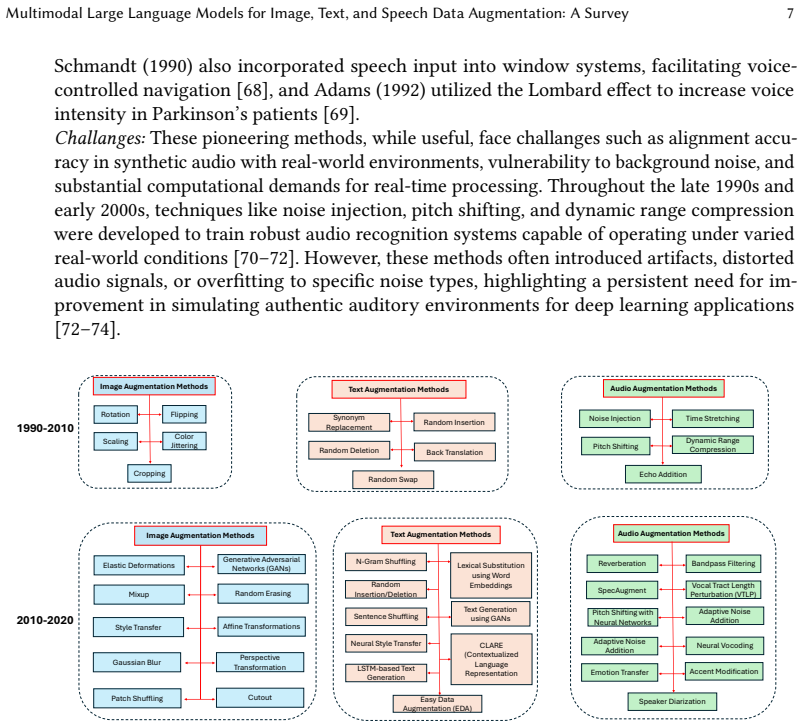
- [Section 3.2] The historical speech augmentation discussion includes works that are not data augmentation. Brandenburg et al. [66] is a surgical vocal-cord augmentation procedure, Watanabe et al. [67] is a teleconferencing system, Schmandt et al. [68] adds speech input to window systems, and Adams and Lang [69] studies the Lombard effect in Parkinson's patients. Presenting these as traditional speech data augmentation methods indicates that the screening criteria were not applied consistently and further weakens the internal consistency of the survey's scope.
- [Sections 4.2.2 and 4.3.2] Both the text and speech subsections state that Figure 6 and Figure 7 outline 'fifteen diverse techniques,' but the enumerated lists contain only ten techniques in each case. The text subsection lists Paraphrasing, Back-Translation, Text Expansion, Role Playing, Synonym Replacement, Text Simplification, Textual Entailment Generation, Noise Injection, Contextual Variation, and Controlled Generation; the speech subsection lists ten similarly. The taxonomy counts are therefore internally inconsistent with the text, and the 'fifteen' number appears to be carried over from the image section without verification.
- [Section 1 (Key Contributions)] The 'first comprehensive survey' claim is not substantiated. The manuscript does not compare its coverage with existing LLM-augmentation surveys such as Ding et al. [19], does not report a completeness analysis, and the non-reproducible protocol and out-of-scope entries described above prevent the reader from assessing whether the corpus is representative. The claim should be softened or supported by a systematic, reproducible selection process and a comparison with prior surveys.
minor comments (5)
- [General] The manuscript contains numerous typographical errors, including 'augmmentation,' 'Challanges,' 'Amplititude,' 'uch as,' 'random swapm,' 'outweight,' and 'theroy'; the paper needs a careful proofreading pass.
- [Section 2.1] The database is referred to as 'DBSL' and 'DataBase systems and Logic Programming platform,' but the link points to dblp.uni-trier.de; the correct name is DBLP (Digital Bibliography and Library Project).
- [Figure 2] The figure caption says keywords are color-coded in red, green, and blue, but the figure appears to be in grayscale or with colors that are not clearly distinguishable; the color coding should be made accessible or replaced with labels.
- [Section 4.1.1] The phrase 'the study by [106]' and similar citations are used informally; several citations in the text refer to bracketed numbers that are not consistently tied to the Tables, making it hard to trace which paper supports which step.
- [Section 5.2] The discussion of DeepSeek R1 and reinforcement-learning-based self-augmentation is speculative and is not part of the reviewed corpus; it should be clearly labeled as a future outlook rather than a surveyed method.
Circularity Check
No circular derivation found: the survey's taxonomy is assembled from external literature, and author self-citations appear only as illustrative examples, not as load-bearing premises.
full rationale
This is a literature survey rather than a derivation or empirical fitting paper, so the classic circularity failure modes (self-definitional predictions, fitted inputs renamed as predictions, uniqueness imported via self-citation, ansatz smuggled in via citation) do not apply. The paper's central claim—that it is the first comprehensive survey of LLM-based augmentation across image, text, and speech—rests on its own literature search and screening process (Sections 2.1–2.5), not on any prior result by the same authors. The self-citations present (e.g., DALL-E apple detection entries in Table 1 and the transparency work cited in Section 4.2.3) are used as examples of augmentation applications or as supporting references for limitations; none of them is used to define the taxonomy, to prove the firstness claim, or to forbid alternative frameworks. The broad inclusion criterion in Section 2.4 could admit papers outside the stated scope, and several Table entries (e.g., OphGLM, LLM-Commentator, LAMB) may not be data-augmentation methods; however, that is a correctness and scoping issue about corpus validity, not circularity, because the survey's conclusions are not forced by fitting parameters to its own outputs. No equation or definitional chain reduces a prediction to an input. Therefore the circularity burden is minimal.
Assumptions & free parameters
assumptions (2)
- domain assumption The selected literature of 24 image, 45 text, and 35 speech studies is representative of the full body of LLM-based data augmentation research.
- domain assumption The category 'multimodal LLM' includes text-to-image generators such as DALL-E, diffusion models, and GANs, even though these are not all language models.
Cite this review
Pith. "Pith review of Multimodal Large Language Models for Image, Text, and Speech Data Augmentation: A Survey." pith.science (2026). https://pith.science/paper/Y3GA5QWL
@misc{pith2026250118648,
  author       = {Pith},
  title        = {Pith review of: Multimodal Large Language Models for Image, Text, and Speech Data Augmentation: A Survey},
  year         = {2026},
  howpublished = {\url{https://pith.science/paper/Y3GA5QWL}},
  note         = {Machine review of arXiv:2501.18648}
}
read the original abstract
In the past five years, research has shifted from traditional Machine Learning (ML) and Deep Learning (DL) approaches to leveraging Large Language Models (LLMs) , including multimodality, for data augmentation to enhance generalization, and combat overfitting in training deep convolutional neural networks. However, while existing surveys predominantly focus on ML and DL techniques or limited modalities (text or images), a gap remains in addressing the latest advancements and multi-modal applications of LLM-based methods. This survey fills that gap by exploring recent literature utilizing multimodal LLMs to augment image, text, and audio data, offering a comprehensive understanding of these processes. We outlined various methods employed in the LLM-based image, text and speech augmentation, and discussed the limitations identified in current approaches. Additionally, we identified potential solutions to these limitations from the literature to enhance the efficacy of data augmentation practices using multimodal LLMs. This survey serves as a foundation for future research, aiming to refine and expand the use of multimodal LLMs in enhancing dataset quality and diversity for deep learning applications. (Surveyed Paper GitHub Repo: https://github.com/WSUAgRobotics/data-aug-multi-modal-llm. Keywords: LLM data augmentation, Grok text data augmentation, DeepSeek image data augmentation, Grok speech data augmentation, GPT audio augmentation, voice augmentation, DeepSeek for data augmentation, DeepSeek R1 text data augmentation, DeepSeek R1 image augmentation, Image Augmentation using LLM, Text Augmentation using LLM, LLM data augmentation for deep learning applications)
Figures


Figures from the paper (5 more)


Forward citations
Cited by 1 Pith paper
-
Breaking the Barriers of Text-Hungry and Audio-Deficient AI
A proposed audio-native translation framework called MAST with fractional diffusion is described, but no evidence is given that it produces working translations.
Reference graph
Works this paper leans on
-
[106]
Integrated image-based deep learning and language models for primary diabetes care
Jiajia Li, Zhouyu Guan, Jing Wang, Carol Y Cheung, Yingfeng Zheng, Lee-Ling Lim, Cynthia Ciwei Lim, Paisan Ruamviboonsuk, Rajiv Raman, Leonor Corsino, et al. Integrated image-based deep learning and language models for primary diabetes care. Nature medicine, pages 1–11, 2024
2024
-
[107]
A medical multimodal large language model for future pandemics
Fenglin Liu, Tingting Zhu, Xian Wu, Bang Yang, Chenyu You, Chenyang Wang, Lei Lu, Zhangdaihong Liu, Yefeng Zheng, Xu Sun, et al. A medical multimodal large language model for future pandemics. NPJ Digital Medicine, 6(1): 226, 2023
2023
-
[176]
Ophglm: An ophthalmology large language-and-vision assistant
Zhuo Deng, Weihao Gao, Chucheng Chen, Zhiyuan Niu, Zheng Gong, Ruiheng Zhang, Zhenjie Cao, Fang Li, Zhaoyi Ma, Wenbin Wei, et al. Ophglm: An ophthalmology large language-and-vision assistant. Artificial Intelligence in Medicine, 157:103001, 2024
2024
-
[175]
Forged-gan-bert: Authorship attribution for llm-generated forged novels
Kanishka Silva, Ingo Frommholz, Burcu Can, Fred Blain, Raheem Sarwar, and Laura Ugolini. Forged-gan-bert: Authorship attribution for llm-generated forged novels. In Proceedings of the 18th Conference of the European Chapter of the Association for Computational Linguistics: Student Research Workshop , pages 325–337, 2024
2024
-
[212]
Llm-commentator: Novel fine-tuning strategies of large language models for automatic commentary generation using football event data
Alec Cook and Oktay Karakuş. Llm-commentator: Novel fine-tuning strategies of large language models for automatic commentary generation using football event data. Knowledge-Based Systems, 300:112219, 2024. , Vol. 1, No. 1, Article . Publication date: March 2025. Multimodal Large Language Models for Image, Text, and Speech Data Augmentation: A Survey 47
2024
-
[214]
Lamb: An open-source software framework to create artificial intelligence assistants deployed and integrated into learning management systems
Marc Alier, Juanan Pereira, Francisco José García-Peñalvo, Maria Jose Casañ, and Jose Cabré. Lamb: An open-source software framework to create artificial intelligence assistants deployed and integrated into learning management systems. Computer Standards & Interfaces , 92:103940, 2025
2025
-
[215]
Abstractive summarization of youtube videos using lamini-flan-t5 llm
A Senthilselvi, RP Prawin, V Harshit, et al. Abstractive summarization of youtube videos using lamini-flan-t5 llm. In 2024 Second International Conference on Advances in Information Technology (ICAIT) , volume 1, pages 1–5. IEEE, 2024
2024
-
[217]
Towards building multilingual language model for medicine
Pengcheng Qiu, Chaoyi Wu, Xiaoman Zhang, Weixiong Lin, Haicheng Wang, Ya Zhang, Yanfeng Wang, and Weidi Xie. Towards building multilingual language model for medicine. Nature Communications, 15(1):8384, 2024
2024
-
[66]
Vocal cord augmentation with autogenous fat
James H Brandenburg, Wayne Kirkham, and Danna Koschkee. Vocal cord augmentation with autogenous fat. The Laryngoscope, 102(5):495–500, 1992
1992
-
[67]
Audio and visually augmented teleconferencing
Kazuhisa Watanabe, S Murakami, HIROSHI Ishikawa, and TAKAHlKO Kamae. Audio and visually augmented teleconferencing. Proceedings of the IEEE , 73(4):656–670, 1985
1985
-
[68]
Ackerman, and Debby Hindus
Chris Schmandt, Mark S. Ackerman, and Debby Hindus. Augmenting a window system with speech input. Computer, 23(8):50–56, 1990
1990
-
[69]
Can the lombard effect be used to improve low voice intensity in parkinson’s disease? European Journal of Disorders of Communication , 27(2):121–127, 1992
Scott G Adams and Anthony E Lang. Can the lombard effect be used to improve low voice intensity in parkinson’s disease? European Journal of Disorders of Communication , 27(2):121–127, 1992
1992
-
[19]
Data augmentation using llms: Data perspectives, learning paradigms and challenges
Bosheng Ding, Chengwei Qin, Ruochen Zhao, Tianze Luo, Xinze Li, Guizhen Chen, Wenhan Xia, Junjie Hu, Luu Anh Tuan, and Shafiq Joty. Data augmentation using llms: Data perspectives, learning paradigms and challenges. In Findings of the Association for Computational Linguistics ACL 2024 , pages 1679–1705, 2024
2024
Show all 300 references
-
[1]
Data aug- mentation techniques in time series domain: a survey and taxonomy
Guillermo Iglesias, Edgar Talavera, Ángel González-Prieto, Alberto Mozo, and Sandra Gómez-Canaval. Data aug- mentation techniques in time series domain: a survey and taxonomy. Neural Computing and Applications , 35(14): 10123–10145, 2023
2023
-
[2]
A survey on image data augmentation for deep learning
Connor Shorten and Taghi M Khoshgoftaar. A survey on image data augmentation for deep learning. Journal of big data, 6(1):1–48, 2019
2019
-
[3]
Learning to compose domain-specific transformations for data augmentation
Alexander J Ratner, Henry Ehrenberg, Zeshan Hussain, Jared Dunnmon, and Christopher Ré. Learning to compose domain-specific transformations for data augmentation. Advances in neural information processing systems , 30, 2017
2017
-
[4]
Data augmentation: A comprehensive survey of modern approaches
Alhassan Mumuni and Fuseini Mumuni. Data augmentation: A comprehensive survey of modern approaches. Array, 16:100258, 2022
2022
-
[5]
An empirical survey of data augmentation for time series classification with neural networks
Brian Kenji Iwana and Seiichi Uchida. An empirical survey of data augmentation for time series classification with neural networks. Plos one, 16(7):e0254841, 2021
2021
-
[6]
A review: Data pre-processing and data augmentation techniques
Kiran Maharana, Surajit Mondal, and Bhushankumar Nemade. A review: Data pre-processing and data augmentation techniques. Global Transitions Proceedings, 3(1):91–99, 2022
2022
-
[7]
Data augmentation in natural language processing: a novel text generation approach for long and short text classifiers
Markus Bayer, Marc-André Kaufhold, Björn Buchhold, Marcel Keller, Jörg Dallmeyer, and Christian Reuter. Data augmentation in natural language processing: a novel text generation approach for long and short text classifiers. International journal of machine learning and cyberne...
2023
-
[8]
Data augmentation for object detection: A review
Parvinder Kaur, Baljit Singh Khehra, and Er Bhupinder Singh Mavi. Data augmentation for object detection: A review. In 2021 IEEE International Midwest Symposium on Circuits and Systems (MWSCAS) , pages 537–543. IEEE, 2021
2021
-
[9]
Toward text data augmentation for sentiment analysis
Hugo Queiroz Abonizio, Emerson Cabrera Paraiso, and Sylvio Barbon. Toward text data augmentation for sentiment analysis. IEEE Transactions on Artificial Intelligence , 3(5):657–668, 2021
2021
-
[10]
Incorporating noise robustness in speech command recognition by noise augmentation of training data
Ayesha Pervaiz, Fawad Hussain, Huma Israr, Muhammad Ali Tahir, Fawad Riasat Raja, Naveed Khan Baloch, Far- ruh Ishmanov, and Yousaf Bin Zikria. Incorporating noise robustness in speech command recognition by noise augmentation of training data. Sensors, 20(8):2326, 2020
2020
-
[11]
Look once to hear: Target speech hearing with noisy examples
Bandhav Veluri, Malek Itani, Tuochao Chen, Takuya Yoshioka, and Shyamnath Gollakota. Look once to hear: Target speech hearing with noisy examples. In Proceedings of the CHI Conference on Human Factors in Computing Systems , pages 1–16, 2024
2024
-
[12]
Perception and sensing for autonomous vehicles under adverse weather conditions: A survey
Yuxiao Zhang, Alexander Carballo, Hanting Yang, and Kazuya Takeda. Perception and sensing for autonomous vehicles under adverse weather conditions: A survey. ISPRS Journal of Photogrammetry and Remote Sensing , 196: 146–177, 2023
2023
-
[13]
Safe traffic sign recognition through data augmentation for autonomous vehicles software
Lisa Jöckel, Michael Kläs, and Silverio Martínez-Fernández. Safe traffic sign recognition through data augmentation for autonomous vehicles software. In 2019 IEEE 19th International Conference on Software Quality, Reliability and Security Companion (QRS-C), pages 540–541. IEEE, 2019
2019
-
[14]
Medical image synthesis for data augmentation and anonymization using generative adversarial networks
Hoo-Chang Shin, Neil A Tenenholtz, Jameson K Rogers, Christopher G Schwarz, Matthew L Senjem, Jeffrey L Gunter, Katherine P Andriole, and Mark Michalski. Medical image synthesis for data augmentation and anonymization using generative adversarial networks. In Simulation and Sy...
2018
-
[15]
A review of medical image data augmentation techniques for deep learning applications.Journal of Medical Imaging and Radiation Oncology, 65(5):545–563, 2021
Phillip Chlap, Hang Min, Nym Vandenberg, Jason Dowling, Lois Holloway, and Annette Haworth. A review of medical image data augmentation techniques for deep learning applications.Journal of Medical Imaging and Radiation Oncology, 65(5):545–563, 2021
2021
-
[16]
To augment or not to augment? a comparative study on text augmentation techniques for low-resource nlp
Gözde Gül Şahin. To augment or not to augment? a comparative study on text augmentation techniques for low-resource nlp. Computational Linguistics, 48(1):5–42, 2022
2022
-
[17]
An empirical survey of data augmentation for limited data learning in nlp
Jiaao Chen, Derek Tam, Colin Raffel, Mohit Bansal, and Diyi Yang. An empirical survey of data augmentation for limited data learning in nlp. Transactions of the Association for Computational Linguistics , 11:191–211, 2023
2023
-
[18]
A survey on face data augmentation for the training of deep neural networks
Xiang Wang, Kai Wang, and Shiguo Lian. A survey on face data augmentation for the training of deep neural networks. Neural computing and applications , 32(19):15503–15531, 2020
2020
-
[20]
Generative pre-trained transformer (gpt) in research: A systematic review on data augmentation
Fahim Sufi. Generative pre-trained transformer (gpt) in research: A systematic review on data augmentation. Information, 15(2):99, 2024. , Vol. 1, No. 1, Article . Publication date: March 2025. Multimodal Large Language Models for Image, Text, and Speech Data Augmentation: A Survey 39
2024
-
[21]
A survey of knowledge enhanced pre-trained language models
Linmei Hu, Zeyi Liu, Ziwang Zhao, Lei Hou, Liqiang Nie, and Juanzi Li. A survey of knowledge enhanced pre-trained language models. IEEE Transactions on Knowledge and Data Engineering , 2023
2023
-
[22]
Data aug- mentation techniques for machine learning applied to optical spectroscopy datasets in agrifood applications: A comprehensive review
Ander Gracia Moisés, Ignacio Vitoria Pascual, José Javier Imas González, and Carlos Ruiz Zamarreño. Data aug- mentation techniques for machine learning applied to optical spectroscopy datasets in agrifood applications: A comprehensive review. Sensors, 23(20):8562, 2023
2023
-
[23]
Speech recognition utilizing deep learning: A systematic review of the latest developments
Dimah Al-Fraihat, Yousef Sharrab, Faisal Alzyoud, Ayman Qahmash, Monther Tarawneh, and Adi Maaita. Speech recognition utilizing deep learning: A systematic review of the latest developments. Human-centric Computing and Information Sciences, 14, 2024
2024
-
[24]
Data augmentation and deep learning methods in sound classification: A systematic review
Olusola O Abayomi-Alli, Robertas Damaševičius, Atika Qazi, Mariam Adedoyin-Olowe, and Sanjay Misra. Data augmentation and deep learning methods in sound classification: A systematic review. Electronics, 11(22):3795, 2022
2022
-
[25]
A survey of text data augmentation
Pei Liu, Xuemin Wang, Chao Xiang, and Weiye Meng. A survey of text data augmentation. In 2020 International Conference on Computer Communication and Network Security (CCNS) , pages 191–195. IEEE, 2020
2020
-
[26]
Survey on videos data augmentation for deep learning models
Nino Cauli and Diego Reforgiato Recupero. Survey on videos data augmentation for deep learning models. Future Internet, 14(3):93, 2022
2022
-
[27]
A survey on data augmentation for text classification
Markus Bayer, Marc-André Kaufhold, and Christian Reuter. A survey on data augmentation for text classification. ACM Computing Surveys, 55(7):1–39, 2022
2022
-
[28]
Image data augmentation approaches: A comprehensive survey and future directions
Teerath Kumar, Rob Brennan, Alessandra Mileo, and Malika Bendechache. Image data augmentation approaches: A comprehensive survey and future directions. IEEE Access, 2024
2024
-
[29]
Advancements in data augmentation and transfer learning: A comprehensive survey to address data scarcity challenges
Salma Fayaz, Syed Zubair Ahmad Shah, Nusrat Mohi ud din, Naillah Gul, and Assif Assad. Advancements in data augmentation and transfer learning: A comprehensive survey to address data scarcity challenges. Recent Advances in Computer Science and Communications (Formerly: Recent ...
2024
-
[30]
A survey of synthetic data augmentation methods in machine vision
Alhassan Mumuni, Fuseini Mumuni, and Nana Kobina Gerrar. A survey of synthetic data augmentation methods in machine vision. Machine Intelligence Research, pages 1–39, 2024
2024
-
[31]
Data augmentation using conditional generative adversarial networks for robust speech recognition
Peiyao Sheng, Zhuolin Yang, Hu Hu, Tian Tan, and Yanmin Qian. Data augmentation using conditional generative adversarial networks for robust speech recognition. In 2018 11th international symposium on Chinese spoken language processing (ISCSLP), pages 121–125. IEEE, 2018
2018
-
[32]
Data augmentation using generative adversarial networks for robust speech recognition
Yanmin Qian, Hu Hu, and Tian Tan. Data augmentation using generative adversarial networks for robust speech recognition. Speech Communication, 114:1–9, 2019
2019
-
[33]
Generative adversarial networks for speech processing: A review
Aamir Wali, Zareen Alamgir, Saira Karim, Ather Fawaz, Mubariz Barkat Ali, Muhammad Adan, and Malik Mujtaba. Generative adversarial networks for speech processing: A review. Computer Speech & Language , 72:101308, 2022
2022
-
[34]
How-to conduct a systematic literature review: A quick guide for computer science research
Angela Carrera-Rivera, William Ochoa, Felix Larrinaga, and Ganix Lasa. How-to conduct a systematic literature review: A quick guide for computer science research. MethodsX, 9:101895, 2022
2022
-
[35]
Guiding principles for ethical research, n.d
National Institutes of Health. Guiding principles for ethical research, n.d. URL https://www.nih.gov/health- information/nih-clinical-research-trials-you/guiding-principles-ethical-research. Accessed: 2025-01-25
2025
-
[36]
Colour retinal image enhancement based on domain knowledge
Gopal Datt Joshi and Jayanthi Sivaswamy. Colour retinal image enhancement based on domain knowledge. In 2008 Sixth Indian Conference on Computer Vision, Graphics & Image Processing , pages 591–598. IEEE, 2008
2008
-
[37]
Gray and color image contrast enhancement by the curvelet transform
J-L Starck, Fionn Murtagh, Emmanuel J Candès, and David L Donoho. Gray and color image contrast enhancement by the curvelet transform. IEEE Transactions on image processing , 12(6):706–717, 2003
2003
-
[38]
Image enhancement by histogram hyperbolization
Werner Frei. Image enhancement by histogram hyperbolization. Computer Graphics and Image Processing , 6(3): 286–294, 1977
1977
-
[39]
Digital image enhancement and noise filtering by use of local statistics
Jong-Sen Lee. Digital image enhancement and noise filtering by use of local statistics. IEEE transactions on pattern analysis and machine intelligence , (2):165–168, 1980
1980
-
[40]
Real-time image enhancement techniques
David J Ketcham. Real-time image enhancement techniques. In Image processing, volume 74, pages 120–125. SPIE, 1976
1976
-
[41]
Feature-oriented image enhancement using shock filters
Stanley Osher and Leonid I Rudin. Feature-oriented image enhancement using shock filters. SIAM Journal on numerical analysis, 27(4):919–940, 1990
1990
-
[42]
Image enhancement using fuzzy set
Sankar K Pal and Robert A King. Image enhancement using fuzzy set. Electronics letters, 16(10):376–378, 1980
1980
-
[43]
Super-resolution image reconstruction: a technical overview
Sung Cheol Park, Min Kyu Park, and Moon Gi Kang. Super-resolution image reconstruction: a technical overview. IEEE signal processing magazine , 20(3):21–36, 2003
2003
-
[44]
Accurate camera calibration for off-line, video-based augmented reality
Simon Gibson, Jonathan Cook, Toby Howard, Roger Hubbold, and Daniel Oram. Accurate camera calibration for off-line, video-based augmented reality. In Proceedings. International Symposium on Mixed and Augmented Reality , pages 37–46. IEEE, 2002
2002
-
[45]
A statistical approach to material classification using image patch exemplars
Manik Varma and Andrew Zisserman. A statistical approach to material classification using image patch exemplars. IEEE transactions on pattern analysis and machine intelligence , 31(11):2032–2047, 2008
2008
-
[46]
Jittering reduction in marker-based augmented reality systems
Monica Rubio, Arturo Quintana, Hebert Pérez-Rosés, Ricardo Quirós, and Emilio Camahort. Jittering reduction in marker-based augmented reality systems. In Computational Science and Its Applications-ICCSA 2006: International Conference, Glasgow, UK, May 8-11, 2006. Proceedings, ...
2006
-
[47]
Transform image enhancement
Sabzali Aghagolzadeh and Okan K Ersoy. Transform image enhancement. Optical Engineering, 31(3):614–626, 1992
1992
-
[48]
Camera identification from cropped and scaled images
Miroslav Goljan and Jessica Fridrich. Camera identification from cropped and scaled images. In Security, Forensics, Steganography, and Watermarking of Multimedia Contents X , volume 6819, pages 154–166. SPIE, 2008
2008
-
[49]
Image enhancement by nonlinear extrapolation in frequency space
Hayit Greenspan, Charles H Anderson, and Sofia Akber. Image enhancement by nonlinear extrapolation in frequency space. IEEE Transactions on Image Processing , 9(6):1035–1048, 2000
2000
-
[50]
A text-to-picture synthesis system for augmenting communication
Xiaojin Zhu, Andrew B Goldberg, Mohamed Eldawy, Charles R Dyer, and Bradley Strock. A text-to-picture synthesis system for augmenting communication. In AAAI, volume 7, pages 1590–1595, 2007
2007
-
[51]
Semantic representations of near-synonyms for automatic lexical choice
Philip Glenny Edmonds. Semantic representations of near-synonyms for automatic lexical choice. University of Toronto, 1999
1999
-
[52]
Word sense disambiguation with pictures
Kobus Barnard and Matthew Johnson. Word sense disambiguation with pictures. Artificial Intelligence, 167(1-2): 13–30, 2005
2005
-
[53]
Text classification by augmenting the bag-of-words representation with redundancy-compensated bigrams
Constantinos Boulis and Mari Ostendorf. Text classification by augmenting the bag-of-words representation with redundancy-compensated bigrams. In Proc. of the International Workshop in Feature Selection in Data Mining , pages 9–16. Citeseer, 2005
2005
-
[54]
Addition–deletion networks
E Ben-Naim and PL Krapivsky. Addition–deletion networks. Journal of Physics A: Mathematical and theoretical , 40 (30):8607, 2007
2007
-
[55]
Are good texts always better? interactions of text coherence, background knowledge, and levels of understanding in learning from text
Danielle S McNamara, Eileen Kintsch, Nancy Butler Songer, and Walter Kintsch. Are good texts always better? interactions of text coherence, background knowledge, and levels of understanding in learning from text. Cognition and instruction, 14(1):1–43, 1996
1996
-
[56]
Missing inaction: the dangers of ignoring missing data
Shinichi Nakagawa and Robert P Freckleton. Missing inaction: the dangers of ignoring missing data. Trends in ecology & evolution, 23(11):592–596, 2008
2008
-
[57]
Techniques for automatically correcting words in text
Karen Kukich. Techniques for automatically correcting words in text. ACM computing surveys (CSUR), 24(4):377–439, 1992
1992
-
[58]
An augmented template-based approach to text realization
Susan W McRoy, Songsak Channarukul, and Syed S Ali. An augmented template-based approach to text realization. Natural Language Engineering, 9(4):381–420, 2003
2003
-
[59]
Scene text extraction and translation for handheld devices
Ismail Haritaoglu. Scene text extraction and translation for handheld devices. InProceedings of the 2001 IEEE Computer Society Conference on Computer Vision and Pattern Recognition. CVPR 2001 , volume 2, pages II–II. IEEE, 2001
2001
-
[60]
Augmenting the power of lsi in text retrieval: Singular value rescaling
Hua Yan, William I Grosky, and Farshad Fotouhi. Augmenting the power of lsi in text retrieval: Singular value rescaling. Data & Knowledge Engineering , 65(1):108–125, 2008
2008
-
[61]
The proper place of men and machines in language translation
Martin Kay. The proper place of men and machines in language translation. machine translation, 12:3–23, 1997
1997
-
[62]
Embedding web-based statistical translation models in cross-language information retrieval
Wessel Kraaij, Jian-Yun Nie, and Michel Simard. Embedding web-based statistical translation models in cross-language information retrieval. Computational Linguistics, 29(3):381–419, 2003
2003
-
[63]
A technical word-and term-translation aid using noisy parallel corpora across language groups
Pascale Fung and Kathleen McKeown. A technical word-and term-translation aid using noisy parallel corpora across language groups. Machine translation, 12:53–87, 1997
1997
-
[64]
Iterative clustering of high dimensional text data augmented by local search
Inderjit S Dhillon, Yuqiang Guan, and Jacob Kogan. Iterative clustering of high dimensional text data augmented by local search. In 2002 IEEE International Conference on Data Mining, 2002. Proceedings. , pages 131–138. IEEE, 2002
2002
-
[65]
Augmented audio reality: Telepresence/vr hybrid acoustic environments
Michael Cohen, Shigeaki Aoki, and Nobuo Koizumi. Augmented audio reality: Telepresence/vr hybrid acoustic environments. In Proceedings of 1993 2nd IEEE International Workshop on Robot and Human Communication , pages 361–364. IEEE, 1993
1993
-
[70]
Speech perception, localization, and lateralization with bilateral cochlear implants
Richard JM van Hoesel and Richard S Tyler. Speech perception, localization, and lateralization with bilateral cochlear implants. The Journal of the Acoustical Society of America , 113(3):1617–1630, 2003
2003
-
[71]
Improving performance in noise for hearing aids and cochlear implants using coherent modulation filtering
Jong Ho Won, Steven M Schimmel, Ward R Drennan, Pamela E Souza, Les Atlas, and Jay T Rubinstein. Improving performance in noise for hearing aids and cochlear implants using coherent modulation filtering. Hearing research, 239(1-2):1–11, 2008
2008
-
[72]
Speech recognition for a humanoid with motor noise utilizing missing feature theory
Yoshitaka Nishimura, Mitsuru Ishizuka, Kazuhiro Nakadai, Mikio Nakano, and Hiroshi Tsujino. Speech recognition for a humanoid with motor noise utilizing missing feature theory. In 2006 6th IEEE-RAS International Conference on Humanoid Robots, pages 26–33. IEEE, 2006
2006
-
[73]
Augmented reality audio for mobile and wearable appliances
Aki Härmä, Julia Jakka, Miikka Tikander, Matti Karjalainen, Tapio Lokki, Jarmo Hiipakka, and Gaëtan Lorho. Augmented reality audio for mobile and wearable appliances. Journal of the Audio Engineering Society , 52(6):618–639, , Vol. 1, No. 1, Article . Publication date: March 2...
2025
-
[74]
Power supply noise in analog audio class d amplifiers
Wei Shu and Joseph S Chang. Power supply noise in analog audio class d amplifiers. IEEE Transactions on Circuits and Systems I: Regular Papers , 56(1):84–96, 2008
2008
-
[75]
Deep convolutional neural network based medical image classification for disease diagnosis
Samir S Yadav and Shivajirao M Jadhav. Deep convolutional neural network based medical image classification for disease diagnosis. Journal of Big data , 6(1):1–18, 2019
2019
-
[76]
Going deep in medical image analysis: concepts, methods, challenges, and future directions
Fouzia Altaf, Syed MS Islam, Naveed Akhtar, and Naeem Khalid Janjua. Going deep in medical image analysis: concepts, methods, challenges, and future directions. IEEE Access, 7:99540–99572, 2019
2019
-
[77]
Adversarial differentiable data augmentation for autonomous systems
Manli Shu, Yu Shen, Ming C Lin, and Tom Goldstein. Adversarial differentiable data augmentation for autonomous systems. In 2021 IEEE International Conference on Robotics and Automation (ICRA) , pages 14069–14075. IEEE, 2021
2021
-
[78]
Data augmentation for deep learning based semantic segmentation and crop-weed classification in agricultural robotics
Daobilige Su, He Kong, Yongliang Qiao, and Salah Sukkarieh. Data augmentation for deep learning based semantic segmentation and crop-weed classification in agricultural robotics. Computers and Electronics in Agriculture , 190: 106418, 2021
2021
-
[79]
Dagam: data augmentation with generation and modification
Byeong-Cheol Jo, Tak-Sung Heo, Yeongjoon Park, Yongmin Yoo, Won Ik Cho, and Kyungsun Kim. Dagam: data augmentation with generation and modification. arXiv preprint arXiv:2204.02633, 2022
2022 arXiv
-
[80]
Generative ai in agriculture: Creating image datasets using dall.e’s advanced large language model capabilities
Ranjan Sapkota and Manoj Karkee. Generative ai in agriculture: Creating image datasets using dall.e’s advanced large language model capabilities. arXiv preprint arXiv:2307.08789, 2023
2023 arXiv
-
[81]
Synthetic data generation for tabular health records: A systematic review
Mikel Hernandez, Gorka Epelde, Ane Alberdi, Rodrigo Cilla, and Debbie Rankin. Synthetic data generation for tabular health records: A systematic review. Neurocomputing, 493:28–45, 2022
2022
-
[82]
Data augmentation for medical imaging: A systematic literature review
Fabio Garcea, Alessio Serra, Fabrizio Lamberti, and Lia Morra. Data augmentation for medical imaging: A systematic literature review. Computers in Biology and Medicine , 152:106391, 2023
2023
-
[83]
Multi-modal llms in agriculture: A comprehensive review
Ranjan Sapkota, Rizwan Qureshi, Syed Zohaib Hassan, John Shutske, Maged Shoman, Muhammad Sajjad, Fayaz Ali Dharejo, Achyut Paudel, Jiajia Li, Zhichao Meng, et al. Multi-modal llms in agriculture: A comprehensive review. Authorea Preprints, 2024
2024
-
[84]
Research on data augmentation for image classification based on convolution neural networks
Jia Shijie, Wang Ping, Jia Peiyi, and Hu Siping. Research on data augmentation for image classification based on convolution neural networks. In 2017 Chinese automation congress (CAC) , pages 4165–4170. IEEE, 2017
2017
-
[85]
Data augmentation and generative machine learning on the cloud platform
Piyush Vyas, Kaushik Muthusamy Ragothaman, Akhilesh Chauhan, and Bhaskar Rimal. Data augmentation and generative machine learning on the cloud platform. International Journal of Information Technology , 16(8):4833–4843, 2024
2024
-
[86]
Data augmentation using deep generative models for embedding based speaker recognition
Shuai Wang, Yexin Yang, Zhanghao Wu, Yanmin Qian, and Kai Yu. Data augmentation using deep generative models for embedding based speaker recognition. IEEE/ACM Transactions on Audio, Speech, and Language Processing , 28: 2598–2609, 2020
2020
-
[87]
Statistical augmentation of a chinese machine-readable dictionary
Pascale Fung and Dekai Wu. Statistical augmentation of a chinese machine-readable dictionary. arXiv preprint cmp-lg/9406015, 1994
1994 arXiv
-
[88]
A comparison of id3 and backpropagation for english text-to-speech mapping
Thomas G Dietterich, Hermann Hild, and Ghulum Bakiri. A comparison of id3 and backpropagation for english text-to-speech mapping. Machine Learning, 18:51–80, 1995
1995
-
[89]
Donald B Rubin. Comment: A noniterative sampling/importance resampling alternative to the data augmentation algorithm for creating a few imputations when fractions of missing information are modest: The sir algorithm.Journal of the American Statistical Association , 82(398):54...
1987
-
[90]
Srl-aco: A text augmentation framework based on semantic role labeling and ant colony optimization
Aytuğ Onan. Srl-aco: A text augmentation framework based on semantic role labeling and ant colony optimization. Journal of King Saud University-Computer and Information Sciences , 35(7):101611, 2023
2023
-
[91]
From theories on styles to their transfer in text: Bridging the gap with a hierarchical survey
Enrica Troiano, Aswathy Velutharambath, and Roman Klinger. From theories on styles to their transfer in text: Bridging the gap with a hierarchical survey. Natural Language Engineering, 29(4):849–908, 2023
2023
-
[92]
Summary of chatgpt-related research and perspective towards the future of large language models
Yiheng Liu, Tianle Han, Siyuan Ma, Jiayue Zhang, Yuanyuan Yang, Jiaming Tian, Hao He, Antong Li, Mengshen He, Zhengliang Liu, et al. Summary of chatgpt-related research and perspective towards the future of large language models. Meta-Radiology, page 100017, 2023
2023
-
[93]
Survey on deep neural networks in speech and vision systems
Mahbubul Alam, Manar D Samad, Lasitha Vidyaratne, Alexander Glandon, and Khan M Iftekharuddin. Survey on deep neural networks in speech and vision systems. Neurocomputing, 417:302–321, 2020
2020
-
[94]
Wahab Khan, Ali Daud, Khairullah Khan, Shakoor Muhammad, and Rafiul Haq. Exploring the frontiers of deep learning and natural language processing: A comprehensive overview of key challenges and emerging trends.Natural Language Processing Journal, page 100026, 2023
2023
-
[95]
Automated building damage assessment and large-scale mapping by integrating satellite imagery, gis, and deep learning
Abdullah M Braik and Maria Koliou. Automated building damage assessment and large-scale mapping by integrating satellite imagery, gis, and deep learning. Computer-Aided Civil and Infrastructure Engineering , 2024
2024
-
[96]
Machine learning for advanced emission monitoring and reduction strategies in fossil fuel power plants
Zitu Zuo, Yongjie Niu, Jiale Li, Hongpeng Fu, and Mengjie Zhou. Machine learning for advanced emission monitoring and reduction strategies in fossil fuel power plants. Applied Sciences, 14(18):8442, 2024
2024
-
[97]
A review on large language models: Architectures, applications, taxonomies, open issues and challenges
Mohaimenul Azam Khan Raiaan, Md Saddam Hossain Mukta, Kaniz Fatema, Nur Mohammad Fahad, Sadman Sakib, Most Marufatul Jannat Mim, Jubaer Ahmad, Mohammed Eunus Ali, and Sami Azam. A review on large language models: Architectures, applications, taxonomies, open issues and challen...
2024
-
[98]
A comparison on data augmentation methods based on deep learning for audio classification
Shengyun Wei, Shun Zou, Feifan Liao, et al. A comparison on data augmentation methods based on deep learning for audio classification. In Journal of physics: Conference series , volume 1453, page 012085. IOP Publishing, 2020
2020
-
[99]
A study on data augmentation in voice anti-spoofing
Ariel Cohen, Inbal Rimon, Eran Aflalo, and Haim H Permuter. A study on data augmentation in voice anti-spoofing. Speech Communication, 141:56–67, 2022
2022
-
[100]
On the analysis of data augmentation methods for spectral imaged based heart sound classification using convolutional neural networks
George Zhou, Yunchan Chen, and Candace Chien. On the analysis of data augmentation methods for spectral imaged based heart sound classification using convolutional neural networks. BMC medical informatics and decision making , 22(1):226, 2022
2022
-
[101]
A comprehensive overview on data augmentation techniques for medical images
Swarajya Madhuri Rayavarapu, Tammineni Shanmukha Prasanthi, Sasibhushana Rao Gottapu, and Aruna Singam. A comprehensive overview on data augmentation techniques for medical images. In 2024 5th International Conference on Electronics and Sustainable Communication Systems (ICESC...
2024
-
[102]
Itimca: Image-text information and cross-attention for multi-modal cassava leaf disease classification based on a novel multi-modal dataset in natural environments
Huinian Li, Baoyu Chen, Jingjia Chen, Shuting Li, Feiyong He, and Hu Yingbiao. Itimca: Image-text information and cross-attention for multi-modal cassava leaf disease classification based on a novel multi-modal dataset in natural environments. Crop Protection, page 106981, 2024
2024
-
[103]
Synthetic meets authentic: Leveraging llm generated datasets for yolo11 and yolov10-based apple detection through machine vision sensors
Ranjan Sapkota, Zhichao Meng, and Manoj Karkee. Synthetic meets authentic: Leveraging llm generated datasets for yolo11 and yolov10-based apple detection through machine vision sensors. Smart Agricultural Technology, page 100614, 2024
2024
-
[104]
Enhanced dual contrast representation learning with cell separation and merging for breast cancer diagnosis
Yang Liu, Yiqi Zhu, Zhehao Gu, Jinshan Pan, Juncheng Li, Ming Fan, Lihua Li, and Tieyong Zeng. Enhanced dual contrast representation learning with cell separation and merging for breast cancer diagnosis. Computer Vision and Image Understanding, 247:104065, 2024
2024
-
[105]
Generative models for grid-based and image-based pathfinding
Daniil Kirilenko, Anton Andreychuk, Aleksandr I Panov, and Konstantin Yakovlev. Generative models for grid-based and image-based pathfinding. Artificial Intelligence, page 104238, 2024
2024
-
[108]
Mistra: Misogyny detection through text–image fusion and representation analy- sis
Nitesh Jindal, Prasanna Kumar Kumaresan, Rahul Ponnusamy, Sajeetha Thavareesan, Saranya Rajiakodi, and Bharathi Raja Chakravarthi. Mistra: Misogyny detection through text–image fusion and representation analy- sis. Natural Language Processing Journal , 7:100073, 2024
2024
-
[109]
Zero-shot automatic annotation and instance segmentation using llm-generated datasets: Eliminating field imaging and manual annotation for deep learning model development
Ranjan Sapkota, Achyut Paudel, and Manoj Karkee. Zero-shot automatic annotation and instance segmentation using llm-generated datasets: Eliminating field imaging and manual annotation for deep learning model development. arXiv preprint arXiv:2411.11285, 2024
2024 arXiv
-
[110]
Improved yolov12 with llm-generated synthetic data for enhanced apple detection and benchmarking against yolov11 and yolov10
Ranjan Sapkota and Manoj Karkee. Improved yolov12 with llm-generated synthetic data for enhanced apple detection and benchmarking against yolov11 and yolov10. arXiv preprint arXiv:2503.00057, 2025
2025 arXiv
-
[111]
Comprehensive performance evaluation of yolov12, yolo11, yolov10, yolov9 and yolov8 on detecting and counting fruitlet in complex orchard environments
Ranjan Sapkota, Zhichao Meng, Martin Churuvija, Xiaoqiang Du, Zenghong Ma, and Manoj Karkee. Comprehensive performance evaluation of yolov12, yolo11, yolov10, yolov9 and yolov8 on detecting and counting fruitlet in complex orchard environments. arXiv preprint arXiv:2407.12040, 2024
2024
-
[112]
Large language models for healthcare data augmentation: An example on patient-trial matching
Jiayi Yuan, Ruixiang Tang, Xiaoqian Jiang, and Xia Hu. Large language models for healthcare data augmentation: An example on patient-trial matching. In AMIA Annual Symposium Proceedings, volume 2023, page 1324. American Medical Informatics Association, 2023
2023
-
[113]
Evolutionary design of explainable algorithms for biomedical image segmentation
Kévin Cortacero, Brienne McKenzie, Sabina Müller, Roxana Khazen, Fanny Lafouresse, Gaëlle Corsaut, Nathalie Van Acker, François-Xavier Frenois, Laurence Lamant, Nicolas Meyer, et al. Evolutionary design of explainable algorithms for biomedical image segmentation. Nature commun...
2023
-
[114]
Multi-modal transformer architecture for medical image analysis and automated report generation
Santhosh Raminedi, S Shridevi, and Daehan Won. Multi-modal transformer architecture for medical image analysis and automated report generation. Scientific Reports, 14(1):19281, 2024
2024
-
[115]
Mllm4rec: multimodal information enhancing llm for sequential recommendation
Yuxiang Wang, Xin Shi, and Xueqing Zhao. Mllm4rec: multimodal information enhancing llm for sequential recommendation. Journal of Intelligent Information Systems , pages 1–17, 2024
2024
-
[116]
Dallmi: Domain adaption for llm-based multi-label classifier
Miruna Bet,ianu, Abele Mălan, Marco Aldinucci, Robert Birke, and Lydia Chen. Dallmi: Domain adaption for llm-based multi-label classifier. In Pacific-Asia Conference on Knowledge Discovery and Data Mining , pages 277–289. Springer, 2024
2024
-
[117]
Neural data augmentation for legal overruling task: Small deep learning models vs
Reshma Sheik, KP Siva Sundara, and S Jaya Nirmala. Neural data augmentation for legal overruling task: Small deep learning models vs. large language models. Neural Processing Letters, 56(2):121, 2024
2024
-
[118]
Df-gan: A simple and effective baseline for text-to-image synthesis
Ming Tao, Hao Tang, Fei Wu, Xiao-Yuan Jing, Bing-Kun Bao, and Changsheng Xu. Df-gan: A simple and effective baseline for text-to-image synthesis. In Proceedings of the IEEE/CVF conference on computer vision and pattern recognition, pages 16515–16525, 2022. , Vol. 1, No. 1, Art...
2022
-
[119]
Rich human feedback for text-to-image generation
Youwei Liang, Junfeng He, Gang Li, Peizhao Li, Arseniy Klimovskiy, Nicholas Carolan, Jiao Sun, Jordi Pont-Tuset, Sarah Young, Feng Yang, et al. Rich human feedback for text-to-image generation. In Proceedings of the IEEE/CVF Conference on Computer Vision and Pattern Recognitio...
2024
-
[120]
Grounded text-to-image synthesis with attention refocusing
Quynh Phung, Songwei Ge, and Jia-Bin Huang. Grounded text-to-image synthesis with attention refocusing. In Proceedings of the IEEE/CVF Conference on Computer Vision and Pattern Recognition , pages 7932–7942, 2024
2024
-
[121]
Semaug: Semantically meaningful image augmentations for object detection through language grounding
Morgan Heisler, Amin Banitalebi-Dehkordi, and Yong Zhang. Semaug: Semantically meaningful image augmentations for object detection through language grounding. InEuropean Conference on Computer Vision, pages 610–626. Springer, 2022
2022
-
[122]
Dalda: Data augmentation leveraging diffusion model and llm with adaptive guidance scaling
Kyuheon Jung, Yongdeuk Seo, Seongwoo Cho, Jaeyoung Kim, Hyun-seok Min, and Sungchul Choi. Dalda: Data augmentation leveraging diffusion model and llm with adaptive guidance scaling. arXiv preprint arXiv:2409.16949, 2024
2024 arXiv
-
[123]
Scaling robot learning with semantically imagined experience
Tianhe Yu, Ted Xiao, Austin Stone, Jonathan Tompson, Anthony Brohan, Su Wang, Jaspiar Singh, Clayton Tan, Jodilyn Peralta, Brian Ichter, et al. Scaling robot learning with semantically imagined experience. arXiv preprint arXiv:2302.11550, 2023
2023 arXiv
-
[124]
Fusecap: Leveraging large language models for enriched fused image captions
Noam Rotstein, David Bensaïd, Shaked Brody, Roy Ganz, and Ron Kimmel. Fusecap: Leveraging large language models for enriched fused image captions. In Proceedings of the IEEE/CVF Winter Conference on Applications of Computer Vision, pages 5689–5700, 2024
2024
-
[125]
Augment the pairs: Semantics- preserving image-caption pair augmentation for grounding-based vision and language models
Jingru Yi, Burak Uzkent, Oana Ignat, Zili Li, Amanmeet Garg, Xiang Yu, and Linda Liu. Augment the pairs: Semantics- preserving image-caption pair augmentation for grounding-based vision and language models. In Proceedings of the IEEE/CVF Winter Conference on Applications of Co...
2024
-
[126]
Synth2: Boosting visual-language models with synthetic captions and image embeddings
Sahand Sharifzadeh, Christos Kaplanis, Shreya Pathak, Dharshan Kumaran, Anastasija Ilic, Jovana Mitrovic, Charles Blundell, and Andrea Banino. Synth2: Boosting visual-language models with synthetic captions and image embeddings. arXiv preprint arXiv:2403.07750, 2024
2024 arXiv
-
[127]
Generating images with multimodal language models.Advances in Neural Information Processing Systems , 36, 2024
Jing Yu Koh, Daniel Fried, and Russ R Salakhutdinov. Generating images with multimodal language models.Advances in Neural Information Processing Systems , 36, 2024
2024
-
[128]
Unimo-g: Unified image generation through multimodal conditional diffusion
Wei Li, Xue Xu, Jiachen Liu, and Xinyan Xiao. Unimo-g: Unified image generation through multimodal conditional diffusion. arXiv preprint arXiv:2401.13388, 2024
2024 arXiv
-
[129]
Visual editing with llm-based tool chaining: An efficient distillation approach for real-time applications
Oren Sultan, Alex Khasin, Guy Shiran, Asnat Greenstein-Messica, and Dafna Shahaf. Visual editing with llm-based tool chaining: An efficient distillation approach for real-time applications. arXiv preprint arXiv:2410.02952, 2024
-
[130]
Forgerygpt: Multimodal large language model for explainable image forgery detection and localization
Jiawei Li, Fanrui Zhang, Jiaying Zhu, Esther Sun, Qiang Zhang, and Zheng-Jun Zha. Forgerygpt: Multimodal large language model for explainable image forgery detection and localization. arXiv preprint arXiv:2410.10238, 2024
2024 arXiv
-
[131]
Image augmentation agent for weakly supervised semantic segmentation
Wangyu Wu, Xianglin Qiu, Siqi Song, Zhenhong Chen, Xiaowei Huang, Fei Ma, and Jimin Xiao. Image augmentation agent for weakly supervised semantic segmentation. arXiv preprint arXiv:2412.20439, 2024
2024 arXiv
-
[132]
Lab-rag: Label boosted retrieval augmented generation for radiology report generation
Steven Song, Anirudh Subramanyam, Irene Madejski, and Robert L Grossman. Lab-rag: Label boosted retrieval augmented generation for radiology report generation. arXiv preprint arXiv:2411.16523, 2024
2024
-
[133]
Diagen: Diverse image augmentation with generative models
Tobias Lingenberg, Markus Reuter, Gopika Sudhakaran, Dominik Gojny, Stefan Roth, and Simone Schaub-Meyer. Diagen: Diverse image augmentation with generative models. arXiv preprint arXiv:2408.14584, 2024
2024 arXiv
-
[134]
T2vid: Translating long text into multi-image is the catalyst for video-llms
Shukang Yin, Chaoyou Fu, Sirui Zhao, Yunhang Shen, Chunjiang Ge, Yan Yang, Zuwei Long, Yuhan Dai, Tong Xu, Xing Sun, et al. T2vid: Translating long text into multi-image is the catalyst for video-llms. arXiv preprint arXiv:2411.19951, 2024
2024 arXiv
-
[135]
Mm-instruct: Generated visual instructions for large multimodal model alignment
Jihao Liu, Xin Huang, Jinliang Zheng, Boxiao Liu, Jia Wang, Osamu Yoshie, Yu Liu, and Hongsheng Li. Mm-instruct: Generated visual instructions for large multimodal model alignment. arXiv preprint arXiv:2406.19736, 2024
2024 arXiv
-
[136]
Dall-m: Context-aware clinical data augmentation with llms
Chihcheng Hsieh, Catarina Moreira, Isabel Blanco Nobre, Sandra Costa Sousa, Chun Ouyang, Margot Brereton, Joaquim Jorge, and Jacinto C Nascimento. Dall-m: Context-aware clinical data augmentation with llms. arXiv preprint arXiv:2407.08227, 2024
2024 arXiv
-
[137]
Contextual object detection with multimodal large language models
Yuhang Zang, Wei Li, Jun Han, Kaiyang Zhou, and Chen Change Loy. Contextual object detection with multimodal large language models. International Journal of Computer Vision , pages 1–19, 2024
2024
-
[138]
Huang, Xianghao Xu, R
Aditya Ganeshan, Ryan Y. Huang, Xianghao Xu, R. Kenny Jones, and Daniel Ritchie. Parsel: Parameterized shape editing with language, 2024. URL https://arxiv.org/abs/2405.20319
2024 arXiv
-
[139]
Qi, Li Yi, Hao Su, and Leonidas J
Charles R. Qi, Li Yi, Hao Su, and Leonidas J. Guibas. Pointnet++: Deep hierarchical feature learning on point sets in a metric space. In Advances in Neural Information Processing Systems (NeurIPS) , pages 5105–5114, 2017
2017
-
[140]
Sarasua, Michael M
Yue Wang, Yongbin Sun, Ziwei Liu, Sanjay E. Sarasua, Michael M. Bronstein, and Justin M. Solomon. Dynamic graph cnn for learning on point clouds. In ACM Transactions on Graphics (TOG) , volume 38, pages 1–12, 2019
2019
-
[141]
Learning representations and generative models for 3d point clouds
Panos Achlioptas, Olga Diamanti, Ioannis Mitliagkas, and Leonidas Guibas. Learning representations and generative models for 3d point clouds. In International Conference on Machine Learning (ICML) , pages 40–49, 2018
2018
-
[142]
Deep part-aware shape editing for 3d point clouds
Weikai Chen, Kai Xu, et al. Deep part-aware shape editing for 3d point clouds. In International Conference on 3D Vision (3DV), pages 438–447, 2021. , Vol. 1, No. 1, Article . Publication date: March 2025. 44 Sapkota et al
2021
-
[143]
Sgpr: Segmentation-guided point cloud reconstruction for rotated objects
Zhihao Fan and Xiaojun Wu. Sgpr: Segmentation-guided point cloud reconstruction for rotated objects. In IEEE Winter Conference on Applications of Computer Vision (W ACV), pages 1465–1474, 2021
2021
-
[144]
Freeman, and Joshua B
Jiajun Wu, Chengkai Zhang, Tianfan Xue, William T. Freeman, and Joshua B. Tenenbaum. Learning a probabilistic latent space of object shapes via 3d generative-adversarial modeling. In Advances in Neural Information Processing Systems (NeurIPS), pages 82–90, 2016
2016
-
[145]
Learning localized generative models for 3d point clouds via graph convolution
Diego Valsesia, Giulia Fracastoro, and Enrico Magli. Learning localized generative models for 3d point clouds via graph convolution. In International Conference on Learning Representations (ICLR) , 2020
2020
-
[146]
3d generative adversarial models with diffusion-based methods
Bo Zhou, Yuan Li, Yijun Li, et al. 3d generative adversarial models with diffusion-based methods. In International Conference on 3D Vision (3DV) , pages 191–202, 2021
2021
-
[147]
Score-based generative models for 3d point cloud generation and editing
Jinliang Luo, Qingyong Hu, Andrew Markham, and Leonidas Guibas. Score-based generative models for 3d point cloud generation and editing. In IEEE Conference on Computer Vision and Pattern Recognition (CVPR) , pages 5527–5537, 2023
2023
-
[148]
Text2mesh: Text-driven neural stylization for meshes and point clouds
Min-Gyu Kim, Sanghyun Park, Gyeongsik Kwon, Hyunwoo Park, and Kyoung Mu Lee Kim. Text2mesh: Text-driven neural stylization for meshes and point clouds. In ACM SIGGRAPH Asia, pages 1–10, 2022
2022
-
[149]
Point-e: A system for generating 3d point clouds from complex prompts
Alex Nichol, Aditya Ramesh, and Prafulla Dhariwal. Point-e: A system for generating 3d point clouds from complex prompts. OpenAI Technical Report, 2022. https://github.com/openai/point-e
2022
-
[150]
Shap-e: Generating conditional 3d implicit functions
Heewoo Jun, Robin Rombach, Andreas Blattmann, Lucas Beyer, Bjorn Ommer, Tim Salimans, and Ilya Sutskever. Shap-e: Generating conditional 3d implicit functions. OpenAI Technical Report, 2023
2023
-
[151]
Barron, et al
Ben Poole, Ajay Jalal, Jonathan T. Barron, et al. Dreamfusion: Text-to-3d using 2d diffusion. Google Research Preprint,
-
[152]
Zero-1-to-3: Zero-shot one image to 3d object
Fangzhou Liu, Pengsong Liu, et al. Zero-1-to-3: Zero-shot one image to 3d object. arXiv preprint arXiv:2303.11328, 2023
2023 arXiv
-
[153]
Shapepart: Learning region-level decompositions of 3d objects via part-aware shape synthesis
Yifan Li, Lin Shao, and Bin Yang. Shapepart: Learning region-level decompositions of 3d objects via part-aware shape synthesis. In IEEE International Conference on Computer Vision (ICCV) , pages 1241–1250, 2021
2021
-
[154]
Pq-net: A generative part quality network for 3d shape composition
Wei Wu, Fangfei Xiang, and Zhen Li. Pq-net: A generative part quality network for 3d shape composition. In IEEE Conference on Computer Vision and Pattern Recognition (CVPR) , pages 4902–4911, 2021
2021
-
[155]
Semanticpc: Semantic-driven part composition for 3d object generation
Yang Su, Qing Liu, and Song-Chun Zhu. Semanticpc: Semantic-driven part composition for 3d object generation. In Conference on Computer Vision and Pattern Recognition (CVPR) , pages 21334–21343, 2023
2023
-
[156]
Det3d: Multimodal 3d detection with point clouds, images, and language prompts
Haoyang Wu, Boqing Chen, Xi Li, and Takashi Sato. Det3d: Multimodal 3d detection with point clouds, images, and language prompts. In IEEE/RSJ International Conference on Intelligent Robots and Systems (IROS) , 2023
2023
-
[157]
Foundations3d: Large-scale pretraining of 3d vision-language models via foundational shapes and descriptions
Hengshuang Zhao, Li Yi, Leonidas Guibas, and Jiaya Jia. Foundations3d: Large-scale pretraining of 3d vision-language models via foundational shapes and descriptions. In International Conference on Machine Learning (ICML) , pages 8487–8501, 2023
2023
-
[158]
Llm vs small model? large language model based text augmentation enhanced personality detection model
Linmei Hu, Hongyu He, Duokang Wang, Ziwang Zhao, Yingxia Shao, and Liqiang Nie. Llm vs small model? large language model based text augmentation enhanced personality detection model. InProceedings of the AAAI Conference on Artificial Intelligence, volume 38, pages 18234–18242, 2024
2024
-
[159]
Improving audio captioning models with fine-grained audio features, text embedding supervision, and llm mix-up augmentation
Shih-Lun Wu, Xuankai Chang, Gordon Wichern, Jee-weon Jung, François Germain, Jonathan Le Roux, and Shinji Watanabe. Improving audio captioning models with fine-grained audio features, text embedding supervision, and llm mix-up augmentation. In ICASSP 2024-2024 IEEE Internation...
2024
-
[160]
Improving text classification with large language model-based data augmentation
Huanhuan Zhao, Haihua Chen, Thomas A Ruggles, Yunhe Feng, Debjani Singh, and Hong-Jun Yoon. Improving text classification with large language model-based data augmentation. Electronics, 13(13):2535, 2024
2024
-
[161]
Identifying citizen-related issues from social media using llm-based data augmentation
Vitor Gaboardi dos Santos, Guto Leoni Santos, Theo Lynn, and Boualem Benatallah. Identifying citizen-related issues from social media using llm-based data augmentation. In International Conference on Advanced Information Systems Engineering, pages 531–546. Springer, 2024
2024
-
[162]
Multimodal fake news detection through data augmentation-based contrastive learning
Jiaheng Hua, Xiaodong Cui, Xianghua Li, Keke Tang, and Peican Zhu. Multimodal fake news detection through data augmentation-based contrastive learning. Applied Soft Computing, 136:110125, 2023
2023
-
[163]
Rumorllm: A rumor large language model-based fake-news-detection data-augmentation approach
Jianqiao Lai, Xinran Yang, Wenyue Luo, Linjiang Zhou, Langchen Li, Yongqi Wang, and Xiaochuan Shi. Rumorllm: A rumor large language model-based fake-news-detection data-augmentation approach. Applied Sciences, 14(8):3532, 2024
2024
-
[164]
La-ucl: Llm-augmented unsupervised contrastive learning framework for few-shot text classification
Jing Zhang, Hui Gao, Peng Zhang, Boda Feng, Wenmin Deng, and Yuexian Hou. La-ucl: Llm-augmented unsupervised contrastive learning framework for few-shot text classification. InProceedings of the 2024 Joint International Conference on Computational Linguistics, Language Resourc...
2024
-
[165]
Llm–assisted data augmentation for chinese dialogue–level dependency parsing
Meishan Zhang, Gongyao Jiang, Shuang Liu, Jing Chen, and Min Zhang. Llm–assisted data augmentation for chinese dialogue–level dependency parsing. Computational Linguistics, pages 1–24, 2024
2024
-
[166]
Tnt-llm: Text mining at scale with large language models
Mengting Wan, Tara Safavi, Sujay Kumar Jauhar, Yujin Kim, Scott Counts, Jennifer Neville, Siddharth Suri, Chirag Shah, Ryen W White, Longqi Yang, et al. Tnt-llm: Text mining at scale with large language models. In Proceedings of , Vol. 1, No. 1, Article . Publication date: Mar...
2025
-
[167]
Resolving the imbalance issue in hierarchical disciplinary topic inference via llm-based data augmentation
Xunxin Cai, Meng Xiao, Zhiyuan Ning, and Yuanchun Zhou. Resolving the imbalance issue in hierarchical disciplinary topic inference via llm-based data augmentation. In 2023 IEEE International Conference on Data Mining Workshops (ICDMW), pages 1424–1429. IEEE, 2023
2023
-
[168]
Llm for patient-trial matching: Privacy-aware data augmenta- tion towards better performance and generalizability
Jiayi Yuan, Ruixiang Tang, Xiaoqian Jiang, and Xia Hu. Llm for patient-trial matching: Privacy-aware data augmenta- tion towards better performance and generalizability. In American Medical Informatics Association (AMIA) Annual Symposium, 2023
2023
-
[169]
Evaluation and analysis of large language models for clinical text augmentation and generation
Atif Latif and Jihie Kim. Evaluation and analysis of large language models for clinical text augmentation and generation. IEEE Access, 2024
2024
-
[170]
Automatic semantic augmentation of language model prompts (for code summarization)
Toufique Ahmed, Kunal Suresh Pai, Premkumar Devanbu, and Earl Barr. Automatic semantic augmentation of language model prompts (for code summarization). In Proceedings of the IEEE/ACM 46th International Conference on Software Engineering, pages 1–13, 2024
2024
-
[171]
Cean: Contrastive event aggregation network with llm-based augmentation for event extraction
Zihao Meng, Tao Liu, Heng Zhang, Kai Feng, and Peng Zhao. Cean: Contrastive event aggregation network with llm-based augmentation for event extraction. In Proceedings of the 18th Conference of the European Chapter of the Association for Computational Linguistics (Volume 1: Lon...
2024
-
[172]
Comparison of textual data augmentation methods on sst-2 dataset
Mustafa Çataltaş, Nurdan Akhan Baykan, and Ilyas Cicekli. Comparison of textual data augmentation methods on sst-2 dataset. In International Congress of Electrical and Computer Engineering , pages 189–201. Springer, 2023
2023
-
[173]
Fine-tuned generative llm oversampling can improve performance over traditional techniques on multiclass imbalanced text classification
Nicolas Antonio Cloutier and Nathalie Japkowicz. Fine-tuned generative llm oversampling can improve performance over traditional techniques on multiclass imbalanced text classification. In 2023 IEEE International Conference on Big Data (BigData), pages 5181–5186. IEEE, 2023
2023
-
[174]
Enhancing task-oriented dialog system with subjective knowledge: A large language model-based data augmentation framework
Haein Jung, Heuiyeen Yeen, Jeehyun Lee, Minju Kim, Namo Bang, and Myoung-Wan Koo. Enhancing task-oriented dialog system with subjective knowledge: A large language model-based data augmentation framework. InProceedings of The Eleventh Dialog System Technology Challenge , pages...
2023
-
[177]
Evaluating llm prompts for data augmentation in multi-label classification of ecological texts
Anna Glazkova and Olga Zakharova. Evaluating llm prompts for data augmentation in multi-label classification of ecological texts. arXiv preprint arXiv:2411.14896, 2024
2024 arXiv
-
[178]
Swissadt: An audio description translation system for swiss languages
Lukas Fischer, Yingqiang Gao, Alexa Lintner, and Sarah Ebling. Swissadt: An audio description translation system for swiss languages. arXiv preprint arXiv:2411.14967, 2024
2024 arXiv
-
[179]
Auggpt: Leveraging chatgpt for text data augmentation
Haixing Dai, Zhengliang Liu, Wenxiong Liao, Xiaoke Huang, Yihan Cao, Zihao Wu, Lin Zhao, Shaochen Xu, Wei Liu, Ninghao Liu, et al. Auggpt: Leveraging chatgpt for text data augmentation. arXiv preprint arXiv:2302.13007, 2023
2023 arXiv
-
[180]
Llm2llm: Boosting llms with novel iterative data enhancement
Nicholas Lee, Thanakul Wattanawong, Sehoon Kim, Karttikeya Mangalam, Sheng Shen, Gopala Anumanchipalli, Michael W Mahoney, Kurt Keutzer, and Amir Gholami. Llm2llm: Boosting llms with novel iterative data enhancement. arXiv preprint arXiv:2403.15042, 2024
2024 arXiv
-
[181]
Aidbench: A benchmark for evaluating the authorship identification capability of large language models
Zichen Wen, Dadi Guo, and Huishuai Zhang. Aidbench: A benchmark for evaluating the authorship identification capability of large language models. arXiv preprint arXiv:2411.13226, 2024
2024 arXiv
-
[182]
Synthetic data generation with llm for improved depression prediction
Andrea Kang, Jun Yu Chen, Zoe Lee-Youngzie, and Shuhao Fu. Synthetic data generation with llm for improved depression prediction. arXiv preprint arXiv:2411.17672, 2024
2024 arXiv
-
[183]
Llms vs established text augmentation techniques for classification: When do the benefits outweight the costs? arXiv preprint arXiv:2408.16502, 2024
Jan Cegin, Jakub Simko, and Peter Brusilovsky. Llms vs established text augmentation techniques for classification: When do the benefits outweight the costs? arXiv preprint arXiv:2408.16502, 2024
2024 arXiv
-
[184]
Arabic stable lm: Adapting stable lm 2 1.6 b to arabic
Zaid Alyafeai, Michael Pieler, Hannah Teufel, Jonathan Tow, Marco Bellagente, Duy Phung, Nikhil Pinnaparaju, Reshinth Adithyan, Paulo Rocha, Maksym Zhuravinskyi, et al. Arabic stable lm: Adapting stable lm 2 1.6 b to arabic. arXiv preprint arXiv:2412.04277, 2024
2024 arXiv
-
[185]
Making retrieval-augmented language models robust to irrelevant context
Ori Yoran, Tomer Wolfson, Ori Ram, and Jonathan Berant. Making retrieval-augmented language models robust to irrelevant context. arXiv preprint arXiv:2310.01558, 2023
2023 arXiv
-
[186]
Unlocking the secrets behind advanced artificial intelligence language models in deidentifying chinese-english mixed clinical text: Development and validation study
You-Qian Lee, Ching-Tai Chen, Chien-Chang Chen, Chung-Hong Lee, Peitsz Chen, Chi-Shin Wu, and Hong-Jie Dai. Unlocking the secrets behind advanced artificial intelligence language models in deidentifying chinese-english mixed clinical text: Development and validation study. Jou...
2024
-
[187]
Llm-powered data augmentation for enhanced cross-lingual performance
Chenxi Whitehouse, Monojit Choudhury, and Alham Fikri Aji. Llm-powered data augmentation for enhanced cross-lingual performance. arXiv preprint arXiv:2305.14288, 2023
2023 arXiv
-
[188]
Recent advances in natural language processing via large pre-trained language models: A survey
Bonan Min, Hayley Ross, Elior Sulem, Amir Pouran Ben Veyseh, Thien Huu Nguyen, Oscar Sainz, Eneko Agirre, Ilana Heintz, and Dan Roth. Recent advances in natural language processing via large pre-trained language models: A survey. ACM Computing Surveys, 56(2):1–40, 2023. , Vol....
2023
-
[189]
Compression of deep learning models for text: A survey
Manish Gupta and Puneet Agrawal. Compression of deep learning models for text: A survey. ACM Transactions on Knowledge Discovery from Data (TKDD) , 16(4):1–55, 2022
2022
-
[190]
A comprehensive review of model compression techniques in machine learning
Pierre Vilar Dantas, Waldir Sabino da Silva Jr, Lucas Carvalho Cordeiro, and Celso Barbosa Carvalho. A comprehensive review of model compression techniques in machine learning. Applied Intelligence, 54(22):11804–11844, 2024
2024
-
[191]
A survey on llm-generated text detection: Necessity, methods, and future directions
Junchao Wu, Shu Yang, Runzhe Zhan, Yulin Yuan, Lidia Sam Chao, and Derek Fai Wong. A survey on llm-generated text detection: Necessity, methods, and future directions. Computational Linguistics, pages 1–65, 2025
2025
-
[192]
Reinforcement learning from experience feedback: Application to economic policy
Tohid Atashbar. Reinforcement learning from experience feedback: Application to economic policy. 2024
2024
-
[193]
Llm-da: Data augmentation via large language models for few-shot named entity recognition
Junjie Ye, Nuo Xu, Yikun Wang, Jie Zhou, Qi Zhang, Tao Gui, and Xuanjing Huang. Llm-da: Data augmentation via large language models for few-shot named entity recognition. arXiv preprint arXiv:2402.14568, 2024
2024 arXiv
-
[194]
Comprehensive analysis of transparency and accessibility of chatgpt, deepseek, and other sota large language models
Ranjan Sapkota, Shaina Raza, and Manoj Karkee. Comprehensive analysis of transparency and accessibility of chatgpt, deepseek, and other sota large language models. arXiv preprint arXiv:2502.18505, 2025
2025 arXiv
-
[195]
Logical consistency of large language models in fact-checking
Bishwamittra Ghosh, Sarah Hasan, Naheed Anjum Arafat, and Arijit Khan. Logical consistency of large language models in fact-checking. arXiv preprint arXiv:2412.16100, 2024
2024 arXiv
-
[196]
A survey on hallucination in large language models: Principles, taxonomy, challenges, and open questions
Lei Huang, Weijiang Yu, Weitao Ma, Weihong Zhong, Zhangyin Feng, Haotian Wang, Qianglong Chen, Weihua Peng, Xiaocheng Feng, Bing Qin, et al. A survey on hallucination in large language models: Principles, taxonomy, challenges, and open questions. ACM Transactions on Informatio...
2023
-
[197]
Aligning with logic: Measuring, evaluating and improving logical consistency in large language models
Yinhong Liu, Zhijiang Guo, Tianya Liang, Ehsan Shareghi, Ivan Vulić, and Nigel Collier. Aligning with logic: Measuring, evaluating and improving logical consistency in large language models. arXiv preprint arXiv:2410.02205, 2024
-
[198]
Ask language model to clean your noisy translation data
Quinten Bolding, Baohao Liao, Brandon James Denis, Jun Luo, and Christof Monz. Ask language model to clean your noisy translation data. arXiv preprint arXiv:2310.13469, 2023
2023 arXiv
-
[199]
Leveraging llm and text-queried separation for noise-robust sound event detection
Han Yin, Yang Xiao, Jisheng Bai, and Rohan Kumar Das. Leveraging llm and text-queried separation for noise-robust sound event detection. arXiv preprint arXiv:2411.01174, 2024
2024 arXiv
-
[200]
Large language model as attributed training data generator: A tale of diversity and bias.Advances in Neural Information Processing Systems, 36, 2024
Yue Yu, Yuchen Zhuang, Jieyu Zhang, Yu Meng, Alexander J Ratner, Ranjay Krishna, Jiaming Shen, and Chao Zhang. Large language model as attributed training data generator: A tale of diversity and bias.Advances in Neural Information Processing Systems, 36, 2024
2024
-
[201]
Tardis: Text augmentation for refining diversity and separability
Kyungmin Kim, SangHun Im, GiBaeg Kim, and Heung-Seon Oh. Tardis: Text augmentation for refining diversity and separability. arXiv preprint arXiv:2501.02739, 2025
2025 arXiv
-
[202]
Effects of diversity incentives on sample diversity and downstream model performance in llm-based text augmentation
Jan Cegin, Branislav Pecher, Jakub Simko, Ivan Srba, Maria Bielikova, and Peter Brusilovsky. Effects of diversity incentives on sample diversity and downstream model performance in llm-based text augmentation. arXiv preprint arXiv:2401.06643, 2024
2024 arXiv
-
[203]
Av-deepfake1m: A large-scale llm-driven audio-visual deepfake dataset
Zhixi Cai, Shreya Ghosh, Aman Pankaj Adatia, Munawar Hayat, Abhinav Dhall, Tom Gedeon, and Kalin Stefanov. Av-deepfake1m: A large-scale llm-driven audio-visual deepfake dataset. In Proceedings of the 32nd ACM International Conference on Multimedia, pages 7414–7423, 2024
2024
-
[204]
Speech de-identification data augmentation leveraging large language model
Priyanshu Dhingra, Satyam Agrawal, Chandra Sekar Veerappan, Thi Nga Ho, Eng Siong Chng, and Rong Tong. Speech de-identification data augmentation leveraging large language model. In 2024 International Conference on Asian Language Processing (IALP) , pages 97–102. IEEE, 2024
2024
-
[205]
Enhancing speech de-identification with llm-based data augmentation
Priyanshu Dhingra, Satyam Agrawal, Chandra Sekar Veerappan, Eng Siong Chng, and Rong Tong. Enhancing speech de-identification with llm-based data augmentation. In 2024 11th International Conference on Advanced Informatics: Concept, Theory and Application (ICAICTA), pages 1–5. ...
2024
-
[206]
Leveraging speech ptm, text llm, and emotional tts for speech emotion recognition
Ziyang Ma, Wen Wu, Zhisheng Zheng, Yiwei Guo, Qian Chen, Shiliang Zhang, and Xie Chen. Leveraging speech ptm, text llm, and emotional tts for speech emotion recognition. In ICASSP 2024-2024 IEEE International Conference on Acoustics, Speech and Signal Processing (ICASSP) , pag...
2024
-
[207]
Audiosetmix: Enhancing audio-language datasets with llm-assisted augmentations
David Xu. Audiosetmix: Enhancing audio-language datasets with llm-assisted augmentations. arXiv preprint arXiv:2405.11093, 2024
2024 arXiv
-
[208]
Synthio: Augmenting small-scale audio classification datasets with synthetic data
Sreyan Ghosh, Sonal Kumar, Zhifeng Kong, Rafael Valle, Bryan Catanzaro, and Dinesh Manocha. Synthio: Augmenting small-scale audio classification datasets with synthetic data. arXiv preprint arXiv:2410.02056, 2024
2024 arXiv
-
[209]
Arzen-llm: Code-switched egyptian arabic-english translation and speech recognition using llms
Ahmed Heakl, Youssef Zaghloul, Mennatullah Ali, Rania Hossam, and Walid Gomaa. Arzen-llm: Code-switched egyptian arabic-english translation and speech recognition using llms. Procedia Computer Science, 244:113–120, 2024
2024
-
[210]
Self-supervised hate speech detection in norwegian texts with lexical and semantic augmentations
Ehtesham Hashmi, Sule Yildirim Yayilgan, Muhammad Mudassar Yamin, Mohamed Abomhara, and Mohib Ullah. Self-supervised hate speech detection in norwegian texts with lexical and semantic augmentations. Expert Systems with Applications, page 125843, 2024
2024
-
[211]
Integrating augmented reality and llm for enhanced cognitive support in critical audio communications
Fang Xu, Tianyu Zhou, Tri Nguyen, Haohui Bao, Christine Lin, and Jing Du. Integrating augmented reality and llm for enhanced cognitive support in critical audio communications. International Journal of Human-Computer Studies , page 103402, 2024
2024
-
[213]
An llm-based approach for enabling seamless human-robot collaboration in assembly
Christos Gkournelos, Christos Konstantinou, and Sotiris Makris. An llm-based approach for enabling seamless human-robot collaboration in assembly. CIRP Annals, 2024
2024
-
[216]
Retrieval augmented end-to-end spoken dialog models
Mingqiu Wang, Izhak Shafran, Hagen Soltau, Wei Han, Yuan Cao, Dian Yu, and Laurent El Shafey. Retrieval augmented end-to-end spoken dialog models. In ICASSP 2024-2024 IEEE International Conference on Acoustics, Speech and Signal Processing (ICASSP), pages 12056–12060. IEEE, 2024
2024
-
[218]
The effect of noise on deep learning for classification of pathological voice
Koki Hasebe, Shintaro Fujimura, Tsuyoshi Kojima, Keiichi Tamura, Yoshitaka Kawai, Yo Kishimoto, and Koichi Omori. The effect of noise on deep learning for classification of pathological voice. The Laryngoscope, 134(8):3537–3541, 2024
2024
-
[219]
Enhancing temporal understanding in audio question answering for large audio language models
Arvind Krishna Sridhar, Yinyi Guo, and Erik Visser. Enhancing temporal understanding in audio question answering for large audio language models. arXiv preprint arXiv:2409.06223, 2024
2024 arXiv
-
[220]
Contextualization of asr with llm using phonetic retrieval-based augmentation.arXiv preprint arXiv:2409.15353, 2024
Zhihong Lei, Xingyu Na, Mingbin Xu, Ernest Pusateri, Christophe Van Gysel, Yuanyuan Zhang, Shiyi Han, and Zhen Huang. Contextualization of asr with llm using phonetic retrieval-based augmentation.arXiv preprint arXiv:2409.15353, 2024
2024 arXiv
-
[221]
Audio dialogues: Dialogues dataset for audio and music understanding
Arushi Goel, Zhifeng Kong, Rafael Valle, and Bryan Catanzaro. Audio dialogues: Dialogues dataset for audio and music understanding. arXiv preprint arXiv:2404.07616, 2024
2024 arXiv
-
[222]
Uniaudio: An audio foundation model toward universal audio generation
Dongchao Yang, Jinchuan Tian, Xu Tan, Rongjie Huang, Songxiang Liu, Xuankai Chang, Jiatong Shi, Sheng Zhao, Jiang Bian, Xixin Wu, et al. Uniaudio: An audio foundation model toward universal audio generation. arXiv preprint arXiv:2310.00704, 2023
-
[223]
Audio-agent: Leveraging llms for audio generation, editing and composition
Zixuan Wang, Yu-Wing Tai, and Chi-Keung Tang. Audio-agent: Leveraging llms for audio generation, editing and composition. arXiv preprint arXiv:2410.03335, 2024
2024 arXiv
-
[224]
The limitations of large language models for understanding human language and cognition
Christine Cuskley, Rebecca Woods, and Molly Flaherty. The limitations of large language models for understanding human language and cognition. Open Mind, 8:1058–1083, 2024
2024
-
[225]
Performance improvement of language-queried audio source separation based on caption augmentation from large language models for dcase challenge 2024 task 9
Do Hyun Lee, Yoonah Song, and Hong Kook Kim. Performance improvement of language-queried audio source separation based on caption augmentation from large language models for dcase challenge 2024 task 9. arXiv preprint arXiv:2406.11248, 2024
2024 arXiv
-
[226]
Unvoiced: Designing an llm-assisted unvoiced user interface using earables
Tanmay Srivastava, Prerna Khanna, Shijia Pan, Phuc Nguyen, and Shubham Jain. Unvoiced: Designing an llm-assisted unvoiced user interface using earables. In Proceedings of the 22nd ACM Conference on Embedded Networked Sensor Systems, pages 784–798, 2024
2024
-
[227]
Automatic speech recognition using advanced deep learning approaches: A survey
Hamza Kheddar, Mustapha Hemis, and Yassine Himeur. Automatic speech recognition using advanced deep learning approaches: A survey. Information Fusion, page 102422, 2024
2024
-
[228]
Groundinggpt: Language enhanced multi-modal grounding model
Zhaowei Li, Qi Xu, Dong Zhang, Hang Song, Yiqing Cai, Qi Qi, Ran Zhou, Junting Pan, Zefeng Li, Vu Tu, et al. Groundinggpt: Language enhanced multi-modal grounding model. In Proceedings of the 62nd Annual Meeting of the Association for Computational Linguistics (Volume 1: Long ...
2024
-
[229]
Llm-based expressive text-to-speech synthesizer with style and timbre disentanglement
Yuanyuan Zhu, Jiaxu He, Ruihao Jing, Yaodong Song, Jie Lian, Xiao-lei Zhang, and Jie Li. Llm-based expressive text-to-speech synthesizer with style and timbre disentanglement. In 2024 IEEE 14th International Symposium on Chinese Spoken Language Processing (ISCSLP) , pages 596–...
2024
-
[230]
A system for describing vocal timbre in popular song
Kate Heidemann. A system for describing vocal timbre in popular song. Music Theory Online, 22(1), 2016
2016
-
[231]
Perception of timbre and sound color.Springer Handbook of Systematic Musicology, pages 687–725, 2018
Albrecht Schneider. Perception of timbre and sound color.Springer Handbook of Systematic Musicology, pages 687–725, 2018
2018
-
[232]
Takin: A cohort of superior quality zero-shot speech generation models
Sijing Chen, Yuan Feng, Laipeng He, Tianwei He, Wendi He, Yanni Hu, Bin Lin, Yiting Lin, Yu Pan, Pengfei Tan, et al. Takin: A cohort of superior quality zero-shot speech generation models. arXiv preprint arXiv:2409.12139, 2024
2024 arXiv
-
[233]
Codec does matter: Exploring the semantic shortcoming of codec for audio language model
Zhen Ye, Peiwen Sun, Jiahe Lei, Hongzhan Lin, Xu Tan, Zheqi Dai, Qiuqiang Kong, Jianyi Chen, Jiahao Pan, Qifeng Liu, et al. Codec does matter: Exploring the semantic shortcoming of codec for audio language model. arXiv preprint arXiv:2408.17175, 2024
2024 arXiv
-
[234]
Generative artificial intelligence: Opportunities and challenges of large language models
Fabian Barreto, Lalita Moharkar, Madhura Shirodkar, Vidya Sarode, Saniya Gonsalves, and Aaron Johns. Generative artificial intelligence: Opportunities and challenges of large language models. InInternational Conference on Intelligent Computing and Networking, pages 545–553. Sp...
2023
-
[235]
Multimodal sensing for depression risk detection: integrating audio, video, and text data
Zhenwei Zhang, Shengming Zhang, Dong Ni, Zhaoguo Wei, Kongjun Yang, Shan Jin, Gan Huang, Zhen Liang, Li Zhang, Linling Li, et al. Multimodal sensing for depression risk detection: integrating audio, video, and text data. Sensors, 24(12):3714, 2024. , Vol. 1, No. 1, Article . P...
2024
-
[236]
Data augmentation techniques for transfer learning-based continuous dysarthric speech recognition
TA Mariya Celin, P Vijayalakshmi, and T Nagarajan. Data augmentation techniques for transfer learning-based continuous dysarthric speech recognition. Circuits, Systems, and Signal Processing , 42(1):601–622, 2023
2023
-
[237]
Voicetextblender: Augmenting large language models with speech capabilities via single-stage joint speech-text supervised fine-tuning
Yifan Peng, Krishna C Puvvada, Zhehuai Chen, Piotr Zelasko, He Huang, Kunal Dhawan, Ke Hu, Shinji Watanabe, Jagadeesh Balam, and Boris Ginsburg. Voicetextblender: Augmenting large language models with speech capabilities via single-stage joint speech-text supervised fine-tunin...
-
[238]
Preserving privacy in speaker and speech characterisation
Andreas Nautsch, Abelino Jiménez, Amos Treiber, Jascha Kolberg, Catherine Jasserand, Els Kindt, Héctor Delgado, Massimiliano Todisco, Mohamed Amine Hmani, Aymen Mtibaa, et al. Preserving privacy in speaker and speech characterisation. Computer Speech & Language , 58:441–480, 2019
2019
-
[239]
Adversarial examples for automatic speech recognition: Attacks and countermeasures
Shengshan Hu, Xingcan Shang, Zhan Qin, Minghui Li, Qian Wang, and Cong Wang. Adversarial examples for automatic speech recognition: Attacks and countermeasures. IEEE Communications Magazine, 57(10):120–126, 2019
2019
-
[240]
Towards understanding and mitigating audio adversarial examples for speaker recognition
Guangke Chen, Zhe Zhao, Fu Song, Sen Chen, Lingling Fan, Feng Wang, and Jiashui Wang. Towards understanding and mitigating audio adversarial examples for speaker recognition. IEEE Transactions on Dependable and Secure Computing, 20(5):3970–3987, 2022
2022
-
[241]
Songyue Han, Mingyu Wang, Jialong Zhang, Dongdong Li, and Junhong Duan. A review of large language models: Fundamental architectures, key technological evolutions, interdisciplinary technologies integration, optimization and compression techniques, applications, and challenges...
2024
-
[242]
Enhancing audio comprehension in large language models: Integrating audio knowledge
Daniel Ogof, Anastasia Romanov, and Viktor Polanski. Enhancing audio comprehension in large language models: Integrating audio knowledge. Authorea Preprints, 2024
2024
-
[243]
Speak while you think: Streaming speech synthesis during text generation
Avihu Dekel, Slava Shechtman, Raul Fernandez, David Haws, Zvi Kons, and Ron Hoory. Speak while you think: Streaming speech synthesis during text generation. In ICASSP 2024-2024 IEEE International Conference on Acoustics, Speech and Signal Processing (ICASSP) , pages 11931–1193...
2024
-
[244]
Teaching via llm-enhanced simulations: Authenticity and barriers to suspension of disbelief
Longwei Zheng, Fei Jiang, Xiaoqing Gu, Yuanyuan Li, Gong Wang, and Haomin Zhang. Teaching via llm-enhanced simulations: Authenticity and barriers to suspension of disbelief. The Internet and Higher Education , 65:100990, 2025
2025
-
[245]
Distinguishing reality from ai: Approaches for detecting synthetic content
David Ghiurău and Daniela Elena Popescu. Distinguishing reality from ai: Approaches for detecting synthetic content. Computers, 14(1):1, 2024
2024
-
[246]
A comprehensive experimental study for analyzing the effects of data augmentation techniques on voice classification
Halit Bakır, Ayşe Nur Çayır, and Tuğba Selcen Navruz. A comprehensive experimental study for analyzing the effects of data augmentation techniques on voice classification. Multimedia Tools and Applications, 83(6):17601–17628, 2024
2024
-
[247]
Environmental sound classification using a regularized deep convolutional neural network with data augmentation
Zohaib Mushtaq and Shun-Feng Su. Environmental sound classification using a regularized deep convolutional neural network with data augmentation. Applied Acoustics, 167:107389, 2020
2020
-
[248]
Mingling or misalignment? temporal shift for speech emotion recognition with pre-trained representations
Siyuan Shen, Feng Liu, and Aimin Zhou. Mingling or misalignment? temporal shift for speech emotion recognition with pre-trained representations. In ICASSP 2023-2023 IEEE International Conference on Acoustics, Speech and Signal Processing (ICASSP), pages 1–5. IEEE, 2023
2023
-
[249]
Audiochatllama: Towards general-purpose speech abilities for llms
Yassir Fathullah, Chunyang Wu, Egor Lakomkin, Ke Li, Junteng Jia, Yuan Shangguan, Jay Mahadeokar, Ozlem Kalinli, Christian Fuegen, and Mike Seltzer. Audiochatllama: Towards general-purpose speech abilities for llms. InProceedings of the 2024 Conference of the North American Ch...
2024
-
[250]
Gptvoicetasker: Advancing multi-step mobile task efficiency through dynamic interface exploration and learning
Minh Duc Vu, Han Wang, Jieshan Chen, Zhuang Li, Shengdong Zhao, Zhenchang Xing, and Chunyang Chen. Gptvoicetasker: Advancing multi-step mobile task efficiency through dynamic interface exploration and learning. In Proceedings of the 37th Annual ACM Symposium on User Interface ...
2024
-
[251]
X-instructblip: A framework for aligning image, 3d, audio, video to llms and its emergent cross-modal reasoning
Artemis Panagopoulou, Le Xue, Ning Yu, Junnan Li, Dongxu Li, Shafiq Joty, Ran Xu, Silvio Savarese, Caiming Xiong, and Juan Carlos Niebles. X-instructblip: A framework for aligning image, 3d, audio, video to llms and its emergent cross-modal reasoning. In European Conference on...
2025
-
[252]
An automatic speech recognition system in odia language using attention mechanism and data augmentation
Malay Kumar Majhi and Sujan Kumar Saha. An automatic speech recognition system in odia language using attention mechanism and data augmentation. International Journal of Speech Technology , 27(3):717–728, 2024
2024
-
[253]
Generating synthetic audio data for attention-based speech recognition systems
Nick Rossenbach, Albert Zeyer, Ralf Schlüter, and Hermann Ney. Generating synthetic audio data for attention-based speech recognition systems. In ICASSP 2020-2020 IEEE International Conference on Acoustics, Speech and Signal Processing (ICASSP), pages 7069–7073. IEEE, 2020
2020
-
[254]
Transformer- based multimodal feature enhancement networks for multimodal depression detection integrating video, audio and remote photoplethysmograph signals
Huiting Fan, Xingnan Zhang, Yingying Xu, Jiangxiong Fang, Shiqing Zhang, Xiaoming Zhao, and Jun Yu. Transformer- based multimodal feature enhancement networks for multimodal depression detection integrating video, audio and remote photoplethysmograph signals. Information Fusio...
2024
-
[255]
A survey on hardware accelerators for large language models
Christoforos Kachris. A survey on hardware accelerators for large language models. Applied Sciences, 15(2):586, 2025
2025
-
[256]
Generative ai for low-carbon artificial intelligence of things with large language models
Jinbo Wen, Ruichen Zhang, Dusit Niyato, Jiawen Kang, Hongyang Du, Yang Zhang, and Zhu Han. Generative ai for low-carbon artificial intelligence of things with large language models. IEEE Internet of Things Magazine , 8(1):82–91, 2024
2024
-
[257]
Power hungry processing: Watts driving the cost of ai deployment? In The 2024 ACM Conference on Fairness, Accountability, and Transparency , pages 85–99, 2024
Sasha Luccioni, Yacine Jernite, and Emma Strubell. Power hungry processing: Watts driving the cost of ai deployment? In The 2024 ACM Conference on Fairness, Accountability, and Transparency , pages 85–99, 2024. , Vol. 1, No. 1, Article . Publication date: March 2025. Multimoda...
2024
-
[258]
Towards model compression for deep learning based speech enhancement
Ke Tan and DeLiang Wang. Towards model compression for deep learning based speech enhancement. IEEE/ACM transactions on audio, speech, and language processing , 29:1785–1794, 2021
2021
-
[259]
Leveraging asr pretrained conformers for speaker verification through transfer learning and knowledge distillation
Danwei Cai and Ming Li. Leveraging asr pretrained conformers for speaker verification through transfer learning and knowledge distillation. IEEE/ACM Transactions on Audio, Speech, and Language Processing , 2024
2024
-
[260]
Fpga based neural network accelerators
Joo-Young Kim. Fpga based neural network accelerators. In Advances in Computers , volume 122, pages 135–165. Elsevier, 2021
2021
-
[261]
Adaptation algorithms for neural network-based speech recognition: An overview
Peter Bell, Joachim Fainberg, Ondrej Klejch, Jinyu Li, Steve Renals, and Pawel Swietojanski. Adaptation algorithms for neural network-based speech recognition: An overview. IEEE Open Journal of Signal Processing , 2:33–66, 2020
2020
-
[262]
A comprehensive review on music transcription
Bhuwan Bhattarai and Joonwhoan Lee. A comprehensive review on music transcription. Applied Sciences, 13(21): 11882, 2023
2023
-
[263]
Harmonycloak: Making music unlearnable for generative ai
Syed Irfan Ali Meerza, Jian Liu, and Lichao Sun. Harmonycloak: Making music unlearnable for generative ai. In 2025 IEEE Symposium on Security and Privacy (SP) , pages 85–85. IEEE Computer Society, 2024
2025
-
[264]
A survey on speech large language models
Jing Peng, Yucheng Wang, Yu Xi, Xv Li, and Kai Yu. A survey on speech large language models. arXiv preprint arXiv:2410.18908, 2024
2024
-
[265]
Voice over vision: A sequence-to-sequence model by text to speech technology
EG Satish, P Ramesh Naidu, Girish Madhava Mogera, HV Karthik, et al. Voice over vision: A sequence-to-sequence model by text to speech technology. In 2024 First International Conference on Innovations in Communications, Electrical and Computer Engineering (ICICEC) , pages 1–7....
2024
-
[266]
Evolution and prospects of foundation models: From large language models to large multimodal models
Zheyi Chen, Liuchang Xu, Hongting Zheng, Luyao Chen, Amr Tolba, Liang Zhao, Keping Yu, and Hailin Feng. Evolution and prospects of foundation models: From large language models to large multimodal models. Computers, Materials & Continua, 80(2), 2024
2024
-
[267]
Deepseek-r1: Incentivizing reasoning capability in llms via reinforcement learning
Daya Guo, Dejian Yang, Haowei Zhang, Junxiao Song, Ruoyu Zhang, Runxin Xu, Qihao Zhu, Shirong Ma, Peiyi Wang, Xiao Bi, et al. Deepseek-r1: Incentivizing reasoning capability in llms via reinforcement learning. arXiv preprint arXiv:2501.12948, 2025
2025 arXiv
-
[268]
Reasoning to attend: Try to understand how< seg> token works
Rui Qian, Xin Yin, and Dejing Dou. Reasoning to attend: Try to understand how< seg> token works. arXiv preprint arXiv:2412.17741, 2024
2024
-
[269]
Pedestrian attribute recognition: A new benchmark dataset and a large language model augmented framework
Jiandong Jin, Xiao Wang, Qian Zhu, Haiyang Wang, and Chenglong Li. Pedestrian attribute recognition: A new benchmark dataset and a large language model augmented framework. arXiv preprint arXiv:2408.09720, 2024
2024 arXiv
-
[270]
Rephrasing electronic health records for pretraining clinical language models
Jinghui Liu and Anthony Nguyen. Rephrasing electronic health records for pretraining clinical language models. arXiv preprint arXiv:2411.18940, 2024
2024 arXiv
-
[271]
Fastrag: Retrieval augmented generation for semi-structured data
Amar Abane, Anis Bekri, and Abdella Battou. Fastrag: Retrieval augmented generation for semi-structured data. arXiv preprint arXiv:2411.13773, 2024
2024 arXiv
-
[272]
Audiobox tta-rag: Improving zero-shot and few-shot text-to-audio with retrieval-augmented generation
Mu Yang, Bowen Shi, Matthew Le, Wei-Ning Hsu, and Andros Tjandra. Audiobox tta-rag: Improving zero-shot and few-shot text-to-audio with retrieval-augmented generation. arXiv preprint arXiv:2411.05141, 2024
2024 arXiv
-
[273]
Llm-ref: Enhancing reference handling in technical writing with large language models
Kazi Ahmed Asif Fuad and Lizhong Chen. Llm-ref: Enhancing reference handling in technical writing with large language models. arXiv preprint arXiv:2411.00294, 2024
2024 arXiv
-
[274]
Llm-generated natural language meets scaling laws: New explorations and data augmentation methods
Zhenhua Wang, Guang Xu, and Ming Ren. Llm-generated natural language meets scaling laws: New explorations and data augmentation methods. arXiv preprint arXiv:2407.00322, 2024
2024 arXiv
-
[275]
Llm-based privacy data augmentation guided by knowledge distillation with a distribution tutor for medical text classification
Yiping Song, Juhua Zhang, Zhiliang Tian, Yuxin Yang, Minlie Huang, and Dongsheng Li. Llm-based privacy data augmentation guided by knowledge distillation with a distribution tutor for medical text classification. arXiv preprint arXiv:2402.16515, 2024
2024
-
[276]
Latex-gcl: Large language models (llms)-based data augmentation for text-attributed graph contrastive learning
Haoran Yang, Xiangyu Zhao, Sirui Huang, Qing Li, and Guandong Xu. Latex-gcl: Large language models (llms)-based data augmentation for text-attributed graph contrastive learning. arXiv preprint arXiv:2409.01145, 2024
2024 arXiv
-
[277]
Improving topic relevance model by mix-structured summarization and llm-based data augmentation
Yizhu Liu, Ran Tao, Shengyu Guo, and Yifan Yang. Improving topic relevance model by mix-structured summarization and llm-based data augmentation. arXiv preprint arXiv:2404.02616, 2024
2024
-
[278]
Use random selection for now: Investigation of few-shot selection strategies in llm-based text augmentation for classification
Jan Cegin, Branislav Pecher, Jakub Simko, Ivan Srba, Maria Bielikova, and Peter Brusilovsky. Use random selection for now: Investigation of few-shot selection strategies in llm-based text augmentation for classification. arXiv preprint arXiv:2410.10756, 2024
-
[279]
Curriculum-style data augmentation for llm-based metaphor detection
Kaidi Jia, Yanxia Wu, and Rongsheng Li. Curriculum-style data augmentation for llm-based metaphor detection. arXiv preprint arXiv:2412.02956, 2024
2024 arXiv
-
[280]
Leveraging large language models for code-mixed data augmentation in sentiment analysis
Linda Zeng. Leveraging large language models for code-mixed data augmentation in sentiment analysis. arXiv preprint arXiv:2411.00691, 2024
2024
-
[281]
Inditext boost: Text augmentation for low resource india languages
Onkar Litake, Niraj Yagnik, and Shreyas Labhsetwar. Inditext boost: Text augmentation for low resource india languages. arXiv preprint arXiv:2401.13085, 2024
2024 arXiv
-
[282]
Promptmix: A class boundary augmentation method for large language model distillation
Gaurav Sahu, Olga Vechtomova, Dzmitry Bahdanau, and Issam H Laradji. Promptmix: A class boundary augmentation method for large language model distillation. arXiv preprint arXiv:2310.14192, 2023
2023 arXiv
-
[283]
Generative data augmentation using llms improves distributional robustness in question answering
Arijit Ghosh Chowdhury and Aman Chadha. Generative data augmentation using llms improves distributional robustness in question answering. arXiv preprint arXiv:2309.06358, 2023. , Vol. 1, No. 1, Article . Publication date: March 2025. 50 Sapkota et al
2023 arXiv
-
[284]
Large language model-based augmentation for imbalanced node classification on text-attributed graphs
Leyao Wang, Yu Wang, Bo Ni, Yuying Zhao, and Tyler Derr. Large language model-based augmentation for imbalanced node classification on text-attributed graphs. arXiv preprint arXiv:2410.16882, 2024
2024
-
[285]
Text-to-audio generation using instruction-tuned llm and latent diffusion model
Deepanway Ghosal, Navonil Majumder, Ambuj Mehrish, and Soujanya Poria. Text-to-audio generation using instruction-tuned llm and latent diffusion model. arXiv preprint arXiv:2304.13731, 2023
2023 arXiv
-
[286]
Augment, drop & swap: Improving diversity in llm captions for efficient music-text representation learning
Ilaria Manco, Justin Salamon, and Oriol Nieto. Augment, drop & swap: Improving diversity in llm captions for efficient music-text representation learning. arXiv preprint arXiv:2409.11498, 2024
2024 arXiv
-
[287]
Divesound: Llm-assisted automatic taxonomy construction for diverse audio generation
Baihan Li, Zeyu Xie, Xuenan Xu, Yiwei Guo, Ming Yan, Ji Zhang, Kai Yu, and Mengyue Wu. Divesound: Llm-assisted automatic taxonomy construction for diverse audio generation. arXiv preprint arXiv:2407.13198, 2024
2024 arXiv
-
[288]
Audio-visual llm for video understanding
Fangxun Shu, Lei Zhang, Hao Jiang, and Cihang Xie. Audio-visual llm for video understanding. arXiv preprint arXiv:2312.06720, 2023
2023 arXiv
-
[289]
Make-an-audio 2: Temporal-enhanced text-to-audio generation
Jiawei Huang, Yi Ren, Rongjie Huang, Dongchao Yang, Zhenhui Ye, Chen Zhang, Jinglin Liu, Xiang Yin, Zejun Ma, and Zhou Zhao. Make-an-audio 2: Temporal-enhanced text-to-audio generation. arXiv preprint arXiv:2305.18474, 2023
2023 arXiv
-
[290]
Audiobert: Audio knowledge augmented language model
Hyunjong Ok, Suho Yoo, and Jaeho Lee. Audiobert: Audio knowledge augmented language model. arXiv preprint arXiv:2409.08199, 2024
2024 arXiv
-
[291]
Codecfake: An initial dataset for detecting llm-based deepfake audio
Yi Lu, Yuankun Xie, Ruibo Fu, Zhengqi Wen, Jianhua Tao, Zhiyong Wang, Xin Qi, Xuefei Liu, Yongwei Li, Yukun Liu, et al. Codecfake: An initial dataset for detecting llm-based deepfake audio. arXiv preprint arXiv:2406.08112, 2024
2024 arXiv
-
[292]
Speechverse: A large-scale generalizable audio language model
Nilaksh Das, Saket Dingliwal, Srikanth Ronanki, Rohit Paturi, Zhaocheng Huang, Prashant Mathur, Jie Yuan, Dhanush Bekal, Xing Niu, Sai Muralidhar Jayanthi, et al. Speechverse: A large-scale generalizable audio language model. arXiv preprint arXiv:2405.08295, 2024
2024 arXiv
-
[293]
Improved baselines for data-efficient perceptual augmentation of llms
Théophane Vallaeys, Mustafa Shukor, Matthieu Cord, and Jakob Verbeek. Improved baselines for data-efficient perceptual augmentation of llms. arXiv preprint arXiv:2403.13499, 2024. A Results and Discussion A.1 LLM-Based Image Data Augmentation Table 4. List of Multi-modal LLMs ...
2024 arXiv
-
[295]
Utilizes a chain-of-thought prompting approach with an LLM to generate synthetic summaries and sentiment analyses for improving depression prediction Significantly enhances the prediction of depression severity while balancing dataset distributions Dependent on the quality and...
-
[296]
Uses image descriptors as labels to enhance retrieval augmented generation for radiology report creation Applied to radiology report generation, LaBRAG achieves supe- rior results without fine-tuning DL models Performance heavily reliant on the quality of image-derived labels ...
-
[297]
Leverages video and textual data to improve AD translation for Swiss languages Applied to ADT for German, French, Italian, and English, show- ing promising results in multilingual accessibility Depends heavily on the quality and synchronization of video data for accurate AD tr...
-
[298]
Prompt-based data augmentation to detect green practices in Russian social media Demonstrated effective use of LLM prompts for generating realistic text samples, improving multi-label classification of ecological texts Limited to Russian language texts; further testing in othe...
-
[299]
It includes two methods, one-to-one and one-to-many identifica- tion, with a focus on privacy risks related to anonymous texts in systems like peer reviews
AIDBench addresses the authorship identification capability of LLMs, introducing a benchmark with various datasets. It includes two methods, one-to-one and one-to-many identifica- tion, with a focus on privacy risks related to anonymous texts in systems like peer reviews. AIDB...
-
[300]
Fine-tuning with synthetic dialogue data Improves Arabic NLP performance on benchmarks with fewer parameters Limited benchmarks for Arabic, overt tokenization issues
-
[2022]
https://dreamfusion3d.github.io/
Reviewed August 10, 2026 · model on record in the stance chip above.
Discussion (0). Continue with ORCID to comment.