REVIEW 4 major objections 7 minor 37 references
SAFL: Structure-Aware Personalized Federated Learning via Client-Specific Clustering and SCSI-Guided Model Pruning
T0 review · 4 major / 7 minor · reviewed 2026-08-10 · deepseek-v4-flash
Pith's one-line read SAFL claims that federated clients should prune their models using structure borrowed from similar clients, yielding smaller and more accurate personalized models than local-only pruning.
desk verdict Plausible engineering combination with consistent gains over Hermes, but the paper doesn't actually test whether the SCSI clustering mechanism causes them. read the letter →
The pith
A machine-rendered reading of the paper's core claim, the machinery that carries it, and where it could break.
The reading
What carries the argument
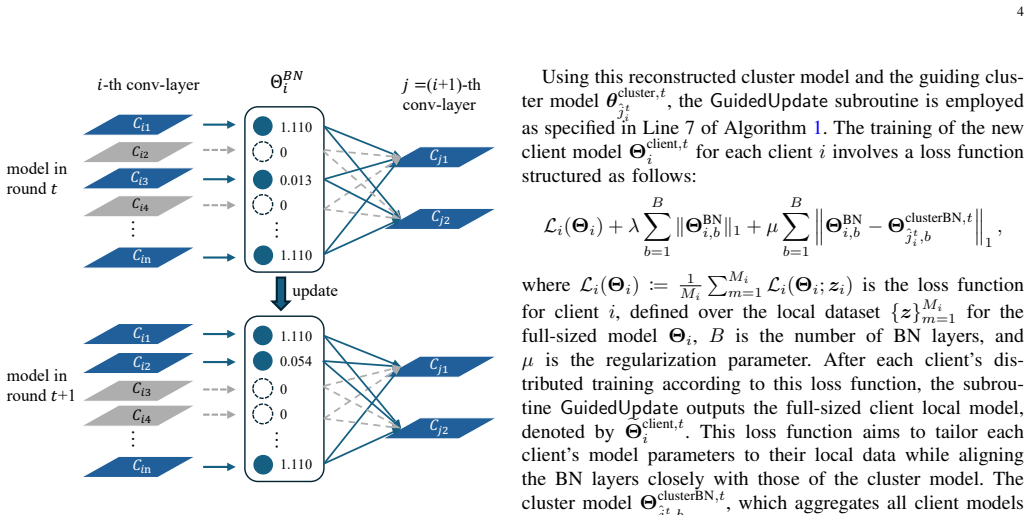
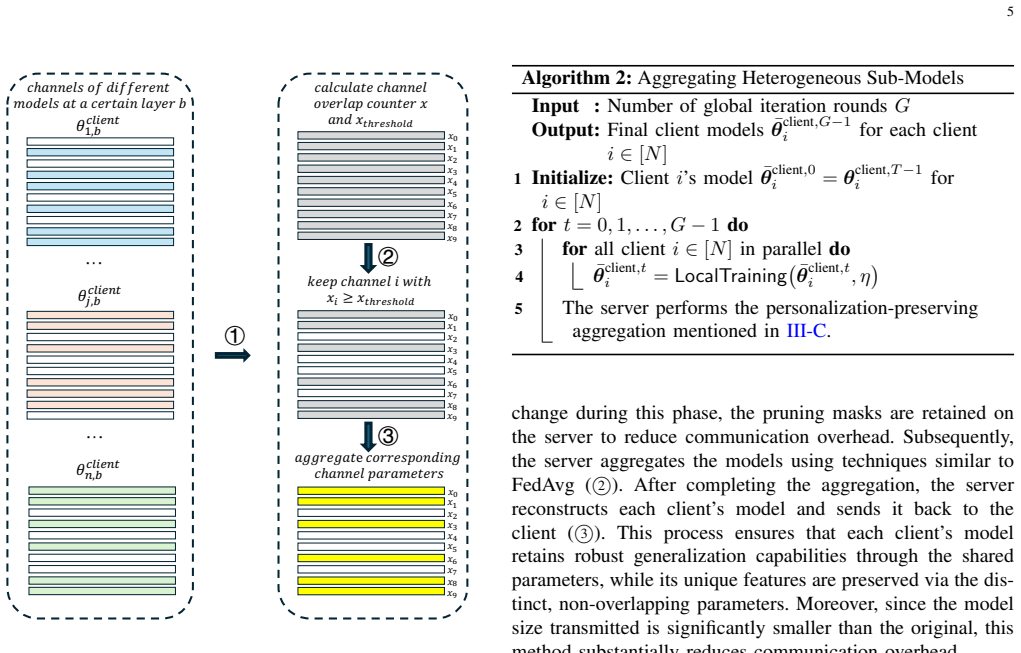
The machinery is the batch-normalization weight vector $\Theta^{\mathrm{BN}}_i$ used as a compact, comparable proxy for a client's data distribution. It appears in three roles: in cluster assignment via the loss $\ell_i(\theta^{\mathrm{cluster}}_j)$; in the GuidedUpdate regularizer $\mu \sum_b \|\Theta^{\mathrm{BN}}_{i,b} - \Theta^{\mathrm{cluster},\mathrm{BN}}_{\hat{j}^t_i,b}\|_1$; and in NetSlim, which prunes channels whose BN weights fall below the round's threshold. Around this sit ModelRecover, which zero-fills pruned channels before each round so they can be revived; heterogeneous model fusion, which retains channels whose overlap count across cluster members exceeds a threshold and averages their parameters; and stage-two personalization-preserving aggregation, which restores full structure and averages overlapping parameters. The BN vector is what makes the cluster's structure transferable without sharing data.
What would settle it
A missing ablation settles the mechanism: set the SCSI regularization coefficient $\mu = 0$ in Algorithm 1, keeping clustering and NetSlim unchanged, and compare 30%-pruned accuracy on CIFAR-10 and MNIST. If accuracy does not drop materially below SAFL's reported 93.29%, then cluster-structure alignment is not carrying the central claim; the same experiment also separates the benefit of clustering itself from the benefit of BN-guided pruning.
Extended reading notes
Core claim
The paper's central claim is that SCSI-guided clustered pruning produces personalized sub-models that are both smaller and more accurate than models pruned from local data alone. Concretely, with a 30% pruning rate, SAFL reports 93.29% accuracy on non-IID CIFAR-10, versus 92.73% for Hermes and 92.61% for FedBN, and 93.29% on MNIST, versus 90.65% for Hermes, while the deployed model is 70% of full size. At a 70% pruning rate on CIFAR-10 the reported gap widens: SAFL holds 89.85% accuracy while Hermes falls to 80.64%. The mechanism is that clients first choose a cluster by testing which pruned cluster model has the lowest loss on their local data, then train with a regularization pulling their batch-normalization weights toward the cluster's BN weights, then prune by ranking channels on BN scale magnitude, with a recovery step that lets previously pruned channels return. Stage two then aggregates the heterogeneous pruned models while preserving each client's non-overlapping channels, using Hermes-style fusion.
Load-bearing premise
The method assumes batch-normalization scale parameters reliably encode a client's data distribution and are comparable across clients, so that aligning BN weights within a cluster transfers useful structural information rather than noise.
Editorial extensions
If this is right
- If SAFL's results hold, 30%-smaller personalized models can beat full-size pFL baselines on standard non-IID benchmarks, making on-device deployment cheaper.
- Higher pruning rates become usable: at 70% pruning on CIFAR-10, SAFL loses about 4.40 accuracy points from its 30%-pruned result, while Hermes loses about 12.09 points.
- Communication savings scale with pruning: on CIFAR-10, SAFL spends about 40% of FedAvg's communication cost at 40% pruning, and on MNIST about 33% at 60% pruning.
- Even with a single cluster, where no meaningful data grouping remains, SAFL still outperforms Hermes, suggesting some benefit flows from the BN-alignment training alone.
- SAFL supports client-specific pruning rates, so devices with different computational budgets can coexist in one federated system.
Reading between the lines
- The BN-signature premise implies that SCSI's benefit should depend on how well BN scale vectors separate the client population; a synthetic experiment with feature shift but identical labels would test this directly.
- SAFL's communication analysis assumes long federated runs, so the $O(KNM)$ cluster-download overhead is worth paying only when the number of stage-two rounds is large; short deployments might not recover the extra cost.
- The paper does not report the $μ = 0$ ablation, so the isolated contribution of the SCSI regularizer remains open; that ablation would separate the benefit of clustering itself from the benefit of BN-guided pruning.
- Because cluster assignment compares pruned cluster models of different structures, misassignment is possible even when total accuracy improves; checking SAFL's cluster identities against known ground-truth client groups would reveal whether correct clustering is necessary for the gains.
Editorial analysis
A structured set of objections, weighed in public.
Referee Report
Summary. The paper proposes SAFL, a personalized federated learning framework that combines client clustering with structured model pruning. In stage one, clients are iteratively assigned to clusters by evaluating cluster models on their local data; each client then recovers its pruned model to full size, trains with an additional regularization term that aligns its batch-normalization (BN) parameters with the selected cluster model, prunes by channel magnitude using Network Slimming, and fine-tunes. The server fuses pruned models within each cluster to form new cluster models. In stage two, clients train their pruned personalized models and the server performs Hermes-style personalization-preserving aggregation. Experiments on non-IID CIFAR-10 and MNIST compare SAFL with FedAvg, LG-FedAvg, FedBN, and Hermes, reporting higher accuracy at 30% pruning and smaller models, with the largest gains over Hermes at higher pruning rates. The paper also gives a communication-cost analysis showing SAFL can be cheaper than FedAvg under stated conditions.
Significance. If the central claim is established, SAFL would be a useful combination of clustered federated learning and structured pruning: it directly addresses the low-data problem in local pruning by pooling structural information from similar clients, and the communication-cost model is a helpful contribution. The experimental comparison includes standard baselines and reports accuracy for several cluster counts. However, the causal attribution of the gains to SCSI-guided clustering is not yet demonstrated: the cluster count is selected from the test-accuracy sweep, the SCSI term is not ablated, and the K=1 results show that clustering is not necessary for the reported improvements. The paper would benefit from additional controlled experiments and a more cautious interpretation of the headline numbers. With those additions, the contribution could be publishable; in its current form, the evidence is suggestive rather than conclusive.
major comments (4)
- [§IV-D, Tables I–II, §III-E] The reported headline configurations (K=5 for CIFAR-10, K=2 for MNIST) are the values that achieve the highest test accuracy in Tables I and II, yet the paper does not describe a principled model-selection procedure. Selecting K on the test set makes the 0.56% and 2.65% gains over Hermes optimistically biased. Please either select K by validation or report the full K-sweep without presenting the best test-accuracy K as the main result.
- [§III-B3, §IV-D] The central claim is that SCSI-guided clustering causes the accuracy improvement, but no experiment isolates the SCSI term. Table I shows SAFL with K=1 outperforms Hermes by 0.29% on CIFAR-10, and Table II shows SAFL with K=1 outperforms Hermes by 2.44% on MNIST; with a single cluster there is no client-specific similar-client structure. The gains could come from ModelRecover, the BN-alignment regularization, the sparsity regularization, or the fine-tuning schedule. Please add ablations such as setting µ=0, using random or permuted cluster BN targets, and comparing K=1 with and without the SCSI term.
- [§IV-C vs. §III-B3] Section IV-C states that aggregating BN parameters leads to significant accuracy reductions on non-IID data and that BN updates are therefore kept local, following FedBN. However, the SCSI loss in Section III-B3 deliberately aligns each client's BN parameters with the cluster model's BN parameters across clients. This creates a tension: aligning BN parameters across clients is a form of cross-client BN information sharing, even if it is done by regularization rather than aggregation. The paper should either reconcile these statements or empirically validate that the alignment term helps in this setting.
- [Table III] Table III reports SAFL and Hermes accuracies at different pruning rates without standard deviations or the number of runs. Since Tables I and II report standard deviations as small as 0.02 percentage points, some of the smaller gaps in Table III may be within noise, while the larger gaps at high pruning rates are likely meaningful. Please provide repeated-run statistics, and ideally significance tests, for the pruning-rate comparison.
minor comments (7)
- [§III-A] The phrase 'two-state SAFL framework' should read 'two-stage SAFL framework'.
- [§IV-A] The text says 'We compare SALF against four baseline methodologies' but the method is SAFL; this typo appears in the first sentence of Section IV-A.
- [§III-B3] The notation 'N' is used both for the number of clients and for the channel dimension in the discussion in Section III-E, where 'Θ^BN_i is an N-dimensional vector'; please disambiguate these two uses.
- [Algorithm 1] In line 5, the one-hot vector is written as 'si = {si,j}k_{j=1}' with lowercase k, but the number of clusters is K; please make the notation consistent.
- [§III-B3] The citation 'the FedBN method [28]' appears to be incorrect: FedBN is reference [9], while [28] is FedMP. Please correct the reference.
- [§III-D] In the communication-cost comparison, the variable p_T is used in the inequality and the solved bound, but the pruning-rate array is indexed only up to T-1; this should be p_{T-1} throughout.
- [§IV-D] The sentence 'SAFL exhibits gains of 0.56% and 2.65% ... while using the same number of clusters (five and two, respectively)' is confusing because Hermes does not use clusters; please rephrase to state that SAFL used K=5 and K=2 in those comparisons.
Circularity Check
No significant circularity: SAFL's reported gains are empirical comparisons, not derivations that reduce to their inputs.
full rationale
The SAFL pipeline is an algorithmic construction, not a claimed first-principles derivation of accuracy. The SCSI-guided update in Section III-B3 regularizes each client's BN parameters toward a cluster-level BN target that is itself aggregated from the same clients (Algorithm 1, lines 11-12), so the structural signal is a self-consistency/consensus target rather than independent external information; however, the paper does not claim a mathematical theorem that this term produces accuracy, and the experimental advantage over Hermes is reported empirically. The lack of an ablation isolating the SCSI term, and the selection of K across reported values, are attribution and hyperparameter-selection concerns rather than circular reductions: Tables I and II show SAFL also exceeds Hermes at K=1, so the headline comparison is not forced by the best-K choice. All cited building blocks (IFCA clustering, Network Slimming, FedBN, Hermes aggregation) are external published methods, and no load-bearing self-citation or imported uniqueness theorem is used. Consequently, the derivation chain is not circular; the paper's weaknesses are experimental isolation and missing ablations, not logical equivalence of output to input.
Assumptions & free parameters
free parameters (5)
- cluster count K =
5 for CIFAR-10, 2 for MNIST
- BN alignment regularization mu =
0.004
- sparsity regularization lambda =
0.0001
- pruning rate schedule r_t =
[0, 0.1, ..., target]
- structure aggregation threshold x_threshold =
unreported
assumptions (4)
- domain assumption Batch-normalization scale parameters are a reliable proxy for client data distribution and are comparable across clients after clustering.
- domain assumption The loss computed on a pruned cluster model is a valid signal for cluster assignment when different cluster models have different structures.
- domain assumption Initial cluster models are available and sufficiently diverse for IFCA-style clustering to separate clients.
- standard math Standard FL convergence assumptions from IFCA and Hermes carry over to the two-stage SAFL pipeline.
Cite this review
Pith. "Pith review of SAFL: Structure-Aware Personalized Federated Learning via Client-Specific Clustering and SCSI-Guided Model Pruning." pith.science (2026). https://pith.science/paper/3XTITJZJ
@misc{pith2026250118659,
  author       = {Pith},
  title        = {Pith review of: SAFL: Structure-Aware Personalized Federated Learning via Client-Specific Clustering and SCSI-Guided Model Pruning},
  year         = {2026},
  howpublished = {\url{https://pith.science/paper/3XTITJZJ}},
  note         = {Machine review of arXiv:2501.18659}
}
read the original abstract
Federated Learning (FL) enables clients to collaboratively train machine learning models without sharing local data, preserving privacy in diverse environments. While traditional FL approaches preserve privacy, they often struggle with high computational and communication overhead. To address these issues, model pruning is introduced as a strategy to streamline computations. However, existing pruning methods, when applied solely based on local data, often produce sub-models that inadequately reflect clients' specific tasks due to data insufficiency. To overcome these challenges, this paper introduces SAFL (Structure-Aware Federated Learning), a novel framework that enhances personalized federated learning through client-specific clustering and Similar Client Structure Information (SCSI)-guided model pruning. SAFL employs a two-stage process: initially, it groups clients based on data similarities and uses aggregated pruning criteria to guide the pruning process, facilitating the identification of optimal sub-models. Subsequently, clients train these pruned models and engage in server-based aggregation, ensuring tailored and efficient models for each client. This method significantly reduces computational overhead while improving inference accuracy. Extensive experiments demonstrate that SAFL markedly diminishes model size and improves performance, making it highly effective in federated environments characterized by heterogeneous data.
Figures

Figures from the paper (5 more)


Reference graph
Works this paper leans on
-
[1]
Communication-efficient learning of deep networks from decentralized data,
B. McMahan, E. Moore, D. Ramage, S. Hampson, and B. A. y Arcas, “Communication-efficient learning of deep networks from decentralized data,” in Proceedings of the 20th Artificial Intelligence and Statistics (AISTATS). PMLR, 2017, pp. 1273–1282
work page 2017
-
[2]
Advances and open problems in federated learning,
P. Kairouz, H. B. McMahan, B. Avent, A. Bellet, M. Bennis, A. N. Bhagoji, K. Bonawitz, Z. Charles, G. Cormode, R. Cummings et al. , “Advances and open problems in federated learning,” Foundations and Trends® in Machine Learning , vol. 14, no. 1–2, pp. 1–210, 2021
2021
-
[3]
Robust fed- erated learning in a heterogeneous environment,
A. Ghosh, J. Hong, D. Yin, and K. Ramchandran, “Robust fed- erated learning in a heterogeneous environment,” arXiv preprint arXiv:1906.06629, 2019
arXiv 1906
-
[4]
F. Sattler, K.-R. M ¨uller, and W. Samek, “Clustered federated learning: Model-agnostic distributed multitask optimization under privacy con- straints,” IEEE Transactions on Neural Networks and Learning Systems , vol. 32, no. 8, pp. 3710–3722, 2020
work page 2020
-
[5]
An efficient frame- work for clustered federated learning,
A. Ghosh, J. Chung, D. Yin, and K. Ramchandran, “An efficient frame- work for clustered federated learning,” Advances in Neural Information Processing Systems, vol. 33, pp. 19 586–19 597, 2020
work page 2020
-
[6]
Pfa: Privacy-preserving federated adaptation for effective model personalization,
B. Liu, Y . Guo, and X. Chen, “Pfa: Privacy-preserving federated adaptation for effective model personalization,” in Proceedings of the Web Conference 2021, 2021, pp. 923–934
work page 2021
-
[7]
Resource- efficient federated learning with hierarchical aggregation in edge com- puting,
Z. Wang, H. Xu, J. Liu, H. Huang, C. Qiao, and Y . Zhao, “Resource- efficient federated learning with hierarchical aggregation in edge com- puting,” in IEEE INFOCOM 2021-IEEE Conference on Computer Communications. IEEE, 2021, pp. 1–10
work page 2021
-
[8]
Learning effi- cient convolutional networks through network slimming,
Z. Liu, J. Li, Z. Shen, G. Huang, S. Yan, and C. Zhang, “Learning effi- cient convolutional networks through network slimming,” inProceedings of the 2017 IEEE International Conference on Computer Vision (ICCV) , 2017, pp. 2736–2744
work page 2017
Show all 37 references
-
[9]
Fedbn: Feder- ated learning on non-iid features via local batch normalization,
X. Li, M. Jiang, X. Zhang, M. Kamp, and Q. Dou, “Fedbn: Feder- ated learning on non-iid features via local batch normalization,” arXiv preprint arXiv:2102.07623, 2021
2021 arXiv
-
[10]
Think locally, act globally: Federated learning with local and global representations,
P. P. Liang, T. Liu, L. Ziyin, N. B. Allen, R. P. Auerbach, D. Brent, R. Salakhutdinov, and L.-P. Morency, “Think locally, act globally: Federated learning with local and global representations,” arXiv preprint arXiv:2001.01523, 2020
2001 arXiv
-
[11]
Hermes: an efficient federated learning framework for heterogeneous mobile clients,
A. Li, J. Sun, P. Li, Y . Pu, H. Li, and Y . Chen, “Hermes: an efficient federated learning framework for heterogeneous mobile clients,” in Proceedings of the 27th Annual International Conference on Mobile Computing and Networking , 2021, pp. 420–437
2021
-
[12]
Channel pruning for accelerating very deep neural networks,
Y . He, X. Zhang, and J. Sun, “Channel pruning for accelerating very deep neural networks,” in Proceedings of the 2017 IEEE International Conference On Computer Vision (ICCV) , 2017, pp. 1389–1397
2017
-
[13]
The lottery ticket hypothesis: Finding sparse, trainable neural networks,
J. Frankle and M. Carbin, “The lottery ticket hypothesis: Finding sparse, trainable neural networks,” arXiv preprint arXiv:1803.03635 , 2018
2018 arXiv
-
[14]
Rethinking the value of network pruning,
Z. Liu, M. Sun, T. Zhou, G. Huang, and T. Darrell, “Rethinking the value of network pruning,” arXiv preprint arXiv:1810.05270 , 2018
2018 arXiv
-
[15]
Federated optimization: Distributed machine learning for on-device intelligence,
J. Kone ˇcn`y, H. B. McMahan, D. Ramage, and P. Richt ´arik, “Federated optimization: Distributed machine learning for on-device intelligence,” arXiv preprint arXiv:1610.02527 , 2016
2016 arXiv
-
[16]
Federated learning for mobile keyboard prediction,
A. Hard, K. Rao, R. Mathews, S. Ramaswamy, F. Beaufays, S. Augen- stein, H. Eichner, C. Kiddon, and D. Ramage, “Federated learning for mobile keyboard prediction,” arXiv preprint arXiv:1811.03604 , 2018
2018 arXiv
-
[17]
Federated learning with non-IID data,
Y . Zhao, M. Li, L. Lai, N. Suda, D. Civin, and V . Chandra, “Federated learning with non-IID data,” arXiv preprint arXiv:1806.00582 , 2018
2018 arXiv
-
[18]
Federated optimization in heterogeneous networks,
T. Li, A. K. Sahu, M. Zaheer, M. Sanjabi, A. Talwalkar, and V . Smith, “Federated optimization in heterogeneous networks,” Proceedings of Machine learning and Systems , vol. 2, pp. 429–450, 2020
2020
-
[19]
Federated multi-task learning,
V . Smith, C.-K. Chiang, M. Sanjabi, and A. S. Talwalkar, “Federated multi-task learning,” Advances in neural information processing systems, vol. 30, 2017
2017
-
[20]
Federated learning with personalization layers,
M. G. Arivazhagan, V . Aggarwal, A. K. Singh, and S. Choud- hary, “Federated learning with personalization layers,” arXiv preprint arXiv:1912.00818, 2019
1912 arXiv
-
[21]
Personalized federated learning with theoretical guarantees: A model-agnostic meta-learning approach,
A. Fallah, A. Mokhtari, and A. Ozdaglar, “Personalized federated learning with theoretical guarantees: A model-agnostic meta-learning approach,” Advances in neural information processing systems , vol. 33, pp. 3557–3568, 2020
2020
-
[22]
Distributed pruning towards tiny neural networks in federated learning,
H. Huang, L. Zhang, C. Sun, R. Fang, X. Yuan, and D. Wu, “Distributed pruning towards tiny neural networks in federated learning,” in 2023 IEEE 43rd International Conference on Distributed Computing Systems (ICDCS). IEEE, 2023, pp. 190–201
2023
-
[23]
Fedprune: Towards inclusive federated learning,
M. T. Munir, M. M. Saeed, M. Ali, Z. A. Qazi, and I. A. Qazi, “Fedprune: Towards inclusive federated learning,” arXiv preprint arXiv:2110.14205, 2021
2021 arXiv
-
[24]
Fedrolex: Model- heterogeneous federated learning with rolling sub-model extraction,
S. Alam, L. Liu, M. Yan, and M. Zhang, “Fedrolex: Model- heterogeneous federated learning with rolling sub-model extraction,” Advances in neural information processing systems, vol. 35, pp. 29 677– 29 690, 2022
2022
-
[25]
Model pruning enables efficient federated learning on edge devices,
Y . Jiang, S. Wang, V . Valls, B. J. Ko, W.-H. Lee, K. K. Leung, and L. Tassiulas, “Model pruning enables efficient federated learning on edge devices,” IEEE Transactions on Neural Networks and Learning Systems, vol. 34, no. 12, pp. 10 374–10 386, 2022
2022
-
[26]
Personalized federated learning by structured and unstructured pruning under data heterogeneity,
S. Vahidian, M. Morafah, and B. Lin, “Personalized federated learning by structured and unstructured pruning under data heterogeneity,” in 2021 IEEE 41st International Conference on Distributed Computing Systems Workshops (ICDCSW). IEEE, 2021, pp. 27–34
2021
-
[27]
Fedpe: Adaptive model pruning-expanding for federated learning on mobile devices,
L. Yi, X. Shi, N. Wang, J. Zhang, G. Wang, and X. Liu, “Fedpe: Adaptive model pruning-expanding for federated learning on mobile devices,” IEEE Transactions on Mobile Computing , 2024
2024
-
[28]
Fedmp: Federated learning through adaptive model pruning in heterogeneous edge computing,
Z. Jiang, Y . Xu, H. Xu, Z. Wang, C. Qiao, and Y . Zhao, “Fedmp: Federated learning through adaptive model pruning in heterogeneous edge computing,” in 2022 IEEE 38th International Conference on Data Engineering (ICDE). IEEE, 2022, pp. 767–779
2022
-
[29]
Accelerating federated learning for iot in big data analytics with pruning, quantization and selective updating,
W. Xu, W. Fang, Y . Ding, M. Zou, and N. Xiong, “Accelerating federated learning for iot in big data analytics with pruning, quantization and selective updating,” IEEE Access, vol. 9, pp. 38 457–38 466, 2021
2021
-
[30]
Fedduap: Federated learning with dynamic update and adaptive pruning using shared data on the server,
H. Zhang, J. Liu, J. Jia, Y . Zhou, H. Dai, and D. Dou, “Fedduap: Federated learning with dynamic update and adaptive pruning using shared data on the server,” arXiv preprint arXiv:2204.11536 , 2022
2022 arXiv
-
[31]
Federated learning with hierarchical clustering of local updates to improve training on non-IID data,
C. Briggs, Z. Fan, and P. Andras, “Federated learning with hierarchical clustering of local updates to improve training on non-IID data,” in 2020 International Joint Conference on Neural Networks (IJCNN) . IEEE, 2020, pp. 1–9
2020
-
[32]
Deep compression: Compressing deep neural networks with pruning, trained quantization and huffman coding,
S. Han, H. Mao, and W. J. Dally, “Deep compression: Compressing deep neural networks with pruning, trained quantization and huffman coding,” arXiv preprint arXiv:1510.00149 , 2015
2015 arXiv
-
[33]
EIE: Efficient inference engine on compressed deep neural network,
S. Han, X. Liu, H. Mao, J. Pu, A. Pedram, M. A. Horowitz, and W. J. Dally, “EIE: Efficient inference engine on compressed deep neural network,” ACM SIGARCH Computer Architecture News , vol. 44, no. 3, pp. 243–254, 2016
2016
-
[34]
Snip: Single-shot network pruning based on connection sensitivity,
N. Lee, T. Ajanthan, and P. H. Torr, “Snip: Single-shot network pruning based on connection sensitivity,”arXiv preprint arXiv:1810.02340, 2018
2018 arXiv
-
[35]
Learning structured sparsity in deep neural networks,
W. Wen, C. Wu, Y . Wang, Y . Chen, and H. Li, “Learning structured sparsity in deep neural networks,” Advances in neural information processing systems, vol. 29, 2016
2016
-
[36]
Gate decorator: Global filter pruning method for accelerating deep convolutional neural networks,
Z. You, K. Yan, J. Ye, M. Ma, and P. Wang, “Gate decorator: Global filter pruning method for accelerating deep convolutional neural networks,” Advances in neural information processing systems , vol. 32, 2019
2019
-
[37]
SOSP: Effi- ciently capturing global correlations by second-order structured prun- ing,
M. Nonnenmacher, T. Pfeil, I. Steinwart, and D. Reeb, “SOSP: Effi- ciently capturing global correlations by second-order structured prun- ing,” arXiv preprint arXiv:2110.11395 , 2021
2021 arXiv
Reviewed August 10, 2026 · model on record in the stance chip above.
Discussion (0). Continue with ORCID to comment.