REVIEW 2 major objections 6 minor 2 cited by
Combining physics-based and data-driven models: advancing the frontiers of research with Scientific Machine Learning
T0 review · 2 major / 6 minor · reviewed 2026-08-09 · deepseek-v4-flash
Pith's one-line read Scientific Machine Learning—hybrid models that inject physics into neural networks and use data to enrich PDE solvers—is, this survey argues, a mature and effective strategy for complex problems governed by partial differential equations…
desk verdict A competent, well-referenced survey that will help newcomers, but it repeats the common high-dimensional PINN overstatement that its own complexity theorems contradict, and it presents the authors' prior cardiac results as established without benchmarks. read the letter →
The pith
A machine-rendered reading of the paper's core claim, the machinery that carries it, and where it could break.
The reading
What carries the argument
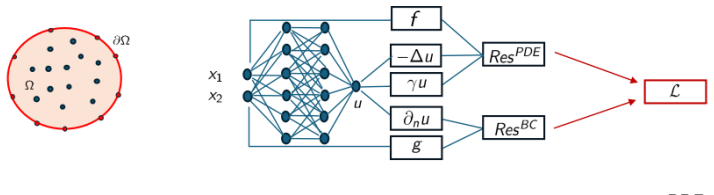
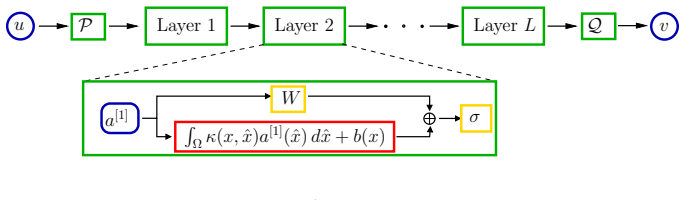
The load-bearing object is the physics-informed loss function: a neural-network hypothesis space whose training objective combines the standard data-fitting term with residuals of the PDE, boundary and initial conditions, and optionally a regularization term. This is what lets the same architecture serve as forward solver, inverse parameter estimator, or surrogate: one changes only which variables are trainable and which terms enter the loss. Secondary machinery includes operator networks, which learn maps between function spaces rather than pointwise values, and reduced-order or latent-dynamics models that compress high-fidelity cardiac simulations into a few latent coordinates. The paper also leans on a formal analogy between finite-element trial spaces and neural-network hypothesis spaces, which frames the whole survey.
What would settle it
Take one of the seven cardiac tasks, for instance the multifidelity PINN estimation of ionic parameters: run it on a public dataset with known ground-truth parameters and compare the recovered values and their uncertainty to a standard finite-element calibration. If the PINN does not meet or beat the baseline within the reported accuracy, the flagship demonstration of SciML fails. Alternatively, on a high-dimensional (say $d=10$) linear PDE with known solution, measure PINN test error versus number of collocation points; if the error shows no better than exponential-in-dimension scaling, the paper's high-dimensional efficiency premise is false.
Extended reading notes
Core claim
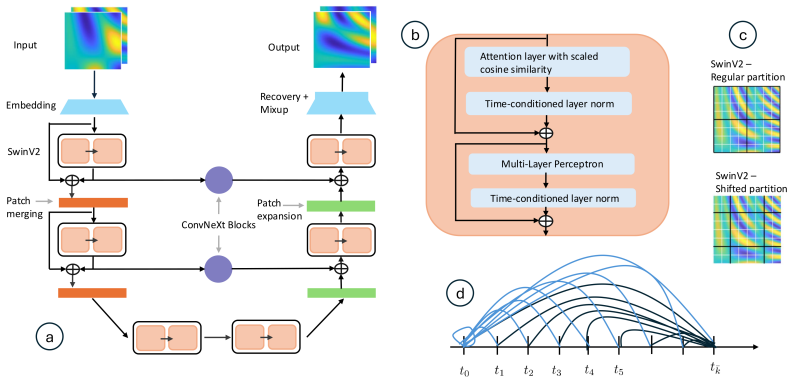
On its own terms, the paper's central claim is that physics and machine learning are not competing paradigms but complementary components of a single modelling strategy. The mechanism is to take the loss function of a neural network and add terms that encode the residual of the governing differential equations, boundary conditions, or data from a high-fidelity solver, so the network is pushed toward physically admissible solutions. The survey classifies the field into three families—surrogate modelling of full-order models, physics-informed learning (PINNs, VPINNs, Deep Ritz), and operator learning (DeepONet, neural operators, neural ODEs)—and then presents seven cardiac applications (ionic parameter estimation by multifidelity PINNs, physics-aware inverse electrocardiography, multiscale learning of microscopic dynamics, time-dependent operator learning for multiphysics coupling, NN surrogates for sensitivity analysis and Bayesian estimation, and Latent Dynamics Networks to accelerate electrophysiology) as evidence that the hybrid approach delivers. The paper does not present new numerical results; it curates and frames existing ones to make the case that SciML is mature enough for flagship biomedical simulation.
Load-bearing premise
The survey's flagship conclusion—that SciML has been successfully applied to simulate the human cardiac function—is inherited from the authors' earlier publications and is presented without independent reproduction, error bars, or comparison to baselines in this paper.
Editorial extensions
If this is right
- Cardiac simulations can move toward real-time and patient-specific use, because neural surrogates and latent-dynamics models reduce the cost of repeatedly solving the same multiphysics model.
- Inverse problems that are ill-posed in classical terms—like estimating ionic parameters from body-surface potentials—become tractable when the PDE residual is embedded in the loss function.
- Operator learning means a model trained on one set of inputs (geometries, material laws, boundary data) can predict solutions for unseen inputs without retraining.
- Sensitivity analysis and Bayesian parameter estimation become affordable because a cheap neural-network surrogate replaces thousands of full-order solves.
- The same hybrid recipes should transfer to other multiscale, multiphysics problems beyond cardiology, such as fluid-structure interaction or materials design.
Reading between the lines
- An implication the paper leaves implicit is that the taxonomy itself is the contribution: by ordering the field into surrogate, physics-informed, and operator-learning families, the survey shapes which combinations of methods are tried next.
- The paper's high-dimensional efficiency claim is worth testing directly: its own approximation bound $N_1 \sim (1/\varepsilon)^{n/s}$ grows exponentially in the input dimension $n$, so a controlled experiment on a $d=10$ PDE would show whether the surveyed successes rely on problem-specific structure rather than general neural-network power.
- A testable extension would be to run the seven cardiac tasks on a standardized public benchmark with error bars and baseline comparisons, turning the survey's inherited evidence into independently reproducible results.
Editorial analysis
A structured set of objections, weighed in public.
Referee Report
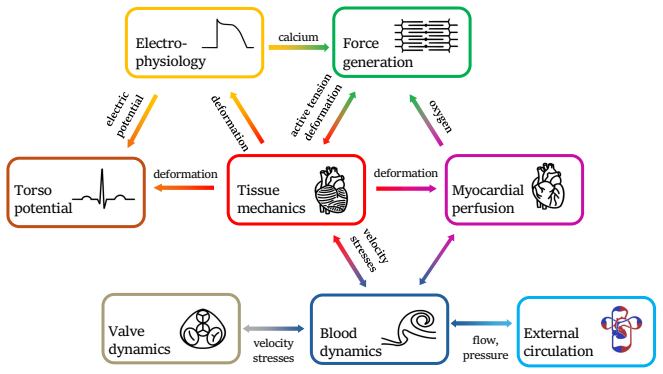
Summary. The paper is a broad survey/tutorial on Scientific Machine Learning (SciML). It first reviews digital models and their mathematical/numerical foundations (Section 2), then introduces machine learning concepts, architectures, training algorithms, and approximation theory (Section 3), and then describes SciML paradigms such as surrogate modeling, PINNs, VPINNs, Deep Ritz, operator learning, and hidden-dynamics discovery (Section 4). The final part (Section 5) presents the authors' Integrated Heart Model program and summarizes seven applications of SciML to cardiac simulation, which the abstract describes as the 'successful application of SciML to the simulation of the human cardiac function.' The central thesis is that combining physics-based models with data-driven algorithms can inject physical knowledge into ML while using data to enhance or accelerate physics-based models.
Significance. As a pedagogical survey, the paper has genuine merit: it provides a readable mathematical introduction to neural networks, cites approximation-theoretic results (Cybenko, Yarotsky, G"uring-Kutyniok-Petersen) accurately, distinguishes observational/inductive/learning biases, and gives practical cost criteria for surrogate models, e.g. Eq. (74). It also explicitly acknowledges some limitations of PINNs, such as spectral bias and higher cost than FEM for forward problems. However, the paper's flagship claim—that SciML has been successfully applied to cardiac simulation—is not established in this manuscript: Sections 5.2-5.8 report the authors' own prior results without external benchmarks, error bars, or reproduction. In addition, a load-bearing statement in Section 4.2.1 about the efficiency of neural networks in high-dimensional spaces conflicts with the paper's own approximation-theoretic lower bounds in Section 3.2.5. These issues materially affect the strength of the conclusions and require revision.
major comments (2)
- [4.2.1] The paragraph claiming that 'in cases involving PDEs in high-dimensional spaces... PINNs offer a compelling alternative. This is due to the neural networks' ability to efficiently approximate functions in high-dimensional spaces' is not supported by the paper's own approximation theory. Theorem 3.2 (Eq. (32)) gives N1 ≳ ε^{-(n-1)/s} for shallow networks on W^{s,2}((0,1)^n), and Theorem 3.5 gives a similar exponential-in-dimension lower bound for deep ReLU networks. The paper itself states in Section 3.2.5 that 'shallow FFNNs suffer from the curse of dimensionality' and that deep FFNNs 'do not break the curse of dimensionality.' Since Section 4.2.1 states no structural assumptions (such as low intrinsic dimension, analyticity, or special solution classes), the high-dimensional-efficiency claim is internally inconsistent. The authors should either remove the claim or qualify it with a concrete problem class for which positive results exist.
- [5.2-5.8] The abstract's claim of 'the successful application of SciML to the simulation of the human cardiac function' is inherited from seven summaries of the authors' own prior publications in Sections 5.2-5.8. The survey provides no error bars, no comparisons against independent baselines or full-order models, and no reproduction or external validation for these results. Because this is the paper's central demonstration, the authors should either include quantitative evidence (e.g., accuracy metrics against FOM solutions or clinical data) or explicitly reframe Section 5 as a programmatic description of the authors' ongoing research rather than an established, independently verified success.
minor comments (6)
- [2.2] The word 'shortbreaking' should be 'shortcomings'.
- [3.2.1] In the density-estimation bullet, 'unveal' should be 'unveil'.
- [3.2.4] The activation function is spelled 'Heavyside' but should be 'Heaviside'.
- [3.2.6] In the RMSProp paragraph, 'RSMProp' is a typo for 'RMSProp'.
- [3.2.3] The phrase 'euclidian distance' should be 'Euclidean distance'.
- [3.3.2] The text uses 'LMM' for 'Large Language Models'; the standard abbreviation is 'LLM'.
Circularity Check
No circular derivation: the paper is an expository survey; its self-cited cardiac illustrations are not predictions derived from the review's own equations.
full rationale
This paper is an expository survey rather than a derivation chain. The educational core (Sections 2 through 4) compiles standard, externally grounded results: Cybenko's universal approximation theorem, Yarotsky's and G"uring--Kutyniok--Petersen complexity bounds, VC-dimension generalization estimates, and standard optimization methods. These are cited to independent sources and are not defined in terms of the paper's own conclusions. The later cardiac-application sections summarize the authors' own prior work, but this is not a circular reduction: the prior papers are external publications containing their own numerical experiments, and the review does not rename a fitted parameter as a prediction or derive an output from an input by construction. The only notable tension is internal consistency, not circularity: Section 4.2.1 claims that PINNs are compelling for high-dimensional PDEs because neural networks efficiently approximate high-dimensional functions, while Theorem 3.2 (Eq. 32) shows the required number of neurons grows exponentially in dimension for fixed regularity. That is a possible overstatement or missing structural assumption, but it is not a case of a result being equivalent to its inputs by definition. Self-citation is present and could raise evidentiary concerns, but under the hard rules it does not constitute circularity unless the load-bearing argument reduces to an unverified self-citation; here the cited prior works are independent publications. Accordingly, no significant circularity is found.
Assumptions & free parameters
assumptions (4)
- standard math Classical approximation theorems are valid as stated (Cybenko UAT, Yarotsky, Guring-Kutyniok-Petersen bounds, VC-dimension generalization bound).
- domain assumption The Integrated Heart Model [75] reliably simulates cardiac electromechanics, valve dynamics, circulation, perfusion, and torso potential.
- domain assumption The authors' previously published SciML results (Sections 5.2-5.8) are correct and generalizable.
- domain assumption Neural networks can efficiently approximate solutions of high-dimensional PDE problems.
Cite this review
Pith. "Pith review of Combining physics-based and data-driven models: advancing the frontiers of research with Scientific Machine Learning." pith.science (2026). https://pith.science/paper/LVZQ25WO
@misc{pith2026250118708,
  author       = {Pith},
  title        = {Pith review of: Combining physics-based and data-driven models: advancing the frontiers of research with Scientific Machine Learning},
  year         = {2026},
  howpublished = {\url{https://pith.science/paper/LVZQ25WO}},
  note         = {Machine review of arXiv:2501.18708}
}
read the original abstract
Scientific Machine Learning (SciML) is a recently emerged research field which combines physics-based and data-driven models for the numerical approximation of differential problems. Physics-based models rely on the physical understanding of the problem, subsequent mathematical formulation, and numerical approximation. Data-driven models instead aim to extract relations between input and output data without arguing any causality principle underlining the available data distribution. In recent years, data-driven models have been rapidly developed and popularized. Such a diffusion has been triggered by a huge availability of data, increasingly cheap computing power, and the development of powerful ML algorithms. SciML leverages the physical awareness of physics-based models and the efficiency of data-driven algorithms. With SciML, we can inject physics and mathematical knowledge into ML algorithms. Yet, we can rely on data-driven algorithms' capability to discover complex and nonlinear patterns from data and improve the descriptive capacity of physics-based models. After recalling the mathematical foundations of digital modelling and ML algorithms and presenting the most popular ML architectures, we discuss the great potential of a broad variety of SciML strategies in solving complex problems governed by PDEs. Finally, we illustrate the successful application of SciML to the simulation of the human cardiac function, a field of significant socioeconomic importance that poses numerous challenges on both the mathematical and computational fronts. Despite the robustness and accuracy of physics-based models, certain aspects, such as unveiling constitutive laws for cardiac cells and myocardial material properties, as well as devising efficient reduced order models to dominate the extraordinary computational complexity, have been successfully tackled by leveraging data-driven models.
Figures


Figures from the paper (43 more)















Forward citations
Cited by 2 Pith papers
-
Multiscale Mixed-Dimensional Simulation via Domain Decomposition and Non-Intrusive Neural Model Order Reduction
A domain-decomposition solver with three cascade-trained neural surrogates replaces all fine-scale local operations, reaching stable ~3-6% L2 accuracy on unseen synthetic vascular networks without global assembly.
-
Introduction to optimization methods for training SciML models
A tutorial review of optimization for SciML that explains PDE-induced stiffness through the NTK/Hessian spectrum and surveys adaptive sampling, second-order, and preconditioning methods.
Reference graph
Works this paper leans on
-
[1]
Adams, M
M. Adams, M. Brezina, J. Hu, and R. Tuminaro. Parallel multigrid smoothing: Polynomial versus Gauss-Seidel. Journal of Computational Physics , 188(2):593 – 610, 2003
2003
-
[2]
lifex: A flexible, high performance library for the numerical solution of complex finite element problems
Pasquale Claudio Africa. lifex: A flexible, high performance library for the numerical solution of complex finite element problems. SoftwareX, 20:101252, 2022
2022
-
[3]
Africa, I
P.C. Africa, I. Fumagalli, M. Bucelli, A. Zingaro, M. Fedele, and A. Quarteroni. lifex-cfd: An open-source computational fluid dynamics solver for cardiovascular applications.Computer Physics Communications, 296:109039, 2024
2024
-
[4]
Africa, R
P.C. Africa, R. Piersanti, M. Fedele, L. Dede’, and A. Quarteroni. lifex-fiber: an open tool for myofibers generation in cardiac computational models. BMC Bioinformatics , 24(1):143, 2023
2023
-
[5]
Africa, R
P.C. Africa, R. Piersanti, F. Regazzoni, M. Bucelli, M. Salvador, M. Fedele, S. Pagani, L. Dede’, and A. Quarteroni. lifex-ep: a robust and efficient software for cardiac electrophysiology simulations. BMC bioinformatics , 24(1):389, 2023
2023
-
[6]
Africa, M
P.C. Africa, M. Salvador, P. Gervasio, L. Dede’, and A. Quarteroni. A matrix–free high–order solver for the numerical solution of cardiac electrophysiology. Journal of Computational Physics , 478:111984, 2023
2023
-
[7]
Aggarwal
Charu C. Aggarwal. Neural Networks and Deep Learning . Springer Cham, 2023
2023
-
[8]
Data on Notable AI Models, 2024
Epoch AI. Data on Notable AI Models, 2024. https://epochai.org/data/notable-ai-models, Accessed: 2024-09-24
2024
Show all 268 references
-
[9]
Optuna: A next-generation hyperparameter optimization framework
Takuya Akiba, Shotaro Sano, Toshihiko Yanase, Takeru Ohta, and Masanori Koyama. Optuna: A next-generation hyperparameter optimization framework. In Proceedings of the 25rd ACM SIGKDD International Conference on Knowledge Discovery and Data Mining , 2019
2019
-
[10]
R. R. Aliev and A. V. Panfilov. A simple two-variable model of cardiac excitation. Chaos, Solitons & Fractals, 7(3):293–301, 1996
1996
-
[11]
Antonietti, Matteo Caldana, and Luca Dede’
Paola F. Antonietti, Matteo Caldana, and Luca Dede’. Accelerating algebraic multigrid methods via artificial neural networks. Vietnam Journal of Mathematics , 51(1):1–36, 2023
2023
-
[12]
K. E. Atkinson. An Introduction to Numerical Analysis . John Wiley, New York, 1989
1989
-
[13]
Augustin, Matthias A.F
Christoph M. Augustin, Matthias A.F. Gsell, Elias Karabelas, Erik Willemen, Frits W. Prinzen, Joost Lumens, Edward J. Vigmond, and Gernot Plank. A computationally efficient physiologically comprehensive 3D–0D closed-loop model of the heart and circulation. Computer methods in ...
2021
-
[14]
The finite element method with penalty
Ivo Babuska. The finite element method with penalty. Mathematics of Computation , 27(122):221 – 228, 1973
1973
-
[15]
Neural machine translation by jointly learning to align and translate
Dzmitry Bahdanau, KyungHyun Cho, and Yoshua Bengio. Neural machine translation by jointly learning to align and translate. 3rd International Conference on Learning Representations, ICLR 2015 - Conference Track Proceedings, page 149801, 2015
2015
-
[16]
Nathan Kutz, and Steven L
Joseph Bakarji, Kathleen Champion, J. Nathan Kutz, and Steven L. Brunton. Discovering govern- ing equations from partial measurements with deep delay autoencoders. Proceedings of the Royal Society A, 479(2276):20230422, 2023. 112
2023
-
[17]
Workshop Report on Basic Research Needs for Scientific Machine Learning: Core Technologies for Artificial Intelligence
Nathan Baker, Frank Alexander, Timo Bremer, Aric Hagberg, Yannis Kevrekidis, Habib Najm, Manish Parashar, Abani Patra, James Sethian, Stefan Wild, Karen Willcox, and Steven Lee. Workshop Report on Basic Research Needs for Scientific Machine Learning: Core Technologies for Arti...
2019
-
[18]
Baraniuk
Richard G. Baraniuk. Compressive sensing [lecture notes]. IEEE signal processing magazine , 24(4):118–121, 2007
2007
-
[19]
Baraniuk, Volkan Cevher, Marco F
Richard G. Baraniuk, Volkan Cevher, Marco F. Duarte, and Chinmay Hegde. Model-based com- pressive sensing. IEEE Transactions on information theory , 56(4):1982–2001, 2010
1982
-
[20]
Barker and Xiao-Chuan Cai
Andrew T. Barker and Xiao-Chuan Cai. Scalable parallel methods for monolithic coupling in fluid- structure interaction with application to blood flow modeling. Journal of Computational Physics , 229(3):642 – 659, 2010
2010
-
[21]
Explainable Artificial Intelligence (XAI): Concepts, taxonomies, opportunities and challenges toward responsible AI
Alejandro Barredo Arrieta, Natalia D ´ ıaz-Rodr ´ ıguez, Javier Del Ser, Adrien Bennetot, Siham Tabik, Alberto Barbado, Salvador Garcia, Sergio Gil-Lopez, Daniel Molina, Richard Benjamins, Raja Chatila, and Francisco Herrera. Explainable Artificial Intelligence (XAI): Concepts...
2020
-
[22]
Battaglia, Jessica B
Peter W. Battaglia, Jessica B. Hamrick, Victor Bapst, Alvaro Sanchez-Gonzalez, Vinicius Zam- baldi, Mateusz Malinowski, Andrea Tacchetti, David Raposo, Adam Santoro, Ryan Faulkner, Caglar Gulcehre, Francis Song, Andrew Ballard, Justin Gilmer, George Dahl, Ashish Vaswani, Kelse...
2018
-
[23]
Ben Belgacem
F. Ben Belgacem. The mortar finite element method with Lagrange multipliers. Numer. Math. , 84(2):173–197, 1999
1999
-
[24]
Reconciling modern machine-learning practice and the classical bias–variance trade-off
Mikhail Belkin, Daniel Hsu, Siyuan Ma, and Soumik Mandal. Reconciling modern machine-learning practice and the classical bias–variance trade-off. Proceedings of the National Academy of Sciences, 116(32):15849–15854, 2019
2019
-
[25]
Bellavia, G
S. Bellavia, G. Gurioli, B. Morini, and Ph.L. Toint. Trust-region algorithms: Probabilistic com- plexity and intrinsic noise with applications to subsampling techniques. EURO Journal on Com- putational Optimization , 10:100043, 2022
2022
-
[26]
Learning long-term dependencies with gradient descent is difficult
Yoshua Bengio, Patrice Simard, and Paolo Frasconi. Learning long-term dependencies with gradient descent is difficult. IEEE transactions on neural networks , 5(2):157–166, 1994
1994
-
[27]
Benner, S
P. Benner, S. Gugercin, and K. Willcox. A survey of projection-based model reduction methods for parametric dynamical systems. SIAM Review, 57(4):483–531, 2015
2015
-
[28]
Algorithms for hyper-parameter optimization
James Bergstra, R´ emi Bardenet, Yoshua Bengio, and Bal´ azs K´ egl. Algorithms for hyper-parameter optimization. In J. Shawe-Taylor, R. Zemel, P. Bartlett, F. Pereira, and K.Q. Weinberger, editors, Advances in Neural Information Processing Systems , volume 24. Curran Associat...
2011
-
[29]
Bernardi, Y
C. Bernardi, Y. Maday, and A.T. Patera. Domain decomposition by the mortar element method. In Asymptotic and numerical methods for partial differential equations with critical parameters (Beaune, 1992) , volume 384 of NATO Adv. Sci. Inst. Ser. C Math. Phys. Sci. , pages 269–28...
1992
-
[30]
The Modern Mathematics of Deep Learning, pages 1–111
Julius Berner, Philipp Grohs, Gitta Kutyniok, and Philipp Petersen. The Modern Mathematics of Deep Learning, pages 1–111. Cambridge University Press, 2022
2022
-
[31]
An analog of the minimax theorem for vector payoffs
David Blackwell. An analog of the minimax theorem for vector payoffs. Pacific Journal of Mathe- matics, 6(1):1–8, 1956. 113
1956
-
[32]
Convergence rate analysis of a stochastic trust-region method via supermartingales
Jose Blanchet, Coralia Cartis, Matt Menickelly, and Katya Scheinberg. Convergence rate analysis of a stochastic trust-region method via supermartingales. INFORMS Journal on Optimization , 1(2):92–119, 2019
2019
-
[33]
P. J. Blanco and R. A. Feij´ oo. A 3d-1d-0d computational model for the entire cardiovascular system. Computational Mechanics, 24:5887–5911, 2010
2010
-
[34]
Bochev and Max D
Pavel B. Bochev and Max D. Gunzburger. Finite element methods of least–squares type. SIAM Review, 40(4):789 – 837, 1998
1998
-
[35]
Curtis, and Jorge Nocedal
L´ eon Bottou, Frank E. Curtis, and Jorge Nocedal. Optimization methods for large-scale machine learning. SIAM Review, 60(2):223 – 311, 2003
2003
-
[36]
Boulakia, S
M. Boulakia, S. Cazeau, M. A. Fern´ andez, J.-F. Gerbeau, and N. Zemzemi. Mathematical modeling of electrocardiograms: a numerical study. Annals of Biomedical Engineering , 38(3):1071–1097, 2010
2010
-
[37]
Brenner and L.R
S.C. Brenner and L.R. Scott. The mathematical theory of finite element methods , volume 15 of Texts in Applied Mathematics . Springer, New York, third edition, 2008
2008
-
[38]
Markov chain Monte Carlo method and its application
Stephen Brooks. Markov chain Monte Carlo method and its application. Journal of the Royal Statistical Society: series D (the Statistician) , 47(1):69–100, 1998
1998
-
[39]
Brunton and J
Steven L. Brunton and J. Nathan Kutz. Data-Driven Science and Engineering: Machine Learning, Dynamical Systems, and Control . Cambridge University Press, 2 edition, 2022
2022
-
[40]
Brunton, Joshua L
Steven L. Brunton, Joshua L. Proctor, and J. Nathan Kutz. Discovering governing equations from data by sparse identification of nonlinear dynamical systems. Proceedings of the national academy of sciences, 113(15):3932–3937, 2016
2016
-
[41]
Bucelli, A
M. Bucelli, A. Zingaro, P.C. Africa, I. Fumagalli, L. Dede’, and A. Quarteroni. A mathematical model that integrates cardiac electrophysiology, mechanics, and fluid dynamics: Application to the human left heart. International Journal for Numerical Methods in Biomedical Enginee...
2023
-
[42]
The lifex library version 2.0
Michele Bucelli. The lifex library version 2.0. arXiv preprint arXiv:2411.19624 , 2024
2024 arXiv
-
[43]
L. Cai, L. Ren, Y. Wang, W. Xie, G. Zhu, and H. Gao. Surrogate models based on machine learning methods for parameter estimation of left ventricular myocardium. Royal Society Open Science, 8(1):201121, 2021
2021
-
[44]
Antonietti, and Luca Dede’
Matteo Caldana, Paola F. Antonietti, and Luca Dede’. A deep learning algorithm to accelerate algebraic multigrid methods in finite element solvers of 3d elliptic pdes. Computers & Mathematics with Applications, 167:217–231, 2024
2024
-
[45]
Antonietti, and Luca Dede’
Matteo Caldana, Paola F. Antonietti, and Luca Dede’. Discovering artificial viscosity models for discontinuous galerkin approximation of conservation laws using physics-informed machine learn- ing. Journal of Computational Physics , 520:113476, 2025
2025
-
[46]
Swin-unet: Unet-like pure transformer for medical image segmentation
Hu Cao, Yueyue Wang, Joy Chen, Dongsheng Jiang, Xiaopeng Zhang, Qi Tian, and Manning Wang. Swin-unet: Unet-like pure transformer for medical image segmentation. arXiv preprint arXiv:2105.05537, 2021
2021 arXiv
-
[47]
Caruel, R
M. Caruel, R. Chabiniok, P. Moireau, Y. Lecarpentier, and D. Chapelle. Dimensional reduc- tions of a cardiac model for effective validation and calibration. Biomechanics and Modeling in Mechanobiology, 13(4):897–914, 2014
2014
-
[48]
Nathan Kutz, and Steven L
Kathleen Champion, Bethany Lusch, J. Nathan Kutz, and Steven L. Brunton. Data-driven dis- covery of coordinates and governing equations. Proceedings of the National Academy of Sciences , 116(45):22445–22451, 2019. 114
2019
-
[49]
Numerical differentiation of noisy, nonsmooth data
Rick Chartrand. Numerical differentiation of noisy, nonsmooth data. International Scholarly Research Notices, 2011(1):164564, 2011
2011
-
[50]
Chaturantabut and D
S. Chaturantabut and D. C. Sorensen. Nonlinear model reduction via discrete empirical interpo- lation. SIAM Journal on Scientific Computing , 32(5):2737–2764, 2010
2010
-
[51]
Ricky T. Q. Chen, Yulia Rubanova, Jesse Bettencourt, and David K Duvenaud. Neural ordinary differential equations. In S. Bengio, H. Wallach, H. Larochelle, K. Grauman, N. Cesa-Bianchi, and R. Garnett, editors, Advances in Neural Information Processing Systems , volume 31. Curr...
2018
-
[52]
Space-time least-squares Petrov-Galerkin projection for non- linear model reduction
Youngsoo Choi and Kevin Carlberg. Space-time least-squares Petrov-Galerkin projection for non- linear model reduction. SIAM Journal on Scientific Computing , 41(1):A26 – A58, 2019
2019
-
[53]
Cohen and R
A. Cohen and R. DeVore. Approximation of high-dimensional parametric PDEs. Acta Numerica, 24:1 – 159, 2015
2015
-
[54]
Colli Franzone, L
P. Colli Franzone, L. F. Pavarino, and S. Scacchi. Mathematical Cardiac Electrophysiology, vol- ume 13 of MS&A. Modeling, Simulation and Applications . Springer, Cham, 2014
2014
-
[55]
Cookson, J
A.N. Cookson, J. Lee, C. Michler, R. Chabiniok, E. Hyde, D.A. Nordsletten, M. Sinclair, M. Siebes, and N.P. Smith. A novel porous mechanical framework for modelling the interaction between coronary perfusion and myocardial mechanics. Journal of Biomechanics , 45(5):850 – 855, 2012
2012
-
[56]
Courtemanche, R.J
M. Courtemanche, R.J. Ramirez, and S. Nattel. Ionic mechanisms underlying human atrial action potential properties: insights from a mathematical model. American Journal of Physiology Heart and Circulation Physiology , 275(1):H301–H321, 1998
1998
-
[57]
Scientific machine learning through physics–informed neural networks: Where we are and what’s next
Salvatore Cuomo, Vincenzo Schiano Di Cola, Fabio Giampaolo, Gianluigi Rozza, Maziar Raissi, and Francesco Piccialli. Scientific machine learning through physics–informed neural networks: Where we are and what’s next. Journal of Scientific Computing , 92:88, 2022
2022
-
[58]
Curtis, Katya Scheinberg, and Rui Shi
Frank E. Curtis, Katya Scheinberg, and Rui Shi. A stochastic trust region algorithm based on careful step normalization. INFORMS Journal on Optimization , 1(3):200–220, 2019
2019
-
[59]
G. Cybenko. Approximation by superpositions of a sigmoidal function. Math. Control Signals Systems, 4(2):303–314, 1989
1989
-
[60]
de Hoop, Daniel Zhengyu Huang, Elizabeth Qian, and Andrew M
Maarten V. de Hoop, Daniel Zhengyu Huang, Elizabeth Qian, and Andrew M. Stuart. The cost-accuracy trade–off in operator learning with neural networks. Journal of Machine Learning , 1(3):299–341, 2022
2022
-
[61]
Ded` e, A
L. Ded` e, A. Gerbi, and A. Quarteroni. Segregated algorithms for the numerical simulation of cardiac electromechanics in the left human ventricle. Lecture Notes in Mathematics, 2260:81 – 116, 2020
2020
-
[62]
Dennis and R.B
J.E.Jr. Dennis and R.B. Schnabel. Numerical methods for unconstrained optimization and nonlinear equations, volume 16 of Classics in Applied Mathematics . Society for Industrial and Applied Mathematics (SIAM), Philadelphia, PA, 1996. Corrected reprint of the 1983 original
1996
-
[63]
Deparis, D
S. Deparis, D. Forti, P. Gervasio, and A. Quarteroni. INTERNODES: an accurate interpolation-- based method for coupling the Galerkin solutions of PDEs on subdomains featuring non-conforming interfaces. Computers & Fluids , 141:22–41, 2016
2016
-
[64]
Deparis, D
S. Deparis, D. Forti, and A. Quarteroni. A fluid-structure interaction algorithm using radial basis function interpolation between non-conforming interfaces, pages 439–450. Modeling and Simulation in Science, Engineering and Technology. Springer, 2016
2016
-
[65]
Di Gregorio, M
S. Di Gregorio, M. Fedele, G. Pontone, A.F. Corno, P. Zunino, C. Vergara, and A. Quarteroni. A computational model applied to myocardial perfusion in the human heart: From large coronaries to microvasculature. Journal of Computational Physics , 424:109836, 2021. 115
2021
-
[66]
A Survey on In-context Learning
Qingxiu Dong, Lei Li, Damai Dai, Ce Zheng, Jingyuan Ma, Rui Li, Heming Xia, Jingjing Xu, Zhiyong Wu, Baobao Chang, Xu Sun, Lei Li, and Zhifang Sui. A Survey on In-context Learning. In Yaser Al-Onaizan, Mohit Bansal, and Yun-Nung Chen, editors, Proceedings of the 2024 Conferenc...
2024
-
[67]
An image is worth 16x16 words: Transformers for image recognition at scale
Alexey Dosovitskiy, Lucas Beyer, Alexander Kolesnikov, Dirk Weissenborn, Xiaohua Zhai, Thomas Unterthiner, Mostafa Dehghani, Matthias Minderer, Georg Heigold, Sylvain Gelly, Jakob Uszkoreit, and Neil Houlsby. An image is worth 16x16 words: Transformers for image recognition at...
2021
-
[68]
Adaptive subgradient methods for online learning and stochastic optimization
John Duchi, Elad Hazan, and Yoram Singer. Adaptive subgradient methods for online learning and stochastic optimization. Journal of Machine Learning Research , 12:2121 – 2159, 2011
2011
-
[69]
Turbulence modeling in the age of data
Karthik Duraisamy, Gianluca Iaccarino, and Heng Xiao. Turbulence modeling in the age of data. Annual review of fluid mechanics , 51(1):357–377, 2019
2019
-
[70]
The Deep Ritz Method: A deep learning-based numerical algorithm for solving variational problems
Weinan E and Bing Yu. The Deep Ritz Method: A deep learning-based numerical algorithm for solving variational problems. Communications in Mathematics and Statistics , 6(1):1 – 12, 2018
2018
-
[71]
Eriksson, D
K. Eriksson, D. Estep, P. Hansbo, and C. Johnson. Computational Differential Equations . Cam- bridge Univ. Press, Cambridge, 1996
1996
-
[72]
Ern and J.-L
A. Ern and J.-L. Guermond. Theory and practice of finite elements , volume 159 of Applied Math- ematical Sciences. Springer-Verlag, New York, 2004
2004
-
[73]
Farhat, S
C. Farhat, S. Grimberg, A. Manzoni, and A. Quarteroni. Computational bottlenecks for proms: Pre-computation and hyperreduction. In Handbook on Model Order Reduction, volume 2, page 182 – 244. De Gruyter, 2021
2021
-
[74]
Fedele, E
M. Fedele, E. Faggiano, L. Ded` e, and A. Quarteroni. A patient-specific aortic valve model based on moving resistive immersed implicit surfaces. Biomechanics and Modeling in Mechanobiology , 16(5):1779 – 1803, 2017
2017
-
[75]
Fedele, R
M. Fedele, R. Piersanti, F. Regazzoni, M. Salvador, P.C. Africa, M. Bucelli, A. Zingaro, L. Dede’, and A. Quarteroni. A comprehensive and biophysically detailed computational model of the whole human heart electromechanics. Computer Methods in Applied Mechanics and Engineering...
2023
-
[76]
Unsupervised discovery of inter- pretable hyperelastic constitutive laws
Moritz Flaschel, Siddhant Kumar, and Laura De Lorenzis. Unsupervised discovery of inter- pretable hyperelastic constitutive laws. Computer Methods in Applied Mechanics and Engineering , 381:113852, 2021
2021
-
[77]
The little book of Deep Learning, 2024
Francois Fleuret. The little book of Deep Learning, 2024. v. 1.2, https://fleuret.org/francois/ lbdl.html
2024
-
[78]
Deep learning-based reduced order models in cardiac electrophysiology
Stefania Fresca, Andrea Manzoni, Luca Ded` e, and Alfio Quarteroni. Deep learning-based reduced order models in cardiac electrophysiology. PloS one , 15(10):e0239416, 2020
2020
-
[79]
Fumagalli, M
I. Fumagalli, M. Fedele, C. Vergara, L. Dede’, S. Ippolito, F. Nicol` o, C. Antona, R. Scrofani, and A. Quarteroni. An image-based computational hemodynamics study of the systolic anterior motion of the mitral valve. Computers in Biology and Medicine , 123:103922, 2020
2020
-
[80]
Fumagalli, P
I. Fumagalli, P. Vitullo, C. Vergara, M. Fedele, A.F. Corno, S. Ippolito, R. Scrofani, and A. Quar- teroni. Image-based computational hemodynamics analysis of systolic obstruction in hypertrophic cardiomyopathy. Frontiers in Physiology, 12:787082, 2022
2022
-
[81]
Theoria motus corporum coelestium in sectionibus conicis solem ambientium, volume 7
Carl Friedrich Gauss. Theoria motus corporum coelestium in sectionibus conicis solem ambientium, volume 7. F A Perthes, 1877
-
[82]
Gerbi, L
A. Gerbi, L. Ded` e, and A. Quarteroni. A monolithic algorithm for the simulation of cardiac electromechanics in the human left ventricle. Mathematics In Engineering , 1(1):1 – 37, 2019. 116
2019
-
[83]
Gillette, M.A.F
K. Gillette, M.A.F. Gsell, M. Strocchi, T. Grandits, A. Neic, M. Manninger, D. Scherr, C.H. Roney, A.J. Prassl, C.M. Augustin, E.J. Vigmond, and G. Plank. A personalized real-time virtual model of whole heart electrophysiology. EP Europace, 25(Supplement 1):euad122.541, 2023
2023
-
[84]
Understanding the difficulty of training deep feedforward neural networks
Xavier Glorot and Yoshua Bengio. Understanding the difficulty of training deep feedforward neural networks. In Proceedings of the thirteenth international conference on artificial intelligence and statistics, pages 249–256. JMLR Workshop and Conference Proceedings, 2010
2010
-
[85]
Golub and C.F
G.H. Golub and C.F. Van Loan. Matrix Computations. The John Hopkins Univ. Press, Baltimore and London, 1989
1989
-
[86]
Deep Learning
Ian Goodfellow, Yoshua Bengio, and Aaron Courville. Deep Learning. MIT Press, 2016. http: //www.deeplearningbook.org
2016
-
[87]
Generative adversarial nets
Ian Goodfellow, Jean Pouget-Abadie, Mehdi Mirza, Bing Xu, David Warde-Farley, Sherjil Ozair, Aaron Courville, and Yoshua Bengio. Generative adversarial nets. In Z. Ghahramani, M. Welling, C. Cortes, N. Lawrence, and K.Q. Weinberger, editors, Advances in Neural Information Proc...
2014
-
[88]
M. Gori, G. Monfardini, and F. Scarselli. A new model for learning in graph domains. In Pro- ceedings. 2005 IEEE International Joint Conference on Neural Networks, 2005. , volume 2, pages 729–734 vol. 2, 2005
2005
-
[89]
On automatic differentiation
Andreas Griewank. On automatic differentiation. In M. Iri and K. Tanabe, editors, Mathematical Programming: Recent Developments and Applications, pages 83–108. Kluwer Academic Publishers, 1989
1989
-
[90]
A mathematical view of automatic differentiation
Andreas Griewank. A mathematical view of automatic differentiation. Acta Numerica, 12:321 – 398, 2003
2003
-
[91]
Mathematical Aspects of Deep Learning
Philipp Grohs and Gitta Kutyniok, editors. Mathematical Aspects of Deep Learning . Cambridge University Press, 2023
2023
-
[92]
J. M. Guccione, A. D. McCulloch, and L. K. Waldman. Passive material properties of intact ven- tricular myocardium determined from a cylindrical model. Journal of Biomechanical Engineering , 113(1):42–55, 1991
1991
-
[93]
Error bounds for approximations with deep relu neural networks in w s, p norms
Ingo G¨ uhring, Gitta Kutyniok, and Philipp Petersen. Error bounds for approximations with deep relu neural networks in w s, p norms. Analysis and Applications , 18(5):803 – 859, 2020
2020
-
[94]
Expressivity of Deep Neural Networks , pages 149–199
Ingo G¨ uhring, Mones Raslan, and Gitta Kutyniok. Expressivity of Deep Neural Networks , pages 149–199. Cambridge University Press, 2022
2022
-
[95]
Gunzburger
Max D. Gunzburger. Perspectives in Flow Control and Optimization . SIAM, Philadelphia, 2002
2002
-
[96]
Scientific computing: a historical perspective , volume 17
Bertil Gustafsson. Scientific computing: a historical perspective , volume 17. Springer, 2018
2018
-
[97]
Pearlmutter, Alexey Andreyevich Radul, and Jeffrey Mark Siskind
Atılım G¨ une¸ s Baydin, Barak A. Pearlmutter, Alexey Andreyevich Radul, and Jeffrey Mark Siskind. Automatic differentiation in machine learning: A survey. Journal of Machine Learning Research , 18:1 – 43, 2018
2018
-
[98]
Approximation to bayes risk in repeated play
James Hannan. Approximation to bayes risk in repeated play. In Contributions to the Theory of Games, volume III, pages 97–139. Princeton University Press, 1957
1957
-
[99]
David Hartman and Lalit K. Mestha. A deep learning framework for model reduction of dynamical systems. In 2017 IEEE Conference on Control Technology and Applications (CCTA) , pages 1917–
2017
-
[100]
Deep residual learning for image recognition, 2015
Kaiming He, Xiangyu Zhang, Shaoqing Ren, and Jian Sun. Deep residual learning for image recognition, 2015. 117
2015
-
[101]
Delving deep into rectifiers: Surpassing human-level performance on imagenet classification
Kaiming He, Xiangyu Zhang, Shaoqing Ren, and Jian Sun. Delving deep into rectifiers: Surpassing human-level performance on imagenet classification. In Proceedings of the IEEE international conference on computer vision , pages 1026–1034, 2015
2015
-
[102]
Deep residual learning for image recognition
Kaiming He, Xiangyu Zhang, Shaoqing Ren, and Jian Sun. Deep residual learning for image recognition. In 2016 IEEE Conference on Computer Vision and Pattern Recognition (CVPR) , pages 770–778, 2016
2016
-
[103]
Machine learning in adaptive domain decomposition methods—predicting the geometric location of constraints
Alexander Heinlein, Axel Klawonn, Martin Lanser, and Janine Weber. Machine learning in adaptive domain decomposition methods—predicting the geometric location of constraints. SIAM Journal on Scientific Computing , 41(6):A3887–A3912, 2019
2019
-
[104]
Poseidon: Efficient foundation models for PDEs, 2024
Maximilian Herde, Bogdan Raoni´ c, Tobias Rohner, Roger K¨ appeli, Roberto Molinaro, Emmanuel de B´ ezenac, and Siddhartha Mishra. Poseidon: Efficient foundation models for PDEs, 2024
2024
-
[105]
Deep learning in computational mechanics: a review
Leon Herrmann and Stefan Kollmannsberger. Deep learning in computational mechanics: a review. Computational Mechanics, 74(2):281 – 331, 2024
2024
-
[106]
Hesthaven, G
J. Hesthaven, G. Rozza, and B. Stamm. Certified Reduced Basis Methods for Parametrized Partial Differential Equations. Springer Cham, 2017
2017
-
[107]
Reduced basis methods for time- dependent problems
Jan S Hesthaven, Cecilia Pagliantini, and Gianluigi Rozza. Reduced basis methods for time- dependent problems. Acta Numerica, 31:265–345, 2022
2022
-
[108]
Higham and Desmond J
Catherine F. Higham and Desmond J. Higham. Deep learning: An introduction for applied math- ematicians. SIAM Review, 61(4):860 – 891, 2019
2019
-
[109]
G. Hinton. Neural networks for machine learning, 2012. Coursera, video lectures
2012
-
[110]
Hirschvogel, M
M. Hirschvogel, M. Bassilious, L. Jagschies, S.M. Wildhirt, and M.W. Gee. A monolithic 3d-0d coupled closed-loop model of the heart and the vascular system: experiment-based parameter esti- mation for patient-specific cardiac mechanics. Int. J. Numer. Methods Biomed. Eng. , 33...
2017
-
[111]
Hodgkin and A.F
A.L. Hodgkin and A.F. Huxley. A quantitative description of membrane current and its application to conduction and excitation in nerve. The Journal of Physiology , 117(4):500 – 544, 1952
1952
-
[112]
Hoffman, J
J. Hoffman, J. Jansson, and M. St¨ ockli. Unified continuum modeling of fluid-structure interaction. Mathematical Models and Methods in Applied Sciences , 21(3):491 – 513, 2011
2011
-
[113]
Hoffman, David M
Matthew D. Hoffman, David M. Blei, Chong Wang, and John Paisley. Stochastic variational inference. Journal of Machine Learning Research , 14(5):1303–1347, 2013
2013
-
[114]
Importance measures in global sensitivity analysis of nonlinear models
Toshimitsu Homma and Andrea Saltelli. Importance measures in global sensitivity analysis of nonlinear models. Reliability Engineering & System Safety , 52(1):1–17, 1996
1996
-
[115]
Hoole and M.K
S.R.H. Hoole and M.K. Haldar. Optimization of electromagnetic devices: circuit models, neural networks and gradient methods in concert. IEEE Transactions on Magnetics , 31(3):2016–2019, 1995
2016
-
[116]
Huxley and R
A.F. Huxley and R. Niedergerke. Structural changes in muscle during contraction: Interference microscopy of living muscle fibres. Nature, 173(4412):971–973, 1954
1954
-
[117]
Huxley and J
H. Huxley and J. Hanson. Changes in the cross-striations of muscle during contraction and stretch and their structural interpretation. Nature, 173(4412):973–976, 1954
1954
-
[118]
Hyde, A.N
E.R. Hyde, A.N. Cookson, J. Lee, C. Michler, A. Goyal, T. Sochi, R. Chabiniok, M. Sinclair, D.A. Nordsletten, J. Spaan, J.P.H.M. Van Den Wijngaard, M. Siebes, and N.P. Smith. Multi-scale parameterisation of a myocardial perfusion model using whole-organ arterial networks. Anna...
2014
-
[119]
https://icerm.brown
The Industrialization of SciML, ICERM workshop, Brown University. https://icerm.brown. edu/events/htw-24-sciml. 118
-
[120]
Batch normalization: Accelerating deep network training by reducing internal covari- ate shift
Sergey Ioffe. Batch normalization: Accelerating deep network training by reducing internal covari- ate shift. arXiv preprint arXiv:1502.03167 , 2015
2015 arXiv
-
[121]
Neural tangent kernel: Convergence and generalization in neural networks
Arthur Jacot, Franck Gabriel, and Clement Hongler. Neural tangent kernel: Convergence and generalization in neural networks. In S. Bengio, H. Wallach, H. Larochelle, K. Grauman, N. Cesa- Bianchi, and R. Garnett, editors, Advances in Neural Information Processing Systems , volu...
2018
-
[122]
James, D
G. James, D. Witten, T. Hastie, and R. Tibshirani. An Introduction to Statistical Learning . Springer Texts in Statistics. Springer NY, 2021
2021
-
[123]
Jenkins, C.P
G.W. Jenkins, C.P. Kemnitz, and G.J. Tortora. Anatomy and Physiology: from Science to Life . Wiley, Hoboken, 2007
2007
-
[124]
Accelerating stochastic gradient descent using predictive variance reduction
Rie Johnson and Tong Zhang. Accelerating stochastic gradient descent using predictive variance reduction. In C.J. Burges, L. Bottou, M. Welling, Z. Ghahramani, and K.Q. Weinberger, editors, Advances in Neural Information Processing Systems , volume 26. Curran Associates, Inc., 2013
2013
-
[125]
Ad- vances and open problems in federated learning
Peter Kairouz, H Brendan McMahan, Brendan Avent, Aur´ elien Bellet, Mehdi Bennis, Arjun Nitin Bhagoji, Kallista Bonawitz, Zachary Charles, Graham Cormode, Rachel Cummings, et al. Ad- vances and open problems in federated learning. Foundations and trends ® in machine learning ,...
2021
-
[126]
Solving inverse problems in physics by optimizing a discrete loss: Fast and accurate learning without neural networks
Petr Karnakov, Sergey Litvinov, and Petros Koumoutsakos. Solving inverse problems in physics by optimizing a discrete loss: Fast and accurate learning without neural networks. PNAS Nexus , 3(1):1–16, 2024
2024
-
[127]
Kevrekidis, Lu Lu, Paris Perdikaris, Sifan Wang, and Liu Yang
George Em Karniadakis, Ioannis G. Kevrekidis, Lu Lu, Paris Perdikaris, Sifan Wang, and Liu Yang. Physics-informed machine learning. Nature Reviews Physics , 3(6):422 – 440, 2021
2021
-
[128]
Ali Kashefi, Davis Rempe, and Leonidas J. Guibas. A point-cloud deep learning framework for prediction of fluid flow fields on irregular geometries. Physics of Fluids , 33(2):027104, 2021
2021
-
[129]
Nonlinear model reduction by deep autoencoder of noise response data
Kenji Kashima. Nonlinear model reduction by deep autoencoder of noise response data. In 2016 IEEE 55th conference on decision and control (CDC) , pages 5750–5755. IEEE, 2016
2016
-
[130]
Kharazmi, Z
E. Kharazmi, Z. Zhang, and G. E. Karniadakis. Variational physics-informed neural networks for solving partial differential equations. arXiv preprint arXiv:1912.00873 , 2019
1912 arXiv
-
[131]
Karniadakis
Ehsan Kharazmi, Zhongqiang Zhang, and George E.M. Karniadakis. hp–VPINNs: Variational physics–informed neural networks with domain decomposition. Computer Methods in Applied Mechanics and Engineering , 374:113547, 2021
2021
-
[132]
Kingma and Jimmy Lei Ba
Diederik P. Kingma and Jimmy Lei Ba. Adam: A method for stochastic optimization. arXiv preprint arXiv:1412.6980, 2015. 3rd International Conference on Learning Representations, ICLR 2015 - Conference Track Proceedings
2015 arXiv
-
[133]
Data driven computing with noisy material data sets
Trenton Kirchdoerfer and Michael Ortiz. Data driven computing with noisy material data sets. Computer Methods in Applied Mechanics and Engineering , 326:622–641, 2017
2017
-
[134]
Machine learning and domain decomposition methods-a survey
Axel Klawonn, Martin Lanser, and Janine Weber. Machine learning and domain decomposition methods-a survey. Computational Science and Engineering , 1(1):2, 2024
2024
-
[135]
Kolmogorov
A. Kolmogorov. Uber die beste An¨ naherung von Funktionen einer gegebene¨ n Funktionenklasse. Annals of Mathematics , 37(1):107–110, 1936
1936
-
[136]
On universal approximation and error bounds for fourier neural operators
Nikola Kovachki, Samuel Lanthaler, and Siddhartha Mishra. On universal approximation and error bounds for fourier neural operators. Journal of Machine Learning Research , 22:1–76, 2021
2021
-
[137]
Neural operator: Learning maps between function spaces with applications to pdes
Nikola Kovachki, Zongyi Li, Burigede Liu, Kamyar Azizzadenesheli, Kaushik Bhattacharya, An- drew Stuart, and Anima Anandkumar. Neural operator: Learning maps between function spaces with applications to pdes. Journal of Machine Learning Research , 23:1–97, 2022. 119
2022
-
[138]
Multigrid for Matrix-Free High-Order Finite Element Computations on Graphics Processors
Martin Kronbichler and Karl Ljungkvist. Multigrid for Matrix-Free High-Order Finite Element Computations on Graphics Processors. ACM Transactions on Parallel Computing, 6(1):1–32, 2019
2019
-
[139]
Estimation of global sensitivity indices for models with dependent variables
Sergei Kucherenko, Stefano Tarantola, and Paola Annoni. Estimation of global sensitivity indices for models with dependent variables. Computer physics communications , 183(4):937–946, 2012
2012
-
[140]
Lagaris, A.C
I.E. Lagaris, A.C. Likas, and D.G. Papageorgiou. Neural-network methods for boundary value problems with irregular boundaries. IEEE Transactions on Neural Networks , 11(5):1041–1049, 2000
2000
-
[141]
Fotiadis
Isaac Elias Lagaris, Aristidis Likas, and Dimitrios I. Fotiadis. Artificial neural networks for solving ordinary and partial differential equations. IEEE Transactions on Neural Networks , 9(5):987 – 1000, 1998
1998
-
[142]
J.D. Lambert. Numerical Methods for Ordinary Differential Systems . John Wiley and Sons, Chichester, 1991
1991
-
[143]
Deep learning
Yann Lecun, Yoshua Bengio, and Geoffrey Hinton. Deep learning. Nature, 521(7553):436 – 444, 2015
2015
-
[144]
Carlberg
Kookjin Lee and Kevin T. Carlberg. Model reduction of dynamical systems on nonlinear manifolds using deep convolutional autoencoders. Journal of Computational Physics , 404:108973, 2020
2020
-
[145]
Fourier neural operator for parametric partial differential equations
Zongyi Li, Nikola Kovachki, Kamyar Azizzadenesheli, Burigede Liu, Kaushik Bhattacharya, An- drew Stuart, and Anima Anandkumar. Fourier neural operator for parametric partial differential equations. arXiv preprint arXiv:2010.08895 , 2021. ICLR 2021 - 9th International Conferenc...
2010 arXiv
-
[146]
Reynolds averaged turbulence modelling using deep neural networks with embedded invariance
Julia Ling, Andrew Kurzawski, and Jeremy Templeton. Reynolds averaged turbulence modelling using deep neural networks with embedded invariance. Journal of Fluid Mechanics , 807:155–166, 2016
2016
-
[147]
A new family of Constitutive Artificial Neural Networks towards automated model discovery
Kevin Linka and Ellen Kuhl. A new family of Constitutive Artificial Neural Networks towards automated model discovery. Computer Methods in Applied Mechanics and Engineering, 403:115731, 2023
2023
-
[148]
Linot and Michael D
Alec J. Linot and Michael D. Graham. Data-driven reduced-order modeling of spatiotemporal chaos with neural ordinary differential equations. Chaos: An Interdisciplinary Journal of Nonlinear Science, 32(7), 2022
2022
-
[149]
J.-L. Lions. Optimal Control of Systems Governed by Partial Differential Equations . Springer Verlag, New York, 1971
1971
-
[150]
Liu and Jorge Nocedal
Dong C. Liu and Jorge Nocedal. On the limited memory BFGS method for large scale optimization. Mathematical Programming, 45(1-3):503 – 528, 1989
1989
-
[151]
Nathan Kutz, and Steven L
Yuying Liu, J. Nathan Kutz, and Steven L. Brunton. Hierarchical deep learning of multi- scale differential equation time-steppers. Philosophical Transactions of the Royal Society A , 380(2229):20210200, 2022
2022
-
[152]
Swin transformer v2: Scaling up capacity and resolution
Ze Liu, Han Hu, Yutong Lin, Zhuliang Yao, Zhenda Xie, Yixuan Wei, Jia Ning, Yue Cao, Zheng Zhang, Li Dong, Furu Wei, and Baining Guo. Swin transformer v2: Scaling up capacity and resolution. arXiv preprint arXiv:2111.09883 , 2022
2022 arXiv
-
[153]
Swin transformer: Hierarchical vision transformer using shifted windows
Ze Liu, Yutong Lin, Yue Cao, Han Hu, Yixuan Wei, Zheng Zhang, Stephen Lin, and Baining Guo. Swin transformer: Hierarchical vision transformer using shifted windows. Proceedings of the IEEE International Conference on Computer Vision , page 9992 – 10002, 2021
2021
-
[154]
Longobardi, A
S. Longobardi, A. Lewalle, S. Coveney, I. Sjaastad, E. K. S. Espe, W. E. Louch, C. J. Musante, A. Sher, and S. A. Niederer. Predicting left ventricular contractile function via gaussian process emulation in aortic-banded rats. Philosophical Transactions of the Royal Society A:...
2020
-
[155]
Learning nonlinear operators via deeponet based on the universal approximation theorem of operators
Lu Lu, Pengzhan Jin, Guofei Pang, Zhongqiang Zhang, and George Em Karniadakis. Learning nonlinear operators via deeponet based on the universal approximation theorem of operators. Nature Machine Intelligence , 3(3):218 – 229, 2021
2021
-
[156]
Networks of spiking neurons: The third generation of neural network models
Wolfgang Maass. Networks of spiking neurons: The third generation of neural network models. Neural Networks, 10(9):1659 – 1671, 1997
1997
-
[157]
Maiorov, R
V. Maiorov, R. Meir, and J. Ratsaby. On the approximation of functional classes equipped with a uniform measure using ridge functions. J. Approx. Theory , 99(1):95–111, 1999
1999
-
[158]
Maiorov and A
V. Maiorov and A. Pinkus. Lower bounds for approximation by mlp neural networks. Neurocom- puting, 25(1–3):81–91, 1999
1999
-
[159]
Manzoni, A
A. Manzoni, A. Quarteroni, and S. Salsa. Optimal Control of Partial Differential Equations. Analysis, Approximation, and Applications . Springer Cham, 2022
2022
-
[160]
Reduced-order modeling of advection- dominated systems with recurrent neural networks and convolutional autoencoders
Romit Maulik, Bethany Lusch, and Prasanna Balaprakash. Reduced-order modeling of advection- dominated systems with recurrent neural networks and convolutional autoencoders. Physics of Fluids, 33(3):037106, 2021
2021
-
[161]
A composite neural network that learns from multi- fidelity data: Application to function approximation and inverse pde problems
Xuhui Meng and George Em Karniadakis. A composite neural network that learns from multi- fidelity data: Application to function approximation and inverse pde problems. Journal of Com- putational Physics , 401:109020, 2020
2020
-
[162]
H. Mhaskar. Neural networks for optimal approximation of smooth and analytic functions. Neural Comp., 8(1):164–177, 1996
1996
-
[163]
Efficient estimation of word represen- tations in vector space, 2013
Tomas Mikolov, Kai Chen, Greg Corrado, and Jeffrey Dean. Efficient estimation of word represen- tations in vector space, 2013
2013
-
[164]
Estimates on the generalization error of physics- informed neural networks for approximating a class of inverse problems for PDEs
Siddhartha Mishra and Roberto Molinaro. Estimates on the generalization error of physics- informed neural networks for approximating a class of inverse problems for PDEs. IMA Journal of Numerical Analysis , 42(2):981 – 1022, 2022
2022
-
[165]
Estimates on the generalization error of physics- informed neural networks for approximating PDEs
Siddhartha Mishra and Roberto Molinaro. Estimates on the generalization error of physics- informed neural networks for approximating PDEs. IMA Journal of Numerical Analysis , 43(1):1– 43, 2023
2023
-
[166]
T. M. Mitchell. The need for biases in learning generalizations. Technical report, Rutgers Univer- sity, New Brunswick, NJ., 1980. Tech. rep. CBMTR-117
1980
-
[167]
Machine Learning
Tom Mitchell. Machine Learning. McGraw Hill, 1997
1997
-
[168]
Applications of Deep Learning to Scientific Computing
Roberto Molinaro. Applications of Deep Learning to Scientific Computing . PhD thesis, ETH Zurich, 2023. https://www.research-collection.ethz.ch/handle/20.500.11850/646749
2023
-
[169]
Methods for interpreting and understanding deep neural networks
Gr´ egoire Montavon, Wojciech Samek, and Klaus-Robert M¨ uller. Methods for interpreting and understanding deep neural networks. Digital signal processing, 73:1–15, 2018
2018
-
[170]
Factorial sampling plans for preliminary computational experiments
Max D Morris. Factorial sampling plans for preliminary computational experiments. Technomet- rics, 33(2):161–174, 1991
1991
-
[171]
Nesterov
Y. Nesterov. A method of solving a convex programming problem with convergence rate ≀(1/k2). Soviet Mathematics Doklady , 27:372–376, 1983
1983
-
[172]
J. Nocedal. Theory of algorithms for unconstrained optimization , pages 199–242. Cambridge University Press, 1991
1991
-
[173]
Computational mechanics enhanced by deep learning
Atsuya Oishi and Genki Yagawa. Computational mechanics enhanced by deep learning. Computer Methods in Applied Mechanics and Engineering , 327:327–351, 2017. 121
2017
-
[174]
Learning two-phase microstructure evolution using neural operators and autoencoder architectures
Vivek Oommen, Khemraj Shukla, Somdatta Goswami, Remi Dingreville, and George Em Kar- niadakis. Learning two-phase microstructure evolution using neural operators and autoencoder architectures. arXiv preprint arXiv:2204.07230 , 2022
2022 arXiv
-
[175]
A survey on transfer learning
Sinno Jialin Pan and Qiang Yang. A survey on transfer learning. IEEE Transactions on knowledge and data engineering , 22(10):1345–1359, 2009
2009
-
[176]
Peirlinck, F
M. Peirlinck, F. Sahli Costabal, J. Yao, J.M. Guccione, S. Tripathy, Y. Wang, D. Ozturk, P. Segars, T.M. Morrison, S. Levine, and E. Kuhl. Precision medicine in human heart modeling: Perspectives, challenges, and opportunities. Biomechanics and Modeling in Mechanobiology , 20(...
2021
-
[177]
Jeffrey Pennington, Richard Socher, and Christopher D. Manning. Glove: Global vectors for word representation. In Empirical Methods in Natural Language Processing (EMNLP), pages 1532–1543, 2014
2014
-
[178]
Courville
Ethan Perez, Florian Strub, Harm de Vries, Vincent Dumoulin, and Aaron C. Courville. Film: Visual reasoning with a general conditioning layer. In AAAI Conference on Artificial Intelligence , 2017
2017
-
[179]
C.S. Peskin. Numerical analysis of blood flow in the heart. J. Comput. Phys. , 25(3):220–252, 1977
1977
-
[180]
Neural network theory, 2022
Philipp Petersen. Neural network theory, 2022. University of Vienna http://pc-petersen.eu/Neural Network Theory.pdf
2022
-
[181]
Hesthaven
Federico Pichi, Beatriz Moya, and Jan S. Hesthaven. A graph convolutional autoencoder approach to model order reduction for parametrized pdes. Journal of Computational Physics , 501:112762, 2024
2024
-
[182]
Piersanti, P.C
R. Piersanti, P.C. Africa, M. Fedele, C. Vergara, L. Dede’, A.F. Corno, and A. Quarteroni. Modeling cardiac muscle fibers in ventricular and atrial electrophysiology simulations. Computer Methods in Applied Mechanics and Engineering , 373:113468, 2021
2021
-
[183]
Piersanti, F
R. Piersanti, F. Regazzoni, M. Salvador, A.F. Corno, L. Dede’, C. Vergara, and A. Quarteroni. 3d–0d closed-loop model for the simulation of cardiac biventricular electromechanics. Computer Methods in Applied Mechanics and Engineering , 391:114607, 2022
2022
-
[184]
Global sensitivity measures from given data
Elmar Plischke, Emanuele Borgonovo, and Curtis L Smith. Global sensitivity measures from given data. European Journal of Operational Research, 226(3):536–550, 2013
2013
-
[185]
B.T. Polyak. Some methods of speeding up the convergence of iteration methods. Comput. Math. Math. Phys. , 4:1–17, 1964
1964
-
[186]
Toward a better understanding of Fourier neural operators: Analysis and improvement from a spectral perspective, 2024
Shaoxiang Qin, Fuyuan Lyu, Wenhui Peng, Dingyang Geng, Ju Wang, Naiping Gao, Xue Liu, and Liangzhu Leon Wang. Toward a better understanding of Fourier neural operators: Analysis and improvement from a spectral perspective, 2024
2024
-
[187]
Quarteroni, L
A. Quarteroni, L. Ded` e, A. Manzoni, and C. Vergara. Mathematical modelling of the human car- diovascular system: Data, numerical approximation, clinical applications , volume 33 of Cambridge Monographs on Applied and Computational Mathematics . Cambridge University Press, 2019
2019
-
[188]
Quarteroni, A
A. Quarteroni, A. Manzoni, and F. Negri. Reduced Basis Methods for Partial Differential Equations. Springer Cham, 2015
2015
-
[189]
Quarteroni, R
A. Quarteroni, R. Sacco, and F. Saleri. Numerical Mathematics. 2nd edition. Texts in Applied Mathematics. Springer-Verlag, Berlin, 2007
2007
-
[190]
Quarteroni, F
A. Quarteroni, F. Saleri, and P. Gervasio. Scientific Computing. 4th ed. Springer Berlin, Heidelberg, 2014
2014
-
[191]
Quarteroni and A
A. Quarteroni and A. Valli. Numerical Approximation of Partial Differential Equations . Springer Verlag, Heidelberg, 1994. 122
1994
-
[192]
Quarteroni and A
A. Quarteroni and A. Valli. Domain Decomposition Methods for Partial Differential Equations . Oxford Science Publications, 1999
1999
-
[193]
Numerical Models for Differential Problems
Alfio Quarteroni. Numerical Models for Differential Problems. 3rd edition. MS&A. Springer, 2017
2017
-
[194]
Raissi, P
M. Raissi, P. Perdikaris, and G.E. Karniadakis. Physics-informed neural networks: A deep learn- ing framework for solving forward and inverse problems involving nonlinear partial differential equations. Journal of Computational Physics , 378:686 – 707, 2019
2019
-
[195]
Pradeep Ramuhalli, Lalita Udpa, and Satish S. Udpa. Finite-element neural networks for solving differential equations. IEEE Transactions on Neural Networks , 16(6):1381 – 1392, 2005
2005
-
[196]
Rao and A
H.S. Rao and A. Mukherjee. Artificial neural networks for predicting the macromechanical be- haviour of ceramic-matrix composites. Computational Materials Science , 5(4):307 – 322, 1996
1996
-
[197]
Ratner, H.O
I. Ratner, H.O. Ali, E.M. Petriu, and G. Eatherley. Neural network modelling of electromag- netic field problems. Proceedings of International Workshop on Neural Networks for Identification, Control, Robotics, and Signal/Image Processing, NICROSP , page 387 – 391, 1996
1996
-
[198]
Regazzoni
F. Regazzoni. Mathematical modeling and machine learning for the numerical simulation of cardiac electromechanics. PhD thesis, Politecnico di Milano, 2020
2020
-
[199]
Regazzoni, S
F. Regazzoni, S. Pagani 1, A. Cosenza, and A. Lombardiand A. Quarteroni. A physics–informed multi–fidelity approach for the estimation of differential equations parameters in low–data or large– noise regimes. Atti della Accademia Nazionale dei Lincei, Classe di Scienze Fisiche...
2021
-
[200]
Regazzoni, L
F. Regazzoni, L. Ded` e, and A. Quarteroni. Active contraction of cardiac cells: a reduced model for sarcomere dynamics with cooperative interactions. Biomechanics and Modeling in Mechanobiology, 17:1663–1686, 2018
2018
-
[201]
Regazzoni, L
F. Regazzoni, L. Ded` e, and A. Quarteroni. Biophysically detailed mathematical models of multi- scale cardiac active mechanics. PLOS Computational Biology , 16(10):e1008294, 2020
2020
-
[202]
Regazzoni, L
F. Regazzoni, L. Ded` e, and A. Quarteroni. Machine learning of multiscale active force generation models for the efficient simulation of cardiac electromechanics. Comput. Methods Appl. Mech. Engrg., 370:113268, 2020
2020
-
[203]
Regazzoni, L
F. Regazzoni, L. Ded` e, and A. Quarteroni. Active force generation in cardiac muscle cells: math- ematical modeling and numerical simulation of the actin-myosin interaction. Vietnam J. Math. , 49(1):87–118, 2021
2021
-
[204]
Regazzoni, L
F. Regazzoni, L. Ded` e, and A. Quarteroni. Machine learning for fast and reliable solution of time-dependent differential equations. Journal of Computational Physics , 397:108852, 2019
2019
-
[205]
Regazzoni, M
F. Regazzoni, M. Salvador, P.C. Africa, M. Fedele, L. Ded` e, and A. Quarteroni. A cardiac elec- tromechanical model coupled with a lumped-parameter model for closed-loop blood circulation. Journal of Computational Physics , 457:111083, 2022
2022
-
[206]
Combining Data Assimilation and Machine Learning to build data-driven models for unknown long time dynamics–Applications in cardiovascular modeling
Francesco Regazzoni, Dominique Chapelle, and Philippe Moireau. Combining Data Assimilation and Machine Learning to build data-driven models for unknown long time dynamics–Applications in cardiovascular modeling. International Journal for Numerical Methods in Biomedical Enginee...
2021
-
[207]
A physics-informed multi-fidelity approach for the estimation of differential equations pa- rameters in low-data or large-noise regimes
Francesco Regazzoni, Stefano Pagani, Alessandro Cosenza, Alessandro Lombardi, and Alfio Quar- teroni. A physics-informed multi-fidelity approach for the estimation of differential equations pa- rameters in low-data or large-noise regimes. Rendiconti Lincei, 32(3):437–470, 2021
2021
-
[208]
Universal Solution Manifold Net- works (USM-Nets): Non-Intrusive Mesh-Free Surrogate Models for Problems in Variable Domains
Francesco Regazzoni, Stefano Pagani, and Alfio Quarteroni. Universal Solution Manifold Net- works (USM-Nets): Non-Intrusive Mesh-Free Surrogate Models for Problems in Variable Domains. Journal of Biomechanical Engineering , 144(12):121004, 09 2022. 121004. 123
2022
-
[209]
Learning the intrinsic dynamics of spatio-temporal processes through Latent Dynamics Networks
Francesco Regazzoni, Stefano Pagani, Matteo Salvador, Luca Dede’, and Alfio Quarteroni. Learning the intrinsic dynamics of spatio-temporal processes through Latent Dynamics Networks. Nature Communications, 15(1):1834, 2024
2024
-
[210]
A machine learning method for real-time numerical simulations of cardiac electromechanics
Francesco Regazzoni, Matteo Salvador, Luca Ded` e, and Alfio Quarteroni. A machine learning method for real-time numerical simulations of cardiac electromechanics. Computer Methods in Applied Mechanics and Engineering , 393:114825, 2022
2022
-
[211]
Robbins and S
H. Robbins and S. Monro. A stochastic approximation method. Ann. Math. Statist. , 22:400 – 407, 1951
1951
-
[212]
U-net: Convolutional networks for biomedi- cal image segmentation
Olaf Ronneberger, Philipp Fischer, and Thomas Brox. U-net: Convolutional networks for biomedi- cal image segmentation. In Nassir Navab, Joachim Hornegger, William M. Wells, and Alejandro F. Frangi, editors, Medical Image Computing and Computer-Assisted Intervention – MICCAI 20...
2015
-
[213]
Neural ode control for classification, approximation, and transport
Dom` enec Ruiz-Balet and Enrique Zuazua. Neural ode control for classification, approximation, and transport. SIAM Review, 65(3):735–773, 2023
2023
-
[214]
Control of neural transport for normalising flows.Jour- nal de Math´ ematiques Pures et Appliqu´ ees, 181:58–90, 2024
Dom` enec Ruiz-Balet and Enrique Zuazua. Control of neural transport for normalising flows.Jour- nal de Math´ ematiques Pures et Appliqu´ ees, 181:58–90, 2024
2024
-
[215]
Making best use of model evaluations to compute sensitivity indices
Andrea Saltelli. Making best use of model evaluations to compute sensitivity indices. Computer physics communications, 145(2):280–297, 2002
2002
-
[216]
Augustin, Luca Dede’, Steven A
Matteo Salvador, Marina Strocchi, Francesco Regazzoni, Christoph M. Augustin, Luca Dede’, Steven A. Niederer, and Alfio Quarteroni. Whole-heart electromechanical simulations using latent neural ordinary differential equations. NPJ Digital Medicine , 7(1):90, 2024
2024
-
[217]
Arthur L. Samuel. Some studies in machine learning using the game of checkers. IBM Journal of Research and Development, 3(3):210–229, 1959
1959
-
[218]
Computational capabilities of graph neural networks
Franco Scarselli, Marco Gori, Ah Chung Tsoi, Markus Hagenbuchner, and Gabriele Monfardini. Computational capabilities of graph neural networks. IEEE Transactions on Neural Networks , 20(1):81–102, 2009
2009
-
[219]
Computational Science and Ma- chine Learning
AI and Mathematics, 2021. Booklet presented at the workshop “Computational Science and Ma- chine Learning” held in the Lorentz Center in Leiden, The Netherlands, November 1–5, 2021. https://platformwiskunde.nl/wp-content/uploads/2021/11/Math_KET_SciML.pdf
2021
-
[220]
https://oden.utexas.edu/research/crosscutting-research-areas/ scientific-machine-learning/
Scientific Machine Learning Research Area web–page, Oden Institute, Septem- ber, 2024. https://oden.utexas.edu/research/crosscutting-research-areas/ scientific-machine-learning/
2024
-
[221]
On the convergence of physics informed neural networks for linear second-order elliptic and parabolic type PDEs.Communications in Computational Physics , 28(5):2042 – 2074, 2020
Yeonjong Shin, J´ erˆ ome Darbon, and George Em Karniadakis. On the convergence of physics informed neural networks for linear second-order elliptic and parabolic type PDEs.Communications in Computational Physics , 28(5):2042 – 2074, 2020
2020
-
[222]
Theoretical foundations of physics-informed neural networks and deep neural operators: A brief review
Yeonjong Shin, Zhongqiang Zhang, and George Em Karniadakis. Theoretical foundations of physics-informed neural networks and deep neural operators: A brief review. In Siddhartha Mishra and Alex Townsend, editors, Numerical Analysis Meets Machine Learning, volume 25 of Handbook ...
2024
-
[223]
On sensitivity estimation for nonlinear mathematical models
Il’ya Meerovich Sobol’. On sensitivity estimation for nonlinear mathematical models. Matematich- eskoe modelirovanie, 2(1):112–118, 1990
1990
-
[224]
Machine learning: the power and promise of computers that learn by example
The Royal Society. Machine learning: the power and promise of computers that learn by example. Technical report, The Royal Society, London, 2017
2017
-
[225]
Dropout: a simple way to prevent neural networks from overfitting
Nitish Srivastava, Geoffrey Hinton, Alex Krizhevsky, Ilya Sutskever, and Ruslan Salakhutdinov. Dropout: a simple way to prevent neural networks from overfitting. The journal of machine learning research, 15(1):1929–1958, 2014. 124
1929
-
[226]
I. Stewart. In Pursuit of the Unknown: 17 Equations That Changed the World . Basic Books (AZ), 2012
2012
-
[227]
Gauss and the invention of least squares
Stephen M Stigler. Gauss and the invention of least squares. the Annals of Statistics , pages 465–474, 1981
1981
-
[228]
Sundar, G
H. Sundar, G. Stadler, and G. Biros. Comparison of multigrid algorithms for high-order continuous finite element discretizations. Numerical Linear Algebra with Applications , 22(4):664–680, 2015
2015
-
[229]
and Chen H
Chen T. and Chen H. Universal approximation to nonlinear operators by neural networks with arbitrary activation functions and its application to dynamical systems. IEEE Trans Neural Netw., 6(4):911–7, 1995
1995
-
[230]
Vahidullah Tac, Francisco Sahli Costabal, and Adrian B. Tepole. Data-driven tissue mechanics with polyconvex neural ordinary differential equations. Computer Methods in Applied Mechanics and Engineering, 398:115248, 2022
2022
-
[231]
Tagliabue, L
A. Tagliabue, L. Ded` e, and A. Quarteroni. Complex blood flow patterns in an idealized left ventricle: a numerical study. Chaos, 27(9):093939, 2017
2017
-
[232]
Tagliabue, L
A. Tagliabue, L. Ded` e, and A. Quarteroni. Fluid dynamics of an idealized left ventricle: the extended Nitsche’s method for the treatment of heart valves as mixed time varying boundary conditions. Internat. J. Numer. Methods Fluids , 85(3):135–164, 2017
2017
-
[233]
Dynamical systems and turbulence
Floris Takens. Dynamical systems and turbulence. Warwick, 1980 , pages 366–381, 1981
1980
-
[234]
Neural network representation of finite element method
Jun Takeuchi and Yukio Kosugi. Neural network representation of finite element method. Neural Networks, 7(2):389 – 395, 1994
1994
-
[235]
Fourier features let net- works learn high frequency functions in low dimensional domains
Matthew Tancik, Pratul Srinivasan, Ben Mildenhall, Sara Fridovich-Keil, Nithin Raghavan, Utkarsh Singhal, Ravi Ramamoorthi, Jonathan Barron, and Ren Ng. Fourier features let net- works learn high frequency functions in low dimensional domains. In H. Larochelle, M. Ranzato, R. ...
2020
-
[236]
PDE-aware deep learning for inverse problems in cardiac electrophysiology
Riccardo Tenderini, Stefano Pagani, Alfio Quarteroni, and Simone Deparis. PDE-aware deep learning for inverse problems in cardiac electrophysiology. SIAM Journal on Scientific Computing , 44(3):B605 – B639, 2022
2022
-
[237]
Toselli and O
A. Toselli and O. Widlund. Domain decomposition methods—algorithms and theory , volume 34 of Springer Series in Computational Mathematics . Springer-Verlag, Berlin, 2005
2005
-
[238]
Trottenberg, C
U. Trottenberg, C. Oosterlee, and A. Sch¨ uller. Multigrid. Elsevier Academic Press, London, UK, 2001
2001
-
[239]
Ten Tusscher and A.V
K.H.W.J. Ten Tusscher and A.V. Panfilov. Alternans and spiral breakup in a human ventricular tissue model. American Journal of Physiology–Heart and Circulatory Physiology , 291(3):H1088– H1100, 2006
2006
-
[240]
Usyk, I.J
T.P. Usyk, I.J. LeGrice, and A.D. McCulloch. Computational model of three-dimensional cardiac electromechanics. Computing and Visualization in Science , 4(4):249–257, 2002
2002
-
[241]
Leslie G. Valiant. A theory of the learnable. Communications of the ACM, 27(11):1134–1142, 1984
1984
-
[242]
V. N. Vapnik and A. Y. Chervonenkis. Theory of Pattern Recognition. Nauka, Moscow, 1974. (in Russian)
1974
-
[243]
Attention is all you need
Ashish Vaswani, Noam Shazeer, Niki Parmar, Jakob Uszkoreit, Llion Jones, Aidan N Gomez, L ukasz Kaiser, and Illia Polosukhin. Attention is all you need. In I. Guyon, U. Von Luxburg, S. Bengio, H. Wallach, R. Fergus, S. Vishwanathan, and R. Garnett, editors, Advances in Neural ...
2017
-
[244]
C. Vergara. Nitsche’s method for defective boundary value problems in incompressibile fluid- dynamics. Journal of Scientific Computing , 46:100–123, 2011
2011
-
[245]
E. J. Vigmond, C. Clements, D. M. McQueen, and C. S. Peskin. Effect of bundle branch block on cardiac output: a whole heart simulation study. Progress in Biophysics and Molecular Biology , 97(2-3):520–542, 2008
2008
-
[246]
Vlachas, Georgios Arampatzis, Caroline Uhler, and Petros Koumoutsakos
Pantelis R. Vlachas, Georgios Arampatzis, Caroline Uhler, and Petros Koumoutsakos. Multiscale simulations of complex systems by learning their effective dynamics. Nature Machine Intelligence , 4(4):359–366, 2022
2022
-
[247]
Understanding and mitigating gradient flow patholo- gies in physics-informed neural networks
Sifan Wang, Yujun Teng, and Paris Perdikaris. Understanding and mitigating gradient flow patholo- gies in physics-informed neural networks. SIAM Journal on Scientific Computing , 43(5):A3055– A3081, 2021
2021
-
[248]
When and why PINNs fail to train: A neural tangent kernel perspective
Sifan Wang, Xinling Yu, and Paris Perdikaris. When and why PINNs fail to train: A neural tangent kernel perspective. Journal of Computational Physics , 449:110768, 2022
2022
-
[249]
Pain, and Yike Guo
Zheng Wang, Dunhui Xiao, Fangxin Fang, Rajesh Govindan, Christopher C. Pain, and Yike Guo. Model identification of reduced order fluid dynamics systems using deep learning. International Journal for Numerical Methods in Fluids , 86(4):255–268, 2018
2018
-
[250]
A. J. Wathen. Preconditioning. Acta Numerica, 24:329–376, 2015
2015
-
[251]
R.E. Wengert. A simple automatic derivative evaluation program. Communications of the ACM , 7(8):463 – 464, 1964
1964
-
[252]
B. I. Wohlmuth. A mortar finite element method using dual spaces for the Lagrange multiplier. SIAM J. Numer. Anal. , 38:989–1012, 2000
2000
-
[253]
Zonghan Wu, Shirui Pan, Fengwen Chen, Guodong Long, Chengqi Zhang, and Philip S. Yu. A comprehensive survey on graph neural networks. IEEE Transactions on Neural Networks and Learning Systems, 32(1):4 – 24, 2021
2021
-
[254]
Using neural networks to accelerate the solution of the boltzmann equation
Tianbai Xiao and Martin Frank. Using neural networks to accelerate the solution of the boltzmann equation. Journal of Computational Physics , 443:110521, 2021
2021
-
[255]
Explainable AI: A brief survey on history, research areas, approaches and challenges
Feiyu Xu, Hans Uszkoreit, Yangzhou Du, Wei Fan, Dongyan Zhao, and Jun Zhu. Explainable AI: A brief survey on history, research areas, approaches and challenges. In Natural language processing and Chinese computing: 8th cCF international conference, NLPCC 2019, dunhuang, China,...
2019
-
[256]
Xu and L
J. Xu and L. Zikatanov. Algebraic multigrid methods. Acta Numerica, 26:591 – 721, 2017
2017
-
[257]
Some nonoverlapping domain decomposition methods
Jinchao Xu and Jun Zou. Some nonoverlapping domain decomposition methods. SIAM Review, 40(4):857 – 914, 1998
1998
-
[258]
Spiking neural networks and their applications: A review
Kashu Yamazaki, Viet-Khoa Vo-Ho, Darshan Bulsara, and Ngan Le. Spiking neural networks and their applications: A review. Brain Sciences, 12(7):863, 2022
2022
-
[259]
Liu Yang, Siting Liu, Tingwei Meng, and Stanley J. Osher. In-context operator learning with data prompts for differential equation problems. Proceedings of the National Academy of Sciences of the United States of America , 120(39):e2310142120, 2023
2023
-
[260]
Error bounds for approximations with deep relu networks
Dmitry Yarotsky. Error bounds for approximations with deep relu networks. Neural Networks , 94:103 – 114, 2017
2017
-
[261]
Dimon: Learning solution operators of partial differential equations on a diffeomorphic family of domains
Minglang Yin, Nicolas Charon, Ryan Brody, Lu Lu, Natalia Trayanova, and Mauro Maggioni. Dimon: Learning solution operators of partial differential equations on a diffeomorphic family of domains. arXiv preprint arXiv:2402.07250 , 2024. 126
2024 arXiv
-
[262]
An integrated heart–torso electromechanical model for the simulation of electrophysi- ological outputs accounting for myocardial deformation
Elena Zappon, Matteo Salvador, Roberto Piersanti, Francesco Regazzoni, Luca Dede’, and Alfio Quarteroni. An integrated heart–torso electromechanical model for the simulation of electrophysi- ological outputs accounting for myocardial deformation. Computer Methods in Applied Me...
2024
-
[263]
Byrd, Peihuang Lu, and Jorge Nocedal
Ciyou Zhu, Richard H. Byrd, Peihuang Lu, and Jorge Nocedal. Algorithm 778: L-BFGS-B: Fortran Subroutines for Large-Scale Bound-Constrained Optimization.ACM Transactions on Mathematical Software, 23(4):550 – 560, 1997
1997
-
[264]
A model learning framework for inferring the dynamics of transmission rate depending on exogenous variables for epidemic forecasts
Giovanni Ziarelli, Stefano Pagani, Nicola Parolini, Francesco Regazzoni, and Marco Verani. A model learning framework for inferring the dynamics of transmission rate depending on exogenous variables for epidemic forecasts. arXiv preprint arXiv:2410.11545 , 2024
-
[265]
Zingaro, M
A. Zingaro, M. Bucelli, I. Fumagalli, L. Dede’, and A. Quarteroni. Modeling isovolumetric phases in cardiac flows by an augmented resistive immersed implicit surface method.International Journal for Numerical Methods in Biomedical Engineering , 39(12):39:e3767, 2023
2023
-
[266]
Zingaro, I
A. Zingaro, I. Fumagalli, L. Dede, M. Fedele, P.C. Africa, A.F. Corno, and A. Quarteroni. A geometric multiscale model for the numerical simulation of blood flow in the human left heart. Discrete and Continuous Dynamical Systems - Series S , 15(8):2391 – 2427, 2022
2022
-
[267]
Zingaro, C
A. Zingaro, C. Vergara, L. Dede’, F. Regazzoni, and A. Quarteroni. A comprehensive mathematical model for cardiac perfusion. Scientific Reports, 13(1):14220, 2023. 127
2023
-
[2024]
Association for Computational Linguistics
Reviewed August 9, 2026 · model on record in the stance chip above.
Discussion (0). Continue with ORCID to comment.