REVIEW 4 major objections 5 minor 1 cited by
SoK: Towards Effective Automated Vulnerability Repair
T0 review · 4 major / 5 minor · reviewed 2026-08-09 · deepseek-v4-flash
Pith's one-line read No single automated repair method wins everywhere: learning-based tools shine on synthetic benchmarks but lag on real-world vulnerabilities, while non-learning tools lead there but struggle with complexity.
desk verdict Useful SoK with a real cross-method benchmark, but the headline claim that learning lags behind is only as strong as a C/C++-heavy, Java-filtered dataset scored at pass@3. read the letter →
The pith
A machine-rendered reading of the paper's core claim, the machinery that carries it, and where it could break.
The reading
What carries the argument
The load-bearing apparatus is the repair success rate (RSR), defined as the number of vulnerabilities successfully repaired divided by the total to repair, applied through a benchmark protocol that spans synthetic SARD C/C++ and real-world C/C++ (ExtractFix, VulnLoc) and Java (Vul4J, VJBench) vulnerabilities. RSR is computed with a three-stage check—successful compilation, oracle/test pass, and manual semantic review—so failures can be attributed to a stage. The four-category taxonomy (template-guided, search-based, constraint-based, learning-driven) organizes the comparison and explains why tools fail: templates and mutation need clear patterns, constraints need precise extraction, and learning needs program understanding.
What would settle it
Run the same ten tools on the unfiltered VJBench (all 42) and Vul4J (all 79) cases, including the 28 multi-file Java vulnerabilities the paper excluded, and compare repair success rates; if GPT-4 or the fine-tuned models repair a substantial share of those, the claim that learning-based methods lag traditional approaches overall would not generalize.
Extended reading notes
Core claim
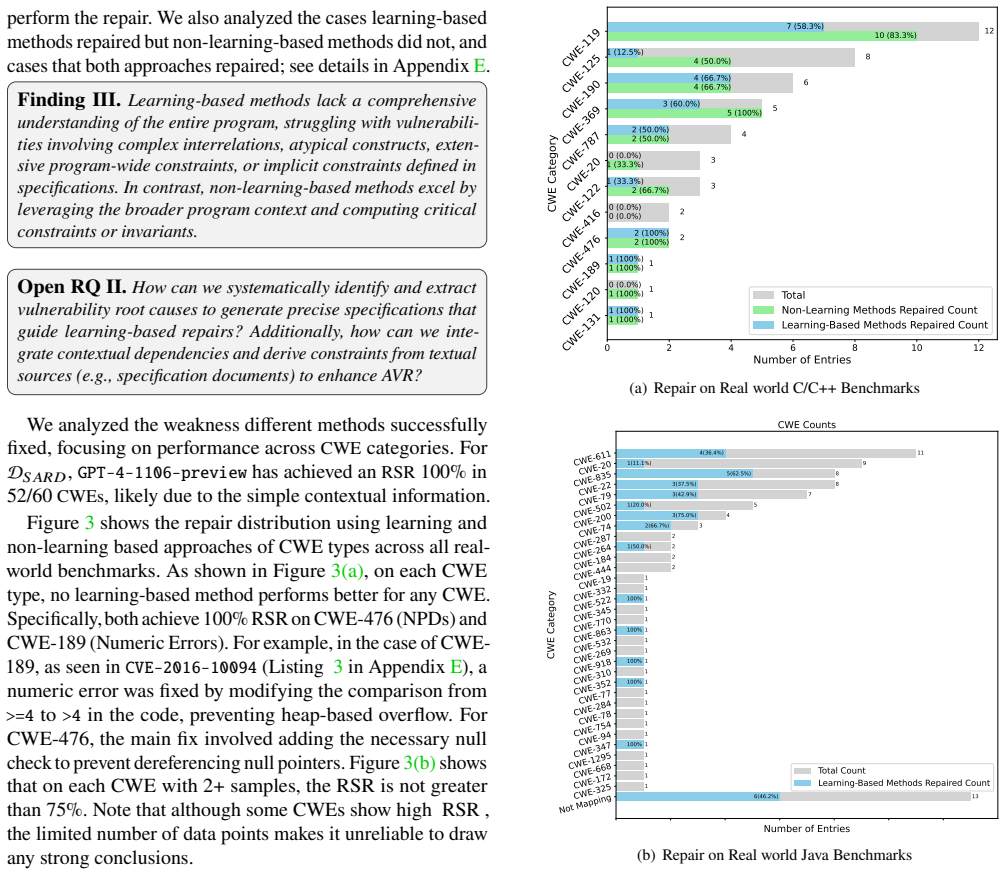
On the paper's own terms, the discovery is a negative result stated as a landscape finding: after surveying 79 papers and running ten repair tools on four benchmarks, no consistently dominant AVR approach exists. The numbers that carry the claim are repair success rates: GPT-4-1106-preview scores 96.6% on 1,000 sampled SARD C/C++ cases, but only 46.67% on the 30-case ExtractFix set, 34.88% on the 43-case VulnLoc set, 37.14% on the filtered 70-case Vul4J Java set, and 21.74% on VJBench. Non-learning tools such as ExtractFix (70.00% on its own benchmark) and VulnFix (43.33% on ExtractFix, 46.51% on VulnLoc) do better on real-world sets but still fail on complex logic, multi-file changes, and constraints hidden in specifications. The paper attributes the gap to a structural difference: learning-based methods produce compilable code often but miss program-wide dependencies and implicit security properties, while non-learning methods compute constraints or invariants from program context. Its Finding IV states the overall result plainly: learning-based AVR methods lag traditional approaches on these benchmarks, even though they excel on specific CWE categories.
Load-bearing premise
The empirical conclusions depend on the curated benchmark suite being representative of AVR's real difficulty distribution; the filters that removed multi-file Java vulnerabilities and several tool categories could make 'learning-based lag traditional' an artifact of test selection.
Editorial extensions
If this is right
- Results from synthetic datasets such as SARD should not be treated as predictions of real-world repair performance; the paper's own numbers show a 96.6% RSR on synthetic C/C++ collapsing to below 50% on real-world C/C++ and Java sets.
- A benchmark's composition—CWE mix, presence of inter-procedural dependencies, and availability of exploits/test oracles—determines which repair method looks best, so AVR comparisons are only meaningful relative to a described benchmark.
- Inter-procedural code dependencies are a more informative difficulty signal than single-hunk versus multi-hunk change size, which the paper finds does not reliably predict repair success.
- Combining learning-based patch generation with program analysis, constraint extraction, or external verifier feedback is a concrete direction the paper identifies for improving both families of methods.
- Security patch validation remains a bottleneck that currently requires human expertise, especially for selecting among multiple generated patches from non-deterministic LLMs.
Reading between the lines
- Editorial inference: if the benchmark-dependence result generalizes, practical adoption should match tool to vulnerability profile—constraint-based tools for memory-safety CVEs with a single exploit, LLM-based tools for well-represented CWE patterns—rather than picking one tool by average score.
- Editorial inference: the paper's filtering decisions (dropping multi-file Java vulnerabilities and tools targeting backporting, Solidity, or NPDs) may have removed exactly the cases where LLMs' strengths or weaknesses are most visible; re-running on unfiltered sets could sharpen or reverse Finding IV.
- Editorial inference: the authors' use of three sampled outputs per non-deterministic model and counting any correct one privileges LLMs relative to deterministic tools; a pass@1 comparison might show an even larger real-world gap.
- Editorial inference: a natural extension would be a benchmark 'fingerprint'—reporting CWE distribution, dependency profile, and exploit availability alongside RSR—so future AVR papers can be compared meaningfully across different datasets.
Editorial analysis
A structured set of objections, weighed in public.
Referee Report
Summary. This SoK paper surveys automated vulnerability repair (AVR), proposes a four-category taxonomy (template-guided, search-based, constraint-based, learning-driven) with sub-strategies and methodologies, and reports a quantitative benchmark evaluation of ten AVR tools on synthetic (SARD) and real-world C/C++ and Java datasets. The main empirical findings are that no single method dominates, that learning-based methods perform very well on synthetic data but drop sharply on real-world benchmarks, and that non-learning methods are generally more effective on the real-world C/C++ cases considered. The paper also analyzes repair difficulty factors (scope of change and code dependencies), presents case studies, and offers future research directions.
Significance. If the empirical findings hold, this is one of the few SoKs that combine a taxonomy with direct, reproducible tool evaluation, and it would be a useful reference for researchers choosing between learning-based and non-learning AVR approaches. The three-step validation with manual review (96.5% agreement, kappa 91.5%) is a genuine strength, as is the explicit reporting of artifact availability and exclusion criteria. The paper also makes a useful conceptual contribution by distinguishing security patch generation from general program repair and by highlighting the role of code dependencies rather than hunk counts in repair difficulty. However, the central 'no single best approach' conclusion is more robust than the sharper Finding IV ('learning lags behind overall'), which depends on a filtered benchmark composition and an asymmetric evaluation protocol.
major comments (4)
- [Section 5.1 / Section 5.2, Finding IV] The 'overall' ranking in Finding IV is not supported by the evaluated benchmark structure. The Java benchmarks were explicitly filtered to remove multi-file vulnerabilities (footnote 1, retaining 23/42 VJBench and 70/79 Vul4J), and no non-learning Java tool was evaluated on the same filtered set (Appendix B excludes Nopol and NPEFix because the Java benchmark lacks NPDs). Consequently, the comparison between learning and non-learning methods is effectively a C/C++-only comparison, and it uses two datasets (ExtractFix and VulnLoc) designed for and dominated by non-learning memory-safety repair tools. To support an 'overall' claim, the authors should either evaluate non-learning Java tools on the filtered Java set, or explicitly restrict Finding IV to the C/C++ benchmarks and discuss how the CWE distribution affects generalizability.
- [Section 5.1, Evaluation Metrics (Eq. 1 and following note)] The evaluation gives non-deterministic LLMs a pass@3 advantage while deterministic tools are run once. This asymmetry favors learning-based methods, so it does not undermine the direction of Finding IV; however, it makes the reported RSR values non-comparable across method families and prevents any quantitative 'overall' ranking. The authors should report per-run success rates for the LLMs (or, equivalently, compute best-of-3 for the deterministic tools) and label the current numbers as pass@3 in Tables 2 and 3.
- [Section 5.2, Finding I] Finding I states that 'the robustness of learning-driven method in our evaluation is excellent,' but the data in Tables 2 and 3 show GPT-4 dropping from 96.6% on SARD to between 10% and 47% on real-world benchmarks, and VRPilot remaining below non-learning tools on both C/C++ sets. The mutation experiments (D_SARD with 200 samples) only measure robustness to syntactic perturbations of synthetic code, not robustness across real-world vulnerability distributions. This finding should be reworded to match the evidence, e.g., 'learning-driven methods are robust on synthetic SARD-style inputs' rather than claiming excellent robustness generally.
- [Section 5.2, Figure 3 and Open RQ III] The CWE-level analysis in Figure 3 is used to support Finding IV, but most CWE categories contain only one or two data points, and the paper itself notes in Open RQ III that 'limited data makes strong conclusions unreliable.' The categorical statements in Findings III and IV go beyond what this sample size supports. The authors should either add confidence intervals or statistical tests on CWE-level RSRs, or soften the findings to explicitly acknowledge that the observed gaps may be an artifact of benchmark composition.
minor comments (5)
- [Throughout] There are numerous typos and grammatical errors, e.g., 'norrowing' instead of 'narrowing' in Section 4.2, 'employsthree' in the same section, 'vulerable' in Section 2.4, and 'techniniques' in Section 6. A careful proofreading pass is needed.
- [Section 5.2 / Table 4] Table 4 is introduced as 'Successful repairs by Scope of Change and Code Dependencies' but the columns mix counts and rates; the header rows should be clarified, and the text should state whether the denominators (25 and 23) are the number of applicable cases for each tool or global totals.
- [Appendix B / Table 6] The artifact-status table is useful, but the symbols in the 'Accessible', 'Instruction', and 'Executable' columns are inconsistently explained: the legend defines check/cross symbols but some rows use a slash, which is not defined in the table notes.
- [Section 2.3, Definition 3] The definition of SPV says a patch is deemed effective if it satisfies three criteria, but the paper later acknowledges (Section 6, D6) that most validation still requires human effort; the definition should make clear that the criteria are ideal conditions, not an operational procedure.
- [Section 4.4, subsection labels] The prompt-engineering subsection labels its subparts as B1, B2, B3 after using A and B for previous subsections; this creates confusion (there are two 'B1's in Section 4.4). Renumber the prompt-engineering items as C1, C2, C3.
Circularity Check
No significant circularity: the SoK's taxonomy and empirical findings are grounded in external tools, external benchmarks, and measured RSR values, not in fitted parameters or self-citations.
full rationale
The paper's central claims—'no single best approach' and Finding IV ('Learning-based AVR methods lag behind traditional approaches overall')—are empirical conclusions drawn from running externally developed tools (Senx, VulnFix, ExtractFix, VRPilot, GPT-4, Gemini, CodeT5, InCoder, etc.) on externally provided benchmarks (SARD, VJBench, Vul4J, ExtractFix, VulnLoc). The taxonomy in Section 3 is a classification scheme imposed by the authors, but it does not mathematically determine any RSR value or any relative ranking. No parameter is fitted to a subset of data and then renamed as a prediction; the RSR metric is defined transparently, and the pass@3 counting for non-deterministic LLMs is disclosed, not disguised. The paper contains no load-bearing self-citations: the evaluated artifacts and datasets come from other research groups, and no 'uniqueness theorem' or prior author-derived ansatz is invoked to force a conclusion. The benchmark filtering choices (e.g., retaining 23/42 VJBench and 70/79 Vul4J cases, excluding backporting/Solidity/NPD-focused tools) are validity limitations that reduce the generality of 'overall' comparisons, but they do not make the observed outcomes true by construction. The paper itself repeatedly cautions that small sample sizes make strong conclusions unreliable, which further indicates that the findings are presented as empirical observations rather than as artifacts of definitional circularity. Therefore, no circular step meeting the required evidentiary standard is present.
Assumptions & free parameters
assumptions (5)
- domain assumption The selected benchmark datasets (SARD sample, VJBench/Vul4J, ExtractFix/VulnLoc) are representative of the AVR problem space and difficulty distribution.
- domain assumption Repair success rate (RSR), computed via compilation, oracle tests/exploits, and manual review, is a valid measure of whether a security patch is correct.
- domain assumption The 79-paper corpus collected through keyword search, filtering, manual review, and snowballing is representative of the AVR literature, and the authors' taxonomy assignments are correct.
- domain assumption GPT-4-1106-preview and Gemini-Pro results generalize to other LLMs and remain stable across model updates.
- domain assumption Tools excluded from the benchmark (backporting, Solidity-specific, NPD-only) would not change the headline finding of no single best approach.
Cite this review
Pith. "Pith review of SoK: Towards Effective Automated Vulnerability Repair." pith.science (2026). https://pith.science/paper/7UZEAJSU
@misc{pith2026250118820,
  author       = {Pith},
  title        = {Pith review of: SoK: Towards Effective Automated Vulnerability Repair},
  year         = {2026},
  howpublished = {\url{https://pith.science/paper/7UZEAJSU}},
  note         = {Machine review of arXiv:2501.18820}
}
read the original abstract
The increasing prevalence of software vulnerabilities necessitates automated vulnerability repair (AVR) techniques. This Systematization of Knowledge (SoK) provides a comprehensive overview of the AVR landscape, encompassing both synthetic and real-world vulnerabilities. Through a systematic literature review and quantitative benchmarking across diverse datasets, methods, and strategies, we establish a taxonomy of existing AVR methodologies, categorizing them into template-guided, search-based, constraint-based, and learning-driven approaches. We evaluate the strengths and limitations of these approaches, highlighting common challenges and practical implications. Our comprehensive analysis of existing AVR methods reveals a diverse landscape with no single ``best'' approach. Learning-based methods excel in specific scenarios but lack complete program understanding, and both learning and non-learning methods face challenges with complex vulnerabilities. Additionally, we identify emerging trends and propose future research directions to advance the field of AVR. This SoK serves as a valuable resource for researchers and practitioners, offering a structured understanding of the current state-of-the-art and guiding future research and development in this critical domain.
Figures


Figures from the paper (1 more)

Forward citations
Cited by 1 Pith paper
-
SoK: Automated Vulnerability Repair: Methods, Tools, and Assessments
Vul4C, a 144-vulnerability C/C++ repair benchmark with exploits and patches, is introduced and used to compare seven C/C++ and two Java automated vulnerability repair tools.
Reference graph
Works this paper leans on
-
[1]
Zero-day vulnera- bilities: 17 consequences and complications
Forbes Technology Council. Zero-day vulnera- bilities: 17 consequences and complications. https://www.forbes.com/sites/forbestechcou ncil/2023/05/26/zero-day-vulnerabilities-17-c onsequences-and-complications. Accessed on: Jan, 2024
2023
-
[2]
Evaluating complexity, code churn, and developer activitymetricsasindicatorsofsoftwarevulnerabilities
YongheeShin,AndrewMeneely,LaurieWilliams,andJasonA Osborne. Evaluating complexity, code churn, and developer activitymetricsasindicatorsofsoftwarevulnerabilities. IEEE TSE, 2010
2010
-
[3]
A large-scale empirical study of security patches
Frank Li and Vern Paxson. A large-scale empirical study of security patches. InProc. ACM CCS, 2017
2017
-
[4]
A novel approach for software vulnerability classifi- cation
Xiaodan Li, Xiaolin Chang, John A Board, and Kishor S Trivedi. A novel approach for software vulnerability classifi- cation. InProc. IEEE RAMS, 2017
2017
-
[5]
Vulnerability remediation timelines: 7 best practices
Makenzie Buenning. Vulnerability remediation timelines: 7 best practices. https://www.ninjaone.com/blog/vu lnerability-remediation-timelines-best-pract ices/, 2024. Accessed on: Mar, 2024
2024
-
[6]
Autopag:towardsautomatedsoftwarepatchgeneration with source code root cause identification and repair
Zhiqiang Lin, Xuxian Jiang, Dongyan Xu, Bing Mao, and LiXie. Autopag:towardsautomatedsoftwarepatchgeneration with source code root cause identification and repair. InProc. ACM CCS, 2007
2007
-
[7]
Exter- minator: automatically correcting memory errors with high probability
Gene Novark, Emery D Berger, and Benjamin G Zorn. Exter- minator: automatically correcting memory errors with high probability. InProc. ACM PLDI, 2007
2007
-
[8]
Program transformations to fix c integers
Zack Coker and Munawar Hafiz. Program transformations to fix c integers. InProc. ACM/IEEE ICSE, 2013
2013
Show all 224 references
-
[9]
XiangGao,BoWang,GregoryJDuck,RuyiJi,YingfeiXiong, andAbhikRoychoudhury.Beyondtests:Programvulnerability repair via crash constraint extraction.ACM TOSEM, 2021
2021
-
[10]
Program vulnerability repair via inductive inference
Yuntong Zhang, Xiang Gao, Gregory J Duck, and Abhik Roychoudhury. Program vulnerability repair via inductive inference. InProc. ACM ISSTA, 2022
2022
-
[11]
Generative adversarial networks.Communi- cations of the ACM, 2020
Ian Goodfellow, Jean Pouget-Abadie, Mehdi Mirza, Bing Xu, David Warde-Farley, Sherjil Ozair, Aaron Courville, and Yoshua Bengio. Generative adversarial networks.Communi- cations of the ACM, 2020
2020
-
[12]
Seqtrans:automaticvulnerabilityfixviasequencetosequence learning
Jianlei Chi, Yu Qu, Ting Liu, Qinghua Zheng, and Heng Yin. Seqtrans:automaticvulnerabilityfixviasequencetosequence learning. IEEE TSE, 2022
2022
-
[13]
Neu- ral transfer learning for repairing security vulnerabilities in c code
Zimin Chen,Steve Kommrusch,andMartin Monperrus. Neu- ral transfer learning for repairing security vulnerabilities in c code. IEEE TSE, 2022
2022
-
[14]
Howeffective areneuralnetworksforfixingsecurityvulnerabilities
YiWu,NanJiang,HungVietPham,ThibaudLutellier,Jordan Davis,LinTan,PetrBabkin,andSameenaShah. Howeffective areneuralnetworksforfixingsecurityvulnerabilities. In Proc. ACM ISSTA, 2023
2023
-
[15]
Examining zero-shot vul- nerability repair with large language models
Hammond Pearce, Benjamin Tan, Baleegh Ahmad, Ramesh Karri, and Brendan Dolan-Gavitt. Examining zero-shot vul- nerability repair with large language models. InProc. IEEE S&P, 2023
2023
-
[16]
Chatgpt for vulnerability detection, classification, and repair: How far are we? InIEEE APSEC, 2023
MichaelFu,ChakkritKlaTantithamthavorn,VanNguyen,and Trung Le. Chatgpt for vulnerability detection, classification, and repair: How far are we? InIEEE APSEC, 2023
2023
-
[17]
Automaticsoftwarerepair:Abibliography
MartinMonperrus. Automaticsoftwarerepair:Abibliography. ACM Computing Surveys (CSUR), 2018
2018
-
[18]
Au- tomatic software repair: A survey
Luca Gazzola, Daniela Micucci, and Leonardo Mariani. Au- tomatic software repair: A survey. InProc. ACM/IEEE ICSE, 2018
2018
-
[19]
PhD thesis, HAL Archives Ouvertes, 2018
Martin Monperrus.The living review on automated program repair. PhD thesis, HAL Archives Ouvertes, 2018
2018
-
[20]
A compara- tive study ofautomatic program repairtechniques forsecurity vulnerabilities
Eduard Pinconschi, Rui Abreu, and Pedro Adão. A compara- tive study ofautomatic program repairtechniques forsecurity vulnerabilities. InProc. IEEE ISSRE, 2021
2021
-
[21]
Let’s talk with developers, not about developers: A review of automatic program repair research.IEEE TSE, 2022
Emily Winter, Vesna Nowack, David Bowes, Steve Coun- sell, Tracy Hall, Sæmundur Haraldsson, and John Woodward. Let’s talk with developers, not about developers: A review of automatic program repair research.IEEE TSE, 2022
2022
-
[22]
A survey on automated program repair techniques.arXiv:2303.18184, 2023
Kai Huang, Zhengzi Xu, Su Yang, Hongyu Sun, Xuejun Li, Zheng Yan, and Yuqing Zhang. A survey on automated program repair techniques.arXiv:2303.18184, 2023
2023 arXiv
-
[23]
A survey of learning-based automated program repair.ACM TOSEM, 2023
Quanjun Zhang, Chunrong Fang, Yuxiang Ma, Weisong Sun, and Zhenyu Chen. A survey of learning-based automated program repair.ACM TOSEM, 2023
2023
-
[24]
Largelan- guage model for vulnerability detection and repair: Literature review and roadmap.arXiv:2404.02525, 2024
XinZhou,SicongCao,XiaobingSun,andDavidLo. Largelan- guage model for vulnerability detection and repair: Literature review and roadmap.arXiv:2404.02525, 2024
2024 arXiv
-
[25]
What if is not enough? fixing null pointer dereference with contextual check
Yunlong Xing, Shu Wang, Shiyu Sun, Xu He, Kun Sun, and Qi Li. What if is not enough? fixing null pointer dereference with contextual check. InUSENIX Security, 2024
2024
-
[26]
Tap- fixer: Automatic detection and repair of home automation vulnerabilities based on negated-property reasoning
Yinbo Yu, Yuanqi Xu, Kepu Huang, and Jiajia Liu. Tap- fixer: Automatic detection and repair of home automation vulnerabilities based on negated-property reasoning. InProc. USENIX Security, 2024
2024
-
[27]
Localizing vulnerabilities statistically from one exploit
ShiqiShen,AashishKolluri,ZhenDong,PrateekSaxena,and Abhik Roychoudhury. Localizing vulnerabilities statistically from one exploit. InProc. ACM ASIACCS, 2021
2021
-
[28]
Vulchecker: Graph-based vulnerability lo- calization in source code
Yisroel Mirsky, George Macon, Michael Brown, Carter Yage- mann, Matthew Pruett, Evan Downing, Sukarno Mertoguno, and Wenke Lee. Vulchecker: Graph-based vulnerability lo- calization in source code. InProc. USENIX Security, 2023
2023
-
[29]
Dynamic program slicing
Hiralal Agrawal and Joseph R Horgan. Dynamic program slicing. ACM SIGPlan Notices, 1990. 15
1990
-
[30]
Icspatch: Automated vulnerability lo- calization and non-intrusive hotpatching in industrial control systems using data dependence graphs
Prashant Hari Narayan Rajput, Constantine Doumanidis, and Michail Maniatakos. Icspatch: Automated vulnerability lo- calization and non-intrusive hotpatching in industrial control systems using data dependence graphs. InProc. USENIX Secur. Symp, 2023
2023
-
[31]
Simplifying and isolat- ing failure-inducing input.IEEE TSE, 2002
Andreas Zeller and Ralf Hildebrandt. Simplifying and isolat- ing failure-inducing input.IEEE TSE, 2002
2002
-
[32]
Racing on the negative force: Efficient vulnerability root-cause analysis through reinforce- ment learning on counterexamples
Dandan Xu, Di Tang, Yi Chen, XiaoFeng Wang, Kai Chen, Haixu Tang, and Longxing Li. Racing on the negative force: Efficient vulnerability root-cause analysis through reinforce- ment learning on counterexamples. InUSENIX Security, 2024
2024
-
[33]
An empirical study of auto- mated vulnerability localization with large language models
Jian Zhang, Chong Wang, Anran Li, Weisong Sun, Cen Zhang, Wei Ma, and Yang Liu. An empirical study of auto- mated vulnerability localization with large language models. arXiv:2404.00287, 2024
2024
-
[34]
Graphspd: Graph-based security patch detection with enriched code semantics
Shu Wang, Xinda Wang, Kun Sun, Sushil Jajodia, Haining Wang, and Qi Li. Graphspd: Graph-based security patch detection with enriched code semantics. InProc. IEEE S&P, 2023
2023
-
[35]
Directed greybox fuzzing
Marcel Böhme, Van-Thuan Pham, Manh-Dung Nguyen, and Abhik Roychoudhury. Directed greybox fuzzing. InProc. ACM CCS, 2017
2017
-
[36]
Evocatio:Conjuringbugcapabilitiesfrom a single poc
Zhiyuan Jiang, Shuitao Gan, Adrian Herrera, Flavio Toffalini, Lucio Romerio, Chaojing Tang, Manuel Egele, Chao Zhang, andMathiasPayer. Evocatio:Conjuringbugcapabilitiesfrom a single poc. InProc. ACM CCS, 2022
2022
-
[37]
Fast and precise on-the-fly patch validation for all
Lingchao Chen, Yicheng Ouyang, and Lingming Zhang. Fast and precise on-the-fly patch validation for all. InIEEE/ACM ICSE, 2021
2021
-
[38]
Au- tomatic software repair: A survey.IEEE TSE, 2017
Luca Gazzola, Daniela Micucci, and Leonardo Mariani. Au- tomatic software repair: A survey.IEEE TSE, 2017
2017
-
[39]
Leveragingsyntax-relatedcodefor automated program repair
QiXinandStevenPReiss. Leveragingsyntax-relatedcodefor automated program repair. InProc. IEEE/ACM ASE, 2017
2017
-
[40]
S3: syntax-and semantic-guided repair synthesis via programming by examples
Xuan-Bach D Le, Duc-Hiep Chu, David Lo, Claire Le Goues, and Willem Visser. S3: syntax-and semantic-guided repair synthesis via programming by examples. InProc. ACM ESEC/FSE, 2017
2017
-
[41]
Anti-patterns in search-based program repair
Shin Hwei Tan,Hiroaki Yoshida,Mukul R Prasad,and Abhik Roychoudhury. Anti-patterns in search-based program repair. In Proc. ACM/IEEE FSE, 2016
2016
-
[42]
Automatedbehavioral regression testing
WeiJin,AlessandroOrso,andTaoXie. Automatedbehavioral regression testing. InProc. IEEE/ACM ICST, 2010
2010
-
[43]
Identifying test-suite-overfitted patches through test case generation
Qi Xin and Steven P Reiss. Identifying test-suite-overfitted patches through test case generation. InProc. ACM ISSTA, 2017
2017
-
[44]
Diffgen: Automated regression unit-test generation
Kunal Taneja and Tao Xie. Diffgen: Automated regression unit-test generation. InProc. IEEE/ACM ASE, 2008
2008
-
[45]
Automaticpatchgenerationlearnedfromhuman-written patches
Dongsun Kim, Jaechang Nam, Jaewoo Song, and Sunghun Kim. Automaticpatchgenerationlearnedfromhuman-written patches. InIEEE ICSME, 2013
2013
-
[46]
Identifying patch correctness in test-based program repair
Yingfei Xiong, Xinyuan Liu, Muhan Zeng, Lu Zhang, and Gang Huang. Identifying patch correctness in test-based program repair. InProc. IEEE/ACM ICSE, 2018
2018
-
[47]
Patchverif: Discovering faulty patches in robotic vehicles
Hyungsub Kim, Muslum Ozgur Ozmen, Z Berkay Celik, Antonio Bianchi, and Dongyan Xu. Patchverif: Discovering faulty patches in robotic vehicles. InProc. USENIX Security, 2023
2023
-
[48]
Verifying security patches
Jonathan Gallagher, Robin Gonzalez, and Michael E Locasto. Verifying security patches. InProceedings of the 2014 in- ternational workshop on privacy & security in programming, 2014
2014
-
[49]
Leveraging large language model for automatic patch correctness assessment.IEEE TSE, 2024
XinZhou,BowenXu,KisubKim,DongGyunHan,HungHuu Nguyen, Thanh Le-Cong, Junda He, Bach Le, and David Lo. Leveraging large language model for automatic patch correctness assessment.IEEE TSE, 2024
2024
-
[50]
Cure: Code-aware neural machine translation for automatic program repair
Nan Jiang,ThibaudLutellier,andLin Tan. Cure: Code-aware neural machine translation for automatic program repair. In 2021 IEEE/ACM ICSE
2021
-
[51]
Thinkrepair: Self-directed automated program repair
Xin Yin, Chao Ni, Shaohua Wang, Zhenhao Li, Limin Zeng, and Xiaohu Yang. Thinkrepair: Self-directed automated program repair. InProc. ACM ISSTA, 2024
2024
-
[52]
Compilation error repair: for the student programs, from the student programs
Umair Z Ahmed, Pawan Kumar, Amey Karkare, Purushottam Kar, and Sumit Gulwani. Compilation error repair: for the student programs, from the student programs. InProc. ICSE, 2018
2018
-
[53]
Deepdelta:learningtorepaircompilation errors
AliMesbah,AndrewRice,EmilyJohnston,NickGlorioso,and EdwardAftandilian. Deepdelta:learningtorepaircompilation errors. InProc. ACM ESEC/FSE, 2019
2019
-
[54]
Xueyang Li, Shangqing Liu, Ruitao Feng, Guozhu Meng, Xi- aofeiXie,KaiChen,andYangLiu.Transrepair:Context-aware program repair for compilation errors. InProc. IEEE/ACM ASE, 2022
2022
-
[55]
Patches as better bug reports
Westley Weimer. Patches as better bug reports. InPro- ceedings of the 5th international conference on Generative programming and component engineering, 2006
2006
-
[56]
Automati- cally fixing c buffer overflows using program transformations
Alex Shaw, Dusten Doggett, and Munawar Hafiz. Automati- cally fixing c buffer overflows using program transformations. InProc. IEEE DSN, 2014
2014
-
[57]
Bovin- spector: automatic inspection and repair of buffer overflow vulnerabilities
Fengjuan Gao, Linzhang Wang, and Xuandong Li. Bovin- spector: automatic inspection and repair of buffer overflow vulnerabilities. InProc. IEEE/ACM ASE, 2016
2016
-
[58]
Using safety properties to generate vulnerability patches
Zhen Huang, David Lie, Gang Tan, and Trent Jaeger. Using safety properties to generate vulnerability patches. InProc. IEEE S&P, 2019
2019
-
[59]
Safe memory-leak fixing for c programs
QingGao,YingfeiXiong,YaqingMi,LuZhang,WeikunYang, Zhaoping Zhou, Bing Xie, and Hong Mei. Safe memory-leak fixing for c programs. InIEEE/ACM ICSE, 2015. 16
2015
-
[60]
Saver: scalable, precise, and safe memory-error repair
Seongjoon Hong, Junhee Lee, Jeongsoo Lee, and Hakjoo Oh. Saver: scalable, precise, and safe memory-error repair. In Proc. ACM/IEEE ICSE, 2020
2020
-
[61]
Auto- matedmemoryleakfixingonvalue-flowslicesforcprograms
Hua Yan, Yulei Sui, Shiping Chen, and Jingling Xue. Auto- matedmemoryleakfixingonvalue-flowslicesforcprograms. InProceedingsofthe31stAnnualACMSymposiumonApplied Computing, 2016
2016
-
[62]
Automatic integer error repair by proper-type inference
Xi Cheng, Min Zhou, Xiaoyu Song, Ming Gu, and Jiaguang Sun. Automatic integer error repair by proper-type inference. IEEE TDSC, 2019
2019
-
[63]
Intrepair: Informed repairing of integer overflows
Paul Muntean, Martin Monperrus, Hao Sun, Jens Grossklags, and Claudia Eckert. Intrepair: Informed repairing of integer overflows. IEEE TSE, 2019
2019
-
[64]
Rupair: towards automatic buffer overflow detection and rectification for rust
Baojian Hua, Wanrong Ouyang, Chengman Jiang, Qiliang Fan, and Zhizhong Pan. Rupair: towards automatic buffer overflow detection and rectification for rust. InProc. ACM ASIACCS, 2021
2021
-
[65]
Automaticallydiagnosingand repairing error handling bugs in c
YuchiTianandBaishakhiRay. Automaticallydiagnosingand repairing error handling bugs in c. InProc. ACM/IEEE ICSE, 2017
2017
-
[66]
Smartshield: Automatic smart contract protection made easy
YuyaoZhang,SiqiMa,JuanruLi,KailaiLi,SuryaNepal,and Dawu Gu. Smartshield: Automatic smart contract protection made easy. InIEEE SANER, 2020
2020
-
[67]
Evmpatch:Timelyandautomatedpatchingofethereum smart contracts
Michael Rodler, Wenting Li, Ghassan O Karame, and Lucas Davi. Evmpatch:Timelyandautomatedpatchingofethereum smart contracts. InProc. USENIX Security, 2021
2021
-
[68]
Ely- sium:Context-awarebytecode-levelpatchingtoautomatically heal vulnerable smart contracts
Christof Ferreira Torres, Hugo Jonker, and Radu State. Ely- sium:Context-awarebytecode-levelpatchingtoautomatically heal vulnerable smart contracts. InProceedings of the 25th International Symposium on Research in Attacks, Intrusions and Defenses, 2022
2022
-
[69]
Sguard: towards fixingvulnerablesmartcontractsautomatically
Tai D Nguyen, Long H Pham, and Jun Sun. Sguard: towards fixingvulnerablesmartcontractsautomatically. In Proc.IEEE S&P, 2021
2021
-
[70]
Contractfix: A framework for automatically fixing vulnerabilities in smart contracts.arXiv:2307.08912, 2023
Pengcheng Fang. Contractfix: A framework for automatically fixing vulnerabilities in smart contracts.arXiv:2307.08912, 2023
2023 arXiv
-
[71]
Automatically fixing security vulnerabilities in java code
Aharon Abadi, Ran Ettinger, Yishai A Feldman, and Mati Shomrat. Automatically fixing security vulnerabilities in java code. InProc. ACM OOPSLA, 2011
2011
-
[72]
Vfix: value-flow-guided precise program repair for null pointer dereferences
Xuezheng Xu, Yulei Sui, Hua Yan, and Jingling Xue. Vfix: value-flow-guided precise program repair for null pointer dereferences. InProc. ACM/IEEE ICSE, 2019
2019
-
[73]
Regexscalpel: Regular expression denial of service (redos) defense by localize-and-fix
Yeting Li, Yecheng Sun, Zhiwu Xu, Jialun Cao, Yuekang Li, Rongchen Li, Haiming Chen, Shing-Chi Cheung, Yang Liu, and Yang Xiao. Regexscalpel: Regular expression denial of service (redos) defense by localize-and-fix. InUSENIX Security, 2022
2022
-
[74]
Cdrep:Auto- matic repairof cryptographic misuses in android applications
SiqiMa,DavidLo,TengLi,andRobertHDeng. Cdrep:Auto- matic repairof cryptographic misuses in android applications. InProc. ACM ASIACCS, 2016
2016
-
[75]
Example-based vulnerability detection and repair in java code
Ying Zhang, Ya Xiao, Md Mahir Asef Kabir, Danfeng Yao, and Na Meng. Example-based vulnerability detection and repair in java code. InProc. IEEE/ACM ICPC, 2022
2022
-
[76]
Vurle: Automatic vulnerability detection and repair by learning from examples
Siqi Ma, Ferdian Thung, David Lo, Cong Sun, and Robert H Deng. Vurle: Automatic vulnerability detection and repair by learning from examples. InProc. IEEE ESORICS, 2017
2017
-
[77]
Binary rewriting without control flow recovery
GregoryJDuck,XiangGao,andAbhikRoychoudhury. Binary rewriting without control flow recovery. InProc. ACM PLDI, 2020
2020
-
[78]
Westley Weimer, ThanhVu Nguyen, Claire Le Goues, and StephanieForrest.Automaticallyfindingpatchesusinggenetic programming. InProc. ACM/IEEE ICSE, 2009
2009
-
[79]
A genetic programming approach to auto- mated software repair
Stephanie Forrest, ThanhVu Nguyen, Westley Weimer, and Claire Le Goues. A genetic programming approach to auto- mated software repair. InProc. ACM/IEEE GECCO, 2009
2009
-
[80]
A systematic study of automated program repair: Fixing 55 out of 105 bugs for $8 each
ClaireLeGoues,MichaelDewey-Vogt,StephanieForrest,and Westley Weimer. A systematic study of automated program repair: Fixing 55 out of 105 bugs for $8 each. InProc. ACM/IEEE ICSE, 2012
2012
-
[81]
Genprog: A generic method for automatic software repair.IEEE TSE, 2011
Claire Le Goues, ThanhVu Nguyen, Stephanie Forrest, and Westley Weimer. Genprog: A generic method for automatic software repair.IEEE TSE, 2011
2011
-
[82]
Sapfix: Automated end-to-end repair at scale
AlexandruMarginean,JohannesBader,SatishChandra,Mark Harman, Yue Jia, Ke Mao, Alexander Mols, and Andrew Scott. Sapfix: Automated end-to-end repair at scale. InProc. ACM/IEEE ICSE, 2019
2019
-
[83]
Hypergi: Automateddetection and repair of information flow leakage
Ibrahim Mesecan, Daniel Blackwell, David Clark, Myra B Cohen,andJustyna Petke. Hypergi: Automateddetection and repair of information flow leakage. InProc. IEEE/ACM ASE, 2021
2021
-
[84]
Dynamic patch generation for null pointer exceptions using metaprogramming
Thomas Durieux, Benoit Cornu, Lionel Seinturier, and Mar- tin Monperrus. Dynamic patch generation for null pointer exceptions using metaprogramming. InProc. IEEE SANER, 2017
2017
-
[85]
Property-based automated repair of defi protocols
Palina Tolmach, Yi Li, and Shang-Wei Lin. Property-based automated repair of defi protocols. InProc. IEEE/ACM ASE, 2022
2022
-
[86]
Backportingsecuritypatchesofwebapplications:Aprototype design and implementation on injection vulnerability patches
YoukunShi,YuanZhang,TianhanLuo,XiangyuMao,Yinzhi Cao, Ziwen Wang, Yudi Zhao, Zongan Huang, and Min Yang. Backportingsecuritypatchesofwebapplications:Aprototype design and implementation on injection vulnerability patches. InUSENIX Security, 2022
2022
-
[87]
Automatedpatch backportinginlinux(experiencepaper)
Ridwan Shariffdeen, Xiang Gao, Gregory J Duck, Shin Hwei Tan,JuliaLawall,andAbhikRoychoudhury. Automatedpatch backportinginlinux(experiencepaper). In Proc.ACMISSTA , 2021. 17
2021
-
[88]
Enhancing oss patch backporting with semantics
Su Yang, Yang Xiao, Zhengzi Xu, Chengyi Sun, Chen Ji, and Yuqing Zhang. Enhancing oss patch backporting with semantics. InProc. ACM SIGSAC CCS, 2023
2023
-
[89]
Automated patch transplantation
Ridwan Salihin Shariffdeen, Shin Hwei Tan, Mingyuan Gao, and Abhik Roychoudhury. Automated patch transplantation. ACM TOSEM, 2020
2020
-
[90]
Fix me up: Repairing access-control bugs in web applications
Sooel Son, Kathryn S McKinley, and Vitaly Shmatikov. Fix me up: Repairing access-control bugs in web applications. In NDSS, 2013
2013
-
[91]
Automatic hot patch generation for android kernels
Zhengzi Xu, Yulong Zhang, Longri Zheng, Liangzhao Xia, Chenfu Bao, Zhi Wang, and Yang Liu. Automatic hot patch generation for android kernels. InUSENIX Security, 2020
2020
-
[92]
Static automated programrepairforheapproperties
Rijnard van Tonder and Claire Le Goues. Static automated programrepairforheapproperties. In Proc.ACM/IEEEICSE , 2018
2018
-
[93]
Memfix:static analysis-based repair of memory deallocation errors for c
JunheeLee,SeongjoonHong,andHakjooOh. Memfix:static analysis-based repair of memory deallocation errors for c. In Proc. ACM ESEC/FSE, 2018
2018
-
[94]
Automating patching of vulnerable open-source software versions in application binaries
Ruian Duan, Ashish Bijlani, Yang Ji, Omar Alrawi, Yiyuan Xiong, Moses Ike, Brendan Saltaformaggio, and Wenke Lee. Automating patching of vulnerable open-source software versions in application binaries. InNDSS, 2019
2019
-
[95]
Programrepairguidedbydatalog-definedstaticanalysis
YuLiu,SergeyMechtaev,PavleSubotić,andAbhikRoychoud- hury. Programrepairguidedbydatalog-definedstaticanalysis. In Proc. ESEC/FSE, 2023
2023
-
[96]
Repairing dos vulnera- bility of real-world regexes
Nariyoshi Chida and Tachio Terauchi. Repairing dos vulnera- bility of real-world regexes. InProc. IEEE S&P, 2022
2022
-
[97]
Semfix: Program repair via semantic analysis
HoangDuongThienNguyen,DaweiQi,AbhikRoychoudhury, and Satish Chandra. Semfix: Program repair via semantic analysis. InProc. ACM/IEEE ICSE, 2013
2013
-
[98]
An- gelix:Scalablemultilineprogrampatchsynthesisviasymbolic analysis
Sergey Mechtaev, Jooyong Yi, and Abhik Roychoudhury. An- gelix:Scalablemultilineprogrampatchsynthesisviasymbolic analysis. InProc. IEEE/ACM ICSE, 2016
2016
-
[99]
Concolicprogramrepair
Ridwan Shariffdeen, Yannic Noller, Lars Grunske, and Abhik Roychoudhury. Concolicprogramrepair. InProc.ACM/IEEE ICSE, 2021
2021
-
[100]
Repairing programs with semantic code search(t)
YalinKe,KathrynTStolee,ClaireLeGoues,andYuriyBrun. Repairing programs with semantic code search(t). InProc. IEEE/ACM ASE, 2015
2015
-
[101]
Directfix: Looking for simple program repairs
Sergey Mechtaev, Jooyong Yi, and Abhik Roychoudhury. Directfix: Looking for simple program repairs. In Proc. ACM/IEEE ICSE, 2015
2015
-
[102]
Adaptive android kernel live patching
Yue Chen, Yulong Zhang, Zhi Wang, Liangzhao Xia, Chenfu Bao, and Tao Wei. Adaptive android kernel live patching. In Proc. USENIX Security, 2017
2017
-
[103]
Crash-avoiding program repair
Xiang Gao, Sergey Mechtaev, and Abhik Roychoudhury. Crash-avoiding program repair. InProc. ACM ISSTA, 2019
2019
-
[104]
Nopol: Automatic repair of conditional statement bugs in java programs.IEEE TSE, 2016
Jifeng Xuan, Matias Martinez, Favio Demarco, Maxime Clement, Sebastian Lamelas Marcote, Thomas Durieux, Daniel Le Berre, and Martin Monperrus. Nopol: Automatic repair of conditional statement bugs in java programs.IEEE TSE, 2016
2016
-
[105]
Learning to repair software vulnerabilities with generative adversarial networks
Jacob Harer, Onur Ozdemir, Tomo Lazovich, Christopher Reale, Rebecca Russell, Louis Kim, et al. Learning to repair software vulnerabilities with generative adversarial networks. Advances in neural information processing systems, 2018
2018
-
[106]
Repairing security vulnerabilities using pre-trained programming language models
Kai Huang, Su Yang, Hongyu Sun, Chengyi Sun, Xuejun Li, and Yuqing Zhang. Repairing security vulnerabilities using pre-trained programming language models. InIEEE DSN-W, 2022
2022
-
[107]
Code security vulnerability repair using reinforcement learning with large language models.arXiv:2401.07031, 2024
Nafis Tanveer Islam and Peyman Najafirad. Code security vulnerability repair using reinforcement learning with large language models.arXiv:2401.07031, 2024
2024 arXiv
-
[108]
Explor- ing the limits of chatgpt in software security applications
Fangzhou Wu, Qingzhao Zhang, Ati Priya Bajaj, Tiffany Bao, Ning Zhang, Ruoyu Wang, Chaowei Xiao, et al. Explor- ing the limits of chatgpt in software security applications. arXiv:2312.05275, 2023
2023 arXiv
-
[109]
Fixing hardware security bugs with large language models.arXiv:2302.01215, 2023
BaleeghAhmad,ShailjaThakur,BenjaminTan,RameshKarri, and Hammond Pearce. Fixing hardware security bugs with large language models.arXiv:2302.01215, 2023
2023 arXiv
-
[110]
Navrepair: Node-type aware c/c++ code vulner- ability repair.arXiv:2405.04994, 2024
Ruoke Wang, Zongjie Li, Chaozheng Wang, Yang Xiao, and Cuiyun Gao. Navrepair: Node-type aware c/c++ code vulner- ability repair.arXiv:2405.04994, 2024
2024
-
[111]
Prompt fix:Vulnerabilityautomaticrepairtechnologybasedonprompt engineering
PengLiu,HeWang,ChenZheng,andYuqingZhang. Prompt fix:Vulnerabilityautomaticrepairtechnologybasedonprompt engineering. InProc. IEEE ICNC, 2024
2024
-
[112]
Exploring chatgpt’s capabilities on vulnerabil- ity management
Peiyu Liu, Junming Liu, Lirong Fu, Kangjie Lu, Yifan Xia, Xuhong Zhang, Wenzhi Chen, Haiqin Weng, Shouling Ji, and Wenhai Wang. Exploring chatgpt’s capabilities on vulnerabil- ity management. InUSENIX Security, 2024
2024
-
[113]
Vision transformer inspired automated vulnerability repair.ACM TOSEM, (3), 2024
Michael Fu, Van Nguyen, Chakkrit Tantithamthavorn, Dinh Phung, and Trung Le. Vision transformer inspired automated vulnerability repair.ACM TOSEM, (3), 2024
2024
-
[114]
Chain-of-thought prompting of large language models for discovering and fixing software vulnerabilities
Yu Nong, Mohammed Aldeen, Long Cheng, Hongxin Hu, Feng Chen, and Haipeng Cai. Chain-of-thought prompting of large language models for discovering and fixing software vulnerabilities. arXiv:2402.17230, 2024
2024 arXiv
-
[115]
arXiv:2409.18395, 2024
ArshiyaKhan,GuannanLiu,andXingGao.Codevulnerability repair with large language model using context-aware prompt tuning. arXiv:2409.18395, 2024
2024 arXiv
-
[116]
Contracttinker: Llm-empoweredvulnerabil- ity repair for real-world smart contracts
Che Wang, Jiashuo Zhang, Jianbo Gao, Libin Xia, Zhi Guan, andZhongChen. Contracttinker: Llm-empoweredvulnerabil- ity repair for real-world smart contracts. InProc. IEEE/ACM ASE, 2024
2024
-
[117]
A case study of llm for automated vulnerability repair: Assessing impact of reasoning and patch validation 18 feedback
Ummay Kulsum, Haotian Zhu, Bowen Xu, and Marcelo d’Amorim. A case study of llm for automated vulnerability repair: Assessing impact of reasoning and patch validation 18 feedback. InProceedings of the 1st ACM International Con- ference on AI-Powered Software, 2024
2024
-
[118]
Out of sight, out of mind: Better automatic vulnerability repair by broadening input ranges and sources
XinZhou,KisubKim,BowenXu,DongGyunHan,andDavid Lo. Out of sight, out of mind: Better automatic vulnerability repair by broadening input ranges and sources. InIEEE/ACM ICSE, 2024
2024
-
[119]
A new era in software security: Towards self-healing soft- ware via large language models and formal verification
Norbert Tihanyi, Ridhi Jain, Yiannis Charalambous, Mo- hamed Amine Ferrag, Youcheng Sun, and Lucas C Cordeiro. A new era in software security: Towards self-healing soft- ware via large language models and formal verification. arXiv:2305.14752, 2023
2023 arXiv
-
[120]
Sok: Software compartmentalization
Hugo Lefeuvre, Nathan Dautenhahn, David Chisnall, and Pierre Olivier. Sok: Software compartmentalization. InProc. IEEE S&P, 2025
2025
-
[121]
Sok: Taxonomy of attacks on open-source software supply chains
PiergiorgioLadisa,HenrikPlate,MatiasMartinez,andOlivier Barais. Sok: Taxonomy of attacks on open-source software supply chains. InProc. IEEE S&P, 2023
2023
-
[122]
https://www.core.edu.au/conf erence-portal, 2024
Core rankings portal. https://www.core.edu.au/conf erence-portal, 2024. Access on: May, 2024
2024
-
[123]
Systematic review: Analysis of coding vulnerabilities across languages
Shreyas Sakharkar. Systematic review: Analysis of coding vulnerabilities across languages. Journal of Information Security, 2023
2023
-
[124]
Can memory-safe programming languages kill 70 https://securityintelligence.com/news/ memory-safe-programming-languages-security-b ugs/, 2024
Jennifer Gregory. Can memory-safe programming languages kill 70 https://securityintelligence.com/news/ memory-safe-programming-languages-security-b ugs/, 2024. Accessed on: May, 2024
2024
-
[125]
Softwarevulnerability repair
RIDWANSALIHINSHARIFFDEEN. Softwarevulnerability repair. 2022
2022
-
[126]
Jon Erickson.Hacking: the art of exploitation. 2008
2008
-
[127]
What was the dao?, 2023
Cryptopedia Staff. What was the dao?, 2023
2023
-
[128]
Controlflowanalysis
FrancesEAllen. Controlflowanalysis. ACMSigplanNotices , 1970
1970
-
[129]
The program dependence graph and its use in optimization.ACM TOPLAS, 1987
Jeanne Ferrante, Karl J Ottenstein, and Joe D Warren. The program dependence graph and its use in optimization.ACM TOPLAS, 1987
1987
-
[130]
https://doc.rust-lang
Rust-ownershipsandlifetimes. https://doc.rust-lang. org/nomicon/ownership.html. Accessed on June 2024
2024
-
[131]
Arbiter: Bridging the static and dynamic divide in vulnerability discovery on binary programs
Jayakrishna Vadayath, Moritz Eckert, Kyle Zeng, Nicolaas Weideman,GokulkrishnaPraveenMenon,YanickFratantonio, Davide Balzarotti, Adam Doupé, Tiffany Bao, Ruoyu Wang, et al. Arbiter: Bridging the static and dynamic divide in vulnerability discovery on binary programs. 2022
2022
-
[132]
Stacked borrows: an aliasing model for rust.Proceedings of the ACM on Programming Languages, (POPL), 2019
RalfJung,Hoang-HaiDang,JeehoonKang,andDerekDreyer. Stacked borrows: an aliasing model for rust.Proceedings of the ACM on Programming Languages, (POPL), 2019
2019
-
[133]
Understanding memory and thread safety practices and issues in real-world rust programs
Boqin Qin,Yilun Chen,Zeming Yu,Linhai Song,andYiying Zhang. Understanding memory and thread safety practices and issues in real-world rust programs. InProc. ACM PLDI, 2020
2020
-
[134]
Heuristic
Wikipedia. Heuristic. https://en.wikipedia.org/wik i/Heuristic_(computer_science), 2024. Accessed on: Jan, 2024
2024
-
[135]
Bugs as deviant behavior: A general approach to inferring errors in systems code.ACM SIGOPS Operating Systems Review, 2001
Dawson Engler, David Yu Chen, Seth Hallem, Andy Chou, and Benjamin Chelf. Bugs as deviant behavior: A general approach to inferring errors in systems code.ACM SIGOPS Operating Systems Review, 2001
2001
-
[136]
https://en.wikipedia.org/wiki/Fuzzing,
Fuzzing. https://en.wikipedia.org/wiki/Fuzzing,
-
[137]
ct-fuzz: Fuzzing for timing leaks
Shaobo He, Michael Emmi, and Gabriela Ciocarlie. ct-fuzz: Fuzzing for timing leaks. InProc. IEEE ICST, 2020
2020
-
[138]
https://en.wikipedia.org/wiki/ Metaprogramming, 2024
Metaprogramming. https://en.wikipedia.org/wiki/ Metaprogramming, 2024. Accessed on: Jan, 2024
2024
-
[139]
On finding duplication and near-duplication in large software systems
Brenda S Baker. On finding duplication and near-duplication in large software systems. InProc. IEEE/ACM RE, 1995
1995
-
[140]
A language independent approach for detecting duplicated code
Stéphane Ducasse, Matthias Rieger, and Serge Demeyer. A language independent approach for detecting duplicated code. InProc. IEEE ICSM, 1999
1999
-
[141]
https://www.lenovo.com/ie/en/glossary/what-is-alt-patch/ , 2024
What is a patch? the essential guide for computer users. https://www.lenovo.com/ie/en/glossary/what-is-alt-patch/ , 2024
2024
-
[142]
Detection of recurring software vulnerabili- ties
Nam H Pham, Tung Thanh Nguyen, Hoan Anh Nguyen, and Tien N Nguyen. Detection of recurring software vulnerabili- ties. InProc. IEEE/ACM ASE, 2010
2010
-
[143]
Backporting security fixes
Red Hat. Backporting security fixes. https://acce ss.redhat.com/security/updates/backporting. Ac- cessed on: Jan, 2024
2024
-
[144]
Documenting and automating collateral evo- lutions in linux device drivers.ACM SIGOPS Operating Systems Review, 2008
Yoann Padioleau, Julia Lawall, René Rydhof Hansen, and Gilles Muller. Documenting and automating collateral evo- lutions in linux device drivers.ACM SIGOPS Operating Systems Review, 2008
2008
-
[145]
Recommending code changes for automatic backporting of linux device drivers
Ferdian Thung, Xuan-Bach D Le, David Lo, and Julia Lawall. Recommending code changes for automatic backporting of linux device drivers. InIEEE ICSME, 2016
2016
-
[146]
https://backports.wiki.kernel
Backports project. https://backports.wiki.kernel. org/index.php/Main_Page,2024. Accessedon:Jan,2024
2024
-
[147]
History driven program repair
Xuan Bach D Le, David Lo, and Claire Le Goues. History driven program repair. In 2016 IEEE 23rd international conferenceonsoftwareanalysis,evolution,andreengineering (SANER), 2016
2016
-
[148]
Context-awarepatchgenerationforbetterautomated program repair
MingWen,JunjieChen,RongxinWu,DanHao,andShing-Chi Cheung. Context-awarepatchgenerationforbetterautomated program repair. InIEEE ICSE, 2018
2018
-
[149]
Recurringbugfixesinobject- oriented programs
Tung Thanh Nguyen, Hoan Anh Nguyen, Nam H Pham, Jafar Al-Kofahi,andTienNNguyen. Recurringbugfixesinobject- oriented programs. InProc. ACM/IEEE ICSE, 2010
2010
-
[150]
Kim Marriott and Peter J Stuckey.Programming with con- straints: an introduction. 1998. 19
1998
-
[151]
Automated program repair.Communications of the ACM, (12), 2019
Claire Le Goues, Michael Pradel, and Abhik Roychoudhury. Automated program repair.Communications of the ACM, (12), 2019
2019
-
[152]
Effective typestate verification in the pres- ence of aliasing.ACM TOSEM, 2008
Stephen J Fink, Eran Yahav, Nurit Dor, G Ramalingam, and Emmanuel Geay. Effective typestate verification in the pres- ence of aliasing.ACM TOSEM, 2008
2008
-
[153]
Exact cover
Wikipedia. Exact cover. https://en.wikipedia.org/w iki/Exact_cover, 2024. Accessed on: Jan, 2024
2024
-
[154]
https://en.wikipedia.org/wiki/Datalog,
Datalog. https://en.wikipedia.org/wiki/Datalog,
-
[155]
Symbolic execution and program testing
James C King. Symbolic execution and program testing. Communications of the ACM, (7), 1976
1976
-
[156]
Accessed on: Jan, 2024
2024
-
[157]
Dart: Directed automated random testing
Patrice Godefroid, Nils Klarlund, and Koushik Sen. Dart: Directed automated random testing. InProceedings of the 2005 ACM SIGPLAN conference on Programming language design and implementation, 2005
2005
-
[158]
Klee: Unassisted and automatic generation of high-coverage tests for complex systems programs
Cristian Cadar, Daniel Dunbar, Dawson R Engler, et al. Klee: Unassisted and automatic generation of high-coverage tests for complex systems programs. InProc. OSDI, 2008
2008
-
[159]
In2012 USENIX annual technical conference (USENIX ATC 12), 2012
KonstantinSerebryany,DerekBruening,AlexanderPotapenko, and Dmitriy Vyukov.{AddressSanitizer}: A fast address sanity checker. In2012 USENIX annual technical conference (USENIX ATC 12), 2012
2012
-
[160]
Satisfiabilitymodulotheories
ClarkBarrettandCesareTinelli. Satisfiabilitymodulotheories . 2018
2018
-
[161]
What is formal methods?NASA LaRC Formal Methods Program, 2001
Ricky W Butler. What is formal methods?NASA LaRC Formal Methods Program, 2001
2001
-
[162]
Undefinedbehaviorsanitizer
Clang. Undefinedbehaviorsanitizer. https://clang.llvm .org/docs/UndefinedBehaviorSanitizer.html, 2024. Accessed on: Jan, 2024
2024
-
[163]
Daikon (system)
Wikipedia. Daikon (system). https://en.wikipedia .org/wiki/Daikon_(system), 2024. Accessed on: May, 2024
2024
-
[164]
A formal theory of inductive inference
Ray J Solomonoff. A formal theory of inductive inference. part i.Information and control, 1964
1964
-
[165]
Model checking
Edmund M Clarke. Model checking. In Foundations of SoftwareTechnologyandTheoreticalComputerScience:17th Conference Kharagpur, India, December 18–20, 1997 Pro- ceedings 17, 1997
1997
-
[166]
cvc5: A versatile and industrial-strength smt solver
Haniel Barbosa, Clark Barrett, Martin Brain, Gereon Kremer, Hanna Lachnitt, Makai Mann, Abdalrhman Mohamed, Mu- dathirMohamed,AinaNiemetz,AndresNötzli,etal. cvc5: A versatile and industrial-strength smt solver. InInternational Conferenceon ToolsandAlgorithmsforthe Construction...
2022
-
[167]
strcpy function
cplusplus. strcpy function. https://cplusplus.com/ reference/cstring/strcpy/, 2024. Accessed on: Jan, 2024
2024
-
[168]
Z3: An efficient smt solver
Leonardo De Moura and Nikolaj Bjørner. Z3: An efficient smt solver. InProc. IEEE TACAS, 2008
2008
-
[169]
Specification-based program repair using sat
DivyaGopinath,MuhammadZubairMalik,andSarfrazKhur- shid. Specification-based program repair using sat. InTools and Algorithms for the Construction and Analysis of Systems, 2011
2011
-
[170]
https://en.wikipedia .org/wiki/Boolean_satisfiability_problem, 2024
Boolean satisfiability problem. https://en.wikipedia .org/wiki/Boolean_satisfiability_problem, 2024. Accessed on: Jan, 2024
2024
-
[171]
https: //www.practicallogix.com/common-challenges-f aced-in-software-requirements-specification-a nd-how-to-overcome-them-your-ultimate-guide/ , 2024
Common challenges faced in software requirements specification and how to overcome them. https: //www.practicallogix.com/common-challenges-f aced-in-software-requirements-specification-a nd-how-to-overcome-them-your-ultimate-guide/ , 2024
2024
-
[172]
Symbolic execution with existential second-order constraints
Sergey Mechtaev, Alberto Griggio, Alessandro Cimatti, and Abhik Roychoudhury. Symbolic execution with existential second-order constraints. InProc. ACM ESEC/FSE, 2018
2018
-
[173]
Elixir: Effective object-oriented program repair
Ripon K Saha, Yingjun Lyu, Hiroaki Yoshida, and Mukul R Prasad. Elixir: Effective object-oriented program repair. In Proc. IEEE/ACM ASE, 2017
2017
-
[174]
Automatic patch generation by learning correct code
Fan Long and Martin Rinard. Automatic patch generation by learning correct code. InProc. ACM POPL, 2016
2016
-
[175]
Dlfix: Context- based code transformation learning for automated program repair
Yi Li, Shaohua Wang, and Tien N Nguyen. Dlfix: Context- based code transformation learning for automated program repair. InProc. ACM/IEEE ICSE, 2020
2020
-
[176]
Sorting and transforming programrepairingredientsviadeeplearningcodesimilarities
MartinWhite,MicheleTufano,MatiasMartinez,MartinMon- perrus, and Denys Poshyvanyk. Sorting and transforming programrepairingredientsviadeeplearningcodesimilarities. InProc. IEEE SANER, 2019
2019
-
[177]
Fixminer:Miningrelevantfixpatternsforautomatedprogram repair
Anil Koyuncu, Kui Liu, Tegawendé F Bissyandé, Dongsun Kim, Jacques Klein, Martin Monperrus, and Yves Le Traon. Fixminer:Miningrelevantfixpatternsforautomatedprogram repair. Empirical Software Engineering, (3), 2020
2020
-
[178]
Learningsyntacticprogramtransformations from examples
Reudismam Rolim, Gustavo Soares, Loris D’Antoni, Olek- sandr Polozov, Sumit Gulwani, Rohit Gheyi, Ryo Suzuki, and BjörnHartmann. Learningsyntacticprogramtransformations from examples. InProc. IEEE/ACM ICSE, 2017
2017
-
[179]
Neuralprogramrepairbyjointlylearning to localize and repair.arXiv:1904.01720, 2019
Marko Vasic, Aditya Kanade, Petros Maniatis, David Bieber, andRishabhSingh. Neuralprogramrepairbyjointlylearning to localize and repair.arXiv:1904.01720, 2019
1904 arXiv
-
[180]
Deepfix: Fixing common c language errors by deep learning
RahulGupta,SohamPal,AdityaKanade,andShirishShevade. Deepfix: Fixing common c language errors by deep learning. InProc. AAAI, 2017
2017
-
[181]
An empiricalstudy on learning bug-fixing patches in the wildvia neural machine translation.ACM TOSEM, 2019
Michele Tufano, Cody Watson, Gabriele Bavota, Massimil- iano Di Penta, Martin White, and Denys Poshyvanyk. An empiricalstudy on learning bug-fixing patches in the wildvia neural machine translation.ACM TOSEM, 2019
2019
-
[182]
Se- quencer: Sequence-to-sequence learning for end-to-end pro- gram repair.IEEE TSE, 2019
Zimin Chen, Steve Kommrusch, Michele Tufano, Louis-Noël Pouchet, Denys Poshyvanyk, and Martin Monperrus. Se- quencer: Sequence-to-sequence learning for end-to-end pro- gram repair.IEEE TSE, 2019. 20
2019
-
[183]
Coconut: combining context-aware neural translation models using ensemble for program repair
ThibaudLutellier,HungVietPham,LawrencePang,YitongLi, Moshi Wei, and Lin Tan. Coconut: combining context-aware neural translation models using ensemble for program repair. In Proceedings of the 29th ACM SIGSOFT international symposium on software testing and analysis, 2020
2020
-
[184]
Codit:Codeeditingwithtree-basedneural models
Saikat Chakraborty, Yangruibo Ding, Miltiadis Allamanis, andBaishakhiRay. Codit:Codeeditingwithtree-basedneural models. IEEE TSE, 2020
2020
-
[185]
Pre-trained model-based automated software vulnerability repair: How far are we? IEEE TDSC, 2023
Quanjun Zhang, Chunrong Fang, Bowen Yu, Weisong Sun, Tongke Zhang, and Zhenyu Chen. Pre-trained model-based automated software vulnerability repair: How far are we? IEEE TDSC, 2023
2023
-
[186]
Dear: A novel deep learning-based approach for automated program repair
Yi Li, Shaohua Wang, and Tien N Nguyen. Dear: A novel deep learning-based approach for automated program repair. arXiv:2205.01859, 2022
2022 arXiv
-
[187]
Codebleu: a method for automatic evaluation of code synthesis.arXiv:2009.10297, 2020
ShuoRen,DayaGuo,ShuaiLu,LongZhou,ShujieLiu,Duyu Tang, Neel Sundaresan, Ming Zhou, Ambrosio Blanco, and Shuai Ma. Codebleu: a method for automatic evaluation of code synthesis.arXiv:2009.10297, 2020
2009 arXiv
-
[188]
Reinforcementlearning:Asurvey
Leslie Pack Kaelbling, Michael L Littman, and Andrew W Moore. Reinforcementlearning:Asurvey. Journalofartificial intelligence research, 1996
1996
-
[189]
Proximal policy optimization algorithms
JohnSchulman,FilipWolski,PrafullaDhariwal,AlecRadford, and Oleg Klimov. Proximal policy optimization algorithms. arXiv:1707.06347, 2017
2017 arXiv
-
[190]
Bertscore: Evaluating text generation with bert
TianyiZhang,VarshaKishore,FelixWu,KilianQWeinberger, and Yoav Artzi. Bertscore: Evaluating text generation with bert. arXiv:1904.09675, 2019
1904 arXiv
-
[191]
https://openai.com/blog/openai-codex, 2022
Codex. https://openai.com/blog/openai-codex, 2022
2022
-
[192]
Codegen2: Lessons for training llms on programming and natural languages
Erik Nijkamp, Hiroaki Hayashi, Caiming Xiong, Silvio Savarese, and Yingbo Zhou. Codegen2: Lessons for training llms on programming and natural languages. arXiv:2305.02309, 2023
2023 arXiv
-
[193]
https://openai.com/gpt-4, 2023
Gpt-4. https://openai.com/gpt-4, 2023
2023
-
[194]
Codet5: Identifier-aware unified pre-trained encoder- decoder models for code understanding and generation
Yue Wang, Weishi Wang, Shafiq Joty, and Steven CH Hoi. Codet5: Identifier-aware unified pre-trained encoder- decoder models for code understanding and generation. arXiv:2109.00859, 2021
2021 arXiv
-
[195]
Sard: A software assurance reference dataset
Paul E Black et al. Sard: A software assurance reference dataset. In Anonymous Cybersecurity Innovation Forum., 2017
2017
-
[196]
Esbmc 5.0: an industrial-strengthcmodelchecker
MikhailRGadelha,FelipeRMonteiro,JeremyMorse,LucasC Cordeiro, Bernd Fischer, and Denis A Nicole. Esbmc 5.0: an industrial-strengthcmodelchecker. In Proc.IEEE/ACMASE , 2018
2018
-
[197]
Large language models for code: Security hardening and adversarial testing
Jingxuan He and Martin Vechev. Large language models for code: Security hardening and adversarial testing. InProc. ACM CCS, 2023
2023
-
[198]
Crossvul: a cross-language vulner- ability dataset with commit data
Georgios Nikitopoulos, Konstantina Dritsa, Panos Louridas, and Dimitris Mitropoulos. Crossvul: a cross-language vulner- ability dataset with commit data. InProc. ACM ESEC/FSE, 2021
2021
-
[199]
A manually-curated dataset of fixes to vulnerabilities of open-source software
Serena Elisa Ponta, Henrik Plate, Antonino Sabetta, Michele Bezzi, and Cédric Dangremont. A manually-curated dataset of fixes to vulnerabilities of open-source software. InProc. IEEE/ACM MSR, 2019
2019
-
[200]
Cvefixes: automated collection of vulnerabilities and their fixes from open-source software
Guru Bhandari, Amara Naseer, and Leon Moonen. Cvefixes: automated collection of vulnerabilities and their fixes from open-source software. InProceedings of the 17th Interna- tional Conference on Predictive Models and Data Analytics in Software Engineering, 2021
2021
-
[201]
A ground-truth dataset of real security patches.arXiv:2110.09635, 2021
Sofia Reis and Rui Abreu. A ground-truth dataset of real security patches.arXiv:2110.09635, 2021
2021 arXiv
-
[202]
Ac/c++ code vulnerability dataset with code changes and cve sum- maries
JiahaoFan,YiLi,ShaohuaWang,andTienNNguyen. Ac/c++ code vulnerability dataset with code changes and cve sum- maries. InProc. IEEE/ACM MSR, 2020
2020
-
[203]
Paul E Black and Paul E Black.Juliet 1.3 test suite. 2018
2018
-
[204]
Vul4j: a dataset of reproducible java vulnerabilities geared towards the study of program repair techniques
Quang-CuongBui,RiccardoScandariato,andNicolásEDíaz Ferreyra. Vul4j: a dataset of reproducible java vulnerabilities geared towards the study of program repair techniques. In Proc. IEEE/ACM MSR, 2022
2022
-
[205]
Incoder:Agenerativemodelforcode infilling and synthesis.arXiv:2204.05999, 2022
Daniel Fried, Armen Aghajanyan, Jessy Lin, Sida Wang, Eric Wallace, Freda Shi, Ruiqi Zhong, Wen-tau Yih, Luke Zettle- moyer,andMikeLewis. Incoder:Agenerativemodelforcode infilling and synthesis.arXiv:2204.05999, 2022
2022 arXiv
-
[206]
Maestro: A platform for benchmarking automatic program repair tools on software vulnerabilities
Eduard Pinconschi, Quang-Cuong Bui, Rui Abreu, Pedro Adão, and Riccardo Scandariato. Maestro: A platform for benchmarking automatic program repair tools on software vulnerabilities. InProc. ISSTA, 2022
2022
-
[207]
Impact of code language models on automated program repair
NanJiang,KevinLiu,ThibaudLutellier,andLinTan. Impact of code language models on automated program repair. In IEEE/ACM ICSE, 2023
2023
-
[208]
Ai-powered patching: the future of automated vulnerability fixes
Jan Nowakowski Jan Keller. Ai-powered patching: the future of automated vulnerability fixes. Accessed on: May, 2024
2024
-
[209]
https://www.w3.org/Grap hics/JPEG/itu-t81.pdf, 1993
Itu-t recommendation t.81. https://www.w3.org/Grap hics/JPEG/itu-t81.pdf, 1993. Accessed on: June, 2024
1993
-
[210]
Google. Gemini. https://gemini.google.com/. Ac- cessed on: May, 2024
2024
-
[211]
Llm-generated invariants for bounded model checking without loop unrolling
Muhammad AA Pirzada, Giles Reger, Ahmed Bhayat, and Lucas C Cordeiro. Llm-generated invariants for bounded model checking without loop unrolling. InProc. IEEE/ACM ASE, 2024
2024
-
[212]
Llm meets bounded model checking: Neuro-symbolic loop invariant inference
Guangyuan Wu, Weining Cao, Yuan Yao, Hengfeng Wei, Taolue Chen, and Xiaoxing Ma. Llm meets bounded model checking: Neuro-symbolic loop invariant inference. InProc. IEEE/ACM ASE, 2024. 21
2024
-
[213]
https: //git.kernel.org/pub/scm/linux/kernel/git/to rvalds/linux.git/commit/?id=8a4cd82d62b5, 2024
nfc: fix refcount leak in llcp_sock_connect(). https: //git.kernel.org/pub/scm/linux/kernel/git/to rvalds/linux.git/commit/?id=8a4cd82d62b5, 2024
2024
-
[214]
Mitigating security risks in linux with klaus: A method for evaluating patch correctness
Yuhang Wu, Zhenpeng Lin, Yueqi Chen, Dang K Le, Dongliang Mu, and Xinyu Xing. Mitigating security risks in linux with klaus: A method for evaluating patch correctness. In Proc. USENIX Security, 2023
2023
-
[215]
Secbench: A database of real security vulnerabilities
Sofia Reis and Rui Abreu. Secbench: A database of real security vulnerabilities. InSecSE@ ESORICS, 2017
2017
-
[216]
Correctbench: Automatic testbench genera- tion with functional self-correction using llms for hdl design
RuidiQiu,GraceLiZhang,RolfDrechsler,UlfSchlichtmann, and Bing Li. Correctbench: Automatic testbench genera- tion with functional self-correction using llms for hdl design. arXiv:2411.08510, 2024
2024 arXiv
-
[217]
https://github.com/bminor/binutils -gdb, 2023
Binutils-gdb. https://github.com/bminor/binutils -gdb, 2023
2023
-
[218]
Vulrepair: a t5-based automated software vulnerability repair
Michael Fu, Chakkrit Tantithamthavorn, Trung Le, Van Nguyen, and Dinh Phung. Vulrepair: a t5-based automated software vulnerability repair. InACM ESEC/FSE, 2022
2022
-
[219]
https://huggingface.co/
Huggingface. https://huggingface.co/. Accessedon: May, 2024
2024
-
[220]
https://github.com/vadz/libtiff, 2023
Libtiff. https://github.com/vadz/libtiff, 2023
2023
-
[221]
Github. Codeql. https://codeql.github.com/, 2024. Accessed on: Jan, 2024
2024
-
[222]
https://joern.io/
Joern. https://joern.io/. Accessed on: May, 2024
2024
-
[223]
%CVEfixes[198] >30 R 209 5,365
OmerTripp,SalvatoreGuarnieri,MarcoPistoia,andAleksandr Aravkin. Aletheia: Improving the usability of static security analysis. InACM CCS, 2014. Appendix The appendix illustrates more details on the experimental setting, dataset selection, mutation strategies, security patch ge...
2014
-
[224]
Why can’t johnny fix vulnerabilities: A usability eval- uation of static analysis tools for security
Justin Smith, Lisa Nguyen Quang Do, and Emerson Murphy- Hill. Why can’t johnny fix vulnerabilities: A usability eval- uation of static analysis tools for security. InSOUPS 2020, 2020
2020
Reviewed August 9, 2026 · model on record in the stance chip above.
Discussion (0). Continue with ORCID to comment.