REVIEW 4 major objections 6 minor 81 references
Auxiliary-field quantum Monte Carlo method with seniority-zero trial wave function
T0 review · 4 major / 6 minor · reviewed 2026-08-09 · deepseek-v4-flash
Pith's one-line read Doubly occupied configuration interaction wave functions can serve as trial states for phaseless auxiliary-field quantum Monte Carlo, matching CAS-based accuracy for single-bond breaking at lower cost, while failing for strongly…
desk verdict Solid, honest benchmark of DOCI/OO-DOCI trials in ph-AFQMC; the single-bond claims mostly hold, but the polymer-additive 'outperforms CCSD(T)' claim needs an exact reference. read the letter →
The pith
A machine-rendered reading of the paper's core claim, the machinery that carries it, and where it could break.
The reading
What carries the argument
The central object is the seniority-zero trial wave function: a configuration-interaction wave function built only from electron-pair configurations, in which every spatial orbital is empty or doubly occupied and the number of unpaired electrons (the seniority) is zero. DOCI supplies this trial state, and orbital-optimized OO-DOCI rotates the orbitals to make it as good as possible. Inside ph-AFQMC the trial enters the phaseless weight update $w_i \propto w_i |S_i| \max(0,\cos\Delta\theta_i)$ through the overlap ratio $S_i = \langle\Psi_T|\Phi_i(\tau+\Delta\tau)\rangle/\langle\Psi_T|\Phi_i(\tau)\rangle$, so it controls the sign and phase bias of the random walk. Its practical role is to supply static correlation cheaply, with $N_{DO} = \binom{n}{k}$ configurations instead of $\binom{n}{k}^2$ for a complete active space, while the imaginary-time propagation adds dynamical correlation.
What would settle it
Compute the squared overlap between the OO-DOCI trial and a near-exact (FCI or DMRG) ground state along the H6 ring and C2 dissociation curves: the paper's account predicts this overlap stays high where OO-DOCI-AFQMC matches CASSCF-AFQMC and drops sharply where its energy error grows, so a low overlap in the failing regions would confirm the diagnosis. Alternatively, rerun the failing points with a trial that adds seniority-2 configurations and check whether the energy error disappears.
Extended reading notes
Core claim
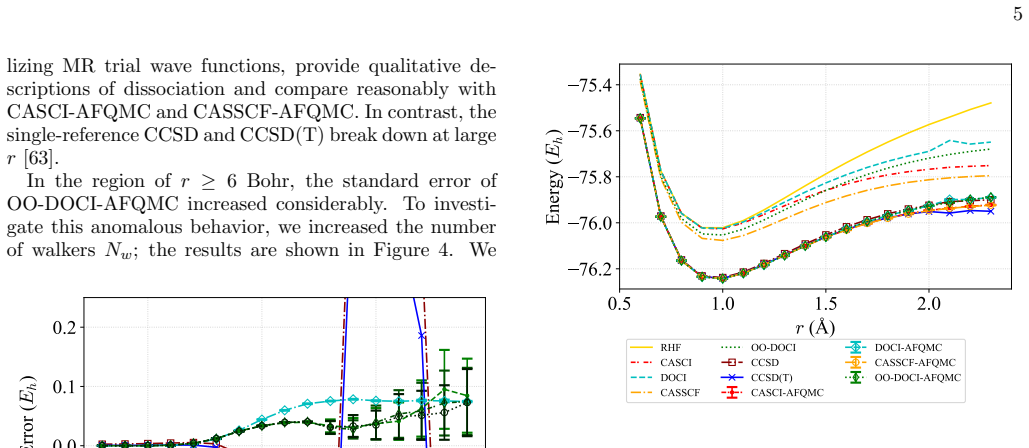
On its own terms, the paper's central claim is that the seniority-zero DOCI wave function is a viable trial state for ph-AFQMC: it supplies enough static correlation to keep the phaseless bias small in mildly multi-reference regimes, and the QMC step supplies the dynamical correlation missing from DOCI itself. The evidence is the set of potential-energy curves: OO-DOCI-AFQMC reproduces CASSCF-AFQMC for single O–H dissociation in water and polymer additives and gives dissociation energies in close agreement with FCI for H2O, while DOCI-AFQMC improves on bare DOCI everywhere. The paper also claims a cost advantage: DOCI's configuration count is binomial in the active space instead of the squared binomial of a complete active space, demonstrated by an OO-DOCI(12e,28o) trial for C2 that CAS cannot reach. The companion claim, made explicitly, is that this strategy is not enough for strongly correlated regimes: errors grow in the fully dissociated H4/H6/H2O curves and in C2, and the paper attributes the failure to the missing seniority-2 (unpaired-electron) configurations in the trial.
Load-bearing premise
The load-bearing premise is that the seniority-zero trial wave function has enough overlap with the true ground state to keep the phaseless AFQMC bias small over the entire bond-breaking curve; the paper's own results show this premise breaks down in exactly the most strongly correlated regimes.
Editorial extensions
If this is right
- For single O–H bond breaking, OO-DOCI-AFQMC reaches CASSCF-AFQMC-level accuracy, so it can serve as a cheaper multi-reference benchmark where CAS trials are too expensive.
- The trial-state configuration count drops from $\binom{n}{k}^2$ to $\binom{n}{k}$, letting ph-AFQMC use multi-reference trial states in active spaces beyond the usual CAS limit, as demonstrated with the (12e,28o) trial on C2.
- In strongly correlated regimes—H4/H6 dissociation, two-bond H2O breaking, and C2—seniority-zero trials produce biased ph-AFQMC energies, so quantitative accuracy there requires extending the trial space beyond seniority zero.
- CCSD(T)'s O–H dissociation curves for hydroquinone and HEMA degrade as the T1 diagnostic exceeds 0.02, while OO-DOCI-AFQMC stays close to the CASSCF-AFQMC reference, reinforcing the need for multi-reference trials in industrially relevant molecules.
Reading between the lines
- Editorial inference: extending the trial space to include seniority-2 configurations (unpaired-electron excitations) should restore quantitative accuracy in C2 and multi-bond dissociation, at a cost still below full CAS; the paper's seniority-zero diagnosis points directly to this as the next test.
- Editorial inference: because DOCI and pair coupled cluster doubles give nearly identical correlation energies and the latter scales more cheaply, replacing DOCI with a pCCD-style trial inside ph-AFQMC could push the same strategy to much larger active spaces than the paper demonstrates.
- Editorial inference: the close agreement between OO-DOCI-AFQMC and CASSCF-AFQMC for single O–H bonds suggests that ph-AFQMC's dynamical correlation correction is robust to modest differences in trial-state detail, implying the practical bottleneck is static-correlation content rather than orbital choice.
Editorial analysis
A structured set of objections, weighed in public.
Referee Report
Summary. This paper proposes using doubly occupied configuration interaction (DOCI) and orbital-optimized DOCI (OO-DOCI) wave functions as trial wave functions in phaseless auxiliary-field quantum Monte Carlo (ph-AFQMC). The motivation is to reduce the exponential cost of complete active space (CAS) trial wave functions while still capturing static correlation, with AFQMC supplying dynamical correlation. The method is tested on linear H4, H6 ring, two-bond water dissociation, the carbon dimer, and single O-H bond breaking in water, hydroquinone (HQ), and 2-hydroxyethyl methacrylate (HEMA). Comparisons are made to CASSCF-AFQMC, CASCI-AFQMC, CCSD, CCSD(T), FCI (for water), and DMRG (for C2). The results show that OO-DOCI-AFQMC closely matches CASSCF-AFQMC and FCI for single O-H bond breaking in water, but deviates significantly in strongly correlated regimes such as the H6 ring dissociation limit, two-bond water dissociation at large r, and the carbon dimer. The authors conclude that seniority-zero trial wave functions are insufficient for strong correlation and suggest extending the seniority space.
Significance. The paper's main positive result, that OO-DOCI-AFQMC reproduces FCI for single O-H bond breaking in water, is a useful demonstration that a seniority-zero trial can work in a regime of moderate static correlation. The honest reporting of failure cases (H6 ring, two-bond water, C2) is a strength and provides clear boundaries for the method's applicability. The use of open-source tools (PySCF, ipie, DOCI module) and detailed computational parameters supports reproducibility. However, the broad promise in the abstract and conclusions, that the method 'offers a path to accurate multi-reference calculations for larger, more complex systems,' is not supported by the data, particularly because the only large-active-space example (C2) shows large errors. The polymer-additive claims also lack an exact reference. The paper is a valid contribution if the claims are recalibrated.
major comments (4)
- [Sec. IV.D, Figs. 9-10] The claim that OO-DOCI-AFQMC 'outperforms coupled-cluster singles, doubles, and perturbative triples' for HQ and HEMA is underdetermined. The only reference for these molecules is CASSCF-AFQMC, which is itself an approximate ph-AFQMC calculation with a different trial; no FCI, DMRG, or other near-exact result is provided. The paper's own data in Figs. 4, 6, and 7 show that seniority-zero trial bias can reach roughly 0.1 Eh in strongly correlated regimes, so agreement with CASSCF-AFQMC does not by itself establish accuracy. To support the claim, the authors should provide an independent reference for HQ/HEMA or weaken the claim to agreement with CASSCF-AFQMC.
- [Sec. IV.C, Fig. 7; Sec. V] The only large-active-space calculation, OO-DOCI(12e,28o)-AFQMC for C2 (Fig. 7), shows significant deviations from DMRG, and its energy profile closely mirrors the (8e,8o) result. This directly contradicts the abstract's and conclusion's statement that the method 'offers a path to accurate multi-reference calculations for larger, more complex systems.' The cost reduction is real, but accuracy at larger active spaces is not demonstrated. The conclusions should be restricted to single-bond dissociation with modest active spaces, or rephrased as an open question.
- [Sec. IV.C, Fig. 7] The symmetry content of the AFQMC calculations for C2 is unspecified. Fig. 7 compares AFQMC energies to DMRG curves for three states (X 1Σ+g, B 1Δg, B′ 1Σ+g), but the text does not state which symmetry or spin each AFQMC curve corresponds to, nor whether the calculations are restricted to a particular irreducible representation. The discussion of crossings and avoided crossings at r≈3.0 Bohr implies the AFQMC may be following the lowest state irrespective of symmetry, but this is not stated. Without this information, the deviations from DMRG and the discontinuities cannot be interpreted.
- [Sec. II.A, Eq. (11); Sec. IV] The central assumption that the seniority-zero trial keeps the phaseless bias small is not quantified. The paper reports no overlap measure (e.g., ⟨ΨT|Ψ0⟩ or local energy variance) for any system, so the reader cannot assess a priori when the method is reliable. Given that the method fails exactly where static correlation is strongest (Figs. 4, 6, 7), a diagnostic based on the DOCI wave function (e.g., weight of the leading configuration or the DOCI–CASSCF energy gap) would strengthen the claim that DOCI captures static correlation in the successful cases.
minor comments (6)
- [Eq. (11)] The notation Δθ_i for the phase of S_i is inconsistent with the definition θ_i = arg(S_i); please rename to avoid implying a difference from the previous time step.
- [Sec. III] The units in 'Δτ = 0.005 E−1 h' should be formatted as E_h^{-1}.
- [Sec. IV.D] The geometries of HQ and HEMA are not provided; please include Cartesian coordinates or a reference to allow reproduction.
- [Fig. 7] The AFQMC curves are not distinguished by symmetry in the legend; consider using different line styles or clarifying in the caption which state is computed.
- [Sec. II.B] The phrase 'reduces the configuration space to the square root' is imprecise; the number of configurations is reduced to the square root of the CAS count, not the space itself.
- [Sec. IV.D] 'The molecular geometries used in the Gaussian and PySCF calculations differed only by an amount on the order of round-off error' should be quantified or replaced with a statement that identical geometries were used.
Circularity Check
No significant circularity: the DOCI trial is generated by independent CI diagonalization and all accuracy claims are checked against external references.
full rationale
The central claim is that seniority-zero DOCI/OO-DOCI trial wave functions, when used in phaseless auxiliary-field quantum Monte Carlo, allow AFQMC to recover dynamical correlation on top of a cheaply captured static correlation. This is not circular by construction. The trial wave function is obtained from an independent variational CI in the seniority-zero subspace (Eq. 13), with its coefficients and, in the OO case, orbitals determined from the electronic Hamiltonian alone; no AFQMC energy enters that construction. The AFQMC energy is computed through imaginary-time propagation (Eqs. 7-11), and the trial enters only through the overlap ratio used for importance sampling and the phaseless constraint. There is no equation in the paper that defines the final AFQMC energy as equal to the DOCI energy or as a function of the DOCI parameters, so the claimed dynamical correlation recovery is a numerical result rather than an identity. Accuracy is judged against FCI, DMRG, CASSCF-AFQMC, CCSD, and CCSD(T), which are external references (though CASSCF-AFQMC is approximate, agreement with it is not enforced by any equation). The paper explicitly reports where the method fails, such as the H6 ring, two-bond H2O dissociation, and the carbon dimer, and attributes these failures to the seniority-zero trial restriction; this is falsifiable evidence rather than an explanation of error away. A few citations are to the authors' own prior work (e.g., refs. 35, 36, 65), but these are not used as uniqueness theorems or as the justification for the seniority-zero ansatz, which is standard DOCI methodology with an independent literature. No load-bearing step reduces to its own inputs, so the paper is self-contained against external benchmarks and no circularity is found.
Assumptions & free parameters
assumptions (4)
- domain assumption The phaseless approximation removes the sign problem but introduces a trial-wave-function-dependent bias (Eq. 11).
- standard math Modified Cholesky decomposition of the two-electron integral tensor is numerically accurate (Eq. 3).
- ad hoc to paper Seniority-zero configurations dominate the static correlation in the single-bond dissociation cases studied.
- domain assumption Orbital optimization in OO-DOCI finds a suitable stationary point for each geometry.
Cite this review
Pith. "Pith review of Auxiliary-field quantum Monte Carlo method with seniority-zero trial wave function." pith.science (2026). https://pith.science/paper/RQ3KPQXG
@misc{pith2026250118937,
  author       = {Pith},
  title        = {Pith review of: Auxiliary-field quantum Monte Carlo method with seniority-zero trial wave function},
  year         = {2026},
  howpublished = {\url{https://pith.science/paper/RQ3KPQXG}},
  note         = {Machine review of arXiv:2501.18937}
}
read the original abstract
We present an approach that uses the doubly occupied configuration interaction (DOCI) wave function as the trial wave function in phaseless auxiliary-field quantum Monte Carlo (ph-AFQMC). DOCI is a seniority-zero method focused on electron pairs. Although DOCI considers much fewer electron configurations than the complete active space (CAS) configuration interaction method, it efficiently captures the static correlation, while the consequent ph-AFQMC recovers the dynamical correlation across all orbitals. We also explore an orbital-optimized version (OO-DOCI) to further improve accuracy. We test this approach on several chemical systems, including single O-H bond breaking in water and polymer additives. In these cases, OO-DOCI-AFQMC closely matches CAS-based ph-AFQMC and even outperforms coupled-cluster singles, doubles, and perturbative triples. However, for strongly correlated systems, such as the carbon dimer and multi-bond dissociation in hydrogen systems and water, the method's accuracy drops. This suggests that seniority-zero space models may be insufficient as trial wave functions in ph-AFQMC for strongly correlated systems, suggesting the need for trial wave functions in an extended space. Despite such a limitation, our study demonstrates that DOCI- and OO-DOCI-based ph-AFQMC can reduce the steep cost of CAS approaches, offering a path to accurate multi-reference calculations for larger, more complex systems.
Figures


Figures from the paper (9 more)


Reference graph
Works this paper leans on
-
[1]
Burke, Perspective on density functional theory, J
K. Burke, Perspective on density functional theory, J. Chem. Phys. 136, 150901 (2012)
2012
-
[2]
R. O. Jones, Density functional theory: Its origins, rise to prominence, and future, Rev. Mod. Phys. 87, 897 (2015)
2015
-
[3]
L. Chanussot, A. Das, S. Goyal, T. Lavril, M. Shuaibi, M. Riviere, K. Tran, J. Heras-Domingo, C. Ho, W. Hu, A. Palizhati, A. Sriram, B. Wood, J. Yoon, D. Parikh, C. L. Zitnick, and Z. Ulissi, Open catalyst 2020 (oc20) dataset and community challenges, ACS Catal. 11, 6059 (2021)
work page 2021
-
[4]
L. Barroso-Luque, M. Shuaibi, X. Fu, B. M. Wood, M. Dzamba, M. Gao, A. Rizvi, C. L. Zitnick, and Z. W. Ulissi, Open materials 2024 (omat24) inorganic materi- als dataset and models (2024), arXiv:2410.12771 [cond- mat.mtrl-sci]
arXiv 2024
-
[5]
Merchant, S
A. Merchant, S. Batzner, S. S. Schoenholz, M. Aykol, G. Cheon, and E. D. Cubuk, Scaling deep learning for materials discovery, Nature 624, 80 (2023)
2023
-
[6]
J. S. Smith, B. T. Nebgen, R. Zubatyuk, N. Lubbers, C. Devereux, K. Barros, S. Tretiak, O. Isayev, and A. E. Roitberg, Approaching coupled cluster accuracy with a general-purpose neural network potential through trans- fer learning, Nat. Commun. 10, 2903 (2019)
work page 2019
-
[7]
D. M. Wilkins, A. Grisafi, Y. Yang, K. U. Lao, R. A. DiS- tasio, and M. Ceriotti, Accurate molecular polarizabili- ties with coupled cluster theory and machine learning, Proceedings of the National Academy of Sciences 116, 3401 (2019)
work page 2019
-
[8]
D. I. Lyakh, M. Musia l, V. F. Lotrich, and R. J. Bartlett, Multireference nature of chemistry: The coupled-cluster view, Chem. Rev. 112, 182 (2012)
work page 2012
Show all 81 references
-
[9]
Riplinger and F
C. Riplinger and F. Neese, An efficient and near linear scaling pair natural orbital based local coupled cluster method, J. Chem. Phys. 138, 034106 (2013)
2013
-
[10]
Riplinger, B
C. Riplinger, B. Sandhoefer, A. Hansen, and F. Neese, Natural triple excitations in local coupled cluster calcu- lations with pair natural orbitals, J. Chem. Phys. 139, 134101 (2013)
2013
-
[11]
Riplinger, P
C. Riplinger, P. Pinski, U. Becker, E. F. Valeev, and F. Neese, Sparse maps—A systematic infrastructure for reduced-scaling electronic structure methods. II. Linear scaling domain based pair natural orbital coupled cluster theory, J. Chem. Phys. 144, 024109 (2016)
2016
-
[12]
Saitow, U
M. Saitow, U. Becker, C. Riplinger, E. F. Valeev, and F. Neese, A new near-linear scaling, efficient and ac- curate, open-shell domain-based local pair natural or- bital coupled cluster singles and doubles theory, J. Chem. Phys. 146, 164105 (2017)
2017
-
[13]
Y. Guo, C. Riplinger, U. Becker, D. G. Liakos, Y. Mi- nenkov, L. Cavallo, and F. Neese, Communication: An improved linear scaling perturbative triples correction for the domain based local pair-natural orbital based singles and doubles coupled cluster method [DLPNO-CCSD(T)], J...
2018
-
[14]
D. G. Liakos, Y. Guo, and F. Neese, Comprehen- sive Benchmark Results for the Domain Based Local Pair Natural Orbital Coupled Cluster Method (DLPNO- CCSD(T)) for Closed- and Open-Shell Systems, J. Phys. Chem. A 124, 90 (2020)
2020
-
[15]
Y. Guo, C. Riplinger, D. G. Liakos, U. Becker, M. Saitow, and F. Neese, Linear scaling perturbative triples cor- rection approximations for open-shell domain-based lo- cal pair natural orbital coupled cluster singles and dou- bles theory [DLPNO-CCSD(T/T)], J. Chem. Phys. 152, ...
2020
-
[16]
Andersson, P
K. Andersson, P. Malmqvist, and B. O. Roos, Second- order perturbation theory with a complete active space self-consistent field reference function, J. Chem. Phys. 96, 1218 (1992)
1992
-
[17]
Zhang and H
S. Zhang and H. Krakauer, Quantum Monte Carlo Method using Phase-Free Random Walks with Slater De- terminants, Phys. Rev. Lett. 90, 136401 (2003)
2003
-
[18]
J. Lee, H. Q. Pham, and D. R. Reichman, Twenty years of auxiliary-field quantum monte carlo in quantum chem- istry: An overview and assessment on main group chem- istry and bond-breaking, J. Chem. Theory Comput. 18, 7024 (2022)
2022
-
[19]
Taheridehkordi, M
A. Taheridehkordi, M. Schlipf, Z. Sukurma, M. Humer, A. Gr¨ uneis, and G. Kresse, Phaseless auxiliary field quantum Monte Carlo with projector-augmented wave method for solids, J. Chem. Phys. 159, 044109 (2023)
2023
-
[20]
J. Lee, F. D. Malone, and M. A. Morales, An auxiliary- Field quantum Monte Carlo perspective on the ground state of the dense uniform electron gas: An investigation with Hartree-Fock trial wavefunctions, J. Chem. Phys. 151, 064122 (2019)
2019
-
[21]
Neugebauer, H
H. Neugebauer, H. T. Vuong, J. L. Weber, R. A. Fries- ner, J. Shee, and A. Hansen, Toward Benchmark-Quality Ab Initio Predictions for 3d Transition Metal Electrocat- alysts: A Comparison of CCSD(T) and ph-AFQMC, J. Chem. Theory Comput. 19, 6208 (2023)
2023
-
[22]
Sukurma, M
Z. Sukurma, M. Schlipf, M. Humer, A. Taheridehko- rdi, and G. Kresse, Benchmark Phaseless Auxiliary-Field Quantum Monte Carlo Method for Small Molecules, J. Chem. Theory Comput. 19, 4921 (2023)
2023
-
[23]
Y. Wei, S. Debnath, J. L. Weber, A. Mahajan, D. R. Reichman, and R. A. Friesner, Scalable Ab Initio Elec- tronic Structure Methods with Near Chemical Accuracy for Main Group Chemistry, J. Phys. Chem. A 128, 5796 (2024)
2024
- [24]
-
[25]
Jiang, M
T. Jiang, M. K. A. Baumgarten, P.-F. Loos, A. Mahajan, A. Scemama, S. F. Ung, J. Zhang, F. D. Malone, and J. Lee, Improved modularity and new features in ipie: Toward even larger AFQMC calculations on CPUs and GPUs at zero and finite temperatures, J. Chem. Phys. 161, 162502 (2024)
2024
-
[26]
Mahajan and S
A. Mahajan and S. Sharma, Taming the sign problem in auxiliary-field quantum monte carlo using accurate wave functions, J. Chem. Theory Comput. 17, 4786 (2021)
2021
-
[27]
F. D. Malone, A. Mahajan, J. S. Spencer, and J. Lee, ipie: A Python-Based Auxiliary-Field Quantum Monte Carlo Program with Flexibility and Efficiency on CPUs and GPUs, J. Chem. Theory Comput. 19, 109 (2023)
2023
-
[28]
Mahajan, J
A. Mahajan, J. Lee, and S. Sharma, Selected configu- ration interaction wave functions in phaseless auxiliary field quantum Monte Carlo, J. Chem. Phys. 156, 174111 (2022)
2022
-
[29]
Mahajan, J
A. Mahajan, J. H. Thorpe, J. S. Kurian, D. R. Reich- man, D. A. Matthews, and S. Sharma, Beyond CCSD(T) accuracy at lower scaling with auxiliary field quantum Monte Carlo, arXiv e-prints , arXiv:2410.02885 (2024), arXiv:2410.02885 [physics.chem-ph]
2024 arXiv
-
[30]
Jiang, B
T. Jiang, B. O’Gorman, A. Mahajan, and J. Lee, Unbias- ing fermionic auxiliary-field quantum Monte Carlo with matrix product state trial wavefunctions, Phys. Rev. Res. 7, 013038 (2025)
2025
-
[31]
Chang and Z.-X
W.-X. Chang and Z.-X. Li, Boosting quantum monte carlo and alleviating sign problem by gutzwiller projec- tion, Phys. Rev. B 110, 085152 (2024)
2024
-
[32]
W. J. Huggins, B. A. O’Gorman, N. C. Rubin, D. R. Reichman, R. Babbush, and J. Lee, Unbiasing fermionic quantum monte carlo with a quantum computer, Nature 603, 416 (2022)
2022
-
[33]
Huang, Y.-T
B. Huang, Y.-T. Chen, B. Gupt, M. Suchara, A. Tran, S. McArdle, and G. Galli, Evaluating a quantum-classical quantum Monte Carlo algorithm with Matchgate shad- ows, Phys. Rev. Res. 6, 043063 (2024)
2024
-
[34]
Sukurma, M
Z. Sukurma, M. Schlipf, and G. Kresse, Self- Refinement of Auxiliary-Field Quantum Monte Carlo via Non-Orthogonal Configuration Interaction, arXiv e-prints , arXiv:2501.12765 (2025), arXiv:2501.12765 [physics.chem-ph]
2025 arXiv
-
[35]
Khinevich and W
V. Khinevich and W. Mizukami, Enhancing quantum computations with the synergy of auxiliary field quantum Monte Carlo and computational basis tomography, arXiv e-prints , arXiv:2502.20066 (2025), arXiv:2502.20066 [quant-ph]
2025
-
[36]
Yoshida, L
Y. Yoshida, L. Erhart, T. Murokoshi, R. Nakagawa, C. Mori, T. Miyanaga, T. Mori, and W. Mizukami, Auxiliary-field quantum Monte Carlo method with quan- tum selected configuration interaction, arXiv e-prints , arXiv:2502.21081 (2025), arXiv:2502.21081 [quant-ph]
2025 arXiv
-
[37]
Danilov, J
D. Danilov, J. Robledo-Moreno, K. J. Sung, M. Motta, and J. Shee, Enhancing the accuracy and efficiency of sample-based quantum diagonalization with phaseless auxiliary-field quantum Monte Carlo, arXiv e-prints , arXiv:2503.05967 (2025), arXiv:2503.05967 [quant-ph]
2025 arXiv
-
[38]
T. L. Allen and H. Shull, ELECTRON PAIRS IN THE BERYLLIUM ATOM, J. Phys. Chem. 66, 2281 (1962)
1962
-
[39]
D. W. Smith and S. J. Fogel, Natural Orbitals and Gem- inals of the Beryllium Atom, J. Chem. Phys. 43, S91 (1965)
1965
-
[40]
Weinhold and E
F. Weinhold and E. B. Wilson, Reduced Density Matri- ces of Atoms and Molecules. I. The 2 Matrix of Double- Occupancy, Configuration-Interaction Wavefunctions for Singlet States, J. Chem. Phys. 46, 2752 (1967)
1967
-
[41]
Veillard and E
A. Veillard and E. Clementi, Complete multi- configuration self-consistent field theory, Theoret. Chim. Acta 7, 133 (1967)
1967
-
[42]
Cook, Doubly-occupied orbital MCSCF methods, Mol
D. Cook, Doubly-occupied orbital MCSCF methods, Mol. Phys. 30, 733 (1975)
1975
-
[43]
Fantucci and S
P. Fantucci and S. Polezzo, Direct minimization of the energy functional in the LCAO-MO density matrix for- malism, Theoret. Chim. Acta 45, 317 (1977)
1977
-
[44]
Couty and M
M. Couty and M. B. Hall, Generalized Molecular Orbital Theory II, J. Phys. Chem. A 101, 6936 (1997)
1997
-
[45]
Kollmar and B
C. Kollmar and B. A. Heß, A new approach to den- sity matrix functional theory, J. Chem. Phys. 119, 4655 (2003)
2003
-
[46]
Bytautas, T
L. Bytautas, T. M. Henderson, C. A. Jim´ enez-Hoyos, J. K. Ellis, and G. E. Scuseria, Seniority and orbital sym- metry as tools for establishing a full configuration inter- action hierarchy, J. Chem. Phys. 135, 044119 (2011)
2011
-
[47]
P. A. Limacher, P. W. Ayers, P. A. Johnson, S. De Baerdemacker, D. Van Neck, and P. Bultinck, A New Mean-Field Method Suitable for Strongly Corre- lated Electrons: Computationally Facile Antisymmetric Products of Nonorthogonal Geminals, J. Chem. Theory Comput. 9, 1394 (2013)
2013
-
[48]
Van Raemdonck, D
M. Van Raemdonck, D. R. Alcoba, W. Poelmans, S. De Baerdemacker, A. Torre, L. Lain, G. E. Massaccesi, D. Van Neck, and P. Bultinck, Polynomial scaling ap- proximations and dynamic correlation corrections to dou- bly occupied configuration interaction wave functions, J. Chem. P...
2015
-
[49]
Lucarini and G
M. Lucarini and G. F. Pedulli, Free radical intermediates in the inhibition of the autoxidation reaction, Chem. Soc. Rev. 39, 2106 (2010)
2010
-
[50]
N. H. F. Beebe and J. Linderberg, Simplifications in the generation and transformation of two-electron integrals in molecular calculations, Int. J. Quant. Chem. 12, 683 (1977)
1977
-
[51]
Aquilante, L
F. Aquilante, L. De Vico, N. Ferr´ e, G. Ghigo, P.- ˚ a. Malmqvist, P. Neogr´ ady, T. B. Pedersen, M. Pitoˇ n´ ak, M. Reiher, B. O. Roos, L. Serrano-Andr´ es, M. Urban, V. Veryazov, and R. Lindh, MOLCAS 7: The Next Gen- eration, J. Comput. Chem. 31, 224 (2010)
2010
-
[52]
Motta and S
M. Motta and S. Zhang, Ab initio computations of molec- ular systems by the auxiliary-field quantum Monte Carlo method, WIREs Comput. Mol. Sci. 8, e1364 (2018)
2018
-
[53]
Stein, T
T. Stein, T. M. Henderson, and G. E. Scuseria, Seniority zero pair coupled cluster doubles theory, J. Chem. Phys. 140, 214113 (2014)
2014
-
[54]
T. M. Henderson, I. W. Bulik, T. Stein, and G. E. Scuse- ria, Seniority-based coupled cluster theory, J. Chem. Phys. 141, 244104 (2014)
2014
-
[55]
T. M. Henderson, I. W. Bulik, and G. E. Scuseria, Pair extended coupled cluster doubles, J. Chem. Phys. 142, 214116 (2015)
2015
-
[56]
T. M. Henderson and G. E. Scuseria, Geminal-based configuration interaction, J. Chem. Phys. 151, 051101 (2019)
2019
-
[57]
Senjean, S
B. Senjean, S. Yalouz, N. Nakatani, and E. Fromager, Re- duced density matrix functional theory from an ab initio seniority-zero wave function: Exact and approximate for- 11 mulations along adiabatic connection paths, Phys. Rev. A 106, 032203 (2022)
2022
-
[58]
Q. Sun, X. Zhang, S. Banerjee, P. Bao, M. Barbry, N. S. Blunt, N. A. Bogdanov, G. H. Booth, J. Chen, Z.-H. Cui, J. J. Eriksen, Y. Gao, S. Guo, J. Hermann, M. R. Hermes, K. Koh, P. Koval, S. Lehtola, Z. Li, J. Liu, N. Mardirossian, J. D. McClain, M. Motta, B. Mussard, H. Q. Pha...
2020
-
[59]
Q. Sun, T. C. Berkelbach, N. S. Blunt, G. H. Booth, S. Guo, Z. Li, J. Liu, J. D. McClain, E. R. Sayfut- yarova, S. Sharma, S. Wouters, and G. K.-L. Chan, Pyscf: the python-based simulations of chemistry framework, WIREs Comput. Mol. Sci. 8, e1340 (2018)
2018
-
[60]
Sun, DOCI module for PySCF (2021)
Q. Sun, DOCI module for PySCF (2021)
2021
-
[61]
M. J. Frisch, G. W. Trucks, H. B. Schlegel, G. E. Scuseria, M. A. Robb, J. R. Cheeseman, G. Scal- mani, V. Barone, G. A. Petersson, H. Nakatsuji, X. Li, M. Caricato, A. V. Marenich, J. Bloino, B. G. Janesko, R. Gomperts, B. Mennucci, H. P. Hratchian, J. V. Or- tiz, A. F. Izmay...
2016
-
[62]
A. V. Sinitskiy, L. Greenman, and D. A. Mazziotti, Strong correlation in hydrogen chains and lattices us- ing the variational two-electron reduced density matrix method, J. Chem. Phys. 133, 014104 (2010)
2010
-
[63]
Kats and F
D. Kats and F. R. Manby, Communication: The distin- guishable cluster approximation, J. Chem. Phys. 139, 021102 (2013)
2013
-
[64]
Kinoshita, O
T. Kinoshita, O. Hino, and R. J. Bartlett, Coupled- cluster method tailored by configuration interaction, J. Chem. Phys. 123, 074106 (2005)
2005
-
[65]
Erhart, Y
L. Erhart, Y. Yoshida, V. Khinevich, and W. Mizukami, Coupled cluster method tailored with quantum comput- ing, Phys. Rev. Res. 6, 023230 (2024)
2024
-
[66]
R. D. J. III, Nist computational chemistry compar- ison and benchmark database, http://cccbdb.nist. gov/ (2022), nIST Standard Reference Database Num- ber 101, Release 22, May 2022
2022
-
[67]
Wouters, W
S. Wouters, W. Poelmans, P. W. Ayers, and D. Van Neck, CheMPS2: A free open-source spin-adapted implementa- tion of the density matrix renormalization group for ab initio quantum chemistry, Comput. Phys. Commun.185, 1501 (2014)
2014
-
[68]
Leszczyk, M
A. Leszczyk, M. M´ at´ e,¨O. Legeza, and K. Boguslawski, Assessing the accuracy of tailored coupled cluster meth- ods corrected by electronic wave functions of polynomial cost, J. Chem. Theory Comput. 18, 96 (2022)
2022
-
[69]
Bond Energies (2023), [Online; accessed 2024-11-03]
2023
-
[70]
T. J. Lee and P. R. Taylor, A diagnostic for determining the quality of single-reference electron correlation meth- ods, Int. J. Quantum Chem. 36, 199 (1989)
1989
-
[71]
Boguslawski, P
K. Boguslawski, P. Tecmer, P. W. Ayers, P. Bultinck, S. De Baerdemacker, and D. Van Neck, Efficient descrip- tion of strongly correlated electrons with mean-field cost, Phys. Rev. B 89, 201106 (2014)
2014
-
[72]
Tecmer and K
P. Tecmer and K. Boguslawski, Geminal-based electronic structure methods in quantum chemistry. toward a gemi- nal model chemistry, Phys. Chem. Chem. Phys.24, 23026 (2022)
2022
-
[73]
Kawasaki and N
A. Kawasaki and N. Nakatani, Low-rank decomposition on the antisymmetric product of geminals for strongly correlated electrons, Mol. Phys. 0, e2449186 (2025)
2025
-
[74]
J. J. Shepherd, T. M. Henderson, and G. E. Scuseria, Us- ing full configuration interaction quantum Monte Carlo in a seniority zero space to investigate the correlation en- ergy equivalence of pair coupled cluster doubles and dou- bly occupied configuration interaction, J. Che...
2016
-
[75]
Kobayashi, ´A
M. Kobayashi, ´A. Szabados, H. Nakai, and P. R. Surj´ an, Generalized Møller-Plesset Partitioning in Multiconfigu- ration Perturbation Theory, J. Chem. Theory Comput. 6, 2024 (2010)
2010
-
[76]
P. A. Limacher, P. W. Ayers, P. A. Johnson, S. De Baerdemacker, D. V. Neck, and P. Bultinck, Simple and inexpensive perturbative correction schemes for an- tisymmetric products of nonorthogonal geminals, Phys. Chem. Chem. Phys. 16, 5061 (2014)
2014
-
[77]
Boguslawski and P
K. Boguslawski and P. W. Ayers, Linearized Coupled Cluster Correction on the Antisymmetric Product of 1- Reference Orbital Geminals, J. Chem. Theory Comput. 11, 5252 (2015)
2015
-
[78]
Boguslawski and P
K. Boguslawski and P. Tecmer, Benchmark of Dynamic Electron Correlation Models for Seniority-Zero Wave Functions and Their Application to Thermochemistry, J. Chem. Theory Comput. 13, 5966 (2017)
2017
-
[79]
A. J. Garza, I. W. Bulik, T. M. Henderson, and G. E. Scuseria, Synergy between pair coupled cluster doubles and pair density functional theory, J. Chem. Phys. 142, 044109 (2015)
2015
-
[80]
A. J. Garza, I. W. Bulik, T. M. Henderson, and G. E. Scuseria, Range separated hybrids of pair coupled clus- ter doubles and density functionals, Phys. Chem. Chem. Phys. 17, 22412 (2015)
2015
-
[81]
A. J. Garza, A. G. Sousa Alencar, and G. E. Scuseria, Actinide chemistry using singlet-paired coupled cluster and its combinations with density functionals, J. Chem. Phys. 143, 244106 (2015)
2015
Reviewed August 9, 2026 · model on record in the stance chip above.
Discussion (0). Continue with ORCID to comment.