REVIEW 4 major objections 5 minor 77 references
OmniPhysGS: 3D Constitutive Gaussians for General Physics-Based Dynamics Generation
T0 review · 4 major / 5 minor · reviewed 2026-08-09 · deepseek-v4-flash
Pith's one-line read OmniPhysGS turns each 3D Gaussian into a learnable constitutive particle, so one diffusion-guided pipeline can synthesize physically plausible dynamics for rubber, sand, honey, water, and mixed-material scenes from a text prompt.
desk verdict Solid, incremental 4D-generation paper that learns to pick among 12 constitutive models per neighborhood, but the evaluation never actually measures physical plausibility, so the central claim outruns the evidence. read the letter →
The pith
A machine-rendered reading of the paper's core claim, the machinery that carries it, and where it could break.
The reading
What carries the argument
The central object is the Constitutive Gaussian: a 3D Gaussian kernel augmented with learnable constitutive-model parameters $\theta = \{\theta_{el}, \theta_{pl}, \theta_{phy}\}$. Rather than letting a free neural network predict stress and deformation directly, a physics-aware decoder computes material logits for each neighborhood from the encoded kernel features and applies a straight-through hardmax to commit to one expert constitutive model per neighborhood (Eq. 6). The selected expert laws then feed a differentiable Material Point Method, which updates positions and deformation gradients; a vectorized GPU reimplementation makes this long Markov chain trainable, while a grouped, mini-batch training strategy keeps the roughly $10^3$-step simulation stable under SDS guidance.
What would settle it
Record a real object with known material parameters, such as a silicone cylinder with a measured stress-strain curve, reconstruct it as 3D Gaussians, run OmniPhysGS with a contradictory prompt like 'collapses like dry sand,' and compare the simulated deformation with a high-speed video and a finite-element reference; the central claim fails if the output follows the prompt while disagreeing with the measured mechanics.
Extended reading notes
Core claim
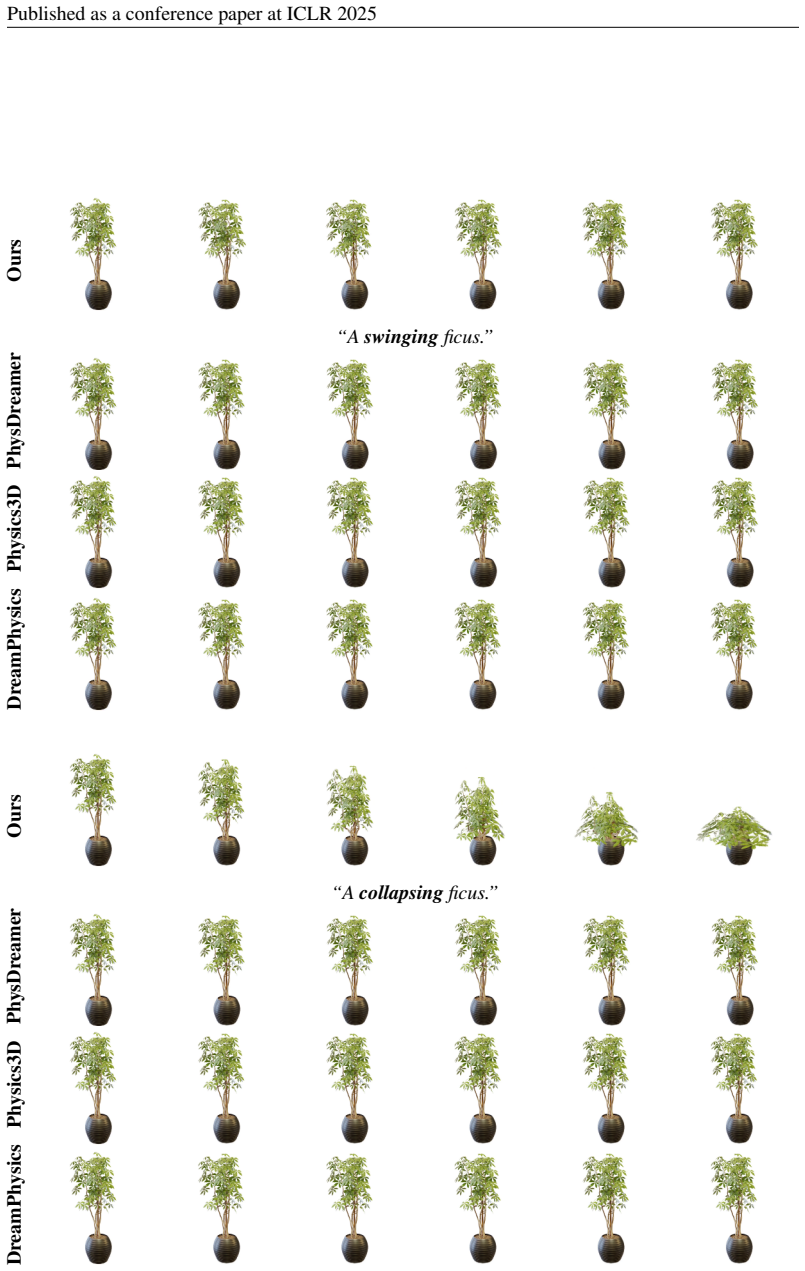
In the Material Point Method, the identity of a material is fully encoded by the hyperelastic energy density $\Psi$, the plasticity return map $\psi$, and the physical parameters $\gamma$. OmniPhysGS makes each of these learnable per Gaussian particle inside a physics-aware decoder, so a neighborhood is assigned one expert model from 12 combinations of three energy functions (fixed corotated, Neo-Hookean, StVK) and four return maps (identity, Drucker-Prager, von Mises, fluid) through a straight-through hardmax operation (Eq. 6). Starting from static Gaussian kernels, a differentiable MPM simulation advances the scene, the simulated states are rendered into a video clip, and the Score Distillation Sampling loss against a pretrained text-to-video diffusion model (Eq. 7) pushes the constitutive-model selection toward the behavior described by the user prompt. The result, as the paper reports, is automatic generation of elastic, viscoelastic, plastic, and fluid dynamics, including interactions between different materials in one scene, without manual material tuning.
Load-bearing premise
The method's only teacher is a pretrained AI video model; if that model produces pretty but physically wrong motion, the learned materials will copy the appearance rather than real physics.
Editorial extensions
If this is right
- Changing only the text prompt can re-animate the same static scene as rubber, sand, jelly, water, or a mixture, so one template serves many material assignments.
- Users no longer need to supply Young's modulus, Poisson's ratio, or damping values; the diffusion prior discovers them through SDS gradients.
- Mixed-material scenes, such as an object falling into water or a rigid collision denting a metal can, stay inside the same MPM formulation instead of requiring per-object hand-tuning.
- The grouped multi-batch training strategy makes end-to-end optimization of long simulations feasible on a single GPU, a prerequisite for scaling the approach to more complex scenes.
- The reported solver comparison indicates roughly 75% lower training memory than the previous MPM solver used in the comparisons.
Reading between the lines
- If the learned 12-law palette is the right inductive bias, a continuous family of constitutive laws interpolating among those experts should cover materials outside the palette with the same pipeline.
- The same setup can double as a probe for whether video diffusion priors encode mechanics: contradictory prompts like 'a steel balloon' would reveal whether the optimizer follows surface appearance or physical knowledge.
- The per-scene SDS cost is high, so the framework points toward amortized training across many scenes to make material inference from a prompt nearly instant.
- Because material labels are assigned per neighborhood, the method implicitly segments a scene by material, which could be reused for physics-aware editing or robot manipulation planning.
Editorial analysis
A structured set of objections, weighed in public.
Referee Report
Summary. The paper proposes OmniPhysGS, a method for generating physics-based 3D dynamics from a static 3D Gaussian Splatting scene and a text prompt. Each Gaussian particle is equipped with a learnable constitutive model, implemented as a per-neighborhood hardmax selection over 12 expert-designed hyperelastic/plasticity constitutive models, and the selection is optimized end-to-end through a differentiable MPM simulator using Score Distillation Sampling from the ModelScope video diffusion model. The authors report quantitative comparisons against PhysDreamer, Physics3D, and DreamPhysics, claiming roughly 3% to 16% improvements in text-alignment and related metrics, together with qualitative results for elastic, viscoelastic, plastic, and fluid materials and multi-material interactions.
Significance. The core idea is timely and valuable: replacing a fixed constitutive model with a learnable, physics-constrained mixture of expert constitutive models inside an MPM-based Gaussian dynamics pipeline is a natural and potentially important extension of existing work. The paper also contributes a vectorized PyTorch MPM solver that substantially reduces training memory (Table 1), includes ablations for the network architecture and training strategy, and plans to release code. If the physical-fidelity claims are supported by stronger evaluation, this would be a useful advance for text-driven 4D content generation. However, the current evidence does not yet establish the central claim of physically plausible material estimation, because the reported metrics do not measure physical correctness.
major comments (4)
- [Section 4.1, Tables 2–3, Appendix B.3] The evaluation metrics do not support the paper's central claim of “physically plausible” dynamics. CLIPSIM (Eq. 31) measures text-frame alignment, while DiffSSIM and DiffCLIP (Eq. 32) measure dissimilarity from a randomly initialized model; none of these detects violations of mechanics, and high values can be achieved by visually salient but physically wrong rollouts. Moreover, Tables 2 and 3 report single numbers without error bars or significance tests, so the claimed 3–16% improvements over baselines are not established as reproducible. I ask for physical validation: for example, material-identification accuracy on scenes with known constitutive parameters, comparison of trajectories against a reference MPM rollout, checks of energy/momentum behavior, or a perceptual study focused on physical plausibility, plus variance over random seeds.
- [Section 3.2.3, Eq. 7; Section 4.1] The only learning signal for the per-neighborhood material selection is SDS against ModelScope (Eq. 7), and the main evaluation uses CLIPSIM, which is the same kind of text-video alignment. This creates a circularity risk: improved CLIPSIM/Diff* scores may reflect better alignment with the diffusion prior's appearance rather than correct material behavior. Since the authors already generate scenes with BlenderNerf (Section 4.1), they have ground-truth material labels available; I ask for a direct test in which the learned expert assignments and continuous physical parameters are compared with the known materials, and for an evaluation on held-out prompts or tasks that is not based on the same diffusion model used for training.
- [Section 3.2.2, Eq. 6] The hardmax assignment fixes one expert constitutive model per FPS/kNN neighborhood computed from initial positions. For scenes with fluids, large deformations, or interpenetrating objects, particles from different materials can move into the same neighborhood, so this fixed homogeneous partition may misassign material identity during the simulation. The paper does not ablate or verify this assumption. A concrete test would be to report per-particle material labels over time in a multi-material scene and to compare a variant that recomputes neighborhoods periodically.
- [Section 3.2.1–3.2.2, Eq. 4–6] The formulation introduces learnable continuous physical parameters gamma (Eq. 4), yet the architecture description in Section 3.2.2 only accounts for discrete expert selection via logits; no details are given for how gamma is parameterized, initialized, or optimized, and no experiment reports the learned values. This makes the “automatic material estimation” claim under-specified and hard to reproduce, and it leaves open whether the discrete expert selection alone, rather than continuous parameter estimation, drives the reported gains.
minor comments (5)
- [Eq. 7] The chain-rule notation ∂V/∂x,F and ∂x,F/∂θ is ambiguous; please spell out the products of Jacobians, such as (∂V/∂x)(∂x/∂θ) + (∂V/∂F)(∂F/∂θ).
- [Figure 3] The caption contains a typo: “Consititutive” should be “Constitutive”.
- [Section 4.1, Appendix B.3] Please specify how the randomly initialized model for DiffSSIM and DiffCLIP is generated (same scene, same prompt, number of seeds), since the random baseline determines both metrics.
- [Appendix B.4, Listing 1] In the training-strategy code snippet, clarify whether the diffusion loss is computed over the whole stage clip or over the mini-batches described in Eq. 8; the current indentation and variable reuse make this unclear.
- [Section 4.2] The claim that all baselines “tend to predict homogeneous material properties” is supported only by qualitative figures; a quantitative measure of per-object material parameter estimates would strengthen the comparison.
Circularity Check
No significant circularity: the constitutive-model selection is genuinely learned from video-diffusion SDS, and the weak evaluation metrics are a validation gap rather than a circular reduction.
full rationale
The paper's derivation chain is self-contained rather than circular. Constitutive Gaussians (Section 3.2.1) extend each Gaussian with learnable hyperelastic, plastic-return, and physical-parameter networks; Eq. 6 selects one of 12 expert constitutive models per neighborhood by hardmax over MLP logits; Eq. 7 back-propagates the SDS loss from the pretrained video diffusion model through the MPM simulation. No equation defines its target in terms of its conclusion, and no result is imported from the authors' own prior work: the 12 constitutive models are taken from external references (Ma et al., 2023; Zong et al., 2023; Xie et al., 2024) and the comparisons are against reimplemented baselines. The evaluation in Section 4.1 uses CLIPSIM, DiffSSIM, and DiffCLIP, which measure text-video alignment and deviation from a random initialization; these metrics do not establish physical correctness, so the paper's 'physically plausible' claim is under-supported, but that is a benchmarking and validity limitation rather than a circularity, because no fitted parameter is renamed as an independent prediction and no evaluation quantity is identical by construction to the training objective. Hence no specific circular step can be quoted with the required reduction.
Assumptions & free parameters
free parameters (1)
- per-neighborhood material category logits =
selected expert constitutive model per neighborhood, 12-way hardmax, not reported numerically
assumptions (5)
- domain assumption The Material Point Method with MLS-MPM accurately approximates the continuum-mechanics conservation equations for the materials in the scenes.
- domain assumption The 12 expert-designed constitutive models (3 elastic energy functions multiplied by 4 plasticity return functions) cover the range of materials the model is claimed to handle.
- domain assumption The pretrained text-to-video diffusion model (ModelScope) provides physically reliable supervision for material behavior.
- domain assumption Each FPS/kNN neighborhood contains homogeneous material, and the partition computed at the initial state remains valid during deformation.
- standard math The straight-through estimator gives usable gradients through the hardmax material selection.
invented entities (1)
-
Constitutive Gaussian
Cite this review
Pith. "Pith review of OmniPhysGS: 3D Constitutive Gaussians for General Physics-Based Dynamics Generation." pith.science (2026). https://pith.science/paper/CCLRBZET
@misc{pith2026250118982,
  author       = {Pith},
  title        = {Pith review of: OmniPhysGS: 3D Constitutive Gaussians for General Physics-Based Dynamics Generation},
  year         = {2026},
  howpublished = {\url{https://pith.science/paper/CCLRBZET}},
  note         = {Machine review of arXiv:2501.18982}
}
read the original abstract
Recently, significant advancements have been made in the reconstruction and generation of 3D assets, including static cases and those with physical interactions. To recover the physical properties of 3D assets, existing methods typically assume that all materials belong to a specific predefined category (e.g., elasticity). However, such assumptions ignore the complex composition of multiple heterogeneous objects in real scenarios and tend to render less physically plausible animation given a wider range of objects. We propose OmniPhysGS for synthesizing a physics-based 3D dynamic scene composed of more general objects. A key design of OmniPhysGS is treating each 3D asset as a collection of constitutive 3D Gaussians. For each Gaussian, its physical material is represented by an ensemble of 12 physical domain-expert sub-models (rubber, metal, honey, water, etc.), which greatly enhances the flexibility of the proposed model. In the implementation, we define a scene by user-specified prompts and supervise the estimation of material weighting factors via a pretrained video diffusion model. Comprehensive experiments demonstrate that OmniPhysGS achieves more general and realistic physical dynamics across a broader spectrum of materials, including elastic, viscoelastic, plastic, and fluid substances, as well as interactions between different materials. Our method surpasses existing methods by approximately 3% to 16% in metrics of visual quality and text alignment.
Figures


Figures from the paper (10 more)




Reference graph
Works this paper leans on
-
[1]
write newline
" write newline "" before.all 'output.state := FUNCTION n.dashify 't := "" t empty not t #1 #1 substring "-" = t #1 #2 substring "--" = not "--" * t #2 global.max substring 't := t #1 #1 substring "-" = "-" * t #2 global.max substring 't := while if t #1 #1 substring * t #2 global.max substring 't := if while FUNCTION format.date year duplicate empty "emp...
-
[2]
4d-fy: Text-to-4d generation using hybrid score distillation sampling
Sherwin Bahmani, Ivan Skorokhodov, Victor Rong, Gordon Wetzstein, Leonidas Guibas, Peter Wonka, Sergey Tulyakov, Jeong Joon Park, Andrea Tagliasacchi, and David B Lindell. 4d-fy: Text-to-4d generation using hybrid score distillation sampling. In Proceedings of the IEEE/CVF Conference on Computer Vision and Pattern Recognition (CVPR), 2024
work page 2024
-
[3]
Real-time subspace integration for st
Jernej Barbi c and Doug L James. Real-time subspace integration for st. venant-kirchhoff deformable models. ACM transactions on graphics (TOG), 2005
work page 2005
-
[5]
ipoke: Poking a still image for controlled stochastic video synthesis
Andreas Blattmann, Timo Milbich, Michael Dorkenwald, and Bj \"o rn Ommer. ipoke: Poking a still image for controlled stochastic video synthesis. In Proceedings of the IEEE/CVF International Conference on Computer Vision (ICCV), 2021
work page 2021
-
[6]
Nonlinear continuum mechanics for finite element analysis
Javier Bonet and Richard D Wood. Nonlinear continuum mechanics for finite element analysis. Cambridge university press, 1997
work page 1997
-
[7]
Gasp: Gaussian splatting for physic-based simulations
Piotr Borycki, Weronika Smolak, Joanna Waczy \'n ska, Marcin Mazur, S awomir Tadeja, and Przemys aw Spurek. Gasp: Gaussian splatting for physic-based simulations. arXiv preprint arXiv:2409.05819, 2024
arXiv 2024
-
[8]
Hybrid discrete-continuum modeling of shear localization in granular media
Peter Yichen Chen, Maytee Chantharayukhonthorn, Yonghao Yue, Eitan Grinspun, and Ken Kamrin. Hybrid discrete-continuum modeling of shear localization in granular media. Journal of the Mechanics and Physics of Solids, 2021
work page 2021
-
[9]
Motion-conditioned diffusion model for controllable video synthesis
Tsai-Shien Chen, Chieh Hubert Lin, Hung-Yu Tseng, Tsung-Yi Lin, and Ming-Hsuan Yang. Motion-conditioned diffusion model for controllable video synthesis. arXiv preprint arXiv:2304.14404, 2023 a
arXiv 2023
Show all 77 references
-
[10]
Control-a-video: Controllable text-to-video generation with diffusion models
Weifeng Chen, Yatai Ji, Jie Wu, Hefeng Wu, Pan Xie, Jiashi Li, Xin Xia, Xuefeng Xiao, and Liang Lin. Control-a-video: Controllable text-to-video generation with diffusion models. arXiv preprint arXiv:2305.13840, 2023 b
2023 arXiv
-
[11]
Livephoto: Real image animation with text-guided motion control
Xi Chen, Zhiheng Liu, Mengting Chen, Yutong Feng, Yu Liu, Yujun Shen, and Hengshuang Zhao. Livephoto: Real image animation with text-guided motion control. arXiv preprint arXiv:2312.02928, 2023 c
2023 arXiv
-
[12]
Soil mechanics and plastic analysis or limit design
Daniel Charles Drucker and William Prager. Soil mechanics and plastic analysis or limit design. Quarterly of applied mathematics, 1952
1952
-
[13]
Gaussian splashing: Unified particles for versatile motion synthesis and rendering, 2024
Yutao Feng, Xiang Feng, Yintong Shang, Ying Jiang, Chang Yu, Zeshun Zong, Tianjia Shao, Hongzhi Wu, Kun Zhou, Chenfanfu Jiang, and Yin Yang. Gaussian splashing: Unified particles for versatile motion synthesis and rendering, 2024
2024
-
[14]
Sync4d: Video guided controllable dynamics for physics-based 4d generation
Zhoujie Fu, Jiacheng Wei, Wenhao Shen, Chaoyue Song, Xiaofeng Yang, Fayao Liu, Xulei Yang, and Guosheng Lin. Sync4d: Video guided controllable dynamics for physics-based 4d generation. arXiv preprint arXiv:2405.16849, 2024
2024 arXiv
-
[15]
Gpu optimization of material point methods
Ming Gao, Xinlei Wang, Kui Wu, Andre Pradhana, Eftychios Sifakis, Cem Yuksel, and Chenfanfu Jiang. Gpu optimization of material point methods. ACM Transactions on Graphics (TOG), 2018
2018
-
[16]
A first course in continuum mechanics
Oscar Gonzalez and Andrew M Stuart. A first course in continuum mechanics. Cambridge University Press, 2008
2008
-
[17]
Controllable video generation with sparse trajectories
Zekun Hao, Xun Huang, and Serge Belongie. Controllable video generation with sparse trajectories. In Proceedings of the IEEE Conference on Computer Vision and Pattern Recognition (CVPR), 2018
2018
-
[18]
Video diffusion models
Jonathan Ho, Tim Salimans, Alexey Gritsenko, William Chan, Mohammad Norouzi, and David J Fleet. Video diffusion models. Advances in Neural Information Processing Systems (NeurIPS), 2022
2022
-
[19]
A moving least squares material point method with displacement discontinuity and two-way rigid body coupling
Yuanming Hu, Yu Fang, Ziheng Ge, Ziyin Qu, Yixin Zhu, Andre Pradhana, and Chenfanfu Jiang. A moving least squares material point method with displacement discontinuity and two-way rigid body coupling. ACM Transactions on Graphics (TOG), 2018
2018
-
[20]
Dreamphysics: Learning physical properties of dynamic 3d gaussians with video diffusion priors
Tianyu Huang, Yihan Zeng, Hui Li, Wangmeng Zuo, and Rynson WH Lau. Dreamphysics: Learning physical properties of dynamic 3d gaussians with video diffusion priors. arXiv preprint arXiv:2406.01476, 2024
2024 arXiv
-
[21]
Plasticinelab: A soft-body manipulation benchmark with differentiable physics
Zhiao Huang, Yuanming Hu, Tao Du, Siyuan Zhou, Hao Su, Joshua B Tenenbaum, and Chuang Gan. Plasticinelab: A soft-body manipulation benchmark with differentiable physics. arXiv preprint arXiv:2104.03311, 2021
2021 arXiv
-
[22]
The affine particle-in-cell method
Chenfanfu Jiang, Craig Schroeder, Andrew Selle, Joseph Teran, and Alexey Stomakhin. The affine particle-in-cell method. ACM Transactions on Graphics (TOG), 2015
2015
-
[23]
The material point method for simulating continuum materials, 2016
Chenfanfu Jiang, Craig Schroeder, Joseph Teran, Alexey Stomakhin, and Andrew Selle. The material point method for simulating continuum materials, 2016
2016
-
[24]
Animate3d: Animating any 3d model with multi-view video diffusion
Yanqin Jiang, Chaohui Yu, Chenjie Cao, Fan Wang, Weiming Hu, and Jin Gao. Animate3d: Animating any 3d model with multi-view video diffusion. In Advances in neural information processing systems (NeurIPS), 2024 a
2024
-
[25]
Consistent4d: Consistent 360 dynamic object generation from monocular video
Yanqin Jiang, Li Zhang, Jin Gao, Weiming Hu, and Yao Yao. Consistent4d: Consistent 360 dynamic object generation from monocular video. In International Conference on Learning Representations (ICLR), 2024 b
2024
-
[26]
Dreampose: Fashion image-to-video synthesis via stable diffusion
Johanna Karras, Aleksander Holynski, Ting-Chun Wang, and Ira Kemelmacher-Shlizerman. Dreampose: Fashion image-to-video synthesis via stable diffusion. In IEEE/CVF International Conference on Computer Vision (ICCV), 2023
2023
-
[27]
3d gaussian splatting for real-time radiance field rendering
Bernhard Kerbl, Georgios Kopanas, Thomas Leimk \"u hler, and George Drettakis. 3d gaussian splatting for real-time radiance field rendering. ACM Transactions on Graphics (TOG), 2023
2023
-
[28]
Adam: A method for stochastic optimization
Diederik P Kingma. Adam: A method for stochastic optimization. arXiv preprint arXiv:1412.6980, 2014
2014 arXiv
-
[29]
Drucker-prager elastoplasticity for sand animation
Gergely Kl \'a r, Theodore Gast, Andre Pradhana, Chuyuan Fu, Craig Schroeder, Chenfanfu Jiang, and Joseph Teran. Drucker-prager elastoplasticity for sand animation. ACM Transactions on Graphics (TOG), 2016
2016
-
[30]
Pac-nerf: Physics augmented continuum neural radiance fields for geometry-agnostic system identification
Xuan Li, Yi-Ling Qiao, Peter Yichen Chen, Krishna Murthy Jatavallabhula, Ming Lin, Chenfanfu Jiang, and Chuang Gan. Pac-nerf: Physics augmented continuum neural radiance fields for geometry-agnostic system identification. arXiv preprint arXiv:2303.05512, 2023
2023 arXiv
-
[31]
Generative image dynamics
Zhengqi Li, Richard Tucker, Noah Snavely, and Aleksander Holynski. Generative image dynamics. In Proceedings of the IEEE/CVF Conference on Computer Vision and Pattern Recognition (CVPR), 2024
2024
-
[32]
Magic3d: High-resolution text-to-3d content creation
Chen-Hsuan Lin, Jun Gao, Luming Tang, Towaki Takikawa, Xiaohui Zeng, Xun Huang, Karsten Kreis, Sanja Fidler, Ming-Yu Liu, and Tsung-Yi Lin. Magic3d: High-resolution text-to-3d content creation. In Proceedings of the IEEE/CVF Conference on Computer Vision and Pattern Recognitio...
2023
-
[33]
Phy124: Fast physics-driven 4d content generation from a single image
Jiajing Lin, Zhenzhong Wang, Yongjie Hou, Yuzhou Tang, and Min Jiang. Phy124: Fast physics-driven 4d content generation from a single image. arXiv preprint arXiv:2409.07179, 2024
2024 arXiv
-
[34]
Align your gaussians: Text-to-4d with dynamic 3d gaussians and composed diffusion models
Huan Ling, Seung Wook Kim, Antonio Torralba, Sanja Fidler, and Karsten Kreis. Align your gaussians: Text-to-4d with dynamic 3d gaussians and composed diffusion models. In Proceedings of the IEEE/CVF Conference on Computer Vision and Pattern Recognition (CVPR), 2024
2024
-
[35]
Physics3d: Learning physical properties of 3d gaussians via video diffusion
Fangfu Liu, Hanyang Wang, Shunyu Yao, Shengjun Zhang, Jie Zhou, and Yueqi Duan. Physics3d: Learning physical properties of 3d gaussians via video diffusion. arXiv preprint arXiv:2406.04338, 2024
2024 arXiv
-
[36]
Learning neural constitutive laws from motion observations for generalizable pde dynamics
Pingchuan Ma, Peter Yichen Chen, Bolei Deng, Joshua B Tenenbaum, Tao Du, Chuang Gan, and Wojciech Matusik. Learning neural constitutive laws from motion observations for generalizable pde dynamics. In International Conference on Machine Learning (ICML), 2023
2023
-
[37]
Warp: A high-performance python framework for gpu simulation and graphics
Miles Macklin. Warp: A high-performance python framework for gpu simulation and graphics. https://github.com/nvidia/warp, 2022. NVIDIA GPU Technology Conference (GTC)
2022
-
[38]
Srinivasan, Matthew Tancik, Jonathan T
Ben Mildenhall, Pratul P. Srinivasan, Matthew Tancik, Jonathan T. Barron, Ravi Ramamoorthi, and Ren Ng. Nerf: Representing scenes as neural radiance fields for view synthesis. In European Conference on Computer Vision (ECCV), 2020
2020
-
[39]
o rper im plastisch-deformablen zustand. Nachrichten von der Gesellschaft der Wissenschaften zu G \
R v Mises. Mechanik der festen k \"o rper im plastisch-deformablen zustand. Nachrichten von der Gesellschaft der Wissenschaften zu G \"o ttingen, Mathematisch-Physikalische Klasse , 1913
1913
-
[40]
Fast dynamic 3d object generation from a single-view video
Zijie Pan, Zeyu Yang, Xiatian Zhu, and Li Zhang. Fast dynamic 3d object generation from a single-view video. arXiv preprint arXiv:2401.08742, 2024
2024
-
[41]
Dreamfusion: Text-to-3d using 2d diffusion
Ben Poole, Ajay Jain, Jonathan T Barron, and Ben Mildenhall. Dreamfusion: Text-to-3d using 2d diffusion. In The Eleventh International Conference on Learning Representations (ICLR), 2023
2023
-
[42]
Pointnet: Deep learning on point sets for 3d classification and segmentation
Charles R Qi, Hao Su, Kaichun Mo, and Leonidas J Guibas. Pointnet: Deep learning on point sets for 3d classification and segmentation. In Proceedings of the IEEE conference on computer vision and pattern recognition (CVPR), 2017 a
2017
-
[43]
Pointnet++: Deep hierarchical feature learning on point sets in a metric space
Charles Ruizhongtai Qi, Li Yi, Hao Su, and Leonidas J Guibas. Pointnet++: Deep hierarchical feature learning on point sets in a metric space. Advances in neural information processing systems (NeurIPS), 2017 b
2017
-
[44]
Language-driven physics-based scene synthesis and editing via feature splatting
Ri-Zhao Qiu, Ge Yang, Weijia Zeng, and Xiaolong Wang. Language-driven physics-based scene synthesis and editing via feature splatting. In European Conference on Computer Vision (ECCV), 2024
2024
-
[45]
BlenderNeRF , 2024
Maxime Raafat. BlenderNeRF , 2024. URL https://github.com/maximeraafat/BlenderNeRF
2024
-
[46]
Learning transferable visual models from natural language supervision
Alec Radford, Jong Wook Kim, Chris Hallacy, Aditya Ramesh, Gabriel Goh, Sandhini Agarwal, Girish Sastry, Amanda Askell, Pamela Mishkin, Jack Clark, et al. Learning transferable visual models from natural language supervision. In International conference on machine learning (IC...
2021
-
[47]
Dreamgaussian4d: Generative 4d gaussian splatting
Jiawei Ren, Liang Pan, Jiaxiang Tang, Chi Zhang, Ang Cao, Gang Zeng, and Ziwei Liu. Dreamgaussian4d: Generative 4d gaussian splatting. arXiv preprint arXiv:2312.17142, 2023
2023 arXiv
-
[48]
L4gm: Large 4d gaussian reconstruction model
Jiawei Ren, Kevin Xie, Ashkan Mirzaei, Hanxue Liang, Xiaohui Zeng, Karsten Kreis, Ziwei Liu, Antonio Torralba, Sanja Fidler, Seung Wook Kim, et al. L4gm: Large 4d gaussian reconstruction model. In Advances in neural information processing systems (NeurIPS), 2024
2024
-
[49]
Animating arbitrary objects via deep motion transfer
Aliaksandr Siarohin, St \'e phane Lathuili \`e re, Sergey Tulyakov, Elisa Ricci, and Nicu Sebe. Animating arbitrary objects via deep motion transfer. In Proceedings of the IEEE/CVF Conference on Computer Vision and Pattern Recognition (CVPR), 2019 a
2019
-
[50]
First order motion model for image animation
Aliaksandr Siarohin, St \'e phane Lathuili \`e re, Sergey Tulyakov, Elisa Ricci, and Nicu Sebe. First order motion model for image animation. In Advances in neural information processing systems (NeurIPS), 2019 b
2019
-
[51]
Motion representations for articulated animation
Aliaksandr Siarohin, Oliver J Woodford, Jian Ren, Menglei Chai, and Sergey Tulyakov. Motion representations for articulated animation. In Proceedings of the IEEE/CVF Conference on Computer Vision and Pattern Recognition (CVPR), 2021
2021
-
[52]
Text-to-4d dynamic scene generation
Uriel Singer, Shelly Sheynin, Adam Polyak, Oron Ashual, Iurii Makarov, Filippos Kokkinos, Naman Goyal, Andrea Vedaldi, Devi Parikh, Justin Johnson, et al. Text-to-4d dynamic scene generation. In International Conference on Machine Learning (ICML), 2023
2023
-
[53]
Energetically consistent invertible elasticity
Alexey Stomakhin, Russell Howes, Craig A Schroeder, and Joseph M Teran. Energetically consistent invertible elasticity. In Symposium on Computer Animation, 2012
2012
-
[54]
A material point method for snow simulation
Alexey Stomakhin, Craig Schroeder, Lawrence Chai, Joseph Teran, and Andrew Selle. A material point method for snow simulation. ACM Transactions on Graphics (TOG), 2013
2013
-
[55]
Augmented mpm for phase-change and varied materials
Alexey Stomakhin, Craig Schroeder, Chenfanfu Jiang, Lawrence Chai, Joseph Teran, and Andrew Selle. Augmented mpm for phase-change and varied materials. ACM Transactions on Graphics (TOG), 2014
2014
-
[56]
Dreamgaussian: Generative gaussian splatting for efficient 3d content creation
Jiaxiang Tang, Jiawei Ren, Hang Zhou, Ziwei Liu, and Gang Zeng. Dreamgaussian: Generative gaussian splatting for efficient 3d content creation. arXiv preprint arXiv:2309.16653, 2023
2023 arXiv
-
[57]
Modelscope text-to-video technical report
Jiuniu Wang, Hangjie Yuan, Dayou Chen, Yingya Zhang, Xiang Wang, and Shiwei Zhang. Modelscope text-to-video technical report. arXiv preprint arXiv:2308.06571, 2023
2023 arXiv
-
[58]
Vidu4d: Single generated video to high-fidelity 4d reconstruction with dynamic gaussian surfels
Yikai Wang, Xinzhou Wang, Zilong Chen, Zhengyi Wang, Fuchun Sun, and Jun Zhu. Vidu4d: Single generated video to high-fidelity 4d reconstruction with dynamic gaussian surfels. arXiv preprint arXiv:2405.16822, 2024 a
2024 arXiv
-
[59]
Prolificdreamer: High-fidelity and diverse text-to-3d generation with variational score distillation
Zhengyi Wang, Cheng Lu, Yikai Wang, Fan Bao, Chongxuan Li, Hang Su, and Jun Zhu. Prolificdreamer: High-fidelity and diverse text-to-3d generation with variational score distillation. Advances in Neural Information Processing Systems (NeurIPS), 2024 b
2024
-
[60]
Image quality assessment: from error visibility to structural similarity
Zhou Wang, Alan C Bovik, Hamid R Sheikh, and Eero P Simoncelli. Image quality assessment: from error visibility to structural similarity. IEEE transactions on image processing, 2004
2004
-
[61]
Godiva: Generating open-domain videos from natural descriptions
Chenfei Wu, Lun Huang, Qianxi Zhang, Binyang Li, Lei Ji, Fan Yang, Guillermo Sapiro, and Nan Duan. Godiva: Generating open-domain videos from natural descriptions. arXiv preprint arXiv:2104.14806, 2021
2021 arXiv
-
[62]
Physgaussian: Physics-integrated 3d gaussians for generative dynamics
Tianyi Xie, Zeshun Zong, Yuxing Qiu, Xuan Li, Yutao Feng, Yin Yang, and Chenfanfu Jiang. Physgaussian: Physics-integrated 3d gaussians for generative dynamics. In Proceedings of the IEEE/CVF Conference on Computer Vision and Pattern Recognition (CVPR), 2024
2024
-
[63]
Diffusion probabilistic modeling for video generation
Ruihan Yang, Prakhar Srivastava, and Stephan Mandt. Diffusion probabilistic modeling for video generation. Entropy, 2023
2023
-
[64]
Dragnuwa: Fine-grained control in video generation by integrating text, image, and trajectory
Shengming Yin, Chenfei Wu, Jian Liang, Jie Shi, Houqiang Li, Gong Ming, and Nan Duan. Dragnuwa: Fine-grained control in video generation by integrating text, image, and trajectory. arXiv preprint arXiv:2308.08089, 2023 a
2023 arXiv
-
[65]
4dgen: Grounded 4d content generation with spatial-temporal consistency
Yuyang Yin, Dejia Xu, Zhangyang Wang, Yao Zhao, and Yunchao Wei. 4dgen: Grounded 4d content generation with spatial-temporal consistency. arXiv preprint arXiv:2312.17225, 2023 b
2023 arXiv
-
[66]
Point-bert: Pre-training 3d point cloud transformers with masked point modeling
Xumin Yu, Lulu Tang, Yongming Rao, Tiejun Huang, Jie Zhou, and Jiwen Lu. Point-bert: Pre-training 3d point cloud transformers with masked point modeling. In Proceedings of the IEEE/CVF conference on computer vision and pattern recognition (CVPR), 2022
2022
-
[67]
Hybrid grains: Adaptive coupling of discrete and continuum simulations of granular media
Yonghao Yue, Breannan Smith, Peter Yichen Chen, Maytee Chantharayukhonthorn, Ken Kamrin, and Eitan Grinspun. Hybrid grains: Adaptive coupling of discrete and continuum simulations of granular media. ACM Transactions on Graphics (TOG), 2018
2018
-
[68]
Stag4d: Spatial-temporal anchored generative 4d gaussians
Yifei Zeng, Yanqin Jiang, Siyu Zhu, Yuanxun Lu, Youtian Lin, Hao Zhu, Weiming Hu, Xun Cao, and Yao Yao. Stag4d: Spatial-temporal anchored generative 4d gaussians. In European Conference on Computer Vision (ECCV), 2024
2024
-
[69]
4diffusion: Multi-view video diffusion model for 4d generation
Haiyu Zhang, Xinyuan Chen, Yaohui Wang, Xihui Liu, Yunhong Wang, and Yu Qiao. 4diffusion: Multi-view video diffusion model for 4d generation. arXiv preprint arXiv:2405.20674, 2024 a
2024 arXiv
-
[70]
I2vgen-xl: High-quality image-to-video synthesis via cascaded diffusion models
Shiwei Zhang, Jiayu Wang, Yingya Zhang, Kang Zhao, Hangjie Yuan, Zhiwu Qin, Xiang Wang, Deli Zhao, and Jingren Zhou. I2vgen-xl: High-quality image-to-video synthesis via cascaded diffusion models. arXiv preprint arXiv:2311.04145, 2023
2023 arXiv
-
[71]
Physdreamer: Physics-based interaction with 3d objects via video generation
Tianyuan Zhang, Hong-Xing Yu, Rundi Wu, Brandon Y Feng, Changxi Zheng, Noah Snavely, Jiajun Wu, and William T Freeman. Physdreamer: Physics-based interaction with 3d objects via video generation. In European Conference on Computer Vision (ECCV), 2024 b
2024
-
[72]
Animate124: Animating one image to 4d dynamic scene
Yuyang Zhao, Zhiwen Yan, Enze Xie, Lanqing Hong, Zhenguo Li, and Gim Hee Lee. Animate124: Animating one image to 4d dynamic scene. arXiv preprint arXiv:2311.14603, 2023
2023 arXiv
-
[73]
A unified approach for text-and image-guided 4d scene generation
Yufeng Zheng, Xueting Li, Koki Nagano, Sifei Liu, Otmar Hilliges, and Shalini De Mello. A unified approach for text-and image-guided 4d scene generation. In Proceedings of the IEEE/CVF Conference on Computer Vision and Pattern Recognition (CVPR), 2024
2024
-
[74]
Reconstruction and simulation of elastic objects with spring-mass 3d gaussians
Licheng Zhong, Hong-Xing Yu, Jiajun Wu, and Yunzhu Li. Reconstruction and simulation of elastic objects with spring-mass 3d gaussians. European Conference on Computer Vision (ECCV), 2024
2024
-
[75]
Neural stress fields for reduced-order elastoplasticity and fracture
Zeshun Zong, Xuan Li, Minchen Li, Maurizio M Chiaramonte, Wojciech Matusik, Eitan Grinspun, Kevin Carlberg, Chenfanfu Jiang, and Peter Yichen Chen. Neural stress fields for reduced-order elastoplasticity and fracture. In SIGGRAPH Asia 2023 Conference Papers, 2023
2023
-
[76]
@esa (Ref
\@ifxundefined[1] #1\@undefined \@firstoftwo \@secondoftwo \@ifnum[1] #1 \@firstoftwo \@secondoftwo \@ifx[1] #1 \@firstoftwo \@secondoftwo [2] @ #1 \@temptokena #2 #1 @ \@temptokena \@ifclassloaded agu2001 natbib The agu2001 class already includes natbib coding, so you should ...
-
[77]
\@lbibitem[] @bibitem@first@sw\@secondoftwo \@lbibitem[#1]#2 \@extra@b@citeb \@ifundefined br@#2\@extra@b@citeb \@namedef br@#2 \@nameuse br@#2\@extra@b@citeb \@ifundefined b@#2\@extra@b@citeb @num @parse #2 @tmp #1 NAT@b@open@#2 NAT@b@shut@#2 \@ifnum @merge>\@ne @bibitem@firs...
-
[78]
o rper im plastisch-deformablen Zustand , author= Mises, R v , journal= Nachrichten von der Gesellschaft der Wissenschaften zu G \
@open @close @open @close and [1] URL: #1 \@ifundefined chapter * \@mkboth \@ifxundefined @sectionbib * \@mkboth * \@mkboth\@gobbletwo \@ifclassloaded amsart * \@ifclassloaded amsbook * \@ifxundefined @heading @heading NAT@ctr thebibliography [1] @ \@biblabel @NAT@ctr \@bibset...
2019 arXiv
Reviewed August 9, 2026 · model on record in the stance chip above.
Discussion (0). Continue with ORCID to comment.