REVIEW 5 major objections 5 minor 1 cited by
Sparse Autoencoder Insights on Voice Embeddings
T0 review · 5 major / 5 minor · reviewed 2026-08-09 · deepseek-v4-flash
Pith's one-line read This paper claims that sparse autoencoders trained on Titanet speaker embeddings extract mono-semantic latent features for language and music, and that these features can be steered to shift the reconstructed embedding between reference…
desk verdict First SAE-on-speaker-embeddings paper with real observations; the steering evidence has an out-of-distribution hole, but the core finding is plausible and worth refereeing. read the letter →
The pith
A machine-rendered reading of the paper's core claim, the machinery that carries it, and where it could break.
The reading
What carries the argument
The central object is the sparse autoencoder with a TopK activation on an expanded latent space: the input is a 192-dimensional Titanet embedding, the latent dimension ranges from 100 to 1,200, and the TopK value K ranges from 5 to 35. The encoder maps the embedding to a sparse latent vector and the decoder reconstructs it. Feature identification is done by training a logistic regression on the latent activations for a manually labeled feature and taking the highest-weight latent index as the feature detector. Feature steering manipulates that index directly: setting the activation to -1 removes the feature, setting it to +1 adds it, and the effect is measured by the change in relative similarity score $\delta_s$ between the reconstructed embedding and reference centroids. The mono-semantic latent index is the unit that carries the argument.
What would settle it
Retrain the SAE grid while selecting the latent dimension, the TopK value, and the latent index using only the training split or a separate validation split, then evaluate the chosen features on the held-out test set; if the Spanish and music detection scores fall substantially below the reported 99.2% and 95.5% for language and 92.3% and 99.1% for music, the claimed mono-semantic detection is an artifact of selection.
Extended reading notes
Core claim
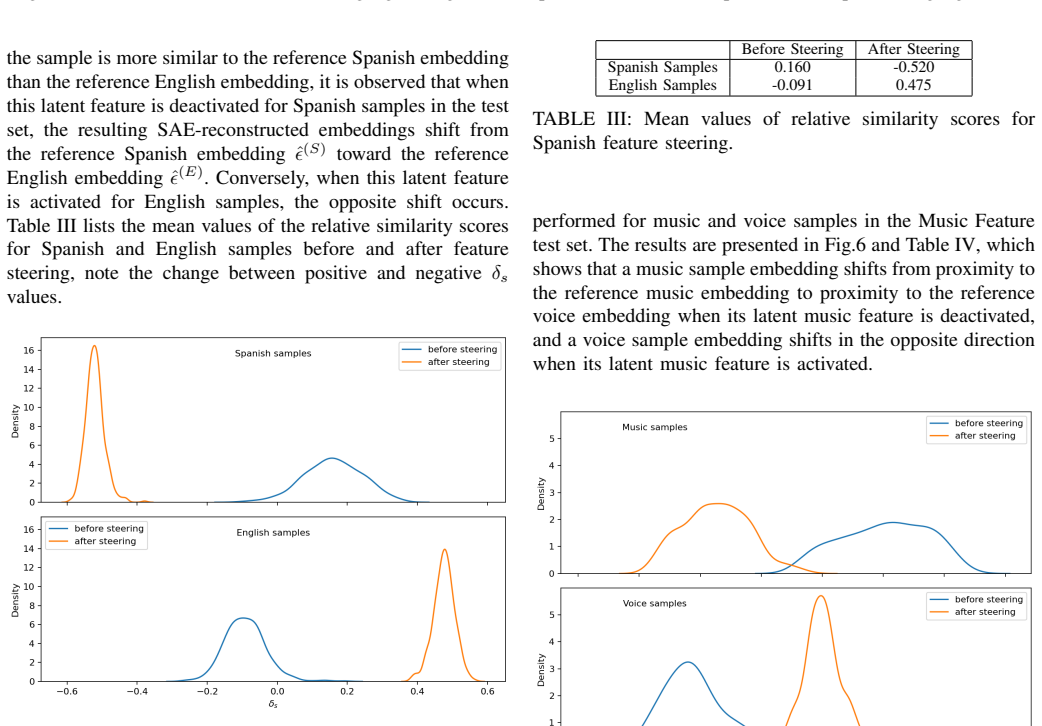
The central discovery is that an SAE trained on about 1.1 million Titanet speaker embeddings learns sparse latent units that correspond to interpretable, non-textual attributes of the audio. For the model with latent dimension 200 and TopK equal to 20, latent index 15 classifies Spanish versus English speech with 99.2 percent precision and 95.5 percent recall, and latent index 74 classifies music versus voice with 92.3 percent precision and 99.1 percent recall. As latent dimensionality grows, the Spanish feature splits into separate male and female features, matching the feature-splitting behavior observed in LLM studies. Steering the identified latents—setting the activation to +1 for English or music samples and to -1 for Spanish or voice samples—reverses the relative cosine similarity of the reconstructed embedding toward the opposite reference class.
Load-bearing premise
The reported precision and recall numbers come from a single autoencoder configuration and a single latent index per feature, and the paper does not state whether the withheld test set was used when picking that configuration and index; the results would be optimistic if test data influenced the selection.
Editorial extensions
If this is right
- If SAEs transfer to speaker embeddings, they provide a way to inspect which acoustic or linguistic attributes a speaker recognition model actually uses, without retraining it.
- The high precision and recall of single latent units for language and music suggest that these attributes are encoded in a local, separable way in Titanet embeddings, contrary to the dense-entanglement view.
- Feature splitting implies that the granularity of SAE features is controlled by latent dimensionality, so larger SAEs could expose finer attributes such as gender, pitch, or prosody as separate units.
- Feature steering gives a practical handle: by adding or removing a latent feature, one can produce counterfactual embeddings, such as removing a Spanish accent or adding hold music, for data augmentation or bias correction.
Reading between the lines
- A consequence the paper leaves implicit is that the same logistic-regression-on-latents recipe could be used to audit commercial speaker verification systems for encoded demographic attributes, such as perceived gender or accent, that are not typically labeled in training data.
- The absence of a dedicated English feature suggests the autoencoder encodes the majority class as the zero state, which predicts that in a balanced multilingual corpus each language would get its own latent unit only if it deviates from a learned default; that prediction is testable by retraining on a different language distribution.
- Since the paper only explores latent-to-input ratios up to about 6 times, the LLM-SAEs regime of much larger expansion might reveal many more splitting and subfeatures, and the reported monotonic relationship between latent size and feature splitting offers a scaling hypothesis to verify.
- The steering operation changes the reconstructed embedding, but the paper does not show whether the steered embedding is still a valid speaker embedding for the original speaker; a falsifiable extension would be to measure speaker verification equal error rate before and after steering.
Editorial analysis
A structured set of objections, weighed in public.
Referee Report
Summary. The paper trains TopK sparse autoencoders (SAEs) on 192-dimensional Titanet speaker embeddings from telephone audio, then uses a logistic-regression probe on the SAE latent space to locate one latent index for Spanish speech and one for hold music. For a single SAE configuration (K=20, latent dimension 200), the Spanish latent is reported with precision 99.2% and recall 95.5%, and the music latent with precision 92.3% and recall 99.1%. The paper also reports feature splitting (the Spanish feature appears to split into male and female latents at larger latent dimensions) and feature steering (setting the target latent to +1 or -1 shifts reconstructed embeddings toward the opposite class centroid). The authors conclude that SAEs extract mono-semantic features from non-textual audio embeddings and exhibit LLM-like behavior such as splitting and steering.
Significance. If the central claims are correct, this is a useful demonstration that sparse autoencoders transfer beyond transformer/LLM embeddings and can expose interpretable structure in speaker embeddings. The paper is strongest in its honest reporting of the limitations in Section V-E, the manual verification of labels, and the breadth of the grid search. However, the monosemanticity claim and the 'not evident in the original embedding' claim currently outrun the evidence, and the steering protocol contains a likely out-of-distribution artifact. The paper is also somewhat under-specified with respect to model selection and does not provide a raw-embedding baseline, both of which are needed to support its headline conclusions.
major comments (5)
- [Section III-D, Eq. (1)] The steering protocol sets the target latent to -a_phi = -1 for 'deactivation', but the encoder uses ReLU followed by TopK activation (Section III-B), so all latent activations are non-negative and the decoder was never trained on negative latent entries. Setting the latent to -1 is therefore an out-of-distribution injection, not a true 'off' state (which would be 0). The large delta_s shifts in Tables III and IV may be artifacts of decoding an OOD vector rather than evidence of feature removal. Please rerun the steering experiments with a_phi = 0 (or by masking the latent) and report whether the shifts persist; if they do not, the steering claim in the abstract is unsupported.
- [Section IV-B and V-A] The paper reports results for one SAE configuration (K=20, latent dimension 200) and one latent index per attribute, selected from the grid search across latent dimensions 100-1,200 and K=5-35, but it never states whether the withheld test sets were used when selecting the configuration or the index. If test data guided model or latent selection, the reported 99.2%/95.5% language scores and 92.3%/99.1% music scores, as well as the steering results, are likely optimistic. Please specify the exact selection rule (e.g., model and index chosen on training data only, or nested validation) and report performance for the chosen configuration on a strictly untouched test set.
- [Abstract and Section V-A] The claim that language and music features are 'not evident in the original embedding' is never tested against a simple baseline. A logistic regression on the raw 192-d Titanet embeddings would very plausibly separate Spanish from English and music from voice, since prior work [6] already shows that speaker attributes can be classified directly from speaker embeddings. Without this baseline, the paper cannot establish that the SAE reveals information not already linearly accessible in the original embedding. Please add this raw-embedding baseline and compare its precision/recall with the SAE latent results.
- [Section V-B and Figure 4] The feature-splitting claim is based on a qualitative reading of Figure 4: at latent dimension 300, the Spanish feature is said to split into a Spanish male index 60 and a Spanish female index 65. The paper does not report per-gender precision/recall for these indices, does not quantify how sharply the split occurs, and does not check whether the two indices are stable across random seeds or across K values. Please provide quantitative evidence, such as confusion rates between male and female for indices 60 and 65, and a stability analysis, before asserting that the SAE discovers separate gender features.
- [Section I and Section V-A] The central term 'mono-semantic' is asserted but never operationally defined or tested. A latent with high logistic-regression weight for Spanish may still be mixed with other attributes such as channel conditions, noise, or speaker-group identity. At minimum, the authors should test whether the selected Spanish and music latents fail to correlate with unrelated attributes (for example, gender for the Spanish latent and non-music noise for the music latent). Without such checks, the abstract's monosemanticity claim is stronger than the evidence.
minor comments (5)
- [Section III-D, Eq. (3)] In Eq. (3), the notation x in {epsilon, epsilon_tilde} should be made explicit: both are SAE reconstructions of a speaker embedding, and the reader must infer that the same decoder is used for the pre- and post-steering reconstructions. A short sentence clarifying this would help.
- [Tables III and IV] The tables report only mean delta_s values; adding standard deviations or interquartile ranges would make the size of the steering effect easier to judge, especially since the distributions in Figures 5 and 6 appear to be wide.
- [Section V-B] The sentence 'This same behavior repeats regardless of K value, however the latent dimensionality at which it occurs does vary' is slightly contradictory; consider rewording to say that the splitting phenomenon is robust across K but the threshold latent dimension depends on K.
- [Section V-E] The limitation paragraph notes that the latent-to-embedding dimension ratio is only about 3x here, versus several orders of magnitude in LLM work. This is an honest statement, but it would be even more useful if the authors indicated which of the observed phenomena (splitting, steering) they expect to be affected by this ratio.
- [Figure captions] Figures 2, 3, and 4 would benefit from self-contained captions identifying the axes, the model configuration shown, and the color/line conventions; the current manuscript text does not always make these clear without reading the surrounding sections.
Circularity Check
No significant circularity: the SAE pipeline is self-contained, uses withheld test data, and does not reduce its claims to its inputs.
full rationale
The paper makes an empirical application of a standard SAE interpretability pipeline rather than a mathematical derivation, so most circularity patterns do not apply. The SAE is trained unsupervised on roughly 1.1M embeddings, and feature identification is done by fitting a logistic regression on SAE latents with a labeled training set and then evaluating the selected latent on a withheld test set (Section V-A1). This is a genuine train/test split, not a fitted parameter renamed as a prediction. The steering experiment in Section III-D uses centroids of SAE-reconstructed training embeddings, which are internal to the SAE, but the test samples are withheld and the decoder is a separately learned component; the observed shift in relative similarity is an empirical outcome rather than an identity forced by construction. No load-bearing self-citations appear: references [8]-[11] are external Anthropic/OpenAI works, and no uniqueness theorem or ansatz is imported from the present authors' prior work. Concerns about the choice a_phi=1 creating out-of-distribution latent values and about possible test-set-informed model selection are validity or robustness threats, not circularity, and under the stated rules they do not raise the circularity score.
Assumptions & free parameters
free parameters (3)
- TopK sparsity K =
20 (grid 5-35)
- Latent dimension L =
200 (grid 100-1,200)
- Steering amplitude a_phi =
1
assumptions (5)
- domain assumption Titanet speaker embeddings encode language and music content.
- domain assumption SAE reconstruction is faithful enough that latent edits transfer to meaningful embedding changes.
- domain assumption A high logistic-regression weight on one latent identifies the causal semantic feature.
- domain assumption Whisper transcripts and manual review provide accurate binary labels for language and music.
- ad hoc to paper TopK sparsity with the grid range prevents pass-through behavior.
Cite this review
Pith. "Pith review of Sparse Autoencoder Insights on Voice Embeddings." pith.science (2026). https://pith.science/paper/QKIRF7LR
@misc{pith2026250200127,
  author       = {Pith},
  title        = {Pith review of: Sparse Autoencoder Insights on Voice Embeddings},
  year         = {2026},
  howpublished = {\url{https://pith.science/paper/QKIRF7LR}},
  note         = {Machine review of arXiv:2502.00127}
}
read the original abstract
Recent advances in explainable machine learning have highlighted the potential of sparse autoencoders in uncovering mono-semantic features in densely encoded embeddings. While most research has focused on Large Language Model (LLM) embeddings, the applicability of this technique to other domains remains largely unexplored. This study applies sparse autoencoders to speaker embeddings generated from a Titanet model, demonstrating the effectiveness of this technique in extracting mono-semantic features from non-textual embedded data. The results show that the extracted features exhibit characteristics similar to those found in LLM embeddings, including feature splitting and steering. The analysis reveals that the autoencoder can identify and manipulate features such as language and music, which are not evident in the original embedding. The findings suggest that sparse autoencoders can be a valuable tool for understanding and interpreting embedded data in many domains, including audio-based speaker recognition.
Figures


Figures from the paper (2 more)

Forward citations
Cited by 1 Pith paper
-
Making Interpretable Discoveries from Unstructured Data: A High-Dimensional Multiple Hypothesis Testing Approach
A new framework combines AI-derived concept embeddings with high-dimensional selective inference to enable statistically principled, interpretable discovery from unstructured data in empirical economics.
Reference graph
Works this paper leans on
-
[6]
C. Luu, P. Bell, and S. Renals, “Leveraging speaker attribute information using multi task learning for speaker verification and diarization,” 2021. [Online]. Available: https://arxiv.org/abs/2010.14269
arXiv 2021
-
[1]
One pixel attack for fooling deep neural networks,
J. Su, D. V . Vargas, and K. Sakurai, “One pixel attack for fooling deep neural networks,” IEEE Transactions on Evolutionary Computation, vol. 23, no. 5, p. 828–841, Oct. 2019. [Online]. Available: http://dx.doi.org/10.1109/TEVC.2019.2890858
-
[2]
M. T. Ribeiro, S. Singh, and C. Guestrin, “”why should i trust you?”: Explaining the predictions of any classifier,” 2016. [Online]. Available: https://arxiv.org/abs/1602.04938
arXiv 2016
-
[3]
M. R. Zafar and N. M. Khan, “Dlime: A deterministic local interpretable model-agnostic explanations approach for computer-aided diagnosis systems,” 2019. [Online]. Available: https://arxiv.org/abs/1906.10263
arXiv 2019
-
[4]
Learning important features through propagating activation differences,
A. Shrikumar, P. Greenside, and A. Kundaje, “Learning important features through propagating activation differences,” 2019. [Online]. Available: https://arxiv.org/abs/1704.02685
arXiv 2019
-
[5]
Axiomatic attribution for deep networks,
M. Sundararajan, A. Taly, and Q. Yan, “Axiomatic attribution for deep networks,” 2017. [Online]. Available: https://arxiv.org/abs/1703.01365
arXiv 2017
-
[7]
Explainable attribute-based speaker verification,
X. Wu, C. Luu, P. Bell, and A. Rajan, “Explainable attribute-based speaker verification,” 2024. [Online]. Available: https://arxiv.org/abs/ 2405.19796
arXiv 2024
-
[8]
Towards monosemanticity: Decomposing language models with dictionary learning,
T. Bricken et al. , “Towards monosemanticity: Decomposing language models with dictionary learning,” Transformer Circuits Thread , 2023, https://transformer-circuits.pub/2023/monosemantic-features/index.html
work page 2023
Show all 15 references
-
[9]
Scaling monosemanticity: Extracting interpretable features from claude 3 sonnet,
A. Templeton, T. Conerly, J. Marcus, J. Lindsey, T. Bricken, B. Chen, A. Pearce, C. Citro, E. Ameisen, A. Jones, H. Cunningham, N. L. Turner, C. McDougall, M. MacDiarmid, C. D. Freeman, T. R. Sumers, E. Rees, J. Batson, A. Jermyn, S. Carter, C. Olah, and T. Henighan, “Scaling ...
2024
-
[10]
Scaling and evaluating sparse autoencoders,
L. Gao et al. , “Scaling and evaluating sparse autoencoders,” 2024. [Online]. Available: https://arxiv.org/abs/2406.04093
2024 arXiv
-
[11]
Gemma scope: Open sparse autoencoders everywhere all at once on gemma 2,
T. Lieberum, S. Rajamanoharan, A. Conmy, L. Smith, N. Sonnerat, V . Varma, J. Kram ´ar, A. Dragan, R. Shah, and N. Nanda, “Gemma scope: Open sparse autoencoders everywhere all at once on gemma 2,”
-
[12]
Titanet: Neural model for speaker representation with 1d depth-wise separable convolutions and global context,
N. R. Koluguri, T. Park, and B. Ginsburg, “Titanet: Neural model for speaker representation with 1d depth-wise separable convolutions and global context,” 2021. [Online]. Available: https: //arxiv.org/abs/2110.04410
2021 arXiv
-
[13]
NeMo: a toolkit for Conversational AI and Large Language Models
E. Harper et al. , “NeMo: a toolkit for Conversational AI and Large Language Models.” [Online]. Available: https://github.com/NVIDIA/ NeMo
-
[14]
Robust speech recognition via large-scale weak supervi- sion,
A. Radford, J. W. Kim, T. Xu, G. Brockman, C. McLeavey, and I. Sutskever, “Robust speech recognition via large-scale weak supervi- sion,” in International conference on machine learning . PMLR, 2023, pp. 28 492–28 518
2023
-
[2024]
Available: https://arxiv.org/abs/2408.05147
[Online]. Available: https://arxiv.org/abs/2408.05147
Reviewed August 9, 2026 · model on record in the stance chip above.
Discussion (0). Continue with ORCID to comment.