REVIEW 3 major objections 3 minor 52 references
PRECISE: PRivacy-loss-Efficient and Consistent Inference based on poSterior quantilEs
T0 review · 3 major / 3 minor · reviewed 2026-08-09 · deepseek-v4-flash
Pith's one-line read This paper claims that a histogram of posterior samples, sanitized with noise calibrated to the total-variation sensitivity of the posterior, yields differentially private quantile intervals that keep nominal coverage and are narrower…
desk verdict A sensible DP interval-estimation pipeline with strong experiments, but the privacy guarantee rests on a false L1-sensitivity identity and the noise scale is too small. read the letter →
The pith
A machine-rendered reading of the paper's core claim, the machinery that carries it, and where it could break.
The reading
What carries the argument
The central object is the privacy-preserving posterior (P3) histogram. The argument's load-bearing identity is the claimed bound ||H_p - H'_p||_1 = 2 sup_b |p_b - p'_b| ≤ 2G(n)h per bin, giving the histogram count sensitivity Δ_H = 2mhG(n); with Δ_H fixed to 1, the number of posterior samples is set to m = (2hG(n))^{-1}. The P3 histogram is fed to PRECISE, which selects bins whose cumulative sanitized counts bracket α/2 and 1-α/2 and samples uniformly from them. The consistency argument decomposes mean squared error into a discretization term O($m^{{-2}}$), a DP-noise term O($n^{{-1/2}}$$e^{{-ε√n/2}}$), and a posterior-sampling term O(1/(mn)), with the dominant term depending on the regime of m.
What would settle it
Enumerate the histogram sensitivities exactly for a small discrete posterior or a fine grid of a continuous one by scanning pairs of neighboring datasets, compute sup ||H_p - H'_p||_1, and compare it with 2mhG(n); if the L1 sensitivity exceeds 2mhG(n) for any n and h, then m = (2hG(n))^{-1} does not provide the claimed DP guarantee.
Extended reading notes
Core claim
The paper formalizes valid privacy-preserving interval estimation (PPIE) as coverage at least 1-α after sanitization, and proposes PRECISE: draw m samples from the posterior f(θ|x), build a histogram H with bin width h, sanitize the counts with Laplace noise for ε-DP or Gaussian noise for μ-GDP using the claimed global sensitivity Δ_H = 2mhG(n), where G(n) is the supremum over neighboring datasets of the total variation distance between posteriors, and collapse tail bins to reduce noise. The sanitized histogram is then used to identify bins whose cumulative counts bracket α/2 and 1-α/2, and uniform draws from those bins supply the private posterior quantiles. The paper claims these intervals asymptotically achieve 1-α coverage and that the private quantiles are MSE-consistent, with error decomposed into discretization, sanitization, and posterior-sampling terms. Extensive simulations claim that PRECISE with non-negativity correction achieves nominal coverage in all tested settings and produces narrower intervals than several existing DP inference methods, while also being faster for large sample sizes. An alternative exponential-mechanism estimator, PPquantile, is analyzed but presented as practically limited.
Load-bearing premise
The privacy guarantee depends on the identity that the L1 distance between two posterior histograms equals twice the largest per-bin count difference; if that equality is false, the noise added for DP is miscalibrated and the stated privacy loss is not delivered.
Editorial extensions
If this is right
- PRECISE gives a general recipe for PPIE: any inference task with posterior samples and a scalar parameter can get a private interval by sanitizing a histogram, rather than deriving task-specific DP estimators.
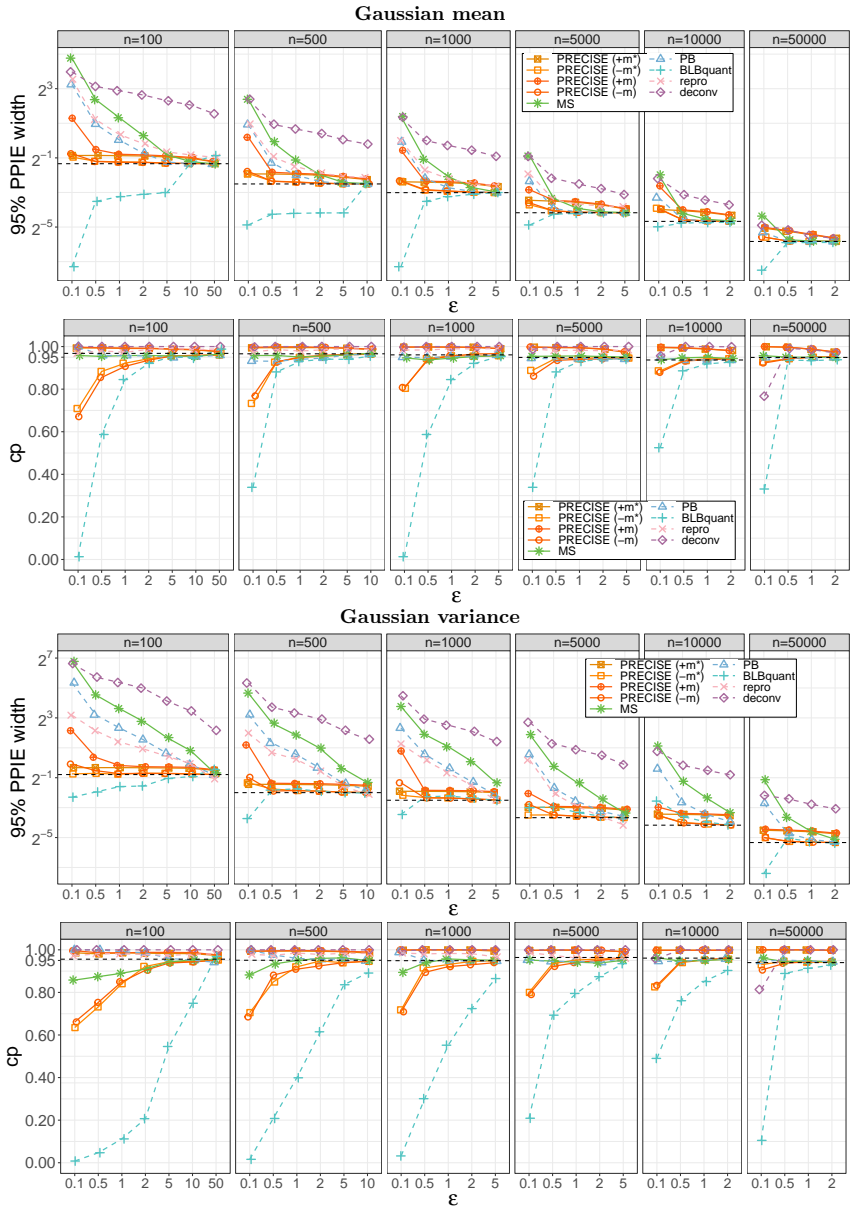
- If the claimed sensitivity is correct, intervals remain at nominal coverage while being narrower than existing approaches such as multiple synthesis and parametric bootstrap, especially at low privacy loss.
- The consistency theorem says the private quantile converges to the true posterior quantile as n or ε grows, with error dominated by histogram discretization for small m, sampling noise for intermediate m, and DP noise for large m.
- The interval asymptotically satisfies the paper's PPIE definition, so a user can report a coverage guarantee together with a DP guarantee.
- The method works under both ε-DP and μ-GDP, and extends to multivariate parameters pointwise by splitting the privacy budget across components.
Reading between the lines
- If the sensitivity identity is corrected, the required noise would scale with the number of histogram bins, roughly 1/h, so the utility advantage would depend heavily on bin-collapsing and careful choice of h rather than only on the headline comparisons.
- A direct numerical check of the privacy claim requires no new theory: on a small discrete posterior, enumerate neighboring datasets, compute the exact histogram L1 sensitivity, and compare it with 2mhG(n); a ratio that grows with 1/h would indicate the reported privacy loss is optimistic.
- The same sanitized-histogram machinery could be reused to release other posterior summaries, such as credible regions or density estimates, once the sensitivity calibration is settled.
- Because G(n) is approximated through Bernstein-von Mises concentration, PRECISE is most likely to deliver its promised tradeoff when the posterior is already concentrated; weakly identified or high-dimensional posteriors are a natural stress test.
Editorial analysis
A structured set of objections, weighed in public.
Referee Report
Summary. The paper introduces PRECISE, a model-agnostic Bayesian procedure for privacy-preserving interval estimation (PPIE). The method draws posterior samples for the parameter of interest, forms a histogram, perturbs the bin counts with a Laplace or Gaussian mechanism, and then constructs posterior intervals from quantiles of the sanitized histogram. The central theoretical contributions are a claimed global sensitivity of the posterior histogram (Theorem 3), an ε-DP / μ-GDP guarantee for the released P3 histogram (Theorem 5), an MSE consistency result for the resulting private quantiles (Theorem 6), and an asymptotic nominal-coverage result (Proposition 7). The paper also reports extensive simulations and two real-data case studies comparing PRECISE with existing PPIE methods.
Significance. If the privacy guarantee and consistency results were correct, PRECISE would be a valuable general-purpose PPIE method with a favorable privacy-utility tradeoff. The paper contributes a formal definition of valid PPIE, a broad experimental comparison across several inferential tasks, and a useful decomposition of the MSE into discretization, DP, and posterior-sampling terms. However, the load-bearing privacy analysis rests on a false identity about the L1 distance between two histograms. As a result, the claimed DP guarantee and all downstream theoretical results derived from the noise scale are not established. The empirical results are not affected by this flaw in the sense that they measure coverage rather than privacy, but they cannot compensate for the invalid privacy claim. The work may be salvageable with a corrected sensitivity analysis, but the current manuscript does not support its central claims.
major comments (3)
- [Appendix A.2] The proof of Theorem 5 (and hence Theorem 3) uses the identity ||H_p-H'_p||_1 = 2 TVD(H_p,H'_p) = 2 sup_b |p_b-p'_b|. This identity is false. For probability vectors, ||p-p'||_1 = 2 TVD = 2 sup_{A⊆bins}|P(A)-P(A')|, where the supremum is over all subsets of bins, not over singleton bins. A concrete four-bin example with p=(0.3,0.3,0.2,0.2) and p'=(0.2,0.2,0.3,0.3) gives ||p-p'||_1=0.4 while 2 sup_b|p_b-p'_b|=0.2. The correct upper bound from the proof's own per-bin bound |p_b-p'_b|≤G h is ||p-p'||_1≤B G h, and the L1 sensitivity of the count histogram is of order m B G h, not 2mhG. Since Algorithm 1 back-calculates m=(2hG)^{-1}, the noise scale in Eq. (8) is too small by a factor that can be as large as about B/2, so Theorem 5's η-DP guarantee is not established.
- [Section 3.2, Definition 4] Definition 4 states G(n)=sup_{θ∈Θ,d(x,x')=1}|f(θ|x)-f(θ|x')| = sup_{d(x,x')=1} TVD(f(θ|x),f(θ|x')). This equality between the pointwise supremum of density differences and the total variation distance is not generally valid: TVD equals (1/2)∫|f-f'|, and the sup norm can differ from the integral norm. This distinction matters for the proof of Theorem 3, where G(n) is used as a per-bin bound on |f(θ|x)-f(θ|x')| through the mean value theorem, while the definition simultaneously claims G(n) is a TVD. The inconsistency propagates to Assumption 4(b) and to the claimed sensitivity calibration.
- [Theorem 6 and Appendix A.3] The MSE consistency result inherits the invalid sensitivity calibration. The proof sets m=(2G(n)h)^{-1} and uses a Laplace noise scale of 1/ε (see Eqs. (7) and (60)-(64)). If the true histogram sensitivity is m∑_b|p_b-p'_b|, the noise needed for ε-DP is larger than 1/ε, so the DP-induced error term T1 and the three asymptotic regimes in Eqs. (9)-(10) are derived for a mechanism that does not provide the stated privacy guarantee. Consequently, Proposition 7's asymptotic nominal coverage is also unsupported because it relies on the MSE consistency of Theorem 6.
minor comments (3)
- [Abstract] The phrase 'with along with its rate of convergence' is ungrammatical and should be rephrased.
- [Appendix A.2] The step 'ξ'_b≈ξ_b if h is small enough' is asserted without a quantitative finite-sample remainder bound; even after correcting the L1 identity, this approximation would need a uniform error estimate to yield a rigorous sensitivity statement.
- [Section 4.1] The text says PRECISE 'achieves the nominal coverage' for all settings, but the simulation sections present results averaged over 1,000 repeats; for small n and ε the coverage plots deviate visibly from 0.95, especially for PRECISE(−) variants. A more precise summary of when nominal coverage is and is not reached would be helpful.
Circularity Check
No significant circularity: PRECISE's derivation is self-contained; the disputed L1 identity is a correctness error, not a circular reduction.
full rationale
I walked the paper's derivation chain: Definition 4 defines the global sensitivity G(n) of the posterior distribution as a total-variation supremum; Theorem 3 then derives the histogram sensitivity as Delta_H = 2mhG(n) from bin-probability bounds. This is a derivation from a defined quantity, not a definitional equivalence: the target DP guarantee is not used as an input. The choice m = (2hG(n))^{-1} (Eq. 7) is a back-calculation from a fixed sensitivity, and Theorem 6 analyzes the MSE of this choice with externally referenced results (Walker 1968, Bernstein-von Mises, Smirnov, Nagaraja et al.); it does not fit the target coverage or interval widths. No load-bearing self-citation appears: the paper's cited prior work by Liu (2022) is used only as a comparison method, not to justify PRECISE's uniqueness or correctness. The manuscript's Appendix A.2 contains the identity ||Hp-H'p||1 = 2 sup_b |p_b-p'_b|, which is false as stated, and this may invalidate the claimed privacy guarantee; however, that is a mathematical correctness risk, not a circularity: the formula is not equivalent by construction to the conclusion, and the paper does not define the histogram sensitivity in terms of the released interval. Hyperparameters (h, L, U, tau, m) affect performance, but tuning sensitivity is not circularity. I therefore find no circular step and assign score 0.
Assumptions & free parameters
free parameters (5)
- bin width h =
e.g., 2.2e-3 (adult case); 5e-4, 0.95e-4, 0.39e-4 (cardiotocography)
- global bounds (L,U) for theta =
e.g., (0.03,0.97) for Bernoulli, (0.25,25) for variance, (0.5,0.05,0.02) for cardiotocography
- global bounds (Lx,Ux) for data =
e.g., (0,1) for Bernoulli, (0,35) for Poisson, (-4,4) for Gaussian
- collapsing thresholds (tauL, tauU) =
e.g., 0 or small constants; 2% and 3% tails in some settings
- upper bound G0 for global sensitivity =
computed from (L,U), (Lx,Ux), and model-specific constants; e.g., 1/sqrt(2e pi) min{L(1-L), U(1-U)} for Bernoulli
assumptions (7)
- standard math Bernstein-von Mises theorem: the posterior converges to a Gaussian distribution centered at the MAP at rate n^{-1/2}.
- ad hoc to paper Assumption 4: the posterior density f(theta|x) has continuous CDF on histogram bins and the sum of f over collapsed tail bins is bounded by G(n).
- domain assumption The neighboring relation is substitution; removal relation is not analyzed.
- domain assumption The prior is non-informative relative to the data.
- domain assumption The MAP estimators on neighboring datasets differ by O(n^{-1}): theta_hat'_n - theta_hat_n approx C/n.
- standard math Asymptotic normality of sample quantiles (Walker, 1968).
- standard math Mean value theorem for integrals applied to histogram bin probabilities.
Cite this review
Pith. "Pith review of PRECISE: PRivacy-loss-Efficient and Consistent Inference based on poSterior quantilEs." pith.science (2026). https://pith.science/paper/2QTR662Q
@misc{pith2026250200192,
  author       = {Pith},
  title        = {Pith review of: PRECISE: PRivacy-loss-Efficient and Consistent Inference based on poSterior quantilEs},
  year         = {2026},
  howpublished = {\url{https://pith.science/paper/2QTR662Q}},
  note         = {Machine review of arXiv:2502.00192}
}
read the original abstract
Differential Privacy (DP) is a mathematical framework for releasing information with formal privacy guarantees. While numerous DP procedures have been developed for statistical analysis and machine learning, valid statistical inference methods offering high utility under DP constraints remain limited. We formalize this gap by introducing the notion of valid Privacy-Preserving Interval Estimation (PPIE) and propose a new PPIE approach -- PRECISE -- to constructing privacy-preserving posterior intervals with the goal of offering a better privacy-utility tradeoff than existing DP inferential methods. PRECISE is a general-purpose and model-agnostic method that generates intervals using quantile estimates obtained from a sanitized posterior histogram with DP guarantees. We explicitly characterize the global sensitivity of the histogram formed from posterior samples for the parameter of interest, enabling its sanitization with formal DP guarantees. We also analyze the sources of error in the mean squared error (MSE) of the histogram-based private quantile estimator and prove its consistency for the true posterior quantiles as the sample size or privacy loss increases with along with its rate of convergence. We conduct extensive experiments to compare the utilities of PRECISE with common existing privacy-preserving inferential approaches across a wide range of inferential tasks, data types and sizes, DP types, and privacy loss levels. The results demonstrated a significant advantage of PRECISE with its nominal coverage and substantially narrower intervals than the existing methods, which are prone to either under-coverage or impractically wide intervals.
Figures


Figures from the paper (2 more)


Reference graph
Works this paper leans on
-
[1]
Abowd, J. M. (2018). The us census bureau adopts differential privacy. In Proceedings of the 24th ACM SIGKDD international conference on knowledge discovery & data mining , pages 2867--2867
work page 2018
-
[2]
Alabi, D., McMillan, A., Sarathy, J., Smith, A., and Vadhan, S. (2020). Differentially private simple linear regression. Proceedings on 23rd Privacy Enhancing Technologies Symposium , 2022 (2):184 204
work page 2020
-
[3]
Alabi, D. and Vadhan, S. (2022). Hypothesis testing for differentially private linear regression. Advances in Neural Information Processing Systems , 35:14196--14209
work page 2022
-
[4]
Amin, K., Dick, T., Kulesza, A., Munoz, A., and Vassilvitskii, S. (2019). Differentially private covariance estimation. Advances in Neural Information Processing Systems , 32
work page 2019
-
[5]
Apple differential privacy technical overview
Apple (2020). Apple differential privacy technical overview. https://www.apple.com/privacy/docs/Differential_Privacy_Overview.pdf
work page 2020
-
[6]
Asi, H. and Duchi, J. C. (2020). Near instance-optimality in differential privacy. arXiv preprint arXiv:2005.10630
arXiv 2020
-
[7]
Avella-Medina, M., Bradshaw, C., and Loh, P.-L. (2023). Differentially private inference via noisy optimization. The Annals of Statistics , 51(5):2067--2092
work page 2023
-
[8]
Awan, J. and Slavkovi \'c , A. (2018). Differentially private uniformly most powerful tests for binomial data. Advances in Neural Information Processing Systems , 31
work page 2018
Show all 52 references
-
[9]
and Wang, Z
Awan, J. and Wang, Z. (2024). Simulation-based, finite-sample inference for privatized data. Journal of the American Statistical Association , pages 1--14
2024
-
[10]
and Kohavi, R
Becker, B. and Kohavi, R. (1996). Adult. UCI Machine Learning Repository , 10:C5XW20
1996
-
[11]
and Sheldon, D
Bernstein, G. and Sheldon, D. R. (2019). Differentially private bayesian linear regression. Advances in Neural Information Processing Systems , 32
2019
-
[12]
Biswas, S., Dong, Y., Kamath, G., and Ullman, J. (2020). Coinpress: Practical private mean and covariance estimation. Advances in Neural Information Processing Systems , 33:14475--14485
2020
-
[13]
and Loh, P.-L
Bojkovic, N. and Loh, P.-L. (2024). Differentially private synthetic data with private density estimation. arXiv preprint arXiv:2405.04554
2024 arXiv
-
[14]
and Steinke, T
Bun, M. and Steinke, T. (2016). Concentrated differential privacy: Simplifications, extensions, and lower bounds. In Theory of Cryptography Conference , pages 635--658. Springer
2016
-
[15]
and Bernardes, J
Campos, D. and Bernardes, J. (2000). Cardiotocography . UCI Machine Learning Repository. DOI : https://doi.org/10.24432/C51S4N
2000 doi
-
[16]
and Rogers, R
Cesar, M. and Rogers, R. (2021). Bounding, concentrating, and truncating: Unifying privacy loss composition for data analytics. In Feldman, V., Ligett, K., and Sabato, S., editors, Proceedings of the 32nd International Conference on Algorithmic Learning Theory , volume 132 of ...
2021
-
[17]
Chadha, K., Duchi, J., and Kuditipudi, R. (2024). Resampling methods for private statistical inference. arXiv preprint arXiv:2402.07131
2024 arXiv
-
[18]
Chaudhuri, K., Monteleoni, C., and Sarwate, A. D. (2011). Differentially private empirical risk minimization. Journal of Machine Learning Research , 12(3)
2011
-
[19]
Covington, C., He, X., Honaker, J., and Kamath, G. (2025). Unbiased statistical estimation and valid confidence intervals under differential privacy. Statistica Sinica , pages 651--670
2025
-
[20]
Dong, J., Durfee, D., and Rogers, R. (2020). Optimal differential privacy composition for exponential mechanisms. In International Conference on Machine Learning , pages 2597--2606. PMLR
2020
-
[21]
Dong, J., Roth, A., and Su, W. J. (2022). Gaussian differential privacy. Journal of the Royal Statistical Society Series B: Statistical Methodology , 84(1):3--37
2022
-
[22]
D'Orazio, V., Honaker, J., and King, G. (2015). Differential privacy for social science inference. Sloan Foundation Economics Research Paper , (2676160)
2015
-
[23]
Drechsler, J., Globus-Harris, I., Mcmillan, A., Sarathy, J., and Smith, A. (2022). Nonparametric differentially private confidence intervals for the median. Journal of Survey Statistics and Methodology , 10(3):804--829
2022
-
[24]
Du, W., Foot, C., Moniot, M., Bray, A., and Groce, A. (2020). Differentially private confidence intervals. arXiv preprint arXiv:2001.02285
2020 arXiv
-
[25]
and Rogers, R
Durfee, D. and Rogers, R. M. (2019). Practical differentially private top-k selection with pay-what-you-get composition. Advances in Neural Information Processing Systems , 32
2019
-
[26]
Dwork, C., Kenthapadi, K., McSherry, F., Mironov, I., and Naor, M. (2006a). Our data, ourselves: Privacy via distributed noise generation. In Advances in Cryptology-EUROCRYPT 2006: 24th Annual International Conference on the Theory and Applications of Cryptographic Techniques,...
2006
-
[27]
and Lei, J
Dwork, C. and Lei, J. (2009). Differential privacy and robust statistics. In Proceedings of the 41st annual ACM symposium on Theory of computing , pages 371--380
2009
-
[28]
Dwork, C., McSherry, F., Nissim, K., and Smith, A. (2006b). Calibrating noise to sensitivity in private data analysis. In Theory of Cryptography: Third Theory of Cryptography Conference, TCC 2006, New York, NY, USA, 2006. Proceedings 3 , pages 265--284. Springer
2006
-
[29]
Erlingsson, \'U ., Pihur, V., and Korolova, A. (2014). Rappor: Randomized aggregatable privacy-preserving ordinal response. In Proceedings of the 2014 ACM SIGSAC conference on computer and communications security , pages 1054--1067
2014
-
[30]
Evans, G., King, G., Schwenzfeier, M., and Thakurta, A. (2023). Statistically valid inferences from privacy-protected data. American Political Science Review , 117(4):1275--1290
2023
-
[31]
Ferrando, C., Wang, S., and Sheldon, D. (2022). Parametric bootstrap for differentially private confidence intervals. In International Conference on Artificial Intelligence and Statistics , pages 1598--1618. PMLR
2022
-
[32]
Gaboardi, M., Lim, H., Rogers, R., and Vadhan, S. (2016). Differentially private chi-squared hypothesis testing: Goodness of fit and independence testing. In International conference on machine learning , pages 2111--2120. PMLR
2016
-
[33]
Gillenwater, J., Joseph, M., and Kulesza, A. (2021). Differentially private quantiles. In International Conference on Machine Learning , pages 3713--3722. PMLR
2021
-
[34]
T., and Liu, D
Gopi, S., Lee, Y. T., and Liu, D. (2022). Private convex optimization via exponential mechanism. In Conference on Learning Theory , pages 1948--1989. PMLR
2022
-
[35]
Ju, N., Awan, J., Gong, R., and Rao, V. (2022). Data augmentation mcmc for bayesian inference from privatized data. Advances in neural information processing systems , 35:12732--12743
2022
-
[36]
and Vadhan, S
Karwa, V. and Vadhan, S. (2017). Finite sample differentially private confidence intervals. arXiv preprint arXiv:1711.03908
2017 arXiv
-
[37]
Kleiner, A., Talwalkar, A., Sarkar, P., and Jordan, M. I. (2014). A scalable bootstrap for massive data. Journal of the Royal Statistical Society Series B: Statistical Methodology , 76(4):795--816
2014
-
[38]
Kulkarni, T., J \"a lk \"o , J., Koskela, A., Kaski, S., and Honkela, A. (2021). Differentially private bayesian inference for generalized linear models. In International Conference on Machine Learning , pages 5838--5849. PMLR
2021
-
[39]
D., and Smith, A
Lin, S., Bun, M., Gaboardi, M., Kolaczyk, E. D., and Smith, A. (2024). Differentially private confidence intervals for proportions under stratified random sampling. Electronic Journal of Statistics , 18(1):1455--1494
2024
-
[40]
Liu, F. (2022). Model-based differentially private data synthesis and statistical inference in multiply synthetic differentially private data. Transactions on Data Privacy , 15(3):141--175
2022
-
[41]
and Talwar, K
McSherry, F. and Talwar, K. (2007). Mechanism design via differential privacy. In 48th Annual IEEE Symposium on Foundations of Computer Science , pages 94--103. IEEE
2007
-
[42]
and Upfal, E
Mitzenmacher, M. and Upfal, E. (2017). Probability and computing: Randomization and probabilistic techniques in algorithms and data analysis . Cambridge university press
2017
-
[43]
N., Bharath, K., and Zhang, F
Nagaraja, H. N., Bharath, K., and Zhang, F. (2015). Spacings around an order statistic. Annals of the Institute of Statistical Mathematics , 67(3):515--540
2015
-
[44]
a is \"a , O., J \
R \"a is \"a , O., J \"a lk \"o , J., Kaski, S., and Honkela, A. (2023). Noise-aware statistical inference with differentially private synthetic data. In International Conference on Artificial Intelligence and Statistics , pages 3620--3643. PMLR
2023
-
[45]
Sheffet, O. (2017). Differentially private ordinary least squares. In International Conference on Machine Learning , pages 3105--3114. PMLR
2017
-
[46]
Smirnov, N. V. (1949). Limit distributions for the terms of a variational series. Trudy Matematicheskogo Instituta imeni VA Steklova , 25:3--60
1949
-
[47]
Smith, A. (2011). Privacy-preserving statistical estimation with optimal convergence rates. In Proceedings of the 43rd ACM symposium on Theory of Computing , pages 813--822
2011
-
[48]
Van der Vaart, A. W. (2000). Asymptotic statistics , volume 3. Cambridge university press
2000
-
[49]
Walker, A. (1968). A note on the asymptotic distribution of sample quantiles. Journal of the Royal Statistical Society Series B: Statistical Methodology , 30(3):570--575
1968
-
[50]
Wang, Y., Kifer, D., and Lee, J. (2019). Differentially private confidence intervals for empirical risk minimization. Journal of Privacy and Confidentiality , 9(1)
2019
-
[51]
Wang, Y.-X. (2018). Revisiting differentially private linear regression: optimal and adaptive prediction & estimation in unbounded domain. arXiv preprint arXiv:1803.02596
2018 arXiv
-
[52]
Wang, Z., Cheng, G., and Awan, J. (2022). Differentially private bootstrap: New privacy analysis and inference strategies. arXiv preprint arXiv:2210.06140
2022
Reviewed August 9, 2026 · model on record in the stance chip above.
Discussion (0). Continue with ORCID to comment.