REVIEW 3 major objections 6 minor 2 cited by
Scaling Flaws of Verifier-Guided Search in Mathematical Reasoning
T0 review · 3 major / 6 minor · reviewed 2026-08-09 · deepseek-v4-flash
Pith's one-line read Verifier-guided search for mathematical reasoning helps at small sample sizes but falls behind repeated sampling as inference budgets grow.
desk verdict Useful failure analysis, but the headline crossover is built on an 8x compute imbalance and likely does not survive compute-matched baselines. read the letter →
The pith
A machine-rendered reading of the paper's core claim, the machinery that carries it, and where it could break.
The reading
What carries the argument
The load-bearing object is step-level beam search with a verifier scoring function. At each step the generator produces K candidate continuations; the verifier scores each partial path; the top b paths survive and generate K/b new continuations each, until b complete solutions are returned. The two verifiers studied are the outcome-supervised value model (OVM), which scores a partial path by the estimated probability it reaches the correct final answer, and the process-supervised reward model (PRM), which scores the correctness of individual steps. The comparison that reveals the scaling flaw equates beam search and repeated sampling by sample size—beam size b versus number of attempts—so both produce the same number of complete solution paths. The other machinery is the paper's diagnostic: at the first selection stage, oracle selection (knowing which candidates are valid) improves steadily with candidate size, while verifier selection saturates or declines, isolating the verifier as the limiting component.
What would settle it
Run beam search and repeated sampling on GSM8K and MATH under a matched total generation budget—equal numbers of generated tokens or FLOPs, rather than equal numbers of complete paths—and record the coverage curves. If the crossover disappears or reverses under such a budget, the claimed scaling flaw is an artifact of the paper's cost metric rather than a property of verifier-guided search.
Extended reading notes
Core claim
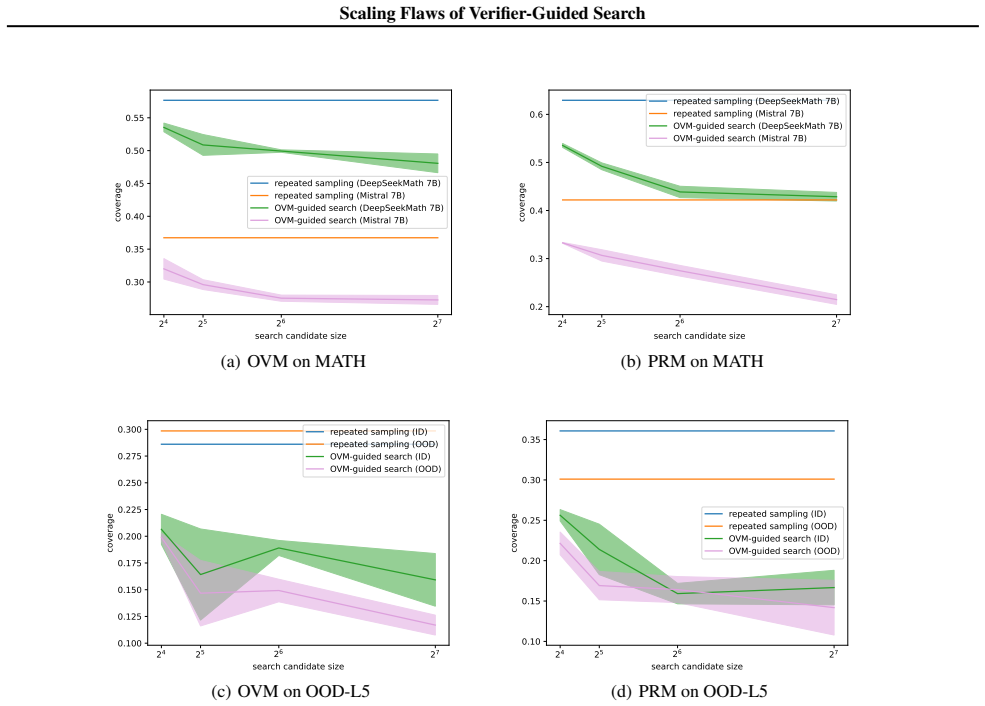
The central claim is that verifier-guided search exhibits scaling flaws: on both Mistral 7B and DeepSeekMath 7B, with both OVMs and PRMs, beam search guided by a verifier starts ahead of repeated sampling but is overtaken as sample size grows. For example, PRM-guided search on GSM8K is overtaken by a sample size of 16 and trails by about 5% at size 32; OVM-guided search on MATH is overtaken at size 4 and trails by about 20% at size 32. The paper attributes the flaw to verifier failures at the selection stage: across benchmarks, 77% to 89% of search failures occur when valid partial paths are generated but the verifier ranks them low and prunes them all. Selection failures track valid-path sparsity—the rarer the correct paths are among candidates, the more often the verifier misses them—and both sparsity and failure rates rise on difficult and out-of-distribution problems. The paper's own experiments with stochastic selection and one-time Monte Carlo rollout show that reducing reliance on verifier scores improves selection accuracy, supporting the diagnosis.
Load-bearing premise
The comparison defines sample size as the number of complete solution paths produced, but beam search generates K = 8b partial continuations at every step before pruning, so it consumes far more generation compute per returned path than repeated sampling; if the comparison were matched by total generated tokens or FLOPs, the crossover point—and possibly the direction of the effect—could change.
Editorial extensions
If this is right
- At large inference budgets on math benchmarks, current OVM- and PRM-guided beam search is expected to solve fewer problems than simply sampling the same number of complete solutions.
- The crossover happens earlier on harder and out-of-distribution problems, so the settings where search is most intended to help are exactly where its scaling flaw is worst.
- Increasing the number of candidates per step does not reliably help, because verifier selection saturates or degrades as candidate sets grow.
- Reducing reliance on verifier scores, e.g. by stochastic selection or a Monte Carlo rollout, improves selection-stage accuracy and is a workable mitigation.
- For applications where coverage equals success, such as proof or code generation with oracle answer checking, the coverage gap implies search is less useful than repeated sampling at scale.
Reading between the lines
- The paper's cost metric counts complete solution paths; beam search actually generates K = 8b partial continuations per step before pruning, so its total token or FLOP cost per returned path is much higher. A compute-matched comparison could push the crossover later, and might even reverse it on some settings.
- If verifier failure is the bottleneck, the scaling flaw is not necessarily intrinsic to search—it is a property of the verifiers tested. Larger verifiers or verifiers trained on harder distributions could plausibly reduce or remove the flaw; the paper leaves this untested.
- The stochastic-selection result suggests a cheap inference-time intervention: annealing selection temperature from high to low as the budget grows, which would start as near-uniform sampling and only trust the verifier when many candidates are available.
- The same failure mode should appear in other verifier-guided decoding settings, such as code generation and formal proof search, whenever valid solutions are sparse; the paper's method of measuring selection-stage failures transfers directly.
Editorial analysis
A structured set of objections, weighed in public.
Referee Report
Summary. The paper studies verifier-guided search (beam search scored by outcome value models or process reward models) for mathematical reasoning, comparing it with repeated sampling at matched 'sample size' (number of complete solution paths). It claims that verifier-guided search has a 'scaling flaw': it outperforms repeated sampling at small sample sizes but is overtaken as the sample size grows, and the gap widens on harder and out-of-distribution problems (Sections 4.1-4.2, Figures 1-2). The paper attributes this to 'verifier failures', where imperfect verifiers misrank and prune all valid paths (Section 5.2, Table 2, Figures 3-4), and proposes two mitigation heuristics, stochastic selection and one-time Monte Carlo rollout (Section 6, Table 3). The evaluation is empirical across GSM8K and MATH, with Mistral 7B and DeepSeekMath 7B, including two OOD settings.
Significance. If the central claim were established, it would have important implications: the common practice of using learned verifiers to guide search would need to be rethought at large inference budgets. The paper is clear in its setup, uses standard external benchmarks, and avoids circularity by labeling valid paths through independent rollouts rather than through the verifier being criticized. However, the headline comparison is confounded by a large compute asymmetry between the two algorithms, and the causal analysis relies on a small number of rollouts for path labeling. As presented, the scaling flaw is not yet convincingly demonstrated, so the paper's significance is conditional on a substantial revision.
major comments (3)
- [Section 5.1, valid-path labeling, and Table 2/Figures 3-4] The comparison between beam search and repeated sampling is compute-imbalanced. In Algorithm 1, at each of T steps the beam search generates K candidate continuations (K/b per beam), so it produces roughly K*T generated steps; repeated sampling with n attempts produces n*T steps. With K/b fixed at 8, a beam search with sample size b consumes 8 times as much generation compute as repeated sampling with n=b attempts. Thus the observed initial advantage at small b, and the crossover at larger b, may be entirely explained by the extra compute rather than by search-guided selection. The same issue affects Figure 2, where K is scaled at fixed b=8 while the repeated-sampling baseline is constant. Please re-run the comparison with compute-matched baselines (e.g., repeated sampling with n=8b attempts against beam search with beam size b, or report curves as a function of total generated tokens) and report whether the scaling flaw and its crossover persist.
- [Section 4.2, experimental repetitions] The definition of a 'valid path' relies on completing each partial path with only 4 rollouts on GSM8K and 16 on MATH/OOD. A partial path that is genuinely valid (can lead to the correct answer) will often fail to do so in a small number of stochastic rollouts, so these labels are noisy and biased toward labeling paths as invalid. This directly affects the selection-failure fractions in Table 2, the verifier-selection curves in Figure 3, and the sparsity analysis in Figure 4. Since the causal story of Section 5.2 is built on these labels, please quantify the misclassification rate (e.g., by increasing rollouts on a subset and estimating stability), or provide a conservative analysis that accounts for label noise.
- [Section 5.2, footnote 1] With only three runs per condition, the reported differences—for example, the 5-20% gaps at sample size 32 that define the crossover in Figure 1—are not accompanied by error bars or significance tests. The text mentions standard deviations but does not report or interpret them. Please provide confidence intervals or significance tests across more seeds, and state explicitly whether the crossover points are stable under this variability.
minor comments (6)
- [Section 2] Typos: 'Obvervation' should be 'Observation', and 'Morever' should be 'Moreover'.
- [Figure 4] In the second paragraph of Related Works, 'the this approach' is a typo and should read 'this approach'.
- [References] The caption contains 'sparisty', which should be 'sparsity'.
- [Section 5.2, footnote] The two Wu et al. entries (2024a and 2024b) share the same arXiv identifier 2408.00724 and nearly identical titles; please distinguish them or merge them appropriately.
- [Section 6] The footnote states that PRM-guided search generation failures are 'expected to be similar' to OVM-guided search, but no evidence is given; please provide data or soften the claim.
- The stochastic selection and Monte Carlo rollout results are reported for a single configuration (b=8, K=64); a sensitivity analysis over beam sizes or candidate counts would make the mitigation claims more robust.
Circularity Check
No significant circularity: the paper's empirical scaling-flaw findings are evaluated against external benchmarks with independently labeled valid paths, and the central causal attribution is supported by measurements rather than by definition.
full rationale
The paper's derivation chain is empirical and self-contained. The main claim—that verifier-guided beam search outperforms repeated sampling at small sample sizes but underperforms at large sample sizes—is established by measuring coverage on GSM8K and MATH500, with no fitted parameters and no prediction that is statistically forced by an input. The 'sample size' alignment for beam search (number of beams b) and repeated sampling (number of attempts) is an explicit definition, not a hidden equivalence, and the observed crossover is a measurement rather than a consequence of that definition. Valid-path labels used in the failure analysis come from independent rollouts (4 for GSM8K, 16 for MATH/OOD), not from the verifier being criticized, so the oracle-selection baseline provides an external reference. The term 'verifier failures' is defined as selection failures in which valid paths are pruned, but the causal claim rests on the empirical distribution of generation versus selection failures and on the measured saturation of verifier selection success relative to oracle selection. Self-citations (OVM and step-level beam search from Yu et al., 2024) are not load-bearing because the scaling-flaw phenomenon is reproduced with PRMs based on external data (Math-Shepherd) across two external benchmarks and multiple settings. There is no imported uniqueness theorem, no ansatz smuggled in via citation, and no renaming of a known result. A compute-asymmetry concern—beam search generates K=8b candidates per step while counting only b final paths as 'sample size'—is a benchmarking-fairness issue, not circularity, because the paper's claim is explicitly about coverage per final solution path rather than computational cost per correct answer.
Assumptions & free parameters
free parameters (3)
- Number of rollouts for valid-path labeling =
4 (GSM8K), 16 (MATH and OOD)
- Softmax temperature in stochastic selection =
0.1, 1, 10
- Lambda in Monte Carlo rollout combination =
0.5, 0.75, 1
assumptions (3)
- domain assumption Coverage is the appropriate performance measure for comparing search and repeated sampling.
- domain assumption The trained generators and verifiers (Mistral 7B, DeepSeekMath 7B, OVM, PRM) are representative of general verifier-guided search systems.
- domain assumption Rollout-based valid-path labeling with few rollouts identifies the true set of valid paths accurately enough for failure attribution.
Cite this review
Pith. "Pith review of Scaling Flaws of Verifier-Guided Search in Mathematical Reasoning." pith.science (2026). https://pith.science/paper/FF3TW7VF
@misc{pith2026250200271,
  author       = {Pith},
  title        = {Pith review of: Scaling Flaws of Verifier-Guided Search in Mathematical Reasoning},
  year         = {2026},
  howpublished = {\url{https://pith.science/paper/FF3TW7VF}},
  note         = {Machine review of arXiv:2502.00271}
}
read the original abstract
Large language models (LLMs) struggle with multi-step reasoning, where inference-time scaling has emerged as a promising strategy for performance improvement. Verifier-guided search outperforms repeated sampling when sample size is limited by selecting and prioritizing valid reasoning paths. However, we identify a critical limitation: scaling flaws, prevalent across different models (Mistral 7B and DeepSeekMath 7B), benchmarks (GSM8K and MATH), and verifiers (outcome value models and process reward models). As sample size increases, verifier-guided search exhibits diminishing advantages and eventually underperforms repeated sampling. Our analysis attributes this to verifier failures, where imperfect verifiers misrank candidates and erroneously prune all valid paths. These issues are further exacerbated in challenging and out-of-distribution problems, restricting search effectiveness. To mitigate verifier failures, we explore reducing reliance on verifiers and conduct preliminary investigations using two simple methods. Our findings reveal fundamental limitations in verifier-guided search and suggest future directions.
Figures


Figures from the paper (1 more)

Forward citations
Cited by 2 Pith papers
-
Verify, Repair, Repeat, or Stop? Robust Stopping for Noisy Verify-Repair Loops in LLM Agents
In noisy verify-repair loops, repair only while the estimated expected gain (1-b)α - bβ stays positive; stop when the belief crosses b* = α/(α+β), and fall back to keep-best when calibration is unreliable.
-
Best-of-$N$ TTS Evaluation is Confounded by ASR Family Alignment
BoN TTS verifier rankings reverse across ASR families; same-family pairs recover 2–3× more oracle headroom, and cross-family rank ensembles give the most robust WER gains.
Reference graph
Works this paper leans on
-
[1]
write newline
" write newline "" before.all 'output.state := FUNCTION n.dashify 't := "" t empty not t #1 #1 substring "-" = t #1 #2 substring "--" = not "--" * t #2 global.max substring 't := t #1 #1 substring "-" = "-" * t #2 global.max substring 't := while if t #1 #1 substring * t #2 global.max substring 't := if while FUNCTION format.date year duplicate empty "emp...
-
[2]
Brown, B. C. A., Juravsky, J., Ehrlich, R. S., Clark, R., Le, Q. V., R \' e , C., and Mirhoseini, A. Large language monkeys: Scaling inference compute with repeated sampling. CoRR, abs/2407.21787, 2024. doi:10.48550/ARXIV.2407.21787. URL https://doi.org/10.48550/arXiv.2407.21787
-
[3]
Alphamath almost zero: process supervision without process
Chen, G., Liao, M., Li, C., and Fan, K. Alphamath almost zero: process supervision without process. CoRR, abs/2405.03553, 2024. doi:10.48550/ARXIV.2405.03553. URL https://doi.org/10.48550/arXiv.2405.03553
-
[4]
Chen, M., Tworek, J., Jun, H., Yuan, Q., de Oliveira Pinto, H. P., Kaplan, J., Edwards, H., Burda, Y., Joseph, N., Brockman, G., Ray, A., Puri, R., Krueger, G., Petrov, M., Khlaaf, H., Sastry, G., Mishkin, P., Chan, B., Gray, S., Ryder, N., Pavlov, M., Power, A., Kaiser, L., Bavarian, M., Winter, C., Tillet, P., Such, F. P., Cummings, D., Plappert, M., Ch...
arXiv 2021
-
[5]
Training verifiers to solve math word problems
Cobbe, K., Kosaraju, V., Bavarian, M., Chen, M., Jun, H., Kaiser, L., Plappert, M., Tworek, J., Hilton, J., Nakano, R., Hesse, C., and Schulman, J. Training verifiers to solve math word problems. CoRR, abs/2110.14168, 2021. URL https://arxiv.org/abs/2110.14168
arXiv 2021
-
[6]
Hao, S., Gu, Y., Ma, H., Hong, J. J., Wang, Z., Wang, D. Z., and Hu, Z. Reasoning with language model is planning with world model. In Bouamor, H., Pino, J., and Bali, K. (eds.), Proceedings of the 2023 Conference on Empirical Methods in Natural Language Processing, EMNLP 2023, Singapore, December 6-10, 2023 , pp.\ 8154--8173. Association for Computationa...
-
[7]
Measuring mathematical problem solving with the MATH dataset
Hendrycks, D., Burns, C., Kadavath, S., Arora, A., Basart, S., Tang, E., Song, D., and Steinhardt, J. Measuring mathematical problem solving with the MATH dataset. In Vanschoren, J. and Yeung, S. (eds.), Proceedings of the Neural Information Processing Systems Track on Datasets and Benchmarks 1, NeurIPS Datasets and Benchmarks 2021, December 2021, virtual...
work page 2021
-
[8]
Q., Sablayrolles, A., Mensch, A., Bamford, C., Chaplot, D
Jiang, A. Q., Sablayrolles, A., Mensch, A., Bamford, C., Chaplot, D. S., de Las Casas, D., Bressand, F., Lengyel, G., Lample, G., Saulnier, L., Lavaud, L. R., Lachaux, M., Stock, P., Scao, T. L., Lavril, T., Wang, T., Lacroix, T., and Sayed, W. E. Mistral 7b. CoRR, abs/2310.06825, 2023. doi:10.48550/ARXIV.2310.06825. URL https://doi.org/10.48550/arXiv.2310.06825
Show all 21 references
-
[9]
H., Gonzalez, J., Zhang, H., and Stoica, I
Kwon, W., Li, Z., Zhuang, S., Sheng, Y., Zheng, L., Yu, C. H., Gonzalez, J., Zhang, H., and Stoica, I. Efficient memory management for large language model serving with pagedattention. In Flinn, J., Seltzer, M. I., Druschel, P., Kaufmann, A., and Mace, J. (eds.), Proceedings o...
2023
-
[10]
Let's verify step by step
Lightman, H., Kosaraju, V., Burda, Y., Edwards, H., Baker, B., Lee, T., Leike, J., Schulman, J., Sutskever, I., and Cobbe, K. Let's verify step by step. In The Twelfth International Conference on Learning Representations, ICLR 2024, Vienna, Austria, May 7-11, 2024 . OpenReview...
2024
-
[11]
and Hutter, F
Loshchilov, I. and Hutter, F. Decoupled weight decay regularization. In 7th International Conference on Learning Representations, ICLR 2019, New Orleans, LA, USA, May 6-9, 2019 . OpenReview.net, 2019. URL https://openreview.net/forum?id=Bkg6RiCqY7
2019
-
[12]
K., Wu, Y., and Guo, D
Shao, Z., Wang, P., Zhu, Q., Xu, R., Song, J., Zhang, M., Li, Y. K., Wu, Y., and Guo, D. Deepseekmath: Pushing the limits of mathematical reasoning in open language models. CoRR, abs/2402.03300, 2024. doi:10.48550/ARXIV.2402.03300. URL https://doi.org/10.48550/arXiv.2402.03300
-
[13]
Scaling LLM test-time compute optimally can be more effective than scaling model parameters
Snell, C., Lee, J., Xu, K., and Kumar, A. Scaling LLM test-time compute optimally can be more effective than scaling model parameters. CoRR, abs/2408.03314, 2024. doi:10.48550/ARXIV.2408.03314. URL https://doi.org/10.48550/arXiv.2408.03314
-
[14]
Toward self-improvement of llms via imagination, searching, and criticizing
Tian, Y., Peng, B., Song, L., Jin, L., Yu, D., Mi, H., and Yu, D. Toward self-improvement of llms via imagination, searching, and criticizing. CoRR, abs/2404.12253, 2024. doi:10.48550/ARXIV.2404.12253. URL https://doi.org/10.48550/arXiv.2404.12253
-
[15]
M., Wen, Y., Zhang, W., and Wang, J
Wan, Z., Feng, X., Wen, M., McAleer, S. M., Wen, Y., Zhang, W., and Wang, J. Alphazero-like tree-search can guide large language model decoding and training. In Forty-first International Conference on Machine Learning, ICML 2024, Vienna, Austria, July 21-27, 2024 . OpenReview....
2024
-
[16]
Math-shepherd: Verify and reinforce llms step-by-step without human annotations
Wang, P., Li, L., Shao, Z., Xu, R., Dai, D., Li, Y., Chen, D., Wu, Y., and Sui, Z. Math-shepherd: Verify and reinforce llms step-by-step without human annotations. In Ku, L., Martins, A., and Srikumar, V. (eds.), Proceedings of the 62nd Annual Meeting of the Association for Co...
2024 doi
-
[17]
An empirical analysis of compute-optimal inference for problem-solving with language models
Wu, Y., Sun, Z., Li, S., Welleck, S., and Yang, Y. An empirical analysis of compute-optimal inference for problem-solving with language models. CoRR, abs/2408.00724, 2024 a . doi:10.48550/ARXIV.2408.00724. URL https://doi.org/10.48550/arXiv.2408.00724
-
[18]
Inference scaling laws: An empirical analysis of compute-optimal inference for problem-solving with language models
Wu, Y., Sun, Z., Li, S., Welleck, S., and Yang, Y. Inference scaling laws: An empirical analysis of compute-optimal inference for problem-solving with language models. arXiv preprint arXiv:2408.00724, 2024 b
2024 arXiv
-
[19]
Z., Song, J., Shao, Z., Zhao, W., Wang, H., Liu, B., Zhang, L., Lu, X., Du, Q., Gao, W., Zhu, Q., Yang, D., Gou, Z., Wu, Z
Xin, H., Ren, Z. Z., Song, J., Shao, Z., Zhao, W., Wang, H., Liu, B., Zhang, L., Lu, X., Du, Q., Gao, W., Zhu, Q., Yang, D., Gou, Z., Wu, Z. F., Luo, F., and Ruan, C. Deepseek-prover-v1.5: Harnessing proof assistant feedback for reinforcement learning and monte-carlo tree sear...
-
[20]
Ovm, outcome-supervised value models for planning in mathematical reasoning
Yu, F., Gao, A., and Wang, B. Ovm, outcome-supervised value models for planning in mathematical reasoning. In Duh, K., G \' o mez - Adorno, H., and Bethard, S. (eds.), Findings of the Association for Computational Linguistics: NAACL 2024, Mexico City, Mexico, June 16-21, 2024 ...
2024 doi
-
[21]
M., and Polu, S
Zheng, K., Han, J. M., and Polu, S. minif2f: a cross-system benchmark for formal olympiad-level mathematics. In The Tenth International Conference on Learning Representations, ICLR 2022, Virtual Event, April 25-29, 2022 . OpenReview.net, 2022. URL https://openreview.net/forum?...
2022
Reviewed August 9, 2026 · model on record in the stance chip above.
Discussion (0). Continue with ORCID to comment.