REVIEW 2 major objections 5 minor 1 cited by
Improved Community Detection using Stochastic Block Models
T0 review · 2 major / 5 minor · reviewed 2026-08-09 · deepseek-v4-flash
Pith's one-line read Stochastic block models often return internally disconnected communities, and a simple post-processing step, Well-Connected Clusters (WCC), that repeatedly removes small edge cuts typically improves clustering accuracy and scales to…
desk verdict Solid empirical study with a useful post-processing tool, but the headline accuracy claim needs a benchmark that does not share WCC's connectivity assumption. read the letter →
The pith
A machine-rendered reading of the paper's core claim, the machinery that carries it, and where it could break.
The reading
What carries the argument
The central object is the Well-Connected Clusters (WCC) post-processor, defined against a threshold for edge-connectivity: a cluster of $n$ nodes is well-connected when its minimum edge cut exceeds $\log_{10}(n)$; the paper uses the VieCut algorithm to find those cuts. WCC takes an SBM clustering, and for any cluster failing the threshold, deletes the minimum cut so the cluster splits in two, iterating until every cluster passes. The second load-bearing mechanism is the description-length decomposition of the degree-corrected SBM, $DL(A,b) = -\log p(A|b,e,k) - \log p(k|b,e) - \log p(b) - \log p(e)$: the $-\log p(e)$ term, which grows with the number of blocks, is what makes the model prefer disconnected clusters, and it is this objective that WCC avoids by operating only on the output clustering.
What would settle it
Generate synthetic networks whose ground-truth communities are deliberately allowed to be poorly connected or internally disconnected, or use real networks with curated ground truth that includes weakly connected communities, then run SBM and SBM+WCC: if the accuracy gains of WCC vanish or reverse on those benchmarks, the claimed improvement is an artifact of testing only against well-connected ground truth.
Extended reading notes
Core claim
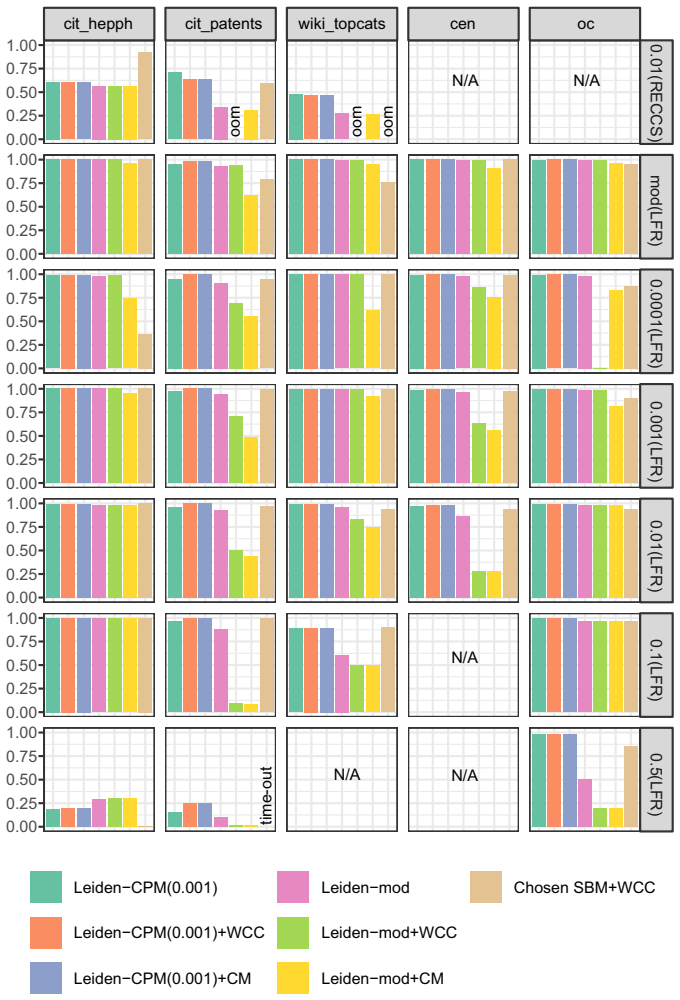
The central claim is that stochastic block model community detection has a systematic tendency to return internally disconnected clusters, and that this failure is baked into the model's own objective. Under the degree-corrected SBM, the description-length score penalizes a large number of blocks $B$ through the $-\log p(e)$ term, which grows as $O(\log B)$; splitting a disconnected cluster into its connected pieces raises $B$ and inflates the description length, so the optimizer leaves clusters disconnected even though the model-likelihood terms prefer connected ones. The proposed remedy, WCC, bypasses the objective entirely: given a clustering and a threshold such as $\log_{10}(n)$ for a cluster of $n$ nodes, it removes the smallest edge cut of any failing cluster, never re-clustering, until every cluster is well-connected. On synthetic LFR and RECCS networks with known ground truth, SBM+WCC is typically at least as accurate as untreated SBM and competitive with Leiden-CPM(0.001)+CM, while on the largest real networks WCC finishes in under two hours on top of an SBM run that takes tens of hours.
Load-bearing premise
The accuracy results assume that synthetic networks whose ground-truth communities come from Leiden clusterings are a fair test of a method whose entire mechanism is to enforce exactly the kind of well-connectedness Leiden guarantees.
Editorial extensions
If this is right
- SBM practitioners can safely add WCC as a fast post-step that guarantees every reported community meets the user's connectivity threshold, at a runtime cost of under two hours even for networks with roughly 14 million nodes.
- On non-bipartite networks, SBM+WCC is generally competitive with, and on several model conditions more accurate than, Leiden-CPM(0.001)+CM across NMI, ARI, AGRI, and RMI on the tested LFR and RECCS benchmarks.
- WCC costs node coverage: the fraction of nodes in non-singleton clusters falls from 100% to 48% on medium and 38% on large non-bipartite networks on average, a larger drop than the Connected Components baseline.
- The description-length analysis implies that any SBM variant whose objective penalizes the number of blocks will tend to prefer internally disconnected clusters; removing the $-\log p(e)$ term flips the preference in 59 of 71 degree-corrected SBM networks.
- WCC is not always free: on one RECCS network it exceeded 256 GB of RAM and on one LFR network it exceeded the 72-hour limit, while CC and CM completed in both cases.
Reading between the lines
- If the disconnection tendency is caused by the block-count penalty, then constraining the SBM search to connected clusterings (the paper's own suggested future direction) could capture most of WCC's benefit without a post-processing stage.
- Because the benchmark ground truth comes from Leiden, which guarantees well-connected communities, a test on synthetic networks with deliberately weak or disconnected ground-truth communities would reveal whether WCC's accuracy gains persist when the target communities are themselves poorly connected.
- The user-set threshold suggests a resolution-style sweep: raising it above $\log_{10}(n)$ would return smaller, tighter clusters and lowering it would return larger ones, giving practitioners a knob between coarse and fine partitions.
- The results are established only for non-bipartite networks; since the paper found nearly all SBM clusters on bipartite networks are disconnected, WCC's behavior there is untested.
Editorial analysis
A structured set of objections, weighed in public.
Referee Report
Summary. The paper studies the connectivity of communities found by Stochastic Block Models (SBMs) on 120 real-world networks, showing that SBMs frequently produce internally disconnected or poorly connected clusters, especially on bipartite and large networks. To address this, the authors propose Well-Connected Clusters (WCC), a post-processing technique that recursively removes small edge cuts until each cluster meets a user-specified well-connectedness threshold (default log10(n)), and compare WCC with two other post-processors (Connected Components and the Connectivity Modifier). Using synthetic LFR and RECCS networks whose ground truth is derived from Leiden clusterings of real networks, the authors report that WCC generally improves SBM clustering accuracy across NMI, ARI, AGRI, and RMI, and is computationally fast on networks with millions of nodes. The paper also offers a description-length analysis explaining why the degree-corrected SBM favors disconnected clusters.
Significance. If the accuracy claim holds, WCC is a simple, fast, and open-source post-processing step that SBM practitioners could apply to obtain well-connected clusters with improved accuracy on non-bipartite networks. The paper's empirical characterization of SBM cluster connectivity across 120 real networks is a useful contribution, and the runtime experiments (Experiment 4) demonstrate WCC's scalability to a network with about 14 million nodes. The description-length analysis (Fig 8, Table 1, Eq 2) provides a plausible mechanistic explanation for why SBMs prefer internally disconnected clusters. However, the central accuracy claim rests on synthetic benchmarks whose ground truth is generated by methods that enforce well-connectedness, which is exactly the property WCC imposes; this creates a systematic bias that must be addressed before the claim can be considered established.
major comments (2)
- [Materials and methods: Synthetic networks; Experiment 3a (Fig 3)] The accuracy evaluation in Experiment 3 is based entirely on synthetic networks whose ground truth is derived from Leiden clusterings of real-world networks: LFR parameters come from networks clustered with Leiden optimizing modularity or CPM, RECCS uses Leiden-CPM(0.01), and the two LFR networks with a large proportion of disconnected ground-truth clusters were excluded from the study. Because Leiden guarantees well-connected communities, the benchmark ground truth is well-connected by construction, which is exactly the property WCC enforces. Consequently, any internally disconnected SBM cluster is automatically an error with respect to this ground truth, and WCC is the treatment designed to repair that error; the comparison SBM vs. SBM+WCC is therefore systematically biased in WCC's favor. To establish that WCC 'typically improves' accuracy, please add benchmarks whose ground truth is not constrained to be well-connected (e.g., LFR or RECCS networks generated from random partitions, from SBM models with disconnected blocks, or from the excluded LFR networks with disconnected ground truth), and report accuracy separately for well-connected versus disconnected ground-truth communities.
- [Experiment 2 (Table A; Fig A in S1 Appendix)] The real-world results in Table A show that WCC reduces node coverage from 100% to 48% on medium and 38% on large non-bipartite networks, with median non-singleton cluster sizes dropping to 3. This is a very different structure from the benchmark ground truth, whose communities are the much larger well-connected clusters produced by Leiden. If WCC fragments real SBM clusters to this degree, it is unclear whether accuracy gains on the synthetic benchmarks, whose ground truth consists of large well-connected communities, will transfer to real-world applications. Please discuss this discrepancy explicitly and, if possible, validate on a real-world network with known community labels, or at least report the distribution of accuracy contributions as a function of cluster size on the synthetic benchmarks.
minor comments (5)
- [Abstract] The abstract contains several typos: 'sh own' should be 'shown', 'an d' should be 'and', 'evalu ate' should be 'evaluate', 'pro pose' should be 'propose', and 'net works' should be 'networks'. Please proofread the entire manuscript.
- [Table A caption (S1 Appendix)] The caption reads 'lage-sized' instead of 'large-sized', and the same typo appears in other supplementary table captions. Please correct these.
- [Figure 8 caption] The caption states 'We show the contribution of − log p(e) term on the description lengths of CC-treated SBM clusterings,' but the box plot shows differences for all four description-length components. Please rephrase to describe the full set of components shown.
- [Experiment 3a (Fig 3)] The heatmap in Fig 3 reports normalized differences, but the underlying numeric accuracy scores (NMI, ARI, AGRI, RMI) are not provided as a table. A supplementary table with these values for each method and each synthetic network would improve reproducibility and allow readers to verify claims such as 'WCC always was neutral or beneficial for NMI and ARI.'
- [Discussion (Eq 2)] The description-length analysis is restricted to the degree-corrected SBM and the CC treatment, while the recommended method is WCC. The explanation would be more compelling if the same component decomposition were reported for WCC and for the non-degree-corrected and planted-partition SBM variants, since these models are also used in the selected SBM clustering.
Circularity Check
Experiment 3's accuracy gain is partly built into a benchmark whose Leiden-derived ground truth shares WCC's connectivity objective; real-world and runtime results remain independent.
-
other
[Materials and methods: Synthetic networks (LFR and RECCS); Materials and methods: Post-processing treatments (WCC); Discussion]
"Each of these networks was produced using the LFR software, using parameters obtained from a clustered real-world network. ... the networks were clustered using Leiden optimizing either modularity or the Constant Potts Model (CPM) ... To produce RECCS networks, we provided parameters to the RECCS software for the Leiden-CPM(0.01) clustering ... WCC checks each cluster to see if it is well-connected. If so, it puts the cluster in the output, and otherwise it removes the small edge cut from the cluster, thus producing two smaller clusters."
The accuracy benchmark in Experiment 3 is generated from Leiden clusterings, and the paper states that 'Leiden never produces disconnected ground truth clusters, unlike SBM, but can produce poorly connected clusters.' WCC is defined as iteratively removing small edge cuts until each cluster is well-connected. Thus the ground truth and the WCC output are both constrained to the same connectivity property by construction: any internally disconnected SBM cluster is an error relative to this ground truth, and WCC is exactly the treatment that repairs that error. The measured ARI/NMI/RMI/AGRI gains are therefore partially artifacts of the benchmark construction, not independent tests.
full rationale
The main accuracy claim — that applying WCC to SBM clusterings can improve accuracy on synthetic networks — is evaluated exclusively on LFR and RECCS benchmarks whose ground-truth partitions are derived from Leiden clusterings of real-world networks (Leiden-mod or Leiden-CPM, and Leiden-CPM(0.01) for RECCS). Leiden's defining property is that it produces connected communities, and the paper explicitly notes that 'Leiden never produces disconnected ground truth clusters, unlike SBM, but can produce poorly connected clusters.' WCC is defined as repeatedly removing small edge cuts until every cluster is well-connected. The benchmark and the treatment therefore share the same connectivity constraint by construction, so the Experiment 3 comparison systematically rewards WCC for repairing exactly the disconnected-cluster error that the benchmark defines as wrong. This is a genuine, if partial, circularity: a control with ground truth not constrained to be connected or well-connected is absent. The paper's own real-world measurements (Table A) show WCC drops node coverage from 100% to 38% on large non-bipartite networks with median cluster sizes of 3, indicating that the benchmark's ground truth is not representative of WCC's real-world output. However, the paper is not fully circular: no parameter is fitted to the accuracy metrics, the connectivity of SBM clusters on real networks is measured directly, the description-length analysis is an independent derivation, and the runtime claims (Experiment 4) are self-contained. The self-citations to the prior LFR and RECCS benchmark papers are secondary to this constructional bias. Score 4 reflects partial benchmark circularity with substantial independent content.
Assumptions & free parameters
free parameters (2)
- well-connectedness threshold t = log10(n) =
log10(n) (default)
- Leiden resolution for synthetic benchmark ground truth =
0.01 for RECCS; 0.0001, 0.001, 0.01, 0.1, 0.5 for LFR
assumptions (3)
- domain assumption Well-connectedness is appropriately measured by minimum edge cut exceeding log10(n), where n is the cluster size.
- domain assumption Synthetic networks generated by LFR and RECCS from Leiden-based clusterings of real networks are faithful proxies for real-world community structure.
- domain assumption VieCut computes correct minimum cuts and graph-tool's SBM inference is a valid oracle for community structure.
Cite this review
Pith. "Pith review of Improved Community Detection using Stochastic Block Models." pith.science (2026). https://pith.science/paper/U3LM4XDT
@misc{pith2026250200686,
  author       = {Pith},
  title        = {Pith review of: Improved Community Detection using Stochastic Block Models},
  year         = {2026},
  howpublished = {\url{https://pith.science/paper/U3LM4XDT}},
  note         = {Machine review of arXiv:2502.00686}
}
read the original abstract
Identifying edge-dense communities that are also well-connected is an important aspect of understanding community structure. Prior work has shown that community detection methods can produce poorly connected communities, and some can even produce internally disconnected communities. In this study we evaluate the connectivity of communities obtained using Stochastic Block Models. We find that SBMs produce internally disconnected communities from real-world networks. We present a simple technique, Well-Connected Clusters (WCC), which repeatedly removes small edge cuts until the communities meet a user-specified threshold for well-connectivity. Our study using a large collection of synthetic networks based on clustered real-world networks shows that using WCC as a post-processing tool with SBM community detection typically improves clustering accuracy. WCC is fast enough to use on networks with millions of nodes and is freely available in open source form.
Figures


Figures from the paper (5 more)




Forward citations
Cited by 1 Pith paper
-
Hypermodularity and community detection in hypergraphs
A spectral algorithm for hypergraph community detection based on higher-order SVD of the hypermodularity tensor, with the caveat that the top singular vector is a heuristic, not a proven optimizer.
Reference graph
Works this paper leans on
-
[1]
On clusterings: Good, bad and spe ctral
Kannan R, Vempala S, Vetta A. On clusterings: Good, bad and spe ctral. Journal of the ACM (JACM). 2004;51(3):497–515
work page 2004
-
[2]
From Louvain to Leiden: guaran teeing well-connected communities
Traag V A, Waltman L, Van Eck NJ. From Louvain to Leiden: guaran teeing well-connected communities. Scientific Reports. 2019;9(1):1–12
work page 2019
-
[3]
Fast unfolding of communities in large networks
Blondel VD, Guillaume JL, Lambiotte R, Lefebvre E. Fast unfolding of communities in large networks. Journal of statistical mechanics: t heory and experiment. 2008;2008(10):P10008
work page 2008
-
[4]
Improv ed Community Detection using Stochastic Block Models; 2024
Park M, Feng DW, Digra S, Vu-Le TA, Chacko G, Warnow T. Improv ed Community Detection using Stochastic Block Models; 2024. arXiv pre print arXiv:2408.10464
arXiv 2024
-
[5]
Peixoto TP. The graph-tool python library. figshare. 2014;doi:10.6084/m9.figshare.1164194
-
[6]
Well-connectedness and community detection
Park M, Tabatabaee Y, Ramavarapu V, Liu B, Pailodi VK, Ramacha ndran R, et al. Well-connectedness and community detection. PLOS Complex S ystems. 2024;1(3):e0000009
work page 2024
-
[7]
Leiden Algorithm: leidenalg; 2019
Traag V. Leiden Algorithm: leidenalg; 2019. https://github.com/vtraag/leidenalg
work page 2019
-
[8]
Rosvall M, Axelsson D, Bergstrom CT. The map equation. The Eur opean Physical Journal Special Topics. 2009;178(1):13–23
work page 2009
Show all 25 references
-
[9]
Center-per iphery structure in research communities
Wedell E, Park M, Korobskiy D, Warnow T, Chacko G. Center-per iphery structure in research communities. Quantitative Science Studies. 2022;3(1):289–314
2022
-
[10]
Graph clustering via a discrete uncoupling process
Dongen SV. Graph clustering via a discrete uncoupling process. SIAM Journal on Matrix Analysis and Applications. 2008;30(1):121–141
2008
-
[11]
Emulating real networks using LFR graphs; 202 3
Tabatabaee Y. Emulating real networks using LFR graphs; 202 3. https://github.com/ytabatabaee/emulate-real-nets
-
[12]
Comparing partitions
Hubert L, Arabie P. Comparing partitions. Journal of classifica tion. 1985;2:193–218
1985
-
[13]
Synthetic Netw orks That Preserve Edge Connectivity
Anne L, Vu-Le TA, Park M, Warnow T, Chacko G. Synthetic Netw orks That Preserve Edge Connectivity. arXiv preprint arXiv:240813647. 202 4;. February 17, 2025 18/19
2025
-
[14]
The Netzschleuder network catalogue and reposit ory; 2020
Peixoto TP. The Netzschleuder network catalogue and reposit ory; 2020. https://networks.skewed.de
2020
-
[15]
Benchmark graphs for testing community detection algorithms
Lancichinetti A, Fortunato S, Radicchi F. Benchmark graphs for testing community detection algorithms. Physical Review E. 2008;78(4):046 110
2008
-
[16]
Synthetic Networks For B enchmarking
Anne L, Park M, Warnow T, Chacko G. Synthetic Networks For B enchmarking
-
[17]
Stochastic blockmodels and community st ructure in networks
Karrer B, Newman ME. Stochastic blockmodels and community st ructure in networks. Physical Review E—Statistical, Nonlinear, and Soft Matt er Physics. 2011;83(1):016107
2011
-
[18]
Stochastic blockmodels: Fir st steps
Holland PW, Laskey KB, Leinhardt S. Stochastic blockmodels: Fir st steps. Social Networks. 1983;5(2):109–137
1983
-
[19]
Statistical inference of assortative com munity structures
Zhang L, Peixoto TP. Statistical inference of assortative com munity structures. Physical Review Research. 2020;2(4):043271
2020
-
[20]
Practical Minimum Cut Alg orithms
Henzinger M, Noe A, Schulz C, Strash D. Practical Minimum Cut Alg orithms. ACM Journal of Experimental Algorithmics. 2018;23:1–22
2018
-
[21]
Elements of Information Theory
Thomas M, Joy AT. Elements of Information Theory. Wiley-Inte rscience; 2006
2006
-
[22]
Comparing graph clusterings: Set partit ion measures vs
Poulin V, Th´ eberge F. Comparing graph clusterings: Set partit ion measures vs. graph-aware measures. IEEE Transactions on Pattern Analysis a nd Machine Intelligence. 2020;43(6):2127–2132
2020
-
[23]
Improved mutual informat ion measure for clustering, classification, and community detection
Newman ME, Cantwell GT, Young JG. Improved mutual informat ion measure for clustering, classification, and community detection. Physical R eview E. 2020;101(4):042304
2020
-
[24]
N/A” cells are those netwo rks that are not available; see text for explanation. There are three out-of-memory (oom) entries (top row) and one “time-out
Peixoto TP. 11. In: Bayesian Stochastic Blockmodeling. John Wile y & Sons, Ltd; 2019. p. 289–332. Available from: https://onlinelibrary.wiley.com/doi/abs/10.1002/9781119483298.ch11. February 17, 2025 19/19 arXiv:2502.00686v3 [cs.SI] 13 Feb 2025 Supplementary Materials for Impr...
2019 arXiv
-
[2025]
Available from: https://doi.org/10.13012/B2IDB-9805305_V1
Reviewed August 9, 2026 · model on record in the stance chip above.
Discussion (0). Continue with ORCID to comment.