REVIEW 4 major objections 5 minor 1 cited by
Error-quantified Conformal Inference for Time Series
T0 review · 4 major / 5 minor · reviewed 2026-08-09 · deepseek-v4-flash
Pith's one-line read A new online conformal method, ECI, adds the size of the miss to hit/miss feedback and claims to hold long-run miscoverage at its target while shrinking prediction sets.
desk verdict Useful new update rule for online conformal inference, but the central coverage theorem is proven for a projected variant; the gap is fixable and worth a major revision. read the letter →
The pith
A machine-rendered reading of the paper's core claim, the machinery that carries it, and where it could break.
The reading
What carries the argument
The central object is the error-quantification (EQ) term $(s_t-q_t)\nabla f(s_t-q_t)$ added to the online gradient update. It is the signed distance between the revealed non-conformity score and the current threshold, scaled by the local slope of a smooth surrogate for the indicator function, such as the sigmoid. This makes the feedback continuous and adaptive: small misses are corrected gently, large deviations produce a larger but damped correction, and the proof uses the boundedness of the term, together with bounded scores, to show that one miss forces the next $N-1$ steps to be hits.
What would settle it
Run the unclipped update in Equation (5) on a simulated stream with $\alpha=0.1$ and scores in $[0,1]$, and check whether every miscoverage step is followed by at least $N-1$ coverage steps; one violating window would falsify Theorem 1's finite-window bound for the implemented algorithm.
Extended reading notes
Core claim
ECI's central claim is that quantile tracking in online conformal inference can be improved by replacing purely binary feedback with partially smoothed feedback. The update is $q_{t+1}=q_t+\eta(\mathrm{err}_t-\alpha+(s_t-q_t)\nabla f(s_t-q_t))$, where $\mathrm{err}_t$ is the miscoverage indicator, $s_t$ is the non-conformity score, and $f$ is a smooth approximation to the indicator of $x>0$, typically the sigmoid $\sigma(cx)$. Under the assumption that scores $s_t$ lie in $[0,B]$ and $|x\nabla f(x)|\leq\lambda$, Theorem 1 proves a dynamic miscoverage bound: for a fixed learning rate satisfying $\eta>2NB$ and a small smoothing scale $c$, every miscoverage step is followed by at least $N-1$ coverage steps, where $N=\lfloor 1/\alpha\rfloor$, so $(1/N)\sum_{t=T+1}^{T+N}\mathbf{1}\{Y_t\notin\hat{C}_t\}\leq 1/N$; when $\alpha=1/N$ this gives the long-run guarantee $(1/T)\sum_{t=1}^{T}\mathbf{1}\{Y_t\notin\hat{C}_t\}\to\alpha$. Theorem 2 gives a finite-sample bound for arbitrary positive learning rates. Empirically, ECI and its cutoff and integral variants hold coverage near the nominal level while reporting shorter average and median prediction-set widths than the baselines on Amazon and Google stock prices, electricity demand, Delhi temperature, and a synthetic changepoint setting. The proof of Theorem 1 works with thresholds clipped at zero after each update, as stated in Appendix B.2.
Load-bearing premise
The long-term coverage guarantee rests on the proof clipping thresholds at zero after every update, while the algorithm as implemented and evaluated uses the unclipped update, and on all scores lying inside a known bound $B$; if either condition fails for the implemented procedure, the advertised guarantee may not hold.
Editorial extensions
If this is right
- A user can run ECI with a single fixed learning rate and still expect long-run miscoverage at level $\alpha$ without any exchangeability or stationarity assumption on the time series.
- The proof structure implies a finite-window guarantee: after any miscoverage step, at least $N-1$ of the next $N$ steps cover the true label, which is stronger than an asymptotic average.
- The empirical widths imply practitioners can shrink prediction intervals without sacrificing calibration on these datasets, which reduces the cost of decisions based on those intervals.
- The cutoff and integral variants show the same feedback idea can be tuned to avoid over-correction for small errors and to stabilize coverage by averaging over past errors.
- Combining ECI with a scorecaster can beat conformal PID using the same scorecaster, indicating that the EQ update is compatible with residualization of systematic forecast error.
Reading between the lines
- A fair test of the guarantee should implement the threshold-clipped update used in the proof; the unclipped update in Equation (5) may behave differently when the optimal threshold would go negative.
- For unbounded real scores, a practical route to satisfy the bounded-score assumption is to transform scores first; whether ECI retains its tighter-width advantage under such transformations is not tested in the paper.
- The one-miss-then-$N-1$-hits pattern suggests ECI could double as a changepoint detector, since a cluster of misses inside a short window signals that the learning rate or base forecaster needs resetting.
- Because the EQ term damps very large deviations, ECI may be less vulnerable than binary-feedback methods to single outliers; a heavy-tailed synthetic experiment would separate this robustness from the distribution-shift benefit.
Editorial analysis
A structured set of objections, weighed in public.
Referee Report
Summary. The paper proposes Error-quantified Conformal Inference (ECI), an online conformal method that updates the threshold q_t via q_{t+1} = q_t + eta[err_t - alpha + (s_t - q_t) nabla f(s_t - q_t)], adding a smooth error-quantification term to the binary feedback used by ACI/OGD. The authors state two distribution-free results: Theorem 1, claiming that with a fixed learning rate every miscoverage step is followed by N-1 coverage steps (yielding a long-run miscoverage bound), and Theorem 2, a finite-sample averaged-miscoverage bound for arbitrary adaptive learning rates. Experiments on stock, electricity, Delhi temperature, and synthetic changepoint data compare ECI and its cutoff/integral variants against ACI, OGD, SF-OGD, decay-OGD, and PID, reporting comparable coverage with generally shorter prediction intervals. The main caveat, detailed below, is that the proof of Theorem 1 is carried out for a projected update q_t <- max(q_t,0), not for the update in Eq. (5) that is implemented and evaluated.
Significance. The core idea is practically appealing: using the signed distance between the score and the threshold to modulate the update can plausibly yield faster adaptation and tighter sets than binary-only feedback. If Theorem 1 can be established for the actual update rule, the paper would be a useful contribution to online conformal inference, related to but distinct from Conformal PID. The paper should be credited for releasing code, testing multiple datasets and base predictors, including ablations on the scale parameter c and window length w, and attempting distribution-free guarantees for both fixed and adaptive learning rates. At present, the central theoretical guarantee is not proved for the algorithm that is actually implemented and evaluated, so the strength of the contribution depends on repairing the proof or adjusting the algorithm.
major comments (4)
- [Section 3.3, Appendix B.2, Eq. (5)] The proof of Theorem 1 begins in Appendix B.2 by declaring 'we set q_t to be max{q_t,0} after each update (which does not affect the validity of our proof)'. This is not a harmless convention. Proposition 1 in Appendix B.1 explicitly permits q_t < 0, and for nonnegative scores a negative threshold makes the prediction set empty and sets err_t = 1, which changes the future updates. Neither Eq. (5) nor the experimental description contains this projection. Therefore the statement that Theorem 1 applies to 'the prediction sets generated by (5)' is not what is proved; the long-term miscoverage guarantee is established only for a clipped variant. This is the central load-bearing issue and should be fixed, either by adding the projection to the algorithm and experiments or by re-deriving the bound for the unprojected update.
- [Appendix B.2, Theorem 1] The main text in Section 3.3 defines N = floor(1/alpha), while the Appendix B.2 statement uses N = ceil(1/alpha) and concludes with a limsup bound rather than Eq. (8). Within the proof, the line 'k <= N-1, alpha >= 1/N' has the inequality reversed: the step (1 - k alpha) >= 1/N requires alpha <= 1/N. This condition holds for the floor definition but is false for the ceiling definition in general (e.g., alpha = 0.12 gives ceil = 9 and alpha > 1/9). Because this inequality produces the lower bound eta/N used in the final positivity argument, the proof does not currently support either version of the theorem as written.
- [Appendix B.3, Theorem 2] The displayed identity in the proof of Theorem 2 has a sign error. From Eq. (5), eta_t(err_t - alpha) = q_{t+1} - q_t - eta_t (s_t - q_t) nabla f(s_t - q_t), so the sum from t = r to T equals q_{T+1} - q_r minus the sum of eta_t g_t, not plus. The subsequent absolute-value steps may be repairable because taking absolute values makes the sign immaterial, but the proof as printed is not a valid derivation of the bound in Eq. (13).
- [Section 3.3, Section 4.1, Section G.2] The theoretical guarantees depend on a known bound B in Assumption 1, and Theorem 1 requires eta > 2NB and c < min{eta,N^2}/(2N^2[B+(1-alpha+lambda)eta]). The experimental section does not state a value of B or verify these inequalities, and the implemented adaptive rates eta_t = eta*(max - min over a window) with eta in {1, 0.5, 0.1, 0.05} will typically violate eta > 2NB for any plausible B on the real datasets. The paper should clarify which theorem is intended to cover the experimental configuration and discuss how B would be obtained in practice; as it stands, the empirical demonstration does not instantiate the conditions of the main theorem.
minor comments (5)
- [Algorithm 5] In Step 5 of Algorithm 5, the adaptive learning rate is defined as eta*(max{s_{t-w+1},...,s_t} - max{s_{t-w+1},...,s_t}), which is identically zero; the second maximum should presumably be a minimum.
- [Algorithm 3] In Algorithm 3, the loop reads 'Observe input X_{t+1}' and returns a prediction set using q_{t+1}, which is inconsistent with the sequential convention used in the other algorithms; it should be X_t and q_t.
- [Section 3.2] The phrase 'degree of miscovery' should be 'degree of miscoverage'.
- [Eq. (6) and Section 4.1] The notation h_t is used both as a fixed cutoff scaled by h and as the window range of the scores; please state the domain of h and clarify the relation between h and h_t explicitly.
- [Section 3.1] The sentence stating that the EQ term 'tends to decrease as s_t - q_t grows' is ambiguous, because for the sigmoid the EQ function increases on small positive x and then decreases; consider describing the non-monotone shape shown in Figure 2.
Circularity Check
No circular derivation: the coverage guarantee is derived from stated assumptions on scores and the update rule, with no parameter fitted to the target coverage rate; noted proof inconsistencies are correctness gaps, not circularity.
full rationale
Walking the derivation chain: ECI's update rule (5) is q_{t+1}=q_t+eta[err_t-alpha+(s_t-q_t) grad f(s_t-q_t)], and Theorems 1 and 2 derive bounds on the averaged miscoverage indicator from Assumptions 1 and 2 plus conditions on eta and c. No parameter is fitted to the target long-run miscoverage rate; alpha is an input, and the proof shows that every miscoverage step is followed by coverage steps under the stated conditions. The proof's projection step 'we set q_t to be max{q_t,0} after each update (which does not affect the validity of our proof)' is an unannounced modification of the update, and Proposition 1 allows q_t to be negative, so the advertised guarantee is not proven for the implemented update; this is a proof gap, not circularity. Similarly, the inconsistency between N=floor(1/alpha) in the main text and N=ceil(1/alpha) in the appendix, and the reversed inequality in the line 'k<=N-1, alpha>=1/N', are mathematical errors, not instances of a conclusion being assumed as an input. No self-citation is load-bearing for the main claims; the citations to the authors' own prior work appear only in related-work discussion. Experimental learning-rate selection is standard tuning and does not make the theoretical coverage result an output of a fitted value. I find no exhibited reduction of a claimed prediction to the paper's own inputs by definition or by construction, so the appropriate circularity score is 0.
Assumptions & free parameters
free parameters (5)
- base learning rate eta =
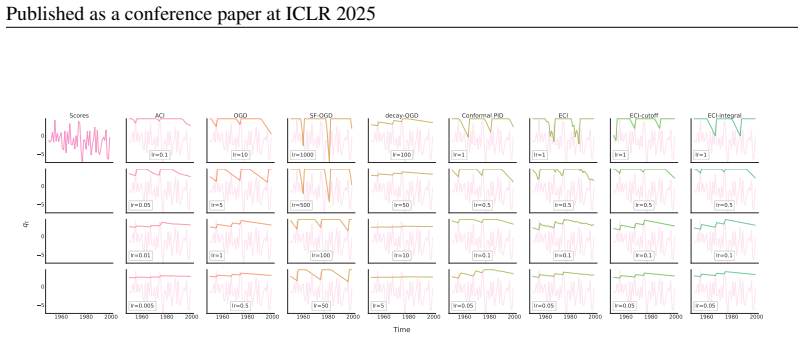
varies per method and dataset: ACI 0.005-0.1, OGD 0.005-10, SF-OGD 0.05-1000, decay-OGD 0.1-2000, PID/ECI 0.05-1
- sigmoid scale c =
1
- cutoff threshold h =
1
- window length w =
100
- ECI-integral decay factor =
0.95
assumptions (3)
- domain assumption Assumption 1: non-conformity scores s_t in [0,B] for all t.
- domain assumption Assumption 2: |x times nabla f(x)| <= lambda and |nabla f(x)| <= c for the smoothing function f.
- ad hoc to paper The proof of Theorem 1 clips q_t to max(q_t,0) after every update.
Cite this review
Pith. "Pith review of Error-quantified Conformal Inference for Time Series." pith.science (2026). https://pith.science/paper/BJSTMQ2N
@misc{pith2026250200818,
  author       = {Pith},
  title        = {Pith review of: Error-quantified Conformal Inference for Time Series},
  year         = {2026},
  howpublished = {\url{https://pith.science/paper/BJSTMQ2N}},
  note         = {Machine review of arXiv:2502.00818}
}
read the original abstract
Uncertainty quantification in time series prediction is challenging due to the temporal dependence and distribution shift on sequential data. Conformal inference provides a pivotal and flexible instrument for assessing the uncertainty of machine learning models through prediction sets. Recently, a series of online conformal inference methods updated thresholds of prediction sets by performing online gradient descent on a sequence of quantile loss functions. A drawback of such methods is that they only use the information of revealed non-conformity scores via miscoverage indicators but ignore error quantification, namely the distance between the non-conformity score and the current threshold. To accurately leverage the dynamic of miscoverage error, we propose \textit{Error-quantified Conformal Inference} (ECI) by smoothing the quantile loss function. ECI introduces a continuous and adaptive feedback scale with the miscoverage error, rather than simple binary feedback in existing methods. We establish a long-term coverage guarantee for ECI under arbitrary dependence and distribution shift. The extensive experimental results show that ECI can achieve valid miscoverage control and output tighter prediction sets than other baselines.
Figures


Figures from the paper (16 more)




Forward citations
Cited by 1 Pith paper
-
Relevance-Aware Thresholding in Online Conformal Prediction for Time Series
Replacing the binary inside/outside error in PID and ECI online conformal prediction with smooth relevance functions can shrink prediction intervals while keeping long-run coverage on several time-series benchmarks.
Reference graph
Works this paper leans on
-
[1]
Angelopoulos, Stephen Bates, Clara Fannjiang, Michael I Jordan, and Tijana Zrnic
Anastasios N. Angelopoulos, Stephen Bates, Clara Fannjiang, Michael I Jordan, and Tijana Zrnic. Prediction-powered inference. Science, 382 0 (6671): 0 669--674, 2023 a
work page 2023
-
[2]
Angelopoulos, Emmanuel Candes, and Ryan J Tibshirani
Anastasios N. Angelopoulos, Emmanuel Candes, and Ryan J Tibshirani. Conformal pid control for time series prediction. Advances in Neural Information Processing Systems, 36, 2023 b
work page 2023
-
[3]
Angelopoulos, Rina Barber, and Stephen Bates
Anastasios N. Angelopoulos, Rina Barber, and Stephen Bates. Online conformal prediction with decaying step sizes. In Forty-first International Conference on Machine Learning, 2024
work page 2024
-
[4]
The theta model: a decomposition approach to forecasting
Vassilis Assimakopoulos and Konstantinos Nikolopoulos. The theta model: a decomposition approach to forecasting. International journal of forecasting, 16 0 (4): 0 521--530, 2000
work page 2000
-
[5]
CAP : A general algorithm for online selective conformal prediction with FCR control
Yajie Bao, Yuyang Huo, Haojie Ren, and Changliang Zou. CAP : A general algorithm for online selective conformal prediction with FCR control. arXiv preprint arXiv:2403.07728, 2024
-
[6]
Predictive inference with the jackknife
Rina Foygel Barber, Emmanuel J Cand \`e s, Aaditya Ramdas, and Ryan J Tibshirani. Predictive inference with the jackknife. The Annals of Statistics, 49 0 (1): 0 486--507, 2021
work page 2021
-
[7]
Conformal prediction beyond exchangeability
Rina Foygel Barber, Emmanuel J Candes, Aaditya Ramdas, and Ryan J Tibshirani. Conformal prediction beyond exchangeability. The Annals of Statistics, 51 0 (2): 0 816--845, 2023
2023
-
[8]
Improved online conformal prediction via strongly adaptive online learning
Aadyot Bhatnagar, Huan Wang, Caiming Xiong, and Yu Bai. Improved online conformal prediction via strongly adaptive online learning. In International Conference on Machine Learning, pp.\ 2337--2363. PMLR, 2023
work page 2023
Show all 46 references
-
[9]
Time series: theory and methods
Peter J Brockwell and Richard A Davis. Time series: theory and methods. Springer science & business media, 1991
1991
-
[10]
Exact and robust conformal inference methods for predictive machine learning with dependent data
Victor Chernozhukov, Kaspar W \"u thrich, and Zhu Yinchu. Exact and robust conformal inference methods for predictive machine learning with dependent data. In Conference On Learning Theory, pp.\ 732--749. PMLR, 2018
2018
-
[11]
Smoothing quantile regressions
Marcelo Fernandes, Emmanuel Guerre, and Eduardo Horta. Smoothing quantile regressions. Journal of Business & Economic Statistics, 39 0 (1): 0 338--357, 2021
2021
-
[12]
Bayesian recurrent neural networks
Meire Fortunato, Charles Blundell, and Oriol Vinyals. Bayesian recurrent neural networks. arXiv preprint arXiv:1704.02798, 2017
2017 arXiv
-
[13]
Inducing high energy-latency of large vision-language models with verbose images
Kuofeng Gao, Yang Bai, Jindong Gu, Shu-Tao Xia, Philip Torr, Zhifeng Li, and Wei Liu. Inducing high energy-latency of large vision-language models with verbose images. In The Twelfth International Conference on Learning Representations, 2024
2024
-
[14]
Probabilistic forecasting with spline quantile function rnns
Jan Gasthaus, Konstantinos Benidis, Yuyang Wang, Syama Sundar Rangapuram, David Salinas, Valentin Flunkert, and Tim Januschowski. Probabilistic forecasting with spline quantile function rnns. In The 22nd international conference on artificial intelligence and statistics, pp.\ ...
1901
-
[15]
Adaptive conformal inference under distribution shift
Isaac Gibbs and Emmanuel Cand \`e s. Adaptive conformal inference under distribution shift. Advances in Neural Information Processing Systems, 34: 0 1660--1672, 2021
2021
-
[16]
Conformal inference for online prediction with arbitrary distribution shifts
Isaac Gibbs and Emmanuel J Cand \`e s. Conformal inference for online prediction with arbitrary distribution shifts. Journal of Machine Learning Research, 25 0 (162): 0 1--36, 2024
2024
-
[17]
Adaptive regret for control of time-varying dynamics
Paula Gradu, Elad Hazan, and Edgar Minasyan. Adaptive regret for control of time-varying dynamics. In Learning for Dynamics and Control Conference, pp.\ 560--572. PMLR, 2023
2023
-
[18]
Splice-2 comparative evaluation: Electricity pricing
Michael Harries, New South Wales, et al. Splice-2 comparative evaluation: Electricity pricing. 1999
1999
-
[19]
Improved strongly adaptive online learning using coin betting
Kwang-Sung Jun, Francesco Orabona, Stephen Wright, and Rebecca Willett. Improved strongly adaptive online learning using coin betting. In Artificial Intelligence and Statistics, pp.\ 943--951. PMLR, 2017
2017
-
[20]
Smoothed estimating equations for instrumental variables quantile regression
David M Kaplan and Yixiao Sun. Smoothed estimating equations for instrumental variables quantile regression. Econometric Theory, 33 0 (1): 0 105--157, 2017
2017
-
[21]
Distribution-free predictive inference for regression
Jing Lei, Max G’Sell, Alessandro Rinaldo, Ryan J Tibshirani, and Larry Wasserman. Distribution-free predictive inference for regression. Journal of the American Statistical Association, 113 0 (523): 0 1094--1111, 2018
2018
-
[22]
Stochastic deep gaussian processes over graphs
Naiqi Li, Wenjie Li, Jifeng Sun, Yinghua Gao, Yong Jiang, and Shu-Tao Xia. Stochastic deep gaussian processes over graphs. Advances in Neural Information Processing Systems, 33: 0 5875--5886, 2020
2020
-
[23]
Enhancing the locality and breaking the memory bottleneck of transformer on time series forecasting
Shiyang Li, Xiaoyong Jin, Yao Xuan, Xiyou Zhou, Wenhu Chen, Yu-Xiang Wang, and Xifeng Yan. Enhancing the locality and breaking the memory bottleneck of transformer on time series forecasting. Advances in Neural Information Processing Systems, 32, 2019
2019
-
[24]
S&P 500 stock data
Cam Nguyen. S&P 500 stock data. Kaggle, 2018
2018
-
[25]
Split conformal prediction and non-exchangeable data
Roberto I Oliveira, Paulo Orenstein, Thiago Ramos, and Joao Vitor Romano. Split conformal prediction and non-exchangeable data. Journal of Machine Learning Research, 25 0 (225): 0 1--38, 2024
2024
-
[26]
Coin betting and parameter-free online learning
Francesco Orabona and D \'a vid P \'a l. Coin betting and parameter-free online learning. Advances in Neural Information Processing Systems, 29, 2016
2016
-
[27]
Inductive confidence machines for regression
Harris Papadopoulos, Kostas Proedrou, Volodya Vovk, and Alex Gammerman. Inductive confidence machines for regression. In European Conference on Machine Learning, pp.\ 345--356. New York: Springer, 2002
2002
-
[28]
Distribution-free uncertainty quantification for classification under label shift
Aleksandr Podkopaev and Aaditya Ramdas. Distribution-free uncertainty quantification for classification under label shift. In Uncertainty in Artificial Intelligence, pp.\ 844--853. PMLR, 2021
2021
-
[29]
Adaptive conformal inference by betting
Aleksandr Podkopaev, Dong Xu, and Kuang-Chih Lee. Adaptive conformal inference by betting. In International Conference on Machine Learning, volume 235 of Proceedings of Machine Learning Research, pp.\ 40886--40907. PMLR, 2024
2024
-
[30]
Conformalized quantile regression
Yaniv Romano, Evan Patterson, and Emmanuel Cand \`e s. Conformalized quantile regression. Advances in Neural Information Processing Systems, 32: 0 3543--3553, 2019
2019
-
[31]
High-dimensional quantile regression: Convolution smoothing and concave regularization
Kean Ming Tan, Lan Wang, and Wen-Xin Zhou. High-dimensional quantile regression: Convolution smoothing and concave regularization. Journal of the Royal Statistical Society Series B: Statistical Methodology, 84 0 (1): 0 205--233, 2022
2022
-
[32]
Forecasting at scale
Sean J Taylor and Benjamin Letham. Forecasting at scale. The American Statistician, 72 0 (1): 0 37--45, 2018
2018
-
[33]
Conformal prediction under covariate shift
Ryan J Tibshirani, Rina Foygel Barber, Emmanuel Cand \`e s, and Aaditya Ramdas. Conformal prediction under covariate shift. Advances in Neural Information Processing Systems, 32, 2019
2019
-
[34]
Attention is all you need
Ashish Vaswani, Noam Shazeer, Niki Parmar, Jakob Uszkoreit, Llion Jones, Aidan N Gomez, ukasz Kaiser, and Illia Polosukhin. Attention is all you need. In Advances in Neural Information Processing Systems, volume 30, 2017
2017
-
[35]
Algorithmic learning in a random world
Vladimir Vovk, Alexander Gammerman, and Glenn Shafer. Algorithmic learning in a random world. Springer Science & Business Media, 2005
2005
-
[36]
Daily climate time series data
Sumanth Vrao. Daily climate time series data. Kaggle, 2017
2017
-
[37]
Online control of the false coverage rate and false sign rate
Asaf Weinstein and Aaditya Ramdas. Online control of the false coverage rate and false sign rate. In International Conference on Machine Learning, pp.\ 10193--10202, 2020
2020
-
[38]
Conformal prediction interval for dynamic time-series
Chen Xu and Yao Xie. Conformal prediction interval for dynamic time-series. In International Conference on Machine Learning, pp.\ 11559--11569. PMLR, 2021
2021
-
[39]
Conformal prediction for time series
Chen Xu and Yao Xie. Conformal prediction for time series. IEEE Transactions on Pattern Analysis and Machine Intelligence, 45 0 (10): 0 11575--11587, 2023
2023
-
[40]
Doubly robust calibration of prediction sets under covariate shift
Yachong Yang, Arun Kumar Kuchibhotla, and Eric Tchetgen Tchetgen. Doubly robust calibration of prediction sets under covariate shift. Journal of the Royal Statistical Society Series B: Statistical Methodology, pp.\ qkae009, 2024 a
2024
-
[41]
Bellman conformal inference: Calibrating prediction intervals for time series
Zitong Yang, Emmanuel Cand \`e s, and Lihua Lei. Bellman conformal inference: Calibrating prediction intervals for time series. arXiv preprint arXiv:2402.05203, 2024 b
2024 arXiv
-
[42]
Adaptive conformal predictions for time series
Margaux Zaffran, Olivier F \'e ron, Yannig Goude, Julie Josse, and Aymeric Dieuleveut. Adaptive conformal predictions for time series. In International Conference on Machine Learning, pp.\ 25834--25866. PMLR, 2022
2022
-
[43]
write newline
" write newline "" before.all 'output.state := FUNCTION n.dashify 't := "" t empty not t #1 #1 substring "-" = t #1 #2 substring "--" = not "--" * t #2 global.max substring 't := t #1 #1 substring "-" = "-" * t #2 global.max substring 't := while if t #1 #1 substring * t #2 gl...
-
[44]
@esa (Ref
\@ifxundefined[1] #1\@undefined \@firstoftwo \@secondoftwo \@ifnum[1] #1 \@firstoftwo \@secondoftwo \@ifx[1] #1 \@firstoftwo \@secondoftwo [2] @ #1 \@temptokena #2 #1 @ \@temptokena \@ifclassloaded agu2001 natbib The agu2001 class already includes natbib coding, so you should ...
-
[45]
\@lbibitem[] @bibitem@first@sw\@secondoftwo \@lbibitem[#1]#2 \@extra@b@citeb \@ifundefined br@#2\@extra@b@citeb \@namedef br@#2 \@nameuse br@#2\@extra@b@citeb \@ifundefined b@#2\@extra@b@citeb @num @parse #2 @tmp #1 NAT@b@open@#2 NAT@b@shut@#2 \@ifnum @merge>\@ne @bibitem@firs...
-
[46]
sits on top
@open @close @open @close and [1] URL: #1 \@ifundefined chapter * \@mkboth \@ifxundefined @sectionbib * \@mkboth * \@mkboth\@gobbletwo \@ifclassloaded amsart * \@ifclassloaded amsbook * \@ifxundefined @heading @heading NAT@ctr thebibliography [1] @ \@biblabel @NAT@ctr \@bibset...
Reviewed August 9, 2026 · model on record in the stance chip above.
Discussion (0). Continue with ORCID to comment.