REVIEW 3 major objections 4 minor 44 references
Nodal lines in a honeycomb plasmonic crystal with synthetic spin
T0 review · 3 major / 4 minor · reviewed 2026-08-09 · deepseek-v4-flash
Pith's one-line read Closed nodal lines around K and K' emerge in a honeycomb lattice of metallic nanodisks, protected not by nonsymmorphic symmetry but by synthetic time-reversal, inversion, and particle-hole symmetries.
desk verdict The unperturbed nodal-loop symmetry argument is solid, but the claimed robustness to time-reversal breaking is contradicted by the paper's own tight-binding model. read the letter →
The pith
A machine-rendered reading of the paper's core claim, the machinery that carries it, and where it could break.
The reading
What carries the argument
The central object is the four-band Dirac Hamiltonian $H_0 = \hbar v(\xi\sigma_x q_x + \sigma_y q_y)s_z$ together with the symmetry-allowed perturbation $V_\xi = \xi\Delta\,\sigma_z\, \mathbf{s}\cdot\hat{\mathbf{v}}$. The decisive identity is that $V_\xi$ commutes with $H_0$ — the opposite of the electronic honeycomb case, where the symmetry-allowed spin-orbit term anti-commutes with the Dirac Hamiltonian and opens a gap. Commutation means the perturbation shifts the two Dirac cones (one in each $\lambda = \pm 1$ sector of $\sigma_z s_y$) in energy rather than mixing them, so their crossing forms a zero-energy nodal loop. The physical origin of the perturbation is an effective second-neighbor hopping between hexapole modes of opposite synthetic spin, mediated by quadrupole and octupole modes that enter only through a projection onto the low-energy hexapole subspace; this produces the interaction $V(k) = t_S[\sum_l \sin(k\cdot a'_l)]\,\sigma_z s_y$, which has opposite signs at $K$ and $K'$ as required. The Kekulé distortion acts as the valley-mixing perturbation that removes the degeneracy and gaps the loop.
What would settle it
A concrete test is to include a first-order coupling between hexapole and quadrupole modes in the tight-binding model (dropping the projection that produces only the effective second-neighbor term) and check whether the zero-energy loop develops a gap; if it does, the four-band classification is incomplete. Equivalently, a full-wave or experimental scan of the dispersion along radial paths from $K$ at $\theta = 15^\circ$, $30^\circ$, and $45^\circ$ that finds a resolvable frequency splitting between the two crossing bands in any direction — or a splitting that grows with the $T$- or $P$-breaking strength — would contradict the claim that the crossings are symmetry-enforced.
Extended reading notes
Core claim
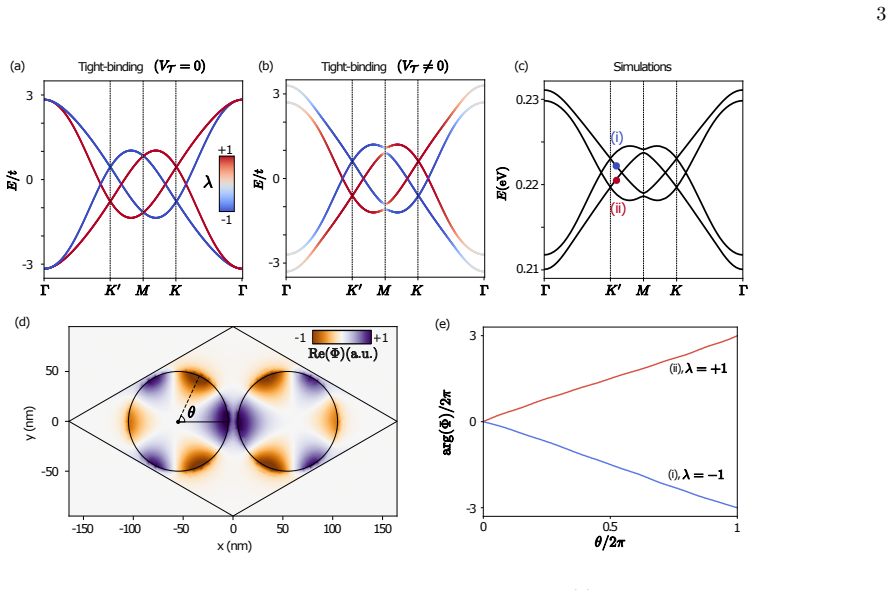
The central claim is that a combination of a synthetic time-reversal symmetry $T = i\sigma_z s_y K$ (with $T^2 = -1$), inversion symmetry $P = \sigma_x$, and particle-hole symmetry $C = s_x K$ enforces nodal lines enclosing the $K$ and $K'$ points of the honeycomb Brillouin zone. In the low-energy four-band hexapole subspace, the Dirac Hamiltonian is $H_0(\mathbf{q}) = \hbar v(\xi\sigma_x q_x + \sigma_y q_y)s_z$ at valley $\xi = \pm 1$, and the only perturbation that preserves all three symmetries is $V_\xi = \xi\Delta\,\sigma_z\, \mathbf{s}\cdot\hat{\mathbf{v}}$, which commutes with $H_0$. Because $V_\xi$ commutes with $H_0$, the eigenstates of $\sigma_z s_y$ stay eigenstates of the full Hamiltonian, and the two Dirac cones (one in each sector labeled $\lambda = \pm 1$) are shifted by $\pm\Delta$ in energy rather than gapped; their crossing at zero energy is a dispersionless nodal loop. The perturbation is realized physically as an effective second-neighbor coupling $V(k) = t_S[\sum_l \sin(k\cdot a'_l)]\,\sigma_z s_y$ between hexapole modes of opposite synthetic spin, mediated by quadrupole and octupole modes that enter only through a projection onto the low-energy hexapole subspace. Full-wave simulations confirm the zero-energy crossings along high-symmetry lines and along paths at $\theta = 15^\circ$, $30^\circ$, and $45^\circ$ from the KM line, with the two crossing bands carrying opposite $\lambda$ values. Weakly breaking $T$ by making the nearest-neighbor hopping magnitudes unequal lifts the paired degeneracies at $\Gamma$ and $M$ but preserves the nodal loops, while a Kekulé distortion that folds $K$ and $K'$ onto the superlattice $\Gamma$ point mixes the valleys and, for sufficient strength, fully gaps the nodal loops.
Load-bearing premise
The derivation assumes the low-energy band structure is governed exactly by the two degenerate hexapole modes of each disk, with every other mode (dipole, quadrupole, octupole) entering only through the effective second-neighbor term; if those modes couple at first order, or the two hexapole modes are not exactly degenerate, the symmetry classification of perturbations and the protection of the nodal loop no longer follow.
Editorial extensions
If this is right
- Nodal lines can be realized in two-dimensional photonic platforms without engineering nonsymmorphic symmetries; any resonator lattice with a doubly degenerate localized mode sharing the lattice's rotational symmetry is a candidate.
- The nodal loops survive weak breaking of the synthetic time-reversal and inversion symmetries, so small disorder in the disk hopping amplitudes will not gap the crossings — only a perturbation outside the allowed classification can.
- Introducing a Kekulé distortion turns the nodal loop into a fully gapped band structure whose band edge has a Mexican-hat shape with zero group velocity in all directions, suggesting slow light and an enhanced optical density of states, with the gap frequency tunable through the distortion strength.
- The construction transfers to other platforms with multipolar localized electromagnetic or mechanical modes, such as surface phonon polariton resonators, giving phononic analogues of the same nodal-loop physics.
Reading between the lines
- Editorial extension: the paper's mechanism reduces to a commuting-versus-anti-commuting dichotomy for symmetry-allowed perturbations; this suggests a general design rule — engineering the representation of time-reversal (here the extra $\sigma_z$ in $T$ is forced by the opposite-sign couplings of the two synthetic spins) decides whether a Dirac node opens a gap or blooms into a nodal loop.
- Editorial extension: the protection argument depends on all non-hexapole modes entering only through the projected second-neighbor term; a direct stress test is to compute whether dipole or quadrupole modes acquire first-order couplings as the disk spacing shrinks, which would predict a small gap opening at the loop.
- Editorial extension: the paper identifies the Mexican-hat band edge from the gapped nodal loop but does not quantify the optical response near it; computing the Purcell factor or the group-velocity dispersion at that band edge would show whether the predicted slow light is practically usable in a plasmonic device.
Signed reviews
Editorial analysis
A structured set of objections, weighed in public.
Referee Report
Summary. This manuscript studies a honeycomb lattice of metallic nanodisks whose doubly degenerate hexapole modes form a four-band model with sublattice (σ) and synthetic-spin (s) degrees of freedom. The authors derive a low-energy Dirac Hamiltonian, classify symmetry-allowed perturbations under synthetic time-reversal T = iσz syK, inversion P = σx, and particle-hole C = sxK, and show that the only term allowed by all three symmetries is Vξ = ξΔ σz s·v̂, which shifts the two Dirac cones and creates a zero-energy nodal loop around K and K′. They construct a tight-binding model with an effective second-neighbor coupling V(k) ∝ σz sy, verify the nodal loop in full-wave COMSOL simulations along high-symmetry and off-symmetry paths, and show that a Kekulé distortion gaps the loop, producing a Mexican-hat band edge and a DOS peak.
Significance. If established, the result is a useful example of symmetry-enforced nodal lines in a photonic platform without nonsymmorphic symmetries, and the Kekulé-gapped Mexican-hat band may be relevant to slow-light applications. The paper's strengths are the systematic Dirac-matrix enumeration in SI S1, the explicit tight-binding derivation, and the independent full-wave verification of crossings on several paths. The main weaknesses are the overbroad robustness claim in the abstract and the absence of a quantitative match between tight-binding parameters and the simulated spectra, both of which need to be addressed before the paper can be recommended for publication.
major comments (3)
- [Abstract; Tight-binding model, Eq. (4)] The claim that the nodal lines survive weak T-breaking is stated too broadly. I checked the chiral-basis determinant for the specific perturbation VT in Eq. (4): with a = δt/2 and u = f + ig, the off-diagonal block is DT = [[iΔ, (a−t)u], [(t+a)u*, iΔ]], so det DT = −Δ² + (t²−a²)|u|². This is real, and the zero-energy loop indeed survives. However, this is a special property of the particular VT, which shares the same k-space structure as H0 and preserves the residual chiral (TC) symmetry. A different T-breaking term with the opposite sign of the g(k)σy piece, e.g. a(f σx + g σy)s0, gives det DT = −Δ² + (t²−a²)|u|² + 2 i a t Im(u²), which is generically complex and reduces the nodal loop to point nodes. The manuscript should therefore qualify the robustness statement: arbitrary weak T-breaking does not necessarily preserve the loop, and the authors should state explicitly that the protection relies on the special form of VT (equivalently, on the residual chiral symmetry) rather than on T alone.
- [Tight-binding model and simulation results; Figs. 2 and 3] The full-wave simulations are presented as verification of the nodal loop, but no quantitative comparison is made between the tight-binding parameters and the simulated spectra. The values of t_S/t and δt/t used in Figs. 2a, 2b, and 3a are not reported, the tight-binding energy axis is not matched to the COMSOL frequency axis, and the simulated δt is not extracted from the observed Kramers splitting at Γ and M. Without such a comparison, the COMSOL crossings on the θ = 15°, 30°, and 45° paths could be accidental or could arise from a regime different from the one described by the model. The authors should provide the parameter values, a direct overlay or frequency calibration, and, if possible, a prediction of the loop radius that is checked against the simulations.
- [SI S2, Schrieffer-Wolff projection] The derivation of the effective second-neighbor coupling V(k) relies on projecting out quadrupole and octupole modes, but the Schrieffer-Wolff transformation is described in a single sentence and no explicit matrix elements Wμν or smallness parameter are given. Since the four-band hexapole subspace is the basis for the entire T,P,C classification, the validity of this projection is load-bearing. I recommend adding the explicit form of the inter-orbital couplings, the energy denominators, and a numerical or analytical check that the projected low-energy Hamiltonian reproduces the simulated band structure to the quoted accuracy.
minor comments (4)
- [Tight-binding model and simulation results] The text states that 'Kramer's degeneracies are evident in the tight-binding band structure shown in fig. 1a'; this should refer to Fig. 2a, not Fig. 1a.
- [Continuum model and symmetries] Equation (1) uses ℏv and q without defining the Dirac velocity v in terms of the lattice parameters; adding the relation v = √3 t a/(2ℏ) or its equivalent would make the continuum-to-tight-binding connection explicit.
- [Methods/COMSOL] The Methods section does not report the mesh size, the number of eigenmodes computed, or the convergence criterion for the band crossings; adding these details would strengthen the full-wave verification.
- [Kekulé distortion] The statement that moving all disks toward the center of the Kekulé unit cell 'will have the same effect as the modulation shown in fig. 4a' deserves a brief justification, since the relation between physical displacement and the three bond strengths t1, t2, t3 is not derived.
Circularity Check
No significant circularity: the nodal-line result is derived from the model symmetries and independently confirmed by full-wave simulation, with no parameter fitted to the predicted crossing.
full rationale
The derivation is self-contained. The paper starts from the physical mode structure of doubly degenerate hexapole modes with opposite-sign nearest-neighbor couplings (t+ = -t-), which yields H0 = t(fσx - gσy)sz. The synthetic symmetries T=iσzsyK, P=σx, and C=sxK are defined as symmetries of this Hamiltonian, and S1 classifies the symmetry-allowed perturbations via Clifford algebra; the unique term Vξ=ξΔσz s·v is shown to commute with H0, shifting the two Dirac cones and producing a zero-energy nodal loop. This is a genuine derivation, not a fit: no parameter is adjusted to produce the crossing, and the form of V is independently obtained in the tight-binding model from a Schrieffer-Wolff inter-orbital projection. The central prediction is checked against full-wave COMSOL simulations of a concrete Drude-disk honeycomb lattice, including off-symmetry paths (θ=15°, 30°, 45°), with no fitted parameters. A reviewer concern that the T-breaking perturbation VT generically gaps the loop is not borne out: in the chiral basis A=σzsz the off-diagonal block remains D=[[iΔ, (a-t)U],[(t+a)U*, iΔ]] with det D=-Δ²+(t²-a²)|U|², a single real condition, so the loop survives. The only self-citation is to the authors' previous synthetic-spin plasmonic model [29], which supplies the starting tight-binding mapping; it does not contain the nodal-line result and is not used to forbid alternatives, so it is not load-bearing. No circular step satisfying the quoted-equation standard was found.
Assumptions & free parameters
free parameters (3)
- t_S/t ratio (effective second-neighbor to nearest-neighbor coupling) =
not specified; chosen for illustration in tight-binding figures
- δt/t (time-reversal breaking strength) =
not specified; chosen for illustration in fig 2b
- Kekulé distortion strength =
2 nm inward shift per disk
assumptions (4)
- domain assumption The two hexapole modes per disk form a doubly degenerate synthetic spin and have nearest-neighbor hopping amplitudes of opposite sign and equal magnitude in the ideal lattice.
- domain assumption All non-hexapole multipole modes appear only as virtual states, so the inter-orbital physics reduces to a single effective second-neighbor term V(k) ∝ σz sy via a Schrieffer-Wolff projection.
- domain assumption The synthetic time-reversal T = iσz syK with T^2 = -1, inversion P = σx, and particle-hole C = sxK are exact symmetries of the lossless plasmonic lattice.
- standard math The 16-term Clifford algebra enumeration of symmetry-allowed perturbations is complete and correct.
invented entities (3)
-
Synthetic spin doublet (ψ+3, ψ-3 hexapole modes)
independent evidence
-
Synthetic time-reversal operator T = iσz syK
-
Particle-hole (chiral) symmetry C = sxK
Cite this review
Pith. "Pith review of Nodal lines in a honeycomb plasmonic crystal with synthetic spin." pith.science (2026). https://pith.science/paper/DJFLIP5P
@misc{pith2026250200932,
  author       = {Pith},
  title        = {Pith review of: Nodal lines in a honeycomb plasmonic crystal with synthetic spin},
  year         = {2026},
  howpublished = {\url{https://pith.science/paper/DJFLIP5P}},
  note         = {Machine review of arXiv:2502.00932}
}
abstract
We analyze a plasmonic model on a honeycomb lattice of metallic nanodisks that hosts nodal lines protected by local symmetries. Using both continuum and tight-binding models, we show that a combination of a synthetic time-reversal symmetry, inversion symmetry, and particle-hole symmetry enforce the existence of nodal lines enclosing the $\mathrm{K}$ and $\mathrm{K}'$ points. The nodal lines are not directly gapped even when these symmetries are weakly broken. The existence of the nodal lines is verified using full-wave electromagnetic simulations. We also show that the degeneracies at nodal lines can be relieved by introducing a Kekul\'e distortion that acts to mix the nodal lines near the $\mathrm{K},\mathrm{K}'$ points. Our findings open pathways for designing novel plasmonic and photonic devices without reliance on complex symmetry engineering, presenting a convenient platform for studying nodal structures in two-dimensional systems.
Figures


Reference graph
Works this paper leans on
-
[1]
Weyl and Dirac semimetals in three-dimensional solids,
N. P. Armitage, E. J. Mele, and Ashvin Vishwanath, “Weyl and Dirac semimetals in three-dimensional solids,” Rev. Mod. Phys. 90, 015001 (2018), arXiv:1705.01111
arXiv 2018
-
[2]
The electronic proper- ties of graphene,
A. H. Castro Neto, F. Guinea, N. M. R. Peres, K. S. Novoselov, and A. K. Geim, “The electronic proper- ties of graphene,” Rev. Mod. Phys. 81, 109–162 (2009), arXiv:0709.1163
arXiv 2009
-
[3]
(b) Folding of the nodal lines at K, K′ of the honeycomb lattice onto the Γ point
su- percell and the colored bonds represent the modulated nearest neighbor coupling strengths. (b) Folding of the nodal lines at K, K′ of the honeycomb lattice onto the Γ point. The solid black line represents the BZ of the superlattice while the solid gray line is the BZ of the original honeycomb lat- tice. Red dashed lines represent the overlapped nodal...
-
[4]
Xiangang Wan, Ari M. Turner, Ashvin Vishwanath, and Sergey Y. Savrasov, “Topological semimetal and Fermi- arc surface states in the electronic structure of pyrochlore iridates,” Phys. Rev. B 83, 205101 (2011)
work page 2011
-
[5]
Discovery of a Weyl Fermion Semimetal and Topological Fermi Arcs
Su Yang Xu, Ilya Belopolski, Nasser Alidoust, Mad- hab Neupane, Guang Bian, Chenglong Zhang, Raman Sankar, Guoqing Chang, Zhujun Yuan, Chi Cheng Lee, Shin Ming Huang, Hao Zheng, Jie Ma, Daniel S. Sanchez, Bao Kai Wang, Arun Bansil, Fangcheng Chou, Pavel P. Shibayev, Hsin Lin, Shuang Jia, and M. Za- hid Hasan, “Discovery of a Weyl fermion semimetal and top...
work page Pith review arXiv 2015
-
[6]
Topolog- ical nodal semimetals,
A. A. Burkov, M. D. Hook, and Leon Balents, “Topolog- ical nodal semimetals,” Phys. Rev. B 84, 235126 (2011), arXiv:1110.1089
arXiv 2011
-
[7]
Chern semi-metal and Quantized Anomalous Hall Effect in HgCr2Se4
Gang Xu, Hongming Weng, Zhijun Wang, Xi Dai, and Zhong Fang, “Chern semi-metal and Quantized Anoma- lous Hall Effect in HgCr2Se4,” Phys. Rev. Lett. 107, 186806 (2011), arXiv:1106.3125
work page Pith review arXiv 2011
-
[8]
Topological nodal line semimetals with and without spin-orbital coupling
Chen Fang, Yige Chen, Hae-Young Kee, and Liang Fu, “Topological nodal line semimetals with and without spin-orbital coupling,” Phys. Rev. B 92, 081201 (2015), arXiv:1506.03449
work page Pith review arXiv 2015
Show all 44 references
-
[9]
Dirac Semimet- als in Two Dimensions,
Steve M. Young and Charles L. Kane, “Dirac Semimet- als in Two Dimensions,” Phys. Rev. Lett. 115, 126803 (2015), arXiv:1504.07977
2015 arXiv
-
[10]
Dirac cone protected by non- symmorphic symmetry and three-dimensional Dirac line node in ZrSiS,
Leslie M. Schoop, Mazhar N. Ali, Carola Straßer, An- dreas Topp, Andrei Varykhalov, Dmitry Marchenko, Vi- ola Duppel, Stuart S. P. Parkin, Bettina V. Lotsch, and Christian R. Ast, “Dirac cone protected by non- symmorphic symmetry and three-dimensional Dirac line node in ZrSiS,...
2016
-
[11]
Topo- logical nodal-line fermions in spin-orbit metal PbTaSe2,
Guang Bian, Tay-Rong Chang, Raman Sankar, Su-Yang Xu, Hao Zheng, Titus Neupert, Ching-Kai Chiu, Shin- Ming Huang, Guoqing Chang, Ilya Belopolski, Daniel S. Sanchez, Madhab Neupane, Nasser Alidoust, Chang Liu, BaoKai Wang, Chi-Cheng Lee, Horng-Tay Jeng, Chen- glong Zhang, Zhuju...
2016
-
[12]
Drumhead Surface States and Topological Nodal-Line Fermions in TlTaSe2,
Guang Bian, Tay-Rong Chang, Hao Zheng, Saa- vanth Velury, Su-Yang Xu, Titus Neupert, Ching-Kai Chiu, Daniel S. Sanchez, Ilya Belopolski, Nasser Ali- doust, Peng-Jen Chen, Guoqing Chang, Arun Ban- sil, Horng-Tay Jeng, Hsin Lin, and M. Zahid Hasan, 6 “Drumhead Surface States and...
2015 arXiv
-
[13]
Experimental realization of two-dimensional Dirac nodal line fermions in monolayer Cu2Si,
Baojie Feng, Botao Fu, Shusuke Kasamatsu, Suguru Ito, Peng Cheng, Cheng-Cheng Liu, Ya Feng, Shilong Wu, Sanjoy K. Mahatha, Polina Sheverdyaeva, Paolo Moras, Masashi Arita, Osamu Sugino, Tai-Chang Chiang, Kenya Shimada, Koji Miyamoto, Taichi Okuda, Kehui Wu, Lan Chen, Yugui Yao...
2017
-
[14]
Nodal surface semimetals: Theory and ma- terial realization,
Weikang Wu, Ying Liu, Si Li, Chengyong Zhong, Zhi- Ming Yu, Xian-Lei Sheng, Y. X. Zhao, and Shengyuan A. Yang, “Nodal surface semimetals: Theory and ma- terial realization,” Phys. Rev. B 97, 115125 (2018), arXiv:1712.09773
2018 arXiv
-
[15]
Discovery of Higher-Order Nodal Surface Semimet- als,
Huahui Qiu, Yuzeng Li, Qicheng Zhang, and Chunyin Qiu, “Discovery of Higher-Order Nodal Surface Semimet- als,” Phys. Rev. Lett. 132, 186601 (2024)
2024
-
[16]
Dirac Line Nodes in Inversion- Symmetric Crystals,
Youngkuk Kim, Benjamin J. Wieder, C. L. Kane, and Andrew M. Rappe, “Dirac Line Nodes in Inversion- Symmetric Crystals,” Phys. Rev. Lett. 115, 036806 (2015), arXiv:1504.03807
2015 arXiv
-
[17]
Topological Node-Line Semimetal and Dirac Semimetal State in Antiperovskite Cu3PdN,
Rui Yu, Hongming Weng, Zhong Fang, Xi Dai, and Xiao Hu, “Topological Node-Line Semimetal and Dirac Semimetal State in Antiperovskite Cu3PdN,” Phys. Rev. Lett. 115, 3–7 (2015), arXiv:1504.04577
2015 arXiv
-
[18]
Nodal-chain metals,
Tom´ aˇ s Bzduˇ sek, Quan Sheng Wu, Andreas R¨ uegg, Man- fred Sigrist, and Alexey A. Soluyanov, “Nodal-chain metals,” Nature 538, 75–78 (2016), arXiv:1604.03112
2016 arXiv
-
[19]
From Nodal Chain Semimetal to Weyl Semimetal in HfC,
Rui Yu, Quansheng Wu, Zhong Fang, and Hong- ming Weng, “From Nodal Chain Semimetal to Weyl Semimetal in HfC,” Phys. Rev. Lett.119, 036401 (2017), arXiv:1701.08502
2017 arXiv
-
[20]
Topological Hopf and Chain Link Semimetal States and Their Application to Co 2MnGa,
Guoqing Chang, Su-Yang Xu, Xiaoting Zhou, Shin-Ming Huang, Bahadur Singh, Baokai Wang, Ilya Belopolski, Jiaxin Yin, Songtian Zhang, Arun Bansil, Hsin Lin, and M. Zahid Hasan, “Topological Hopf and Chain Link Semimetal States and Their Application to Co 2MnGa,” Phys. Rev. Lett....
2017
-
[21]
Nodal-link semimet- als,
Zhongbo Yan, Ren Bi, Huitao Shen, Ling Lu, Shou- Cheng Zhang, and Zhong Wang, “Nodal-link semimet- als,” Phys. Rev. B 96, 041103 (2017), arXiv:1704.00655
2017 arXiv
-
[22]
Topological semimetals carrying arbi- trary Hopf numbers: Fermi surface topologies of a Hopf link, Solomon’s knot, trefoil knot, and other linked nodal varieties,
Motohiko Ezawa, “Topological semimetals carrying arbi- trary Hopf numbers: Fermi surface topologies of a Hopf link, Solomon’s knot, trefoil knot, and other linked nodal varieties,” Phys. Rev. B 96, 041202 (2017)
2017
-
[23]
Nodal-knot semimetals,
Ren Bi, Zhongbo Yan, Ling Lu, and Zhong Wang, “Nodal-knot semimetals,” Phys. Rev. B 96, 201305 (2017), arXiv:1704.06849
2017 arXiv
-
[24]
Dirac-like Plasmons in Honeycomb Lattices of Metallic Nanoparticles,
Guillaume Weick, Claire Woollacott, William L. Barnes, Ortwin Hess, and Eros Mariani, “Dirac-like Plasmons in Honeycomb Lattices of Metallic Nanoparticles,” Phys. Rev. Lett. 110, 106801 (2013), arXiv:1209.5005
2013 arXiv
-
[25]
Weyl points and line nodes in gyroid photonic crystals,
Ling Lu, Liang Fu, John D. Joannopoulos, and Marin Soljacic, “Weyl points and line nodes in gyroid photonic crystals,” Nat. Photonics 7, 294–299 (2013)
2013
-
[26]
Photonic Weyl point in a two-dimensional resonator lat- tice with a synthetic frequency dimension,
Qian Lin, Meng Xiao, Luqi Yuan, and Shanhui Fan, “Photonic Weyl point in a two-dimensional resonator lat- tice with a synthetic frequency dimension,” Nat. Com- mun. 7, 13731 (2016)
2016
-
[27]
Ob- servation of Hourglass Nodal Lines in Photonics,
Lingbo Xia, Qinghua Guo, Biao Yang, Jiaguang Han, Chao Xing Liu, Weili Zhang, and Shuang Zhang, “Ob- servation of Hourglass Nodal Lines in Photonics,” Phys. Rev. Lett. 122, 103903 (2019)
2019
-
[28]
Experimental observation of photonic nodal line degeneracies in metacrystals,
Wenlong Gao, Biao Yang, Ben Tremain, Hongchao Liu, Qinghua Guo, Lingbo Xia, Alastair P. Hibbins, and Shuang Zhang, “Experimental observation of photonic nodal line degeneracies in metacrystals,” Nat. Commun. 9, 950 (2018)
2018
-
[29]
Line nodes, Dirac points, and Lif- shitz transition in two-dimensional nonsymmorphic pho- tonic crystals,
Jun Yu Lin, Nai Chao Hu, You Jian Chen, Ching Hua Lee, and Xiao Zhang, “Line nodes, Dirac points, and Lif- shitz transition in two-dimensional nonsymmorphic pho- tonic crystals,” Phys. Rev. B 96, 075438 (2017)
2017
-
[31]
Polarization- Orthogonal Nondegenerate Plasmonic Higher-Order Topological States,
Yuanzhen Li, Su Xu, Zijian Zhang, Yumeng Yang, Xin- rong Xie, Wenzheng Ye, Feng Liu, Haoran Xue, Liqiao Jing, Zuojia Wang, Qi-Dai Chen, Hong-Bo Sun, Erp- ing Li, Hongsheng Chen, and Fei Gao, “Polarization- Orthogonal Nondegenerate Plasmonic Higher-Order Topological States,” Ph...
2023
-
[32]
Electron Fractionalization in Two-Dimensional Graphenelike Structures,
Chang-Yu Hou, Claudio Chamon, and Christopher Mudry, “Electron Fractionalization in Two-Dimensional Graphenelike Structures,” Phys. Rev. Lett. 98, 186809 (2007)
2007
-
[33]
Imaging chiral symmetry breaking from Kekul´ e bond order in graphene,
Christopher Guti´ errez, Cheol Joo Kim, Lola Brown, Theanne Schiros, Dennis Nordlund, Edward B. Lochocki, Kyle M. Shen, Jiwoong Park, and Abhay N. Pasupathy, “Imaging chiral symmetry breaking from Kekul´ e bond order in graphene,” Nat. Phys. 12, 950–958 (2016)
2016
-
[34]
Valley-momentum locking in a graphene superlattice with Y-shaped Kekul´ e bond texture,
O. V. Gamayun, V. P. Ostroukh, N. V. Gnezdilov, ˙I Adagideli, and C W J Beenakker, “Valley-momentum locking in a graphene superlattice with Y-shaped Kekul´ e bond texture,” New J. Phys. 20, 023016 (2018), arXiv:1708.08348
2018 arXiv
-
[35]
Experimen- tal Evidence of Chiral Symmetry Breaking in Kekul´ e- Ordered Graphene,
Changhua Bao, Hongyun Zhang, Teng Zhang, Xi Wu, Laipeng Luo, Shaohua Zhou, Qian Li, Yanhui Hou, Wei Yao, Liwei Liu, Pu Yu, Jia Li, Wenhui Duan, Hong Yao, Yeliang Wang, and Shuyun Zhou, “Experimen- tal Evidence of Chiral Symmetry Breaking in Kekul´ e- Ordered Graphene,” Phys. R...
2021 arXiv
-
[36]
Plasmonics in graphene at infrared frequencies,
Marinko Jablan, Hrvoje Buljan, and Marin Soljaˇ ci´ c, “Plasmonics in graphene at infrared frequencies,” Phys. Rev. B 80, 245435 (2009), arXiv:0910.2549
2009 arXiv
-
[37]
Graphene plasmonics for terahertz to mid-infrared applications,
Tony Low and Phaedon Avouris, “Graphene plasmonics for terahertz to mid-infrared applications,” ACS Nano 8, 1086–1101 (2014), arXiv:1403.2799
2014 arXiv
-
[38]
Graphene plasmonics: Chal- lenges and opportunities,
F. Javier Garc´ ıa De Abajo, “Graphene plasmonics: Chal- lenges and opportunities,” ACS Photonics 1, 133–152 (2014), arXiv:1402.1969
2014 arXiv
-
[39]
Tunable infrared plasmonic devices using graphene/insulator stacks,
Hugen Yan, Xuesong Li, Bhupesh Chandra, George Tulevski, Yanqing Wu, Marcus Freitag, Wenjuan Zhu, Phaedon Avouris, and Fengnian Xia, “Tunable infrared plasmonic devices using graphene/insulator stacks,” Nat. Nanotechnol. 7, 330–334 (2012), arXiv:1202.5235
2012 arXiv
-
[40]
Uni- form circular disks with synthetically tailorable diam- eters: Two-dimensional nanoparticles for plasmonics,
Matthew N. O’Brien, Matthew R. Jones, Kevin L. Kohlstedt, George C. Schatz, and Chad A. Mirkin, “Uni- form circular disks with synthetically tailorable diam- eters: Two-dimensional nanoparticles for plasmonics,” Nano Lett. 15, 1012–1017 (2015)
2015
-
[41]
Spectral Tuning of 7 Localized Surface Phonon Polariton Resonators for Low- Loss Mid-IR Applications,
Yiguo Chen, Yan Francescato, Joshua D. Caldwell, Vin- cenzo Giannini, Tobias W.W. Ma, Orest J. Glembocki, Francisco J. Bezares, Thomas Taubner, Richard Kasica, Minghui Hong, and Stefan A. Maier, “Spectral Tuning of 7 Localized Surface Phonon Polariton Resonators for Low- Loss ...
2014
-
[42]
Sub-diffractional volume-confined polaritons in the natural hyperbolic material hexagonal boron ni- tride,
Joshua D. Caldwell, Andrey V. Kretinin, Yiguo Chen, Vincenzo Giannini, Michael M. Fogler, Yan Francescato, Chase T. Ellis, Joseph G. Tischler, Colin R. Woods, Alexander J. Giles, Minghui Hong, Kenji Watanabe, Takashi Taniguchi, Stefan A. Maier, and Kostya S. Novoselov, “Sub-di...
2014 arXiv
-
[43]
Z2 Topological Order and the Quantum Spin Hall Effect,
C. L. Kane and E. J. Mele, “Z2 Topological Order and the Quantum Spin Hall Effect,” Phys. Rev. Lett. 95, 146802 (2005)
2005
-
[44]
Helical boundary modes from synthetic spin in a plasmonic lattice,
Sang Hyun Park, Michael Sammon, E J Mele, and Tony Low, “Helical boundary modes from synthetic spin in a plasmonic lattice,” Phys. Rev. B 109, L161301 (2024)
2024
-
[45]
Infrared Topological Plasmons in Graphene,
Dafei Jin, Thomas Christensen, Marin Soljaˇ ci´ c, Nicholas X. Fang, Ling Lu, and Xiang Zhang, “Infrared Topological Plasmons in Graphene,” Phys. Rev. Lett. 118, 245301 (2017). 6
2017
Reviewed August 9, 2026 · model on record in the stance chip above.
Discussion (0). Continue with ORCID to comment.