REVIEW 3 major objections 5 minor 66 references
Fabrication and characterization of shape- and topology-optimized optical cavities with deep sub-wavelength confinement for interfacing with colloidal quantum dots
T0 review · 3 major / 5 minor · reviewed 2026-08-09 · deepseek-v4-flash
Pith's one-line read This paper shows that a combined shape- and topology-optimization method yields manufacturable photonic-crystal nanocavities that confine light in air gaps as small as 6 nm, with simulated mode volumes as low as $0.043…
desk verdict A solid design-to-fabrication paper with a real methodological contribution; the unquantified Q gap and unmeasured mode volume keep the deep-subwavelength claim at the level of validated simulation rather than direct experiment. read the letter →
The pith
A machine-rendered reading of the paper's core claim, the machinery that carries it, and where it could break.
The reading
What carries the argument
The central machinery is the combined shape- and topology-optimization scheme applied to a two-dimensional photonic crystal cavity. Topology optimization in the central region, with a minimum feature resolution as small as 1 nm near the center, freely redistributes dielectric material to maximize the field intensity in a central air target; shape optimization deforms the surrounding holes' boundaries to tune the quality factor. Length-scale and connectivity constraints keep the resulting blueprint fabricable. The analysis uses quasinormal modes (leaky resonator solutions with complex frequencies) to compute the mode volume and single-mode Purcell factor, and it validates the single-mode approximation by comparing it with an independent reference calculation.
What would settle it
Measure the Purcell-enhanced decay rate of a single quantum dot placed in the gap of a fabricated cavity by time-resolved photoluminescence and compare it with the rate predicted from the simulated mode volume; a measured enhancement several times smaller than the prediction would show the fabricated devices do not confine light as strongly as the blueprint.
Extended reading notes
Core claim
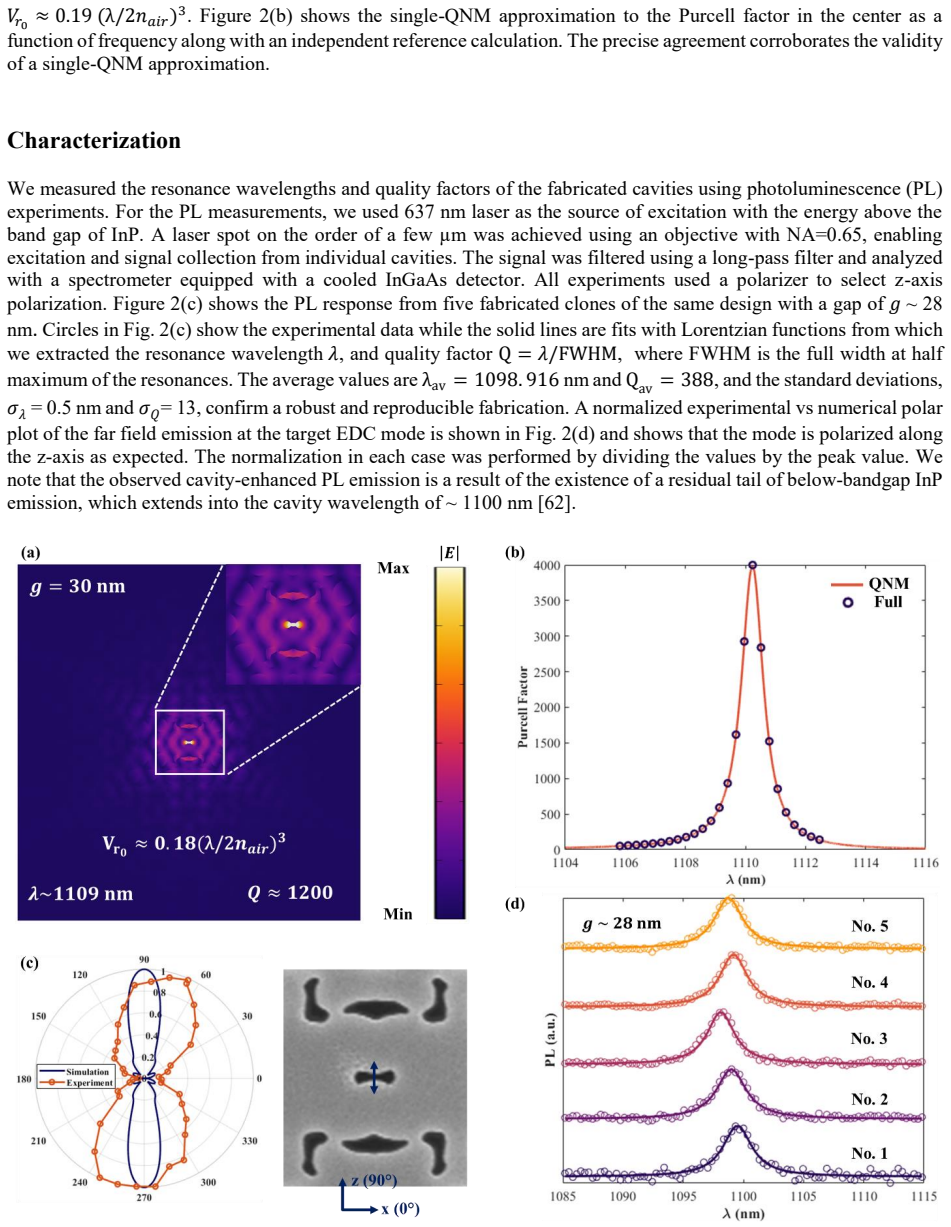
The central claim is that a hybrid shape-plus-topology optimization—where the photonic crystal holes away from the center are reshaped while the central region (about 5 percent of the footprint) is freely re-designed under a 1–5 nm resolution—can push the confined electric field into an air gap while keeping the device fabricable. On the blueprint, the optimized cavity has a resonance near 1110 nm, Q about 1245, and an effective mode volume of about $0.19 (\lambda/2n_{\mathrm{air}})^3$ at a 30 nm gap, and shrinking the gap uniformly to 6 nm reduces the mode volume to about $0.043 (\lambda/2n_{\mathrm{air}})^3$ while increasing Q. Experimentally, five nominally identical cavities with about 28 nm gaps show reproducible photoluminescence resonances with average wavelength 1098.9 nm and average Q 388. The paper also reports that a cavity with spin-coated Ag2S quantum dots shows a resonance shift and linewidth narrowing that exceed the measured clone-to-clone spread, and it interprets this as evidence of interaction between the dots and the cavity field, while explicitly refraining from strong conclusions about the coupling regime.
Load-bearing premise
The central claim assumes that the simulated mode volumes and Purcell enhancements for the idealized designs hold for the real fabricated cavities, even though the measured quality factors are about three times lower than predicted and the wavelength shifts with gap size are smaller than simulated.
Editorial extensions
If this is right
- If the simulated trend persists at smaller gaps, shrinking the air gap from 30 nm to 6 nm lowers the mode volume from $0.19$ to $0.043 (\lambda/2n_{\mathrm{air}})^3$ while Q increases, so the Purcell enhancement grows.
- The fabrication yield is high enough that clones of the same design differ by only about 0.5 nm in resonance wavelength and 13 in quality factor, making statistical cavity experiments practical.
- Spin-coating puts multiple colloidal quantum dots near the gap and produces a measurable shift and narrowing of the cavity resonance, though deterministic single-dot placement remains out of reach.
- The hybrid optimization keeps the computational cost manageable for $4.5\lambda \times 4.5\lambda$ footprints, covering a device area that pure topology optimization would struggle to handle.
Reading between the lines
- Inference: Because the measured Q is about three times lower than simulated, the real mode volumes are likely larger than the blueprint values; a direct measurement of the Purcell factor, rather than a resonance linewidth change, would be needed to confirm deep-subwavelength confinement in the fabricated devices.
- Inference: The hybrid shape/topology split is material-agnostic, so the same recipe could be transferred to other membrane platforms such as silicon nitride or gallium arsenide, or to emitters other than colloidal quantum dots, such as molecules or color centers.
- Inference: The observed linewidth narrowing could also arise from spectral filtering by the inhomogeneously broadened quantum-dot ensemble or from a change in the effective index, so a control sample with off-resonant dots or a direct lifetime measurement would test the interaction interpretation.
Editorial analysis
A structured set of objections, weighed in public.
Referee Report
Summary. The paper presents a combined shape- and topology-optimization strategy for designing InP photonic-crystal nanocavities with air gaps down to ~6 nm and simulated mode volumes as low as 0.043 (λ/2n_air)^3. It reports fabrication of cavities with gaps ~28 nm, reproducible photoluminescence resonances (λ_av=1098.9 nm, Q_av=388, σ_λ=0.5 nm, σ_Q=13), qualitative agreement with simulated trends in Q and wavelength when the gap is shrunk, and a preliminary demonstration of spectral shift and linewidth narrowing after spin-coating Ag2S colloidal quantum dots. The authors are careful to label the mode volumes as theoretical and the QD results as preliminary.
Significance. The hybrid optimization approach is a useful contribution: it extends inverse design to larger footprints by restricting topology optimization to a small central region, and the fabrication reproducibility data (σ_λ=0.5 nm) are valuable for practical applications. The single-QNM Purcell factor check in Fig. 2(b) is a good consistency test. However, the experimental Q is roughly a factor of three below simulation, and the deep-subwavelength mode volume is never measured; the central claim therefore rests on simulation combined with an unquantified fabrication-deviation assumption. With added uncertainty analysis or appropriately reframed claims, the work could become a solid demonstration of manufacturable subwavelength cavities.
major comments (3)
- [Characterization / Fig. 4, Table 1] The measured quality factors (Q=381–488 for gaps of 28–13 nm) are roughly three times lower than the simulated Q≈1245 at comparable gaps, and the experimental wavelength shifts with decreasing gap size are smaller than predicted. The sentence attributing these deviations to "minor geometric discrepancies... increasing with shrinkage" is not quantified, and no simulation of likely fabrication errors (e.g., sidewall angle, corner rounding, roughness) is provided. Because Q and mode volume are both sensitive to geometry, the same discrepancies that lower Q by a factor of three are likely to increase V, so the simulated values V=0.19–0.09 (λ/2n_air)^3 for the fabricated gap range are not experimentally validated. The manuscript should either include a quantitative robustness analysis linking plausible geometric deviations to both Q and V, or clearly state that the deep-subwavelength mode volumes are theoretical predictions rather than measured properties of the fabricated devices.
- [Design, fabrication, and modeling / Fig. 3, Fig. 4] The flagship mode volume V=0.043 (λ/2n_air)^3 corresponds to a gap of g=6 nm, but the sample at this gap was lost before PL measurements (Fig. 4 caption). Moreover, the smaller experimental wavelength shifts with decreasing gap indicate that the realized geometries deviate increasingly from the blueprints as the gap shrinks. Consequently, the g=6 nm prediction is an extrapolation into an unvalidated regime and should be presented as such; the current wording in the conclusions is acceptable, but the abstract and title should not imply that this deep-subwavelength value was demonstrated experimentally.
- [Interfacing with colloidal QDs / Fig. 5] The evidence for QD–cavity interaction rests on a single pair of measurements (one cavity with QDs, one without), with no repeated samples, no off-resonance control, and no measurement of the bare QD contribution at the cavity wavelength. While the authors explicitly refrain from strong claims, the conclusion that the shift and narrowing are "consistent with a weakly coupled QD-cavity system" is not uniquely supported; a local refractive-index change from the QD layer or absorption-induced linewidth changes could also produce similar signatures. Additional control experiments or a more cautious interpretation are needed before the proof-of-principle claim is fully supported.
minor comments (5)
- [Conclusions] The quoted initial values for the 30 nm gap are λ=1113 nm and Q~1257, whereas Section 2 reports λ~1110 nm and Q~1245; these numbers should be reconciled.
- [Fig. 4 caption] The caption says "PL spectrum of five cavities with different gap sizes," but the text and Table 1 present seven spectra (g=28, 24, 22, 18, 13, and two g=0 cavities); please clarify the count.
- [Introduction] The term "manufactural" should be "manufacturable"; there are also minor formatting issues in some references (e.g., Ref. 15 missing a space).
- [Design, fabrication, and modeling] The mode-volume normalization is cited to Ref. [61], but stating the explicit definition of V used in this work would help readers assess comparability with other bowtie-cavity literature.
- [Design, fabrication, and modeling] The convergence study mentioned in the Design section is not shown; adding a brief statement of the mesh and mode-volume convergence would strengthen the numerical claims.
Circularity Check
No load-bearing circularity: optimization, QNM simulation, and PL characterization form an independent chain; self-citations are methodological context only.
full rationale
The paper's main derivation chain is not circular. The design step maximizes the electric-field intensity in a fixed, 15-nm-radius air target under Gaussian plane-wave excitation ('the field intensity |E|2 integrated over a central cylindrical target region with a radius of 15 nm in the device layer was maximized'), while the reported quantities—resonance wavelength, Q, and effective mode volume—are computed after optimization from the resulting quasinormal mode; mode volume is an output, not the optimized objective, so there is no self-definitional identity. The single-QNM approximation is validated internally by comparison with an independent reference calculation, and the fabricated-device comparison uses measured PL spectra (Lorentzian fits to resonance wavelength and Q) that are not fitted parameters of the design. The experimental validation is genuinely external to the optimization, even though it is quantitative only for Q and wavelength: measured Q is about three times lower than simulation and mode volume is not measured, and the paper itself flags 'minor geometric discrepancies between blueprints and realized devices increasing with shrinkage' and, for the QD result, 'due to lack of reference measurements on different samples, we refrain from drawing strong conclusions'. These are acknowledged validation gaps, not circular reductions. The paper does cite the authors' earlier work (Refs. 31, 32, 34, 35), but these citations provide the optimization framework and comparative context; they do not substitute for the present fabrication and PL evidence. No quotable equation-level circular step can be identified.
Assumptions & free parameters
free parameters (1)
- Central target region radius =
15 nm (chosen)
assumptions (4)
- standard math Maxwell's equations with time-harmonic fields and radiation boundary conditions
- domain assumption Single-quasinormal-mode approximation of the Purcell factor
- standard math Effective mode volume defined via QNM normalization (Ref 61)
- domain assumption Fabricated geometry approximates the blueprint closely enough for the simulated Q and V to apply
Cite this review
Pith. "Pith review of Fabrication and characterization of shape- and topology-optimized optical cavities with deep sub-wavelength confinement for interfacing with colloidal quantum dots." pith.science (2026). https://pith.science/paper/3WR2QJQ2
@misc{pith2026250200936,
  author       = {Pith},
  title        = {Pith review of: Fabrication and characterization of shape- and topology-optimized optical cavities with deep sub-wavelength confinement for interfacing with colloidal quantum dots},
  year         = {2026},
  howpublished = {\url{https://pith.science/paper/3WR2QJQ2}},
  note         = {Machine review of arXiv:2502.00936}
}
read the original abstract
We employ a combined shape- and topology-optimization strategy to design manufacturable two-dimensional photonic crystal-based optical nanocavities that confine light to length scales well below the resonance wavelength. We present details of the design strategy as well as scanning electron micrographs of the fabricated indium phosphide cavities with a compact footprint of ~"4.5{\lambda}*4.5{\lambda}" , which feature gaps on the order of 10 nm and theoretical mode volumes in the gap center below (0.1 ({\lambda}/2n_air))^3. Subsequent optical characterization of the far-field emission as well as Purcell-enhanced photoluminescence from the cavities with and without spin-coated colloidal quantum dots are compared to numerical simulations. The results corroborate the potential of the design strategy and fabrication process for ensuring high yield and reliable performance as well as the viability of the material platform for exploring light-matter interaction with colloidal QDs.
Figures


Figures from the paper (1 more)

Reference graph
Works this paper leans on
-
[1]
K. J. Vahala, “Optical microcavities,” Nature (London) 424, 839-846 (2003)
work page 2003
-
[2]
Photonic crystal nanocavity with a Q factor exceeding eleven million,
T. Asano, Y. Ochi, Y. Takahashi, K. Kishimoto, and S. Noda, “Photonic crystal nanocavity with a Q factor exceeding eleven million,” Opt. Express 25, 1769-1777 (2017)
work page 2017
-
[3]
Automated optimization of photonic crystal slab cavities,
M. Minkov, and V. Savona, “Automated optimization of photonic crystal slab cavities,” Sci. Rep. 4, 5124 (2014)
work page 2014
-
[4]
Photonic crystal nanocavity with a Q-factor of ~9 million,
H. Sekoguchi, Y. Takahashi, T. Asano, and S. Noda, “Photonic crystal nanocavity with a Q-factor of ~9 million,” Opt. Express 22, 916–924 (2014)
work page 2014
-
[5]
Spontaneous-emission control by photonic crystals and nanocavities,
S. Noda, M. Fujita, and T. Asano, “Spontaneous-emission control by photonic crystals and nanocavities,” Nat. Photonics 1, 449- 458 (2007)
work page 2007
-
[6]
T. Tanabe, M. Notomi, E. Kuramochi, A. Shinya, and H. Taniyama, “Trapping and delaying photons for one nanosecond in an ultrasmall high-Q photonic-crystal nanocavity,” Nat. Photonics 1, 49-52 (2007)
work page 2007
-
[7]
How to deal with the loss in plasmonics and metamaterials,
J. B. Khurgin, “How to deal with the loss in plasmonics and metamaterials,” Nat. Nanotechnol. 10, 2–6 (2015)
work page 2015
-
[8]
Smallest possible electromagnetic mode volume in a dielectric cavity,
R. Coccioli, M. Boroditsky, K. Kim, Y. Rahmat-Samii, and E. Yablonovitch, “Smallest possible electromagnetic mode volume in a dielectric cavity,” IEE Proc., Optoelectron. 145, 391–397 (1998)
work page 1998
Show all 66 references
-
[9]
Spontaneous emission probabilities at radio frequencies,
E. M. Purcell, “Spontaneous emission probabilities at radio frequencies,” Phys. Rev. 69, 674 (1946)
1946
-
[10]
General properties of local plasmons inmetal nanostructures
F. Wang, and Y. R. Shen, “General properties of local plasmons inmetal nanostructures”. Phys. Rev. Lett. 97, 206806 (2006)
2006
-
[11]
Spontaneous emergence of periodic patterns in a biologically inspired simulation of photonic structures,
A. Gondarenko, S. Preble, J. Robinson, L. Chen, H. Lipson, and M. Lipson, “Spontaneous emergence of periodic patterns in a biologically inspired simulation of photonic structures,” Phys. Rev. Lett. 96(14), 143904 (2006)
2006
-
[12]
Formulation for scalable optimization of microcavities via the frequency-averaged local density of states,
X. Liang, and S. G. Johnson, “Formulation for scalable optimization of microcavities via the frequency-averaged local density of states,” Opt. Express 21, 30812–30841 (2013)
2013
-
[13]
Guiding and confining light in void nanostructure,
V. R. Almeida, Q. Xu, C. A. Barrios, and M. Lipson, “Guiding and confining light in void nanostructure,” Opt. Lett. 29(11), 1209 (2004)
2004
-
[14]
Strong optomechanical coupling in a slotted photonic crystal nanobeam cavity with an ultrahigh quality factor-to-mode volume ratio,
K. Schneider, and P. Seidler, “Strong optomechanical coupling in a slotted photonic crystal nanobeam cavity with an ultrahigh quality factor-to-mode volume ratio,” Opt. Express 24, 13850–13865 (2016)
2016
-
[15]
Design of photonic crystal cavities for extreme light concentration,
S. Hu and S. M. Weiss, “Design of photonic crystal cavities for extreme light concentration,” ACS Photonics 3(9), 1647–1653 (2016)
2016
-
[16]
Self -similar nanocavity design with ultrasmall mode volume for single -photon nonlinearities,
H. Choi, M. Heuck, and D. Englund, “Self -similar nanocavity design with ultrasmall mode volume for single -photon nonlinearities,” Phys. Rev. Lett. 118(22), 223605 (2017)
2017
-
[17]
Ultrasmall mode volumes in dielectric optical microcavities,
J. T. Robinson, C. Manolatou, L. Chen, and M. Lipson, “Ultrasmall mode volumes in dielectric optical microcavities,” Phys. Rev. Lett. 95(14), 143901 (2005)
2005
-
[18]
Two regimes of confinement in photonic nanocavities: bulk confinement versus lightning rods,
M. Albrechtsen, B. V. Lahijani, and S. Stobbe, “Two regimes of confinement in photonic nanocavities: bulk confinement versus lightning rods,” Opt. Express 30(9), 15458 (2022)
2022
-
[19]
Experimental realization of deep-subwavelength confinement in dielectric optical resonators,
S. Hu, M. Khater, R. Salas-Montiel, E. Kratschmer, S. Engelmann, W. M. J. Green, and S. M. Weiss, “Experimental realization of deep-subwavelength confinement in dielectric optical resonators,” Sci. Adv. 4(8), 1 (2018)
2018
-
[20]
Ultra -low mode volume on -substrate silicon nanobeam cavity,
J. Zhou, J. Zheng, Z. Fang, P. Xu, and A. Majumdar, “Ultra -low mode volume on -substrate silicon nanobeam cavity,” Opt. Express 27(21), 30692 (2019)
2019
-
[21]
Modulation response of nanoLEDs and nanolasers exploiting Purcell enhanced spontaneous emission,
T. Suhr, N. Gregersen, K. Yvind, and J. Mørk, “Modulation response of nanoLEDs and nanolasers exploiting Purcell enhanced spontaneous emission,” Opt. Express 18, 11230-11241, (2010)
2010
-
[22]
Squeezing of intensity noise in nanolasers and nanoLEDs with extreme dielectric confinement,
J. Mork and K. Yvind, “Squeezing of intensity noise in nanolasers and nanoLEDs with extreme dielectric confinement,” Optica, 7, 1641-1644, (2020)
2020
-
[23]
Scaling laws of the cavity enhancement for nitrogenvacancy centers in diamond,
H. Kaupp, C. Deutsch, H -C. Chang, J. Reichel, T.W. Hänsch, and D. Hunger, “Scaling laws of the cavity enhancement for nitrogenvacancy centers in diamond,” Phys. Rev. A. 88, 053812 (2013)
2013
-
[24]
Interfacing single photons and single quantum dots with photonic nanostructures,
P. Lodahl, S. Mahmoodian, S. Stobbe, “Interfacing single photons and single quantum dots with photonic nanostructures,” Rev. Mod. Phys. 87, 347–400 (2015)
2015
-
[25]
Cavity quantum electrodynamics with color centers in diamond,
E. Janitz, M. K. Bhaskar, and L. Childress, “Cavity quantum electrodynamics with color centers in diamond,” Optica 7, 1232- 1252 (2020)
2020
-
[26]
Vacuum Rabi splitting in a plasmonic cavity at the single quantum emitter limit,
K. Santhosh, O. Bitton, L. Chuntonov, and G. Haran, “Vacuum Rabi splitting in a plasmonic cavity at the single quantum emitter limit,” Nat. Commun. 7, 11823 (2016)
2016
-
[27]
Real-Time Tunable Strong Coupling: From Individual Nanocavities to Metasurfaces,
J. Huang, A. J. Traverso, G. Yang, and M. H. Mikkelsen, “Real-Time Tunable Strong Coupling: From Individual Nanocavities to Metasurfaces,” ACS Photonics, 6, 838-843 (2019)
2019
-
[28]
Design of an ultra-compact slotted photonic crystal nanobeam cavity for biosensing,
T. Lin, X. Zhang, G. Zhou, C. F. Siong, and J. Deng, “Design of an ultra-compact slotted photonic crystal nanobeam cavity for biosensing,” J. Opt. Soc. Am. B. 32, 1788-1791 (2015)
2015
-
[29]
Topology optimization for nanophotonics,
J. S. Jensen, and O. Sigmund, “Topology optimization for nanophotonics,” Laser Photonics Rev. 5, 308–321 (2011)
2011
-
[30]
Inverse design in nanophotonics,
Molesky, Z. Lin, A. Y. Piggott, W. Jin, J. Vucković, and A. W. Rodriguez, “Inverse design in nanophotonics,” Nat. Photonics 12, 659–670 (2018)
2018
-
[31]
Maximizing the quality factor to mode volume ratio for ultra- small photonic crystal cavities,
F. Wang, R. E. Christiansen, Y. Yu, J. Mørk, and O. Sigmund, “Maximizing the quality factor to mode volume ratio for ultra- small photonic crystal cavities,” Appl. Phys. Lett. 113, 241101 (2018)
2018
-
[32]
Inverse design in photonics by topology optimization: tutorial,
R. E. Christiansen, and O. Sigmund, “Inverse design in photonics by topology optimization: tutorial,” J. Opt. Soc. Am. B. 38, 496-509 (2021)
2021
-
[33]
Minimum length scale in topology optimization by geometric constraints,
M. Zhou, B. S. Lazarov, F. Wang, and O. Sigmund, “Minimum length scale in topology optimization by geometric constraints,” Comput. Methods Appl. Mech. Eng. 293, 266–282 (2015)
2015
-
[34]
Nanometer -scale photon conf inement in topology -optimized dielectric cavities,
M. Albrechtsen, B. V. Lahijani, R. E. Christiansen, V. T. H. Nguyen, L. N. Casses, S. E. Hansen, N. Stenger, O. Sigmund, H. Jansen, J. Mørk, and S. Stobbe, “Nanometer -scale photon conf inement in topology -optimized dielectric cavities,” Nat. Commun. 13, 6281 (2022)
2022
-
[35]
On the trade-off between mode volume and quality factor in dielectric nanocavities optimized for Purcell enhancement,
G. Isiklar, P. T. Kristensen, J. Mørk, O. Sigmund and R. E. Christiansen, “On the trade-off between mode volume and quality factor in dielectric nanocavities optimized for Purcell enhancement,” Opt. Express 30, 47304-47314 (2022)
2022
-
[36]
Design of photonic crystal microcavities for cavity QED,
J. Vučković, M. Lončar, H. Mabuchi, and A. Scherer, “Design of photonic crystal microcavities for cavity QED, ” Phys. Rev. E. 65, 016608 (2001)
2001
-
[37]
Momentum space design of high -Q photonic crystal optical cavities ,
K. Srinivasan and O. Painter, “Momentum space design of high -Q photonic crystal optical cavities ,” Opt. Express 10, 670 (2002)
2002
-
[38]
Experimental demonstration of a high quality factor photonic crystal microcavity,
K. Srinivasan, P. E. Barclay, O. Painter, J. Chen, A. Y. Cho, C. Gmachl, “Experimental demonstration of a high quality factor photonic crystal microcavity,” Appl. Phys. Lett. 83, 1915–1917 (2003)
2003
-
[39]
Demonstration of an air -slot mode-gap confined photonic crystal slab nanocavity with ultrasmall mode volumes,
J. Gao, J. F. McMillan, M -C. Wu, J. Zheng, S. Assefa, and C. W. Wong, “Demonstration of an air -slot mode-gap confined photonic crystal slab nanocavity with ultrasmall mode volumes,” Appl. Phys. Lett. 96, 051123 (2010)
2010
-
[40]
Design of a high -Q air-slot cavity based on a width-modulated line-defect in a photonic crystal slab,
T. Yamamoto, M. Notomi, H. Taniyama, E. Kuramochi, Y. Yoshikawa, Y. Torii, and T. Kuga, “Design of a high -Q air-slot cavity based on a width-modulated line-defect in a photonic crystal slab,” Opt. Express 16, 13809-13817 (2008)
2008
-
[41]
Optomechanics in an ultrahigh-Q two-dimensional photonic crystal cavity,
H. S.-N. Amir, P. M. A. Thiago, W. Martin and P. Oskar, “Optomechanics in an ultrahigh-Q two-dimensional photonic crystal cavity,” Appl. Phys. Lett. 97, 181106 (2010)
2010
-
[42]
GaAs-based air-slot photonic crystal nanocavity for optomechanical oscillators,
M. Nomura, “GaAs-based air-slot photonic crystal nanocavity for optomechanical oscillators,” Opt. Express 20, 5204-5212 (2012)
2012
-
[43]
Full Spectral and Angular Characterization of Highly Directional Emission from Nanocrystal Quantum Dots Positioned on Circular Plasmonic Lenses,
M. G. Harats, N. Livneh, G. Zaiats, S. Yochelis, E Lifshitz, and R. Rapaport, “Full Spectral and Angular Characterization of Highly Directional Emission from Nanocrystal Quantum Dots Positioned on Circular Plasmonic Lenses,” Nano Lett. 14, 10, 5766– 5771 (2014)
2014
-
[44]
Design, fabrication and characterization of a hybrid metal-dielectric nanoantenna with a single nanocrystal for directional single photon emission,
M. G. Harats, N. Livneh, and R. Rapaport, “Design, fabrication and characterization of a hybrid metal-dielectric nanoantenna with a single nanocrystal for directional single photon emission,” Opt. Mater. Express 7, 834-843 (2017)
2017
-
[45]
Single photon sources with near unity collection efficiencies by deterministic placement of quantum dots in nanoantennas,
H. Abudayyeh, B. Lubotzky, A. Blake, J. Wang, S. Majumder, Z. Hu, Y. Kim, H. Htoon, R. Bose, A. V. Malko , J. A. Hollingsworth, and R. Rapaport, “Single photon sources with near unity collection efficiencies by deterministic placement of quantum dots in nanoantennas,” APL Phot...
2021
-
[46]
Y. Cui, M. T. Björk, J. A. Liddle, C. Sönnichsen, B. Boussert, and A. P. Alivisatos, “Integration of colloidal nanocrystals into lithographically patterned devices. Nano Lett. 4, 1093–1098 (2004)
2004
-
[47]
Complex plasmon-exciton dynamics revealed through quantum dot light emission in a nanocavity,
S.N. Gupta, O. Bitton, T. Neuman, R. Esteban, L. Chuntonov, J. Aizpurua, and G. Haran, “Complex plasmon-exciton dynamics revealed through quantum dot light emission in a nanocavity,” Nat Commun. 12, 1310 (2021)
2021
-
[48]
Minimum Dielectric-Resonator Mode Volumes,
Q. Zhao, L. Zhang, and O. D. Miller, “Minimum Dielectric-Resonator Mode Volumes,” arXiv:2008.13241v1 [physics.optics], (2020)
2020 arXiv
-
[49]
On projection methods, convergence and robust formulations in topology optimization,
F. Wang, B. S. Lazarov, and O. Sigmund, “On projection methods, convergence and robust formulations in topology optimization,” Struct Multidisc Optim. 43, 767–784 (2011)
2011
-
[50]
Filters in topology optimization based on Helmholtz -type differential equations ,
B. S. Lazarov, and O. Sigmund, “Filters in topology optimization based on Helmholtz -type differential equations ,” Int. J. Numer. Meth. Engng. 86, 765-781 (2011)
2011
-
[51]
Q. Li, W. Chen, S. Liu, and L. Tong, “Structural topology optimization considering connectivity constraint. Struct. Multidisc. Optim. 54, 971–984 (2016)
2016
-
[52]
6.1 (available at: www.comsol.com)
Comsol multiphysics® v. 6.1 (available at: www.comsol.com)
-
[53]
DTU Computing Center Resources, 2024
DTU Computing Center. DTU Computing Center Resources, 2024
2024
-
[54]
Quasinormal-mode expansion for waves in open systems,
E. S. C. Ching, P. T. Leung, A. Maassen van den Brink, W. M. Suen, S. S. Tong, and K. Young, “Quasinormal-mode expansion for waves in open systems,” Rev. Mod. Phys. 70, 1545–1554 (1998)
1998
-
[55]
Modes and mode volumes of leaky optical cavities and plasmonic nanoresonators,
P. T. Kristensen and S. Hughes, “Modes and mode volumes of leaky optical cavities and plasmonic nanoresonators, ” ACS Photonics 1, 2–10 (2014)
2014
-
[56]
Light interaction with photonic and plasmonic resonances,
P. Lalanne, W. Yan, K. Vynck, C. Sauvan, and J. -P. Hugonin, “Light interaction with photonic and plasmonic resonances, ” Laser Photon. Rev. 12, 1700113 (2018)
2018
-
[57]
Modeling electromagnetic resonators using quasinormal modes,
P. T. Kristensen, K. Herrmann, F. Intravaia, and K. Busch, “Modeling electromagnetic resonators using quasinormal modes,” Adv. Opt. Photon. 12, 612–708 (2020)
2020
-
[58]
Resonant states and their uses,
G. García-Calderón and R. Peierls, “Resonant states and their uses,” Nucl. Phys. A. 265, 443 (1976)
1976
-
[59]
Brillouin- wigner perturbation theory in open electromagnetic systems,
E. A. Muljarov, W. Langbein, and R. Zimmermann, “Brillouin- wigner perturbation theory in open electromagnetic systems,” Europhys. Lett. 92, 50010 (2010)
2010
-
[60]
Resonant states and their role in nanopho- tonics,
S. Both and T. Weiss, “Resonant states and their role in nanopho- tonics,” Semicond. Sci. Technol. 37, 013002 (2022)
2022
-
[61]
Generalized effective mode volume for leaky optical cavities,
P. T. Kristensen, C. V. Vlack, and S. Hughes, “Generalized effective mode volume for leaky optical cavities, ” Opt. Lett. 37, 1649 (2012)
2012
-
[62]
Confocal polarization tomography of dielectric nanocavities,
F. Schröder, M. Xiong, G. Kountouris, M. Wubs, P. T. Kristensen, and N. Stenger, “Confocal polarization tomography of dielectric nanocavities,” arXiv:2412.12943 [physics.optics] (2024)
2024 arXiv
-
[63]
Modal properties of dielectric bowtie cavities with deep sub - wavelength confinement,
G. Kountouris, J. Mørk, E. V. Denning, and P. T. Kristensen, “Modal properties of dielectric bowtie cavities with deep sub - wavelength confinement,” Opt. Express 30, 40367-40378 (2022)
2022
-
[64]
Ultrasmall Mode Volumes in Dielectric Optical Microcavities,
J. T. Robinson, C. Manolatou, L. Chen, and M. Lipson, “Ultrasmall Mode Volumes in Dielectric Optical Microcavities,” Phys. Rev. Lett. 95, 143901 (2005)
2005
-
[65]
Light interaction with photonic and plasmonic resonances,
P. Lalanne, W. Yan, K. Vynck, C. Sauvan, and J.-P. Hugonin, “Light interaction with photonic and plasmonic resonances,” Laser Photon. Rev. 12, 1700113 (2018)
2018
-
[66]
Modal approach to the coupling strength of quantum emitters in electromagnetic resonators,
M. Abutoama, G. Kountouris, J. Mørk, and P. T. Kristensen, “Modal approach to the coupling strength of quantum emitters in electromagnetic resonators,” Phys. Rev. B. 110, 195434 (2024)
2024
Reviewed August 9, 2026 · model on record in the stance chip above.
Discussion (0). Continue with ORCID to comment.