REVIEW 3 major objections 5 minor 24 references
CLIP-UP: A Simple and Efficient Mixture-of-Experts CLIP Training Recipe with Sparse Upcycling
T0 review · 3 major / 5 minor · reviewed 2026-08-09 · deepseek-v4-flash
Pith's one-line read CLIP-UP claims that sparse upcycling—converting a pre-trained dense CLIP into a mixture-of-experts model—makes text-to-image retrieval substantially better and cheaper than training a larger dense CLIP.
desk verdict A practical single-stage sparse-upcycling recipe for CLIP with honest ablations, but the headline retrieval margins rest on one hand-picked capacity factor and single runs, so treat the exact numbers as preliminary. read the letter →
The pith
A machine-rendered reading of the paper's core claim, the machinery that carries it, and where it could break.
The reading
What carries the argument
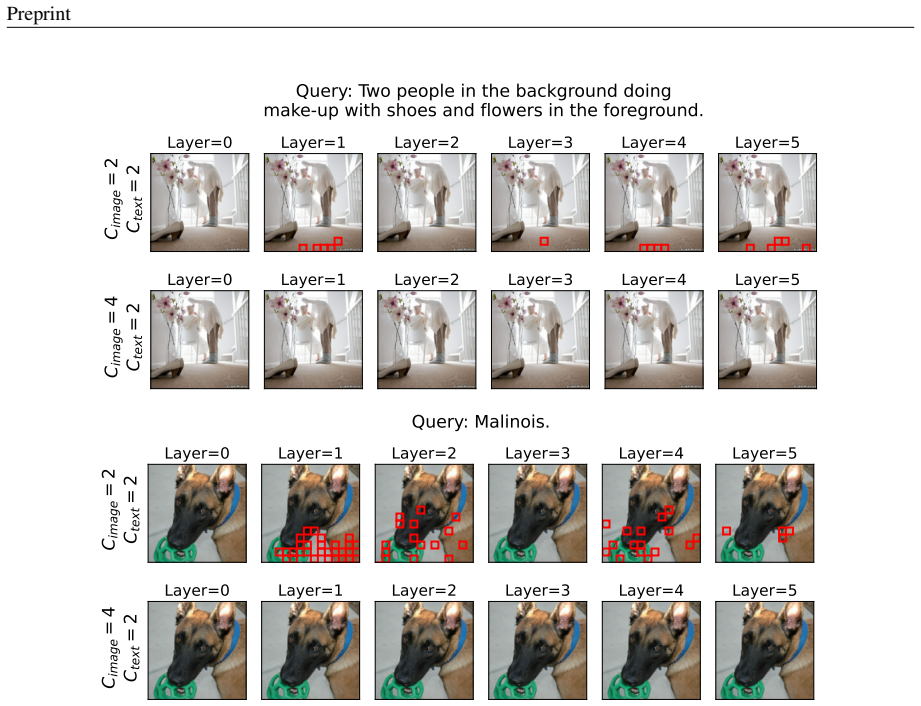
The central mechanism is sparse upcycling with per-modality separated experts: each MoE layer replaces a dense MLP with E=8 expert MLPs initialized by copying the pre-trained dense weights, plus a randomly initialized router that selects the top-2 experts per token. Each expert has a fixed token buffer set by the capacity factor C, giving capacity $B_e=(B_t/E)\times C$ per expert on a first-come-first-served basis; tokens that exceed capacity are dropped. This token-dropping behavior, together with the load-balance and router-z losses, is what the paper credits for the retrieval gains, and the same capacity factor is the dial that shifts performance between classification and retrieval.
What would settle it
Run the identical CLIP-UP recipe at expert capacity factors C=2.0 and C=4.0 on the same data with several random seeds, and compare COCO text-to-image Recall@1 to the dense baseline; if the C=2.0 model does not consistently beat dense CLIP, or if C=4.0 also beats it while matching ImageNet accuracy, the claimed retrieval advantage and trade-off mechanism are not stable.
Extended reading notes
Core claim
On the paper's own terms, the discovery is that a pre-trained dense CLIP checkpoint can be turned into a high-performing sparse MoE model by copying the dense MLP weights into E experts, randomly initializing routers, and fine-tuning with a reduced learning rate. With separated per-modality backbones, 8 experts per modality, top-2 routing, and an expert capacity factor C=2.0, the resulting CLIP-UP B/16 model reaches 52.1% COCO text-to-image Recall@1 and 80.9% Flickr30k text-to-image Recall@1, surpassing the dense B/16 model (44.9% and 74.3%) and even the dense L/14 model (50.2% and 79.3%) at a fraction of the inference compute. The paper further claims this upcycling recipe requires fewer total training FLOPs than training a sparse MoE from scratch, and that simple load-balance and router z-loss auxiliary losses suffice, without the more complex entropy losses used by prior MoE CLIP training.
Load-bearing premise
The retrieval advantage depends on the hand-picked expert capacity factor C=2.0 and the chosen loss weights; the paper provides no rule for setting them, and its own appendix shows C=4.0 flips the result.
Editorial extensions
If this is right
- If CLIP-UP is correct, scaling a CLIP model's capacity no longer requires training a larger dense model or an MoE from scratch: a dense checkpoint can be upgraded in roughly the same training budget.
- Retrieval systems could ship a B/16 sparse model that beats an L/14 dense model at a fraction of the inference cost, making high-quality text-to-image search cheaper to deploy.
- The recipe's insensitivity to complex auxiliary losses (load balance and router-z loss suffice) lowers the barrier to adopting MoE in multimodal models.
- The reported classification–retrieval trade-off means the expert capacity factor becomes a task-specific dial, not a free lunch: raising it helps ImageNet but hurts COCO retrieval.
Reading between the lines
- Editorial inference: If token dropping is genuinely what drives the retrieval gains, then an adaptive capacity factor that drops more tokens on cluttered images and fewer on single-object images could break the ImageNet–COCO trade-off; this is testable.
- Editorial inference: Because experts are copied from a dense model that already aligns images and text, CLIP-UP could serve as a cheap way to upgrade existing deployed CLIP models without retraining from scratch, a deployment consequence the paper does not discuss.
- Editorial inference: The observed expert specialization patterns suggest that upcycled experts may become interpretable modules; probing whether these specializations transfer to other datasets or modalities could clarify what the router actually learns.
Editorial analysis
A structured set of objections, weighed in public.
Referee Report
Summary. The paper proposes CLIP-UP, a training recipe that converts a pretrained dense CLIP model into a mixture-of-experts (MoE) CLIP via sparse upcycling: alternating MLP layers are replaced by MoE layers whose experts are initialized from the dense checkpoint, routers are random, and fine-tuning uses load-balance and router z-losses. The central empirical claims are that the upcycled B/16 model outperforms its dense counterpart by 7.2 and 6.6 points on COCO and Flickr30K text-to-image Recall@1, respectively, that it surpasses a dense L/14 model on retrieval while using roughly 31% of the inference GFLOPs, and that this is achieved with less total training compute than training from scratch. The paper also reports ablations of shared versus separated backbones, the LIMOE auxiliary loss, expert capacity factor, per-modality MoE placement, and routing analyses.
Significance. If the recipe reproduces across seeds and settings, it is a practically valuable result: it offers a simple, low-cost route from an existing dense checkpoint to a sparse model with better retrieval at lower inference cost. The paper is unusually honest about the ImageNet/retrieval trade-off, and the ablation coverage is broad, including capacity factor, backbone sharing, and auxiliary losses. However, the headline numerical claims rest on a single hand-selected hyperparameter and on single-run measurements, so the current evidence supports the direction of the result more strongly than the specific magnitudes claimed.
major comments (3)
- [§3.3, Table 2; Appendix B.2, Table 7] The headline B/16 gains over the dense 790k baseline (COCO T2I R@1 52.1 vs 44.9, Flickr30K T2I R@1 80.9 vs 74.3) are produced by the default expert capacity factor C=2.0. The paper's own ablation, Appendix Table 7, shows that setting C_image=4.0 changes COCO T2I R@1 from 52.1 to 46.3 and Flickr30K T2I R@1 from 80.9 to 75.5, shrinking the gains to +1.4 and +1.2 and eliminating the margin over dense L/14 (46.3 vs 50.2 on COCO). Since no multi-seed evidence and no principled selection rule for C are provided, the paper does not currently establish that the reported advantage is a stable property of the recipe rather than a tuned operating point. The limitation section acknowledges the trade-off, but it does not address the stability of the central quantitative claims.
- [§3.3, Table 2; Appendix B.2, Table 7] All reported evaluations appear to be single runs with no error bars or repeated seeds. This matters specifically because the decision-relevant comparison 'CLIP-UP B/16 surpasses dense L/14' is only 1.9 COCO points (52.1 vs 50.2), while the capacity sweep in Table 7 moves the same metric by 5.8 points. Without variance estimates, the reader cannot tell whether the margin over L/14 is significant or an artifact of the selected C and initialization seed. Please report multiple seeds or bootstrap confidence intervals for at least the main configurations, including the dense baselines.
- [§1, §3, Appendix A.1] The recipe's exact settings are reported inconsistently, which undermines reproducibility for a paper whose contribution is a recipe. Section 3 states the router z-loss weight as β=0.001, while Appendix Table 3 reports 0.0001. The abstract claims a 6.6% gain on Flickr30K while the introduction's contribution 2 claims 5.5%. These discrepancies should be reconciled and the final numbers aligned across abstract, introduction, tables, and appendix.
minor comments (5)
- [§3.3 vs Abstract] The abstract says '30% of the inference FLOPs' while §3.3 says '31% of the GFLOPS'; Table 2 gives 54.3/175.5 ≈ 31%, so please standardize the wording and numbers.
- [Figure 6, Appendix B.2] The x-axis of Figure 6 is labeled 'Top-K' even though the surrounding text and Table 7 describe the expert capacity factor C; please correct the axis label or the caption to avoid confusion.
- [Throughout] There are several typos and formatting issues: 'ZFLOPs' in §3.1 and Figure 1, 'seprated' in Figure 3's axis, 'F LICKR30K' in Table 1, and 'A CC@5' in Table 2. A copyedit pass is needed.
- [Figure 8, Appendix B.3] The caption and text say that post-routing normalization improves image-to-text retrieval but worsens text-to-image retrieval, but the figure does not clearly label which curve is 'before' and which is 'after' beyond the axis text; please add an explicit legend.
- [§5, Appendix B.2] The limitation section discusses the ImageNet/retrieval trade-off qualitatively; citing the concrete numbers from Appendix Table 7 (e.g., C_image=2.0 gives 76.9 ImageNet / 52.1 COCO T2I vs C_image=4.0 giving 78.4 / 46.3) in the main text would make the trade-off much clearer to readers.
Circularity Check
No significant circularity: CLIP-UP reports measured retrieval/classification results against matched dense baselines; the gains are empirical outcomes, not predictions encoded by construction in the recipe.
full rationale
This is an empirical recipe paper, not a derivation, so the definitional circularity patterns do not apply. The reported CLIP-UP numbers (COCO/Flickr T2I R@1, ImageNet Acc@1) are measurements on standard benchmarks after training; none of the paper's equations (1)-(4) or the sparse-upcycling initialization contains the target eval values, and the dense comparison models are trained with matched step counts (790k dense vs. 440k dense + 350k upcycle). The expert capacity factor C=2.0 and loss weights are user-chosen hyperparameters, not fitted to reproduce the headline results. Appendix Table 7 does show sensitivity (C=4.0 changes COCO T2I R@1 from 52.1 to 46.3 while improving ImageNet from 76.9 to 78.4), but hyperparameter sensitivity is a robustness/selection concern, not circularity: the reported evaluations are not determined by the choice of C through any identity. Self-citations such as Wu et al. for the WIT-300M training data and Radford et al. for CLIP are data/method provenance, not load-bearing uniqueness arguments. The limitation section explicitly acknowledges the retrieval/classification trade-off and states that no configuration gives large gains on both, which is consistent with an honest empirical report rather than a result forced by construction. The internal inconsistencies (abstract says 6.6% on Flickr30k while the introduction says 5.5%; Section 3 gives router-z loss weight beta=0.001 while Appendix Table 3 gives 0.0001) are copy-editing or reporting inconsistencies, not circular steps, and do not alter the circularity verdict.
Assumptions & free parameters
free parameters (5)
- Expert capacity factor C =
2.0 for both modalities
- Load-balance loss weight alpha =
0.01
- Router z-loss weight beta =
0.001 in Section 3, 0.0001 in Appendix A
- Upcycling peak learning rate and weight decay =
LR 5e-5, WD 0.05
- MoE configuration (experts, top-K, placement) =
8 experts, top-2, alternating dense/sparse MLP layers
assumptions (4)
- domain assumption The CLIP contrastive objective transfers to zero-shot classification and retrieval benchmarks.
- domain assumption WIT-300M and DFN-5B provide a sufficient and appropriately filtered training corpus for the reported dense and MoE CLIP models.
- ad hoc to paper The alternating [dense, sparse] MoE pattern and top-2 routing are stable and effective for upcycled CLIP models.
- domain assumption The load-balance and router z-losses are sufficient to stabilize sparse upcycling without more complex LIMOE entropy losses.
Cite this review
Pith. "Pith review of CLIP-UP: A Simple and Efficient Mixture-of-Experts CLIP Training Recipe with Sparse Upcycling." pith.science (2026). https://pith.science/paper/ZPXWVRZV
@misc{pith2026250200965,
  author       = {Pith},
  title        = {Pith review of: CLIP-UP: A Simple and Efficient Mixture-of-Experts CLIP Training Recipe with Sparse Upcycling},
  year         = {2026},
  howpublished = {\url{https://pith.science/paper/ZPXWVRZV}},
  note         = {Machine review of arXiv:2502.00965}
}
read the original abstract
Mixture-of-Experts (MoE) models are crucial for scaling model capacity while controlling inference costs. While integrating MoE into multimodal models like CLIP improves performance, training these models is notoriously challenging and expensive. We propose CLIP-Upcycling (CLIP-UP), an efficient alternative training strategy that converts a pre-trained dense CLIP model into a sparse MoE architecture. Through extensive experimentation with various settings and auxiliary losses, we demonstrate that CLIP-UP significantly reduces training complexity and cost. Remarkably, our sparse CLIP B/16 model, trained with CLIP-UP, outperforms its dense counterpart by 7.2% and 6.6% on COCO and Flickr30k text-to-image Recall@1 benchmarks respectively. It even surpasses the larger CLIP L/14 model on this task while using only 30% of the inference FLOPs. We further demonstrate the generalizability of our training recipe across different scales, establishing sparse upcycling as a practical and scalable approach for building efficient, high-performance CLIP models.
Figures


Figures from the paper (8 more)




Reference graph
Works this paper leans on
-
[4]
Data filtering networks. Preprint, arXiv:2309.17425. William Fedus, Barret Zoph, and Noam Shazeer
-
[5]
Switch transformers: Scaling to trillion parameter models with simple and efficient sparsity. Preprint, arXiv:2101.03961. Zhe Gan, Linjie Li, Chunyuan Li, Lijuan Wang, Zicheng Liu, and Jianfeng Gao
-
[6]
Vision-language pre- training: Basics, recent advances, and future trends. Preprint, arXiv:2210.09263. Dan Hendrycks, Steven Basart, Norman Mu, Saurav Kadavath, Frank Wang, Evan Dorundo, Rahul De- sai, Tyler Zhu, Samyak Parajuli, Mike Guo, Dawn Song, Jacob Steinhardt, and Justin Gilmer. 2021a. The many faces of robustness: A critical analy- sis of out-of-...
-
[7]
Sparse upcycling: Training mixture-of-experts from dense checkpoints. Preprint, arXiv:2212.05055. Tsung-Yi Lin, Michael Maire, Serge Belongie, James Hays, Pietro Perona, Deva Ramanan, Piotr Dollár, and C Lawrence Zitnick
-
[9]
Visual instruction tuning. Preprint, arXiv:2304.08485. Basil Mustafa, Carlos Riquelme, Joan Puigcerver, Rodolphe Jenatton, and Neil Houlsby
-
[10]
Mul- timodal contrastive learning with limoe: the language-image mixture of experts. Preprint, arXiv:2206.02770. Bryan A. Plummer, Liwei Wang, Chris M. Cervantes, Juan C. Caicedo, Julia Hockenmaier, and Svet- lana Lazebnik
-
[12]
Exploring the limits of transfer learning with a unified text-to-text trans- former. Preprint, arXiv:1910.10683. Aditya Ramesh, Mikhail Pavlov, Gabriel Goh, Scott Gray, Chelsea V oss, Alec Radford, Mark Chen, and Ilya Sutskever
arXiv 1910
-
[13]
Zero-shot text-to-image gener- ation. Preprint, arXiv:2102.12092. Yongming Rao, Wenliang Zhao, Guangyi Chen, Yan- song Tang, Zheng Zhu, Guan Huang, Jie Zhou, and Jiwen Lu
Show all 24 references
-
[14]
Preprint, arXiv:2112.01518
Denseclip: Language-guided dense prediction with context-aware prompting. Preprint, arXiv:2112.01518. Benjamin Recht, Rebecca Roelofs, Ludwig Schmidt, and Vaishaal Shankar
-
[19]
Preprint, arXiv:2402.01739
Openmoe: An early effort on open mixture-of-experts language models. Preprint, arXiv:2402.01739. Zhiyuan Zeng, Qipeng Guo, Zhaoye Fei, Zhangyue Yin, Yunhua Zhou, Linyang Li, Tianxiang Sun, Hang Yan, Dahua Lin, and Xipeng Qiu
-
[20]
Preprint, arXiv:2402.12399
Turn waste into worth: Rectifying top- k router of moe. Preprint, arXiv:2402.12399. Jihai Zhang, Xiaoye Qu, Tong Zhu, and Yu Cheng
-
[21]
Preprint, arXiv:2409.19291
Clip-moe: Towards building mixture of experts for clip with diversified multiplet upcycling. Preprint, arXiv:2409.19291. Kaiyang Zhou, Jingkang Yang, Chen Change Loy, and Ziwei Liu
-
[22]
Preprint, arXiv:2202.08906
St-moe: Designing stable and transferable sparse expert models. Preprint, arXiv:2202.08906. 6 Preprint A Training Details Below, we provide detailed training hyper-parameters and setups for dense CLIP (weights are used for sparse upcycling), sparse CLIP trained from scratch, a...
-
[23]
Table 3 summarizes the hyper-parameters for all experiments, including MoE-specific configurations and parameters for dense CLIP, sparse CLIP, and CLIP-UP
training datasets. Table 3 summarizes the hyper-parameters for all experiments, including MoE-specific configurations and parameters for dense CLIP, sparse CLIP, and CLIP-UP. Table 3: Training hyper-parameters and settings for dense CLIP used for sparse upcycling and CLIP-UP G...
2023
-
[24]
We also explore the effect of adding MoE layers to only one modality while keeping the other modality fully dense
ROUTER TYPE TOP-2 ROUTING EXPERT CAPACITY FACTOR(C) 2.0 ( BOTH TEXT AND IMAGE) MOE POSITION [DENSE, SPARSE] (HALF OFMLPLAYERS REPLACED BYMOE LAYERS) LOAD BALANCE LOSS WEIGHT 0.01 ROUTER-Z LOSS WEIGHT 0.0001 DENSEMODEL STEPS 439087 (i.e.,∼ 14B EXAMPLES SEEN) PEAK LEARNING RATE(...
2019
-
[2009]
In 2009 IEEE conference on computer vision and pattern recognition , pages 248–255
Imagenet: A large-scale hier- archical image database. In 2009 IEEE conference on computer vision and pattern recognition , pages 248–255. Ieee. Nan Du, Yanping Huang, Andrew M. Dai, Simon Tong, Dmitry Lepikhin, Yuanzhong Xu, Maxim Krikun, Yanqi Zhou, Adams Wei Yu, Orhan Firat...
2009
-
[2014]
In Computer Vision– ECCV 2014: 13th European Conference, Zurich, Switzerland, September 6-12, 2014, Proceedings, Part V 13, pages 740–755
Microsoft coco: Common objects in context. In Computer Vision– ECCV 2014: 13th European Conference, Zurich, Switzerland, September 6-12, 2014, Proceedings, Part V 13, pages 740–755. Springer. Haotian Liu, Chunyuan Li, Qingyang Wu, and Yong Jae Lee
2014
-
[2017]
Preprint, arXiv:1701.06538
Outrageously large neural net- works: The sparsely-gated mixture-of-experts layer. Preprint, arXiv:1701.06538. Wentao Wu, Aleksei Timofeev, Chen Chen, Bowen Zhang, Kun Duan, Shuangning Liu, Yantao Zheng, Jonathon Shlens, Xianzhi Du, Zhe Gan, and Yin- fei Yang
-
[2019]
Vaishaal Shankar, Rebecca Roelofs, Horia Mania, Alex Fang, Benjamin Recht, and Ludwig Schmidt
Do imagenet classifiers generalize to imagenet? Preprint, arXiv:1902.10811. Vaishaal Shankar, Rebecca Roelofs, Horia Mania, Alex Fang, Benjamin Recht, and Ludwig Schmidt
1902 arXiv
-
[2020]
Preprint, arXiv:2002.04745
On layer normalization in the transformer architecture. Preprint, arXiv:2002.04745. Fuzhao Xue, Zian Zheng, Yao Fu, Jinjie Ni, Zang- wei Zheng, Wangchunshu Zhou, and Yang You
2002 arXiv
-
[2021]
Preprint, arXiv:2103.00020
Learn- ing transferable visual models from natural language supervision. Preprint, arXiv:2103.00020. 5 Preprint Colin Raffel, Noam Shazeer, Adam Roberts, Katherine Lee, Sharan Narang, Michael Matena, Yanqi Zhou, Wei Li, and Peter J. Liu
-
[2022]
Preprint, arXiv:2112.06905
Glam: Efficient scaling of language models with mixture-of- experts. Preprint, arXiv:2112.06905. Alex Fang, Albin Madappally Jose, Amit Jain, Lud- wig Schmidt, Alexander Toshev, and Vaishaal Shankar
-
[2023]
In 2023 IEEE/CVF Conference on Computer Vision and Pattern Recog- nition (CVPR)
Reproducible scaling laws for con- trastive language-image learning. In 2023 IEEE/CVF Conference on Computer Vision and Pattern Recog- nition (CVPR). IEEE. Jia Deng, Wei Dong, Richard Socher, Li-Jia Li, Kai Li, and Li Fei-Fei
2023
-
[2024]
Preprint, arXiv:2306.07952
Mofi: Learning image representa- tions from noisy entity annotated images. Preprint, arXiv:2306.07952. Ruibin Xiong, Yunchang Yang, Di He, Kai Zheng, Shuxin Zheng, Chen Xing, Huishuai Zhang, Yanyan Lan, Liwei Wang, and Tie-Yan Liu
Reviewed August 9, 2026 · model on record in the stance chip above.
Discussion (0). Continue with ORCID to comment.