REVIEW 3 major objections 5 minor 35 references
ZeroBP: Learning Position-Aware Correspondence for Zero-shot 6D Pose Estimation in Bin-Picking
T0 review · 3 major / 5 minor · reviewed 2026-08-09 · deepseek-v4-flash
Pith's one-line read ZeroBP claims that adding global position to local feature matching lets a zero-shot pose estimator handle textureless stacked parts, lifting correct-pose recall on ROBI from 36.7% to 45.8%.
desk verdict ZeroBP shows a real 9.1-point gain on ROBI for zero-shot bin-picking pose, but Eq. (2) normalizes by squared norm, so the angular-consistency story is unverified as written. read the letter →
The pith
A machine-rendered reading of the paper's core claim, the machinery that carries it, and where it could break.
The reading
What carries the argument
The central object is the Position-Aware Correspondence (PAC) module, built from two pieces. The first is a multiplicative positional encoding: for each point, the direction vector from the CAD-model centroid to that point, computed in a shared coordinate system and normalized in Eq. (2); this is what converts 'where is this point relative to the whole object' into a feature that can be multiplied with local appearance features. The second is a bidirectional position-aware cross-attention that adds positional embeddings to query and key features and multiplies the softmax attention map by a normalized cosine similarity matrix of the two clouds' directional vectors, before a feed-forward update. These pieces are wrapped in a coarse-to-fine registration pipeline with alternate refinement: each pass uses the current pose to build position encodings, uses the encodings to re-estimate correspondences, and uses those correspondences to update the pose.
What would settle it
Re-run the ROBI evaluation with Eq. (2) changed from $\|\cdot\|_2^2$ to $\|\cdot\|_2$ in the denominator, so the directional vectors are truly unit length before the cosine reweighting in Eq. (4). If the reported average recall of 45.8% (and the 55.7% ablation) stays the same, the mechanism is the direction itself and the explanation holds; if the recall drops sharply, the published numbers depend on the squared-distance scaling, and the claimed cosine mechanism is not what is doing the work.
Extended reading notes
Core claim
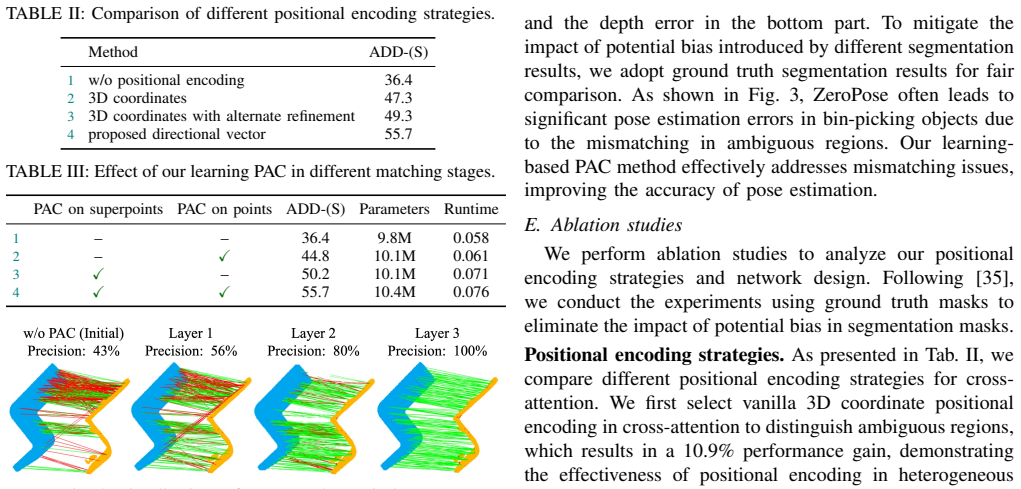
The central discovery is that a global position signal, expressed as a multiplicative directional-vector encoding and injected through position-aware cross-attention, resolves the correspondence ambiguity that defeats textureless bin-picking objects. The method treats the scene point cloud and CAD point cloud as heterogeneous sources and projects both into a shared coordinate system using the current pose estimate; the directional vector from the object centroid to each point then becomes a position embedding, and a cosine-similarity matrix between the two clouds' directional vectors reweights the attention map. The cyclical dependency between pose and global position is broken by an iterative loop: estimate an initial pose from local features only, compute positional encodings under that pose, refine correspondences with position-aware attention, solve for a new pose, and repeat for three coarse and three fine steps. The result is an accuracy gain from 36.7% to 45.8% average recall on the seven-object ROBI benchmark, with the paper attributing most of the gain to the directional-vector encoding (55.7% AR in the full ablation) and to applying position-aware correspondence at both superpoint and point levels.
Load-bearing premise
The paper's account of why its position signal works assumes the vectors in Eq. (2) are unit-length directions whose inner product equals the cosine of the angle between them; the equations as written divide by squared distance, so that assumption is not met.
Editorial extensions
If this is right
- New workpieces can be picked with only a CAD model and a text prompt, skipping the days-long data collection and retraining that object-specific methods require.
- The method brings zero-shot accuracy to textureless and reflective parts, a regime where earlier zero-shot methods degraded badly.
- On the ROBI benchmark, the reported 45.8% average recall is above the best zero-shot baseline (36.7%) and closer to the best object-specific model (64.1%).
- The full configuration adds only 0.6M parameters over the no-PAC baseline and runs at 0.076 seconds per instance, so the accuracy gain does not require a heavier network.
- With three alternating refinements, the paper's visualizations show coarse correspondences rising from 43% to 100% precision on the displayed case.
Reading between the lines
- If the central claim holds, the same centroid-direction positional encoding could be transferred to other point-cloud registration tasks with self-similar surfaces.
- A natural next experiment, not run in the paper, is to measure how the alternating loop degrades as the initial pose is made noisier.
- The accuracy gains might also compound with stronger detection or segmentation, since the paper's core ablation uses ground-truth masks for evaluation.
Editorial analysis
A structured set of objections, weighed in public.
Referee Report
Summary. The paper proposes ZeroBP, a zero-shot 6D pose estimation method for bin-picking. It uses a two-stage pipeline: picking-box-aware detection followed by point registration, and introduces Position-Aware Correspondence (PAC), which combines local features with a multiplicative positional encoding based on directional vectors from the object centroid, together with position-aware cross-attention and iterative pose/position refinement. Experiments on the ROBI dataset report an average ADD(-S) recall of 45.8%, outperforming ZeroPose and SAM6D by 16.4% and 9.1% respectively. The manuscript includes ablations showing the contribution of the positional encoding and of applying PAC at both superpoint and point levels, plus visualizations of correspondence refinement across layers.
Significance. If the reported results stand, the paper is a meaningful step toward zero-shot pose estimation in bin-picking: it targets a practical scenario where existing zero-shot methods built on local feature matching struggle, and it demonstrates a substantial improvement over strong baselines on a public real-world benchmark. The core idea, resolving ambiguous local matches by explicitly encoding global position and refining pose and position alternately, is sensible and is not circular; it is a standard iterative-refinement scheme trained with a supervised loss on synthetic data. The main weakness is that the central mathematical definition in Eq. (2) is inconsistent with the claimed angular interpretation, and no code is provided to establish which variant was actually implemented. With that corrected, the contribution would be solid and of clear interest to the robotics and computer vision communities.
major comments (3)
- [III-C, Eq. (2) and Eq. (4)] The directional-vector encoding in Eq. (2) divides by the squared L2 norm, so V_s and V_o are not unit vectors. With unit vectors one would write (P_s - t')/||P_s - t'||_2 and (R' P_o)/||R' P_o||_2. As printed, the magnitudes are 1/||P_s - t'||_2 and 1/||R' P_o||_2, so the inner product in Eq. (4) is cos(theta)/(||P_s - t'||_2 ||R' P_o||_2), not cos(theta), and A_cos is not normalized to [0,1]; near the centroid the reweighting term can be arbitrarily large. The textual claim that the inner product measures the angle between directions, and the explanation in Section IV.E that the 19.3% gain in Table II comes from 'the natural angle constraint in vector multiplication', are therefore unsupported by the equations as written. If the implementation uses the unsquared norm, Eq. (2) must be corrected and the code released; if it uses the squared norm, the ablation result should be reinterpreted as an inverse-distance weighting effect rather than angular consistency.
- [IV.D/IV.E and Table I] The main quantitative comparison in Table I does not state whether the full detection pipeline or ground-truth masks are used for the reported AR values, whereas Section IV.E explicitly says the ablation experiments use ground-truth masks. Because ZeroBP's gains could partly come from detection or mask quality, the comparison conditions should be stated precisely for Table I, including the protocol used for the baselines ZeroPose and SAM6D.
- [III-E and IV.B] The refinement procedure is not fully specified: the paper says the initial pose comes from top-K coarse feature matches and that WSVD solves Eq. (1), but it does not state how many RANSAC/WSVD iterations are used, how the pose estimate is updated between the N refinement steps, or whether the fine-level refinement re-estimates the pose once or iteratively. Without these details and without a released implementation, the algorithm in Eqs. (2)-(4) cannot be reproduced from the manuscript alone.
minor comments (5)
- [III-D, Eq. (3)] The text says the attention map is 'calculated by K and V', but the equation uses QK^T; this should read 'Q and K'.
- [References] References [29] and [30] are the same Vaswani et al. paper; one duplicate should be removed.
- [IV.E, Fig. 4] The reported correspondence precision 'from 43% to 100%' is not defined; please state how precision is computed, for example as the fraction of matches within a distance threshold.
- [Table III] The runtime is reported without hardware details; please list the GPU/CPU and software versions used.
- [IV.B] The sentence 'we keep the same network layers N=3 in both superpoints and point correspondence learning' is missing a verb and should be reworded for clarity.
Circularity Check
No significant circularity: ZeroBP's core PAC uses iterative pose-position refinement trained on GSO and tested on ROBI, with an external benchmark and no fitted-input-as-prediction reduction.
full rationale
ZeroBP's derivation chain is self-contained against an external benchmark. The position encodings in Eq. (2) are computed from an initial pose obtained by feature matching, then used to reweight cross-attention in Eqs. (3)-(4), and the resulting correspondences are solved with Eq. (1) to update the pose. This is iterative refinement, not circularity: the final pose is not defined to be the initial pose or the positional encoding, and the process is trained with overlap-aware circle loss and negative log-likelihood on synthetic GSO data and evaluated on the real ROBI dataset. The reported 9.1% gain over SAM6D is an external empirical result, not an algebraic consequence of the paper's inputs. The paper's self-citations (ZeroPose [4], Geo6D [3]) are used as baseline comparison and pipeline or loss choices, but they do not carry the central claim: the novel PAC module is trained and ablated within the paper. The Eq. (2) normalization issue, where the squared L2 norm appears instead of the L2 norm, is a mathematical correctness concern about the claimed angular interpretation, not a circularity. No step reduces a prediction to its own inputs by construction, so the circularity score is 0.
Assumptions & free parameters
free parameters (2)
- N (number of refinement layers) =
3
- K (top superpoint correspondences) =
256
assumptions (4)
- domain assumption The initial pose from local feature matching is sufficiently close to the true pose to bootstrap the alternate refinement.
- ad hoc to paper The directional vector encoding in Eq. (2) yields unit vectors whose inner product is the cosine of the angle between rays.
- domain assumption Synthetic GSO data can train a model that transfers to real ROBI objects without fine-tuning.
- domain assumption The detection stage provides accurate instance masks for the main comparison.
Cite this review
Pith. "Pith review of ZeroBP: Learning Position-Aware Correspondence for Zero-shot 6D Pose Estimation in Bin-Picking." pith.science (2026). https://pith.science/paper/6GL7N4QN
@misc{pith2026250201004,
  author       = {Pith},
  title        = {Pith review of: ZeroBP: Learning Position-Aware Correspondence for Zero-shot 6D Pose Estimation in Bin-Picking},
  year         = {2026},
  howpublished = {\url{https://pith.science/paper/6GL7N4QN}},
  note         = {Machine review of arXiv:2502.01004}
}
read the original abstract
Bin-picking is a practical and challenging robotic manipulation task, where accurate 6D pose estimation plays a pivotal role. The workpieces in bin-picking are typically textureless and randomly stacked in a bin, which poses a significant challenge to 6D pose estimation. Existing solutions are typically learning-based methods, which require object-specific training. Their efficiency of practical deployment for novel workpieces is highly limited by data collection and model retraining. Zero-shot 6D pose estimation is a potential approach to address the issue of deployment efficiency. Nevertheless, existing zero-shot 6D pose estimation methods are designed to leverage feature matching to establish point-to-point correspondences for pose estimation, which is less effective for workpieces with textureless appearances and ambiguous local regions. In this paper, we propose ZeroBP, a zero-shot pose estimation framework designed specifically for the bin-picking task. ZeroBP learns Position-Aware Correspondence (PAC) between the scene instance and its CAD model, leveraging both local features and global positions to resolve the mismatch issue caused by ambiguous regions with similar shapes and appearances. Extensive experiments on the ROBI dataset demonstrate that ZeroBP outperforms state-of-the-art zero-shot pose estimation methods, achieving an improvement of 9.1% in average recall of correct poses.
Figures


Figures from the paper (1 more)
Reference graph
Works this paper leans on
-
[1]
ZS6D: Zero-shot 6D Object Pose Estimation using Vision Transformers
Philipp Ausserlechner et al. “ZS6D: Zero-shot 6D Ob- ject Pose Estimation using Vision Transformers”. In: arXiv preprint arXiv:2309.11986 (2023)
work page Pith review arXiv 2023
-
[2]
Method for registration of 3-D shapes
Paul J Besl and Neil D McKay. “Method for registration of 3-D shapes”. In: Sensor fusion IV: control paradigms and data structures. V ol. 1611. 1992, pp. 586–606
work page 1992
-
[3]
Geo6D: Geometric Constraints Learning for 6D Pose Estimation
Jianqiu Chen et al. “Geo6D: Geometric Constraints Learning for 6D Pose Estimation”. In: arXiv preprint arXiv:2210.10959 (2023)
work page Pith review arXiv 2023
-
[4]
ZeroPose: CAD-Model-based Zero-Shot Pose Estimation
Jianqiu Chen et al. ZeroPose: CAD-Model-based Zero-Shot Pose Estimation. 2023. arXiv: 2305.17934 [cs.CV]
arXiv 2023
-
[5]
Sim-to-real 6d object pose estimation via iterative self-training for robotic bin picking
Kai Chen et al. “Sim-to-real 6d object pose estimation via iterative self-training for robotic bin picking”. In: European Conference on Computer Vision . Springer. 2022, pp. 533– 550
work page 2022
-
[6]
Stefan Hinterstoisser et al. “Model Based Training, Detection and Pose Estimation of Texture-Less 3D Objects in Heavily Cluttered Scenes”. In: Computer Vision – ACCV 2012,Lec- ture Notes in Computer Science . 2013, pp. 548–562
work page 2012
-
[7]
Sim-to-real Object Pose Estimation for Random Bin Picking
Boyoung Kim and Junhong Min. “Sim-to-real Object Pose Estimation for Random Bin Picking”. In: 2024 IEEE Inter- national Conference on Robotics and Automation (ICRA) . 2024, pp. 10749–10756
work page 2024
-
[8]
Single shot 6d object pose estimation
Kilian Kleeberger and Marco F Huber. “Single shot 6d object pose estimation”. In: 2020 IEEE International Conference on Robotics and Automation (ICRA) . IEEE. 2020, pp. 6239– 6245
work page 2020
Show all 35 references
-
[9]
MegaPose: 6D Pose Estimation of Novel Objects via Render & Compare
Yann Labbé et al. “MegaPose: 6D Pose Estimation of Novel Objects via Render & Compare”. In: CoRL. 2022
2022
-
[10]
Deep learning
Yann LeCun, Yoshua Bengio, and Geoffrey Hinton. “Deep learning”. In: nature 521.7553 (2015), pp. 436–444
2015
-
[11]
Backpropagation applied to handwritten zip code recognition
Yann LeCun et al. “Backpropagation applied to handwritten zip code recognition”. In: Neural computation 1.4 (1989), pp. 541–551
1989
-
[12]
Multi-View Keypoints for Reliable 6D Object Pose Estimation
Alan Li and Angela P Schoellig. “Multi-View Keypoints for Reliable 6D Object Pose Estimation”. In: 2023 IEEE Inter- national Conference on Robotics and Automation (ICRA) . IEEE. 2023, pp. 6988–6994
2023
-
[13]
Sam-6d: Segment anything model meets zero-shot 6d object pose estimation
Jiehong Lin et al. “Sam-6d: Segment anything model meets zero-shot 6d object pose estimation”. In: Proceedings of the IEEE/CVF Conference on Computer Vision and Pattern Recognition. 2024, pp. 27906–27916
2024
-
[14]
Grounding dino: Marrying dino with grounded pre-training for open-set object detection
Shilong Liu et al. “Grounding dino: Marrying dino with grounded pre-training for open-set object detection”. In: arXiv preprint arXiv:2303.05499 (2023)
2023 arXiv
-
[15]
Petr: Position embedding transformation for multi-view 3d object detection
Yingfei Liu et al. “Petr: Position embedding transformation for multi-view 3d object detection”. In: European Confer- ence on Computer Vision . Springer. 2022, pp. 531–548
2022
-
[16]
Gigapose: Fast and robust novel object pose estimation via one correspondence
Van Nguyen Nguyen et al. “Gigapose: Fast and robust novel object pose estimation via one correspondence”. In: Proceed- ings of the IEEE/CVF Conference on Computer Vision and Pattern Recognition. 2024, pp. 9903–9913
2024
-
[17]
Foundpose: Unseen object pose estimation with foundation features
Evin Pınar Örnek et al. “Foundpose: Unseen object pose estimation with foundation features”. In: arXiv preprint arXiv:2311.18809 (2023)
2023 arXiv
-
[18]
Latentfusion: End-to-end differen- tiable reconstruction and rendering for unseen object pose estimation
Keunhong Park et al. “Latentfusion: End-to-end differen- tiable reconstruction and rendering for unseen object pose estimation”. In: Proceedings of the IEEE/CVF conference on computer vision and pattern recognition . 2020, pp. 10710– 10719
2020
-
[19]
Pointnet: Deep learning on point sets for 3d classification and segmentation
Charles R Qi et al. “Pointnet: Deep learning on point sets for 3d classification and segmentation”. In: Proceedings of the IEEE conference on computer vision and pattern recognition. 2017, pp. 652–660
2017
-
[20]
Pointnet++: Deep hierarchical feature learning on point sets in a metric space
Charles Ruizhongtai Qi et al. “Pointnet++: Deep hierarchical feature learning on point sets in a metric space”. In: Ad- vances in neural information processing systems 30 (2017)
2017
-
[21]
GeoTransformer: Fast and Robust Point Cloud Registration With Geometric Transformer
Zheng Qin et al. “GeoTransformer: Fast and Robust Point Cloud Registration With Geometric Transformer”. In: IEEE Transactions on Pattern Analysis and Machine Intelligence (2023)
2023
-
[22]
OSOP: A Multi-Stage One Shot Object Pose Estimation Framework
Ivan Shugurov et al. “OSOP: A Multi-Stage One Shot Object Pose Estimation Framework”. In: CVPR. 2022
2022
-
[23]
Uni6Dv2: Noise Elimination for 6D Pose Estimation
Mingshan Sun et al. “Uni6Dv2: Noise Elimination for 6D Pose Estimation”. In: arXiv preprint arXiv:2208.06416 (2022)
2022 arXiv
-
[24]
Augmented autoencoders: Im- plicit 3D orientation learning for 6D object detection
Martin Sundermeyer et al. “Augmented autoencoders: Im- plicit 3D orientation learning for 6D object detection”. In: IJCV (2020)
2020
-
[25]
Multi-path learning for object pose estimation across domains
Martin Sundermeyer et al. “Multi-path learning for object pose estimation across domains”. In: CVPR. 2020
2020
-
[26]
MidasTouch: Monte-Carlo infer- ence over distributions across sliding touch
Sudharshan Suresh et al. “MidasTouch: Monte-Carlo infer- ence over distributions across sliding touch”. In: Conference on Robot Learning . PMLR. 2023, pp. 319–331
2023
-
[27]
Kpconv: Flexible and deformable convolution for point clouds
Hugues Thomas et al. “Kpconv: Flexible and deformable convolution for point clouds”. In: Proceedings of the IEEE/CVF international conference on computer vision . 2019, pp. 6411–6420
2019
-
[28]
Robust 6d object pose estimation by learning rgb-d features
Meng Tian et al. “Robust 6d object pose estimation by learning rgb-d features”. In: ICRA. 2020
2020
-
[29]
Attention is all you need
Ashish Vaswani et al. “Attention is all you need”. In: Advances in neural information processing systems . 2017, pp. 5998–6008
2017
-
[30]
Attention is all you need
Ashish Vaswani et al. “Attention is all you need”. In: Ad- vances in neural information processing systems 30 (2017)
2017
-
[31]
FoundationPose: Unified 6D Pose Esti- mation and Tracking of Novel Objects
Bowen Wen et al. “FoundationPose: Unified 6D Pose Esti- mation and Tracking of Novel Objects”. In: Proceedings of the IEEE/CVF Conference on Computer Vision and Pattern Recognition (CVPR). 2024, pp. 17868–17879
2024
-
[32]
ROBI: A Multi-View Dataset for Reflec- tive Objects in Robotic Bin-Picking
Jun Yang et al. “ROBI: A Multi-View Dataset for Reflec- tive Objects in Robotic Bin-Picking”. In: 2021 IEEE/RSJ International Conference on Intelligent Robots and Systems (IROS). 2021, pp. 9788–9795
2021
-
[33]
Learning Instance-Aware Correspon- dences for Robust Multi-Instance Point Cloud Registration in Cluttered Scenes
Zhiyuan Yu et al. “Learning Instance-Aware Correspon- dences for Robust Multi-Instance Point Cloud Registration in Cluttered Scenes”. In: Proceedings of the IEEE/CVF Conference on Computer Vision and Pattern Recognition . 2024, pp. 19605–19614
2024
-
[34]
PPR-Net++: Accurate 6-D pose estimation in stacked scenarios
Long Zeng et al. “PPR-Net++: Accurate 6-D pose estimation in stacked scenarios”. In: IEEE Transactions on Automation Science and Engineering 19.4 (2021), pp. 3139–3151
2021
-
[35]
Learning symmetry-aware geometry cor- respondences for 6d object pose estimation
Heng Zhao et al. “Learning symmetry-aware geometry cor- respondences for 6d object pose estimation”. In: Proceedings of the IEEE/CVF International Conference on Computer Vision. 2023, pp. 14045–14054
2023
Reviewed August 9, 2026 · model on record in the stance chip above.
Discussion (0). Continue with ORCID to comment.