REVIEW 3 major objections 6 minor 113 references
A Pristine View of Galactic Globular Clusters and their Peripheries: Omega Centauri
T0 review · 3 major / 6 minor · reviewed 2026-08-09 · deepseek-v4-flash
Pith's one-line read This paper claims the first evidence that the two dominant stellar populations of Omega Centauri extend beyond the tidal radius and into its tidal tails, implying the tails are made of tidally stripped cluster stars.
desk verdict A useful first chemical map of Omega Cen's outer regions, but the two-population claim in the tails needs a selection-function analysis before it can be trusted. read the letter →
The pith
A machine-rendered reading of the paper's core claim, the machinery that carries it, and where it could break.
The reading
What carries the argument
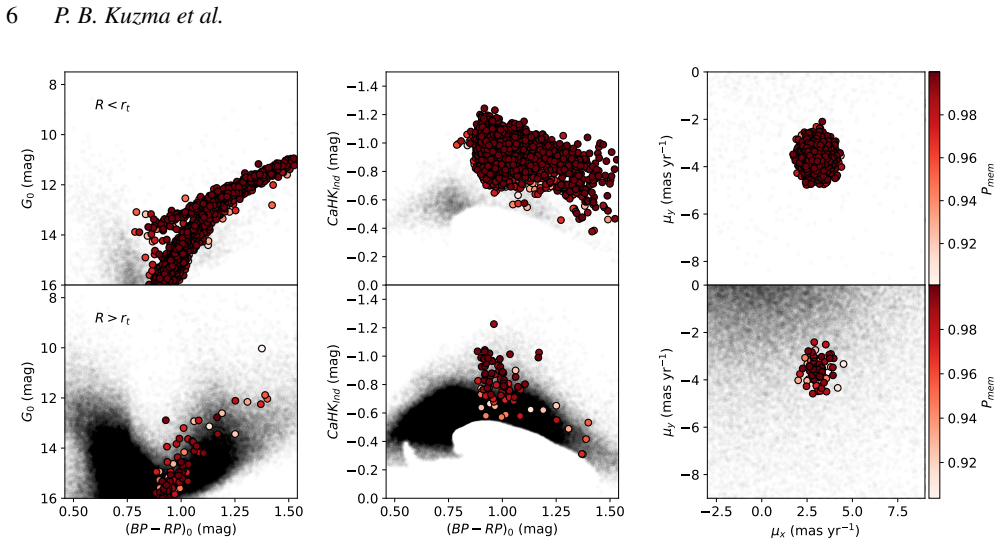
The argument is carried by the CaHKind colour-colour index, (CaHK - G0) - 2.5(GBP,0 - GRP,0), built from Pristine's CaHK-band photometry and Gaia's dereddened colours, which is sensitive to metallicity and helps separate $\Omega$ Cen-like stars from the Galactic field. Membership probabilities are built by multiplying a 2D Gaussian proper-motion likelihood, a k-nearest-neighbour local density in colour-magnitude space, and the analogous density in CaHKind space, with the cluster-to-field ratio set by maximising a mixture likelihood. The metallicity distributions at different radii are then decomposed into 1D Gaussian mixtures selected by the Akaike Information Criterion.
What would settle it
A spectroscopic survey of the conservative high-probability stars (Pmem > 0.99) between the tidal and Jacobi radii and along the tidal tails would settle it: if the [Fe/H] distribution does not show two groups near -2.0 and -1.3 dex, or at least a broad distribution matching the cluster's main body, the claim fails. Re-running the analysis with a crowding-corrected metallicity calibration and watching the bimodality disappear would also falsify it.
Extended reading notes
Core claim
In this paper the authors report the first detection of multiple stellar populations outside the tidal radius of $\Omega$ Centauri. Using a conservative membership threshold, they find two groups between the tidal radius (48 arcmin) and the Jacobi radius (107 arcmin), at [Fe/H]CaHKsyn = -2.01 +/- 0.07 and -1.26 +/- 0.06 dex, and beyond the Jacobi radius a broad metallicity distribution that spans the same range as the cluster's main body. They interpret this as the first evidence that the same two populations seen in the outer regions of the cluster are present outside the tidal radius and into the tidal tails, mixed about the stream and typically among the faintest stars in the sample, all indicating that the tails are constructed of tidally stripped $\Omega$ Cen stars.
Load-bearing premise
The load-bearing premise is that the synthetic CaHK metallicities and the CaHKind colour-colour separation remain accurate for the sparse outer-region stars; the paper itself shows deviations of up to 0.2 dex or more from independent spectroscopic metallicities for stars within 15 arcmin, and if a similar bias affects the outer regions, the two detected populations could be artefacts of the photometric pipeline.
Editorial extensions
If this is right
- The tidal tails of Omega Centauri are confirmed as tidally stripped cluster stars rather than chance alignments of field stars.
- The cluster's multiple stellar populations are stripped together and remain mixed along the stream, preserving the cluster's internal population mix in its debris.
- The presence of a metal-rich group between the tidal and Jacobi radii supports earlier photometric evidence that Omega Cen's more metal-rich populations are more spatially extended.
- Stars in the Fimbuthal stream and Stream #55 can now be chemically tested against the measured extra-tidal populations to firm up their association with the cluster.
- Deeper photometry and targeted spectroscopy should reveal more faint stripped stars and fill the apparent gap between central and tidal-region populations.
Reading between the lines
- A direct way to test the claim is to put the high-probability extra-tidal stars on a medium- or high-resolution spectrograph; if the two groups near -2.0 and -1.3 dex do not reproduce in [Fe/H], the detection is a photometric artefact.
- The same photometric-plus-astrometric pipeline could be turned on other massive globular clusters with known tidal debris to see whether multiple populations are generically stripped, rather than a peculiarity of Omega Cen.
- The well-mixed nature of the tails implies any radial population gradient inside the cluster is erased in the debris, which is a constraint on models of tidal stripping and internal kinematics.
- If crowding inflates the metal-poor tail inside 15 arcmin, as the paper suspects, the true metal-poor content of Omega Cen may be smaller than the raw synthetic metallicities suggest, with consequences for the dwarf-galaxy-core interpretation.
Editorial analysis
A structured set of objections, weighed in public.
Referee Report
Summary. This paper presents a probabilistic selection of Omega Centauri-like stars out to 5 degrees using Pristine-Gaia synthetic CaHK photometry and Gaia astrometry, combining proper motion, CMD, and colour-colour membership probabilities. The method recovers previously known tidal tails and measures the photometric metallicity distribution as a function of clustercentric radius. The authors report two dominant populations within the cluster (peaks at about -1.82 and -1.45 dex) between 15 arcmin and the tidal radius, and claim the first detection of the same two populations outside the tidal radius and in the tidal tails (with peaks at about -2.01 and -1.26 dex between the tidal and Jacobi radii). They interpret the well-mixed metallicity distribution in the tails as evidence that the tails are built from tidally stripped cluster stars.
Significance. If the claimed extra-tidal populations are real, the paper would provide the first chemical tagging of multiple stellar populations in the tidal tails of a disrupting globular cluster, with implications for how multiple populations are stripped and mixed and for connections to halo substructures such as Fimbuthal and Stream #55. The paper also releases membership probabilities as a data product, which is useful. However, the central claim is currently not secure because the membership selection and the metallicity estimator share the same CaHK photometry, and because the small extra-tidal sample is not subjected to formal statistical tests.
major comments (3)
- [§3, Eqs. (5)–(7); §4.2, Fig. 8] The central claim of two populations beyond the tidal radius is not currently supported because the membership probability P_mem (Eq. 7) includes P_CC (Eq. 5), a 10-nearest-neighbour density in CaHKind and (GBP−RP)0 evaluated against the cluster reference sample, while [Fe/H]CaHKsyn is derived from the same CaHK photometry. A hard P_mem>0.99 cut will preferentially retain stars whose CaHKind lies near the dense parts of the cluster colour-colour locus; in the outer field this can produce [Fe/H] peaks near the cluster's known populations even if the underlying tail metallicity distribution is smooth or unimodal. The paper does not quantify this selection function, nor does it test whether a smooth tail model subjected to the same membership cuts would reproduce the two peaks in Fig. 8. Since the abstract explicitly claims 'first evidence' for these populations, this gap must be closed.
- [§5.1, Fig. 9] The paper documents in §5.1 that the Pristine-Gaia synthetic [Fe/H] values deviate from APOGEE/M21 by up to 0.2 dex or more within 15 arcmin and still show a non-one-to-one relation in the 15–30 arcmin bin. The abstract's first cited result (two components at -1.82 and -1.45 dex between 15 arcmin and the tidal radius) is measured over a range that includes the poorly calibrated inner annulus; the one-to-one external calibration shown in Fig. 9 is only demonstrated outside 30 arcmin. Because the internal warning in §5.1 explicitly says that metal-poor populations may be biased, the authors need to either restrict the in-cluster population claim to the radius range with validated photometric metallicities or provide an additional validation (e.g., a crowding-aware simulation or a comparison using an independent metallicity estimator) for the 15 arcmin to rt annulus.
- [§4.2, Fig. 8] The two extra-tidal 'populations' are inferred from histograms with very small counts: the rt–rj panel of Fig. 8 shows at most a few stars per 0.1-dex bin, and no statistical test (AIC, dip test, bootstrap likelihood ratio, or comparison with a field model) is presented for this region. The quoted uncertainties of ±0.06–0.07 dex are bootstrap uncertainties on the peak locations, not a demonstration that the distribution is bimodal. Given that the central claim rests on this bimodality, a formal significance test or a statement of the expected histogram under a single-component model is required.
minor comments (6)
- [Abstract] The abstract reads 'at -1.83 and 1.45 dex'; the second value should be '-1.45 dex' (missing minus sign).
- [Fig. 4 caption] The caption's 'on the right' and 'for the left' appear to be swapped relative to the two panels: the four-peak fit is for r<15 arcmin (left panel) and the two-peak fit is for 15 arcmin<r<rt (right panel). The caption also gives a peak at -1.22±0.05 dex while the text in §4.2 gives -1.19±0.06 dex; these values should be reconciled.
- [Data Availability] 'The data sets that are unpinning this paper' should be 'underpinning'.
- [Throughout] The notation for the membership probability is inconsistent ('Pmem' and 'P_mem' both appear); one symbol should be used throughout.
- [Fig. 9 label] The label 'Mészáros + 21' should be 'Mészáros et al. 2021' to match journal style.
- [§5.2] 'the under theory of GC disruption' should read 'the underlying theory of GC disruption'.
Circularity Check
Outer-region 'two populations' partly self-confirming: the P_mem>0.99 sample is selected in CaHKind, the same CaHK photometry used to derive [Fe/H]CaHKsyn.
-
self definitional
[§3 (cluster reference sample and eqs. 4–7); §4.2 (conservative P_mem>0.99 sample and Fig. 8)]
"The membership probability in colour-colour space (PCC), the space of colour index (CaHK − G0) − 2.5(GBP,0 − GRP,0) (hereafter CaHKind) ... take the same form as eq. 4. ... Therefore, to comment on the metallicities along the debris, we adopted a very conservative probability threshold to analyse, Pmem > 0.99."
PCC is a 10-nearest-neighbour local density in CaHKind evaluated against the cluster reference sample, which is defined as all stars within the tidal radius and near the cluster proper motion. CaHKind is constructed from the same (CaHK−G0) photometry from which the Pristine-Gaia-synthetic catalogue derives [Fe/H]CaHKsyn. Stars passing the hard Pmem > 0.99 cut therefore preferentially occupy the dense regions of the cluster's own colour-colour locus, and their [Fe/H]CaHKsyn histogram (Fig. 8) is expected to reproduce the cluster's metallicity peaks even if the underlying tail population is smooth or unimodal.
full rationale
The paper's tidal-tail recovery, position angle, and spatial-overdensity results rest on Gaia astrometry and an external orbit and are not circular; the self-citation to Kuzma et al. (2021) is used for method inspiration and comparison, not as load-bearing uniqueness evidence. The central population claim, however, is not fully independent. The conservative sample used for the rt–rj metallicity histogram is defined by Pmem > 0.99, and Pmem includes PCC, a nearest-neighbour density in CaHKind measured against the cluster reference sample. Since CaHKind and [Fe/H]CaHKsyn are both derived from the same CaHK photometry in the Pristine-Gaia-synthetic catalogue, the selected stars are expected to reflect the cluster's colour-colour peaks in metallicity space; the detection of the 'same two populations' outside rt therefore has a built-in component. The paper does not correct or model this selection function, so the strength of the 'first detection' claim is overstated. The calibration comparison in §5.1 is an honest external check and does not itself create circularity, though it compounds the concern in the crowded inner regions. Overall score 6 reflects one central claim partially reducing to the membership construction, while the spatial and mixing results retain independent content.
Assumptions & free parameters
free parameters (3)
- Gaussian mixture component means for inner populations =
-2.11, -1.83, -1.50, -1.22 dex
- Gaussian mixture component means for 15 arcmin to tidal radius =
-1.82, -1.45 dex
- Gaussian mixture component means between tidal and Jacobi radii =
-2.01, -1.26 dex
assumptions (3)
- domain assumption Photometric CaHK metallicities from the Pristine-Gaia synthetic catalogue are reliable tracers of [Fe/H] in the outer regions.
- domain assumption The cluster reference sample defined within the tidal radius and within 1.5 mas/yr of the bulk proper motion is representative of Omega Centauri's stellar populations.
- domain assumption The MWPotential2014 Galactic potential from Bovy (2014) adequately describes the orbit of Omega Centauri.
Cite this review
Pith. "Pith review of A Pristine View of Galactic Globular Clusters and their Peripheries: Omega Centauri." pith.science (2026). https://pith.science/paper/MNGDYYRX
@misc{pith2026250201135,
  author       = {Pith},
  title        = {Pith review of: A Pristine View of Galactic Globular Clusters and their Peripheries: Omega Centauri},
  year         = {2026},
  howpublished = {\url{https://pith.science/paper/MNGDYYRX}},
  note         = {Machine review of arXiv:2502.01135}
}
abstract
The central regions of the globular cluster Omega Centauri ($\omega$ Cen) have been extensively studied, but its outer regions and tidal structure have been less so. Gaia's astrometry uncovered substantial tidal substructure associated with $\omega$ Cen, yet the lack of chemical tagging makes these associations tenuous. In this paper, we utilise the Gaia-Synthetic CaHK-band photometry, metallicities from the Pristine survey and Gaia's astrometry to explore up to a clustercentric radius of 5 degrees from $\omega$ Cen. We identify $\omega$ Cen-like stars based on proper motion, colour-magnitude and colour-colour space, exploring the morphology, and stellar populations of the outer regions. Our probabilistic approach recovers the tidal tails of $\omega$ Cen, and we investigate the metallicity distribution of $\omega$ Cen ranging from a radius of 15 arcmin to the tidal radius, and beyond into the tidal tails. We present (1) two components between 15 arcmin and tidal radius at -1.83 and -1.45 dex which are also the dominant populations within 15 arcmin, and (2) the first evidence that the same two populations in the outer regions of the cluster are present outside the tidal radius and into the tidal tails. These populations are mixed about the stream, and are typically amongst the faintest stars in our sample; all indicating that the tidal tails are made of tidally stripped $\omega$ Cen stars.
Figures


Figures from the paper (6 more)


Reference graph
Works this paper leans on
-
[1]
write newline
" write newline "" before.all 'output.state := FUNCTION fin.entry write newline FUNCTION new.block output.state before.all = 'skip after.block 'output.state := if FUNCTION new.sentence output.state after.block = 'skip output.state before.all = 'skip after.sentence 'output.state := if if FUNCTION not #0 #1 if FUNCTION and 'skip pop #0 if FUNCTION or pop #1...
-
[2]
Abdurro'uf et al., 2022, @doi [ ] 10.3847/1538-4365/ac4414 , https://ui.adsabs.harvard.edu/abs/2022ApJS..259...35A 259, 35
-
[3]
Ahumada R., et al., 2020, @doi [ ] 10.3847/1538-4365/ab929e , https://ui.adsabs.harvard.edu/abs/2020ApJS..249....3A 249, 3
-
[4]
Alvarez Garay D. A., Mucciarelli A., Bellazzini M., Lardo C., Ventura P., 2024, @doi [ ] 10.1051/0004-6361/202347834 , https://ui.adsabs.harvard.edu/abs/2024A&A...681A..54A 681, A54
-
[5]
Balbinot E., Gieles M., 2018, MNRAS, 474, 2479
2018
-
[6]
Baumgardt H., Hilker M., 2018, @doi [ ] 10.1093/mnras/sty1057 , https://ui.adsabs.harvard.edu/abs/2018MNRAS.478.1520B 478, 1520
-
[7]
Baumgardt H., Vasiliev E., 2021, @doi [ ] 10.1093/mnras/stab1474 , https://ui.adsabs.harvard.edu/abs/2021MNRAS.505.5957B 505, 5957
-
[8]
R., Piotto G., Anderson J., Cassisi S., King I
Bedin L. R., Piotto G., Anderson J., Cassisi S., King I. R., Momany Y., Carraro G., 2004, ApJ, 605, L125
2004
Show all 113 references
-
[9]
C., 2003, MNRAS, 346, L11
Bekki K., Freeman K. C., 2003, MNRAS, 346, L11
2003
-
[10]
R., Ibata R., 2003, AJ, 125, 188
Bellazzini M., Ferraro F. R., Ibata R., 2003, AJ, 125, 188
2003
-
[11]
Bellazzini M., Ibata R., Malhan K., Martin N., Famaey B., Thomas G., 2020, @doi [ ] 10.1051/0004-6361/202037621 , https://ui.adsabs.harvard.edu/abs/2020A&A...636A.107B 636, A107
2020 doi
-
[12]
R., King I
Bellini A., Piotto G., Bedin L. R., King I. R., Anderson J., Milone A. P., Momany Y., 2009, A & A, 507, 1393
2009
-
[13]
R., Piotto G., Milone A
Bellini A., Bedin L. R., Piotto G., Milone A. P., Marino A. F., Villanova S., 2010, AJ, 140, 631
2010
-
[14]
P., Anderson J., Marino A
Bellini A., Milone A. P., Anderson J., Marino A. F., Piotto G., van der Marel R. P., Bedin L. R., King I. R., 2017, @doi [ ] 10.3847/1538-4357/aa7b7e , https://ui.adsabs.harvard.edu/abs/2017ApJ...844..164B 844, 164
2017 doi
-
[15]
Bellini A., et al., 2018, @doi [ ] 10.3847/1538-4357/aaa3ec , https://ui.adsabs.harvard.edu/abs/2018ApJ...853...86B 853, 86
2018 doi
-
[16]
W., Koposov S
Belokurov V., Erkal D., Evans N. W., Koposov S. E., Deason A. J., 2018, MNRAS, 478, 611
2018
-
[17]
Boer de de Boer T. J. L., Gieles M., Balbinot E., H \'e nault-Brunet V., Sollima A., Watkins L. L., Claydon I., 2019, MNRAS, 485, 4906
2019
-
[18]
Bovy J., 2014, ApJ, 795, 95
2014
-
[19]
Bovy J., 2015, ApJS, 216, 29
2015
-
[20]
Buchner J., 2019, @doi [ ] 10.1088/1538-3873/aae7fc , https://ui.adsabs.harvard.edu/abs/2019PASP..131j8005B 131, 108005
2019 doi
-
[21]
Buchner J., 2021, @doi [The Journal of Open Source Software] 10.21105/joss.03001 , https://ui.adsabs.harvard.edu/abs/2021JOSS....6.3001B 6, 3001
2021 doi
-
[22]
Buchner J., et al., 2014, A & A, 564, A125
2014
-
[23]
Calamida A., et al., 2017, @doi [ ] 10.3847/1538-3881/aa6397 , https://ui.adsabs.harvard.edu/abs/2017AJ....153..175C 153, 175
2017 doi
-
[24]
Cantat-Gaudin T., et al., 2023, @doi [ ] 10.1051/0004-6361/202244784 , https://ui.adsabs.harvard.edu/abs/2023A&A...669A..55C 669, A55
2023 doi
-
[25]
A., 2019, MNRAS, 486, 1667
Carballo-Bello J. A., 2019, MNRAS, 486, 1667
2019
-
[26]
A., Salinas R., Piatti A
Carballo-Bello J. A., Salinas R., Piatti A. E., 2020, MNRAS, 499, 2157
2020
- [27]
-
[28]
Cirasuolo M., et al., 2020, @doi [The Messenger] 10.18727/0722-6691/5195 , https://ui.adsabs.harvard.edu/abs/2020Msngr.180...10C 180, 10
2020 doi
-
[29]
Clontz C., et al., 2024, @doi [ ] 10.3847/1538-4357/ad8621 , https://ui.adsabs.harvard.edu/abs/2024ApJ...977...14C 977, 14
2024 doi
-
[30]
Cordoni G., et al., 2020, @doi [ ] 10.3847/1538-4357/aba04b , https://ui.adsabs.harvard.edu/abs/2020ApJ...898..147C 898, 147
2020 doi
-
[31]
S., Armandroff T
Da Costa G. S., Armandroff T. E., 1995, AJ, 109, 2533
1995
-
[32]
S., Coleman M
Da Costa G. S., Coleman M. G., 2008, AJ, 136, 506
2008
-
[33]
S., Ramsay S
Dalton G., et al., 2012, in McLean I. S., Ramsay S. K., Takami H., eds, Proceedings of the SPIE. SPIE, p. 84460P
2012
-
[34]
I., Girard T
Dinescu D. I., Girard T. M., van Altena W. F., 1999, AJ, 117, 1792
1999
-
[35]
Drimmel R., Poggio E., 2018, @doi [Research Notes of the American Astronomical Society] 10.3847/2515-5172/aaef8b , https://ui.adsabs.harvard.edu/abs/2018RNAAS...2..210D 2, 210
2018 doi
-
[36]
K., Sahlholdt C
Feuillet D. K., Sahlholdt C. L., Feltzing S., Casagrande L., 2021, @doi [ ] 10.1093/mnras/stab2614 , https://ui.adsabs.harvard.edu/abs/2021MNRAS.508.1489F 508, 1489
2021 doi
-
[37]
C., Rodgers A
Freeman K. C., Rodgers A. W., 1975, @doi [ ] 10.1086/181945 , https://ui.adsabs.harvard.edu/abs/1975ApJ...201L..71F 201, L71
1975 doi
-
[38]
Gaia Collaboration et al., 2016, A & A, 595, A1
2016
-
[39]
Gaia Collaboration et al., 2018a, A & A, 616, A1
-
[40]
Gaia Collaboration et al., 2018b, A & A, 616, A12
-
[41]
Gaia Collaboration et al., 2023a, @doi [ ] 10.1051/0004-6361/202243940 , https://ui.adsabs.harvard.edu/abs/2023A&A...674A...1G 674, A1
-
[42]
Gaia Collaboration et al., 2023b, @doi [ ] 10.1051/0004-6361/202347203 , https://ui.adsabs.harvard.edu/abs/2023A&A...680A..35G 680, A35
-
[43]
Ginsburg A., et al., 2019, AJ, 157, 98
2019
-
[44]
G., Johnson C
Gratton R. G., Johnson C. I., Lucatello S., D'Orazi V., Pilachowski C., 2011, @doi [ ] 10.1051/0004-6361/201117093 , https://ui.adsabs.harvard.edu/abs/2011A&A...534A..72G 534, A72
2011 doi
-
[45]
J., 2019, @doi [ ] 10.3847/1538-4357/ab441d , https://ui.adsabs.harvard.edu/abs/2019ApJ...884..174G 884, 174
Grillmair C. J., 2019, @doi [ ] 10.3847/1538-4357/ab441d , https://ui.adsabs.harvard.edu/abs/2019ApJ...884..174G 884, 174
2019 doi
-
[46]
J., 2022, @doi [ ] 10.3847/1538-4357/ac5bd7 , https://ui.adsabs.harvard.edu/abs/2022ApJ...929...89G 929, 89
Grillmair C. J., 2022, @doi [ ] 10.3847/1538-4357/ac5bd7 , https://ui.adsabs.harvard.edu/abs/2022ApJ...929...89G 929, 89
2022 doi
-
[47]
C., 2001, in Deiters S., Fuchs B., Just A., Spurzem R., Wielen R., eds, Astronomical Society of the Pacific Conference Series Vol
Heggie D. C., 2001, in Deiters S., Fuchs B., Just A., Spurzem R., Wielen R., eds, Astronomical Society of the Pacific Conference Series Vol. 228, Dynamics of Star Clusters and the Milky Way. p. 29 ( @eprint arXiv astro-ph/0007336 )
2001 arXiv
-
[48]
H., Massari D., Veljanoski J., Brown A
Helmi A., Babusiaux C., Koppelman H. H., Massari D., Veljanoski J., Brown A. G. A., 2018, Nature, 563, 85
2018
- [49]
-
[50]
Hozumi S., Burkert A., 2015, MNRAS, 446, 3100
2015
-
[51]
D., 2007, Computing in Science and Engineering, 9, 90
Hunter J. D., 2007, Computing in Science and Engineering, 9, 90
2007
-
[52]
A., Gilmore G., Irwin M
Ibata R. A., Gilmore G., Irwin M. J., 1995, MNRAS, 277, 781
1995
-
[53]
A., Bellazzini M., Malhan K., Martin N., Bianchini P., 2019, Nature Astronomy, 112, 1487
Ibata R. A., Bellazzini M., Malhan K., Martin N., Bianchini P., 2019, Nature Astronomy, 112, 1487
2019
-
[54]
Ibata R., et al., 2024, @doi [ ] 10.3847/1538-4357/ad382d , https://ui.adsabs.harvard.edu/abs/2024ApJ...967...89I 967, 89
2024 doi
-
[55]
I., Pilachowski C
Johnson C. I., Pilachowski C. A., 2010, @doi [ ] 10.1088/0004-637X/722/2/1373 , https://ui.adsabs.harvard.edu/abs/2010ApJ...722.1373J 722, 1373
2010 doi
-
[56]
I., Dupree A
Johnson C. I., Dupree A. K., Mateo M., Bailey John I. I., Olszewski E. W., Walker M. G., 2020, @doi [ ] 10.3847/1538-3881/ab8819 , https://ui.adsabs.harvard.edu/abs/2020AJ....159..254J 159, 254
2020 doi
-
[57]
S., et al., 2019, The Messenger, 175, 3
Jong De de Jong R. S., et al., 2019, The Messenger, 175, 3
2019
-
[58]
J \"o nsson H., et al., 2020, @doi [ ] 10.3847/1538-3881/aba592 , https://ui.adsabs.harvard.edu/abs/2020AJ....160..120J 160, 120
2020 doi
-
[59]
Kaderali S., Hunt J. A. S., Webb J. J., Price-Jones N., Carlberg R., 2019, MNRAS: Letters, 484, L114
2019
-
[60]
King I., 1962, AJ, 67, 471
1962
-
[61]
H., Helmi A., Massari D., Roelenga S., Bastian U., 2019, @doi [ ] 10.1051/0004-6361/201834769 , https://ui.adsabs.harvard.edu/abs/2019A&A...625A...5K 625, A5
Koppelman H. H., Helmi A., Massari D., Roelenga S., Bastian U., 2019, @doi [ ] 10.1051/0004-6361/201834769 , https://ui.adsabs.harvard.edu/abs/2019A&A...625A...5K 625, A5
2019 doi
-
[62]
Kruijssen J. M. D., et al., 2020, @doi [ ] 10.1093/mnras/staa2452 , https://ui.adsabs.harvard.edu/abs/2020MNRAS.498.2472K 498, 2472
2020 doi
-
[63]
G., Minniti D., Singh H
Kundu R., Fern \'a ndez-Trincado J. G., Minniti D., Singh H. P., Moreno E., Reyl \'e C., Robin A. C., Soto M., 2019, @doi [ ] 10.1093/mnras/stz2500 , https://ui.adsabs.harvard.edu/abs/2019MNRAS.489.4565K 489, 4565
2019 doi
-
[64]
K \"u pper A. H. W., Kroupa P., Baumgardt H., Heggie D. C., 2010, MNRAS, 401, 105
2010
-
[65]
B., Ferguson A
Kuzma P. B., Ferguson A. M. N., Pe \ n arrubia J., 2021, @doi [ ] 10.1093/mnras/stab2280 , https://ui.adsabs.harvard.edu/abs/2021MNRAS.507.1127K 507, 1127
2021 doi
-
[66]
O., Kamann S., Dreizler S., Brinchmann J., 2021, @doi [ ] 10.1051/0004-6361/202141791 , https://ui.adsabs.harvard.edu/abs/2021A&A...653L...8L 653, L8
Latour M., Calamida A., Husser T. O., Kamann S., Dreizler S., Brinchmann J., 2021, @doi [ ] 10.1051/0004-6361/202141791 , https://ui.adsabs.harvard.edu/abs/2021A&A...653L...8L 653, L8
2021 doi
-
[67]
R., Majewski S
Law D. R., Majewski S. R., 2010, ApJ, 718, 1128
2010
-
[68]
W., Joo J
Lee Y. W., Joo J. M., Sohn Y. J., Rey S. C., Lee H. C., Walker A. R., 1999, @doi [ ] 10.1038/46985 , https://ui.adsabs.harvard.edu/abs/1999Natur.402...55L 402, 55
1999 doi
-
[69]
Leon S., Meylan G., Combes F., 2000, A & A, 359, 907
2000
-
[70]
O., P \'e rez-Villegas A., Rossi S., Perottoni H
Limberg G., Souza S. O., P \'e rez-Villegas A., Rossi S., Perottoni H. D., Santucci R. M., 2022, @doi [ ] 10.3847/1538-4357/ac8159 , https://ui.adsabs.harvard.edu/abs/2022ApJ...935..109L 935, 109
2022 doi
-
[71]
Lindegren L., et al., 2018, A & A, 616, A2
2018
-
[72]
Lindegren L., et al., 2021, @doi [ ] 10.1051/0004-6361/202039709 , https://ui.adsabs.harvard.edu/abs/2021A&A...649A...2L 649, A2
2021 doi
-
[73]
Lucatello S., et al., 2023, @doi [The Messenger] 10.18727/0722-6691/5302 , https://ui.adsabs.harvard.edu/abs/2023Msngr.190...13L 190, 13
2023 doi
-
[74]
Malhan K., 2022, @doi [ ] 10.3847/2041-8213/ac67da , https://ui.adsabs.harvard.edu/abs/2022ApJ...930L...9M 930, L9
2022 doi
-
[75]
A., 2018, @doi [ ] 10.1093/mnras/sty912 , https://ui.adsabs.harvard.edu/abs/2018MNRAS.477.4063M 477, 4063
Malhan K., Ibata R. A., 2018, @doi [ ] 10.1093/mnras/sty912 , https://ui.adsabs.harvard.edu/abs/2018MNRAS.477.4063M 477, 4063
2018 doi
-
[76]
Malhan K., Rix H.-W., 2024, @doi [ ] 10.3847/1538-4357/ad1885 , https://ui.adsabs.harvard.edu/abs/2024ApJ...964..104M 964, 104
2024 doi
-
[77]
Malhan K., et al., 2022, @doi [ ] 10.3847/1538-4357/ac4d2a , https://ui.adsabs.harvard.edu/abs/2022ApJ...926..107M 926, 107
2022 doi
-
[78]
F., et al., 2011, @doi [ ] 10.1088/0004-637X/731/1/64 , https://ui.adsabs.harvard.edu/abs/2011ApJ...731...64M 731, 64
Marino A. F., et al., 2011, @doi [ ] 10.1088/0004-637X/731/1/64 , https://ui.adsabs.harvard.edu/abs/2011ApJ...731...64M 731, 64
2011 doi
- [79]
-
[80]
H., Helmi A., 2019, @doi [ ] 10.1051/0004-6361/201936135 , https://ui.adsabs.harvard.edu/abs/2019A&A...630L...4M 630, L4
Massari D., Koppelman H. H., Helmi A., 2019, @doi [ ] 10.1051/0004-6361/201936135 , https://ui.adsabs.harvard.edu/abs/2019A&A...630L...4M 630, L4
2019 doi
-
[81]
M \'e sz \'a ros S., et al., 2021, @doi [ ] 10.1093/mnras/stab1208 , https://ui.adsabs.harvard.edu/abs/2021MNRAS.505.1645M 505, 1645
2021 doi
-
[82]
P., et al., 2017, MNRAS, 469, 800
Milone A. P., et al., 2017, MNRAS, 469, 800
2017
-
[83]
C., Evans N
Myeong G. C., Evans N. W., Belokurov V., Sanders J. L., Koposov S. E., 2018, MNRAS, 478, 5449
2018
-
[84]
C., Vasiliev E., Iorio G., Evans N
Myeong G. C., Vasiliev E., Iorio G., Evans N. W., Belokurov V., 2019, @doi [ ] 10.1093/mnras/stz1770 , https://ui.adsabs.harvard.edu/abs/2019MNRAS.488.1235M 488, 1235
2019 doi
- [85]
-
[86]
S., et al., 2024, @doi [ ] 10.3847/1538-4357/ad5289 , https://ui.adsabs.harvard.edu/abs/2024ApJ...970..152N 970, 152
Nitschai M. S., et al., 2024, @doi [ ] 10.3847/1538-4357/ad5289 , https://ui.adsabs.harvard.edu/abs/2024ApJ...970..152N 970, 152
2024 doi
-
[87]
E., Da Costa G
Norris J. E., Da Costa G. S., 1995, ApJ, 447, 680
1995
-
[88]
E., Freeman K
Norris J. E., Freeman K. C., Mayor M., Seitzer P., 1997, @doi [ ] 10.1086/310895 , https://ui.adsabs.harvard.edu/abs/1997ApJ...487L.187N 487, L187
1997 doi
-
[89]
Pagnini G., Di Matteo P., Khoperskov S., Mastrobuono-Battisti A., Haywood M., Renaud F., Combes F., 2023, @doi [ ] 10.1051/0004-6361/202245128 , https://ui.adsabs.harvard.edu/abs/2023A&A...673A..86P 673, A86
2023 doi
- [90]
-
[91]
R., Bellazzini M., Piotto G., Zoccali M., 2000, @doi [ ] 10.1086/312658 , https://ui.adsabs.harvard.edu/abs/2000ApJ...534L..83P 534, L83
Pancino E., Ferraro F. R., Bellazzini M., Piotto G., Zoccali M., 2000, @doi [ ] 10.1086/312658 , https://ui.adsabs.harvard.edu/abs/2000ApJ...534L..83P 534, L83
2000 doi
-
[92]
R., Bellazzini M., Piotto G., 2003, @doi [ ] 10.1046/j.1365-8711.2003.06981.x , https://ui.adsabs.harvard.edu/abs/2003MNRAS.345..683P 345, 683
Pancino E., Seleznev A., Ferraro F. R., Bellazzini M., Piotto G., 2003, @doi [ ] 10.1046/j.1365-8711.2003.06981.x , https://ui.adsabs.harvard.edu/abs/2003MNRAS.345..683P 345, 683
2003
-
[93]
Pedregosa F., et al., 2011, Journal of Machine Learning Research, 12, 2825
2011
-
[94]
M., 2017, @doi [The Journal of Open Source Software] 10.21105/joss.00388 , 2
Price-Whelan A. M., 2017, @doi [The Journal of Open Source Software] 10.21105/joss.00388 , 2
2017 doi
-
[95]
Price-Whelan A., et al., 2020, adrn/gala: v1.3, @doi 10.5281/zenodo.4159870 , https://doi.org/10.5281/zenodo.4159870
2020 doi
-
[96]
Sbordone L., et al., 2015, A & A, 579, A104
2015
-
[97]
D., Cottrell P
Simpson J. D., Cottrell P. L., Worley C. C., 2012, @doi [ ] 10.1111/j.1365-2966.2012.22012.x , https://ui.adsabs.harvard.edu/abs/2012MNRAS.427.1153S 427, 1153
2012
-
[98]
D., et al., 2020, MNRAS, 491, 3374
Simpson J. D., et al., 2020, MNRAS, 491, 3374
2020
-
[99]
Sollima A., 2020, MNRAS, 495, 2222
2020
-
[100]
R., Pancino E., Bellazzini M., 2005a, @doi [ ] 10.1111/j.1365-2966.2005.08646.x , https://ui.adsabs.harvard.edu/abs/2005MNRAS.357..265S 357, 265
Sollima A., Ferraro F. R., Pancino E., Bellazzini M., 2005a, @doi [ ] 10.1111/j.1365-2966.2005.08646.x , https://ui.adsabs.harvard.edu/abs/2005MNRAS.357..265S 357, 265
2005
-
[101]
R., Bellazzini M., Straniero O., Pasquini L., 2005b, @doi [ ] 10.1086/496945 , https://ui.adsabs.harvard.edu/abs/2005ApJ...634..332S 634, 332
Sollima A., Pancino E., Ferraro F. R., Bellazzini M., Straniero O., Pasquini L., 2005b, @doi [ ] 10.1086/496945 , https://ui.adsabs.harvard.edu/abs/2005ApJ...634..332S 634, 332
-
[102]
Stoica P., Selen Y., 2004, @doi [IEEE Signal Processing Magazine] 10.1109/MSP.2004.1311138 , 21, 36
2004 arXiv
-
[103]
J., Simard L., Takami H., eds, Society of Photo-Optical Instrumentation Engineers (SPIE) Conference Series Vol
Tamura N., et al., 2016, in Evans C. J., Simard L., Takami H., eds, Society of Photo-Optical Instrumentation Engineers (SPIE) Conference Series Vol. 9908, Ground-based and Airborne Instrumentation for Astronomy VI. p. 99081M ( @eprint arXiv 1608.01075 ), @doi 10.1117/12.2232103
2016 arXiv
-
[104]
The Astropy Collaboration et al., 2013, A & A, 558, A33
2013
-
[105]
The Astropy Collaboration et al., 2018, AJ, 156, 123
2018
-
[106]
Vasiliev E., Baumgardt H., 2021, @doi [ ] 10.1093/mnras/stab1475 , https://ui.adsabs.harvard.edu/abs/2021MNRAS.505.5978V 505, 5978
2021 doi
-
[107]
Villanova S., et al., 2007, @doi [ ] 10.1086/517905 , https://ui.adsabs.harvard.edu/abs/2007ApJ...663..296V 663, 296
2007 doi
-
[108]
G., Cassisi S., 2014, ApJ, 791, 107
Villanova S., Geisler D., Gratton R. G., Cassisi S., 2014, ApJ, 791, 107
2014
-
[109]
Virtanen P., et al., 2020, @doi [Nature Methods] 10.1038/s41592-019-0686-2 , https://rdcu.be/b08Wh 17, 261
2020 doi
-
[110]
C., Varoquaux G., 2011, arXiv, 13, 22
Walt van van der Walt S., Colbert S. C., Varoquaux G., 2011, arXiv, 13, 22
2011
-
[111]
Yang Y., Zhao J.-K., Tang X.-Z., Ye X.-H., Zhao G., 2023, @doi [ ] 10.3847/1538-4357/acdee2 , https://ui.adsabs.harvard.edu/abs/2023ApJ...953..130Y 953, 130
2023 doi
-
[112]
Youakim K., Lind K., Kushniruk I., 2023, @doi [ ] 10.1093/mnras/stad1952 , https://ui.adsabs.harvard.edu/abs/2023MNRAS.524.2630Y 524, 2630
2023 doi
-
[113]
M., Rix H.-W., 2023, @doi [ ] 10.1093/mnras/stad1941 , https://ui.adsabs.harvard.edu/abs/2023MNRAS.524.1855Z 524, 1855
Zhang X., Green G. M., Rix H.-W., 2023, @doi [ ] 10.1093/mnras/stad1941 , https://ui.adsabs.harvard.edu/abs/2023MNRAS.524.1855Z 524, 1855
2023 doi
Reviewed August 9, 2026 · model on record in the stance chip above.
Discussion (0). Continue with ORCID to comment.