REVIEW 4 major objections 5 minor 3 cited by
Radiant Foam: Real-Time Differentiable Ray Tracing
T0 review · 4 major / 5 minor · reviewed 2026-08-09 · deepseek-v4-flash
Pith's one-line read Radiant Foam shows that a Voronoi-tessellated volumetric mesh—a foam of polyhedral cells—can be ray traced in real time and optimized by gradients, matching Gaussian Splatting's speed and quality without dedicated ray tracing hardware.
desk verdict Real contribution: a differentiable Voronoi-mesh radiance field with Weiler-style ray tracing that plausibly matches 3DGS speed and quality on commodity GPUs, with a few honest soft spots but nothing fatal. read the letter →
The pith
A machine-rendered reading of the paper's core claim, the machinery that carries it, and where it could break.
The reading
What carries the argument
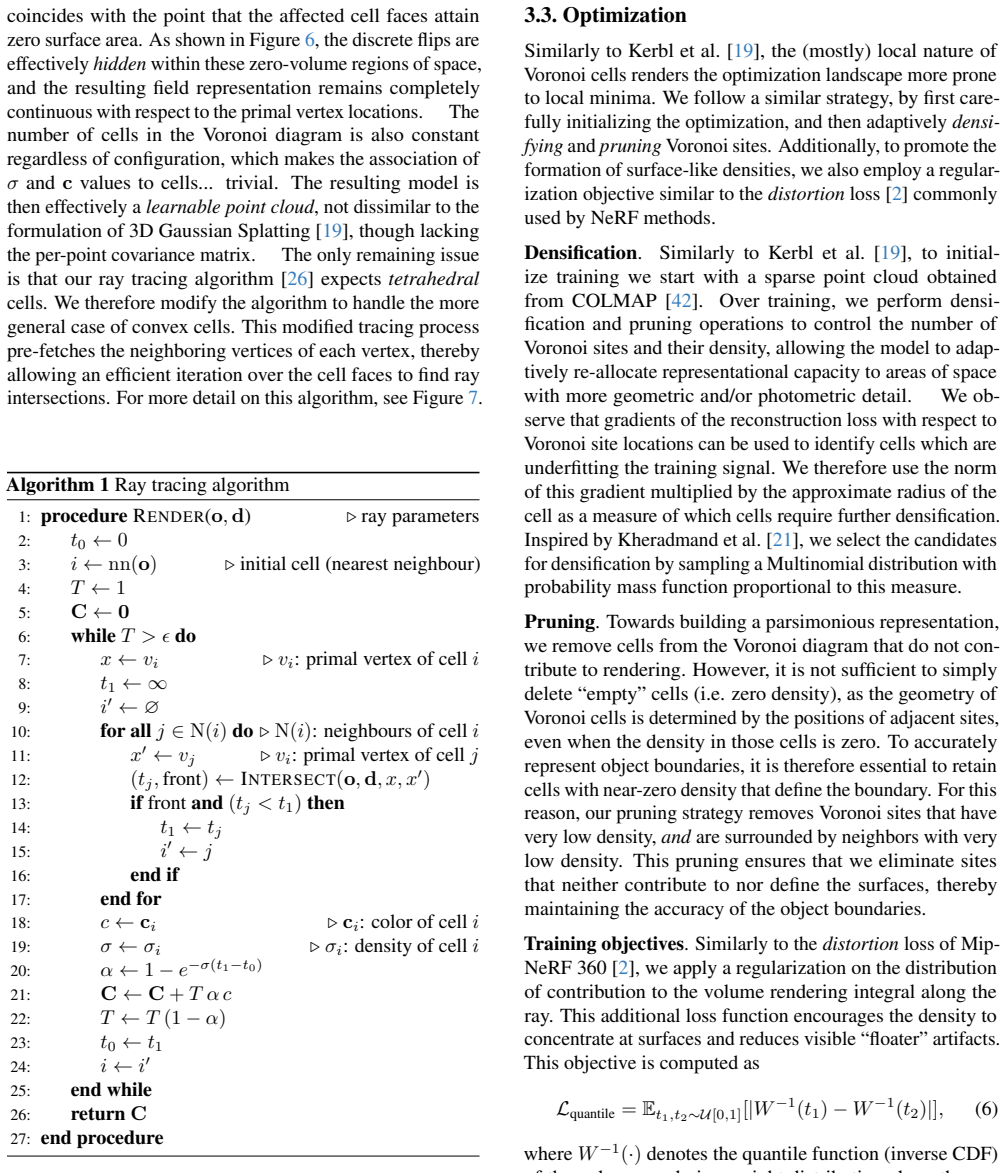
The central object is the Voronoi diagram of a set of optimizable sites, the 'foam' whose bubbles partition space into convex polyhedral cells, each storing a scalar density and spherical-harmonic color. The exact piecewise-constant volume rendering integral is evaluated by a cell-to-cell traversal that iterates the faces of the current cell to find the exit face, modified from the classical tetrahedral traversal to handle general convex cells; no hierarchical acceleration structure is needed. The differentiability hinge is the duality with the Delaunay triangulation: discrete connectivity flips occur at configurations where the changed face has zero area, so ray-segment lengths and therefore the rendered pixel values are continuous functions of the site positions.
What would settle it
Instrument a standard 20,000-iteration training run on a Mip-NeRF 360 scene to count how many incremental Delaunay rebuilds fail when sites become near-coincident; if failures are frequent, or if a variant that rebuilds from scratch with exact predicates achieves clearly better quality, the continuity guarantee the method depends on is not holding in practice.
Extended reading notes
Core claim
The core discovery is that a volumetric mesh parameterized as a Voronoi diagram is both renderable in real time and continuously optimizable. The paper adapts a two-decade-old volumetric mesh ray tracing algorithm that needs no acceleration structure and no specialized ray tracing hardware: a ray steps from cell to neighboring cell through the convex polyhedron faces, and the volume rendering integral is evaluated in closed form per cell. To make the mesh learnable, connectivity is defined through the Delaunay triangulation of the site positions, and although Delaunay connectivity flips discretely when one site crosses another's circumsphere, the dual Voronoi diagram experiences these flips exactly at configurations where the affected face has zero area, so cell geometry and rendered colors vary continuously with the sites. Training follows the NeRF recipe: a photometric loss plus a quantile regularization, with adaptive densification and pruning of sites. The paper reports frame rates above 300 FPS on some scenes and quality metrics close to those of 3DGS, all on a consumer GPU without RT cores or acceleration APIs.
Load-bearing premise
The training pipeline depends on the incremental Delaunay triangulation not failing numerically when sites become very close or identical, and the paper itself concedes that this triangulation algorithm can fail on such inputs, which would break the connectivity that the differentiability argument relies on.
Editorial extensions
If this is right
- A ray-based differentiable renderer can run at hundreds of frames per second on ordinary GPUs, so real-time radiance field rendering no longer has to choose between rasterization speed and ray tracing flexibility.
- Effects that are hard to rasterize — reflections, refractions, transparency, and non-linear camera models — become minor changes to the rendering code rather than research projects.
- Because training is ray-based, established NeRF-style objectives such as distortion or quantile regularization transfer directly to the mesh representation.
- Because the geometry is an explicit polyhedral mesh, surface extraction and spatial queries are more direct than for implicit fields.
Reading between the lines
- The same Voronoi parameterization could serve other differentiable geometry problems, such as inverse rendering or physics simulation, wherever discrete topology changes currently block gradient flow.
- A concrete extension is to replace per-cell spherical-harmonic colors with a small per-cell network or a texture atlas on cell faces; the explicit foam geometry supports this without changing the ray traversal.
- The paper's limitation note suggests relaxing the equidistant-boundary constraint of Voronoi cells (for example toward weighted or power diagrams) as the natural next step, potentially removing the need for many thin empty cells at surfaces.
- If the hardware-free claim holds, a WebGL or mobile port would be a strong independent demonstration; a browser demo running at interactive rates would confirm the central speed claim beyond the reported benchmarks.
Editorial analysis
A structured set of objections, weighed in public.
Referee Report
Summary. The paper introduces Radiant Foam, a differentiable scene representation based on a Voronoi diagram whose polyhedral cells carry constant density and view-dependent color. Rendering is performed by a ray-stepping algorithm that traverses the convex cells without a hierarchical acceleration structure or dedicated ray-tracing hardware. The parameters (Voronoi site positions, density, spherical-harmonic color) are optimized via volume rendering against photometric loss with a quantile regularization, plus densification and pruning. On the Mip-NeRF 360 and Deep Blending datasets, the method reports quality close to 3D Gaussian Splatting while reaching higher frame rates than 3DGRT, and the paper argues that the representation keeps ray tracing advantages such as reflections and refractions.
Significance. If the claims hold, this is a meaningful contribution: it would be the first differentiable ray-based representation to match rasterization-based 3DGS in speed and quality on commodity GPUs without relying on RTX/OptiX, potentially enabling light-transport effects that are difficult in splatting. The paper is clearly written, the ray-marching algorithm is simple, and the per-scene tables provide a useful level of detail. The central speed/quality claim, however, rests on experimental comparisons and on the assumption that the optimized mesh is the true continuous Voronoi representation, and both of these need stronger support.
major comments (4)
- [Section 3.4 and Section 4.1] The continuity argument in Section 3.2 applies to the exact Voronoi diagram, but the implementation updates the adjacency structure only every 1-100 optimizer steps, and Section 4.1 states that the incremental Delaunay triangulation can fail on very close or identical points. Between rebuilds, the renderer traces cells defined by stale neighbor sets, so the gradients actually used in training are not those of the continuous representation analyzed in Section 3.2, and densification deliberately creates close points that trigger the identified failure mode. Please report the frequency of triangulation failures during training, add an ablation that rebuilds the mesh every step or otherwise controls the rebuild frequency, and provide evidence that the stale-mesh approximation does not bias the reported quality and speed numbers; as written, the central claim depends on an assumption about the optimized object that the paper does not verify.
- [Table 1 and Section 4 (Quantitative results)] The headline FPS comparison against 3DGRT is not apples-to-apples: the 3DGRT frame rates are taken from the original publication and were measured on an RTX 6000 Ada GPU, while Radiant Foam frame rates were measured on an RTX 4090. The text's statement that the method is 'more than twice as fast as 3DGRT' cannot be supported by this comparison because the hardware difference alone can account for a large speed gap. Please measure both methods on the same GPU (or provide a normalized comparison) and report per-scene FPS with measurement variability.
- [Tables 1-4] The reported quality differences between Radiant Foam and 3DGS are small (e.g., 28.47 vs. 28.69 PSNR on Mip-NeRF 360, and 28.95 vs. 29.41 on Deep Blending), and the training pipeline includes stochastic components such as multinomial densification sampling and random initialization in ablations. Without error bars or multiple seeds, the claim of 'comparable' quality is not statistically supported. Please report means and standard deviations over at least three independent runs, or clearly justify why the pipeline is deterministic and the reported numbers are exact.
- [Table 2 and Section 4.1] The no-densification ablation is confounded with the no-SfM-initialization ablation. The row with both SfM and Densify unchecked uses the random initialization strategy described in Section 4.1, because the triangulation cannot handle duplicated or perturbed SfM points. The large PSNR drop in that row therefore cannot be attributed solely to removing densification. Please add an experiment that keeps the SfM initialization while disabling densification (or otherwise isolates the two factors), or clearly label the row as a joint ablation.
minor comments (5)
- [Equation (3)] Equation (3) contains an extraneous 'dt' at the end of the sum; the term should be 'cn' only, since the integral has already been converted into a discrete sum.
- [Table 4] In Table 4, the Dr Johnson row reports '28.33 / /0.88 / 0.27', which has an extra slash before the SSIM value; this should be corrected.
- [Section 5 (Limitations)] The sentence in the Limitations section that 'foam-based ray tracing can exceed the performance of dedicated ray tracing hardware' overstates the evidence, since the only FPS comparison with 3DGRT is across different GPUs; please qualify this claim.
- [Section 3.2] The sentence 'the number of tetrahedra in this model is not fixed in this model' contains a duplicated phrase; it should read 'is not fixed' or 'is variable'.
- [Figure 8] The label 'No Densify+SFM' in the figure caption is ambiguous; it appears to refer to a condition without both densification and SfM initialization, but the caption and table should make clear that this is a joint ablation, not a single-factor one.
Circularity Check
No significant circularity: the claimed speed/quality result is evaluated on held-out novel views against external baselines, and the self-citations are to borrowed techniques, not to the prediction itself.
full rationale
Radiant Foam's central claim is an empirical one: that a Voronoi-cell ray tracer can reach rendering speed and quality comparable to 3D Gaussian Splatting. This claim is tested by optimizing the representation on training views and measuring PSNR/SSIM/LPIPS on held-out views from the Mip-NeRF 360 and Deep Blending datasets, with frame rates measured on an RTX 4090. The comparison targets are external methods (3DGS, Mip-Splatting, 3DGS-MCMC, 3DGRT, Mip-NeRF 360, etc.), so the headline numbers are not constructed from the model's own definitions. The optimization objective L = Lrgb + λLquantile reuses the Mip-NeRF 360 distortion-loss idea, but that is a regularization term, not the quantity being predicted. The ray-marching algorithm is credited to the external Weiler et al. work, and the Delaunay/Voronoi machinery is classical. The paper does cite the authors' own prior work—DeRF [36] in the related-work discussion and 3DGS-MCMC [21] as inspiration for densification sampling—but neither citation defines the reported quality/speed result or acts as a uniqueness theorem that forces the representation. The manuscript's own stated limitation that the incremental triangulation 'can fail when processing very close (or identical) points' is a numerical robustness caveat; it weakens confidence in the implementation but does not make the derivation circular. No fitted parameter is renamed as a prediction, and no equation reduces to its own input by construction.
Assumptions & free parameters
free parameters (4)
- Quantile loss weight lambda
- Initial learning rates for position, density, SH =
2e-4, 1e-1, 5e-3
- Densification and pruning thresholds
- Point growth and mesh rebuild schedule =
grow until 50% of iterations; rebuild ratio 1:1 to 1:100
assumptions (5)
- standard math The piecewise-constant volume rendering integral (Eq. 3) exactly models the radiance field when density and color are constant inside each Voronoi cell.
- standard math For a convex polyhedral cell, the exit point of a ray is the closest front-facing face intersection found by iterating over all faces.
- domain assumption Discrete Voronoi connectivity flips do not disrupt gradient-based optimization because affected faces have zero area at the flip.
- domain assumption COLMAP SfM point clouds provide a sufficiently good initialization for Voronoi sites.
- domain assumption The incremental Delaunay triangulation remains numerically robust during training.
Cite this review
Pith. "Pith review of Radiant Foam: Real-Time Differentiable Ray Tracing." pith.science (2026). https://pith.science/paper/NA62OPHW
@misc{pith2026250201157,
  author       = {Pith},
  title        = {Pith review of: Radiant Foam: Real-Time Differentiable Ray Tracing},
  year         = {2026},
  howpublished = {\url{https://pith.science/paper/NA62OPHW}},
  note         = {Machine review of arXiv:2502.01157}
}
read the original abstract
Research on differentiable scene representations is consistently moving towards more efficient, real-time models. Recently, this has led to the popularization of splatting methods, which eschew the traditional ray-based rendering of radiance fields in favor of rasterization. This has yielded a significant improvement in rendering speeds due to the efficiency of rasterization algorithms and hardware, but has come at a cost: the approximations that make rasterization efficient also make implementation of light transport phenomena like reflection and refraction much more difficult. We propose a novel scene representation which avoids these approximations, but keeps the efficiency and reconstruction quality of splatting by leveraging a decades-old efficient volumetric mesh ray tracing algorithm which has been largely overlooked in recent computer vision research. The resulting model, which we name Radiant Foam, achieves rendering speed and quality comparable to Gaussian Splatting, without the constraints of rasterization. Unlike ray traced Gaussian models that use hardware ray tracing acceleration, our method requires no special hardware or APIs beyond the standard features of a programmable GPU.
Figures


Figures from the paper (5 more)



Forward citations
Cited by 3 Pith papers
-
ContraGS: Codebook-Condensed and Trainable Gaussian Splatting for Fast, Memory-Efficient Reconstruction
ContraGS trains 3D Gaussian Splatting directly on codebook-compressed representations, cutting peak model memory ~3.5x with small quality loss.
-
Spherical Voronoi: Directional Appearance as a Differentiable Partition of the Sphere
Spherical Voronoi—a softmax partition of the sphere with learnable sites—is proposed as a differentiable appearance basis for Gaussian splatting, improving view-dependent radiance and reflection modeling.
-
A Bag of Tricks for Efficient Implicit Neural Point Clouds
A curated set of sampling, rasterization, and CNN pretraining tricks doubles rendering speed and cuts training time and memory of implicit neural point clouds with no loss of image quality.
Reference graph
Works this paper leans on
-
[1]
Barron, Ben Mildenhall, Matthew Tancik, Peter Hedman, Ricardo Martin-Brualla, and Pratul P
Jonathan T. Barron, Ben Mildenhall, Matthew Tancik, Peter Hedman, Ricardo Martin-Brualla, and Pratul P. Srinivasan. Mip-nerf: A multiscale representation for anti-aliasing neural radiance fields. ICCV, 2021
2021
-
[2]
Barron, Ben Mildenhall, Dor Verbin, Pratul P
Jonathan T. Barron, Ben Mildenhall, Dor Verbin, Pratul P. Srinivasan, and Peter Hedman. Mip-nerf 360: Unbounded anti-aliased neural radiance fields. CVPR, 2022
2022
-
[3]
Barron, Ben Mildenhall, Dor Verbin, Pratul P
Jonathan T. Barron, Ben Mildenhall, Dor Verbin, Pratul P. Srinivasan, and Peter Hedman. Zip-nerf: Anti- aliased grid-based neural radiance fields. ICCV, 2023
work page 2023
-
[4]
Revising densification in gaussian splat- ting, 2024
Samuel Rota Bul `o, Lorenzo Porzi, and Peter Kontschieder. Revising densification in gaussian splat- ting, 2024
work page 2024
-
[5]
Zhiqin Chen, Thomas Funkhouser, Peter Hedman, and Andrea Tagliasacchi. Mobilenerf: Exploiting the poly- gon rasterization pipeline for efficient neural field ren- dering on mobile architectures. In CVPR, 2023
work page 2023
-
[6]
Boris Delaunay. Sur la sphere vide. Bulletin of the Academy of Sciences of the USSR Classe des Sciences Mathematiques et Naturelles, 1934
work page 1934
-
[7]
Smerf: Streamable memory efficient radiance fields for real- time large-scene exploration
Daniel Duckworth, Peter Hedman, Christian Reiser, Peter Zhizhin, Jean-Fran c ¸ois Thibert, Mario Lu ˇci´c, Richard Szeliski, and Jonathan T Barron. Smerf: Streamable memory efficient radiance fields for real- time large-scene exploration. ACM Transactions on Graphics (TOG), 43(4):1–13, 2024
work page 2024
-
[8]
Lightgaussian: Un- bounded 3d gaussian compression with 15x reduction and 200+ fps
Zhiwen Fan, Kevin Wang, Kairun Wen, Zehao Zhu, Dejia Xu, and Zhangyang Wang. Lightgaussian: Un- bounded 3d gaussian compression with 15x reduction and 200+ fps. arXiv preprint arXiv:2311.17245, 2023
arXiv 2023
Show all 57 references
-
[9]
Relightable 3d gaussian: Real- time point cloud relighting with brdf decomposition and ray tracing
Jian Gao, Chun Gu, Youtian Lin, Hao Zhu, Xun Cao, Li Zhang, and Yao Yao. Relightable 3d gaussian: Real- time point cloud relighting with brdf decomposition and ray tracing. arXiv preprint arXiv:2311.16043 , 2023
2023 arXiv
-
[10]
Tetrahedron splatting for 3d generation
Chun Gu, Zeyu Yang, Zijie Pan, Xiatian Zhu, and Li Zhang. Tetrahedron splatting for 3d generation. In NeurIPS, 2024
2024
-
[11]
Sugar: Surface- 9 aligned gaussian splatting for efficient 3d mesh recon- struction and high-quality mesh rendering
Antoine Gu´edon and Vincent Lepetit. Sugar: Surface- 9 aligned gaussian splatting for efficient 3d mesh recon- struction and high-quality mesh rendering. In Proceed- ings of the IEEE/CVF Conference on Computer Vision and Pattern Recognition (CVPR), pages 5354–5363, 2024
2024
-
[12]
Primitives for the manipulation of general subdivisions and the compu- tation of voronoi
Leonidas Guibas and Jorge Stolfi. Primitives for the manipulation of general subdivisions and the compu- tation of voronoi. ACM Trans. Graph., 4(2):74–123, 1985
1985
-
[13]
Deep blending for free-viewpoint image-based rendering
Peter Hedman, Julien Philip, True Price, Jan-Michael Frahm, George Drettakis, and Gabriel Brostow. Deep blending for free-viewpoint image-based rendering. 37 (6):257:1–257:15, 2018
2018
-
[14]
2d gaussian splatting for geomet- rically accurate radiance fields
Binbin Huang, Zehao Yu, Anpei Chen, Andreas Geiger, and Shenghua Gao. 2d gaussian splatting for geomet- rically accurate radiance fields. In ACM SIGGRAPH 2024 Conference Papers, New York, NY , USA, 2024. Association for Computing Machinery
2024
-
[15]
On the error analysis of 3d gaussian splatting and an optimal projection strategy
Letian Huang, Jiayang Bai, Jie Guo, Yuanqi Li, and Yanwen Guo. On the error analysis of 3d gaussian splatting and an optimal projection strategy. arXiv preprint arXiv:2402.00752, 2024
2024 arXiv
-
[16]
Gaus- sianshader: 3d gaussian splatting with shading func- tions for reflective surfaces
Yingwenqi Jiang, Jiadong Tu, Yuan Liu, Xifeng Gao, Xiaoxiao Long, Wenping Wang, and Yuexin Ma. Gaus- sianshader: 3d gaussian splatting with shading func- tions for reflective surfaces. In Proceedings of the IEEE/CVF Conference on Computer Vision and Pat- tern Recognition, page...
2024
-
[17]
Harmonic coordinates for character articulation
Pushkar Joshi, Mark Meyer, Tony DeRose, Brian Green, and Tom Sanocki. Harmonic coordinates for character articulation. ACM transactions on graphics (TOG), 26(3):71–es, 2007
2007
-
[18]
The rendering equation
James T Kajiya. The rendering equation. In Proceed- ings of the 13th annual conference on Computer graph- ics and interactive techniques, 1986
1986
-
[19]
3d gaussian splatting for real-time radiance field rendering
Bernhard Kerbl, Georgios Kopanas, Thomas Leimk¨uhler, and George Drettakis. 3d gaussian splatting for real-time radiance field rendering. ACM Transactions on Graphics, 42(4), 2023
2023
-
[20]
A hierarchical 3d gaussian repre- sentation for real-time rendering of very large datasets
Bernhard Kerbl, Andreas Meuleman, Georgios Kopanas, Michael Wimmer, Alexandre Lanvin, and George Drettakis. A hierarchical 3d gaussian repre- sentation for real-time rendering of very large datasets. ACM Transactions on Graphics, 43(4), 2024
2024
-
[21]
3d gaussian splatting as markov chain monte carlo
Shakiba Kheradmand, Daniel Rebain, Gopal Sharma, Weiwei Sun, Jeff Tseng, Hossam Isack, Abhishek Kar, Andrea Tagliasacchi, and Kwang Moo Yi. 3d gaussian splatting as markov chain monte carlo. NeurIPS, 2024
2024
-
[22]
Adam: A method for stochastic optimization
Diederik P Kingma. Adam: A method for stochastic optimization. arXiv preprint arXiv:1412.6980, 2014
2014 arXiv
-
[23]
Tetra-nerf: Rep- resenting neural radiance fields using tetrahedra
Jonas Kulhanek and Torsten Sattler. Tetra-nerf: Rep- resenting neural radiance fields using tetrahedra. In ICCV, 2023
2023
-
[24]
Pulsar: Ef- ficient sphere-based neural rendering
Christoph Lassner and Michael Zollhofer. Pulsar: Ef- ficient sphere-based neural rendering. In Proceedings of the IEEE/CVF Conference on Computer Vision and Pattern Recognition, pages 1440–1449, 2021
2021
-
[25]
Gs-ir: 3d gaussian splatting for inverse ren- dering
Zhihao Liang, Qi Zhang, Ying Feng, Ying Shan, and Kui Jia. Gs-ir: 3d gaussian splatting for inverse ren- dering. In Proceedings of the IEEE/CVF Conference on Computer Vision and Pattern Recognition , pages 21644–21653, 2024
2024
-
[26]
Fast ray traver- sal of tetrahedral and hexahedral meshes for direct volume rendering
Gerd Marmitt and Philipp Slusallek. Fast ray traver- sal of tetrahedral and hexahedral meshes for direct volume rendering. In Proceedings of the Joint Eu- rographics/IEEE VGTC conference on Visualization, pages 235–242, 2006
2006
-
[27]
Local and global illu- mination in the volume rendering integral
Nelson Max and Min Chen. Local and global illu- mination in the volume rendering integral. Technical report, Lawrence Livermore National Lab. (LLNL), Livermore, CA (United States), 2005
2005
-
[28]
Srinivasan, Matthew Tancik, Jonathan T
Ben Mildenhall, Pratul P. Srinivasan, Matthew Tancik, Jonathan T. Barron, Ravi Ramamoorthi, and Ren Ng. Nerf: Representing scenes as neural radiance fields for view synthesis. ECCV, 2020
2020
-
[29]
3d gaussian ray tracing: Fast tracing of particle scenes
Nicolas Moenne-Loccoz, Ashkan Mirzaei, Or Perel, Riccardo de Lutio, Janick Martinez Esturo, Gavriel State, Sanja Fidler, Nicholas Sharp, and Zan Gojcic. 3d gaussian ray tracing: Fast tracing of particle scenes. ACM Transactions on Graphics and SIGGRAPH Asia, 2024
2024
-
[30]
Instant neural graphics primitives with a multiresolution hash encoding
Thomas M ¨uller, Alex Evans, Christoph Schied, and Alexander Keller. Instant neural graphics primitives with a multiresolution hash encoding. SIGGRAPH, 2022
2022
-
[31]
Compressed 3d gaussian splatting for accelerated novel view synthesis
Simon Niedermayr, Josef Stumpfegger, and R ¨udiger Westermann. Compressed 3d gaussian splatting for accelerated novel view synthesis. In Proceedings of the IEEE/CVF Conference on Computer Vision and Pattern Recognition, pages 10349–10358, 2024
2024
-
[32]
Radsplat: Radiance field-informed gaussian splatting for robust real-time rendering with 900+ fps
Michael Niemeyer, Fabian Manhardt, Marie-Julie Rakotosaona, Michael Oechsle, Daniel Duckworth, Rama Gosula, Keisuke Tateno, John Bates, Dominik Kaeser, and Federico Tombari. Radsplat: Radiance field-informed gaussian splatting for robust real-time rendering with 900+ fps. arXi...
2024
-
[33]
Re- ducing the memory footprint of 3d gaussian splatting
Panagiotis Papantonakis, Georgios Kopanas, Bernhard Kerbl, Alexandre Lanvin, and George Drettakis. Re- ducing the memory footprint of 3d gaussian splatting. Proceedings of the ACM on Computer Graphics and Interactive Techniques, 7(1):1–17, 2024
2024
-
[34]
Surfels: Surface elements as ren- dering primitives
Hanspeter Pfister, Matthias Zwicker, Jeroen Van Baar, and Markus Gross. Surfels: Surface elements as ren- dering primitives. In Proceedings of the 27th annual conference on Computer graphics and interactive tech- niques, pages 335–342, 2000. 10
2000
-
[35]
Stopthepop: Sorted gaussian splatting for view- consistent real-time rendering
Lukas Radl, Michael Steiner, Mathias Parger, Alexan- der Weinrauch, Bernhard Kerbl, and Markus Stein- berger. Stopthepop: Sorted gaussian splatting for view- consistent real-time rendering. ACM Transactions on Graphics (TOG), 2024
2024
-
[36]
Derf: De- composed radiance fields
Daniel Rebain, Wei Jiang, Soroosh Yazdani, Ke Li, Kwang Moo Yi, and Andrea Tagliasacchi. Derf: De- composed radiance fields. In Proceedings of the IEEE/CVF Conference on Computer Vision and Pattern Recognition (CVPR), pages 14153–14161, 2021
2021
-
[37]
Kilonerf: Speeding up neural radiance fields with thousands of tiny mlps
Christian Reiser, Songyou Peng, Yiyi Liao, and An- dreas Geiger. Kilonerf: Speeding up neural radiance fields with thousands of tiny mlps. In Proceedings of the IEEE/CVF international conference on computer vision, pages 14335–14345, 2021
2021
-
[38]
Binary opacity grids: Capturing fine geometric detail for mesh-based view synthesis
Christian Reiser, Stephan Garbin, Pratul Srini- vasan, Dor Verbin, Richard Szeliski, Ben Mildenhall, Jonathan Barron, Peter Hedman, and Andreas Geiger. Binary opacity grids: Capturing fine geometric detail for mesh-based view synthesis. ACM Transactions on Graphics (TOG), 43(4...
2024
-
[39]
Octree-gs: Towards consistent real-time rendering with lod-structured 3d gaussians
Kerui Ren, Lihan Jiang, Tao Lu, Mulin Yu, Linning Xu, Zhangkai Ni, and Bo Dai. Octree-gs: Towards consistent real-time rendering with lod-structured 3d gaussians. arXiv preprint arXiv:2403.17898, 2024
2024 arXiv
-
[40]
Ob- ject space ewa surface splatting: A hardware accel- erated approach to high quality point rendering
Liu Ren, Hanspeter Pfister, and Matthias Zwicker. Ob- ject space ewa surface splatting: A hardware accel- erated approach to high quality point rendering. In Computer Graphics Forum, pages 461–470. Wiley On- line Library, 2002
2002
-
[41]
Plenoxels: Radiance fields without neural networks
Sara Fridovich-Keil and Alex Yu, Matthew Tancik, Qin- hong Chen, Benjamin Recht, and Angjoo Kanazawa. Plenoxels: Radiance fields without neural networks. In CVPR, 2022
2022
-
[42]
Structure-from-motion revisited
Johannes Lutz Sch ¨onberger and Jan-Michael Frahm. Structure-from-motion revisited. Conference on Com- puter Vision and Pattern Recognition (CVPR), 2016
2016
-
[43]
Gaussian splatting on the move: Blur and rolling shutter compensation for natural camera motion
Otto Seiskari, Jerry Ylilammi, Valtteri Kaatrasalo, Pekka Rantalankila, Matias Turkulainen, Juho Kan- nala, Esa Rahtu, and Arno Solin. Gaussian splatting on the move: Blur and rolling shutter compensation for natural camera motion. In European Conference on Computer Vision, pa...
2025
-
[44]
V olumetric rendering with baked quadrature fields
Gopal Sharma, Daniel Rebain, Kwang Moo Yi, and Andrea Tagliasacchi. V olumetric rendering with baked quadrature fields. ECCV, 2024
2024
-
[45]
Deep marching tetrahedra: a hybrid representation for high-resolution 3d shape synthesis
Tianchang Shen, Jun Gao, Kangxue Yin, Ming-Yu Liu, and Sanja Fidler. Deep marching tetrahedra: a hybrid representation for high-resolution 3d shape synthesis. NeurIPS, 2021
2021
-
[46]
Delaunay refinement algorithms for triangular mesh generation
Jonathan Richard Shewchuk. Delaunay refinement algorithms for triangular mesh generation. Compu- tational Geometry , 22(1):21–74, 2002. 16th ACM Symposium on Computational Geometry
2002
-
[47]
V olume ren- dering digest (for nerf), 2022
Andrea Tagliasacchi and Ben Mildenhall. V olume ren- dering digest (for nerf), 2022
2022
-
[48]
Nouvelles applications des param`etres continus `a la th ´eorie des formes quadra- tiques
Georges V oronoi. Nouvelles applications des param`etres continus `a la th ´eorie des formes quadra- tiques. Journal f¨ur die reine und angewandte Mathe- matik (Crelles Journal), 1908
1908
-
[49]
Neus: Learning neural implicit surfaces by volume rendering for multi- view reconstruction
Peng Wang, Lingjie Liu, Yuan Liu, Christian Theobalt, Taku Komura, and Wenping Wang. Neus: Learning neural implicit surfaces by volume rendering for multi- view reconstruction. arXiv preprint arXiv:2106.10689, 2021
2021 arXiv
-
[50]
Adaptive shells for efficient neural radiance field rendering
Zian Wang, Tianchang Shen, Merlin Nimier-David, Nicholas Sharp, Jun Gao, Alexander Keller, Sanja Fi- dler, Thomas M¨uller, and Zan Gojcic. Adaptive shells for efficient neural radiance field rendering. arXiv preprint arXiv:2311.10091, 2023
2023 arXiv
-
[51]
D. F. Watson. Computing the n-dimensional delaunay tessellation with application to voronoi polytopes. The Computer Journal, 24(2):167–172, 1981
1981
-
[52]
Weiler, M
M. Weiler, M. Kraus, M. Merz, and T. Ertl. Hardware- based view-independent cell projection. IEEE Trans- actions on Visualization and Computer Graphics, 9(2): 163–175, 2003
2003
-
[53]
An improved illumination model for shaded display
Turner Whitted. An improved illumination model for shaded display. In ACM Siggraph 2005 Courses, pages 4–es. 2005
2005
-
[54]
V olume rendering of neural implicit surfaces.Advances in Neural Information Processing Systems, 34:4805– 4815, 2021
Lior Yariv, Jiatao Gu, Yoni Kasten, and Yaron Lipman. V olume rendering of neural implicit surfaces.Advances in Neural Information Processing Systems, 34:4805– 4815, 2021
2021
-
[55]
Mip-splatting: Alias-free 3d gaus- sian splatting
Zehao Yu, Anpei Chen, Binbin Huang, Torsten Sattler, and Andreas Geiger. Mip-splatting: Alias-free 3d gaus- sian splatting. Conference on Computer Vision and Pattern Recognition (CVPR), 2024
2024
-
[56]
Surface splatting
Matthias Zwicker, Hanspeter Pfister, Jeroen van Baar, and Markus Gross. Surface splatting. In Proceedings of the 28th Annual Conference on Computer Graphics and Interactive Techniques, page 371–378, New York, NY , USA, 2001. Association for Computing Machin- ery. 11 3DGS [19] ...
2001
-
[57]
These include results for both Mip-NeRF360 [2] and Deep Blending [13] scenes
Per Scene metrics Tables 3 and 4 summarize the error metrics collected for our evaluation of all considered techniques. These include results for both Mip-NeRF360 [2] and Deep Blending [13] scenes. However, 3DGRT [29] is excluded from per-scene comparisons as these values are ...
Reviewed August 9, 2026 · model on record in the stance chip above.
Discussion (0). Continue with ORCID to comment.