REVIEW 4 major objections 5 minor 29 references
Molecular Odor Prediction with Harmonic Modulated Feature Mapping and Chemically-Informed Loss
T0 review · 4 major / 5 minor · reviewed 2026-08-09 · deepseek-v4-flash
Pith's one-line read The paper claims that a harmonic-modulated feature mapping and a chemically-informed loss improve molecular odor prediction across GCN, GraphSAGE, and MPNN, raising the best F1 score from 0.3230 to 0.4780 on a 5,788-molecule dataset.
desk verdict Plausible loss and feature-mapping ideas, but the central F1 claim rests on baselines that move between tables; needs a fixed-protocol re-run before the numbers can be trusted. read the letter →
The pith
A machine-rendered reading of the paper's core claim, the machinery that carries it, and where it could break.
The reading
What carries the argument
HMFM is a feature remapping layer: it computes importance weights $w_{\mathrm{imp}} = \sigma(\mathrm{LayerNorm}(\mathrm{Linear}(x)))$, forms weighted features $x' = x \odot w_{\mathrm{imp}}$, learns a modulation $f = \sigma(\mathrm{Linear}(x'))$, multiplies it by base frequencies $b = 2\pi\sigma' j/D$ to get $m = b \odot f$, and outputs $\mathrm{concat}(\cos(m \odot x'), \sin(m \odot x'))$ along the feature dimension. CIL is the loss $\mathcal{L}_{\mathrm{total}} = \mathcal{L}_{\mathrm{basis}} + \lambda_1 \mathcal{L}_{\mathrm{stt}} + \lambda_2 \mathcal{L}_{\mathrm{class}} + \lambda_3 \mathcal{L}_{\mathrm{sample}} + \lambda_4 \mathcal{L}_{\mathrm{col}}$, with the five terms being weighted BCE, structural-similarity consistency, a co-occurrence-adjusted energy target, a per-sample label-count constraint, and predicted-versus-true label correlation matching. These two objects carry the argument: the first changes the representation, the second changes what the network is optimized for.
What would settle it
Re-run GCN, GraphSAGE, and MPNN with and without HMFM and CIL across many random splits with fixed seeds, reporting the mean and standard deviation of F1 and AUROC; the central claim holds only if the combined method's mean F1 gain over the plain BCE baseline clearly exceeds the split-to-split variation. A second check is to shuffle the label co-occurrence matrix used to set the energy targets: if the F1 gain survives shuffling, then the chemical information in that loss term is not what produces the improvement.
Extended reading notes
Core claim
The paper's central claim is that the bottleneck in molecular odor prediction is not only the predictor architecture but also how atomic features are encoded and how label imbalance is penalized. In their telling, HMFM works because feature importance learning lets the model emphasize the atomic features that matter for odor, and frequency modulation supplies periodic and phase encodings that express non-linear structure-odor relationships while keeping feature dimensions independent. CIL works because it reweights minority descriptors, enforces consistent predictions among structurally similar molecules, sets per-descriptor energy targets from label co-occurrence, aligns predicted label counts with true counts, and matches predicted label correlations to observed correlations. Empirically, the paper reports that either component improves F1 on GCN, GraphSAGE, and MPNN, and the two together give the best results, with the largest combined gain on MPNN reaching F1=0.4780.
Load-bearing premise
The results rest on the assumption that the unstated train/test split, random seeds, and hyperparameter choices are fair; if any were tuned on the test set, the reported F1 gains could disappear.
Editorial extensions
If this is right
- If HMFM and CIL transfer to other molecule-property datasets, existing GCN, GraphSAGE, and MPNN models could be upgraded by swapping in one feature layer and one loss, without retraining from a new architecture.
- The F1 gains (from roughly 0.32 to 0.48 in the best case, with AUROC unchanged near 0.93) imply the method mainly improves precision-recall balance, especially for minority odor descriptors.
- CIL alone produces larger gains than HMFM alone in the reported tables, suggesting that imbalance-aware and co-occurrence-aware supervision carries most of the benefit.
- Because the method is defined at the feature and loss level, it should combine with any future graph backbone, keeping the claims relevant as architectures change.
Reading between the lines
- Editorial inference: the energy-target terms in CIL are computed from the same label matrix used for supervision, so the method implicitly bets that label co-occurrence frequencies encode genuine chemistry rather than dataset artifacts; a testable extension is to compare energy targets derived from an external chemical knowledge base.
- Editorial inference: HMFM's frequency encoding resembles a learned positional encoding, so the layer could be dropped into other molecular property tasks (solubility, toxicity, activity) to see whether the gains are odor-specific or general.
- Editorial inference: the paper reports single F1 and AUROC values without train/test split details, so the robustness of the margins across random splits is currently an open question that repeated-seed experiments would settle.
Editorial analysis
A structured set of objections, weighed in public.
Referee Report
Summary. The paper proposes two components for multi-label molecular odor prediction: Harmonic Modulated Feature Mapping (HMFM), which learns per-feature importance weights and modulates frequencies before concatenating sine/cosine encodings, and Chemically-Informed Loss (CIL), which combines weighted binary cross-entropy with structural similarity, energy-target, sample-level label-count, and label-correlation terms. Experiments are reported on a cleaned dataset of 5,788 molecules and 154 odor descriptors, using GCN, GraphSAGE, and MPNN backbones. The best combined model (MPNN+HMFM+CIL) reaches F1=0.4780 and AUROC=0.9309, compared to MPNN+BCE F1=0.3230. The paper concludes that the proposed method significantly improves molecular odor prediction accuracy across deep learning models.
Significance. If the empirical claims are reproducible, the proposed modules are simple, modular, and may be useful additions to molecular property prediction. The paper compares against several existing feature mappings and loss functions, and it explicitly addresses label imbalance and label co-occurrence. However, the current evidence is not sufficient to support the central claim. The evaluation protocol is underspecified, baseline results are inconsistent across tables, no error bars or significance tests are provided, and the 'chemical' grounding of the energy loss is derived from the same label matrix used for supervision. The contribution is plausible but unverified; the most valuable next step is a fully specified, reproducible evaluation with a single coherent training protocol.
major comments (4)
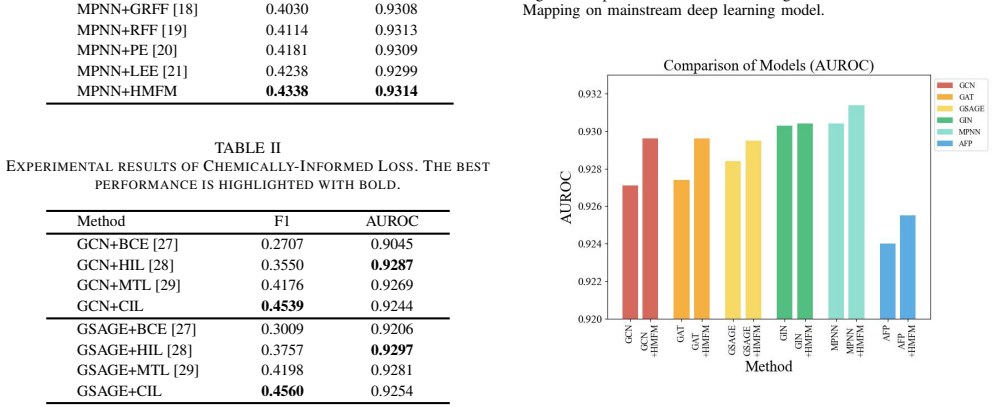
- [Section IV-B, Tables I-III] The baseline performance for the same architecture is not held constant across tables. For example, GCN appears as F1=0.3701 in Table I but as GCN+BCE F1=0.2707 in Table II; MPNN appears as F1=0.4235 in Table I and MPNN+BCE F1=0.3230 in Table II. Since the paper does not state what loss, split, or training protocol produced the Table I numbers, the apparent CIL gains (e.g., +0.15 F1 for MPNN relative to MPNN+BCE) could reflect a comparison against an under-tuned or differently configured baseline rather than the proposed method. The authors must report one consistent protocol in which all baselines and proposed variants share the same split, loss configuration, and tuning procedure.
- [Section IV-B and Eq. (18)] Neither the train/validation/test split nor the random seeds are reported, and the hyperparameters λ1–λ4, c, e1=e2=1, τ, and σ′ are asserted without describing how they were selected. If any of these hyperparameters were tuned on the test set, the reported gains could be inflated. Moreover, every result is a single F1/AUROC value with no error bars or significance tests; differences such as GCN+HMFM+CIL (0.4560) versus GCN+CIL (0.4539) are within plausible random variation. The abstract's claim of 'significantly' improving accuracy is therefore not supported by the reported evidence.
- [Section III-B, Eqs. (11)–(14)] The 'chemical property energy' targets min and mout are computed from the same label matrix used for supervision (Eqs. 12–13). They encode training-set label co-occurrence frequencies, not independent chemical or physical knowledge. The loss is a label-derived regularizer, and calling it 'chemically-informed' overstates its grounding. The authors should either supply independent chemical grounding (e.g., experimentally determined odor-descriptor affinities) or relabel the component and temper the corresponding scientific claim.
- [Section III-B, Eqs. (15)–(16)] The sample-level expected energy Eexpected(i)=e1+e2·Σ_j Y_ij and the resulting loss Lsample are also defined directly from label counts, so the 'expected energy' is a count-based target rather than an energy from a physical or chemical model. This is not necessarily an error, but the manuscript repeatedly invokes 'energy', 'physical laws', and 'chemical properties' without support. The component should be described as a heuristic regularizer unless an external energy model is provided.
minor comments (5)
- [Abstract and Section I] The abstract contains the ungrammatical phrase 'significantly can improves the accuracy'; Section I contains the typo 'coremainessential'. These should be corrected.
- [Table III] The row 'MPNN+HMFM+HIL' is inconsistent with the table's stated ablation of CIL and HMFM; it should read 'MPNN+HMFM+CIL' if that is the intended result, and otherwise the corresponding CIL experiment for MPNN is missing.
- [Figures 4 and 5] The captions describe 'histogram' comparisons, but the figures are bar charts. The captions should be reworded to match the plotted content.
- [Section IV-A] The dataset is described as 'the [22] dataset' and reference [22] is an arXiv preprint. Please provide the dataset version, license, and the exact cleaning/filtering steps as a reproducible pipeline, rather than a prose summary.
- [Eq. (9)] The structural similarity loss depends on a threshold τ, but no value or tuning method for τ is given in Section III-B or Section IV. Please report how τ was set and whether the results are sensitive to it.
Circularity Check
No circularity: the empirical claim is tested against external baselines; the label-derived energy targets are supervised regularization, not a self-derived prediction.
full rationale
The paper's central claim is empirical: HMFM and CIL improve F1/AUROC for GCN, GraphSAGE, and MPNN on a fixed molecular odor dataset. That claim is evaluated against external benchmark models and feature-mapping baselines (GRFF, RFF, PE, LEE) and loss baselines (BCE, HIL, MTL), so the reported comparisons do not reduce by construction to the paper's own inputs. The most self-referential-looking element is the 'chemical property energy' loss: Eqs. (12)-(13) set the energy targets min and mout directly from the same label matrix Y used for supervised loss and label-correlation loss, and Eq. (11) defines predicted energy as the average prediction probability. This means the 'chemical' constraint is not an externally supplied physical law but a label-derived target, which is a potential overclaim about chemical grounding. However, in a training-loss context this is target/regularization design, not a prediction derived from the prediction, and it does not force the reported gains: Table III still compares final models against plain GCN/GSAGE/MPNN baselines within the same experimental setup. The evaluation protocol concerns (unreported split, seeds, hyperparameter selection, and the inconsistency between Table I and Table II baseline F1 values) are reproducibility and correctness risks, not circularity. No load-bearing step in the derivation chain is equivalent to its own input, and there is no reliance on self-citations or imported uniqueness theorems.
Assumptions & free parameters
free parameters (9)
- lambda_1 =
0.3
- lambda_2 =
0.3
- lambda_3 =
0.5
- lambda_4 =
0.3
- c =
0.2
- e1 =
1
- e2 =
1
- similarity_threshold_tau =
not specified
- base_frequency_scale_sigma_prime =
not specified
assumptions (5)
- domain assumption Learned Fourier-type encoding can represent the non-smooth molecule-odor mapping.
- domain assumption The cleaned dataset of 5,788 molecules and 154 odor descriptors is a valid benchmark.
- ad hoc to paper Label co-occurrence frequencies in the training set encode chemical properties, so they can set energy targets.
- domain assumption Molecules with cosine similarity above threshold tau should have similar odor predictions.
- ad hoc to paper Evaluation split and hyperparameters are unbiased.
invented entities (1)
-
Odor descriptor energy E_j
Cite this review
Pith. "Pith review of Molecular Odor Prediction with Harmonic Modulated Feature Mapping and Chemically-Informed Loss." pith.science (2026). https://pith.science/paper/QVT2MH34
@misc{pith2026250201296,
  author       = {Pith},
  title        = {Pith review of: Molecular Odor Prediction with Harmonic Modulated Feature Mapping and Chemically-Informed Loss},
  year         = {2026},
  howpublished = {\url{https://pith.science/paper/QVT2MH34}},
  note         = {Machine review of arXiv:2502.01296}
}
read the original abstract
Molecular odor prediction has great potential across diverse fields such as chemistry, pharmaceuticals, and environmental science, enabling the rapid design of new materials and enhancing environmental monitoring. However, current methods face two main challenges: First, existing models struggle with non-smooth objective functions and the complexity of mixed feature dimensions; Second, datasets suffer from severe label imbalance, which hampers model training, particularly in learning minority class labels. To address these issues, we introduce a novel feature mapping method and a molecular ensemble optimization loss function. By incorporating feature importance learning and frequency modulation, our model adaptively adjusts the contribution of each feature, efficiently capturing the intricate relationship between molecular structures and odor descriptors. Our feature mapping preserves feature independence while enhancing the model's efficiency in utilizing molecular features through frequency modulation. Furthermore, the proposed loss function dynamically adjusts label weights, improves structural consistency, and strengthens label correlations, effectively addressing data imbalance and label co-occurrence challenges. Experimental results show that our method significantly can improves the accuracy of molecular odor prediction across various deep learning models, demonstrating its promising potential in molecular structure representation and chemoinformatics.
Figures


Figures from the paper (2 more)

Reference graph
Works this paper leans on
-
[1]
Odor prediction of whiskies based on their molecular composition,
S. Singh, D. Schicker, H. Haug, T. Sauerwald, and A. T. Grasskamp, “Odor prediction of whiskies based on their molecular composition,” Communications Chemistry, vol. 7, no. 1, p. 293, 2024
work page 2024
-
[2]
Predicting human olfactory perception from chemical features of odor molecules,
A. Keller, R. C. Gerkin, Y . Guan, A. Dhurandhar, G. Turu, B. Szalai, J. D. Mainland, Y . Ihara, C. W. Yu, R. Wolfinger et al., “Predicting human olfactory perception from chemical features of odor molecules,” Science, vol. 355, no. 6327, pp. 820–826, 2017
work page 2017
-
[3]
A. Sharma, R. Kumar, S. Ranjta, and P. K. Varadwaj, “Smiles to smell: decoding the structure–odor relationship of chemical compounds using the deep neural network approach,” Journal of Chemical Information and Modeling, vol. 61, no. 2, pp. 676–688, 2021
work page 2021
-
[4]
Q. Liu, D. Luo, T. Wen, H. GholamHosseini, X. Qiu, and J. Li, “Poi- 3dgcn: Predicting odor intensity of monomer flavors based on three- dimensionally embedded graph convolutional network,” Expert Systems with Applications, vol. 199, p. 116997, 2022
work page 2022
-
[5]
L. Zhang, H. Mao, L. Liu, J. Du, and R. Gani, “A machine learning based computeraided molecular design/screening methodology for fragrance molecules,” Computers Chemical Engineering, vol. 115, pp. 295–308, 2018
work page 2018
-
[6]
Predicting odor from molecular structure: A multi-label classification approach,
K. Saini and V . Ramanathan, “Predicting odor from molecular structure: A multi-label classification approach,” Scientific reports, vol. 12, no. 1, p. 13863, 2022
work page 2022
-
[7]
Padel-descriptor: An open source software to calculate molecular descriptors and fingerprints,
C. W. Yap, “Padel-descriptor: An open source software to calculate molecular descriptors and fingerprints,” Journal of computational chem- istry, vol. 32, no. 7, pp. 1466–1474, 2011
work page 2011
-
[8]
Mordred: a molecular descriptor calculator,
H. Moriwaki, Y .-S. Tian, N. Kawashita, and T. Takagi, “Mordred: a molecular descriptor calculator,” Journal of cheminformatics, vol. 10, pp. 1–14, 2018
work page 2018
Show all 29 references
-
[9]
Convolutional networks on graphs for learning molecular fingerprints,
D. K. Duvenaud, D. Maclaurin, J. Iparraguirre, R. Bombarell, T. Hirzel, A. Aspuru-Guzik, and R. P. Adams, “Convolutional networks on graphs for learning molecular fingerprints,” Advances in neural information processing systems, vol. 28, 2015
2015
-
[10]
A principal odor map unifies diverse tasks in olfactory perception,
B. K. Lee, E. J. Mayhew, B. Sanchez-Lengeling, J. N. Wei, W. W. Qian, K. A. Little, M. Andres, B. B. Nguyen, T. Moloy, J. Yasonik et al., “A principal odor map unifies diverse tasks in olfactory perception,” Science, vol. 381, no. 6661, pp. 999–1006, 2023
2023
-
[11]
Owsum: al- gorithmic odor prediction and insight into structure-odor relationships,
D. Schicker, S. Singh, J. Freiherr, and A. T. Grasskamp, “Owsum: al- gorithmic odor prediction and insight into structure-odor relationships,” Journal of Cheminformatics, vol. 15, no. 1, p. 51, 2023
2023
-
[12]
Predictive modeling for odor character of a chemical using machine learning combined with natural language processing,
Y . Nozaki and T. Nakamoto, “Predictive modeling for odor character of a chemical using machine learning combined with natural language processing,” PloS one, vol. 13, no. 6, p. e0198475, 2018
2018
-
[13]
Automatic chemical design using a data-driven continuous representation of molecules,
R. G ´omez-Bombarelli, J. N. Wei, D. Duvenaud, J. M. Hern´andezLobato, B. S ´anchez-Lengeling, D. Sheberla, J. Aguilera-Iparraguirre, T. D. Hirzel, R. P. Adams, and A. Aspuru- Guzik, “Automatic chemical design using a data-driven continuous representation of molecules,” ACS ce...
2018
-
[14]
Cross-entropy loss functions: Theoretical analysis and applications,
A. Mao, M. Mohri, and Y . Zhong, “Cross-entropy loss functions: Theoretical analysis and applications,” in International conference on Machine learning. PMLR, 2023, pp. 23 803–23 828
2023
-
[15]
Balanced energy regularization loss for out-of-distribution detection,
H. Choi, H. Jeong, and J. Y . Choi, “Balanced energy regularization loss for out-of-distribution detection,” in Proceedings of the IEEE/CVF Conference on Computer Vision and Pattern Recognition, 2023, pp. 15 691–15 700
2023
-
[16]
Leffingwell associates,
J. C. Leffingwell, “Leffingwell associates,” Chirality Odour Perception. Available online: http://www.leffingwell.com/chirality/chirality.htm (ac- cessed on 15 November 2023), 2005
2023
-
[17]
Food, and cosmetics ingredients information,
F. Flavor, “Food, and cosmetics ingredients information,” The Good Scents Company, 2018
2018
-
[18]
Local random feature approximations of the gaussian kernel,
J. Wacker and M. Filippone, “Local random feature approximations of the gaussian kernel,” Procedia Computer Science, vol. 207, pp. 987–996, 2022
2022
-
[19]
Random fourier feature-based deep learning for wireless communications,
R. Mitra and G. Kaddoum, “Random fourier feature-based deep learning for wireless communications,” IEEE Transactions on Cognitive Commu- nications and Networking, vol. 8, no. 2, pp. 468–479, 2022
2022
-
[20]
Prediction of anticancer peptides based on an ensemble model of deep learning and machine learning using ordinal positional encoding,
Q. Yuan, K. Chen, Y . Yu, N. Q. K. Le, and M. C. H. Chua, “Prediction of anticancer peptides based on an ensemble model of deep learning and machine learning using ordinal positional encoding,” Briefings in Bioinformatics, vol. 24, no. 1, p. bbac630, 2023
2023
-
[21]
Spatial smoothing using graph laplacian penalized filter,
H. Yamada, “Spatial smoothing using graph laplacian penalized filter,” Spatial Statistics, p. 100799, 2024
2024
-
[22]
Machine learning for scent: Learning generalizable perceptual representations of small molecules,
B. Sanchez-Lengeling, J. N. Wei, B. K. Lee, R. C. Gerkin, A. Aspu- ruGuzik, and A. B. Wiltschko, “Machine learning for scent: Learning generalizable perceptual representations of small molecules,” arXiv preprint arXiv:1910.10685, 2019
1910 arXiv
-
[23]
Incorporating la- bel dependency into the binary relevance framework for multi-label classification,
E. Alvares-Cherman, J. Metz, and M. C. Monard, “Incorporating la- bel dependency into the binary relevance framework for multi-label classification,” Expert Systems with Applications, vol. 39, no. 2, pp. 1647–1655, 2012
2012
-
[24]
Semi-supervised classification with graph convolutional networks,
T. N. Kipf and M. Welling, “Semi-supervised classification with graph convolutional networks,” arXiv preprint arXiv:1609.02907, 2016
2016 arXiv
-
[25]
Subgraph generation applied in graphsage deal with imbalanced node classification,
K. Huang and C. Chen, “Subgraph generation applied in graphsage deal with imbalanced node classification,” Soft Computing, pp. 1–14, 2024
2024
-
[26]
Application of message passing neural networks for molecular property prediction,
M. Tang, B. Li, and H. Chen, “Application of message passing neural networks for molecular property prediction,” Current Opinion in Struc- tural Biology, vol. 81, p. 102616, 2023
2023
-
[27]
Compression of molecular fingerprints with autoencoder networks,
A. Ilnicka and G. Schneider, “Compression of molecular fingerprints with autoencoder networks,” Molecular Informatics, vol. 42, no. 6, p. 2300059, 2023
2023
-
[28]
Hierarchy-aware biased bound margin loss function for hierarchical text classification,
G. Kim, S. Im, and H.-S. Oh, “Hierarchy-aware biased bound margin loss function for hierarchical text classification,” in Findings of the As- sociation for Computational Linguistics ACL 2024, 2024, pp. 76727682
2024
-
[29]
Multi-task learning using uncertainty to weigh losses for heterogeneous face attribute estimation,
H. Yuan, Y . He, P. Du, and L. Song, “Multi-task learning using uncertainty to weigh losses for heterogeneous face attribute estimation,” arXiv preprint arXiv:2403.00561, 2024
2024 arXiv
Reviewed August 9, 2026 · model on record in the stance chip above.
Discussion (0). Continue with ORCID to comment.