REVIEW 4 major objections 4 minor 44 references
Developing universal logical state-purification strategy for quantum error correcting codes
T0 review · 4 major / 4 minor · reviewed 2026-08-09 · deepseek-v4-flash
Pith's one-line read A thermal quantum error correcting code can be reset to any logical state with unit fidelity by one engineered interaction plus a post-selected ancilla measurement.
desk verdict A sound two-level purification argument with an honest limitation: the 'universal' Hamiltonian is only constructed for one small code, and the paper says so itself. read the letter →
The pith
A machine-rendered reading of the paper's core claim, the machinery that carries it, and where it could break.
The reading
What carries the argument
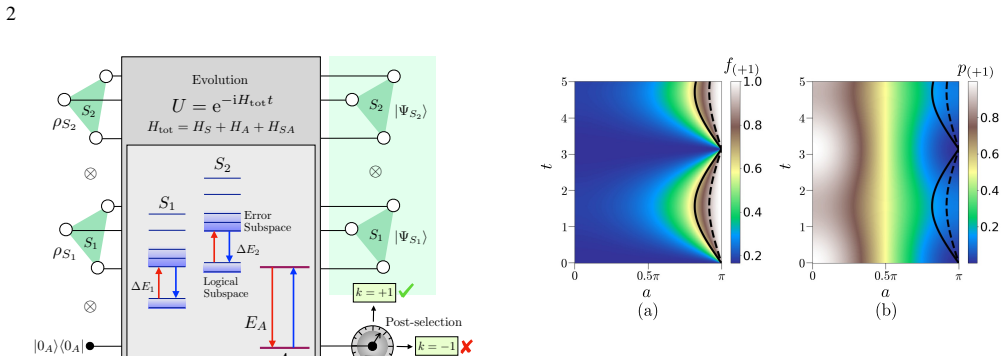
The load-bearing object is the interaction Hamiltonian $H_{SA}=g|\Psi_S\rangle\langle\Phi_S|\otimes|1_A\rangle\langle 0_A|+\mathrm{h.c.}$, where $|\Phi_S\rangle$ is a uniform superposition of the first-excited error states of all the codes and $|\Psi_S\rangle$ is the product of the desired logical states. It creates a two-level, energy-conserving transition between the error subspace and the logical subspace conditioned on the auxiliary qubit flipping; with the ancilla energy set to $E_A=\sum_i \Delta E_i$, time evolution produces Rabi-like oscillations between $|\Phi_S,0_A\rangle$ and $|\Psi_S,1_A\rangle$. A projective measurement on the ancilla and post-selection of the $+1$ outcome collapses the codes onto $|\Psi_S\rangle$. The closed-form expressions for the post-selected probability and fidelity, together with the parametrized measurement family $M_A(k,a,b)$, are what allow the authors to analyze both optimal and sub-optimal bases and to design the repeated 'evolve-measure-repeat' rounds.
What would settle it
Take a stabilizer code with distance at least three, construct the canonical $H_{SA}$ exactly from its error subspace, and numerically simulate the full evolution including all terms of $\rho_{SA}(t)$; the Proposition predicts fidelity exactly 1 for the $+1$ outcome at every time except $t=n\pi/g$, so any time at which the post-selected state deviates from $|\Psi_S\rangle$ would refute the unit-fidelity claim.
Extended reading notes
Core claim
The central claim is the Proposition: an arbitrary thermal state $\rho_S = \otimes_i \rho_{S_i}$ of $L$ quantum error correcting codes can be perfectly purified to the product logical state $|\Psi_S\rangle = \otimes_i |\Psi_{S_i}\rangle$ with unit fidelity and finite probability, by evolving under an engineered Hamiltonian and then measuring the auxiliary qubit. The evolution is generated by $H_{SA}=g|\Psi_S\rangle\langle\Phi_S|\otimes|1_A\rangle\langle 0_A|+\mathrm{h.c.}$, which couples the target logical state to a uniform superposition $|\Phi_S\rangle$ of the first-excited error states of all codes. When the ancilla energy $E_A$ matches the total gap $\sum_i \Delta E_i$, the population that was thermally spread over the error subspace oscillates coherently into $|\Psi_S\rangle\otimes|1_A\rangle$; a $\sigma_z$ measurement on the ancilla and post-selection of the $+1$ outcome leaves the codes in $|\Psi_S\rangle$ with fidelity one. The probability of success is finite and equals $p_\beta = \prod_i Z_i^{-1} e^{-\beta\Delta E_i}$, which for maximally mixed initial states and one code of $N$ qubits is $2^{-N}$. The paper also proves that non-optimal measurements can still reach the classical fidelity $0.66$ or be iterated to $0.9$, and that the logical qubit of an isotropic Heisenberg quantum state transfer setup is purified by the same procedure.
Load-bearing premise
The protocol stands on being able to engineer $H_{SA}$ for the code at hand, which requires detailed access to the code's error subspace and a target-specific multi-qubit Hamiltonian; the paper itself notes that this becomes difficult for codes with large distance.
Editorial extensions
If this is right
- A code for which $H_{SA}$ can be built can be initialized to any chosen logical state from a thermal state with one measurement, independent of temperature, coupling strength, and evolution time.
- Non-optimal measurement bases can still beat the classical fidelity bound $0.66$, and repeated rounds can push the fidelity above $0.9$ for many parameter choices.
- The Corollary turns the protocol into a single-shot ground-state preparation method for arbitrary Hamiltonians, not only for quantum error correcting codes.
- For one code of $N$ data qubits at infinite temperature the best success probability is $2^{-N}$, so the scheme pays an exponential post-selection cost in code size.
- The same measurement-plus-repeat procedure prepares the six cardinal states of the logical Bloch sphere for the Heisenberg spin-chain logical qubit used in quantum state transfer.
Reading between the lines
- Because $H_{SA}$ is written for a specific target $|\Psi_S\rangle$, preparing a different logical state requires re-engineering the Hamiltonian; the universality is over codes and states one can write down, not a single fixed coupling that erases all targets at once.
- The success probability $p_\beta$ is largest for maximally mixed (high-temperature) codes and falls off when the thermal state is already close to the logical subspace, so the protocol is best understood as converting unwanted error-subspace population into the target state under post-selection rather than as a cooling step.
- The paper's repeated-round analysis commits to the $+1$ outcome in every round and therefore gives an upper bound on the minimal number of rounds; optimizing over all $2^M$ outcome strings could yield shorter purification sequences.
- The same mechanism may transfer to entanglement distillation or magic-state distillation if the relevant noise subspace can play the role of the error subspace, a possibility the paper does not pursue.
Editorial analysis
A structured set of objections, weighed in public.
Referee Report
Summary. The paper proposes a measurement-based protocol for purifying logical states of quantum error-correcting codes (QECCs) from thermal states. An auxiliary qubit is coupled to the codes via an engineered Hamiltonian HSA = g|ΨS⟩⟨ΦS| ⊗ |1A⟩⟨0A| + h.c., where |ΨS⟩ is the target logical product state and |ΦS⟩ is a uniform superposition over the first-excited error subspaces. Under the resonance condition EA = ΣΔE_i, a projective measurement on the auxiliary qubit followed by post-selection on outcome +1 yields the target state with unit fidelity and probability pβ sin²(gt). The authors derive explicit formulas for fidelity and success probability, provide a Pauli-level construction for the 3-qubit repetition code, and numerically study repeated-round ('EMR') purification for logical qubits in the isotropic Heisenberg model, including the use of multiple auxiliary qubits.
Significance. The protocol's core mechanism is clean and the two-level resonance derivation is internally consistent. A notable strength is that unit fidelity is achieved in a single round for any measurement time and interaction strength, with a success probability determined by the thermal population of the error subspaces. The explicit Pauli decomposition for the 3-qubit repetition code and the identifiability of the required interaction types with trapped-ion/superconducting platforms are valuable. The EMR protocol provides a concrete method to boost sub-optimal fidelities. However, the significance of the central 'universal' claim is contingent on the availability of HSA for arbitrary codes, which is not established.
major comments (4)
- [§II, Proposition and Eq. (2)] The Proposition asserts perfect purification for arbitrary QECCs, but the proof presupposes that the Hamiltonian HSA = g|ΨS⟩⟨ΦS| ⊗ |1A⟩⟨0A| + h.c. can be engineered for every code and target state. The only explicit construction is for the 3-qubit repetition code (Eq. (17)), and the text after Eq. (17) acknowledges that 'determination of the canonical form of HSA requires access to ES, and therefore is difficult for QECCs with large distances.' Since no general decomposition or complexity bound is provided, the universal claim is not supported by the demonstrated results; the Proposition holds as a conditional mathematical identity but the paper does not establish it as a practical purification strategy for large-distance codes.
- [Appendix A, Eqs. (A10) and (A16)] The operator O0_S(t) is defined as ρSA(0) + (p0(t)-pβ)(...), using the full initial state ρSA(0) on S⊗A where a system-only operator ρS(0) is required. Similarly, the post-measurement state in Eq. (A16) includes ρSA(0), which is not compatible with the projection of the ancilla onto |ψ_A^{(+1)}⟩. The final probability and fidelity formulas (A17)-(A18) are consistent with the corrected identification ρS(0), indicating a fixable typo, but as written the derivation is formally incorrect.
- [§II.A (Corollary) and Introduction] The paper claims that the protocol 'serves as a ground state preparation protocol for arbitrary Hamiltonians.' However, the interaction Hamiltonian in Eq. (21) contains the target ground state |0S⟩ and the first-excited superposition |ΦS⟩ as explicit inputs. No method is given to construct HSA without prior knowledge of these states, so the ground-state preparation claim is circular and considerably weaker than advertised.
- [Sec. III and Eq. (23)] The numerical demonstration of repeated-round purification for Heisenberg-model logical qubits uses the XY-type Hamiltonian (23), not the canonical HSA of Eq. (2). While the EMR results show that high fidelity can be achieved with this different interaction, they do not test the universality of the HSA construction for QECCs. The abstract and conclusion present these results as part of the same universal strategy, which overstates the evidence.
minor comments (4)
- [Introduction] There are typos in the first paragraph: 'falut-tolerant' should be 'fault-tolerant' and 'specitic' should be 'specific'.
- [Sec. II, after Eq. (9)] The range of the parameter b is stated as '0 ≤ a ≤ 2π' in the initialization description; it should read '0 ≤ b ≤ 2π'.
- [Fig. 2 caption] The description of the continuous and dashed lines is ambiguous; please state that they are contour lines for the indicated fidelity values.
- [Sec. III, Table I] The notation p(k1,k2) in Table I is not defined in the main text; please define the success probability for the two-ancilla case.
Circularity Check
Unit-fidelity result is built into the engineered Hamiltonian HSA by construction; practical universality is left unproven for large-distance codes.
-
self definitional
[Sec. II, Proposition proof; Eqs. (2)-(6)]
"Consider an interaction Hamiltonian HSA = g |ΨS⟩ ⟨ΦS| ⊗ |1A⟩ ⟨0A| + h.c. (2) ... O1 S(t) = p(+1) ⊗L i=1 |ΨSi ⟩ ⟨ΨSi | , (6)"
HSA is defined using the target logical state |ΨS⟩ as the only system state correlated with the ancilla level |1A⟩. The time evolution generated by this rank-one coupling can populate |1A⟩ only together with |ΨS⟩, so tracing out the ancilla after post-selecting outcome +1 necessarily leaves the system in |ΨS⟩; Eq. (6) is the definition of HSA restated. The unit-fidelity claim is therefore not an independent prediction but a direct consequence of the chosen interaction. Genuine extra content (finite probability pβ, resonance condition, multi-code simultaneous extension, repeated-round robustness) is separate, but the core 'perfect purification' step reduces by construction.
full rationale
The Proposition's unit-fidelity statement is an algebraic consequence of the chosen HSA: since Eq. (2) couples only the product target state |ΨS⟩ with the ancilla level |1A⟩, the block of ρSA(t) conditioned on outcome +1 is proportional to |ΨS⟩⟨ΨS| (Eq. (6)); no independent dynamical prediction of the final logical state is being made. The finite-probability factor pβ, the resonance condition EA = ΣΔEi, the multi-code tensor-product extension, and the EMR repeated-round analysis are genuine additional content and are not circular. However, the central 'universal purification' claim inherits a practical gap that the authors themselves flag after Eq. (17): 'determination of the canonical form of HSA requires access to ES, and therefore is difficult for QECCs with large distances.' For a generic code, no scalable decomposition of the rank-one HSA into physical interactions is given; the one explicit Pauli form is only for the 3-qubit repetition code. Thus the theorem is a correct mathematical identity, but the advertised universality is conditioned on an unproven Hamiltonian-engineering capability. This warrants a moderate-to-substantial circularity score rather than a clean non-finding.
Assumptions & free parameters
free parameters (5)
- Auxiliary energy EA =
EA = Σ_i ΔE_i
- Measurement angle a =
a = π for perfect purification
- Evolution time t =
t = (n+1/2)π/g for maximum success probability
- Interaction strength g =
g > 0, dimensionless in examples
- Heisenberg control parameters (J2, γ, a_j, b_j, k_j) =
Values in Table I, e.g., J2 = 0.85, γ = 0.85 for |Ψ+_x⟩
assumptions (5)
- standard math Standard postulates of quantum mechanics: unitary evolution, projective measurement, Born rule.
- domain assumption Each QECC is described by a stabilizer Hamiltonian with a doubly degenerate ground logical subspace, energy gap ΔE_i, and a degenerate first-error subspace.
- domain assumption Initial states are thermal Gibbs states diagonal in the energy eigenbasis, all at the same inverse temperature β.
- domain assumption The auxiliary qubit can be initialized in |0_A⟩, has tunable energy EA, and can be measured in any single-qubit basis.
- ad hoc to paper The engineered interaction Hamiltonian HSA in Eq. (2) is physically implementable, including access to the error-subspace state |ΦS⟩.
Cite this review
Pith. "Pith review of Developing universal logical state-purification strategy for quantum error correcting codes." pith.science (2026). https://pith.science/paper/ZV7PW2DC
@misc{pith2026250201393,
  author       = {Pith},
  title        = {Pith review of: Developing universal logical state-purification strategy for quantum error correcting codes},
  year         = {2026},
  howpublished = {\url{https://pith.science/paper/ZV7PW2DC}},
  note         = {Machine review of arXiv:2502.01393}
}
abstract
We develop a measurement-based protocol for simultaneously purifying arbitrary logical states in multiple quantum error correcting codes with unit fidelity and finite probability, starting from arbitrary thermal states of each code. The protocol entails a time evolution caused by an engineered Hamiltonian, which results in transitions between the logical and error subspaces of the quantum error correcting code mediated by the auxiliary qubit, followed by a projective measurement in an optimum basis on the auxiliary qubit and an appropriate post-selection of the measurement outcomes. We illustrate the results with the three-qubit repetition code and the logical qubit used in quantum state transfer protocol. We further demonstrate that when the measurement base is not optimal, it is possible to achieve both classical fidelity, and fidelity as high as $90\%$ through several iterations of the purifying procedure, thereby establishing its robustness against variations in the measurement basis. By repeating the purification rounds, we show that purifying the cardinal states of the logical Bloch sphere corresponding to logical qubits in quantum state transfer is feasible utilizing paradigmatic quantum spin models as the generator of the time evolution.
Figures


Figures from the paper (1 more)

Reference graph
Works this paper leans on
- [1]
-
[2]
M. A. Nielsen and I. L. Chuang, Quantum Computation and Quantum Information (Cambridge University Press, 2010); M. Hayashi, S. Ishizaka, A. Kawachi, G. Kimura, and T. Ogawa, Introduction to Quantum Information Science (Springer Berlin, Heidelberg, 2012); V . Vedral, Introduction to Quantum Information Science (Oxford University Press, 2013); M. M. Wilde, ...
work page 2010
-
[3]
N. D. Mermin, Quantum Computer Science: An Introduction (Cambridge University Press, 2012); W. Scherer, Mathemat- ics of Quantum Computing: An Introduction (Springer Cham, 2019). 11
work page 2012
-
[4]
A. K. Ekert, Phys. Rev. Lett. 67, 661 (1991); C. H. Bennett, G. Brassard, and N. D. Mermin, Phys. Rev. Lett. 68, 557 (1992); C. H. Bennett and S. J. Wiesner, Phys. Rev. Lett. 69, 2881 (1992); C. H. Bennett, G. Brassard, C. Cr ´epeau, R. Jozsa, A. Peres, and W. K. Wootters, Phys. Rev. Lett.70, 1895 (1993)
work page 1991
-
[5]
Gisin, G
N. Gisin, G. Ribordy, W. Tittel, and H. Zbinden, Rev. Mod. Phys. 74, 145 (2002)
2002
-
[6]
P. W. Shor, SIAM Journal on Computing 26, 1484 (1997)
work page 1997
-
[7]
A. W. Harrow and A. Montanaro, Nature549, 203 (2017); A. M. Dalzell, A. W. Harrow, D. E. Koh, and R. L. La Placa, Quantum 4, 264 (2020)
work page 2017
-
[8]
R. Raussendorf and H. J. Briegel, Phys. Rev. Lett. 86, 5188 (2001); R. Raussendorf, D. E. Browne, and H. J. Briegel, Phys. Rev. A 68, 022312 (2003)
work page 2001
Show all 44 references
-
[9]
Mattle, H
K. Mattle, H. Weinfurter, P. G. Kwiat, and A. Zeilinger, Phys. Rev. Lett.76, 4656 (1996); D. Bouwmeester, J.-W. Pan, K. Mat- tle, M. Eibl, H. Weinfurter, and A. Zeilinger, Nature 390, 575 (1997); T. Jennewein, C. Simon, G. Weihs, H. Weinfurter, and A. Zeilinger, Phys. Rev. Let...
1996
- [10]
-
[11]
H ¨affner, C
H. H ¨affner, C. Roos, and R. Blatt, Physics Reports 469, 155 (2008)
2008
-
[12]
B. P. Lanyon, P. Jurcevic, M. Zwerger, C. Hempel, E. A. Mar- tinez, W. D¨ur, H. J. Briegel, R. Blatt, and C. F. Roos, Phys. Rev. Lett. 111, 210501 (2013)
2013
-
[13]
Albarr ´an-Arriagada, G
F. Albarr ´an-Arriagada, G. Alvarado Barrios, M. Sanz, G. Romero, L. Lamata, J. C. Retamal, and E. Solano, Phys. Rev. A 97, 032320 (2018)
2018
-
[14]
Krantz, M
P. Krantz, M. Kjaergaard, F. Yan, T. P. Orlando, S. Gustavsson, and W. D. Oliver, Applied Physics Reviews 6, 021318 (2019); M. Kjaergaard, M. E. Schwartz, J. Braum ¨uller, P. Krantz, J. I.- J. Wang, S. Gustavsson, and W. D. Oliver, Annual Review of Condensed Matter Physics 11,...
2019
-
[15]
L. M. K. Vandersypen, M. Steffen, G. Breyta, C. S. Yannoni, M. H. Sherwood, and I. L. Chuang, Nature 414, 883 (2001)
2001
-
[16]
T. D. Ladd, F. Jelezko, R. Laflamme, Y . Nakamura, C. Monroe, and J. L. O’Brien, Nature 464, 45 (2010)
2010
-
[17]
Fault-tolerant quantum computa- tion,
P. W. Shor, arXiv e-prints (1996), 10.48550/arXiv.quant- ph/9605011; J. Preskill, “Fault-tolerant quantum computa- tion,” in Introduction to Quantum Computation and Informa- tion, edited by H.-K. Lo, T. Spiller, and S. Popescu (WORLD SCIENTIFIC, 1998) Chap. 8, pp. 213–269; D. ...
1996 doi
-
[18]
B. M. Terhal, Rev. Mod. Phys. 87, 307 (2015); J. Roffe, Con- temporary Physics 60, 226 (2019)
2015
-
[19]
Z. Cai, R. Babbush, S. C. Benjamin, S. Endo, W. J. Huggins, Y . Li, J. R. McClean, and T. E. O’Brien, Rev. Mod. Phys. 95, 045005 (2023)
2023
-
[20]
A. R. Calderbank and P. W. Shor, Phys. Rev. A 54, 1098 (1996); A. Steane, Proceedings of the Royal Society of London. Series A: Mathematical, Phys- ical and Engineering Sciences 452, 2551 (1996), https://royalsocietypublishing.org/doi/pdf/10.1098/rspa.1996.0136
1996
-
[21]
Fujii, Quantum Computation with Topological Codes (Springer Nature, Singapore, 2015); A
K. Fujii, Quantum Computation with Topological Codes (Springer Nature, Singapore, 2015); A. Prakash and T.-C. Wei, Phys. Rev. A 92, 022310 (2015)
2015
-
[22]
Dennis, A
E. Dennis, A. Kitaev, A. Landahl, and J. Preskill, J. Math. Phys. 43, 4452 (2002); A. Kitaev, Ann. Phys. 303, 2 (2003); Ann. Phys. 321, 2 (2006)
2002
-
[23]
Bombin and M
H. Bombin and M. A. Martin-Delgado, Phys. Rev. Lett. 97, 180501 (2006); Phys. Rev. Lett. 98, 160502 (2007)
2006
-
[24]
Preskill, Quantum 2, 79 (2018); B
J. Preskill, Quantum 2, 79 (2018); B. Nash, V . Gheorghiu, and M. Mosca, Quantum Sci. Technol. 5, 025010 (2020)
2018
-
[25]
Chiaverini, D
J. Chiaverini, D. Leibfried, T. Schaetz, M. D. Barrett, R. B. Blakestad, J. Britton, W. M. Itano, J. D. Jost, E. Knill, C. Langer, R. Ozeri, and D. J. Wineland, Nature 432, 602 (2004); P. Schindler, J. T. Bar- reiro, T. Monz, V . Nebendahl, D. Nigg, M. Chwalla, M. Hennrich, an...
2004 doi
-
[26]
M. D. Reed, L. DiCarlo, S. E. Nigg, L. Sun, L. Frunzio, S. M. Girvin, and R. J. Schoelkopf, Nature 482, 382 (2012); J. Kelly, R. Barends, A. G. Fowler, A. Megrant, E. Jeffrey, T. C. White, D. Sank, J. Y . Mutus, B. Campbell, Y . Chen, Z. Chen, B. Chiaro, A. Dunsworth, I. C. Ho...
2012
- [27]
- [28]
-
[29]
Bose, Phys
S. Bose, Phys. Rev. Lett. 91, 207901 (2003)
2003
-
[30]
C. B. Pushpan, H. K J, and A. K. Pal, Phys. Lett. A 511, 129543 (2024)
2024
-
[31]
A. G. Fowler, M. Mariantoni, J. M. Martinis, and A. N. Cleland, Phys. Rev. A 86, 032324 (2012); C. Gidney, Quantum 8, 1310 (2024)
2012
-
[32]
Aliferis and B
P. Aliferis and B. M. Terhal, Quantum Info. Comput.7, 139–156 (2007); K. C. Miao, M. McEwen, J. Atalaya, D. Kafri, L. P. Pryadko, et al., Nature Physics 19, 1780 (2023)
2007
-
[33]
Manabe, Y
H. Manabe, Y . Suzuki, and A. S. Darmawan, arXiv e-prints , arXiv:2308.08186 (2023), arXiv:2308.08186 [quant-ph]
2023 arXiv
-
[34]
Bravyi and A
S. Bravyi and A. Kitaev, Phys. Rev. A71, 022316 (2005); Y . Li, New Journal of Physics 17, 023037 (2015); E. T. Campbell 12 and M. Howard, Phys. Rev. A 95, 022316 (2017); C. Gid- ney and A. G. Fowler, Quantum 3, 135 (2019); P. Sales Ro- driguez, J. M. Robinson, and P. N. o. Je...
2005
-
[35]
Yan and J
J.-s. Yan and J. Jing, Phys. Rev. A 108, 042215 (2023)
2023
-
[36]
Nakazato, T
H. Nakazato, T. Takazawa, and K. Yuasa, Phys. Rev. Lett. 90, 060401 (2003); H. Nakazato, M. Unoki, and K. Yuasa, Phys. Rev. A 70, 012303 (2004)
2003
-
[37]
S. Roy, J. T. Chalker, I. V . Gornyi, and Y . Gefen, Phys. Rev. Res. 2, 033347 (2020); J. Langbehn, K. Snizhko, I. Gornyi, G. Morigi, Y . Gefen, and C. P. Koch, PRX Quantum5, 030301 (2024)
2020
-
[38]
Massar and S
S. Massar and S. Popescu, Phys. Rev. Lett. 74, 1259 (1995)
1995
-
[39]
Mintert and C
F. Mintert and C. Wunderlich, Phys. Rev. Lett. 87, 257904 (2001); D. Porras and J. I. Cirac, Phys. Rev. Lett. 92, 207901 (2004)
2001
-
[40]
Dalmonte, S
M. Dalmonte, S. I. Mirzaei, P. R. Muppalla, D. Marcos, P. Zoller, and G. Kirchmair, Phys. Rev. B 92, 174507 (2015)
2015
-
[41]
M. E. Fisher, American Journal of Physics 32, 343 (1964); F. Mila, European Journal of Physics 21, 499 (2000); T. Gi- amarchi, Quantum physics in one dimension , International se- ries of monographs on physics (Clarendon Press, Oxford, 2004); F. Franchini, An Introduction to I...
1964
-
[42]
C. B. Pushpan, H. K J, P. Narayan, and A. K. Pal, Phys. Rev. A 110, 032408 (2024)
2024
-
[43]
Barouch, B
E. Barouch, B. M. McCoy, and M. Dresden, Phys. Rev. A 2, 1075 (1970); E. Barouch and B. M. McCoy, Phys. Rev. A 3, 786 (1971); Phys. Rev. A 3, 2137 (1971)
1970
-
[44]
Sachdev, Quantum phase transitions (Cambridge University Press, Cambridge, 2011)
S. Sachdev, Quantum phase transitions (Cambridge University Press, Cambridge, 2011)
2011
Reviewed August 9, 2026 · model on record in the stance chip above.
Discussion (0). Continue with ORCID to comment.