REVIEW 4 major objections 5 minor 43 references
Docking-Aware Attention: Dynamic Protein Representations through Molecular Context Integration
T0 review · 4 major / 5 minor · reviewed 2026-08-09 · deepseek-v4-flash
Pith's one-line read Docking-aware attention generates dynamic, substrate-dependent protein representations that substantially improve enzymatic reaction prediction.
desk verdict A genuinely new mechanism for context-dependent protein representations, but the docking-quality assumption and statistical reporting need work before the numerical claims can be taken at face value. read the letter →
The pith
A machine-rendered reading of the paper's core claim, the machinery that carries it, and where it could break.
The reading
What carries the argument
The central object is the Docking-Aware Attention operator, defined as $\text{Attention}(Q,K,V,S) = \mathrm{softmax}\left(\frac{QK^T + \gamma S}{\sqrt{d}}\right)V$, where $S$ is a smoothed, pose-averaged per-residue Lennard-Jones interaction profile of the protein–molecule pair and $\gamma$ is a learned balance. It combines fixed learned attention patterns with a physical signal that varies by molecule, and it is what generates the paper's substrate-dependent protein representation.
What would settle it
Replace the docking-derived interaction scores with random per-residue values while keeping the attention architecture and training protocol identical; if top-5 accuracy on complex molecules stays near 62.2% rather than falling to the static-embedding baseline, the docking signal itself is not the cause of the reported improvement.
Extended reading notes
Core claim
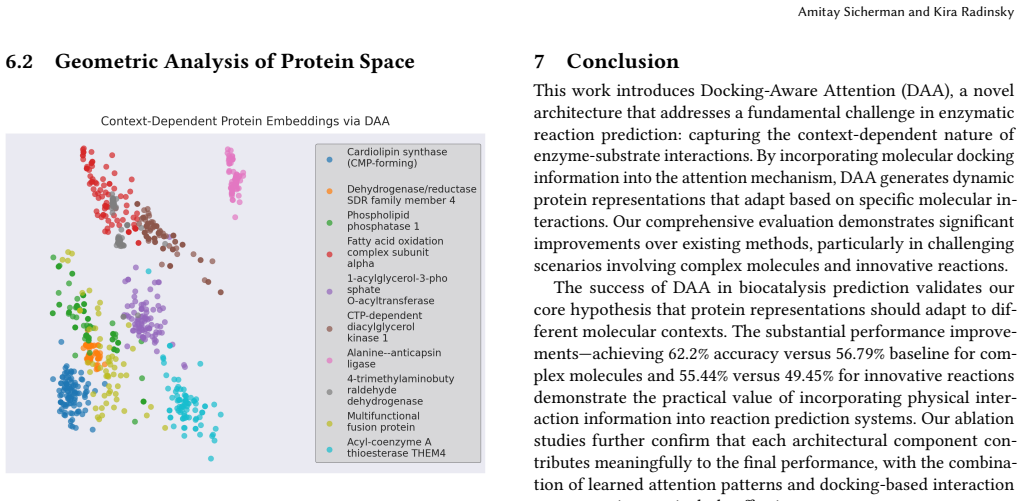
The central discovery is that biasing the attention mechanism with docking-derived interaction scores turns a fixed protein embedding into a context-dependent one: for each protein–molecule pair, the model samples several binding poses, averages per-residue Lennard-Jones potentials across them, smooths the profile, and adds it (with a learned weight $\gamma$) to the pre-attention logits. The result is that the same protein receives different representations for different molecules, and those dynamic representations are what the paper credits for the reported gains, particularly on chemically complex or unseen reactions.
Load-bearing premise
The sampled docking poses for the enzyme–substrate pairs in the dataset are accurate enough that the per-residue Lennard-Jones scores genuinely reflect which residues interact with the molecule.
Editorial extensions
If this is right
- Substrate-dependent protein embeddings give the largest reported gains exactly where static models struggle: molecules with high Bertz complexity and reactions with novel products.
- The docking-aware mechanism improves every base protein encoder tested (ESM3, ProtBERT, GearNet), suggesting the benefit transfers across embedding architectures.
- Injecting the dynamic representation as a new token in the sequence-to-sequence model outperforms concatenation or addition, so how context is integrated matters.
- The learned attention patterns are interpretable and differ for the same enzyme across reactions, which could make model predictions easier to audit.
- The open-sourced code and models make it possible to extend DAA to other biocatalysis prediction settings, such as synthesis planning.
Reading between the lines
- A cheap learned surrogate for the docking sampler could test how much of the gain comes from the physical scores versus the attention architecture's ability to condition on any per-residue signal.
- The same mechanism should transfer to predicting protein-ligand binding affinity or enzyme substrate specificity, where the representation must likewise be partner-dependent.
- Using a differentiable interaction module instead of sampled Lennard-Jones scores could make the physical bias trainable end-to-end and remove the need for a separate docking model at inference.
Editorial analysis
A structured set of objections, weighed in public.
Referee Report
Summary. The paper introduces Docking-Aware Attention (DAA), a mechanism that augments attention-based protein representations with per-residue interaction scores derived from DiffDock docking poses and Lennard-Jones potentials, in order to make protein representations context-dependent for enzymatic reaction prediction. The model is evaluated on the ECREACT dataset using a sequence-to-sequence T5 backbone with a protein embedding injected as a special token. The authors report improvements over baselines on overall accuracy (Top-5 71.48% vs 66.64% for EC Tokens), on a 'complex molecules' subset defined by Bertz Complexity Index >1500 (Top-5 62.20% vs 56.79%), and on an 'innovative reactions' split (Top-5 55.54% vs 49.45%). Ablation studies compare attention variants, embedding models, and token integration strategies, and the paper claims statistical significance for the main results via a two-proportion z-test.
Significance. If the central claim holds, DAA is a plausible and useful step toward context-dependent protein representations for enzymatic reaction prediction, and the idea of using docking-derived physical scores as an attention bias is a concrete and potentially transferable contribution. The paper ships open-source code and pre-trained models, and the ablation across embedding models (ESM3, ProtBERT, GearNet) is a strength, as it suggests the mechanism is not tied to a single encoder. However, the physical-interpretation claim rests on unverified docking pose quality and unstated protein structure provenance, and the statistical and split-definition gaps prevent full verification of the headline numbers. The core idea is defensible, but the current evidence is not yet sufficient to support the strong physical-interpretation and significance claims.
major comments (4)
- [Section 3.2.2, Eq. (2)-(3)] The physical-interpretation claim depends on DiffDock pose quality and on the availability of reliable protein 3D structures, neither of which is documented. Eq. (2) calls DiffDock(P, M, k) on ECREACT enzyme-substrate pairs, but ECREACT provides sequences and EC numbers rather than structures; the manuscript never states whether the structures come from PDB, AlphaFold, ESMFold, or homology models, and it does not validate DiffDock pose accuracy for these metabolite-like substrates. If the poses are largely inaccurate, the per-residue scores S_i in Eq. (3) are not physical interaction strengths but deterministic functions of geometry noise, making the 'docking-aware' component a learned molecule-dependent bias with an unsupported physical interpretation. Please specify the structure source and docking preprocessing, and include a pose-quality check or a negative control with randomized poses.
- [Section 4.4.1] Statistical significance is claimed for all bold entries in Table 1, but no p-values, confidence intervals, or test assumptions are reported. The Two-Proportion Z-Test is described only in general terms; the sample sizes for the All, Complex, and Novel subsets are not given, and no correction for multiple comparisons is mentioned. Please report exact p-values or confidence intervals for the headline comparisons (e.g., DAA vs. EC Tokens and DAA vs. ReactEmbed at Top-1 and Top-5 for each split), or temper the significance claims accordingly.
- [Sections 5.1 and 5.2] The two headline evaluation splits are under-specified. The 'complex' split uses an ad hoc Bertz Complexity Index threshold of 1500 with no sensitivity analysis, and the 'innovative reactions' split is described only as 'target molecules not seen during training' without defining the molecular similarity criterion or the size of the subset. Because the abstract's main gains (62.2% vs. 56.79% and 55.54% vs. 49.45%) are computed on these splits, please define them precisely and show robustness to the threshold and split choices.
- [Section 3.2.3, Eq. (4), and Algorithm 1] There is a notational inconsistency in the smoothing step and several free hyperparameters are omitted. Eq. (4) defines \hat{S}_i = \beta V_i + (1-\beta) \frac{1}{n} \sum_j S_j, but V_i is not defined in the text, while Algorithm 1 (lines 8-10) uses V_i in the same expression and Eq. (3) defines S_i; this prevents exact reproduction of the interaction-profile computation. Please unify the S/V notation and report K (number of DiffDock samples), the Lennard-Jones epsilon and sigma values, the initialization of beta and gamma, and any docking preprocessing details.
minor comments (5)
- [Section 7] The conclusion states 55.44% for innovative reactions, which is inconsistent with the 55.54% reported in the Abstract and Table 1; please correct the discrepancy.
- [Table 2] The ProtBERT base Top-5 value appears as 64.8 in Table 2 but 64.82 in Table 1, and the Addition row lists Top-3 as 57.113 with an extra digit; please standardize the decimal reporting.
- [Section 3.2.2] The statement that 'higher absolute values of S_i indicate stronger consistent interactions' is not immediately clear because the Lennard-Jones potential is signed, with positive values corresponding to repulsion; please clarify how the sign is handled in the attention bias.
- [Section 5.3.1] The ablation shows Docking-Only outperforming Standard Attention at Top-3 and Top-5 but not at Top-1; the text's claim that physical scores 'provide valuable signals' would benefit from a brief comment on this non-monotonic pattern.
- [References] Reference [21] cites the USPTO patent assignment dataset, but the USPTO reaction dataset typically used for augmentation is a different resource (Lowe's reaction dataset); please cite the correct source for the reaction data.
Circularity Check
No significant circularity: the docking-derived interaction scores are computed from the input substrate and enzyme, not from the target product, so DAA's representations are input features rather than relabeled outputs.
full rationale
The load-bearing derivation chain is: DiffDock samples poses of the input molecule M against protein P (Eq. 2); per-residue Lennard-Jones scores S_i are computed from those poses (Eq. 3); smoothing and a learned gamma produce attention (Eqs. 4-5); the resulting context-dependent representation p_M is inserted as a special token, and a T5 decoder predicts the product SMILES. Nowhere does the product (the prediction target) enter the computation of S, p_M, or the attention. Beta and gamma are trained on the benchmark, which is ordinary supervised learning, not circularity. DiffDock and ESM3 are external pretrained models with independent training data, not outputs of this paper's fitted values. The only self-citation is ReactEmbed [30], used solely as a baseline in Table 1, not as justification for DAA's design, so it is not load-bearing. Concerns about unstated protein-structure provenance and DiffDock pose quality on ECREACT are legitimate correctness and reproducibility risks, but they do not make the derivation circular: even if the poses are wrong, S_i is still a deterministic function of input geometry and never a function of the label. Likewise, reporting gains on complex or novel subsets defined after the fact affects statistical soundness rather than circularity. No circular step can be exhibited from the paper's equations or citations.
Assumptions & free parameters
free parameters (5)
- beta (smoothing weight) =
learned during training, value not reported
- gamma (docking attention weight) =
learned during training, value not reported
- Lennard-Jones epsilon and sigma =
not specified in paper
- K (number of DiffDock poses) =
not stated
- Bertz complexity threshold =
1500
assumptions (5)
- standard math The Lennard-Jones potential approximates the relevant protein-molecule interaction energy for attention weighting.
- domain assumption DiffDock produces sufficiently accurate binding poses for enzyme-substrate pairs in ECREACT.
- domain assumption Reliable 3D protein structures are available or predictable for all enzymes in the dataset.
- domain assumption The ECREACT dataset augmented with USPTO reactions is a valid benchmark for enzymatic reaction prediction.
- ad hoc to paper Molecules with Bertz Complexity Index above 1500 form a meaningful 'complex' test subset.
Cite this review
Pith. "Pith review of Docking-Aware Attention: Dynamic Protein Representations through Molecular Context Integration." pith.science (2026). https://pith.science/paper/P3OABEFT
@misc{pith2026250201461,
  author       = {Pith},
  title        = {Pith review of: Docking-Aware Attention: Dynamic Protein Representations through Molecular Context Integration},
  year         = {2026},
  howpublished = {\url{https://pith.science/paper/P3OABEFT}},
  note         = {Machine review of arXiv:2502.01461}
}
read the original abstract
Computational prediction of enzymatic reactions represents a crucial challenge in sustainable chemical synthesis across various scientific domains, ranging from drug discovery to materials science and green chemistry. These syntheses rely on proteins that selectively catalyze complex molecular transformations. These protein catalysts exhibit remarkable substrate adaptability, with the same protein often catalyzing different chemical transformations depending on its molecular partners. Current approaches to protein representation in reaction prediction either ignore protein structure entirely or rely on static embeddings, failing to capture how proteins dynamically adapt their behavior to different substrates. We present Docking-Aware Attention (DAA), a novel architecture that generates dynamic, context-dependent protein representations by incorporating molecular docking information into the attention mechanism. DAA combines physical interaction scores from docking predictions with learned attention patterns to focus on protein regions most relevant to specific molecular interactions. We evaluate our method on enzymatic reaction prediction, where it outperforms previous state-of-the-art methods, achieving 62.2\% accuracy versus 56.79\% on complex molecules and 55.54\% versus 49.45\% on innovative reactions. Through detailed ablation studies and visualizations, we demonstrate how DAA generates interpretable attention patterns that adapt to different molecular contexts. Our approach represents a general framework for context-aware protein representation in biocatalysis prediction, with potential applications across enzymatic synthesis planning. We open-source our implementation and pre-trained models to facilitate further research.
Figures


Figures from the paper (1 more)
Reference graph
Works this paper leans on
-
[1]
Parit Bansal, Anne Morgat, Kristian B Axelsen, Venkatesh Muthukrishnan, Elisa- beth Coudert, Lucila Aimo, Nevila Hyka-Nouspikel, Elisabeth Gasteiger, Arnaud Kerhornou, Teresa Batista Neto, et al. 2022. Rhea, the reaction knowledgebase in
work page 2022
-
[2]
Steven H Bertz. 1981. The first general index of molecular complexity. Journal of the American Chemical Society 103, 12 (1981), 3599–3601
work page 1981
-
[3]
Nadav Brandes, Dan Ofer, Yam Peleg, Nadav Rappoport, and Michal Linial. 2021. ProteinBERT: A universal deep-learning model of protein sequence and function. Bioinformatics 38 (2021), 2102–2110
work page 2021
-
[4]
Xiaorui Chen, Hongming Liu, and Jianping Zhang. 2023. Deep learning driven biosynthetic pathways navigation for natural products with BioNavi-NP. Nature Communications 14, 1 (2023), 1–12
work page 2023
-
[5]
Seyone Chithrananda, Gabriel Grand, and Bharath Ramsundar. 2020. ChemBERTa: Large-scale self-supervised pretraining for molecular property prediction. arXiv preprint arXiv:2010.09885 (2020)
arXiv 2020
-
[6]
Gabriele Corso, Hannes Stärk, Bowen Jing, Regina Barzilay, and Tommi Jaakkola
-
[7]
Jacob Devlin. 2018. Bert: Pre-training of deep bidirectional transformers for language understanding. arXiv preprint arXiv:1810.04805 (2018). 8 Docking-Aware Attention: Dynamic Protein Representations through Molecular Context Integration
arXiv 2018
-
[8]
Ahmed Elnaggar, Michael Heinzinger, Christian Dallago, Ghalia Rehawi, et al
Show all 43 references
-
[9]
Hehe Fan, Zhangyang Wang, Yi Yang, and Mohan Kankanhalli. 2023. Continuous- Discrete Convolution for Geometry-Sequence Modeling in Proteins.ICLR (2023)
2023
-
[10]
artificial metabolisms
Wolf-Dieter Fessner. 2015. Systems Biocatalysis: Development and engineering of cell-free “artificial metabolisms” for preparative multi-enzymatic synthesis. New biotechnology 32, 6 (2015), 658–664
2015
-
[11]
Mathias Ganter, Thomas Bernard, Sébastien Moretti, Joerg Stelling, and Marco Pagni. 2013. MetaNetX. org: a website and repository for accessing, analysing and manipulating metabolic networks. Bioinformatics 29, 6 (2013), 815–816
2013
-
[12]
Manoj Kumar Goshisht. 2024. Machine learning and deep learning in synthetic biology: Key architectures, applications, and challenges. ACS omega 9, 9 (2024), 9921–9945
2024
-
[13]
Guillaume Gricourt, Philippe Meyer, Thomas Duigou, and Jean-Loup Faulon. 2024. Artificial Intelligence Methods and Models for Retro-Biosynthesis: A Scoping Review. ACS Synthetic Biology 13, 8 (2024), 2276–2294
2024
-
[14]
Tomas Hayes, Roshan Rao, Halil Akin, Nicholas J Sofroniew, Deniz Oktay, Zeming Lin, Robert Verkuil, Vincent Q Tran, Jonathan Deaton, Marius Wiggert, et al
-
[15]
Pedro Hermosilla, Marco Schäfer, Matěj Lang, Gloria Fackelmann, Pere Pau Vázquez, Barbora Kozlíková, Michael Krone, Tobias Ritschel, and Timo Ropinski
-
[16]
Bowen Jing, Stephan Eismann, Patricia Suriana, Raphael JL Townshend, and Ron Dror. 2020. Learning from protein structure with geometric vector perceptrons. arXiv preprint arXiv:2009.01411 (2020)
2020 arXiv
-
[17]
John Jumper, Richard Evans, Alexander Pritzel, Tim Green, Michael Figurnov, Olaf Ronneberger, Kathryn Tunyasuvunakool, Russ Bates, Augustin Žídek, Anna Potapenko, et al. 2021. Highly accurate protein structure prediction with Al- phaFold. nature 596, 7873 (2021), 583–589
2021
-
[18]
David Kreutter, Philippe Schwaller, and Jean-Louis Reymond. 2021. Predicting enzymatic reactions with a molecular transformer. Chemical science 12, 25 (2021), 8648–8659
2021
-
[19]
Zeming Lin, Halil Akin, Roshan Rao, Brian Hie, Zhongkai Zhu, Wenting Lu, Nikita Smetanin, Robert Verkuil, Ori Kabeli, Yaniv Shmueli, et al. 2023. Evolutionary- scale prediction of atomic-level protein structure with a language model. Science 379, 6637 (2023), 1123–1130
2023
-
[20]
Wei Lu, Qifeng Wu, Jixian Zhang, Jiahua Rao, Chengtao Li, and Shuangjia Zheng
-
[21]
Alan C Marco, Amanda Myers, Stuart JH Graham, Paul D’Agostino, and Kirsten Apple. 2015. The USPTO patent assignment dataset: Descriptions and analysis. (2015)
2015
-
[22]
Ariel T McNutt, Paul Francoeur, Rachit Aggarwal, Tomohide Masuda, Rocco Meli, Matthew Ragoza, Jocelyn Sunseri, and David Ryan Koes. 2021. A deep learning approach to scoring protein-ligand poses using molecular dynamics- based metrics. Journal of Chemical Information and Model...
2021
-
[23]
Muhammed T Muhammed and Esin Aki-Yalcin. 2024. Molecular docking: princi- ples, advances, and its applications in drug discovery. Letters in Drug Design & Discovery 21, 3 (2024), 480–495
2024
-
[24]
Sandra Placzek, Ida Schomburg, Antje Chang, Lisa Jeske, Marcus Ulbrich, Jana Tillack, and Dietmar Schomburg. 2016. BRENDA in 2017: new perspectives and new tools in BRENDA. Nucleic acids research (2016), gkw952
2016
-
[25]
Daniel Probst, Matteo Manica, Yves Gaetan Nana Teukam, Alessandro Castro- giovanni, Federico Paratore, and Teodoro Laino. 2022. Biocatalysed synthesis planning using data-driven learning. Nature Communications 13, 964 (2022)
2022
-
[26]
Advances in neural information processing systems 35 (2022), 7236–7249
Tankbind: Trigonometry-aware neural networks for drug-protein binding structure prediction. Advances in neural information processing systems 35 (2022), 7236–7249
2022
-
[27]
Jerret Ross, Brian Belgodere, Vijil Chenthamarakshan, Inkit Padhi, Youssef Mroueh, and Payel Das. 2022. Large-scale chemical language representations capture molecular structure and properties. Nature Machine Intelligence 4, 12 (2022), 1256–1264
2022
-
[28]
Philippe Schwaller, Teodoro Laino, Théophile Gaudin, Peter Bolgar, Christopher A Hunter, Costas Bekas, and Alpha A Lee. 2019. Molecular transformer: a model for uncertainty-calibrated chemical reaction prediction. ACS central science 5, 9 (2019), 1572–1583
2019
-
[29]
Sanghamitra Sen and Judit E Puskas. 2015. Green polymer chemistry: Enzyme catalysis for polymer functionalization. Molecules 20, 5 (2015), 9358–9379
2015
-
[30]
Amitay Sicherman and Kira Radinsky. 2025. ReactEmbed: A Cross-Domain Frame- work for Protein-Molecule Representation Learning via Biochemical Reaction Networks. arXiv:2501.18278 [cs.LG] https://arxiv.org/abs/2501.18278
2025 arXiv
-
[31]
Hannes Stärk, Octavian Ganea, Lagnajit Pattanaik, Regina Barzilay, and Tommi Jaakkola. 2022. Equibind: Geometric deep learning for drug binding structure prediction. In International conference on machine learning . PMLR, 20503–20521
2022
-
[32]
Alexander Rives, Joshua Meier, Tom Sercu, Siddharth Goyal, Zeming Lin, Jason Liu, Demi Guo, Myle Ott, C Lawrence Zitnick, Jerry Ma, et al. 2021. Biological structure and function emerge from scaling unsupervised learning to 250 million protein sequences. Proceedings of the Nat...
2021
-
[33]
Liong Seng Tee, Sukehiro Gotoh, and Warren E Stewart. 1966. Molecular param- eters for normal fluids. Lennard-Jones 12-6 Potential. Industrial & Engineering Chemistry Fundamentals 5, 3 (1966), 356–363
1966
-
[34]
Ashish Vaswani, Noam Shazeer, Niki Parmar, Jakob Uszkoreit, Llion Jones, Aidan N Gomez, Lukasz Kaiser, and Illia Polosukhin. 2017. Attention is All you Need. Advances in Neural Information Processing Systems 30 (2017)
2017
-
[35]
Xipeng Wang, Simón Ramírez-Hinestrosa, Jure Dobnikar, and Daan Frenkel. 2020. The Lennard-Jones potential: when (not) to use it. Physical Chemistry Chemical Physics 22, 19 (2020), 10624–10633
2020
-
[36]
David S Wishart, Carin Li, Ana Marcu, Hasan Badran, Allison Pon, Zachary Budinski, Jonas Patron, Debra Lipton, Xuan Cao, Eponine Oler, et al. 2020. Path- Bank: a comprehensive pathway database for model organisms. Nucleic acids research 48, D1 (2020), D470–D478
2020
-
[37]
Zuobai Zhang, Minghao Xu, Arian Rokkum Jamasb, et al. 2023. Protein Repre- sentation Learning by Geometric Structure Pretraining. ICLR (2023). 9
2023
-
[38]
Hannes Stärk, Octavian-Eugen Ganea, Lagnajit Pattanaik, Regina Barzilay, and Tommi Jaakkola. 2022. EquiBind: Geometric Deep Learning for Drug Binding Structure Prediction. Proceedings of the 39th International Conference on Machine Learning (2022)
2022
-
[2020]
arXiv preprint arXiv:2007.06252 (2020)
Intrinsic-extrinsic convolution and pooling for learning on 3d protein structures. arXiv preprint arXiv:2007.06252 (2020)
2020 arXiv
-
[2021]
IEEE Transactions on Pattern Analysis and Machine Intelligence (2021), 1–1
ProtTrans: Towards cracking the language of life’s code through self- supervised deep learning and high performance computing. IEEE Transactions on Pattern Analysis and Machine Intelligence (2021), 1–1
2021
-
[2022]
Nucleic acids research 50, D1 (2022), D693–D700
2022
-
[2023]
Inter- national Conference on Learning Representations (2023)
DiffDock: Diffusion Steps, Twists, and Turns for Molecular Docking. Inter- national Conference on Learning Representations (2023)
2023
-
[2024]
bioRxiv (2024), 2024–07
Simulating 500 million years of evolution with a language model. bioRxiv (2024), 2024–07
2024
Reviewed August 9, 2026 · model on record in the stance chip above.
Discussion (0). Continue with ORCID to comment.