REVIEW 4 major objections 3 minor 1 cited by
Origin of phonon decoherence
T0 review · 4 major / 3 minor · reviewed 2026-08-09 · deepseek-v4-flash
Pith's one-line read Phonon decoherence rates are the imaginary part of a non-equilibrium phonon self-energy.
desk verdict A formally grounded derivation of coherent-phonon decoherence from the nonequilibrium self-energy, with a validation that is suggestive but underdetermined by calibrated inputs. read the letter →
The pith
A machine-rendered reading of the paper's core claim, the machinery that carries it, and where it could break.
The reading
What carries the argument
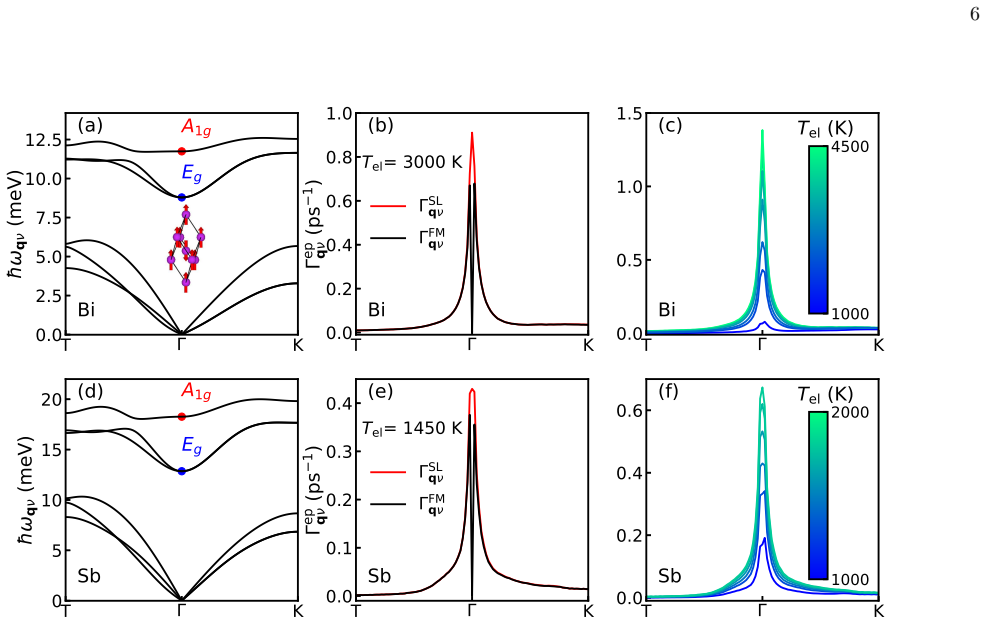
The central object is the non-equilibrium phonon self-energy $\Pi_{\mathbf q\nu}$—a many-body correction describing how a phonon exchanges energy with electrons and with other phonons. For the electron-phonon channel it is built from the retarded density-density response function (Eq. 15); for the phonon-phonon channel it is summed over three-phonon scattering processes weighted by Bose occupation factors (Eq. 23). To make the electron-phonon self-energy usable for coherent modes at the zone center, the paper adopts the self-consistent linewidth approximation (Eq. 24), which replaces the strict energy-conserving delta with a Lorentzian of width $\gamma=15$ meV and thereby restores the intraband transitions that the Fan-Migdal approximation misses. These objects are what convert the exact equation of motion into the damped-oscillator form whose solutions are the observed decaying coherent oscillations.
What would settle it
A time- and angle-resolved photoemission experiment on bismuth at the fluence the paper maps to $T_{\mathrm{el}}=3000$ K, taken simultaneously with a measurement of the A1g decay rate, would settle the point: if the decay rate does not track the instantaneous occupations of the electronic states near the Fermi surface, the quasi-equilibrium mapping used in Eq. (24) fails.
Extended reading notes
Core claim
Starting from a many-body Hamiltonian that avoids the Born-Oppenheimer approximation and couples the phonon displacement to the time-dependent electron density, the paper derives an exact equation of motion for the coherent displacement $U_{\mathbf q\nu}$. The equation has the form of a damped driven oscillator, and the damping emerges rather than being assumed: the decoherence rate is $\Gamma_{\mathbf q\nu}=-\mathrm{Im}\,\Pi_{\mathbf q\nu}^{\mathrm{NA}}$ for electron-phonon coupling and $\Gamma_{\mathbf q\nu}=-\mathrm{Im}\,\Pi_{\mathbf q\nu}^{\mathrm{pp}}$ for phonon-phonon coupling, with frequency renormalization given by $2\omega_{\mathbf q\nu}\mathrm{Re}\,\Pi_{\mathbf q\nu}$. A technical obstacle is that the standard Fan-Migdal self-energy for the electron-phonon channel vanishes exactly at the zone center, where coherent phonons live; the paper overcomes this with a self-consistent linewidth approximation that includes intraband transitions and yields finite decoherence rates. First-principles calculations for the A1g mode in Bi and Sb then give lifetimes that shrink with rising electronic temperature (pump fluence) and with rising lattice temperature, in agreement with pump-probe experiments; the paper concludes that electron-phonon and phonon-phonon scattering each dominate decoherence in different experimentally accessible regimes.
Load-bearing premise
The load-bearing premise is that a photoexcited semimetal behaves as if its electrons have one temperature set by the pump intensity while the lattice keeps its own temperature; if the real electron distribution is not of this two-temperature form, the computed fluence dependence is not a clean test of the self-energy formula.
Editorial extensions
If this is right
- Coherent phonon lifetimes in semimetals can be computed from ground-state electronic structure plus electronic and lattice temperatures, so experiments can be interpreted without a full time-dependent simulation.
- The phenomenological damping terms used in earlier coherent-phonon models are replaced by specific self-energy diagrams, giving a physical meaning to each contribution to the decay.
- In bismuth and antimony, electron-phonon scattering controls decoherence at high pump fluences and low lattice temperature, while phonon-phonon scattering dominates at high lattice temperature; the two channels have different signatures that experiments can separate.
- The Fan-Migdal approximation alone is inadequate for coherent phonons at the Brillouin-zone center, and the self-consistent linewidth correction becomes necessary for any material where a Raman-active or A1g-like mode is studied.
- The same formalism extends to other driven solids, so the timescales of light-induced phase transitions and structural switching can be predicted from first principles.
Reading between the lines
- The effective-temperature mapping from pump fluence to a single electronic temperature is the least controlled step in the calculation; I would test it by computing the same lifetimes with a time-resolved non-equilibrium occupation and checking whether the decay rate follows the instantaneous distribution rather than a Fermi-Dirac one.
- If the self-energy view is right, decoherence and equilibrium phonon linewidths are the same object only when occupations are thermal; out of equilibrium, stimulated-emission and absorption channels can differ, so a coherent phonon in a strongly pumped material could decay faster or slower than any equilibrium linewidth would suggest.
- A natural extension is to multimode coherent states: because self-energy contributions are additive at linear order, the framework predicts a hierarchy of decoherence times for simultaneously excited modes, which multi-color pump-probe experiments could map.
- The framework should be testable in insulators and semiconductors with intense mid-infrared pumping, where the electron-phonon channel is weak and anharmonic decay should set the lifetime; a failure of the predicted temperature scaling there would point to missing electron-hole or four-phonon terms.
Editorial analysis
A structured set of objections, weighed in public.
Referee Report
Summary. The manuscript derives quantum kinetic equations for coherent phonons from a non-adiabatic electron-phonon Hamiltonian extended with cubic anharmonicity, and identifies the decoherence rate and frequency renormalization with the imaginary and real parts of the non-equilibrium phonon self-energy (Eqs. 13-15 and 21-23). It then evaluates these expressions for the A1g mode of Bi and Sb using first-principles electron-phonon and phonon-phonon calculations, comparing the resulting coherent-phonon lifetimes with fluence-dependent and temperature-dependent pump-probe experiments (Fig. 3). The paper concludes that both electron-phonon and phonon-phonon scattering contribute to decoherence, with the former controlling the fluence dependence and the latter controlling the temperature dependence.
Significance. If the formal mapping between coherent-phonon decoherence and the non-equilibrium phonon self-energy is correct, this is a valuable bridge between coherent phonon dynamics and existing equilibrium self-energy implementations. The manuscript has clear strengths: the derivation starts from an explicit many-body Hamiltonian, the final expressions reduce to known equilibrium self-energies when distributions are thermalized, the problem of the vanishing Fan-Migdal rate at q=0 is addressed through a self-consistent linewidth scheme, and the computational setup uses widely available first-principles tools. However, the numerical validation currently relies on several external or empirical inputs, so the reported agreement with experiments is not yet an independent confirmation of the formalism. The main text is not self-contained for the key validation steps, and the quantitative claims are stronger than the evidence presented.
major comments (4)
- [§III, Eq. (24) and Figs. 2(b),(e)] The finite zone-center rate Γ_SL_A1g is produced by replacing the energy-conserving delta function with a Lorentzian of width γ = 15 meV, described only as 'representative of the electron linewidths.' Because the Fan-Migdal rate vanishes exactly at q=0, the quoted electron-phonon decoherence rates Γ_ep ≈ 0.9 ps⁻¹ (Bi) and 0.4 ps⁻¹ (Sb) are controlled by this uncomputed width rather than by the ab initio couplings alone. The authors should provide a sensitivity study over γ, or preferably compute the electron linewidths that enter the self-consistent scheme, before the electron-phonon channel can be regarded as quantitatively predictive.
- [§III, Fig. 3(a)-(b) and text after Eq. (24)] The x-axis of the fluence comparison is an effective electronic temperature obtained from the experimental fluence through a prescription confined to the Supplemental Material. The main text states that the temperatures are 'chosen to reproduce the experimental conditions,' but it does not show the conversion or list its assumptions, such as absorbed fraction, electronic specific heat, or thermalization time. If any part of this mapping is adjustable, the reported τ ∝ 1/T_el agreement with experiment can be shifted along the x-axis and is not an independent test of Eq. (24). The conversion and its material-specific parameters should be presented in the main text or at least summarized with a sensitivity analysis.
- [§III, text after Eq. (25) and Figs. 3(c)-(d)] The phonon-phonon comparison introduces an empirical constant rate Γ_eff_A1g taken from Refs. [50,51], which are analyses of the same experiments whose data are plotted in the figure. Adding this offset makes the absolute agreement partly constructed rather than predicted. The authors should either compute the residual rate from an independent mechanism, clearly label it as a fit parameter, or restrict the validation claim to the temperature slope. A related uncontrolled simplification is the neglect of photoexcited phonon distributions in Γ_pp, which the manuscript acknowledges but does not quantify; this affects the separation of the fluence dependence into an electron-phonon part and a temperature-only phonon-phonon part.
- [§II B, Eq. (7)] The displayed Heisenberg equation of motion is incorrect as written. For a coordinate U and conjugate momentum P, the double commutator [U,[U,H]] is proportional to [U,P] and does not yield the acceleration term; the correct form is d²U/dt² = −ℏ⁻²⟨[H,[U,H]]⟩ (equivalently +ℏ⁻²⟨[[U,H],H]⟩), which is what leads to Eq. (8). This appears to be a typographical error, but since Eq. (7) is the stated starting point of the central derivation, it should be corrected and the corresponding steps in the Supplemental Material should be checked.
minor comments (3)
- [Abstract and Conclusions] The phrases 'robust agreement' and 'good quantitative agreement' overstate the evidence given the empirical constants and calibrated temperatures; 'consistent with' or similar wording would be more proportionate unless the above issues are resolved.
- [Fig. 3 caption] The caption contains a typo: 'ans Sb' should read 'and Sb'.
- [General] The manuscript depends heavily on the Supplemental Material for both the derivation leading to Eqs. (12)-(15) and the fluence-to-temperature mapping; if the SM is not included with the arXiv posting, the referees and readers cannot assess these steps. The authors should ensure the SM is available and its equations are numbered for cross-reference.
Circularity Check
No significant circularity: the decoherence rate is derived from the non-equilibrium phonon self-energy, and the numerical validation, while containing some calibrated inputs, does not reduce its central claim to those inputs by construction.
full rationale
The central derivation connects the coherent-phonon equation of motion to the imaginary and real parts of non-equilibrium self-energies (Eqs. 12-15 and 21-23). The paper explicitly derives these equations from the Hamiltonian and cross-checks them against equilibrium self-energy expressions; nothing in the derivation presupposes the experimentally measured decoherence times. The numerical section uses external benchmarks (pump-probe data from Refs. 17, 50, 51, 53) and independent first-principles inputs (DFT/EPW). Calibrated quantities appear: the effective electronic temperatures are chosen to match the experimental fluence conditions, the Lorentzian width gamma = 15 meV is set as representative, and an effective constant rate Gamma_eff from Refs. 50/51 is added to absorb residual offsets. These are acknowledged inputs and post-hoc corrections, not hidden inversions of the target data, and they do not enter the formal self-energy identities. The manuscript also openly states that calculations overestimate lifetimes without phonon-phonon coupling and that photoexcited phonon distributions are omitted; such limitations weaken numerical completeness but do not make the derivation circular. No self-citation is load-bearing: Ref. 53 supports the displacive-excitation context, and Refs. 18/64-67 are background. Accordingly, no step reduces to its own input by construction.
Assumptions & free parameters
free parameters (3)
- Effective electronic temperature Tel =
Bi: 3000 K, Sb: 1450 K; varied up to 4500 K
- Lorentzian broadening gamma in SL approximation =
15 meV
- Effective residual decoherence rate Gamma_eff =
Bi: 0.05 ps^-1, Sb: 0.1 ps^-1
assumptions (4)
- domain assumption Third-order anharmonicities in the Born-Oppenheimer approximation; fourth-order and non-adiabatic phonon-phonon terms neglected
- domain assumption Small-displacement expansion to second order and linear response for the electronic density
- domain assumption Quasi-equilibrium occupations: electrons Fermi-Dirac at Tel, phonons Bose-Einstein at Tph
- domain assumption BBGKY hierarchy is closed by factorizing three-phonon correlations and neglecting off-diagonal self-energy contributions
Cite this review
Pith. "Pith review of Origin of phonon decoherence." pith.science (2026). https://pith.science/paper/NOY7UFQA
@misc{pith2026250201529,
  author       = {Pith},
  title        = {Pith review of: Origin of phonon decoherence},
  year         = {2026},
  howpublished = {\url{https://pith.science/paper/NOY7UFQA}},
  note         = {Machine review of arXiv:2502.01529}
}
read the original abstract
Phonon decoherence determines the characteristic timescales over which coherent lattice vibrations decay, making it a crucial process for understanding the non-equilibrium dynamics of crystal lattices after excitation by a pump pulse. Here, we report a theoretical and computational investigation of the origin of phonon decoherence within a first-principles many-body framework. We derive quantum kinetic equations for the dynamics of coherent phonons by explicitly accounting for dissipation processes induced by electron-phonon and phonon-phonon interactions. The decoherence rate and frequency renormalization are formulated in terms of the non-equilibrium phonon self energy, providing a framework amenable for ab initio calculations. To validate this approach, we conduct a first-principles study of phonon decoherence for the elemental semimetals antimony and bismuth. The robust agreement with available temperature- and fluence-dependent experimental data confirms the accuracy of our theoretical and computational framework. More generally, our findings reveal that either electron-phonon and phonon-phonon coupling can prevail in determining the decoherence time, depending on the temperature and driving conditions. Overall, this work fills a critical gap in the theoretical understanding of phonon decoherence, providing a predictive framework for determining the timescales of light-induced structural dynamics in driven solids.
Figures


Forward citations
Cited by 1 Pith paper
-
The First Principles Equation for Coherent Phonons: Dynamics and Polaron distortions
A first-principles equation of motion for coherent phonons is derived, with renormalized frequencies and a damping term identical to quantum phonons, plus a new screened electron-phonon coupling.
Reference graph
Works this paper leans on
-
[1]
J. G. Horstmann, H. B¨ ockmann, B. Wit, F. Kurtz, G. Storeck, and C. Ropers, Coherent control of a surface structural phase transition, Nature 583, 232 (2020)
work page 2020
-
[2]
( 1)-(3), we expect the effects of decoher- ence to be encoded in the density fluctuation δn(r,t )
is an exact result for the Hamiltonian specified by Eqs. ( 1)-(3), we expect the effects of decoher- ence to be encoded in the density fluctuation δn(r,t ). To retrieve an explicit expression for the decoherence rate mediated by the electron-phonon coupling, we express δn(r,t ) making use of linear response theory: δn(r,t ) = δn(r,t 0) (9) + ∫ dr′ ∫ t t0 dt′...
-
[3]
Y. Qi, M. Guan, D. Zahn, T. Vasileiadis, H. Seiler, Y. W. Windsor, H. Zhao, S. Meng, and R. Ernstorfer, Travers- ing double-well potential energy surfaces: Photoinduced concurrent intralayer and interlayer structural transitions in XTe2 (X = Mo, W), ACS Nano 16, 11124 (2022)
work page 2022
-
[4]
M.-X. Guan, X.-B. Liu, D.-Q. Chen, X.-Y. Li, Y.-P. Qi, Q. Yang, P.-W. You, and S. Meng, Optical control of mul- tistage phase transition via phonon coupling in MoTe 2, Phys. Rev. Lett. 128, 015702 (2022)
work page 2022
-
[5]
X. Li, T. Qiu, J. Zhang, E. Baldini, J. Lu, A. M. Rappe, and K. A. Nelson, Terahertz field in- duced ferroelectricity in quantum paraelectric SrTiO 3, Science 364, 1079 (2019)
work page 2019
-
[6]
de la Torre, D
A. de la Torre, D. M. Kennes, M. Claassen, S. Gerber, J. W. McIver, and M. A. Sentef, Colloquium: Nonther- mal pathways to ultrafast control in quantum materials, Rev. Mod. Phys. 93, 041002 (2021)
2021
-
[7]
F¨ orst, C
M. F¨ orst, C. Manzoni, S. Kaiser, Y. Tomioka, Y. Tokura, R. Merlin, and A. Cavalleri, Nonlinear phononics as an ultrafast route to lattice control, Nat. Phys. 7, 854 (2011)
2011
-
[8]
How- ever, since Eq
resembles the equation of motion of a un- damped driven harmonic oscillator, which is reflected by the absence of a term proportional to ∂U qν/∂t . How- ever, since Eq. (
Show all 82 references
-
[9]
as: δn(r,t ) = δn(r,t 0) +δnA(r,t ) +δnNA(r,t ) . (10) The adiabatic density response arises from the instan- taneous response of the density [ 32, 33] to the nuclear displacement Uqν , and it can be derived by assum- ing a parametric dependence in the form δnA(r,t ) = δnA(r;U...
-
[10]
Inspection of the decoherence rate (Fig
alone systematically over- estimate the experimental lifetime. Inspection of the decoherence rate (Fig. S1 in the SM [ 34]) reveals un- derestimation by a constant offset, suggesting the pres- ence of additional interaction mechanisms – independent of Tel – contributing to the ...
-
[11]
Scholz, T
R. Scholz, T. Pfeifer, and H. Kurz, Density-matrix theory of coherent phonon oscillations in germanium, Phys. Rev. B 47, 16229 (1993)
1993
-
[12]
M. Y. Zhang, Z. X. Wang, Y. N. Li, L. Y. Shi, D. Wu, T. Lin, S. J. Zhang, Y. Q. Liu, Q. M. Liu, J. Wang, T. Dong, and N. L. Wang, Light- induced subpicosecond lattice symmetry switch in MoTe2, Phys. Rev. X 9, 021036 (2019)
2019
-
[13]
by considering the Fan-Migdal approximation (FM) to the phonon self-energy Π NA qν due to electron-phonon coupling. To explicitly account for the energy transferred to the electrons by a pump pulse, we describe electronic occupations via a Fermi-Dirac dis- tribution with an el...
-
[14]
Merlin, Generating coherent THz phonons with light pulses, Solid State Commun
R. Merlin, Generating coherent THz phonons with light pulses, Solid State Commun. 102, 207 (1997) , highlights in Condensed Matter Physics and Materials Science
1997
-
[15]
with the non- adiabatic phonon self-energy derived within the equi- librium Green’s function formalism enables the appli- cation of the available implementations for the phonon self-energy to study decoherence and softening of coher- ent phonons. In particular, the phonon self...
-
[16]
Mankowsky, A
R. Mankowsky, A. von Hoegen, M. F¨ orst, and A. Cav- alleri, Ultrafast reversal of the ferroelectric polarizat ion, Phys. Rev. Lett. 118, 197601 (2017)
2017
-
[17]
S. W. Teitelbaum, T. Shin, J. W. Wolfson, Y.-H. Cheng, I. J. P. Molesky, M. Kandyla, and K. A. Nelson, Real- time observation of a coherent lattice transformation into a high-symmetry phase, Phys. Rev. X 8, 031081 (2018)
2018
-
[18]
M. Guan, D. Chen, Q. Chen, Y. Yao, and S. Meng, Coherent phonon assisted ultrafast order-parameter reversal and hidden metallic state in Ta 2NiSe5, Phys. Rev. Lett. 131, 256503 (2023)
2023
-
[19]
and ( 20) are the first terms of the Bo- goliubov–Born–Green–Kirkwood–Yvon (BBGKY) hier- archy, which recast the equation of motion for the n-th order correlator, in terms of correlators of order n + 1. In order to close the equation, we can derive the equation of motion for ⟨ ...
-
[20]
D. M. Juraschek, M. Fechner, and N. A. Spaldin, Ul- trafast structure switching through nonlinear phononics, Phys. Rev. Lett. 118, 054101 (2017)
2017
-
[21]
Numerical evaluation of Γ pp A1g at room temperature (Tph = 300 K) for the A1g mode of Sb and Bi yields 0.26 and 0.15 ps −1, respectively
and ( 23), leading to: Γ pp qν =π 2 ∑ q′q′′ν ′ν ′′ |Ψ ν,ν ′,ν ′′ −q, q′, q′′ |2 (25) × [ (nq′ν ′ +nq′′ν ′′ + 1)δ(ω q′ν ′ +ω q′′ν ′′ −ω qν ) + 2(nq′′ν ′′ −nq′ν ′ )δ(ω q′ν ′ −ω q′′ν ′′ −ω qν ) ] . Numerical evaluation of Γ pp A1g at room temperature (Tph = 300 K) for the A1g mod...
2000
-
[22]
D. M. Juraschek, Q. N. Meier, and P. Narang, Paramet- ric excitation of an optically silent goldstone-like phono n mode, Phys. Rev. Lett. 124, 117401 (2020)
2020
-
[23]
A detailed derivation of this result is reported in the SM [ 34]
coincides with the phonon self-energy obtained within the equilibrium Green function formal- ization [ 45–49]. A detailed derivation of this result is reported in the SM [ 34]. Overall, these results formally relates the deco- herence rate and frequency renormalization of cohe...
-
[24]
2 (b) and (e) for momenta along the T-Γ-K path
is reported in red in Figs. 2 (b) and (e) for momenta along the T-Γ-K path. Away from Γ, the de- coherence rate Γ SL qν coincides with the result of the Fan- Migdal approximation Γ FM qν , however, the two approxi- mations differ significantly at the zone center. Specifi- cally, ...
2000
-
[25]
G. A. Garrett, T. F. Albrecht, J. F. Whitaker, and R. Merlin, Coherent THz phonons driven by light pulses and the Sb problem: What is the mechanism?, Phys. Rev. Lett. 77, 3661 (1996)
1996
-
[26]
Qi, Y.-H
T. Qi, Y.-H. Shin, K.-L. Yeh, K. A. Nelson, and A. M. Rappe, Collective coherent control: Synchronization of polarization in ferroelectric PbTiO 3 by shaped THz fields, Phys. Rev. Lett. 102, 247603 (2009)
2009
-
[27]
D. M. Juraschek and S. F. Maehrlein, Sum-frequency ionic raman scattering, Phys. Rev. B 97, 174302 (2018)
2018
-
[28]
Caruso and M
F. Caruso and M. Zacharias, Quantum the- ory of light-driven coherent lattice dynamics, Phys. Rev. B 107, 054102 (2023)
2023
-
[29]
Bauer, A
R. Bauer, A. Schmid, P. Pavone, and D. Strauch, Electron-phonon coupling in the metallic elements al, au, na, and nb: A first-principles study, Phys. Rev. B 57, 11276 (1998)
1998
-
[30]
Cappelluti, Electron-phonon effects on the raman spectrum in Mgb 2, Phys
E. Cappelluti, Electron-phonon effects on the raman spectrum in Mgb 2, Phys. Rev. B 73, 140505 (2006)
2006
-
[31]
A. M. Saitta, M. Lazzeri, M. Calandra, and F. Mauri, Giant nonadiabatic effects in layer metals: Ra- man spectra of intercalated graphite explained, Phys. Rev. Lett. 100, 226401 (2008)
2008
-
[32]
C.-H. Park, F. Giustino, M. L. Cohen, and S. G. Louie, Electron-phonon interactions in graphene, bilayer graphene, and graphite, Nano Lett. 8, 4229 (2008)
2008
-
[33]
Lazzeri, S
M. Lazzeri, S. Piscanec, F. Mauri, A. C. Fer- rari, and J. Robertson, Phonon linewidths and electron-phonon coupling in graphite and nanotubes, Phys. Rev. B 73, 155426 (2006)
2006
-
[34]
Calandra, G
M. Calandra, G. Profeta, and F. Mauri, Adiabatic and nonadiabatic phonon dispersion in a wannier function ap- proach, Phys. Rev. B 82, 165111 (2010)
2010
-
[35]
Giustino, M
F. Giustino, M. L. Cohen, and S. G. Louie, Electron-phonon interaction using wannier functions, Phys. Rev. B 76, 165108 (2007)
2007
-
[36]
Caruso, M
F. Caruso, M. Hoesch, P. Achatz, J. Serrano, M. Krisch, E. Bustarret, and F. Giustino, Nonadia- batic kohn anomaly in heavily boron-doped diamond, Phys. Rev. Lett. 119, 017001 (2017)
2017
-
[37]
Novko, F
D. Novko, F. Caruso, C. Draxl, and E. Cappel- luti, Ultrafast hot phonon dynamics in MgB 2 driven by anisotropic electron-phonon coupling, Phys. Rev. Lett. 124, 077001 (2020) . 9
2020
-
[38]
Marini, Nonadiabatic effects lead to the breakdown of the semiclassical phonon picture, Phys
A. Marini, Nonadiabatic effects lead to the breakdown of the semiclassical phonon picture, Phys. Rev. B 110, 024306 (2024)
2024
-
[39]
Cheng, S
Y.-H. Cheng, S. W. Teitelbaum, F. Y. Gao, and K. A. Nelson, Femtosecond laser amorphization of tellurium, Phys. Rev. B 98, 134112 (2018)
2018
-
[40]
Stefanucci, R
G. Stefanucci, R. van Leeuwen, and E. Perfetto, In and out-of-equilibrium ab initio theory of electrons and phonons, Phys. Rev. X 13, 031026 (2023)
2023
-
[41]
van Leeuwen, First-principles ap- proach to the electron-phonon interaction, Phys
R. van Leeuwen, First-principles ap- proach to the electron-phonon interaction, Phys. Rev. B 69, 115110 (2004)
2004
-
[42]
Baroni, S
S. Baroni, S. de Gironcoli, A. Dal Corso, and P. Giannozzi, Phonons and related crystal prop- erties from density-functional perturbation theory, Rev. Mod. Phys. 73, 515 (2001)
2001
-
[43]
Giannozzi, S
P. Giannozzi, S. de Gironcoli, P. Pavone, and S. Baroni, Ab initio calculation of phonon dispersions in semicon- ductors, Phys. Rev. B 43, 7231 (1991)
1991
-
[44]
[ 68–72] are in- cluded in SI
See Supplemental Material at [URL], Ref. [ 68–72] are in- cluded in SI
-
[45]
Giustino, Electron-phonon interactions from first prin- ciples, Rev
F. Giustino, Electron-phonon interactions from first prin- ciples, Rev. Mod. Phys. 89, 015003 (2017)
2017
-
[46]
Berges, N
J. Berges, N. Girotto, T. Wehling, N. Marzari, and S. Ponc´ e, Phonon self-energy corrections: To screen, or not to screen, Phys. Rev. X 13, 041009 (2023)
2023
-
[47]
Marini, Equilibrium and out-of-equilibrium re- alistic phonon self-energy free from overscreening, Phys
A. Marini, Equilibrium and out-of-equilibrium re- alistic phonon self-energy free from overscreening, Phys. Rev. B 107, 024305 (2023)
2023
-
[48]
Caldarelli, A
G. Caldarelli, A. Guandalini, F. Macheda, and F. Mauri, Variational formulation of dynamical electronic response functions in presence of nonlocal exchange interactions, arXiv e-prints , arXiv:2410.22889 (2024)
2024 arXiv
-
[49]
Stefanucci and E
G. Stefanucci and E. Perfetto, Exact formula with two dynamically screened electron-phonon cou- plings for positive phonon-linewidths approximations, Phys. Rev. B 111, 024307 (2025)
2025
-
[50]
L. Sun, P. Kumar, Z. Liu, J. Choi, B. Fang, S. Roesch, K. Tran, J. Casara, E. Priego, Y.-M. Chang, G. Moody, K. L. Silverman, V. O. Lorenz, M. Scheibner, T. Luo, and X. Li, Phonon dephasing dynamics in MoS 2, Nano Lett. 21, 1434 (2021)
2021
-
[51]
C. J. Sayers, A. Genco, C. Trovatello, S. D. Conte, V. O. Khaustov, J. Cervantes-Villanueva, D. San- galli, A. Molina-Sanchez, C. Coletti, C. Gader- maier, and G. Cerullo, Strong coupling of coher- ent phonons to excitons in semiconducting monolayer MoTe2, Nano Lett. 23, 9235 (2023)
2023
-
[52]
Trovatello, H
C. Trovatello, H. P. C. Miranda, A. Molina-S´ anchez, R. Borrego-Varillas, C. Manzoni, L. Moretti, L. Ganzer, M. Maiuri, J. Wang, D. Dumcenco, A. Kis, L. Wirtz, A. Marini, G. Soavi, A. C. Ferrari, G. Cerullo, D. San- galli, and S. D. Conte, Strongly coupled coherent phonons in...
2020
-
[53]
T. Y. Jeong, B. M. Jin, S. H. Rhim, L. Debbichi, J. Park, Y. D. Jang, H. R. Lee, D.-H. Chae, D. Lee, Y.-H. Kim, S. Jung, and K. J. Yee, Coherent lattice vibrations in mono- and few-layer WSe 2, ACS Nano 10, 5560 (2016)
2016
-
[54]
W. Li, J. Carrete, N. A. Katcho, and N. Mingo, Sheng- BTE: A solver of the boltzmann transport equation for phonons, Comput. Phys. Commun. 185, 1747 (2014)
2014
-
[55]
Lazzeri, M
M. Lazzeri, M. Calandra, and F. Mauri, An- harmonic phonon frequency shift in MgB 2, Phys. Rev. B 68, 220509 (2003)
2003
-
[56]
R. A. Cowley, Anharmonic crystals, Rep. Prog. Phys. 31, 123 (1968)
1968
-
[57]
B. V. Thompson, Neutron scattering by an anharmonic crystal, Phys. Rev. 131, 1420 (1963)
1963
-
[58]
A. A. Maradudin and A. E. Fein, Scattering of neutrons by an anharmonic crystal, Phys. Rev. 128, 2589 (1962)
1962
-
[59]
Lax, Quantum relaxation, the shape of lat- tice absorption and inelastic neutron scattering lines, J
M. Lax, Quantum relaxation, the shape of lat- tice absorption and inelastic neutron scattering lines, J. Phys. Chem. Solids 25, 487 (1964)
1964
-
[60]
M. Hase, K. Mizoguchi, H. Harima, S.-i. Nakashima, and K. Sakai, Dynamics of coherent phonons in bismuth generated by ultrashort laser pulses, Phys. Rev. B 58, 5448 (1998)
1998
-
[61]
M. Hase, K. Ushida, and M. Kitajima, Anhar- monic decay of coherent optical phonons in antimony, J. Phys. Soc. Jpn. 84, 024708 (2015)
2015
-
[62]
Ishioka and O
K. Ishioka and O. V. Misochko, Suppression of shear ionic motions in bismuth by coupling with large-amplitude in- ternal displacement, Phys. Rev. B 110, 094313 (2024)
2024
-
[63]
Emeis, S
C. Emeis, S. Jauernik, S. Dahiya, Y. Pan, C. E. Jensen, P. Hein, M. Bauer, and F. Caruso, Coherent Phonons and Quasiparticle Renormalization in Semimetals from First Principles, arXiv e-prints , arXiv:2407.17118 (2024)
2024 arXiv
-
[64]
Ponc´ e, E
S. Ponc´ e, E. Margine, C. Verdi, and F. Giustino, Epw: Electron–phonon coupling, transport and superconduct- ing properties using maximally localized wannier func- tions, Comp. Phys. Commun. 209, 116 (2016)
2016
-
[65]
Giannozzi, O
P. Giannozzi, O. Andreussi, T. Brumme, O. Bunau, M. B. Nardelli, M. Calandra, R. Car, C. Cavazzoni, D. Ceresoli, M. Cococcioni, et al. , Advanced capabili- ties for materials modelling with quantum ESPRESSO, J. Phys.: Condens. Matter 29, 465901 (2017)
2017
-
[66]
Pizzi, V
G. Pizzi, V. Vitale, R. Arita, S. Bl¨ ugel, F. Freimuth, G. G´ eranton, M. Gibertini, D. Gresch, C. John- son, T. Koretsune, J. Iba˜ nez-Azpiroz, H. Lee, J.- M. Lihm, D. Marchand, A. Marrazzo, Y. Mokrousov, J. I. Mustafa, Y. Nohara, Y. Nomura, L. Paulatto, S. Ponc´ e, T. Ponwe...
2020
-
[67]
H. J. Zeiger, J. Vidal, T. K. Cheng, E. P. Ip- pen, G. Dresselhaus, and M. S. Dresselhaus, The- ory for displacive excitation of coherent phonons, Phys. Rev. B 45, 768 (1992)
1992
-
[68]
A. V. Kuznetsov and C. J. Stanton, Theory of coherent phonon oscillations in semiconductors, Phys. Rev. Lett. 73, 3243 (1994)
1994
-
[69]
J. J. Li, J. Chen, D. A. Reis, S. Fahy, and R. Merlin, Opti- cal probing of ultrafast electronic decay in bi and sb with slow phonons, Phys. Rev. Lett. 110, 047401 (2013)
2013
-
[70]
Novko, Nonadiabatic coupling effects in MgB 2 reex- amined, Phys
D. Novko, Nonadiabatic coupling effects in MgB 2 reex- amined, Phys. Rev. B 98, 041112 (2018)
2018
-
[71]
J.-M. Lihm, S. Ponc´ e, and C.-H. Park, Self-consistent electron lifetimes for electron-phonon scattering, Phys. Rev. B 110, L121106 (2024)
2024
-
[72]
Park, Non-adiabatic phonon self- energy due to electrons with finite linewidths, arXiv e-prints , arXiv:2411.12221 (2024)
C.-H. Park, Non-adiabatic phonon self- energy due to electrons with finite linewidths, arXiv e-prints , arXiv:2411.12221 (2024)
2024
-
[73]
Bonini, M
N. Bonini, M. Lazzeri, N. Marzari, and F. Mauri, Phonon anharmonicities in graphite and graphene, Phys. Rev. Lett. 99, 176802 (2007) . 10
2007
-
[74]
Caruso, Nonequilibrium lattice dynamics in monolayer MoS2, J
F. Caruso, Nonequilibrium lattice dynamics in monolayer MoS2, J. Phys. Chem. Lett. 12, 1734 (2021)
2021
-
[75]
Caruso and D
F. Caruso and D. Novko, Ultrafast dynamics of electrons and phonons: from the two-temperature model to the time-dependent boltzmann equation, Adv. Phys.: X 7, 2095925 (2022)
2022
-
[76]
Pan and F
Y. Pan and F. Caruso, Vibrational dichroism of chiral valley phonons, Nano Lett. 23, 7463 (2023)
2023
-
[77]
Pan and F
Y. Pan and F. Caruso, Strain-induced activa- tion of chiral-phonon emission in monolayer WS 2, npj 2D Mater. Appl. 8, 42 (2024)
2024
-
[78]
D. R. Hamann, Optimized norm-conserving vanderbilt pseudopotentials, Phys. Rev. B 88, 085117 (2013)
2013
-
[79]
J. P. Perdew, K. Burke, and M. Ernzerhof, Gen- eralized gradient approximation made simple, Phys. Rev. Lett. 77, 3865 (1996)
1996
-
[80]
G. D. Mahan, Many-particle Physics (Springer New York, NY, 2000)
2000
-
[81]
P. B. Allen, Neutron spectroscopy of superconductors, Phys. Rev. B 6, 2577 (1972)
1972
-
[82]
S. L. Johnson, P. Beaud, E. Vorobeva, C. J. Milne, E. D. Murray, S. Fahy, and G. Ingold, Directly observing squeezed phonon states with femtosecond x-ray diffrac- tion, Phys. Rev. Lett. 102, 175503 (2009)
2009
Reviewed August 9, 2026 · model on record in the stance chip above.
Discussion (0). Continue with ORCID to comment.