REVIEW 5 major objections 5 minor 1 cited by
Massive Values in Self-Attention Modules are the Key to Contextual Knowledge Understanding
T0 review · 5 major / 5 minor · reviewed 2026-08-09 · deepseek-v4-flash
Pith's one-line read Concentrated massive values in Q and K, created by RoPE, are what let LLMs use in-context knowledge.
desk verdict Real phenomenon, useful quantization insight, but the contextual-vs-parametric dissociation is confounded by attention precision and undercut by the paper's own passkey caveat. read the letter →
The pith
A machine-rendered reading of the paper's core claim, the machinery that carries it, and where it could break.
The reading
What carries the argument
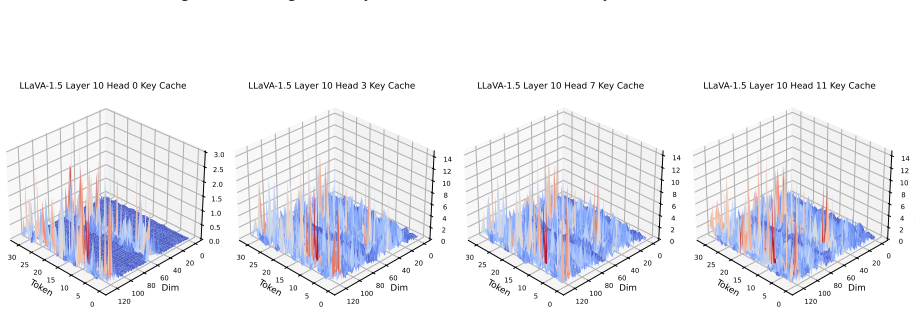
The load-bearing object is the massive-value coordinate set: dimensions in Q and K whose $\ell^2$ norm over the sequence is at least five times the head's mean, found to cluster in the low-frequency half of RoPE's paired rotation dimensions. The second object is the prefill-stage disruption operation, which replaces those coordinates by the global mean of the tensor; because only the prefilling phase is altered, generation mechanics stay intact and performance changes are attributable to context processing. RoPE itself is the causal mechanism: its frequency schedule $\theta_j = 10000^{-2j/d}$ partitions dimensions into high-frequency (position-sensitive) and low-frequency (semantic) regions, and the massive values land in the low-frequency region. That placement is what lets the paper separate contextual knowledge from parametric knowledge, since disrupting the semantic-carrying low-frequency coordinates should selectively impair context tasks.
What would settle it
Run the same prefill disruption on an RoPE model while holding absolute positions fixed but permuting token identities, or vice versa, and measure whether the massive-value dimensions respond to semantic content or to position; alternatively, ablate only the highest-frequency non-massive RoPE dimensions and check whether long-context passkey retrieval collapses, which would indicate that the massive-value effect is positional rather than semantic. A cleaner test: train or fine-tune an RoPE model with the low-frequency rotation frequencies set to zero so those dimensions cannot encode position at all, and check whether massive values still concentrate there and still carry context-task performance.
Extended reading notes
Core claim
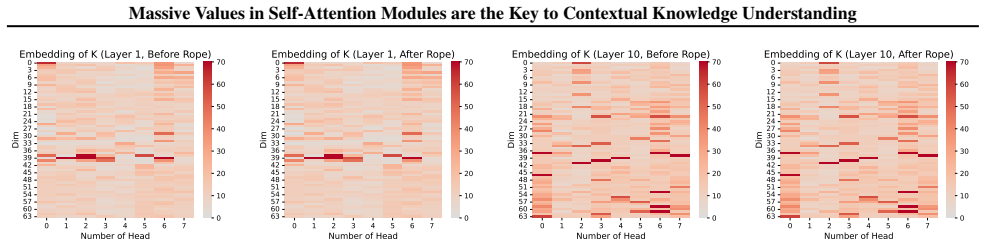
The paper defines a massive value as an entry of the per-head, per-dimension norm matrix $M_{h,d} = \|Q_{:,h,d}\|_2$ (and likewise for K) that exceeds five times that head's average over dimensions, and calls the pattern concentrated when those entries cluster in the same low-frequency dimension block across heads. The central discovery is that in RoPE-based models, including Llama, Gemma, Qwen, Mistral, Phi, LLaVA, and Qwen2-VL, this concentrated pattern appears in Q and K from the very first layer, is absent from V, and is absent from non-RoPE models such as GPT-2, GPT-Neo, OPT, and Jamba. Replacing these massive-value coordinates with the tensor mean during the prefilling phase drops GSM8K from roughly 77-87% to 4-16%, AQUA from roughly 53-64% to 10-20%, IMDB from roughly 94-97% to 2-11%, and passkey retrieval from 100% to 0-9%, while parametric QA tasks fall only 15-20 percentage points and non-massive-value disruption leaves all tasks within about 1%. Quantization comparisons show that AWQ and SmoothQuant, which preserve or redistribute massive values, retain contextual-task accuracy, while GPTQ, which does not protect them, drops GSM8K and AQUA to about 75% normalized accuracy. The paper attributes the pattern's origin to RoPE's frequency pairing and reports that the pattern appears essentially unchanged before and after the RoPE rotation is applied, indicating that the concentration is formed through training rather than by the rotation itself.
Load-bearing premise
The argument depends on the premise that the low-frequency dimensions carrying the massive values encode semantic, context-derived content rather than position or ordering information; if those dimensions mostly encode where tokens are, the observed task split would be a positional-information artifact rather than evidence for a dedicated contextual-knowledge channel.
Editorial extensions
If this is right
- Quantization methods that protect or redistribute massive-value dimensions, such as AWQ and SmoothQuant, should be preferred when serving context-heavy workloads, whereas GPTQ-style uniform quantization will disproportionately hurt in-context reasoning even if factual QA accuracy looks acceptable.
- KV-cache and activation compression schemes should allocate more bits to the massive-value coordinates in Q and K to preserve long-context and reasoning abilities.
- RoPE-free architectures, including those using absolute position embeddings, do not exhibit the concentrated pattern, so the contextual-knowledge channel described here is tied to the rotary mechanism rather than to attention in general.
- Models with partial RoPE, such as GPT-NeoX with rotation on only the first quarter of dimensions, still show concentration but at a different location, consistent with the claim that RoPE's rotation structure determines where massive values land.
Reading between the lines
- If the massive-value coordinates are the semantic channel for context, then steering or patching just those few dimensions during decoding could edit in-context behavior without touching parametric knowledge, a cheap intervention for interpretability and control that the paper does not explore.
- The paper's own appendix notes that passkey retrieval does not require contextual understanding, so the observed collapse of passkey performance may indicate that the massive-value dimensions also carry the binding or indexing signal needed to locate tokens; this would blur the clean context-versus-parametric split and is worth testing directly.
- Because the massive-value pattern appears identically before and after applying RoPE, the concentration is likely learned into the Q/K projections themselves during training; if so, fine-tuning an RoPE model with scrambled rotation frequencies should make the pattern disappear, offering a direct causal check of RoPE's role.
Editorial analysis
A structured set of objections, weighed in public.
Referee Report
Summary. The paper reports that in modern transformer LLMs using RoPE, the query (Q) and key (K) tensors contain a small number of dimensions whose L2 norms are dramatically larger than the rest, that these 'massive values' are concentrated in low-frequency dimensions, and that they are absent in V and in models without RoPE. The authors disrupt these values during the prefill phase and report that accuracy on math reasoning, sentiment analysis, and passkey retrieval collapses, while parametric fact QA degrades only modestly. They additionally compare three quantization methods and conclude that methods protecting massive values better preserve contextual-knowledge performance. The paper attributes the emergence of the concentration to RoPE and provides extensive layer-wise visualizations and open-source code.
Significance. If the central claim were established, the work would provide a practical handle for quantization and a mechanistic distinction between contextual and parametric processing in LLMs. The observational contribution—the systematic documentation of concentrated Q/K outliers across many RoPE-based models and their correlation with RoPE—is valuable and consistent with related work such as Barbero et al. (2025), and the release of code and visualizations is a strength. However, the current evidence does not establish the dedicated 'contextual knowledge' interpretation: the disruption protocol is confounded with attention-logit magnitude, the task taxonomy is internally inconsistent, and parts of the mechanistic argument are circular. The paper's strongest reliable contribution is the empirical phenomenon itself, not yet the mechanistic explanation.
major comments (5)
- [Section 3.3, Eqs. (9)-(10)] The disruption protocol does not clearly target the 'massive values' defined in Definition 1. Definition 1 (Eq. 7) selects coordinates by thresholding the per-head, per-dimension L2 norm over the sequence, but Eq. (9) replaces the per-token argmax dimension with the global mean, and Eq. (10) replaces per-token minima. These are different sets of coordinates, so the paper does not actually specify that the ablated entries are the massive values of Definition 1. Please clarify the exact selection rule or rewrite Eqs. (9)-(10); as written, the experiment is not reproducible and the reported effects cannot be attributed to the defined massive values.
- [Section 3.4, Table 1; Appendix A.2] The non-massive control is not matched in magnitude or functional contribution. Replacing the largest-magnitude Q/K coordinates removes the dominant contributors to attention logits, while replacing the smallest coordinates leaves those logits largely unchanged; hence any task that depends on precise multi-token attention (GSM8K, AQUA, IMDB, passkey) will suffer more than a single-hop fact lookup regardless of whether the coordinates encode 'contextual knowledge.' The passkey result illustrates the confound: Appendix A.2 explicitly states that passkey retrieval 'does not require contextual knowledge understanding ability, only locating the passkey,' yet Table 1 counts it as a contextual-knowledge benchmark, and its 100%-to-0% collapse is exactly what a positional or attention-precision artifact predicts. Moreover, all Table 1 entries are single numbers without error bars or significance tests, so statements such as 'only 15-20% degradation' are not statistically supported. The task dissociation in Table 1 therefore does not by itself establish a dedicated contextual-knowledge channel.
- [Section 4.1, Evidence 1; Section 4.2; Appendix F] The semantic-versus-positional argument is circular. Evidence 1 concludes that low-frequency massive values 'primarily encode rich semantic content rather than positional information' by citing the same disruption results whose interpretation depends on that assumption, and no independent probe of the encoded information is provided (e.g., decoding positional information from these dimensions, or ablating equally large non-massive low-frequency coordinates). In addition, Section 4.2 and Appendix F state that the patterns are 'largely consistent' before and after applying RoPE and that the concentration is 'gradually formed through training rather than being solely caused by the addition of RoPE,' which conflicts with the abstract's claim that the concentration 'is caused by Rotary Positional Encoding (RoPE).' At minimum, RoPE should be described as a structural condition or contributor, not a direct cause, and the causal claim needs a test that does not rely on the disputed disruption results.
- [Table 3 and Appendix F, Table 11 and Figure 46] The paper's treatment of GPT-2 is internally inconsistent: Section 4.1 and Table 3 state that models without RoPE, including GPT-2, show no concentrated massive values, while Appendix F Table 11 and Figure 46 report that GPT-2 does exhibit concentrated massive values (concentrated along heads rather than along depth dimensions). Since the 'RoPE causes concentration' claim is central, this contradiction must be resolved. Either the body-text claim is incorrect, or the appendix uses a different criterion for 'concentrated massive values'; the paper should state the criterion explicitly and apply it uniformly.
- [Section 3.6, Figure 5] The quantization evidence is reported only as normalized accuracy with no absolute values, no error bars, and no description of the bit-widths, calibration sets, or number of runs for AWQ, SmoothQuant, and GPTQ. With only three methods and no matched control for which weights are altered, Figure 5 does not independently corroborate the contextual-knowledge interpretation; it is also consistent with the confound in my second comment, since methods that preserve attention-dominant coordinates will better preserve any attention-heavy task. Please provide full accuracy tables and either a matched comparison or a clearly stated supporting-role claim.
minor comments (5)
- [Section 4.1, Evidence 1] The sentence 'It decreases from 0-(⌈d/2⌉) as the dimensional rotation angle decreases' is unclear and appears to conflate dimension index with rotation frequency; please rewrite with precise definitions.
- [Figure 3b and Table 7] The perplexity plot in Figure 3b should be checked against Table 7; for example, Llama3-8B IMDB massive-disrupted perplexity is reported as 112.61 in Table 7, but the bar height and axis limits in the figure are not easy to verify, and the legend should state explicitly which condition is shown.
- [Section 2.2, Eqs. (4)-(6)] The tensor notation is inconsistent: X is introduced as R^{lprompt×h×d}, but the equations then use l, h, d without defining the mapping to the per-head dimension D used in Section 3.1; please unify the notation.
- [References] Some references are incomplete, such as the Anthropic long-context prompting entry with 'Accessed: date-of-access' as the access date, and a few author lists are left as 'et al.' with no page numbers; these should be completed before publication.
- [Appendix A.2] The passkey-retrieval section explicitly says the task 'does not require contextual knowledge understanding ability,' which directly contradicts its inclusion under 'Contextual Knowledge Understanding Task' in Table 1 and Section 3.4; this should be reconciled in the main text.
Circularity Check
Massive-value task dissociation is real, but the semantic-vs-positional reading in Section 4.1 is an interpretive loop, and passkey collapse is an inconsistently labeled benchmark.
-
other
[Section 4.1, Evidence 1 (paragraph after Eq. 12)]
"This concentration of massive values in low-frequency regions primarily encodes rich semantic content rather than positional information, as evidenced by experimental results showing that disrupting these values severely impairs contextual understanding tasks (with IMDB accuracy dropping from 94% to single digits) while preserving basic parametric knowledge retrieval (showing only 15-20% degradation)."
The task dissociation in Section 3.4 is the evidence used to conclude that massive values are critical for contextual knowledge. Section 4.1 then cites the same dissociation as evidence that massive values encode 'rich semantic content rather than positional information,' and that semantic attribution is subsequently used as the mechanism explaining the dissociation. This is an interpretive loop: the behavioral results do not distinguish semantic content from positional binding, because both contribute to attention logits. The paper's own Appendix F shows non-RoPE models also lose both parametric and contextual performance when massive values are disrupted, which contradicts the semantic-only attribution rather than supporting it.
-
renaming known result
[Table 1 and Section 3.4 vs. Appendix A.2]
"this task serves as a good in-context retrieval benchmark, as it does not require understanding the text content (not require contextual knowledge understanding ability), only locating the passkey retrieval."
Passkey retrieval is listed under 'Contextual Knowledge Understanding Task' in Table 1, and its collapse from 100% to near-zero after massive-value disruption is reported as evidence for the contextual-knowledge claim. But the paper's own appendix explicitly says the task does not require contextual-knowledge understanding. The benchmark is therefore relabeled as contextual knowledge despite the paper's own definition, so the claimed dissociation is partly manufactured by the benchmark taxonomy rather than established by the mechanism.
full rationale
The primary observation—that replacing the largest-norm Q/K coordinates in prefill degrades context-dependent benchmarks more than parametric QA—is not circular: it is an external behavioral test with no fitted parameter renamed as a prediction. The circularity appears when the paper promotes the behavioral dissociation to a mechanistic claim: Section 4.1 uses the same dissociation as evidence that massive values encode semantic content rather than position, then invokes that semantic encoding to explain the dissociation. This is an interpretive loop. The passkey benchmark is also mislabeled as contextual-knowledge evidence in the main tables while the appendix admits it requires only location. These are partial, not total, circularity: no load-bearing self-citation chain or uniqueness theorem forces the result, and the underlying massive-value phenomenon is independently observed. Score 4 reflects one core interpretive loop and one benchmark relabeling, while the central disruption experiment still has independent content.
Assumptions & free parameters
free parameters (1)
- Massive value threshold lambda =
5
assumptions (3)
- ad hoc to paper Massive-value coordinates identified by the L2-norm criterion and lambda=5 correspond to functionally dedicated 'contextual knowledge' channels.
- domain assumption The parametric knowledge retrieval benchmarks are purely parametric and do not involve contextual reasoning.
- ad hoc to paper Low-frequency RoPE dimensions carry semantic content rather than positional information in the tested models.
Cite this review
Pith. "Pith review of Massive Values in Self-Attention Modules are the Key to Contextual Knowledge Understanding." pith.science (2026). https://pith.science/paper/W32W7T37
@misc{pith2026250201563,
  author       = {Pith},
  title        = {Pith review of: Massive Values in Self-Attention Modules are the Key to Contextual Knowledge Understanding},
  year         = {2026},
  howpublished = {\url{https://pith.science/paper/W32W7T37}},
  note         = {Machine review of arXiv:2502.01563}
}
read the original abstract
Large language models (LLMs) have achieved remarkable success in contextual knowledge understanding. In this paper, we show that these concentrated massive values consistently emerge in specific regions of attention queries (Q) and keys (K) while not having such patterns in values (V) in various modern transformer-based LLMs (Q, K, and V mean the representations output by the query, key, and value layers respectively). Through extensive experiments, we further demonstrate that these massive values play a critical role in interpreting contextual knowledge (knowledge obtained from the current context window) rather than in retrieving parametric knowledge stored within the model's parameters. Our further investigation of quantization strategies reveals that ignoring these massive values leads to a pronounced drop in performance on tasks requiring rich contextual understanding, aligning with our analysis. Finally, we trace the emergence of concentrated massive values and find that such concentration is caused by Rotary Positional Encoding (RoPE), which has appeared since the first layers. These findings shed new light on how Q and K operate in LLMs and offer practical insights for model design and optimization. The Code is Available at https://github.com/MingyuJ666/Rope_with_LLM.
Figures


Figures from the paper (41 more)






Forward citations
Cited by 1 Pith paper
-
Awakening Diffusion Transformers: Eliciting Stronger Generation and Understanding via Massive Activation Modulation
Massive activations in DiTs are timestep-driven detail channels; suppressing them guides finer sampling and AdaLN-modulating them yields more discriminative dense features.
Reference graph
Works this paper leans on
-
[1]
Cannot determine the relation between (G) and (I)
-
[2]
Cannot determine the relation between (A) and (C)
-
[3]
Dosovitskiy, A., Beyer, L., Kolesnikov, A., Weissenborn, D., and Zhai, X
URL https://api.semanticscholar.org/CorpusID: 52967399. Dosovitskiy, A., Beyer, L., Kolesnikov, A., Weissenborn, D., and Zhai, X. Thomas unterthiner mostafa dehghani matthias minderer georg heigold sylvain gelly jakob uszkoreit and neil houlsby. an image isworth 16 × 16 words: Transformers for image recognition atscale. In International Conference on Lear...
arXiv 2021
-
[7]
(A < C) 1 (D < E) (E < F) (D < E, E < F), what is the relation between (D) and (F)?
-
[8]
Cannot determine the relation between (D) and (F)
-
[9]
(D > F) 1 (G > H) (H < I) (G > H, H < I), what is the relation between (G) and (I)?
-
[11]
(G > I) 1 17 Massive Values in Self-Attention Modules are the Key to Contextual Knowledge Understanding Prompt in LLM to save Embedding Vector A car is being driven, in a straight line and at a uniform speed, towards the base of a vertical tower. The top of the tower is observed from the car and, in the process, it takes 10 minutes for the angle of elevat...
work page 2022
-
[12]
Log-Probability Computation: For each token wi, the log-probability log P (wi | w1, w2, . . . , wi−1) is extracted from the predicted probability tensor P by selecting the value corresponding to the actual token wi’s index in the vocabulary
Show all 14 references
-
[13]
Averaging Log-Probabilities: Compute the average log-probability over the entire sequence: 1 N NX i=1 log P (wi | w1, w2, . . . , wi−1)
-
[14]
poodlesque
Exponential Transformation: Take the negative exponential to convert the average log-probability into perplexity: PPL = exp − 1 N NX i=1 log P (wi | w1, w2, . . . , wi−1) ! The table presents perplexity (PPL) changes across three datasets (AQUA, IMDB, GSM8K) for three models (...
-
[2017]
Liu, H., Li, C., Wu, Q., and Lee, Y
URL https://aclanthology.org/P17-1015. Liu, H., Li, C., Wu, Q., and Lee, Y . J. Visual instruction tuning. In Proceedings of the 37th Advances in Neural Information Processing Systems (NeurIPS), volume 36, 2024. Liu, Z., Yuan, J., Jin, H., Zhong, S., Xu, Z., Braverman, V ., Ch...
2024
-
[2019]
Dao, T., Fu, D
URL https://api.semanticscholar.org/CorpusID: 57759363. Dao, T., Fu, D. Y ., Ermon, S., Rudra, A., and Ré, C. Flashat- tention: Fast and memory-efficient exact attention with io-awareness. In Proceedings of the 35th Neural Informa- tion Processing Systems Conference (NeurIPS),...
2022
-
[2022]
URL https://aclanthology.org/2022.bigscience-1. 9/. Brown, T. B., Mann, B., Ryder, N., Subbiah, M., Kaplan, J., Dhariwal, P., Neelakantan, A., Shyam, P., Sastry, G., Askell, A., et al. Language models are few-shot learners. In Proceedings of the 34th International Conference o...
2022 arXiv
-
[2023]
Tang, H., Zhang, C., Jin, M., Yu, Q., Wang, Z., Jin, X., Zhang, Y ., and Du, M
URL https://aclanthology.org/2023.acl-long.816/. Tang, H., Zhang, C., Jin, M., Yu, Q., Wang, Z., Jin, X., Zhang, Y ., and Du, M. Time series forecasting with llms: Understanding and enhancing model capabilities. ACM SIGKDD Explorations Newsletter, 26(2):109–118, 2025. Team, G....
2023 arXiv
Reviewed August 9, 2026 · model on record in the stance chip above.
Discussion (0). Continue with ORCID to comment.